The Hunchback of Notre-Dame
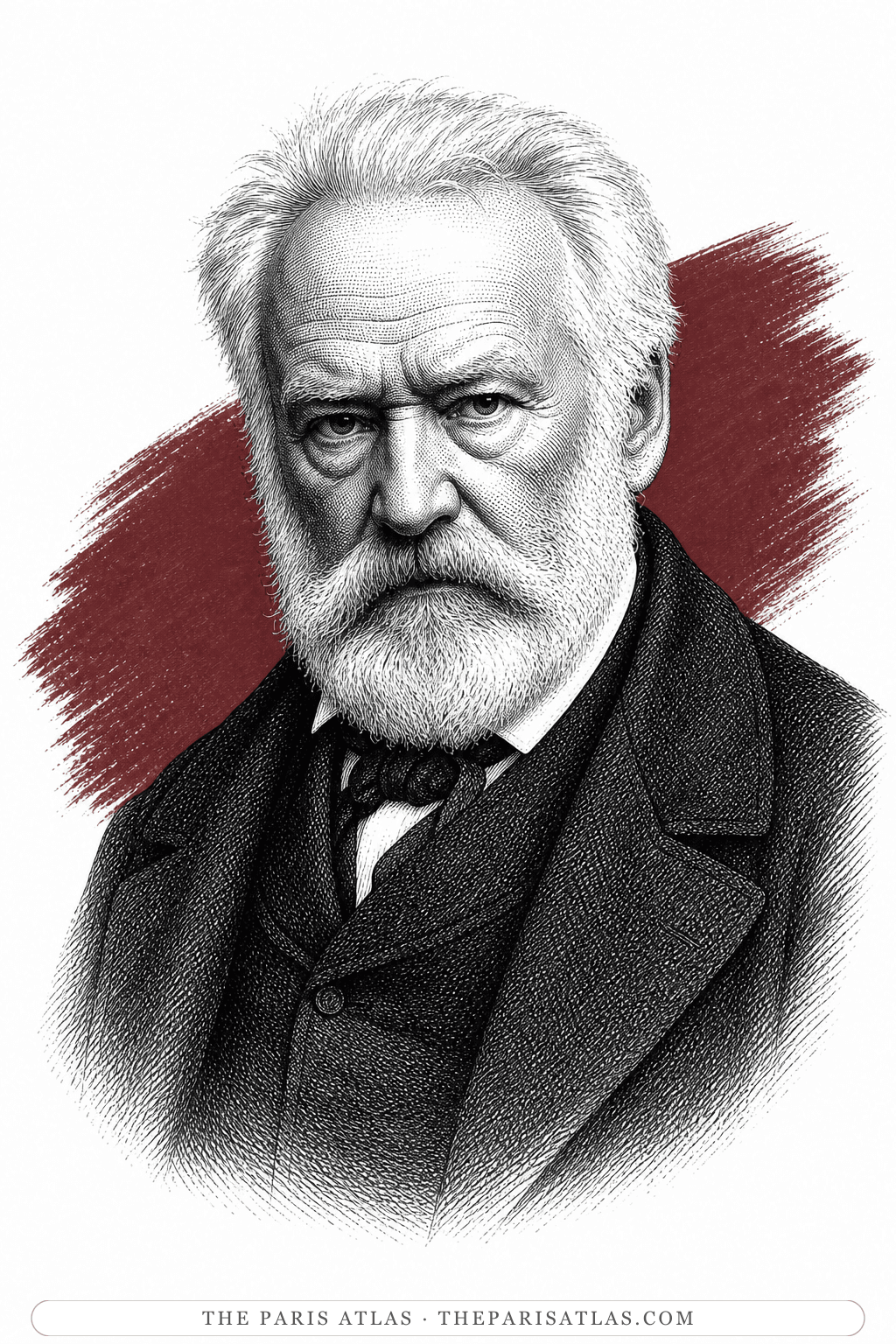
Victor Hugo
The Hunchback of Notre-Dame
The other Paris novel, written thirty years earlier, and the one where Hugo first stopped a story to explain a building.
Read our takeLes Misérables
Victor Hugo
by Victor Hugo
An ex-convict, the policeman who will not let him go, and a quarter of a million words on why France was built to produce both.
Victor Hugo published Les Misérables in 1862, having written most of it in exile on Guernsey. Jean Valjean serves nineteen years in the prison hulks for stealing a loaf of bread and then trying to escape. He breaks parole, takes a false name, and becomes a factory owner and a mayor. Inspector Javert spends the rest of the book trying to put him back. Around that chase Hugo sets the factory worker Fantine, her daughter Cosette, the innkeeper Thénardier and his children, the law student Marius Pontmercy, and the republican students who die behind a barricade in Paris in June 1832. The novel also stops, at length and on purpose, to explain the battle of Waterloo, the slang of thieves, and the sewers under the city.
Publication ran across three months of 1862. A. Lacroix, Verboeckhoven & Cie of Brussels was the publisher of record, with Pagnerre handling France and Steinacker handling Germany. The first two volumes, both titled Fantine, went on sale in Paris and Brussels on 3 April. Parts two and three followed on 15 May in Paris, and between 16 and 19 May in Brussels, where an accident to a steam engine at the printing works held them up. The last four volumes appeared in both cities on 30 June.[1]
Hugo had been out of France for a decade by then. He left after Louis-Napoléon Bonaparte seized power in December 1851, lived on Jersey, and settled on Guernsey in 1855.[2] Larousse dates the novel's conception to the years around the Second Republic of 1848 and places the writing at Hauteville House, his home on Guernsey. The five parts are Fantine, Cosette, Marius, L'Idylle rue Plumet et l'épopée rue Saint-Denis, and Jean Valjean.[3]
English readers meet the book through several different translations, and they are not the same length. Charles E. Wilbour made his in 1862, and Everyman's Library still prints it at about 1,430 pages. Isabel Florence Hapgood made hers in 1887, and Project Gutenberg carries that text free.[4] Both are out of copyright. Norman Denny's translation of 1976 remains in copyright, and the Penguin printing of it runs to about 1,230 pages.[5]
Jean Valjean walks out of the prison hulks at Toulon in 1815 after nineteen years, five for stealing a loaf of bread and fourteen more for trying to get out. No inn will take him. The bishop of Digne, Charles-François Myriel, feeds him and gives him a bed. Valjean steals the bishop's silver in the night, is caught with it, and is saved when Myriel tells the police it was a gift.[4]
Valjean breaks parole, takes a new name, and by 1820 owns a factory and is mayor of a small town in the north. Fantine works in that factory until she is sacked for having a child out of wedlock. She sells her hair and two front teeth to keep paying the Thénardiers, the innkeepers who are minding her daughter Cosette and inventing new charges, and then sells herself. Fantine dies in the town infirmary. Valjean, whose real name Inspector Javert has by then guessed, buys Cosette out of the inn and hides with her in a Paris convent.[4]
Nine years later Cosette is grown, and a law student named Marius Pontmercy sees her in the Luxembourg Gardens. Marius has friends in a republican club, the Friends of the ABC, led by Enjolras. In June 1832 the funeral of General Jean Maximilien Lamarque brings crowds into the streets, and the club throws up a barricade across a narrow street near the market halls of central Paris. Marius goes to it expecting to die, and Valjean follows him there.[4]
Soldiers take the barricade and kill Enjolras and almost all the students. Éponine Thénardier dies after taking a bullet meant for Marius. Gavroche, a small boy living rough who turns out to be the Thénardiers' abandoned son, is shot while collecting cartridges in the open. Valjean carries the unconscious Marius down into the sewers and wades for hours under the city, sinking to his neck in one soft stretch. Thénardier lets him out at the far end, taking him for a murderer disposing of a body, and Javert is waiting on the bank.
Javert lets Valjean go. He cannot square that choice with his idea of the law, and drowns himself in the Seine. Marius recovers and marries Cosette. Valjean tells Marius who he has been and then withdraws from the household; the young couple learn too late that he is dying, and reach him in time to be there at the end. He is buried under a blank stone.
Valjean's whole life turns on a lie told by a bishop. The police bring him back to the house with the stolen silver in his pack. Charles-François Myriel tells them the silver was a gift, then takes two silver candlesticks off the mantelpiece and puts those in the pack as well. Hugo gives the bishop no speech about mercy at that moment. What happens is a piece of property changing hands in front of two policemen, and the plainness is why it works.
Hugo spends the entire first book of the novel on Myriel before Valjean ever arrives: his income, what he does with the rooms of his palace, the size of his household. Readers often find that opening slow and start later. The candlesticks are what it pays for. A reader who has watched the bishop hand his good rooms to the sick knows the lie is in character rather than a device to start the plot. Valjean keeps the candlesticks for the rest of his life, and they are beside him when he dies.
Hugo puts a history of the Paris sewers in front of the escape that uses them. The second book of volume five opens on money rather than filth: Paris casts twenty-five millions yearly into the water, he writes, and this without metaphor. His point is agricultural, because the city's waste is fertiliser nobody is spreading on a field. Pages follow on when each tunnel was dug, who first mapped the network, and what has been found in it.
The argument and the chase are doing one job between them. Hugo calls the sewer the conscience of the city, the place where everything Paris discards arrives and can finally be seen for what it is. Valjean's walk puts a body in that claim. He carries Marius for miles underground, goes in up to his neck, and surfaces into the hands of Thénardier and then Javert. A man the state has been chasing for decades is now literally beneath the city, carrying someone else's son out of it alive.
The seventh book of volume four stops the story to discuss argot, the language of thieves. Hugo opens on a Latin word, pigritia, meaning laziness, and builds a whole underworld out of it: idleness the mother, theft her son, hunger her daughter. He then states his subject plainly. Slang, he writes, is at one and the same time a nation and a dialect, theft in its two kinds, people and language.
The chapter is partly an answer to critics, and Hugo says so, recalling the outcry when he had earlier put a thief who talked argot into a book. It is also a claim about who counts as a speaker of French. Hugo treats slang as a language with a grammar and a history rather than as noise made by criminals. That decision governs how the novel handles its poor characters. Gavroche and the Thénardiers are not comic turns with funny voices, and the digression is where Hugo tells the reader how to hear them.
The barricade in Les Misérables belongs to neither of the risings readers usually assume. Hugo's students die in the June Rebellion of 1832, two days of street fighting that began at the funeral of General Jean Maximilien Lamarque and were put down by the army. The tenth book of volume four is titled for the date, the 5th of June 1832, and the first book of volume five, which covers the fighting itself, is called The War Between Four Walls.
Enjolras and his friends are therefore not winners, and Hugo never suggests they will be. They hold a short stretch of street near the market halls, run out of cartridges, and are shot where they stand. Hugo still gives their case its strongest form, in Enjolras's speeches about the century to come. Marius lives because Valjean carries him away, not because the barricade holds. Readers who arrive expecting a successful revolution find a defeat: the rising of June 1832 changed no government.
Paris casts twenty-five millions yearly into the water. And this without metaphor.
The sewer is the conscience of the city. Everything there converges and confronts everything else. In that livid spot there are shades, but there are no longer any secrets.
What is slang? It is at one and the same time, a nation and a dialect; it is theft in its two kinds; people and language.
Waterloo, the convent, thieves' slang and the sewers are not padding around a chase. Hugo uses them to argue that poverty is manufactured, and the plot is the demonstration.
The novel maps the city in both directions. Hugo puts his barricade in a real quarter near the market halls, where a real rising was crushed in June 1832. He then sends Valjean into the tunnel network underneath it, carrying a dying man for miles.
Charles E. Wilbour's 1862 translation and Isabel Florence Hapgood's of 1887 are both out of copyright. Project Gutenberg carries the Hapgood text in full.
Hugo gives the policeman a real case and a coherent conscience, then breaks him with a single act of mercy. The suicide is the novel testing its own position.
Sentenced to five years for stealing bread and held for nineteen after repeated escape attempts. Breaks parole, makes a fortune under a false name, and spends the rest of his life paying for other people.
A policeman born in a prison to a convict father, who believes the law cannot be wrong. Hunts Valjean for decades and cannot survive being shown mercy by him.
A factory worker sacked for having a child out of wedlock. Sells her hair, two front teeth, and then herself to keep paying the innkeepers who are minding her daughter.
Fantine's daughter, worked as a child servant by the Thénardiers until Valjean buys her out. Grows up in a Paris convent and marries Marius Pontmercy.
A law student who breaks with his royalist grandfather, discovers his father fought for Napoleon, and joins a republican club. Survives the barricade because Valjean carries him out.
The Thénardiers' eldest daughter, petted as a child and starving as a young woman. Loves Marius, delivers him to Cosette anyway, and takes a bullet meant for him.
A boy living rough in the streets of Paris, singing and stealing and sheltering smaller children. The Thénardiers' abandoned son, though the book keeps that quiet. Shot gathering cartridges in front of the barricade.
An innkeeper, then a Paris criminal, who scavenged the field at Waterloo and invoices Fantine for a child he mistreats. Turns up at every level of the plot looking for money.
The leader of the republican club that builds the barricade, and the novel's clearest political voice. Argues for the century to come and is shot against a wall.
The bishop of Digne, who gives his good rooms to the sick and lies to the police to keep Valjean out of prison. Adds two silver candlesticks to the silver Valjean had already stolen.
1848
Hugo conceives the novel around the years of the Second Republic. Larousse places the writing at Hauteville House, his home on Guernsey.
1851
Hugo leaves France in December after Louis-Napoléon Bonaparte seizes power. The book is finished in exile.
3 April 1862
The first two volumes, both titled Fantine, go on sale in Paris and Brussels. A. Lacroix, Verboeckhoven & Cie is the publisher of record.
15 May 1862
Parts two and three appear in Paris. Brussels follows between 16 and 19 May, delayed by an accident to a steam engine at the printing works.
30 June 1862
The last four volumes appear in Paris and Brussels on the same day.
1887
Isabel Florence Hapgood's English translation appears in New York. Project Gutenberg's free text of the novel is this translation.


The Hunchback of Notre-Dame
Victor Hugo
The other Paris novel, written thirty years earlier, and the one where Hugo first stopped a story to explain a building.
Read our takeLes Contemplations
Victor Hugo
The poems of the same exile, and the private grief running under the public argument.
Read our takeThe Toilers of the Sea
Victor Hugo
Written on Guernsey four years later, with the same appetite for a long technical digression before the danger arrives.
Read our takeHernani
Victor Hugo
The 1830 play whose opening night was a riot, and the first public fight Hugo won.
Read our take
Charles Dickens on French revolution and judicial cruelty, published three years earlier, and the obvious companion in English.
Read our takeAn ex-convict called Jean Valjean, the policeman who spends decades trying to re-arrest him, and the people whose lives cross theirs in France between 1815 and 1833. Around that story Hugo argues that poverty and crime are produced by law and custom rather than by bad character.
About 1,430 pages in the Everyman's Library printing of the Charles E. Wilbour translation, and about 1,230 in the Penguin printing of Norman Denny's. Hugo published it in five parts, which older editions split into ten volumes.
Charles E. Wilbour's, from 1862, and Isabel Florence Hapgood's, from 1887, are both complete and both out of copyright. Everyman's Library prints Wilbour; Project Gutenberg carries Hapgood free. Norman Denny's 1976 translation and Julie Rose's of 2008 are in copyright and still in the shops.
The plot survives it. The digressions on Waterloo, the convent, thieves' slang and the sewers make up roughly a quarter of the book, and they carry the argument the plot is meant to prove. Readers short of time often read the novel through once for the story and go back for them.
No. The fighting is the June Rebellion of 1832, forty-three years after 1789. It began at the funeral of General Jean Maximilien Lamarque, lasted two days, was crushed by the army, and changed no government. Hugo titles one book of the novel for the date, the 5th of June 1832.
Yes. Isabel Florence Hapgood's complete 1887 translation is Project Gutenberg ebook 135, and the French text is also free. Both are out of copyright worldwide.
The musical follows Valjean, Javert, Fantine, Cosette, Marius, Éponine and the barricade, and leaves out nearly all of Hugo's argument. Gavroche, Thénardier and Enjolras are in both. The sewer escape is in both, much shortened.
Explore authors with a similar voice, perspective, and influence.

The doctor of the Paris slums who wrote the century's blackest, funniest novel — and changed the sound of French prose.
View author
American poet and novelist of Los Angeles rooming houses, racetracks and the post office, who quit his job to write when a publisher offered him a hundred dollars a month. He came to Paris once, in September 1978, drank his way through a live television book programme and walked off the set — and French television has been replaying it ever since.
View author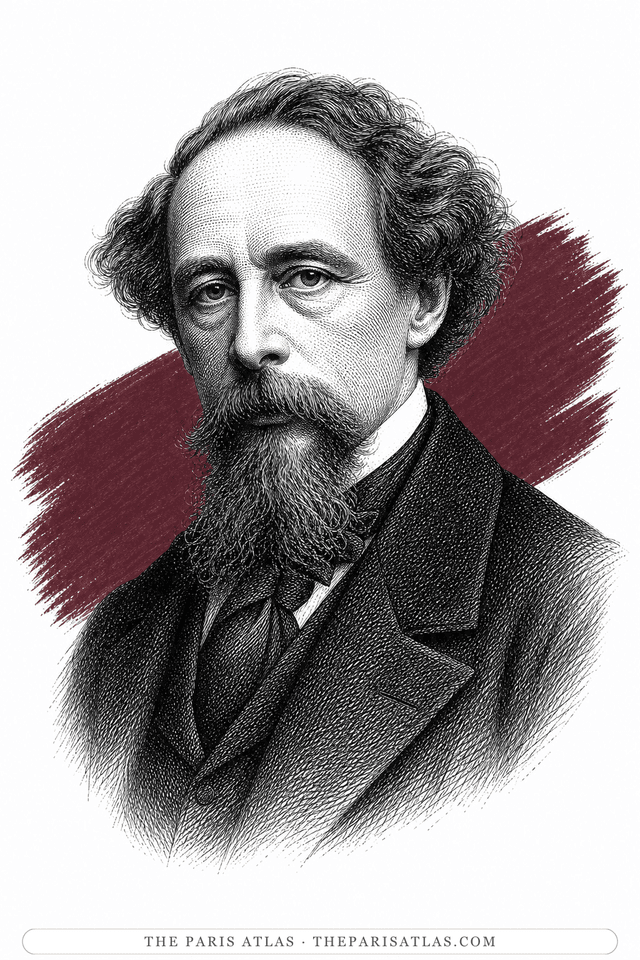
The most popular English novelist of the nineteenth century, who was never a Paris resident in the ordinary sense but kept coming back for twenty-five years: one winter in a rented mansion on the rue de Courcelles, a second winter on the Champs-Élysées writing Little Dorrit, repeated compulsive visits to the Paris Morgue — the riverside building where the city displayed its unidentified dead to the public — and a novel of the French Revolution, A Tale of Two Cities, that has shaped how English readers picture Paris ever since.
View authorThe sources below include the primary text, editions, scholarship, archival materials, and other records that informed this page. They document Les Misérables, its publication, and its place in literary history.


A rare-book dealer's bibliographic investigation of the first edition, and the source for the publisher arrangement and the three 1862 publication dates.
Graham Robb's biography, for the flight from France in December 1851 and the years on Jersey and Guernsey.
Encyclopédie Larousse on the novel: the 1862 publication, the writing at Hauteville House, and the titles of the five parts.
Library catalogue records for the editions, used to confirm each ISBN, each named translator, and the 1862 Paris issue.
Encyclopédie Larousse on Hugo himself, for the shape of the exile.
The primary text represented by this page, used for descriptions of the work’s contents and for any quoted passages shown here.
The primary text is the baseline reference for every book page. Additional references document publication history, interpretation, and historical context where that evidence is available.
 Explore more resources