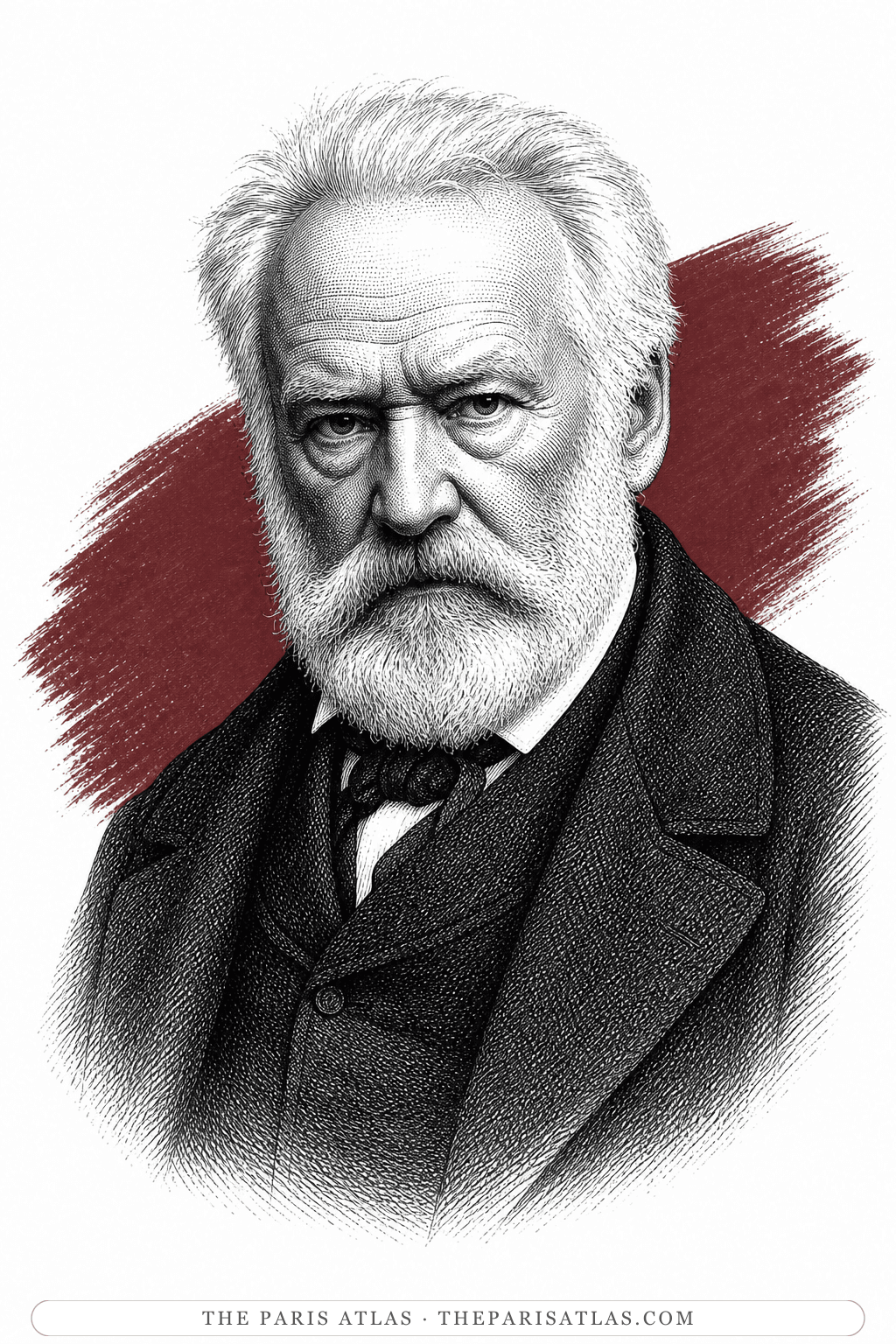
Les Misérables
Victor Hugo
Les Misérables
The novel of human law, written in the same exile and named by Hugo in this book's preface as the second of his three struggles.
Read our takeThe Toilers of the Sea
Victor Hugo
by Victor Hugo
Hugo's exile novel: one fisherman, one wrecked steam engine on a reef, and the octopus chapter that gave French a new word.
Victor Hugo wrote The Toilers of the Sea on Guernsey, where he had been living in exile since 1855, and published it in 1866. Gilliatt is a solitary fisherman on the island whom his neighbours suspect of witchcraft. Mess Lethierry owns the Durande, the first steamship on the Guernsey run, and loves it second only to his niece Déruchette. When a captain runs the Durande onto the Douvres, a reef out in open water, Lethierry says he will give Déruchette to whoever salvages the engine. Gilliatt goes out alone, lives on the rock for weeks, and takes the machine out of the wreck with tools he makes himself. The rescue takes the middle third of the book, and an octopus is waiting in a cave under it.
Hugo signed the preface at Hauteville House, his home on Guernsey, in March 1866, and used it to line up three of his novels. Religion, Society and Nature, he wrote, are the three struggles of man. In Notre-Dame de Paris he had denounced the fatality of dogma; in Les Misérables he had shown the oppression of human laws; in this book he takes on the inexorability of nature.[1] The dedication is to Guernsey itself, severe yet kind, his present asylum and perhaps his tomb.
The book is in three parts: Sieur Clubin, Malicious Gilliatt, and Déruchette. Part two is the salvage, and it is split into four books named The Rock, The Labour, The Struggle, and Pitfalls in the Way. Hugo had been drawing and painting the coast for years by then, and the Modern Library edition prints his own pictures alongside the text.[2]
Library catalogue records put the 1866 Paris issue with J. Hetzel, the publisher who handled Hugo's work through the exile years, and show London and New York editions following quickly.[2] W. Moy Thomas made the standard nineteenth-century English translation, and it is out of copyright and free from Project Gutenberg.[1] James Hogarth's translation of 2002, published by the Modern Library with an introduction by Graham Robb, is in copyright.
Gilliatt lives alone in a house on the Guernsey coast that the island believes is haunted, and keeps a sloop and a reputation for sorcery. He has loved Déruchette since the morning she wrote his name with her finger in the snow. Her uncle, Mess Lethierry, is a retired sailor who built the Durande, the first steamer to work the run between Guernsey and Saint-Malo, and treats the vessel as a member of the family.[1]
Sieur Clubin, the Durande's captain, has spent years building a reputation for absolute honesty in order to spend it once. He arranges to wreck the ship on the Hanois reef, take a belt of stolen banknotes, and swim ashore while everyone assumes he drowned. Fog and a compass he does not know has been tampered with put the Durande on the Douvres instead, miles out in open water. The passengers get away in a boat, and the hull breaks, leaving the engine wedged intact between two rocks.[1]
Lethierry is ruined without the machine, and says in front of witnesses that Déruchette will marry the man who brings it back. Gilliatt sails out to the Douvres the same day. He spends weeks on the reef with no shelter and almost no food, building a hoist out of wreckage, forging his own tools, and surviving a storm that he prepares for by walling up a gap in the rocks. Then he goes into a cave below the waterline to bathe, and something takes hold of his arm.[1]
Gilliatt kills the octopus by cutting through its head, and finds Clubin's skeleton in the same cave with the belt of banknotes still on it. He gets the engine and the money back to Guernsey. Lethierry is overjoyed and keeps his promise, and the bells are rung for the engagement. Then Gilliatt overhears Déruchette in the garden with Ebenezer Caudray, the young rector, and learns that the two of them are in love.
Gilliatt gives her up without telling her he is doing it. He arranges the marriage himself, gets the couple onto the Cashmere sailing for England that same morning, and hands over the banknotes as her dowry. Then he walks to the Gild-Holm-'Ur, a seat worn into the rock below his house that the rising tide covers, and sits down in it facing the sea. The water comes up while he watches the ship go. In the last sentences the vessel vanishes on the line of the horizon, Gilliatt's head disappears, and nothing is visible but the sea.
Hugo opens with a page that tells the reader what he thinks he has been doing for thirty-five years. Religion, Society and Nature, he writes, are the three struggles of man, and each answers a need: faith needs a temple, making needs a city, living needs the plough and the ship. He then assigns one book to each fight. Notre-Dame de Paris denounced the fatality of dogma, Les Misérables showed the oppression of human laws, and this one takes on the inexorability of nature.
The preface then adds a fourth thing, and it is the one the plot actually turns on. Mixed in with those three fatalities, Hugo says, is an inward one: the human heart. Gilliatt beats the sea, the rock, the storm and the octopus. What defeats him is a conversation he overhears in a garden. Hugo dates the page at Hauteville House in March 1866, which is the house on Guernsey he was living in as an exile while writing about the water outside it.
The middle of the novel is a salvage job described in the detail a working boatman would want. Gilliatt has one sloop, a wrecked hull, two rocks and no help. Hugo follows him through the whole sequence. Gilliatt surveys the wreck and decides to cut the engine free rather than raise the ship. He builds a hoist from the Durande's own timbers, lights a forge on bare rock, and shapes the tools he lacks. The four books of part two are named for the stages, The Rock, The Labour, The Struggle and Pitfalls in the Way.
Readers who come for the octopus have to earn it, and that is the design. The work is what makes Gilliatt formidable, so that when the animal does arrive it is fighting a man who has already beaten weather and physics. Hugo also uses the labour to answer the island's gossip. Gilliatt is suspected of witchcraft in part one; part two shows exactly where his powers come from, which is patience, rope, fire and iron.
Hugo stops the fight to define his animal, and does it by listing everything it does not have. The whale has bulk, the scorpion a dart, the shark sharp fins, the crocodile jaws; the devil-fish has no dart, no fins, no claws, no beak, no teeth, no poison and no shell. Then the turn: yet he is of all creatures the most formidably armed. He answers his own question a line later, and the answer is that the devil-fish is the sea vampire.
Hugo also stops to say what the thing is called, and the naming outlived the novel. English sailors call them devil-fish and sometimes bloodsuckers, he writes, and in the Channel Islands they are called pieuvres. That local word is the one the book carried into general French, where it is now the ordinary word for an octopus. The fight itself is short and physical. Five bands take hold of Gilliatt at separate points, each one feeling like a small mouth, and he gets free by going for the head with a knife.
Gilliatt wins everything the plot offered and then declines it. He has the engine, the stolen banknotes, Lethierry's public promise and the island's gratitude. He overhears Déruchette and Ebenezer Caudray in the garden, and from that moment he works to get them married and onto a boat by the same morning, using his own salvage money as her dowry. He never tells her what he is giving up, which keeps the sacrifice from becoming a claim on her.
The last scene is a man sitting still. The Gild-Holm-'Ur is a natural seat worn into the rock below Gilliatt's house, and the tide covers it; Hugo established both facts in part one, twenty chapters before he needs them. Gilliatt sits in it facing the water and watches the Cashmere carry Déruchette to England. Hugo reports the drowning in two clauses and no adjectives: the vessel vanishes on the line of the horizon, Gilliatt's head disappears, and nothing is visible now but the sea.
Religion, Society, and Nature! these are the three struggles of man.
What, then, is the devil-fish? It is the sea vampire.
In the Channel Islands they are called pieuvres.
The preface assigns Notre-Dame de Paris to dogma, Les Misérables to human law, and this novel to nature, then adds a fourth fatality, the human heart. Reading the three in that order is Hugo's suggestion, not a critic's.
Weeks on a bare reef with a hoist built from wreckage and a forge lit on rock. Hugo gives the salvage the attention other novelists give a courtship, and the octopus is more frightening because of it.
Hugo signed the preface at Hauteville House on Guernsey in March 1866, having lived on the island since 1855. The dedication is to Guernsey, severe yet kind, his present asylum and perhaps his tomb.
W. Moy Thomas's nineteenth-century English text is out of copyright and available in full from Project Gutenberg as ebook 32338.
A solitary Guernsey fisherman his neighbours take for a sorcerer. Salvages a steam engine from a reef alone, kills an octopus, and then gives up the woman he did it for.
Mess Lethierry's niece, who once wrote Gilliatt's name in the snow with her finger and never thought about it again. In love with the new rector.
A retired sailor who built the Durande, the first steamship on the Guernsey run, and loves it almost as much as his niece. Ruined when it is wrecked.
The Durande's captain, who spent thirty years building a reputation for honesty in order to cash it in once. Plans to wreck the ship on one reef and hits another.
The young rector of the parish, in love with Déruchette and loved back. Gilliatt marries them and puts them on a boat to England in a single morning.
The steamship itself, treated by the novel as a character and by Lethierry as family. Its engine survives the wreck wedged between two rocks, and the salvage is the plot.
1855
Hugo settles on Guernsey after being expelled from Jersey, and lives there until the Second Empire falls.
March 1866
Hugo signs the preface at Hauteville House, his home on Guernsey, and dedicates the book to the island.
1866
Les Travailleurs de la mer is published. Library catalogues record the Paris issue of that year with J. Hetzel.
1866
W. Moy Thomas's English translation appears, and American editions follow from Harper & Brothers in New York and Estes and Lauriat in Boston.
2002
The Modern Library publishes James Hogarth's new translation, with an introduction by Graham Robb and Hugo's own drawings.


Les Misérables
Victor Hugo
The novel of human law, written in the same exile and named by Hugo in this book's preface as the second of his three struggles.
Read our takeThe Hunchback of Notre-Dame
Victor Hugo
The novel of dogma, the first of the three struggles, and the other book built around a long digression.
Read our takeLes Contemplations
Victor Hugo
The poems of the same island years, where the sea is grief rather than an opponent.
Read our takeHernani
Victor Hugo
A Guernsey fisherman called Gilliatt who salvages the engine of a wrecked steamship from a reef alone, to win the right to marry the owner's niece. The salvage takes weeks and the middle third of the book, and an octopus is living in a cave under the wreck.
Yes. Hugo devotes a chapter, titled The Monster, to describing the animal by listing every weapon it does not have, and then calls it the sea vampire. The fight itself runs only a few pages.
It carried one word into it. Hugo records pieuvre as the Channel Islands name for the animal, alongside the sailors' devil-fish. Pieuvre is now the ordinary French word for an octopus.
At Hauteville House on Guernsey, where he had lived in exile since 1855. He signed the preface there in March 1866, and dedicated the book to the island as his present asylum and perhaps his tomb.
Hugo lines the three up himself in the preface. Notre-Dame de Paris denounces the fatality of dogma, Les Misérables the oppression of human laws, and this novel the inexorability of nature. He then adds a fourth fatality, the human heart.
James Hogarth's, published by the Modern Library in 2002, is complete and in copyright, and prints Hugo's drawings. W. Moy Thomas's nineteenth-century translation is out of copyright and free from Project Gutenberg as ebook 32338.
Gilliatt succeeds and then gives everything away. He marries Déruchette to the rector she loves, hands over his salvage money as her dowry, and sits in a tidal seat below his house watching their ship leave while the water rises over him.
Explore authors with a similar voice, perspective, and influence.

The doctor of the Paris slums who wrote the century's blackest, funniest novel — and changed the sound of French prose.
View author
American poet and novelist of Los Angeles rooming houses, racetracks and the post office, who quit his job to write when a publisher offered him a hundred dollars a month. He came to Paris once, in September 1978, drank his way through a live television book programme and walked off the set — and French television has been replaying it ever since.
View author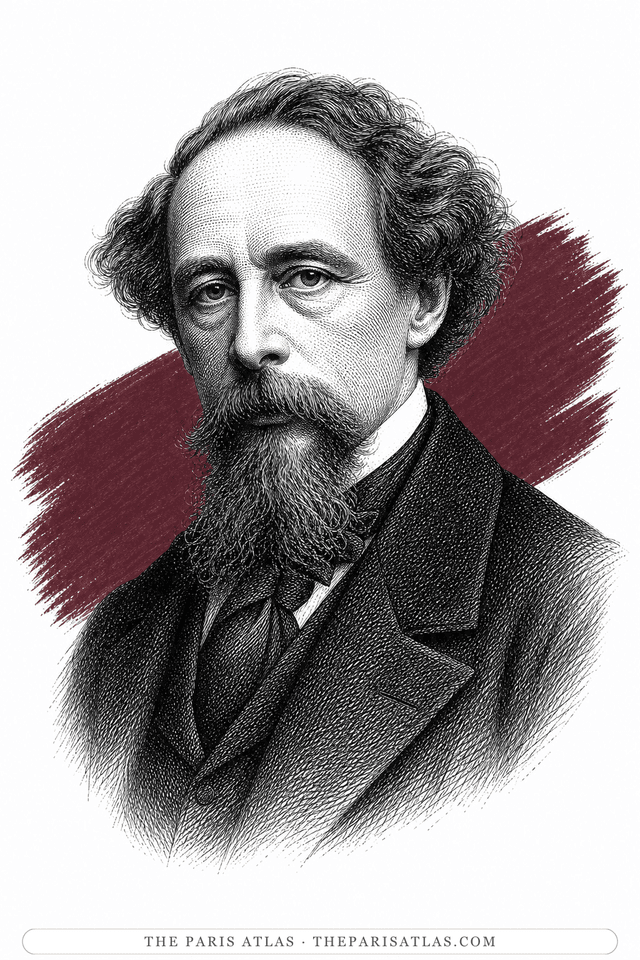
The most popular English novelist of the nineteenth century, who was never a Paris resident in the ordinary sense but kept coming back for twenty-five years: one winter in a rented mansion on the rue de Courcelles, a second winter on the Champs-Élysées writing Little Dorrit, repeated compulsive visits to the Paris Morgue — the riverside building where the city displayed its unidentified dead to the public — and a novel of the French Revolution, A Tale of Two Cities, that has shaped how English readers picture Paris ever since.
View authorThe sources below include the primary text, editions, scholarship, archival materials, and other records that informed this page. They document The Toilers of the Sea, its publication, and its place in literary history.


Graham Robb's biography, for the exile years on Jersey and Guernsey. Robb also introduces the Modern Library translation of this novel.
Encyclopédie Larousse on Hugo, for the shape of the exile and the place of the late novels in it.
The Paris Musées record of the Hugo houses, for the Guernsey years and the furnishings he designed there.
The primary text represented by this page, used for descriptions of the work’s contents and for any quoted passages shown here.
The primary text is the baseline reference for every book page. Additional references document publication history, interpretation, and historical context where that evidence is available.
 Explore more resources