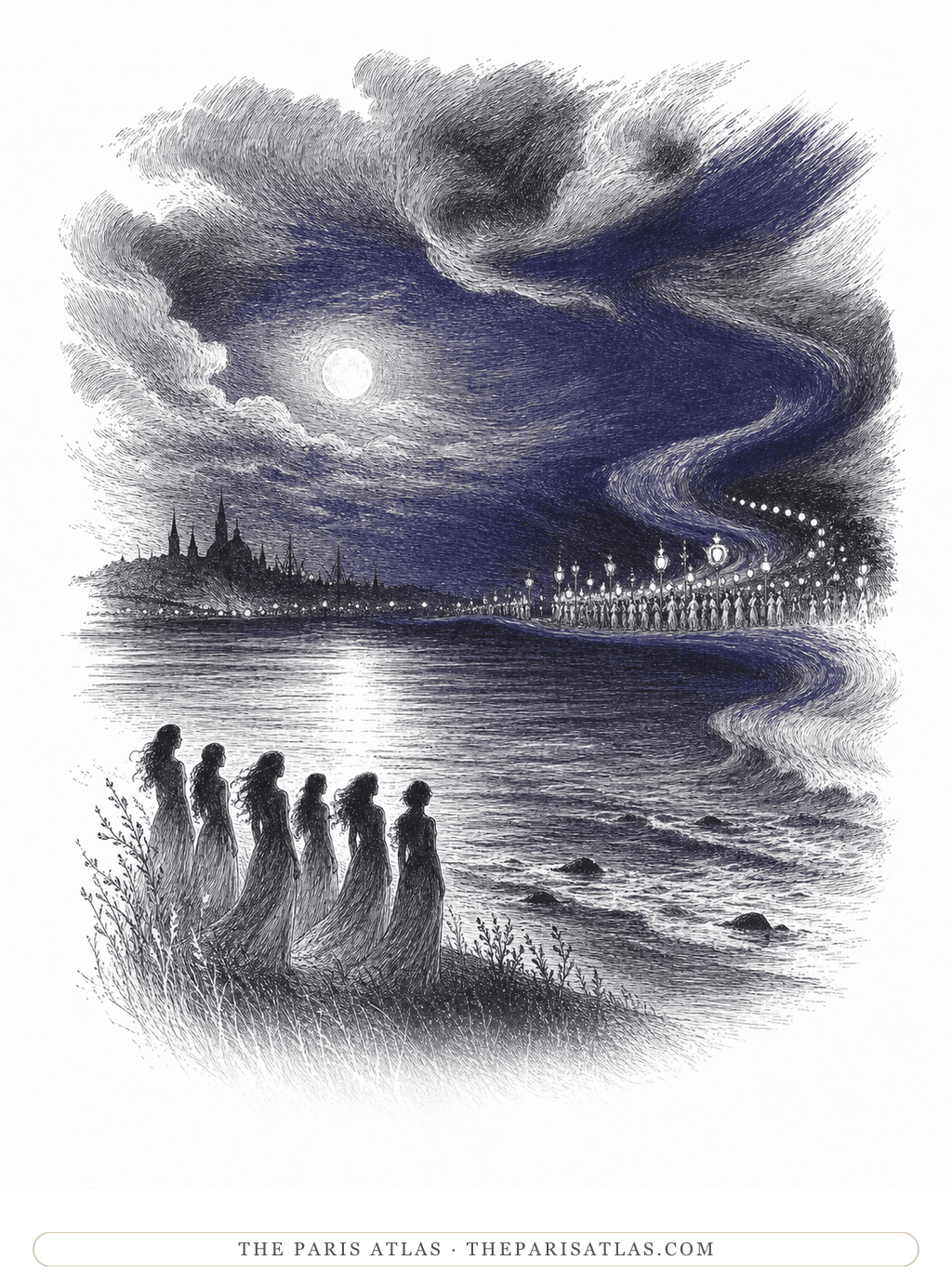
Nocturnes
Three orchestral studies in changing perception: clouds crossing an unmoving sky, the pulse and procession of a festival, and moonlit sea heard through a wordless women’s chorus.
- 1897–1899; premiered 1900–1901
- Three nocturnes for orchestra; women’s chorus in Sirènes
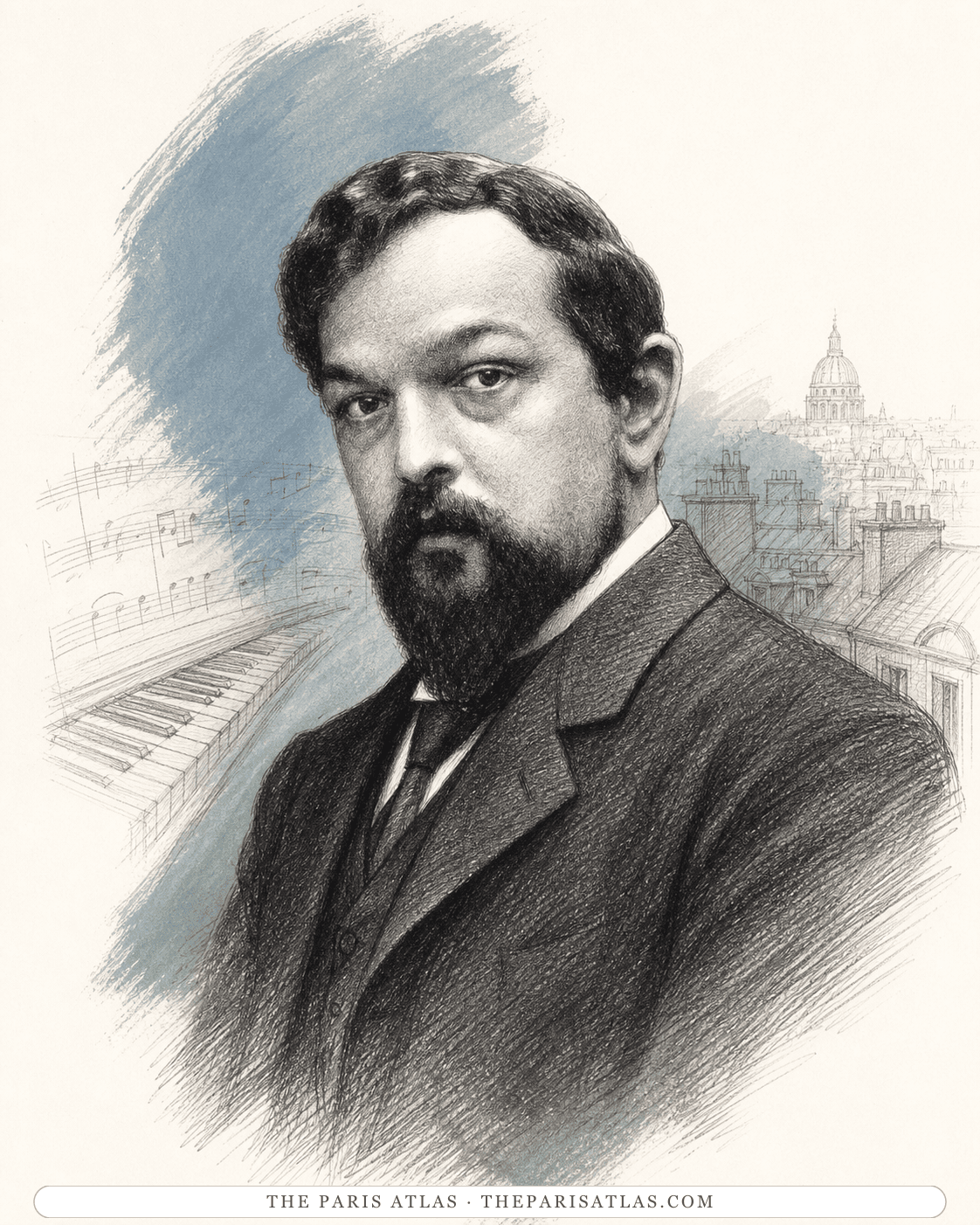
About Claude Debussy
Three ways of hearing atmosphere
Debussy’s Nocturnes are not three scenes joined by a plot. Each creates a different field of motion, light and distance:
- Nuages — Clouds: slow-changing layers, subdued color and a recurring English-horn figure.
- Fêtes — Festivals: dancing energy interrupted and transformed by the approach of a distant procession.
- Sirènes — Sirens: orchestra and wordless women’s chorus merge into a fluid image of sea, moonlight and imagined voices.
The triptych moves from suspended observation through public motion to an ambiguous encounter between human sound and the natural world.
Nuages: motion without arrival
Nuages avoids conventional dramatic development. Small figures recur while the orchestral color changes around them, creating the sense of clouds moving across a sky whose scale cannot be measured by a single melody.
The English horn’s repeated idea and the quiet layering of winds and strings make stillness active. Something is always changing, but the music does not need to travel toward a triumphant destination.
Fêtes: a procession heard from a distance
Fêtes begins with flickering rhythms and bright, unstable orchestral gestures. A march then emerges as if approaching from far away, grows until it fills the sound field and recedes again into the surrounding festival.
The movement demonstrates Debussy’s ability to create musical perspective. Distance is not described in words; it is built from dynamics, register, repetition and the gradual accumulation of instrumental color.
Sirènes: the chorus becomes orchestral color
Sirènes adds a women’s chorus singing without words. The voices do not narrate a myth or identify characters. They become one changing color among the orchestra’s strings, winds and harps, sometimes emerging clearly and sometimes dissolving back into the texture.
That decision is central to the work’s modernity. A human voice can carry presence and desire without carrying a sentence; timbre itself can become expressive meaning.
The two Paris premieres
Nuages and Fêtes were first performed at the Nouveau-Théâtre in Paris on 9 December 1900 by the Concerts Lamoureux under Camille Chevillard. The complete triptych, now including Sirènes and its chorus, was heard there on 27 October 1901.
The split premiere makes the work’s chronology unusually clear: listeners first encountered the orchestral pair, then heard how the wordless voices of Sirènes changed the scale and color of the whole conception.
Why the Nocturnes matter
The Nocturnes show Debussy making orchestral color structural. Instead of decorating a theme after it has been composed, instrumentation helps determine what the musical idea is and how it changes over time.
They stand between the breakthrough of Prélude à l’après-midi d’un faune and the larger transformations of La Mer. Together, those scores made atmosphere, perception and timbre central materials of modern orchestral form.
Timeline
1897–1899
Debussy composes the three orchestral Nocturnes.
9 December 1900
Nuages and Fêtes premiere at the Nouveau-Théâtre in Paris under Camille Chevillard.
27 October 1901
Sirènes joins them for the first complete performance of the triptych at the same Paris venue.
20th century
The work becomes a central example of Debussy’s transformation of orchestral color into musical form.
Frequently asked questions
What are the three movements of Debussy’s Nocturnes?
Nuages, Fêtes and Sirènes—Clouds, Festivals and Sirens.
When did Debussy compose the Nocturnes?
He composed them between 1897 and 1899.
When were the Nocturnes first performed?
Nuages and Fêtes premiered in Paris on 9 December 1900; the complete work with Sirènes followed on 27 October 1901.
Does the work use a chorus?
Sirènes uses a women’s chorus without words, treating the voices as part of the orchestral color.
Are Debussy’s Nocturnes piano music?
No. They are an orchestral triptych, with a women’s chorus added in the final movement.
Why are the Nocturnes important?
They make timbre, changing perspective and atmosphere part of the work’s structure rather than mere decoration.
More by Claude Debussy
If you like Claude Debussy
Explore composers from the same movements and circles.
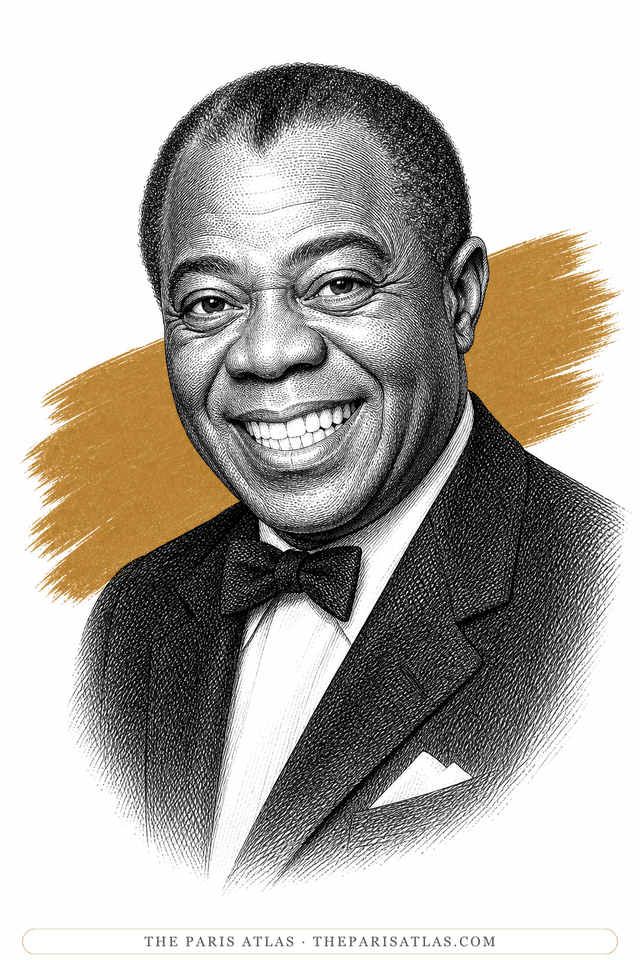
Louis Armstrong
The New Orleans trumpeter and singer who turned jazz from a band music into a soloist's art, and whose voice became one of the most recognisable sounds of the twentieth century. Paris took him early: he spent the autumn of 1934 living in the city, made his only French records that November, played the Salle Pleyel, the city's principal concert hall, and kept coming back for thirty years — including for the 1961 film Paris Blues, shot in the streets he had once idled in.
View artist
Chet Baker
American trumpeter and singer with the smallest, plainest sound in jazz, who arrived in Paris in September 1955 for eight months, recorded — for the French label Barclay — the sessions that are still his most argued-over records, and lost his pianist Dick Twardzik to a heroin overdose in a Paris hotel room ten days after their first session together.
View artist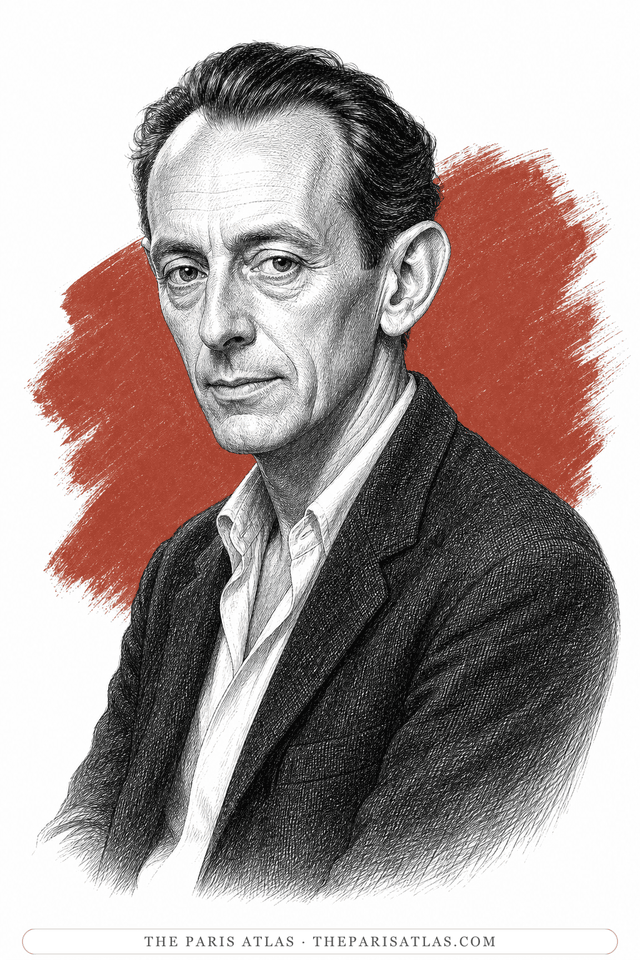
Paul Bowles
American novelist and composer whose expatriate fiction explores dislocation, unstable intimacy, fatalism, and North Africa.
View artist
References
The sources below include collection records, catalogues, scholarly research, and primary materials that informed this page. They document Nocturnes, its making, and its place in cultural history.


1Nocturnes pour orchestre
WebsitePhilharmonie de ParisUsed forWeb source consulted for documented facts and historical context presented on the Nocturnes page.
2Claude Debussy: Biographie
WebsiteIRCAM–Centre PompidouUsed forWeb source consulted for documented facts and historical context presented on the Nocturnes page.
3Claude Debussy
WebsiteOpéra national de ParisUsed forWeb source consulted for documented facts and historical context presented on the Nocturnes page.

4The Velvet Revolution of Claude Debussy
PeriodicalThe New Yorker, 2018Used forContemporary reporting or criticism used to document the historical reception and context of Nocturnes.
5Nocturnes — Claude Debussy: Programme Note
WebsiteBBC Scottish Symphony OrchestraUsed forWeb source consulted for documented facts and historical context presented on the Nocturnes page.
These references provide the documented foundation for this work's history and interpretation. Claim-level citations remain attached to the specific claims they support.
 Explore more resources