The Paris AtlasCharting the artists, works, and places worth returning to.
  • Musician
  • Singer
· American · 1929–1988

Chet Baker

American trumpeter and singer with the smallest, plainest sound in jazz, who arrived in Paris in September 1955 for eight months, recorded — for the French label Barclay — the sessions that are still his most argued-over records, and lost his pianist Dick Twardzik to a heroin overdose in a Paris hotel room ten days after their first session together.

Details

Lived
1929–1988
Born
23 December 1929
Birthplace
Yale, Oklahoma
Died
13 May 1988 · aged 58
Place of death
Amsterdam
Nationality
American
Roles
MusicianSinger

About Chet Baker

Chet Baker played the trumpet quietly. In a decade of fast, dense, hard-driving jazz he made a small sound with almost no vibrato — the note left plain — and sang in a voice so soft that engineers had to push the microphone at him. It made him a star in California before he was twenty-five, and it never left him through thirty years of heroin addiction, prison, expulsions and the European touring life he ended up living.

He landed at Orly airport outside Paris on 5 September 1955 and stayed eight months. In that time he made the records for the French label Barclay that are still the ones musicians argue about, and lost his pianist: Dick Twardzik, a twenty-four-year-old from Boston with a startling harmonic imagination, died of a heroin overdose in a Paris hotel room on 21 October 1955, ten days after their first session together. Baker was back in the same studio three days after the death, and kept recording in Paris until March 1956. He died in Amsterdam in 1988, at fifty-eight, after falling from a hotel window.

The prettiest sound in California

Chesney Henry Baker was born on 23 December 1929 in Yale, a small town in Oklahoma, and grew up in California, where he learned the trumpet in school and army bands. He read music poorly all his life and played almost entirely by ear. In 1952 the alto saxophonist Charlie Parker — the central figure of bebop, the fast, harmonically dense style that had remade jazz in the 1940s — hired him for a run of West Coast dates, and later that year Baker joined the baritone saxophonist Gerry Mulligan in a quartet with no piano in it, an unusual, transparent line-up in which his trumpet had nowhere to hide. Their recording of the song My Funny Valentine made him famous.

Then he sang. The 1954 album Chet Baker Sings put a thin, unschooled, almost boyish voice in front of the same repertoire, and split the audience permanently between listeners who found it unbearably intimate and listeners who found it simply unbearable. The same year he won the trumpet category in Down Beat magazine's readers' poll, ahead of the trumpeter Miles Davis — a result the jazz press treated as an insult and Baker treated as a fact. He was also, by then, using heroin, which organised the rest of his life.

Orly, September 1955

Baker's quartet landed at Orly, the airport south of Paris, on 5 September 1955. The arrival was awkward: the French jazz monthly Jazz Hot had just told its readers that the tour was cancelled, and the musicians came anyway. The Paris debut was on 4 October at the Salle Pleyel, the city's principal concert hall on the rue du Faubourg-Saint-Honoré in the 8th arrondissement, and among the people who came to hear him was Sidney Bechet, the New Orleans soprano saxophonist who had settled in France and was by then a bigger star there than he had ever been at home.

The quartet also played the cellar clubs of Saint-Germain-des-Prés, the Left Bank quarter that was then the centre of modern jazz in Europe — the Club Saint-Germain and Le Tabou, basements where the audience sat close enough to hear a trumpeter breathe. Baker was twenty-five, at the top of an American poll, and playing to rooms that had decided in advance that he was the most beautiful thing in jazz.

The Barclay sessions

On 11 and 14 October 1955 the quartet recorded at Studio Pathé-Magellan in Paris for Barclay, the French record label that supplied most of the recording work available to American jazz musicians passing through the city. The line-up was Baker on trumpet, Dick Twardzik on piano, Jimmy Bond on bass and Peter Littman on drums. What they played was unusual: instead of standards, they worked through pieces by Bob Zieff, a Boston composer whose crooked, written-out lines Twardzik had collected in a hurry from a New York hotel before the quartet left for Europe. Baker, who was neither a strong sight-reader nor an enthusiast for rehearsal, had not played them in public.

The results are the reason the Paris months matter. Zieff's tunes gave Baker no chord sequence to lean on and no familiar melody to charm his way through, and the playing that came out of it — his and Twardzik's both — is the least decorative music either man recorded. The sessions were issued and reissued for the next half-century as Chet Baker in Paris, and reviewers have written about them ever since as records made on the edge of a catastrophe that had not happened yet.

21 October 1955

Richard "Dick" Twardzik was born in Massachusetts on 30 April 1931 and came to the quartet on the recommendation of Russ Freeman, the pianist Baker had been working with in California. He was addicted to heroin, as Baker was. On 21 October 1955, a week after the second Barclay session, he was found dead of an overdose in his hotel room in Paris. He was twenty-four. Accounts of his last hours have never been settled, and the suspicion that Baker was in the room and left has trailed the death ever since.

Three days later, on 24 October, Baker was back at Studio Pathé-Magellan with the French pianist Gérard Gustin, Jimmy Bond again on bass and the Swedish drummer Bert Dahlander. The day after that he recorded with a larger group including the French pianist René Urtreger. He went on recording in Paris on 28 November and 26 December 1955, and on 10 February and 15 March 1956, and left Europe in the middle of April, eight months after he had arrived.

He had matured, and gained confidence and authority.

Alain Tercinet, French jazz historian, on Baker's eight months in Europe

The long European life

Back in the United States he recorded for the American label Riverside, including the album Chet, made at Reeves Sound Studios in New York on 30 December 1958 and 19 January 1959 with Bill Evans at the piano — the pianist who would shortly become the most influential harmonic thinker in jazz. Then the collapse: arrested for drugs in Italy in 1960, Baker spent more than a year in prison there, and was expelled from one European country after another. In the late 1960s a beating cost him his front teeth, and he had to rebuild his embouchure — the lip and jaw control a trumpeter's tone depends on — around dentures.

He came back, and spent the last fifteen years of his life almost entirely in Europe, playing small rooms in Italy, the Netherlands, Germany and France, recording constantly and often carelessly, still using heroin. In 1987 and 1988 the photographer Bruce Weber filmed him for the documentary Let's Get Lost, which caught a ruined face and an intact sound. On 13 May 1988 Baker fell from the window of his room in an Amsterdam hotel and died in the street below. He was fifty-eight. The Paris records made thirty-three years earlier are the ones that keep being reissued.

Life events

  1. 1929

    Born Chesney Henry Baker on 23 December in Yale, Oklahoma; raised in California.

    James Gavin, Deep in a Dream: The Long Night of Chet Baker (2002)

  2. 1952

    Plays West Coast dates with Charlie Parker, then joins Gerry Mulligan's pianoless quartet; their My Funny Valentine makes his name.

    James Gavin, Deep in a Dream: The Long Night of Chet Baker (2002)

  3. 1954

    Chet Baker Sings introduces the singing voice; he wins the trumpet category of Down Beat's readers' poll ahead of Miles Davis.

    James Gavin, Deep in a Dream: The Long Night of Chet Baker (2002)

  4. 1955

    Lands at Orly on 5 September with his quartet, for what becomes eight months in Europe.

    Alain Tercinet, Chet Baker in Paris — liner notes to the Emarcy four-CD edition, translated by Martin Deo

  5. 1955

    Paris debut at the Salle Pleyel on 4 October, with Sidney Bechet in the audience; the quartet also plays the Club Saint-Germain and Le Tabou.

    Alain Tercinet, Chet Baker in Paris — liner notes to the Emarcy four-CD edition, translated by Martin Deo

  6. 1955

    Records at Studio Pathé-Magellan for Barclay on 11 and 14 October with Dick Twardzik, Jimmy Bond and Peter Littman, playing Bob Zieff's compositions.

    Chet Baker Catalog — session dates, studios and personnel; Chet Baker Quartet — Chet Baker in Paris, Vol. 1 (Barclay, 1955)

  7. 1955

    Dick Twardzik dies of a heroin overdose in his Paris hotel room on 21 October, aged twenty-four.

    Jazz Remembered: Dick Twardzik (2018); Gene Seymour, 'Chet Baker in Paris' a reflection of tragedy (2000)

  8. 1955

    Records again at Studio Pathé-Magellan on 24 October, three days after the death, with the French pianist Gérard Gustin, and on 25 October with a quintet including René Urtreger.

    Chet Baker Catalog — session dates, studios and personnel

  9. 1956

    Last Paris sessions for Barclay on 10 February and 15 March; he leaves Europe in mid-April.

    Chet Baker Catalog — session dates, studios and personnel; Alain Tercinet, Chet Baker in Paris — liner notes to the Emarcy four-CD edition, translated by Martin Deo

  10. 1958

    Records the Riverside album Chet in New York on 30 December 1958 and 19 January 1959, with Bill Evans on piano.

    Chet Baker Catalog — session dates, studios and personnel

  11. 1960

    Arrested for drugs in Italy; more than a year in prison there, followed by expulsions from several European countries.

    James Gavin, Deep in a Dream: The Long Night of Chet Baker (2002)

  12. 1988

    Dies on 13 May after falling from the window of his Amsterdam hotel room, aged fifty-eight; Bruce Weber's documentary Let's Get Lost, filmed in his last year, appears the same year.

    James Gavin, Deep in a Dream: The Long Night of Chet Baker (2002)

People they knew

Documented connections — every one carries its source.

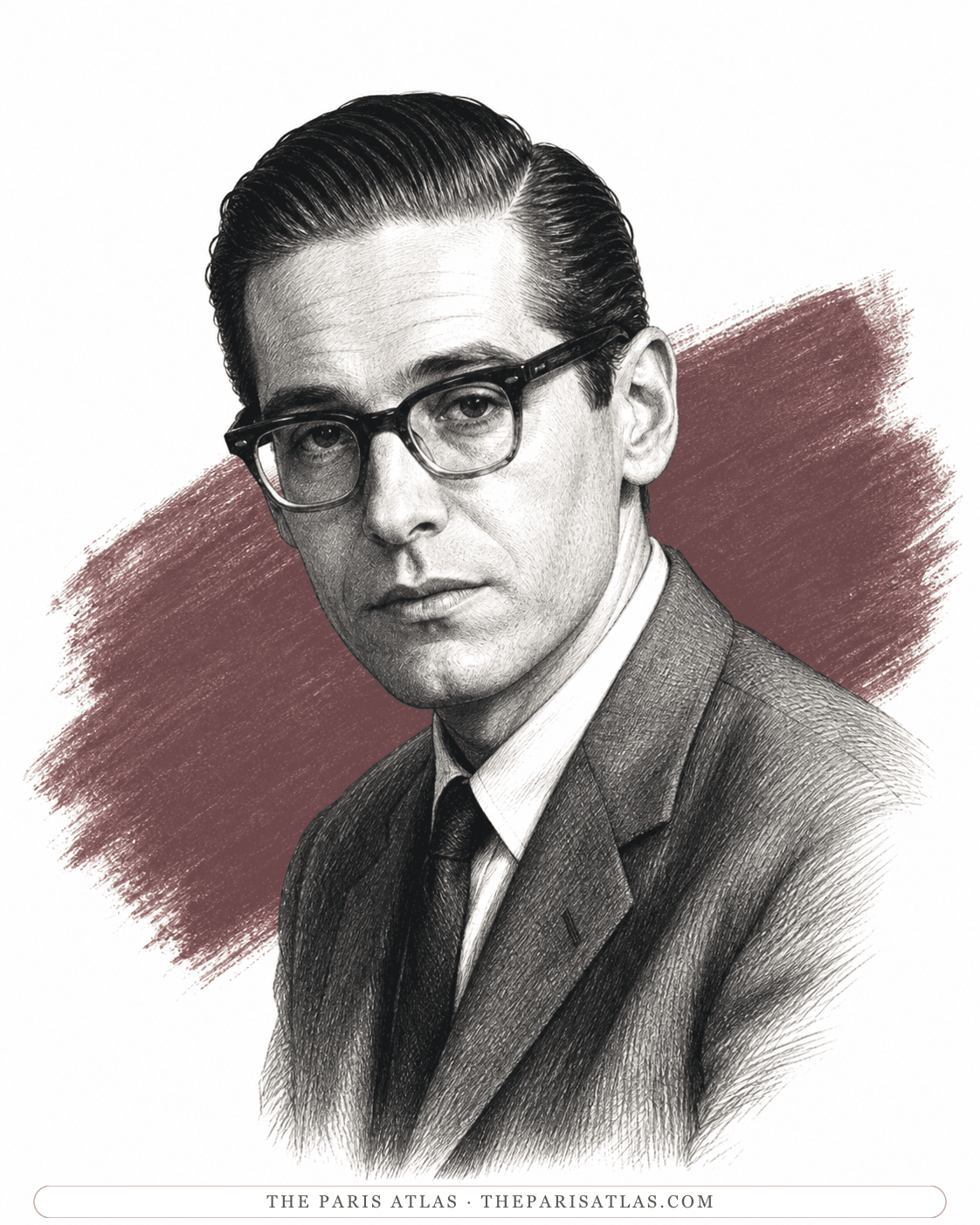
Illustrated portrait of Bill Evans

Bill Evans

  • Musician

Collaborated with · 1958–1959

Evans played piano on most of the Riverside album Chet, recorded at Reeves Sound Studios in New York on 30 December 1958 and 19 January 1959 with Herbie Mann, Pepper Adams, Kenny Burrell and Paul Chambers. It is the fullest meeting on record between Baker's plain trumpet line and the harmonic language Evans was then building.
Chet Baker Catalog — session dates, studios and personnel

Chet Baker’s Places

The cataloged places connected to Chet Baker — through the books, and through the documented record.

Places you can enter today appear first, followed by addresses to see from outside and sites that have vanished.

Questions about Chet Baker

Who was Chet Baker?

An American jazz trumpeter and singer, born in Oklahoma in 1929 and raised in California, who became famous around 1953 for a small, plain, vibrato-less trumpet sound and a soft singing voice. He was addicted to heroin for most of his adult life, spent his last fifteen years touring Europe, and died in Amsterdam in 1988 after falling from a hotel window.

What are the Chet Baker in Paris recordings?

The sessions Baker made for the French label Barclay at Studio Pathé-Magellan in Paris between October 1955 and March 1956, reissued for decades under that title. The first two dates, on 11 and 14 October 1955, are the ones with the pianist Dick Twardzik, playing pieces written by the Boston composer Bob Zieff; Twardzik died a week later. Baker recorded again in the same studio on 24 and 25 October, on 28 November and 26 December 1955, and on 10 February and 15 March 1956.

Who was Dick Twardzik and how did he die?

Richard "Dick" Twardzik, born in Massachusetts on 30 April 1931, was the pianist of Chet Baker's quartet on its 1955 European tour, recommended by Baker's previous pianist Russ Freeman. He was found dead of a heroin overdose in his Paris hotel room on 21 October 1955, aged twenty-four, a week after the Barclay session the two of them had recorded. The account of his last hours was never settled.

Where did Chet Baker play in Paris?

His Paris debut was at the Salle Pleyel, the city's main concert hall, on 4 October 1955, with the New Orleans saxophonist Sidney Bechet in the audience. The quartet also played the modern-jazz cellars of Saint-Germain-des-Prés on the Left Bank — the Club Saint-Germain and Le Tabou. The recording work was done at Studio Pathé-Magellan.

Why did Chet Baker spend so much of his life in Europe?

Partly because European audiences kept booking him after American ones stopped, and partly because his drug convictions made an ordinary career impossible. He was arrested in Italy in 1960 and imprisoned there for more than a year, then expelled from several countries. From the early 1970s he lived and worked almost entirely in Europe, playing small clubs and recording constantly.

How did Chet Baker die?

He fell from the window of his hotel room in Amsterdam in the early hours of 13 May 1988 and died in the street below, aged fifty-eight. He had been playing in Europe until days before.

Did Chet Baker really sing?

Yes, and it was half of his fame. Chet Baker Sings (1954) put his light, untrained, almost expressionless voice in front of standards like My Funny Valentine and But Not for Me. Critics who admired the trumpet often disliked the singing; the singing is what most listeners now know him for.

Sourced claims

Every connection the graph holds for Chet, with the evidence behind it.

Collaborated with · 1958–1959

Bill Evans

Evans played piano on most of the Riverside album Chet, recorded at Reeves Sound Studios in New York on 30 December 1958 and 19 January 1959 with Herbie Mann, Pepper Adams, Kenny Burrell and Paul Chambers. It is the fullest meeting on record between Baker's plain trumpet line and the harmonic language Evans was then building.
Chet Baker Catalog — session dates, studios and personnel

Frequented · 1955–1956

Saint-Germain-des-Prés

During the eight months he spent in Europe from September 1955, Baker's quartet played the modern-jazz cellars of the quarter — the Club Saint-Germain and Le Tabou — alongside the concert dates and the Barclay recording sessions.

Alain Tercinet, Chet Baker in Paris — liner notes to the Emarcy four-CD edition, translated by Martin Deo

References

References

The sources below include biographies, scholarly essays, interviews, and primary materials that informed this page. They reflect both the historical record and ongoing critical conversations about Chet Baker and their work.

  1. 1Deep in a Dream: The Long Night of Chet Baker

    Alfred A. Knopf, 2002

    The standard biography, and the fullest account of the European years and the death in Amsterdam.

  2. 2Chet Baker in Paris — liner notes to the Emarcy four-CD edition, translated by Martin Deo

    Emarcy; reproduced on JazzProfiles

    Alain Tercinet's notes to the Emarcy edition of the Paris recordings: the arrival at Orly, the Salle Pleyel debut, the clubs.

    View source
  3. 3Chet Baker Catalog — session dates, studios and personnel

    JazzDisco.org (Jazz Discography Project)

    Session-by-session dates, studios and personnel.

    View source
  1. 4Jazz Remembered: Dick Twardzik

    Sandy Brown Jazz, 2018
    View source
  2. 5Chet Baker Quartet — Chet Baker in Paris, Vol. 1 (Barclay, 1955)

    Sam Records
    View source
  3. 6'Chet Baker in Paris' a reflection of tragedy

    Deseret News (from Newsday), 2000
    View source
i
Why these sources are here

These references anchor the page in the documented record and in the scholarly conversations around Chet Baker. Every claim on this page traces back to one or more of the works listed here.

Explore more resources