The Paris AtlasCharting the artists, works, and places worth returning to.
  • Musician
· American · 1926–1991

Miles Davis

The trumpeter who changed what jazz sounded like roughly every decade, improvised a film score in a Paris studio in one night, and spent forty years finding the city a better place to be a Black musician than his own country.

Details

Lived
1926–1991
Born
26 May 1926
Birthplace
Alton, Illinois, United States
Died
28 September 1991 · aged 65
Place of death
Santa Monica, California, United States
Nationality
American
Married
Frances Taylor · 1959–1968Betty Mabry · 1968–1969Cicely Tyson · 1981–1989
Children
Cheryl Davis, Gregory Davis, Miles Davis IV, Erin Davis
Roles
Musician
Also known as
Miles Dewey Davis III

About Miles Davis

Miles Davis was an American trumpeter and bandleader, born in Illinois in 1926 to a comfortable family — his father was a dentist. He arrived in New York at eighteen to study at the Juilliard School and left within a year to play with Charlie Parker, which is what he had actually come for. Over the next four decades he led a series of bands that each changed the direction of jazz, and then abandoned each one.

He is best known for Kind of Blue, released in 1959 and still the best-selling jazz album ever made. Paris runs through his life from 1949, when a two-week festival trip convinced him that a Black musician could be treated as an artist somewhere, to the night in 1957 when he improvised the score to a French thriller while the film played on a studio wall. He died in California in 1991.

A dentist's son in East St. Louis

Miles Dewey Davis III was born in Alton, Illinois on 26 May 1926, and the family moved to East St. Louis the following year. They were not poor. His father was a dentist who owned land in Arkansas, and his mother was a music teacher and violinist. This matters to the story, because almost every myth about jazz musicians of his generation assumes poverty, and Davis spent his life refusing to perform one.

He was given a trumpet at nine and taught by Elwood Buchanan, who told him not to use vibrato — the wobble most trumpeters add to a held note. Buchanan's reasoning was that he would develop a wobble on his own when he got old. Davis never did add it, and that plain, unwavering tone became the most recognisable sound in the music.

Juilliard, and the man he actually came for

In September 1944 his father sent him to the Juilliard School in New York. Davis went, and then spent most of his time in Harlem clubs looking for Charlie Parker, the alto saxophonist at the centre of bebop — the fast, harmonically dense style that was then remaking jazz. He found him. He dropped out after three semesters.

In 1945, at nineteen, he replaced Dizzy Gillespie in Parker's quintet, which is roughly the equivalent of being handed the second lead in the most important band in the country. He was not yet good enough and knew it. He stayed until 1948, and what he learned there was partly how to play and partly what he did not want to sound like: where Gillespie was fast and high and dazzling, Davis went quiet, middle-register and spare.

Paris, 1949

In May 1949 he came to Paris for the Paris International Jazz Festival, playing with the Tadd Dameron Quintet. He was twenty-two and it was his first time out of the United States. The trip lasted about two weeks and he talked about it for the rest of his life.

What struck him was not the audiences, though they were good. It was being treated as an artist by people who assumed that was what he was. Writers and painters wanted to talk to him. Nobody moved him along. He said afterwards that it changed the way he looked at things permanently, and that coming home was the hardest part.

It changed the way I looked at things forever.

Miles Davis, on his first two weeks in Paris

He also met Juliette Gréco, the singer and actress then at the centre of the Saint-Germain-des-Prés scene. Neither spoke much of the other's language. They were together on and off for years, and he later said he had considered staying — and that Gréco talked him out of it, on the grounds that a French life would cost him the music.

The years he lost

He came home from Paris into a depression and very little work, and began using heroin. The addiction ran for roughly four years. He hustled, borrowed, pawned his horn, and by 1953 was playing badly enough that a DownBeat interview made it public. He was twenty-seven.

He went home to his father's farm in Arkansas and stopped, by shutting himself in a room and waiting it out. He was clean by February 1954. He joined a gym, called the record labels, and made a run of albums he regarded as the point where he became himself. He was never sentimental about the period and never claimed the drugs had helped.

Kind of Blue, and what modal means

Recorded in two sessions in March and April 1959 with John Coltrane, Cannonball Adderley, Bill Evans, Wynton Kelly, Paul Chambers and Jimmy Cobb. It has sold more than five million copies in the United States alone and is the best-selling jazz album ever made.

The thing it is famous for needs one sentence of explanation. Most jazz until then improvised over chord changes — a fixed sequence the soloist had to keep up with, like hitting marks. Kind of Blue mostly does away with that and gives the players a scale and a lot of time. The result is why the record works on people who do not otherwise listen to jazz: nothing is hurrying, and there is nowhere the music has to get to.

The musicians were handed sketches in the studio and most of what was released was a first or second take.

Drawn for The Paris Atlas. (Illustration — The Paris Atlas)

The night he made up a film score

In December 1957 Davis was in Paris and the twenty-four-year-old director Louis Malle needed music for his first film, a thriller called Ascenseur pour l'échafaud — Lift to the Scaffold. The idea of asking Davis came from Malle's assistant. Juliette Gréco and Malle met him at the airport.

He watched the film, agreed, and on 4 and 5 December went into Le Poste Parisien studio with four musicians — the French players Barney Wilen, Pierre Michelot and René Urtreger, and the American drummer Kenny Clarke, who lived in Paris. He had written nothing. He gave them a few chords he had worked out in his hotel room, explained the plot, and had the relevant scenes projected on a loop while they played.

The whole score was improvised to picture in those two nights. Malle called it un cadeau — a gift. It is still the standard example of what jazz can do for a film, and the trumpet over the opening, a woman on a telephone at night, is the most famous forty seconds Davis recorded in Europe.

Beaten outside his own gig

In August 1959, the year of Kind of Blue, Davis stepped outside Birdland in New York between sets to put a woman into a taxi. A policeman told him to move along. Davis said he was working there — his name was on the awning above them — and did not move.

He was hit in the stomach with a nightstick, then struck over the head from behind by a detective while others held the crowd back. He needed five stitches and was charged with assaulting an officer. He was acquitted the following January.

He said afterwards that it made him bitter and cynical again at exactly the moment he had begun to think the country was changing. It is worth setting beside the Paris trip ten years earlier: the two events are the same subject seen from either side.

The second quintet

Between 1963 and 1968 he led the band most musicians will name if pressed: Herbie Hancock on piano, Ron Carter on bass, Tony Williams on drums, and from 1964 Wayne Shorter on saxophone. Williams was seventeen when he joined.

Their method had a name — time no changes — and it meant keeping a pulse while abandoning the fixed chord sequence entirely, so the rhythm section followed wherever the soloist went instead of holding a shape for him to fill. It is difficult music that does not sound difficult, which was the point.

Going electric

In 1969 and 1970 he plugged in. In a Silent Way and then Bitches Brew brought electric pianos, electric bass, rock rhythms and studio editing into the music, and split his audience down the middle. Jazz critics called it a betrayal. Bitches Brew went gold and reached a rock audience that had never bought a jazz record.

The pattern by now was established. He had done the same thing at least three times before, and each time the people who loved the previous band took it personally.

The silence, 1975 to 1980

After two festival dates in 1975 he stopped. He had a hip replaced that December, and then did essentially nothing for five years. In the autobiography he is blunt about it: cocaine and alcohol took the place music had held, and the house went to ruin around him.

Columbia kept paying him through it — an arrangement the label extended to almost nobody. He came back in 1981 and worked, with declining health, for the last decade of his life.

Why he sounded like that when he spoke

The famous rasp was an injury. In 1955 he had polyps removed from his larynx and was told not to speak while it healed. He got into an argument too soon and damaged the cords permanently. For the rest of his life he could only produce a hoarse whisper, which people mistook for a manner.

France, and the welcome table

He kept coming back. He played the festival at Antibes on the Riviera repeatedly, and whenever he did he would drive up to James Baldwin's house at Saint-Paul-de-Vence and stay a day or two. He had read Baldwin before he met him, and wrote that the two of them opened up to each other and became great friends.

His account of it is domestic rather than grand: sitting in the big house while Baldwin told stories, then moving out to the garden and carrying on. France gave him, over forty years, the two things his own country was least willing to — respect on arrival and somewhere to rest.

Where to start listening

Because he reinvented himself so often, there is no single Miles Davis sound, and picking the wrong record first is the usual reason people bounce off him.

  • Kind of Blue (1959) — start here, always. Slow, quiet, unhurried, and it requires nothing of you.
  • Ascenseur pour l'échafaud (1958) — the Paris film score. Under half an hour, and the most atmospheric thing he made.
  • Sketches of Spain (1960) — orchestral, arranged by Gil Evans around Spanish sources. The one to try if you like film music.
  • Round About Midnight (1957) — the first quintet with John Coltrane, if you want the classic small-group sound.
  • Bitches Brew (1970) — the electric turn. Difficult, long, and best approached once you already like him.

If you only ever hear one thing, make it the opening minute of the Ascenseur score. It was invented on the spot in a room on the boulevard des Italiens, and it does not sound like it.

Death, and what he left

Miles Davis died in Santa Monica, California on 28 September 1991, aged sixty-five, from the combined effects of a stroke, pneumonia and respiratory failure. France had made him a Chevalier of the Légion d'honneur earlier that year.

He was inducted into the Rock and Roll Hall of Fame in 2006, which is either a category error or exactly right, depending on which decade of his work you start from.

Life events

  1. 1926

    Born in Alton, Illinois on 26 May; the family moves to East St. Louis the next year.

  2. 1935

    Given his first trumpet, and taught by Elwood Buchanan to play without vibrato.

  3. 1944

    Enrols at the Juilliard School in New York, and spends his nights in Harlem looking for Charlie Parker.

  4. 1945

    Drops out and replaces Dizzy Gillespie in Parker's quintet, at nineteen.

  5. 1949

    First trip to Paris, for the International Jazz Festival in May. Meets Juliette Gréco.

  6. 1949–1953

    Heroin addiction; work and playing both fall away.

  7. 1954

    Quits, at his father's farm in Arkansas, and begins recording again.

  8. 1955

    A larynx operation and an argument too soon afterwards leave him with a permanent whisper.

  9. 1957

    Improvises the score to Louis Malle's Ascenseur pour l'échafaud in a Paris studio on 4 and 5 December.

  10. 1959

    Kind of Blue is recorded in two sessions. In August he is beaten by police outside Birdland.

  11. 1960

    Sketches of Spain, with Gil Evans.

  12. 1963–1968

    The second quintet: Hancock, Carter, Williams and, from 1964, Shorter.

  13. 1970

    Bitches Brew turns the band electric and splits the audience.

  14. 1975

    Stops playing after two festival dates, and does not return for five years.

  15. 1981

    Comes back to recording and touring.

  16. 1991

    Made a Chevalier of the Légion d'honneur. Dies in Santa Monica on 28 September, aged sixty-five.

Miles Davis quotes

Verbatim, as recorded by the witnesses of the era — sources on every quotation.

It changed the way I looked at things forever.
Miles Davis on his first trip to Paris, in Miles: The Autobiography (1989)

People they knew

Documented connections — every one carries its source.

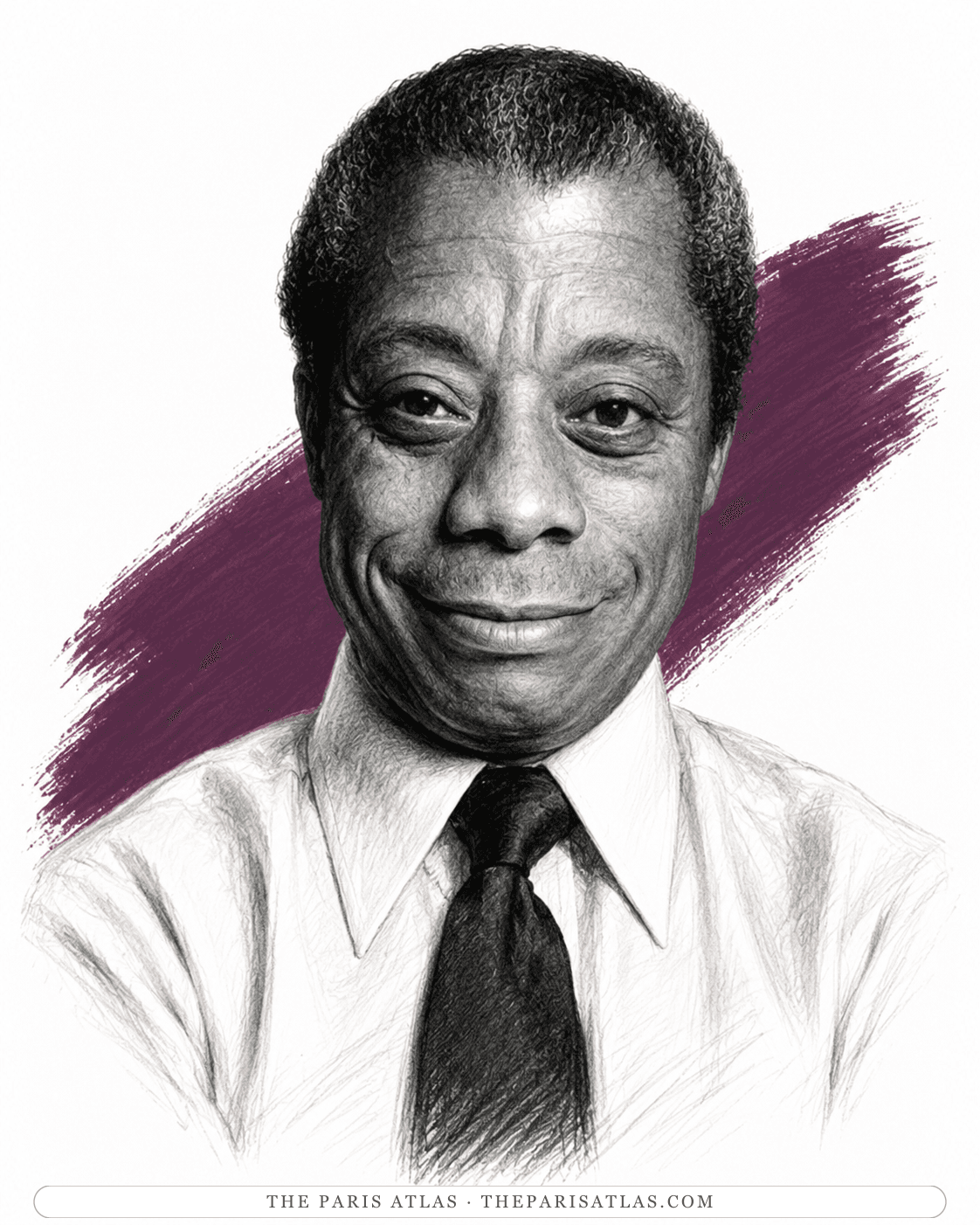
Illustrated portrait of James Baldwin

James Baldwin

  • Author
  • Playwright
  • Critic
  • +1

Met

They became close friends. Davis wrote in his autobiography that whenever he played the festival at Antibes he would spend a day or two at Baldwin's house in Saint-Paul-de-Vence, sitting in the house and then in the garden while Baldwin talked.
Miles Davis with Quincy Troupe, Miles: The Autobiography (1989); Commune de Saint-Paul de Vence — James Baldwin

Who they drew from

Influence running inward — the writers and artists whose work fed theirs. Admiration is not acquaintance; these edges claim neither a meeting nor a friendship.

Illustrated portrait of James Baldwin

James Baldwin

The books came before the friendship. Davis wrote that he had read Baldwin and respected what he had to say, and that the two of them opened up to each other once he knew the man behind them.

Miles Davis with Quincy Troupe, Miles: The Autobiography (1989)

Questions about Miles Davis

What should I listen to by Miles Davis first?

Kind of Blue (1959). It is slow, quiet and unhurried, it asks nothing of the listener, and it is the best-selling jazz album ever made for exactly that reason. After it, try the Ascenseur pour l'échafaud film score, which is under half an hour.

Why is Kind of Blue so famous?

It largely abandoned chord changes — the fixed sequence a soloist normally has to keep up with — and gave the players a scale and time instead. Nothing hurries, and there is nowhere the music has to arrive. That is why it works on people who do not otherwise listen to jazz. It was recorded in two sessions in 1959, mostly in one or two takes.

What is Ascenseur pour l'échafaud?

Louis Malle's first film, a 1958 thriller, and the score Davis improvised for it in Paris on 4 and 5 December 1957. He had written nothing in advance: he gave four musicians a few chords and the plot, had the scenes projected on a loop, and played to the picture. Malle called the result un cadeau — a gift.

What was Miles Davis's connection to Paris?

He first came in May 1949, aged twenty-two, for the Paris International Jazz Festival, and said the two weeks changed him permanently — he was treated as an artist rather than as a Black man who happened to play. He met Juliette Gréco on that trip and considered staying. He returned throughout his life, recorded the Ascenseur score there, and was made a Chevalier of the Légion d'honneur in 1991.

Why did Miles Davis's voice sound like that?

It was an injury, not a mannerism. He had polyps removed from his larynx in 1955 and was told not to speak while it healed. He got into an argument too soon and damaged the vocal cords permanently, leaving him with a hoarse whisper for the rest of his life.

Was Miles Davis friends with James Baldwin?

Yes. Davis had read and admired Baldwin's books before they met, and wrote in his autobiography that they became great friends. Whenever he played the festival at Antibes he would spend a day or two at Baldwin's house in Saint-Paul-de-Vence.

Did Miles Davis use heroin?

Yes, from around 1949 to 1954. It cost him roughly four years of work and playing, and became public through a DownBeat interview in 1953. He quit at his father's farm in Arkansas by shutting himself in a room until it passed, and was clean by February 1954. He never suggested it had helped the music.

How many times did Miles Davis change his style?

At least five: bebop with Charlie Parker, the cool nonet of 1949, hard bop with the first quintet, modal jazz on Kind of Blue, the open playing of the second quintet, and electric fusion from 1969. Each change lost him part of the audience that had loved the previous one.

How did Miles Davis die?

Of the combined effects of a stroke, pneumonia and respiratory failure, in Santa Monica, California, on 28 September 1991. He was sixty-five.

Sourced claims

Every connection the graph holds for Miles, with the evidence behind it.

Met

James Baldwin

They became close friends. Davis wrote in his autobiography that whenever he played the festival at Antibes he would spend a day or two at Baldwin's house in Saint-Paul-de-Vence, sitting in the house and then in the garden while Baldwin talked.

Miles Davis with Quincy Troupe, Miles: The Autobiography (1989); Commune de Saint-Paul de Vence — James Baldwin

Influenced by

James Baldwin

The books came before the friendship. Davis wrote that he had read Baldwin and respected what he had to say, and that the two of them opened up to each other once he knew the man behind them.

Miles Davis with Quincy Troupe, Miles: The Autobiography (1989)