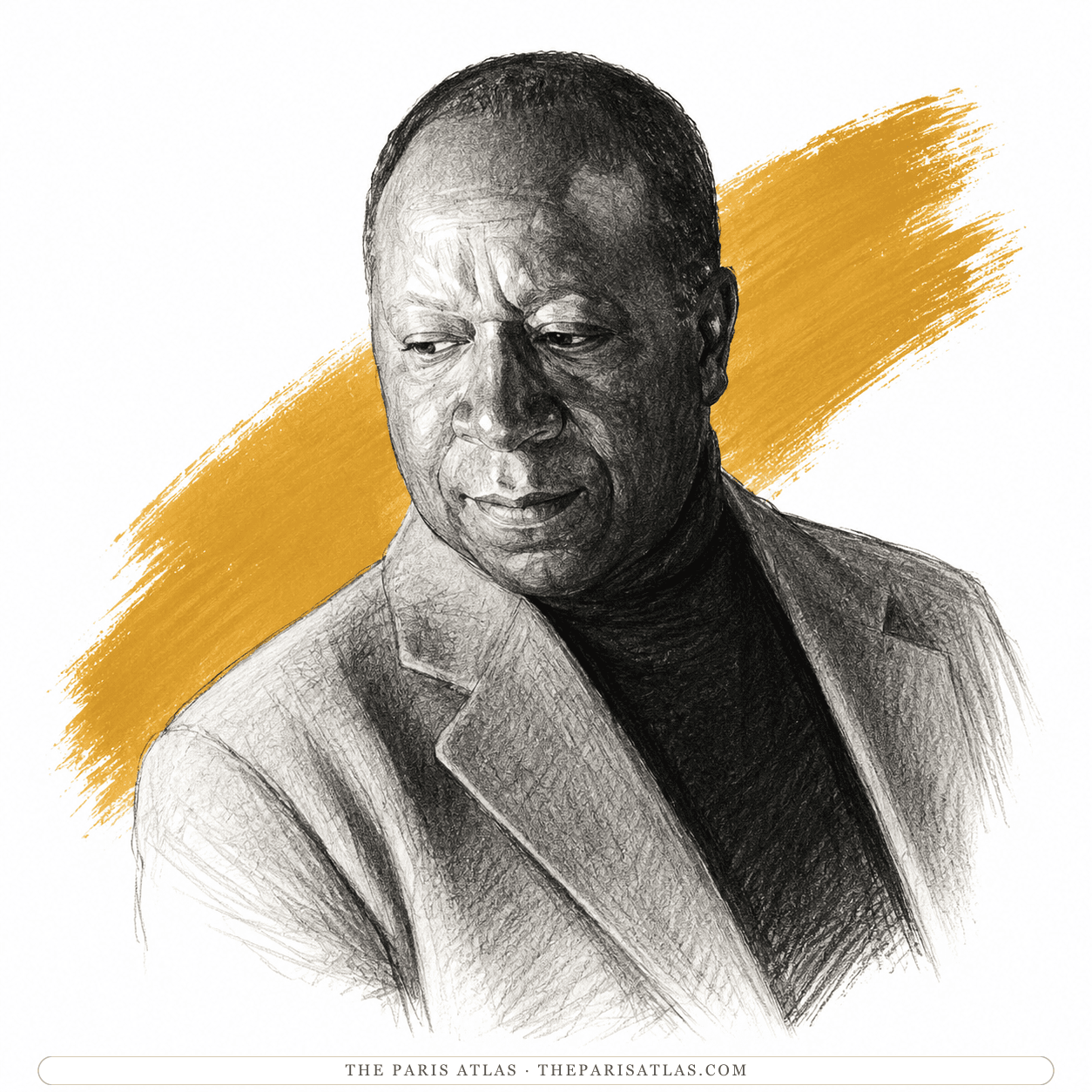
The Paris AtlasCharting the artists, works, and places worth returning to.
  • Author
  • Playwright
  • Critic
  • Poet
· American · 1924–1987

James Baldwin

American novelist and essayist who left Harlem for Paris at twenty-four with forty dollars, and wrote the books that made him the most quoted witness to race, sex and belonging in twentieth-century America.

In images

Details

Lived
1924–1987
Born
2 August 1924
Birthplace
Harlem, New York City, United States
Died
1 December 1987 · aged 63
Place of death
Saint-Paul-de-Vence, France
Nationality
American
Partner
Lucien Happersberger · 1949–1987
Roles
AuthorPlaywrightCriticPoet
Also known as
James Arthur Baldwin

About James Baldwin

James Baldwin was an American novelist, essayist and playwright, born in Harlem in 1924. He grew up poor in a strictly religious household, preached in a Pentecostal church as a teenager, and at twenty-four left the United States for Paris because he did not believe he could survive as a writer at home. He stayed in France, on and off, for most of the next forty years.

He is best known for the essay collections Notes of a Native Son and The Fire Next Time, and for the novels Go Tell It on the Mountain and Giovanni's Room. His subject was what race and sexuality do to the people who have to live inside them, and he wrote about it in long, carefully built sentences that borrow their rhythm from the pulpit he walked away from. He died in the south of France in 1987, and his books have been read more widely in the decades since than they were in his lifetime.

Harlem, and the church he preached in

James Arthur Baldwin was born in Harlem Hospital on 2 August 1924. His mother, Emma Berdis Jones, had left his biological father before he was born, and Baldwin never met him or learned much about him. When he was three she married David Baldwin, a factory worker who preached on Sundays, and who gave the boy his surname and very little else. Eight more children followed. Baldwin, the oldest, spent his childhood minding them.

His stepfather was harder on him than on the others, and Baldwin wrote about that relationship for the rest of his life without ever quite settling it. The household was poor and rigorously religious, and the two facts were connected: the church was where the family's dignity lived.

At fourteen Baldwin had a religious conversion and became a junior minister at the Fireside Pentecostal Assembly. He preached there for three years, to congregations that were sometimes larger than his stepfather's. He left the pulpit at seventeen and never went back, but the training stayed with him. Anyone who has heard a recording of Baldwin speaking has heard a preacher, and his prose is built the same way — a plain statement, then a qualification, then a return to the statement with all its weight added.

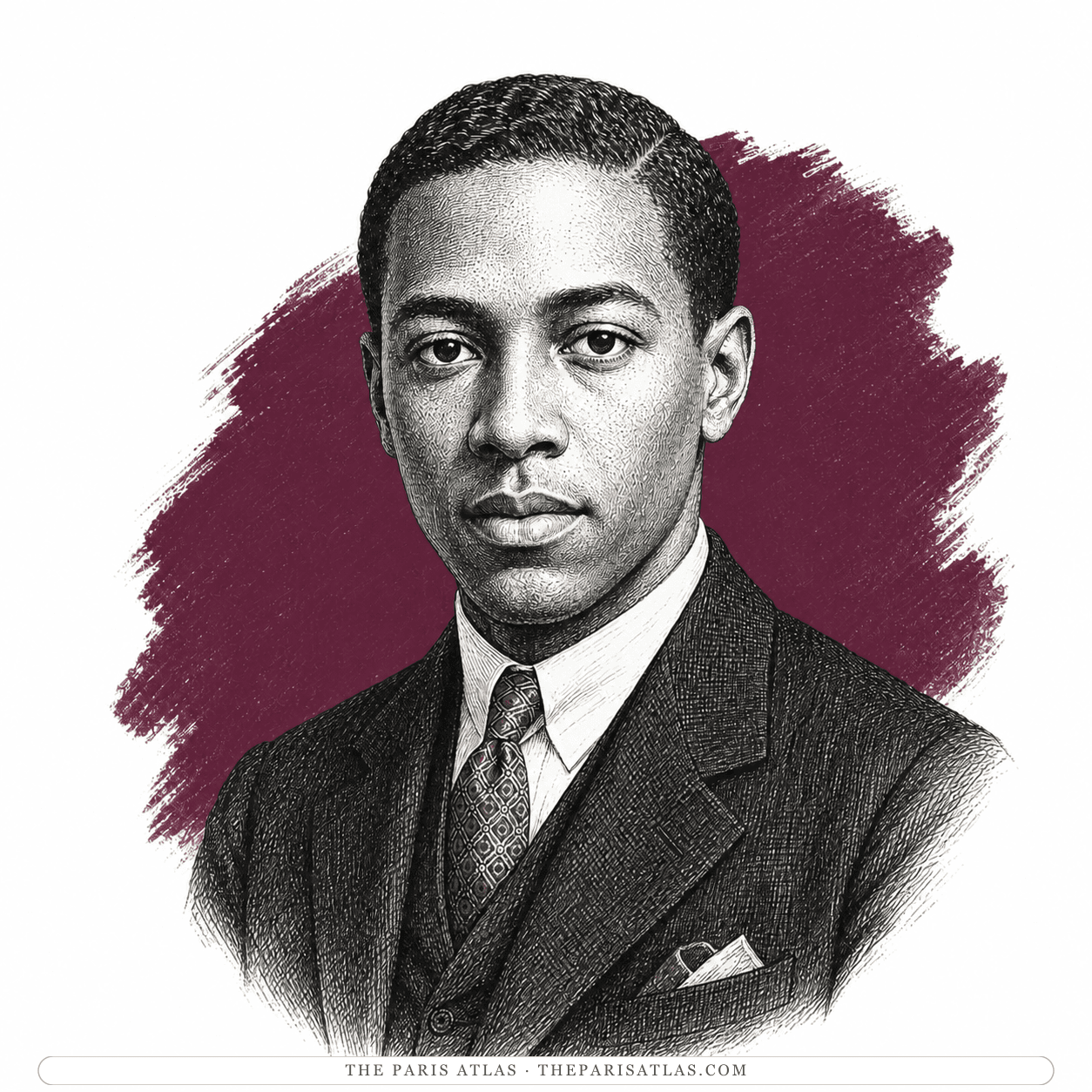
Baldwin preached from fourteen to seventeen. Drawn for The Paris Atlas. (Illustration — The Paris Atlas)

The painter who told him he could be an artist

At fifteen, a school friend gave Baldwin an address in Greenwich Village and told him to go and knock on the door. It belonged to Beauford Delaney, a Black painter then in his late thirties, living and working in a single room. Baldwin went. The friendship lasted almost forty years.

What Delaney gave him was not technique but permission. Baldwin had never met a Black person who lived as an artist and was not apologising for it. Delaney also taught him to look at things — light on a puddle, light on a face — and Baldwin said for the rest of his life that his own way of seeing came from watching Delaney see.

I learned about light from Beauford Delaney, the light contained in every thing, in every surface, in every face.

James Baldwin, on the painter who mentored him

Delaney moved to Paris himself in 1953 and stayed. The two men saw each other there for the rest of Delaney's life, which ended badly: he suffered from severe mental illness in his last years and died in a Paris hospital in 1979.

Why he left for Paris

Baldwin went to DeWitt Clinton High School in the Bronx, where he was literary editor of the school magazine, and graduated in 1942. There was no money for college. He spent the next six years on menial jobs, writing at night, and publishing book reviews where he could.

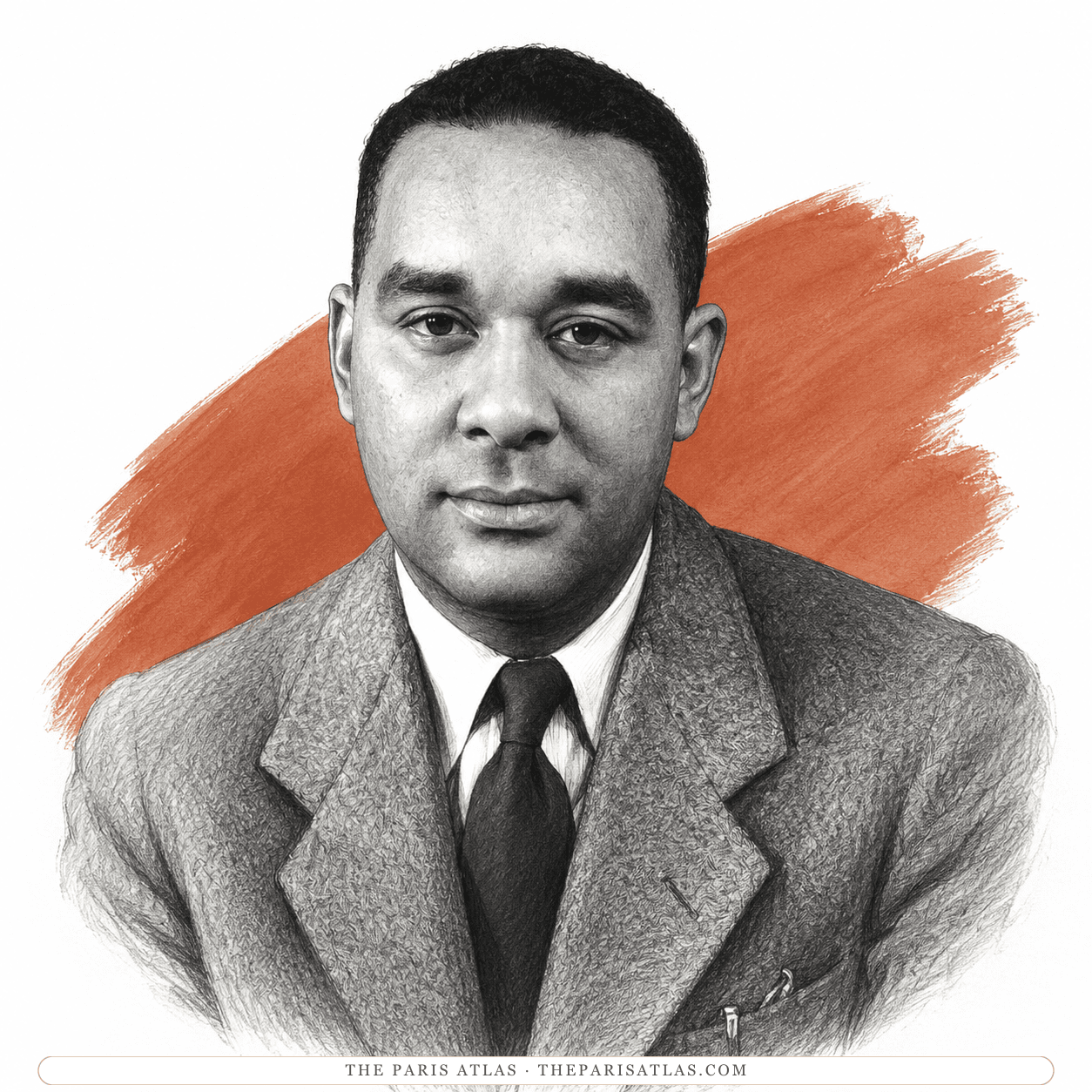
In 1944 he met Richard Wright, whose novel Native Son had made him the most famous Black writer in America. Wright read Baldwin's unfinished manuscript and helped him win a Eugene F. Saxton fellowship in 1945. Three years later a Rosenwald Foundation fellowship paid for a ship.

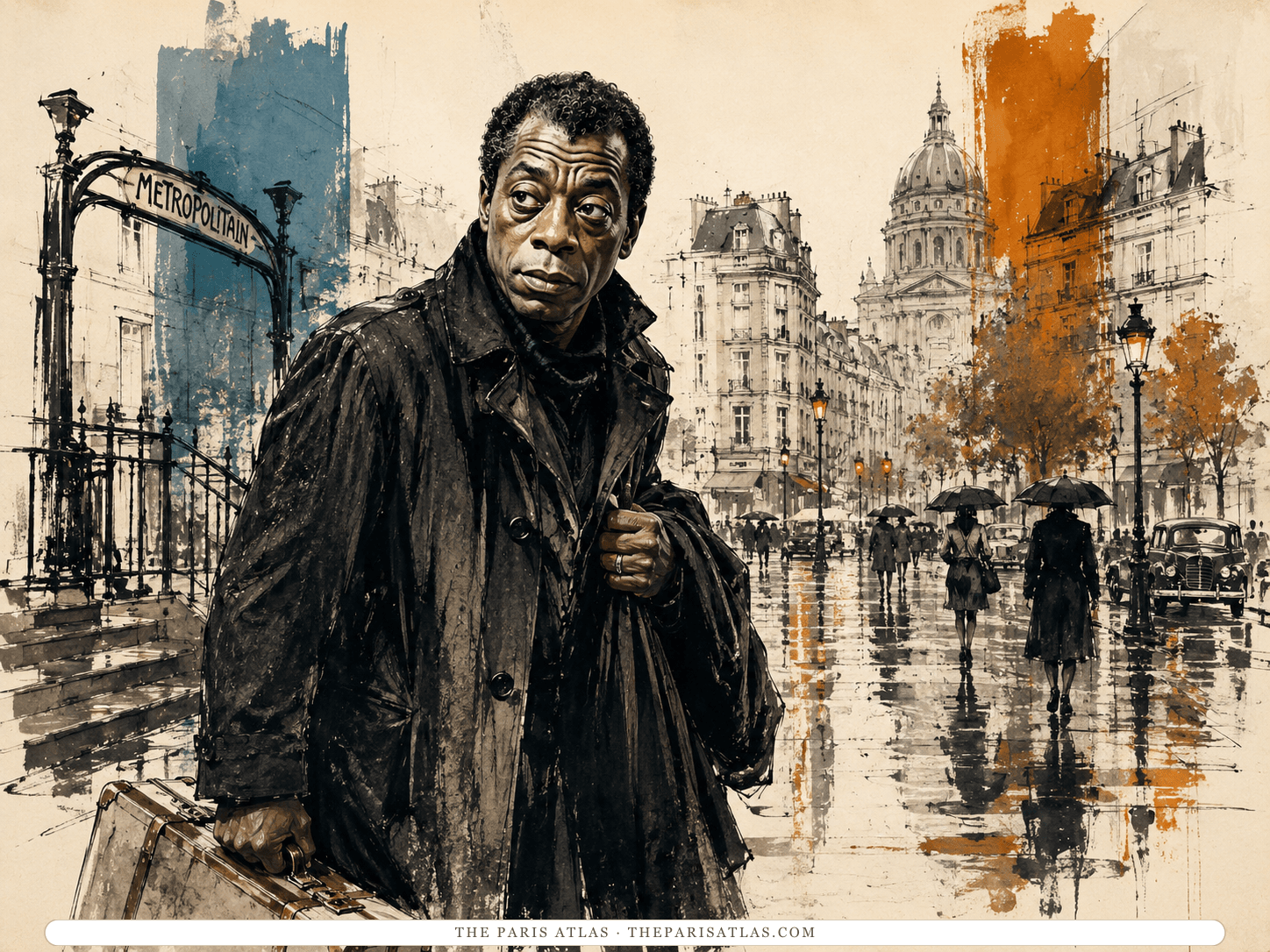
Baldwin landed in Paris in November 1948. He was twenty-four and had forty dollars. He later gave several explanations for going, and they do not contradict each other so much as accumulate: he was Black, he was homosexual, a friend had recently jumped from the George Washington Bridge, and he had come to believe that if he stayed in New York he would either be killed or become the kind of writer who could only write about being Black in America. Leaving was not a career move. He described it as staying alive.

The six years of menial jobs and night writing, before the ship. Drawn for The Paris Atlas. (Illustration — The Paris Atlas)

The Paris years

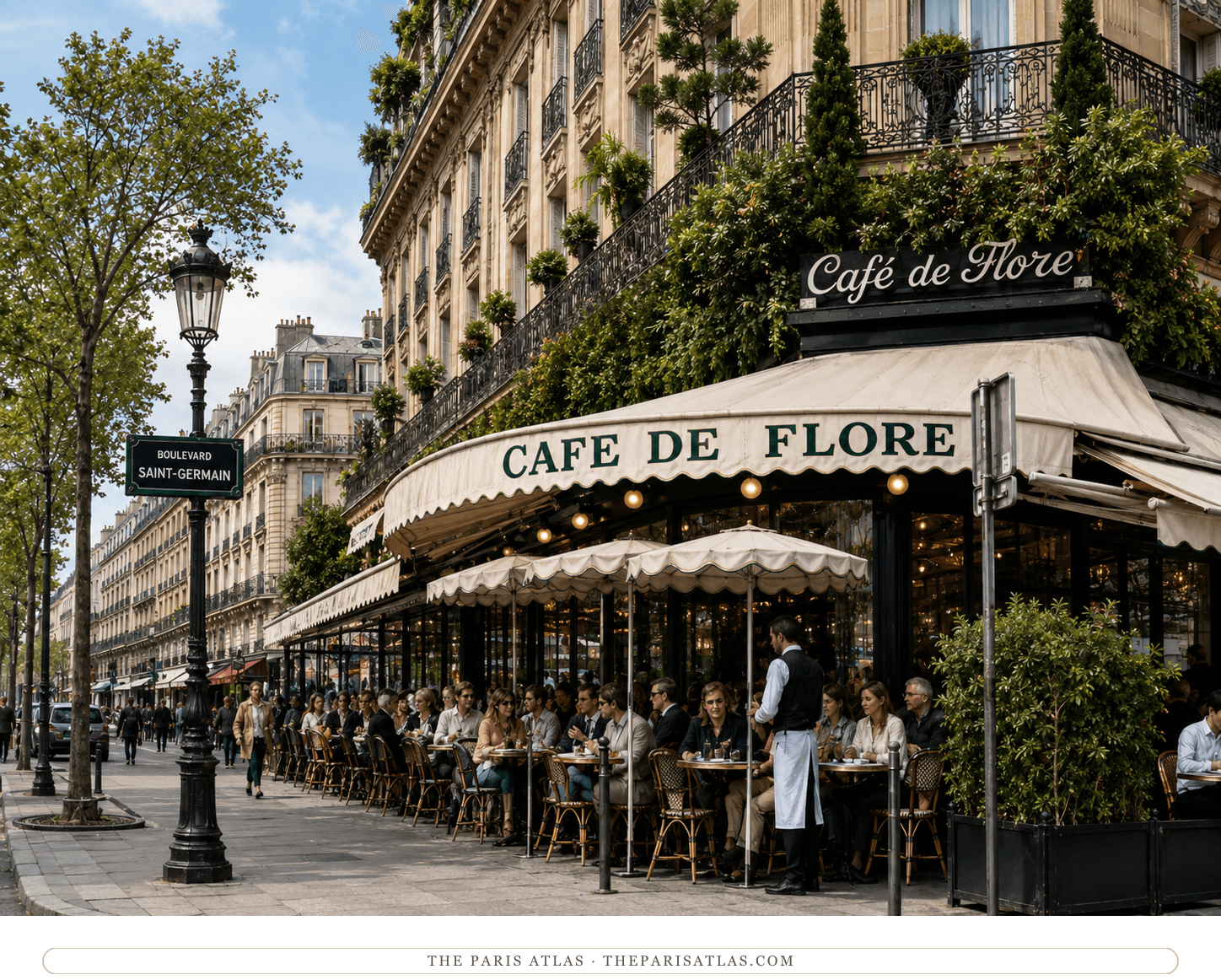
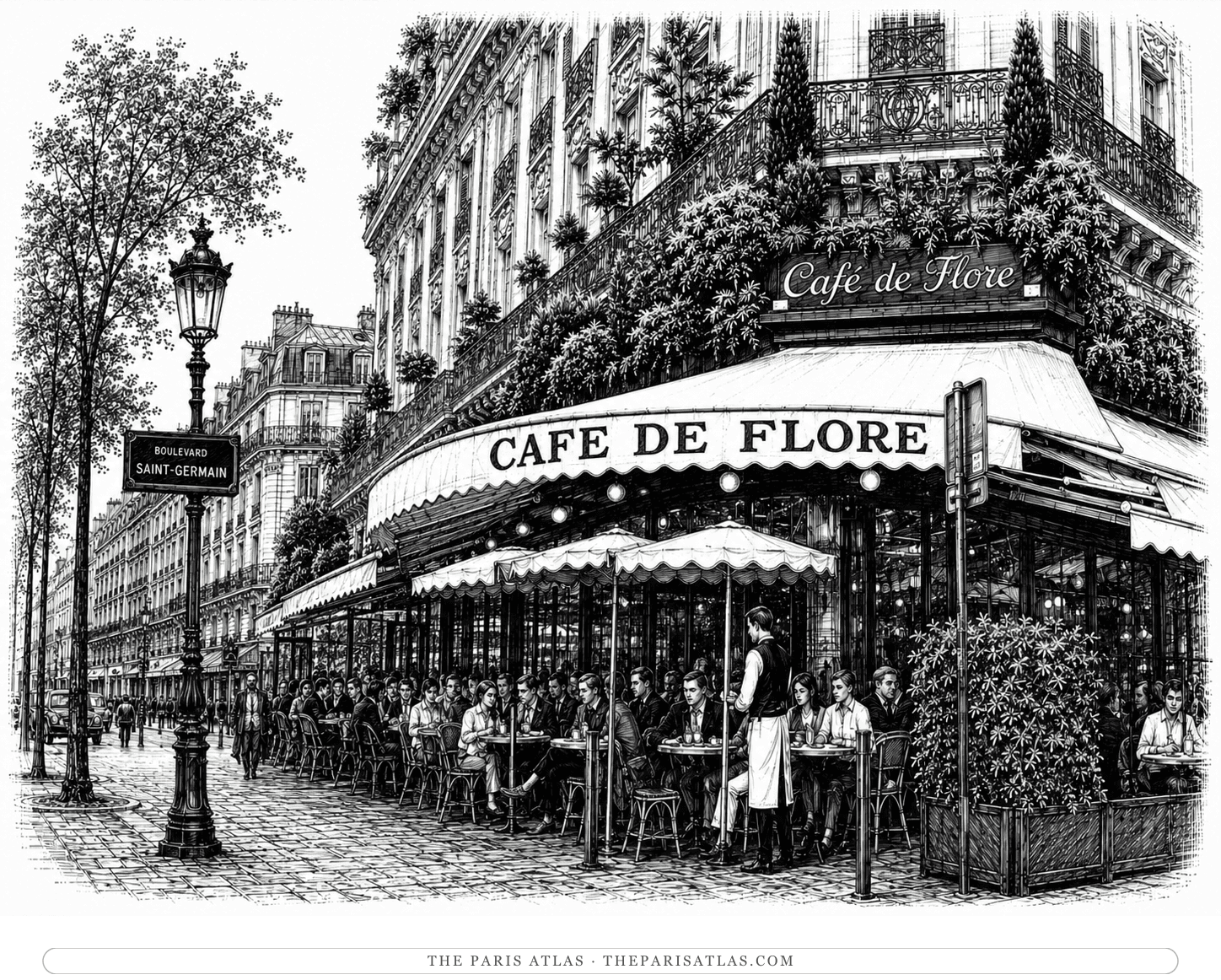
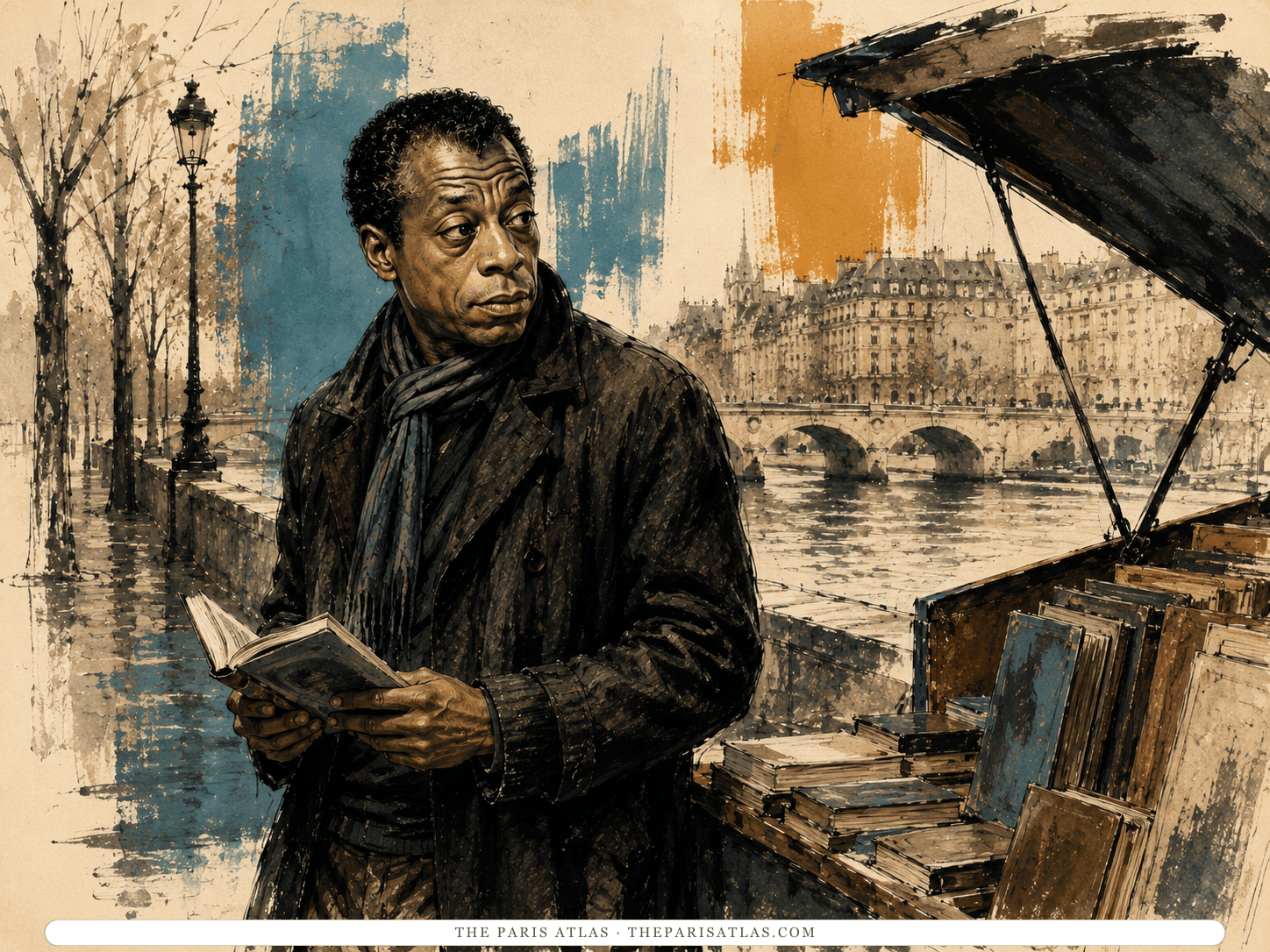
The forty dollars went almost immediately. For the next several years Baldwin lived in cheap hotels around Saint-Germain-des-Prés, borrowed money constantly, and wrote in cafés because they were heated and his rooms were not. He worked at the Café de Flore on the boulevard Saint-Germain, one of the two cafés on that corner where the Paris intellectual world conducted its business in public.

Baldwin worked and argued in Paris cafés from 1948, writing in them because the rooms he could afford were unheated. The other figure is not identified. (The Paris Atlas · © The Paris Atlas)

What Paris gave him was not acceptance. He was clear that the French had their own colonial subjects to look down on, and that his welcome had a good deal to do with being American. What it gave him was distance. In New York he had been a Black man before he was anything else, including a writer. In Paris he was a foreigner among foreigners, and from that distance he could finally see the country he had left clearly enough to write about it.

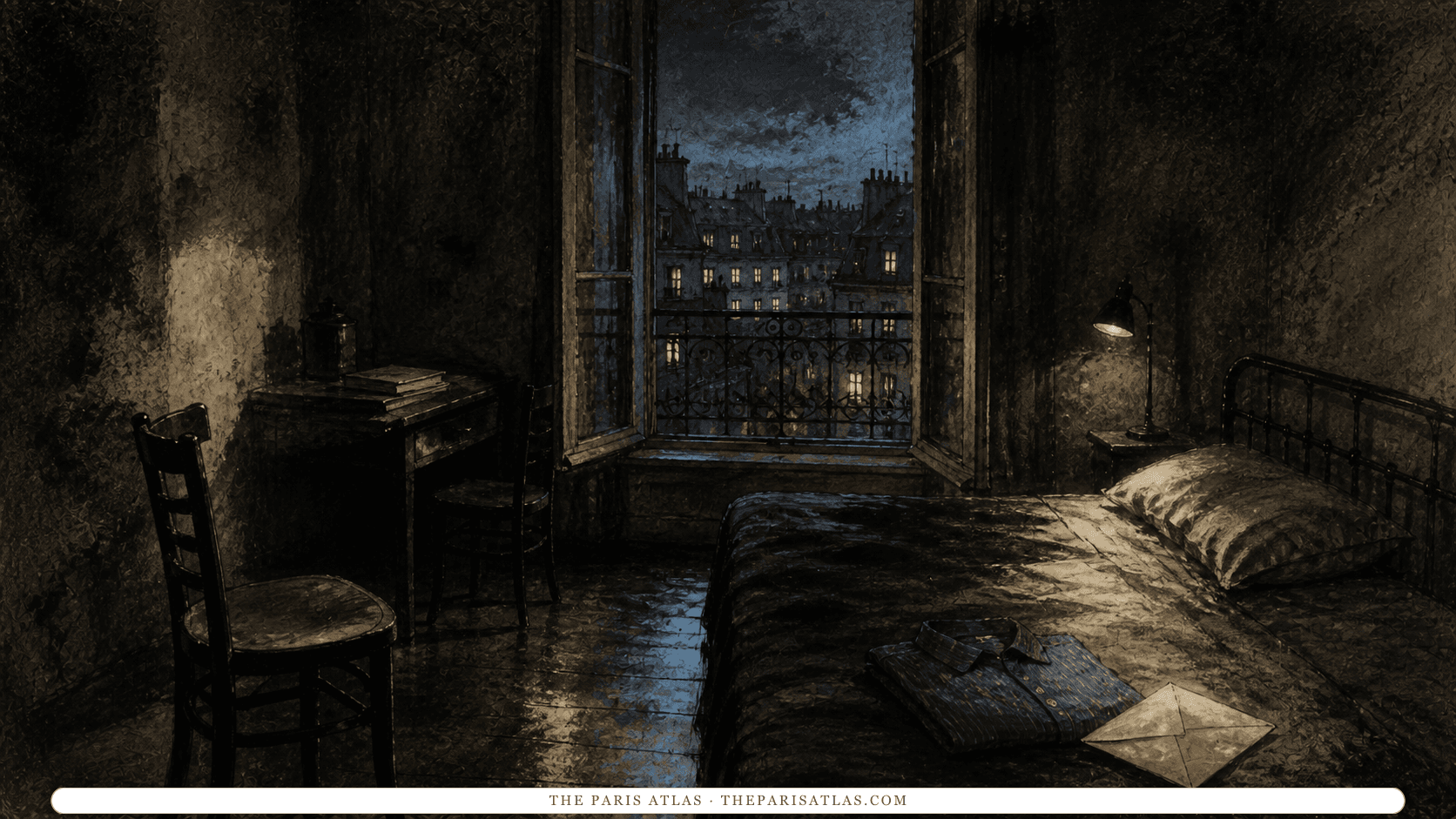
A rented room off Saint-Germain-des-Prés. Drawn for The Paris Atlas. (Illustration — The Paris Atlas)

Eight days in a French jail

On 19 December 1949 Baldwin was arrested for the first time in his life. An American acquaintance had taken a sheet from a hotel he was angry at, and had passed it on to Baldwin, whose own bedding was filthy. The police came for the acquaintance and took Baldwin too. He spent eight days in prison over Christmas, unable to make anyone understand that he did not know the sheet was stolen, and half convinced that he had simply disappeared and no one would come.

He wrote it up years later as "Equal in Paris," published in Commentary in March 1955 and collected in Notes of a Native Son. The essay's point is not that the French were racist. It is that they were indifferent — that the machinery which had him ground him because it grinds everybody, and that this was, in its way, the most disorienting thing that had ever happened to him. It is one of the best things he wrote and among the easiest to start with.

Paris in winter, the year of the arrest. Drawn for The Paris Atlas. (Illustration — The Paris Atlas)

The friendship he ended with an essay

Richard Wright had helped Baldwin get to Paris, and was living there himself. In 1949 Baldwin published an essay called "Everybody's Protest Novel" in the small Paris magazine Zero. It was an attack on protest fiction, and its central example was Native Son.

Baldwin's argument was that a novel written to prove that racism is evil ends up accepting racism's own terms. It has to make its Black protagonist a case rather than a person, and a case cannot surprise you. He thought Wright's Bigger Thomas had been built to be pitied and feared, and that a human being is more than that.

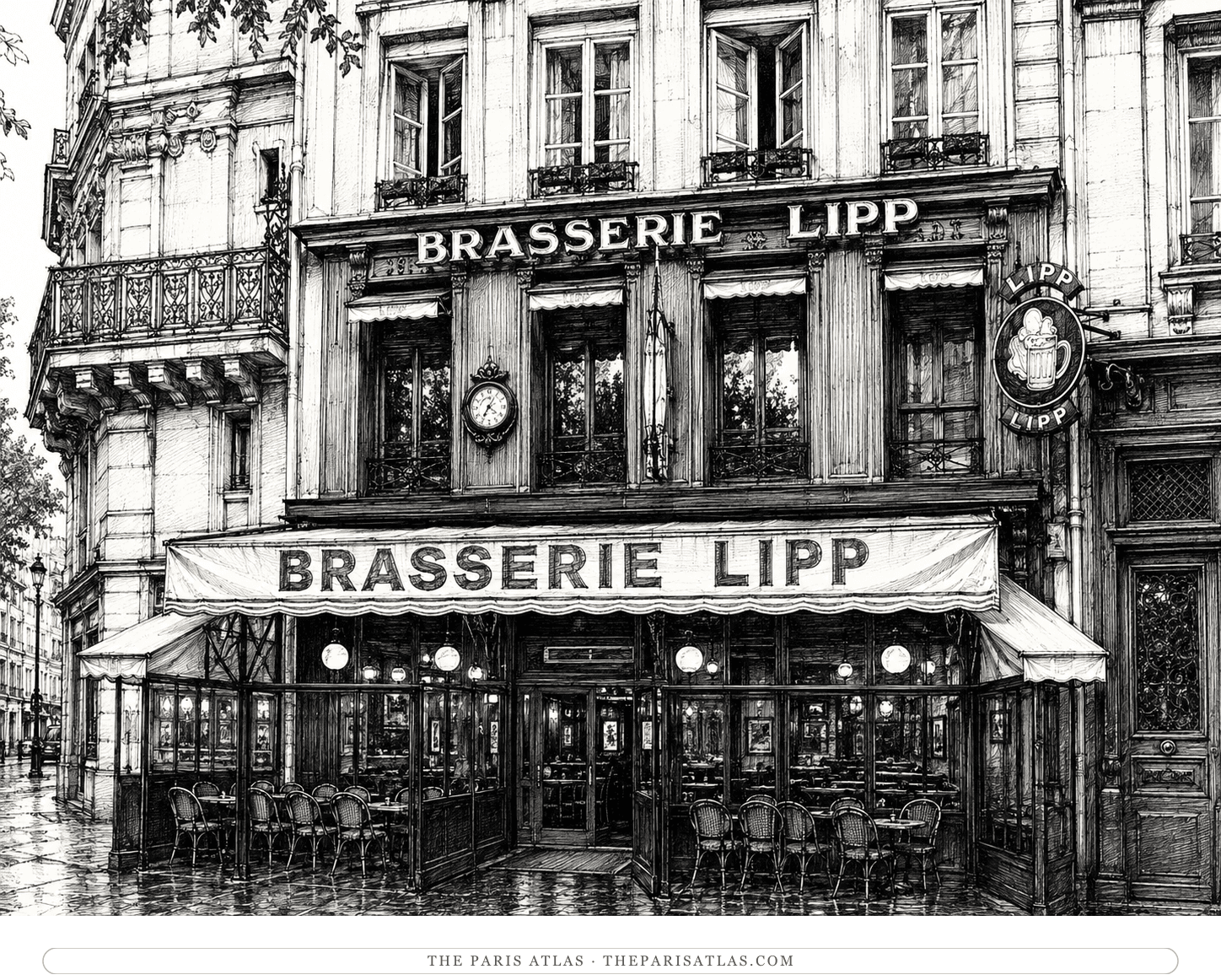
Wright took it as a betrayal by a younger writer he had carried. It came to a head on the day Zero published the essay, at Brasserie Lipp on the boulevard Saint-Germain: Baldwin walked in, Richard Wright was already sitting there, and Wright called him over. The friendship never recovered. Baldwin returned to it repeatedly afterwards, most painfully in "Alas, Poor Richard," written after Wright died in 1960 — the essay that describes that afternoon at Lipp. He never withdrew the criticism, and he never stopped saying that he had loved the man.

The cafés where the argument with Richard Wright was conducted. Drawn for The Paris Atlas. (Illustration — The Paris Atlas)

A Swiss village, and the first novel

Baldwin had been trying to write his first novel since he was seventeen. He finished it in the winter of 1951, in a chalet in Loèche-les-Bains, a village high in the Swiss Alps belonging to the family of Lucien Happersberger, a young Swiss painter he had met in 1949 at La Reine Blanche, a Saint-Germain gay bar, and who was, at various points, his lover and the closest friend of his life.

He wrote to two Bessie Smith records and a typewriter, in a village where most people had never seen a Black person. That produced a second piece of work: "Stranger in the Village," an essay about being stared at by people who mean no harm, and about what it means that they can afford not to know their own history while he cannot afford to forget his.

Go Tell It on the Mountain was published in 1953. It follows one day in the life of a fourteen-year-old boy in a Harlem storefront church, and opens out into the histories of the adults around him. It is closely drawn from Baldwin's own childhood, and it is the book to read if you want to understand where the rest of him came from.

Giovanni's Room, and the book he was told not to publish

His second novel, published in 1956, is set in Paris and has no Black characters at all. David, a young white American, is engaged to a woman and in love with an Italian bartender named Giovanni. He cannot admit the second thing, and the refusal destroys everyone involved.

James Baldwin photographed by Carl Van Vechten on 13 September 1955, the year before Giovanni's Room was published. He was thirty-one and had spent most of the previous seven years in Europe. (Carl Van Vechten, Library of Congress · Public domain)

Baldwin's American publisher turned it down and advised him to burn the manuscript. The reasoning was commercial rather than moral: he had been received as a promising Black writer, and a novel about white men in love with each other would confuse the audience he had. He published it in England instead, and it came out in the United States the same year with a different house.

It is now the book many readers meet him through, and it is short. It is dedicated to Lucien Happersberger.

Coming home to the civil rights movement

Baldwin returned to the United States in 1957, at the point where he could no longer justify watching the civil rights movement from another continent. He went south for the first time in his life, reported on school desegregation, and met the people running the movement. He was never an organiser and held no position in any group. What he had was a voice, and for about a decade he used it constantly — on television, in lecture halls, and in essays that arrived like verdicts.

Baldwin spent the 1960s talking — in apartments, lecture halls and on television — as much as writing. The listeners here are not identified. (The Paris Atlas · © The Paris Atlas)

The Fire Next Time, published in 1963, made him nationally famous. It is two pieces: a short letter to his fourteen-year-old nephew, and a long essay about his own religious childhood and an unsettling dinner with the Nation of Islam leader Elijah Muhammad. Its argument is that white America is trapped in a story about itself that is not true, that Black Americans have always known this, and that the country will not survive continuing to pretend otherwise.

James Baldwin at the March on Washington, 28 August 1963, with the actors Marlon Brando and Charlton Heston. The Fire Next Time had been published seven months earlier. (U.S. Information Agency, U.S. National Archives (NARA 542051) · Public domain)

On 18 February 1965 he debated the conservative writer William F. Buckley Jr. at the Cambridge Union, on the motion that the American dream had been achieved at the expense of the American Negro. The recording is still widely watched. Baldwin won the vote 544 to 164.

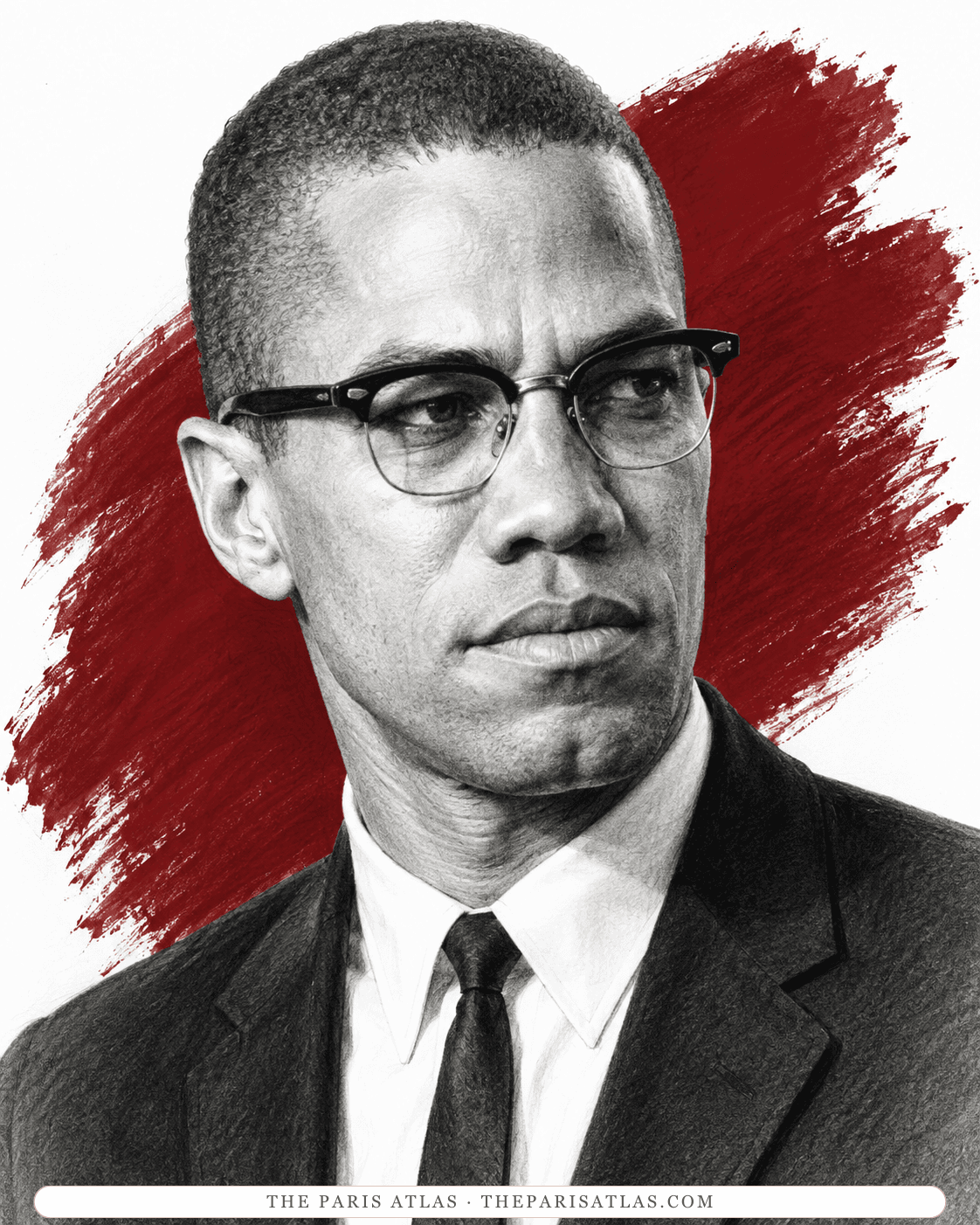
The murders of the following years — Medgar Evers, Malcolm X, Martin Luther King Jr., all three of whom he knew — damaged him badly, and the work that came after them is angrier and less hopeful. Younger militants found him too gentle; the mainstream that had celebrated The Fire Next Time found him too bitter.

The books, by kind

Baldwin published across five forms in a career of about thirty-eight years: six novels, seven books of essays, one book of stories, two plays, and a screenplay, plus collaborations and a children's book. The list below follows the bibliography kept by PBS American Masters.

James Baldwin at a press conference in the Hotel Americain, Amsterdam, on 14 November 1974, presenting a new book. (Rob Croes / Anefo, Nationaal Archief · CC0)
  • Go Tell It on the Mountain (1953) — one day in a Harlem storefront church, and the family histories underneath it.
  • Giovanni's Room (1956) — an American in Paris who cannot admit what he wants. His shortest novel.
  • Another Country (1962) — his longest and most crowded, moving between Harlem, Greenwich Village and France, across every combination of race and desire he could get on the page.
  • Tell Me How Long the Train's Been Gone (1968) — a successful Black actor has a heart attack and reviews how he got there.
  • If Beale Street Could Talk (1974) — a young woman in Harlem fights to free the father of her child from a charge he did not earn. Filmed by Barry Jenkins in 2018.
  • Just Above My Head (1979) — his last novel: a gospel singer's life told by his brother, and the fullest thing he wrote about faith.
  • Notes of a Native Son (1955) — the first collection, and the one most readers should start with.
  • Nobody Knows My Name (1961) — the essays of the return to America, including the first trip south.
  • The Fire Next Time (1963) — two pieces, about a hundred pages, the book that made him famous.
  • No Name in the Street (1972) — the assassinations, and the loss of hope in the movement.
  • The Devil Finds Work (1976) — a book about the movies, and one of the sharpest things ever written about how films handle race.
  • The Evidence of Things Not Seen (1985) — on the Atlanta child murders of 1979 to 1981.
  • The Price of the Ticket (1985) — his collected non-fiction to that date, the single most useful volume to own.
  • Going to Meet the Man (1965) — his only book of short stories, including "Sonny's Blues," the most anthologised thing he wrote.
  • The Amen Corner (staged 1954, published 1968) — a play about a woman preacher in Harlem and the son who leaves her church.
  • Blues for Mister Charlie (1964) — a play based on the murder of Emmett Till.
  • Jimmy's Blues (1983) — poems.
  • One Day When I Was Lost (1972) — his screenplay from The Autobiography of Malcolm X, written for a film that was never made from it.
  • Nothing Personal (1964) with Richard Avedon, A Rap on Race (1971) with Margaret Mead, and A Dialogue (1973) with Nikki Giovanni — three collaborations.
  • Little Man, Little Man (1976) — a children's book about a Harlem block, written for his nephew and illustrated by Yoran Cazac.
  • The Cross of Redemption (2011) — uncollected pieces, published posthumously.

Where to start with James Baldwin

Start with the essays, not the novels. Baldwin is one of the great essayists in English and only a very good novelist, and the essays are also shorter, which matters when you are deciding whether a writer is for you.

The best single entry point is Notes of a Native Son (1955). It contains "Equal in Paris," "Stranger in the Village," and the title essay about his stepfather's funeral, which takes place on the day of the 1943 Harlem riot and is one of the finest essays anyone has written in the language. If you would rather commit to a hundred pages than a whole collection, read The Fire Next Time instead.

James Baldwin in Hyde Park, London, in 1969, photographed by Allan Warren. (Allan Warren, Wikimedia Commons · CC BY-SA 3.0)

Then choose your novel by appetite. Giovanni's Room if you want the shortest and most contained. Go Tell It on the Mountain if you want to understand him. If Beale Street Could Talk if you have seen the film or want the warmest of them. Leave Another Country until you are sure, because it is long and sprawling and it argues with itself.

One story is worth going out of your way for on its own: "Sonny's Blues," from Going to Meet the Man. A schoolteacher and his younger brother, a jazz pianist coming out of prison, and about forty pages. It is widely taught, and for once the reputation is deserved.

How he writes

The sentences are long, but they are not difficult. Baldwin builds by adding clauses that each qualify the one before, so that a sentence arrives somewhere different from where it started while remaining perfectly clear at every point. It is the structure of a sermon: a claim, an objection, a concession, and then the claim again, now impossible to argue with.

James Baldwin in Los Angeles in 1964, photographed for the Los Angeles Times. He was forty, and the year after The Fire Next Time made him a national figure. (R. L. Oliver / Los Angeles Times, UCLA Library Digital Collections · CC BY 4.0)

He also uses "we" and "you" a great deal, which is why reading him can feel like being addressed personally, and occasionally like being accused. That is deliberate. He did not believe an essay about American racism could be written from outside it, and he included himself and the reader in every diagnosis he made.

  • Race in America, treated as a question about white people at least as much as Black people.
  • Sexuality, and the damage done by refusing to admit what you want.
  • Fathers, sons, and the church — the three are usually the same subject in his work.
  • Exile, and what a country looks like once you have left it.
  • Love, which he used as a demanding word rather than a warm one: the willingness to see another person accurately.

He resisted being described as a spokesman, a Black writer, or a gay writer, not because the descriptions were untrue but because each of them narrowed what he was allowed to write about next. He called himself a witness.

Saint-Paul-de-Vence

By the end of the 1960s Baldwin was exhausted, drinking heavily and repeatedly ill. At the start of the 1970s, with help from the actress Simone Signoret, he found a house in Saint-Paul-de-Vence, a hill village above the coast between Nice and Cannes. It was a seventeenth-century property near the village ramparts, with a garden and a long table under the trees.

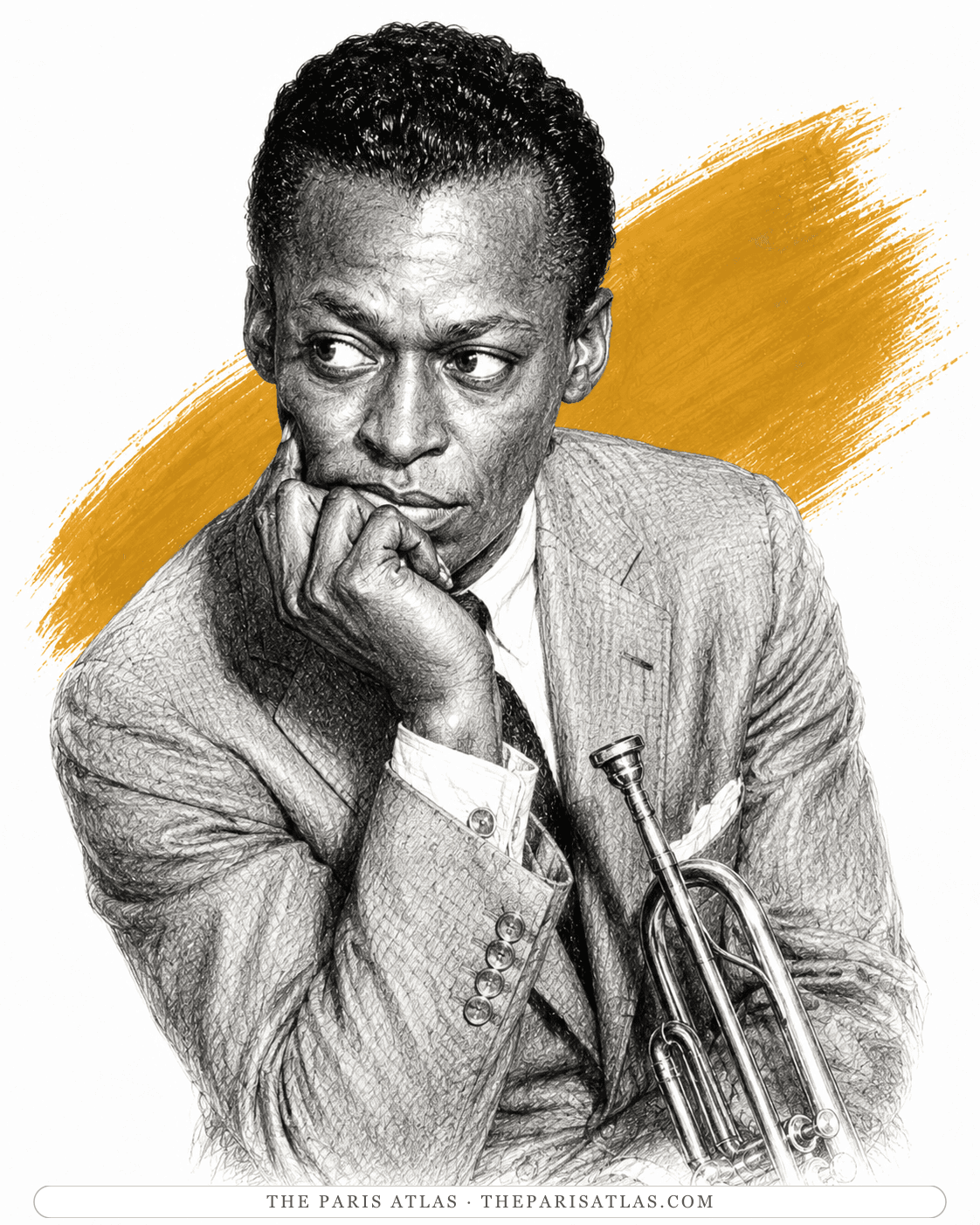
He lived there for the last seventeen years of his life and worked in the early hours of the morning, a habit he kept from Paris. Visitors came constantly — Nina Simone, Miles Davis, Josephine Baker, Toni Morrison, Maya Angelou — and were fed at the long table. He called it the welcome table, and it turns up in the play he was working on when he died.

The last seventeen years were spent here. Drawn for The Paris Atlas. (Illustration — The Paris Atlas)

The house was sold after his death and the property has since been largely redeveloped, over the objections of a long campaign to preserve it as a memorial. Very little of what Baldwin knew is still standing.

His death, and the return of his books

Baldwin was diagnosed with stomach cancer in the spring of 1987. He died at the house in Saint-Paul-de-Vence on 1 December 1987, aged sixty-three, with his brother David and Lucien Happersberger there. His funeral was held at the Cathedral of St John the Divine in New York, and he is buried in Ferncliff Cemetery in Hartsdale, New York.

James Baldwin lecturing in Amsterdam on 2 December 1984, in a series called Another Window on the World. He died three years later. (Sjakkelien Vollebregt / Anefo, Nationaal Archief · CC0)

His reputation dipped in the years immediately after, and then rose further than it had ever gone in his lifetime. Raoul Peck's documentary I Am Not Your Negro, built from an unfinished Baldwin manuscript, was nominated for an Academy Award in 2017; Barry Jenkins filmed If Beale Street Could Talk the following year. He is now quoted more than almost any other American writer of his century, often by people who have read the quotation rather than the book.

The books reward the difference. He is much funnier on the page than his reputation suggests, and much less certain.

Baldwin was filmed and televised more than almost any other writer of his generation, and he was better in front of a camera than most of them. The recordings below are complete or official, and they are the ones worth the time.

Terence Dixon's twenty-eight-minute film, shot in Paris in 1970. A British crew set out to make a literary portrait and Baldwin refused the terms, arguing with the director on camera about what they actually wanted from him. It is the closest thing on film to the Paris he lived in. (Terence Dixon, 1970 — streamed on YouTube Movies)
The full debate of 18 February 1965, broadcast by the BBC that evening, on the motion that the American dream had been achieved at the expense of the American Negro. Baldwin speaks for about twenty-four minutes and wins the vote 544 to 164. (Aeon Video, republished with permission of The Cambridge Union)
Baldwin on American television, 16 May 1969, on racial prejudice, the civil rights movement and the police. Seventeen minutes, from the show's own archive. (The Dick Cavett Show / Daphne Productions)
Raoul Peck built his documentary from Remember This House, the book about Medgar Evers, Malcolm X and Martin Luther King Jr. that Baldwin left thirty pages into. The narration is Baldwin's own writing, read by Samuel L. Jackson. (Magnolia Pictures)

Life events

  1. 1924

    Born James Arthur Baldwin at Harlem Hospital, New York, on 2 August, to Emma Berdis Jones.

  2. 1927

    His mother marries David Baldwin, a factory worker and preacher; eight more children follow.

    The Harlem household James Baldwin grew up in, the eldest of nine children in rooms this size. Drawn for The Paris Atlas; the children are not individually identified. (The Paris Atlas)
  3. 1938

    Undergoes a religious conversion at fourteen and becomes a junior minister at the Fireside Pentecostal Assembly, where he preaches for three years.

    James Baldwin preached as a junior minister from the age of fourteen, and said afterwards that his prose was built the way a sermon is. Drawn for The Paris Atlas. (The Paris Atlas)
  4. 1939

    Meets the painter Beauford Delaney in Greenwich Village, the first Black artist he had ever known.

    James Baldwin at fifteen with the painter Beauford Delaney, the first Black artist he had known. Drawn for The Paris Atlas. (The Paris Atlas)
  5. 1942

    Graduates from DeWitt Clinton High School in the Bronx, where he edited the school magazine. There is no money for college.

  6. 1944

    Meets Richard Wright, who reads his unfinished novel and backs him for a fellowship.

  7. 1948

    Sails for France on a Rosenwald fellowship, arriving in Paris in November at twenty-four with forty dollars.

    James Baldwin reached Paris in November 1948 with forty dollars and no French. Drawn for The Paris Atlas. (The Paris Atlas)
  8. 1949

    Publishes "Everybody's Protest Novel" in Zero, breaking with Wright. Arrested on 19 December over a stolen hotel sheet and held eight days.

  9. 1951

    Finishes his first novel in a chalet at Loèche-les-Bains in the Swiss Alps, belonging to Lucien Happersberger's family.

    James Baldwin finished his first novel in a Swiss mountain village in the winter of 1951, working in a chalet belonging to Lucien Happersberger's family. Drawn for The Paris Atlas. (The Paris Atlas)
  10. 1953

    Go Tell It on the Mountain published.

  11. 1955

    Notes of a Native Son published.

  12. 1956

    Giovanni's Room published, after his American publisher advised him to burn it.

  13. 1957

    Returns to the United States and travels in the South for the first time.

  14. 1963

    The Fire Next Time makes him a national figure. He takes part in the March on Washington.

    The March on Washington of 28 August 1963, the year The Fire Next Time made James Baldwin a national figure. Drawn for The Paris Atlas; apart from Martin Luther King Jr., the figures are not identified. (The Paris Atlas)
  15. 1965

    Debates William F. Buckley Jr. at the Cambridge Union on 18 February and wins the vote 544 to 164.

  16. 1970

    Settles in Saint-Paul-de-Vence in the south of France, where he lives for the rest of his life.

  17. 1974

    If Beale Street Could Talk published.

  18. 1979

    Just Above My Head, his last novel, published. Beauford Delaney dies in Paris.

  19. 1985

    The Price of the Ticket collects his non-fiction to date.

  20. 1987

    Dies of stomach cancer at Saint-Paul-de-Vence on 1 December, aged sixty-three.

James Baldwin quotes

Verbatim, as recorded by the witnesses of the era — sources on every quotation.

Not everything that is faced can be changed; but nothing can be changed until it is faced.
James Baldwin, "As Much Truth As One Can Bear," The New York Times Book Review, 14 January 1962
I was broke. I got to Paris with forty dollars in my pocket, but I had to get out of New York.
James Baldwin, The Art of Fiction No. 78, The Paris Review, issue 91, Spring 1984
When I arrived in Paris in 1948 I didn’t know a word of French. I didn’t know anyone and I didn’t want to know anyone.
James Baldwin, The Art of Fiction No. 78, The Paris Review, issue 91, Spring 1984
All 316 James Baldwin quotes

People they knew

Documented connections — every one carries its source.

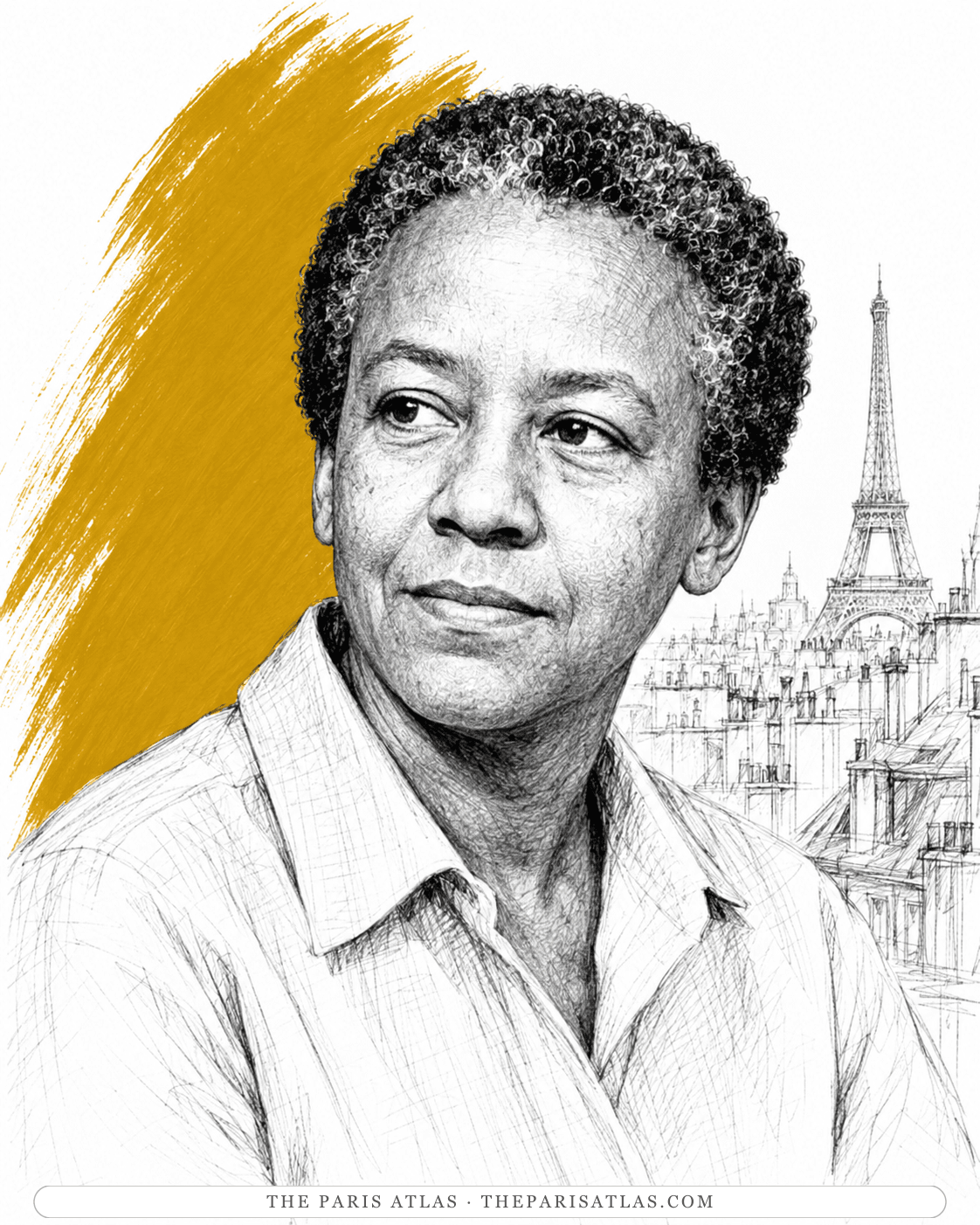
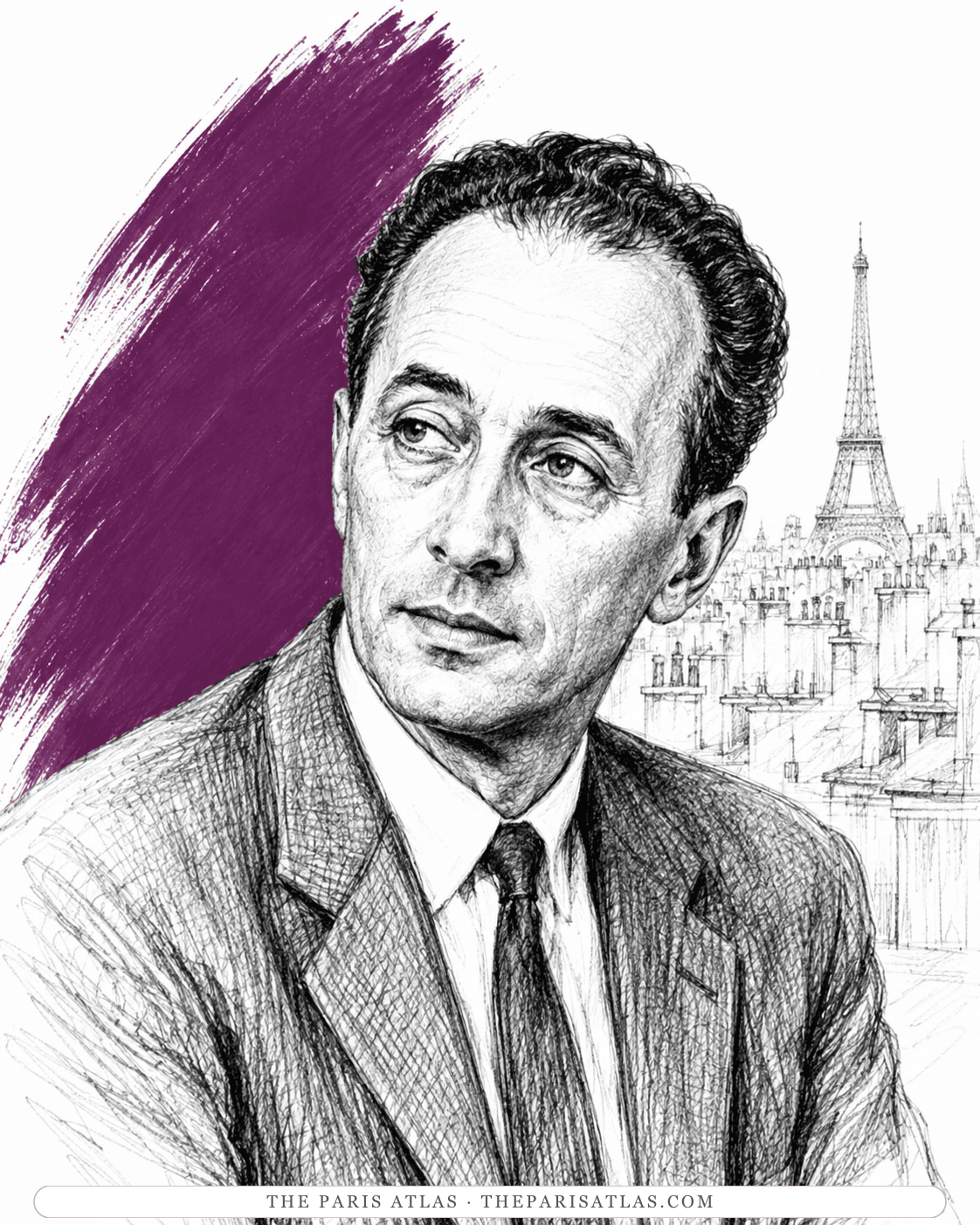
Illustrated portrait of Richard Avedon

Richard Avedon

  • Photographer
  • Author

Collaborated with

Classmates on the Magpie editorial board at DeWitt Clinton High School in the Bronx. In 1964 they published Nothing Personal, Avedon's photographs alongside Baldwin's text on American identity in the civil rights era.
Back to School with the Berg Collection (2023); Richard Avedon, Members of the Student Nonviolent Coordinating Committee, Atlanta, Georgia (object 2018.40)

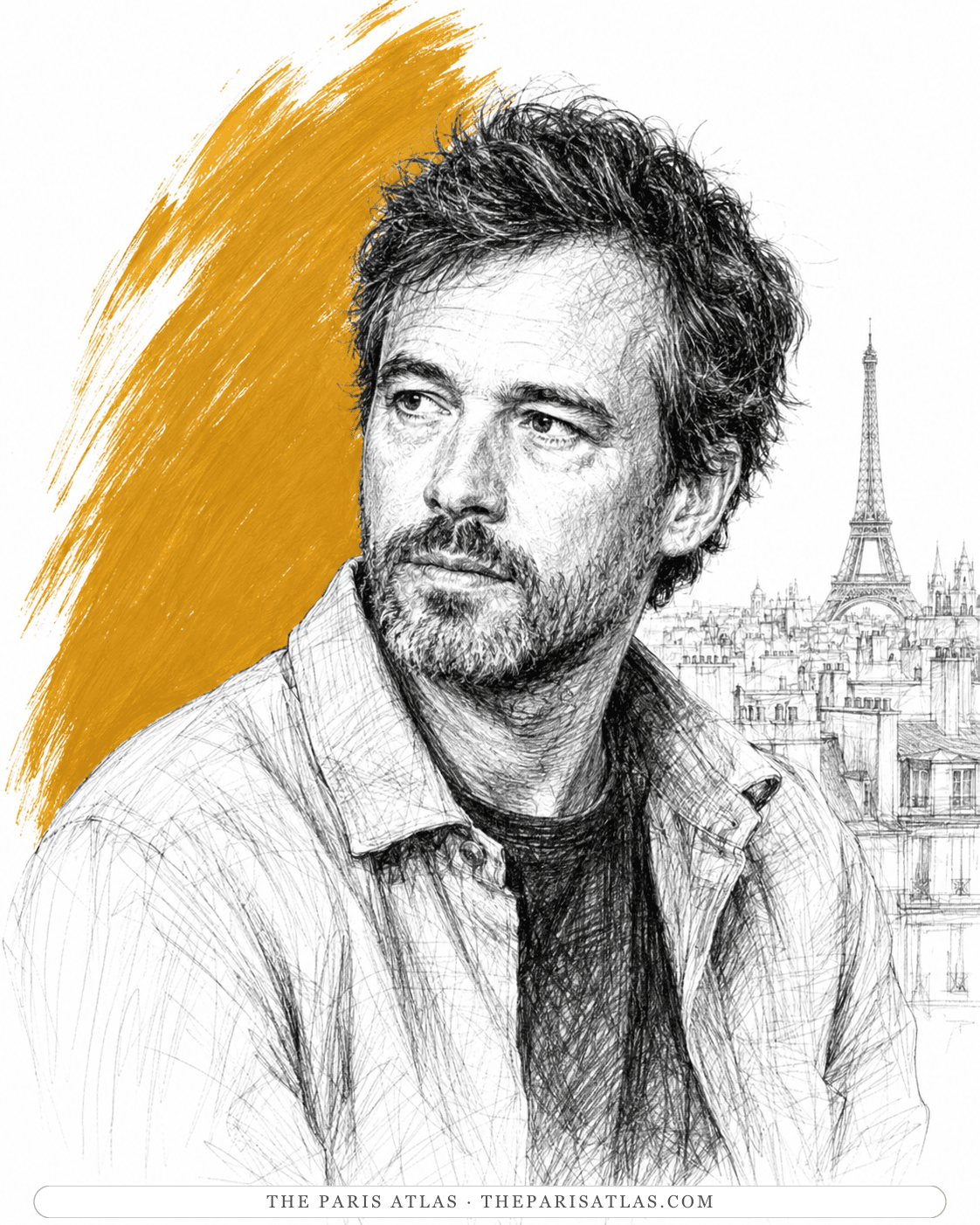
Illustrated portrait of Sol Stein

Sol Stein

  • Editor
  • Publisher
  • Author

Collaborated with

Friends from the editorial board of the Magpie at DeWitt Clinton High School. In the summer of 1954, at the MacDowell Colony together, Stein convinced Baldwin to publish the essays that became Notes of a Native Son, and edited the book. Their letters were published as Native Sons in 2005.

A Century of Creativity: The MacDowell Colony — Giovanni's Room featured object; Back to School with the Berg Collection (2023)

Met

The friendship began at DeWitt Clinton High School in the Bronx, where both were students and budding writers on The Magpie, the school's literary magazine — the same school that produced Richard Avedon. Native Sons (2004) collects what the friendship left on paper.

Native Sons: A Friendship That Created One of the Greatest Works of the 20th Century (review) (2004)

Illustrated portrait of Yoran Cazac

Yoran Cazac

  • Painter
  • Illustrator

Collaborated with

Cazac illustrated Little Man, Little Man, Baldwin's only children's book, published by Dial Press in 1976 and reissued by Duke University Press in 2018.

Little Man, Little Man: A Story of Childhood – Another View of James Baldwin

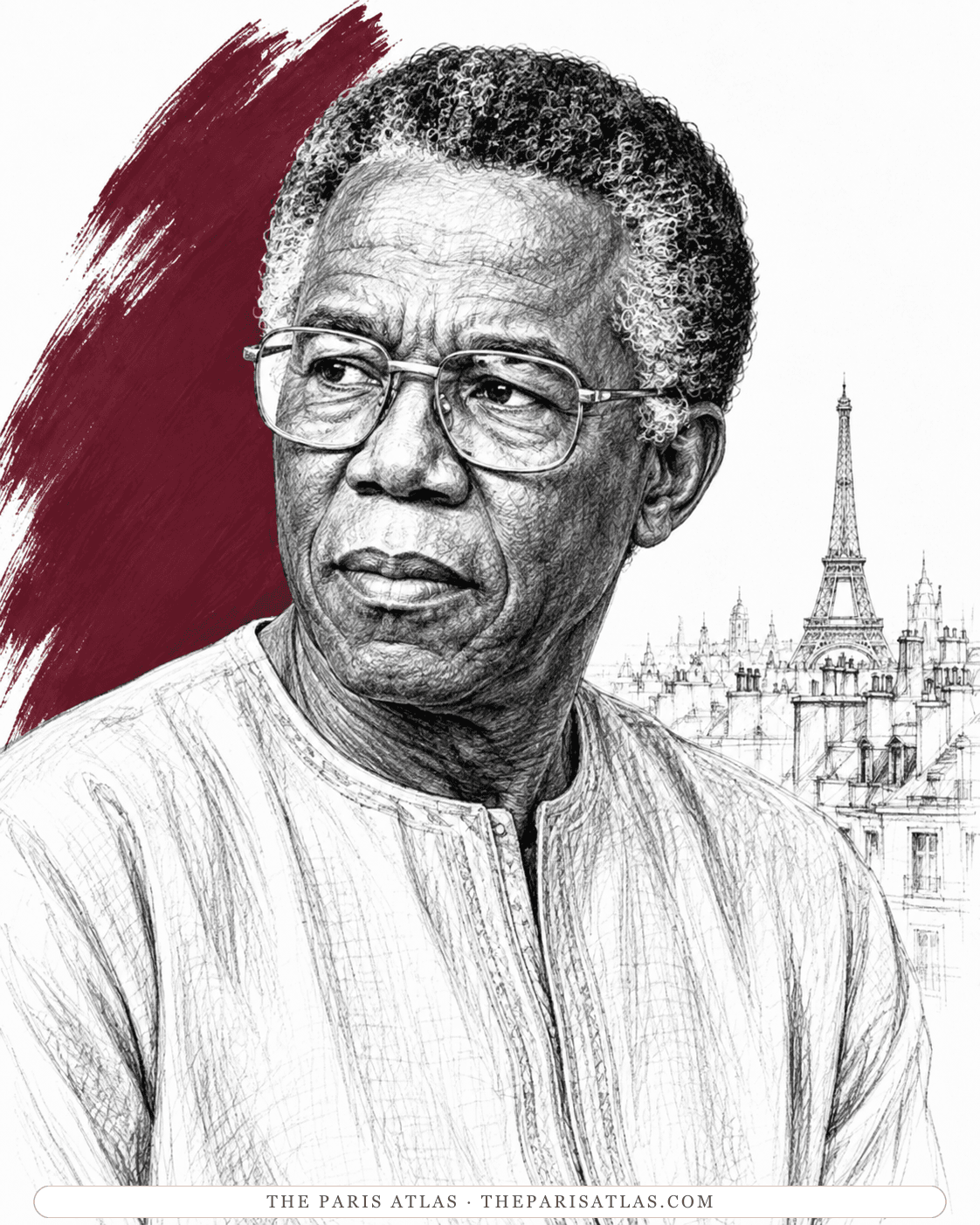
Illustrated portrait of Chinua Achebe

Chinua Achebe

  • Author

Met · 1980

They met at the 1980 African Literature Association conference in Gainesville, Florida, where Baldwin greeted Achebe with the words: this is my brother who I'm meeting 400 years after. A University of Florida exhibition calls it their first and only meeting, though its own archive holds photos of the two together in St. Augustine around 1982.

Achebe–Baldwin at 40: An Online Exhibition

Illustrated portrait of Jean Genet

Jean Genet

  • Author
  • Playwright

Met · 1970

The two writers sat on a panel together at the American Center for Students and Artists in Paris in 1970. A contact sheet by the photographer Jacques Robert, held at the Schomburg Center, records the occasion.

Jacques Robert, Contact sheet of James Baldwin with Jean Genet at American Center (1970)

Illustrated portrait of Langston Hughes

Langston Hughes

  • Poet
  • Author
  • Playwright
  • +1

Met · 1961

In January 1961 the two sat on the same WBAI radio panel on the Black writer in America, alongside Lorraine Hansberry, Alfred Kazin, and Emile Capouya, with Nat Hentoff moderating. The recording survives in the American Archive of Public Broadcasting.

The Negro in American Culture; No. 3; The Negro Writer In America (WBAI, 1961) (1961)

Illustrated portrait of Lorraine Hansberry

Lorraine Hansberry

  • Playwright

Met · 1958

They first met in the winter of 1958 at a workshop production of Giovanni's Room and stayed close until Hansberry's death from cancer in 1965, at thirty-four. In his tribute essay Sweet Lorraine, Baldwin wrote: I loved her, she was my sister and my comrade.

Comrades in the Struggle; Typescript letter signed, to Lorraine Hansberry from James Baldwin, ca. 1961

Illustrated portrait of Maya Angelou

Maya Angelou

  • Poet
  • Author

Met

They met in the 1950s, when Angelou came through France with the touring production of Porgy and Bess. They called each other brother and sister; Baldwin wrote the liner notes for her 1969 poetry album, and Angelou gave a eulogy at his funeral in 1987.

The Wisdom & Stories of Maya Angelou at the Schomburg Center (2024); Comrades in the Struggle

Illustrated portrait of Nikki Giovanni

Nikki Giovanni

  • Poet
  • Author

Met · 1971

In November 1971 the two taped a two-part conversation in London for the WNET program Soul! — Baldwin was forty-seven, Giovanni twenty-eight. The exchange was published as the book A Dialogue in 1973.

Soul!; 53; Conversation Between Giovanni and Baldwin. Part 1 (1971)

Collaborated with · 1971–1973

The conversation they taped in London on 4 November 1971 for the television program Soul! became a book: J. B. Lippincott published the full transcript as A Dialogue in 1973, with a foreword by Ida Lewis and an afterword by Orde M. Coombs.

Soul!; 53; Conversation Between Giovanni and Baldwin. Part 1 (1971); A Dialogue

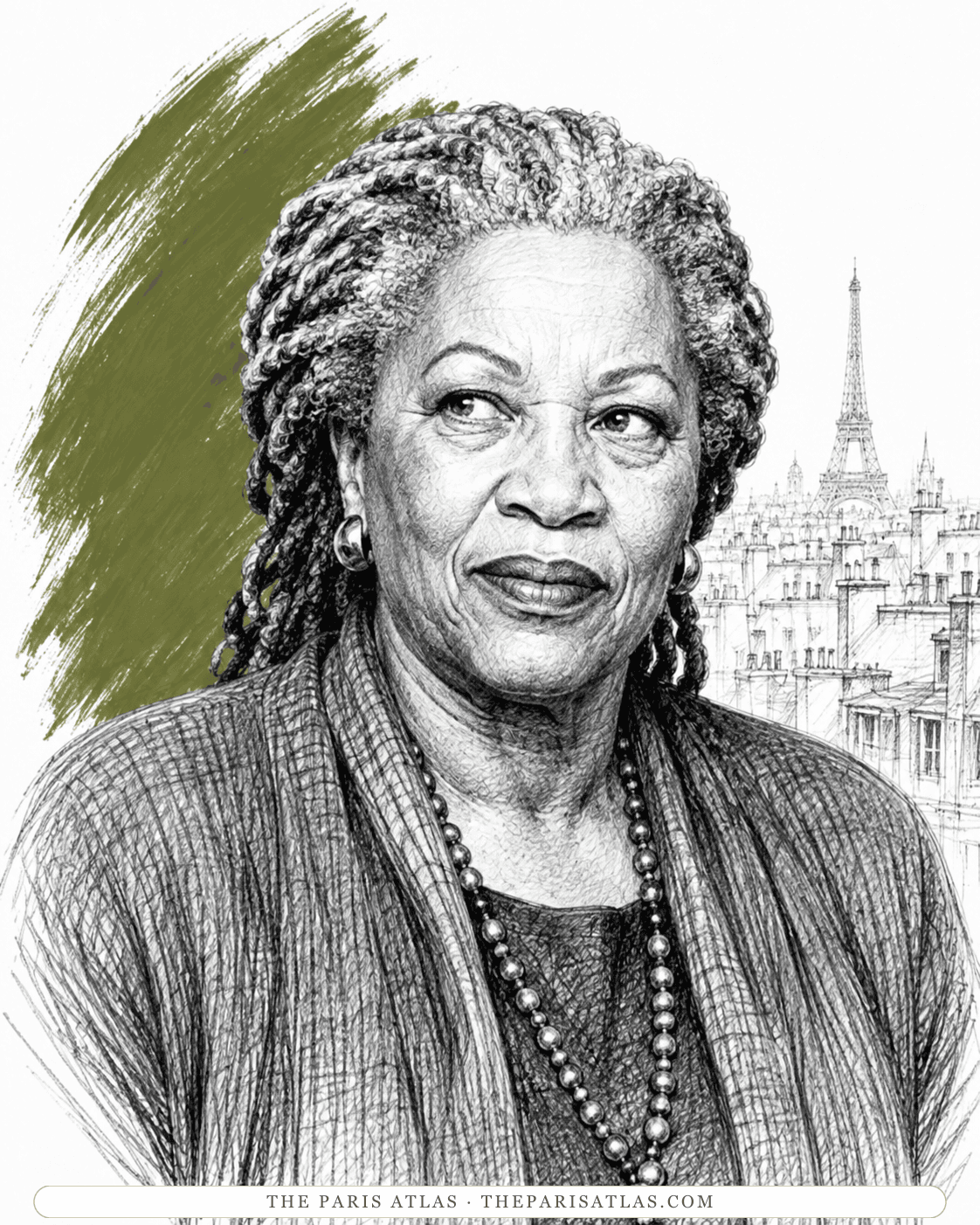
Illustrated portrait of Toni Morrison

Toni Morrison

  • Author
  • Editor

Met

Morrison is named among the significant correspondents in Baldwin's papers at the Schomburg Center. Baldwin said she was literally his ally; Morrison gave a eulogy at his 1987 funeral in which she said he had given the Black literary world three gifts — language, courage, and tenderness.

James Baldwin papers, 1936–1992 (Sc MG 936), finding aid; Comrades in the Struggle

Illustrated portrait of Lucien Happersberger

Lucien Happersberger

  • Painter

Partner of · 1949–1987

They met in Paris in 1949, a year after Baldwin arrived. In 1950 they left for the Happersberger family's village in the Swiss Alps, where Baldwin — pulled back from the edge of a ravine by Lucien on a hike — settled on the title Go Tell It on the Mountain. Giovanni's Room is dedicated to him, and Baldwin called him the love of his life. The partnership, in its shifting forms, ran to Baldwin's death in 1987.

Brandon Tensley, A New Biography Offers the Most Intimate Portrait Yet of One of the 20th Century's Greatest Authors (2025)

Illustrated portrait of Beauford Delaney

Beauford Delaney

  • Painter

Mentored by · 1940

Baldwin was about fifteen when a school friend sent him to Delaney's room in Greenwich Village. He credited the painter with two things for the rest of his life: proof that a Black person could live as an artist, and his own way of looking at the physical world.

David Zwirner — James Baldwin on Beauford Delaney; Comrades in the Struggle

Illustrated portrait of Richard Wright

Richard Wright

  • Author
  • Poet
  • Journalist

Mentored by · 1944

Wright read the twenty-year-old Baldwin's unfinished first novel and backed him for the Eugene F. Saxton fellowship he won in 1945. The support is what put Baldwin on a ship to Paris three years later, and it is also what made the 1949 Zero essay read as a betrayal.

Chicago Public Library — James Baldwin Biography

Clashed with · 1949

Baldwin's 1949 essay Everybody's Protest Novel, published in the Paris magazine Zero, used Wright's Native Son as its example. Baldwin's own account, in "Alas, Poor Richard", puts the confrontation at Brasserie Lipp on the day Zero published the essay. The friendship never fully recovered; he returned to the break in two later essays and regretted the parting without retracting the argument. A separate 1953 quarrel involving Chester Himes happened at Les Deux Magots and is often merged with this one — Wright and Himes later gave conflicting accounts of that evening.

James Baldwin, Nobody Knows My Name (1961), "Alas, Poor Richard", pp. 196–197 (Vintage International, 1993); Baldwin in France

Illustrated portrait of Miles Davis

Miles Davis

  • Musician

Met

They became close friends. Davis wrote in his autobiography that whenever he played the festival at Antibes he would spend a day or two at Baldwin's house in Saint-Paul-de-Vence, sitting in the house and then in the garden while Baldwin talked.

Miles Davis with Quincy Troupe, Miles: The Autobiography (1989); Commune de Saint-Paul de Vence — James Baldwin

Illustrated portrait of Amiri Baraka

Amiri Baraka

  • Poet
  • Playwright

Met

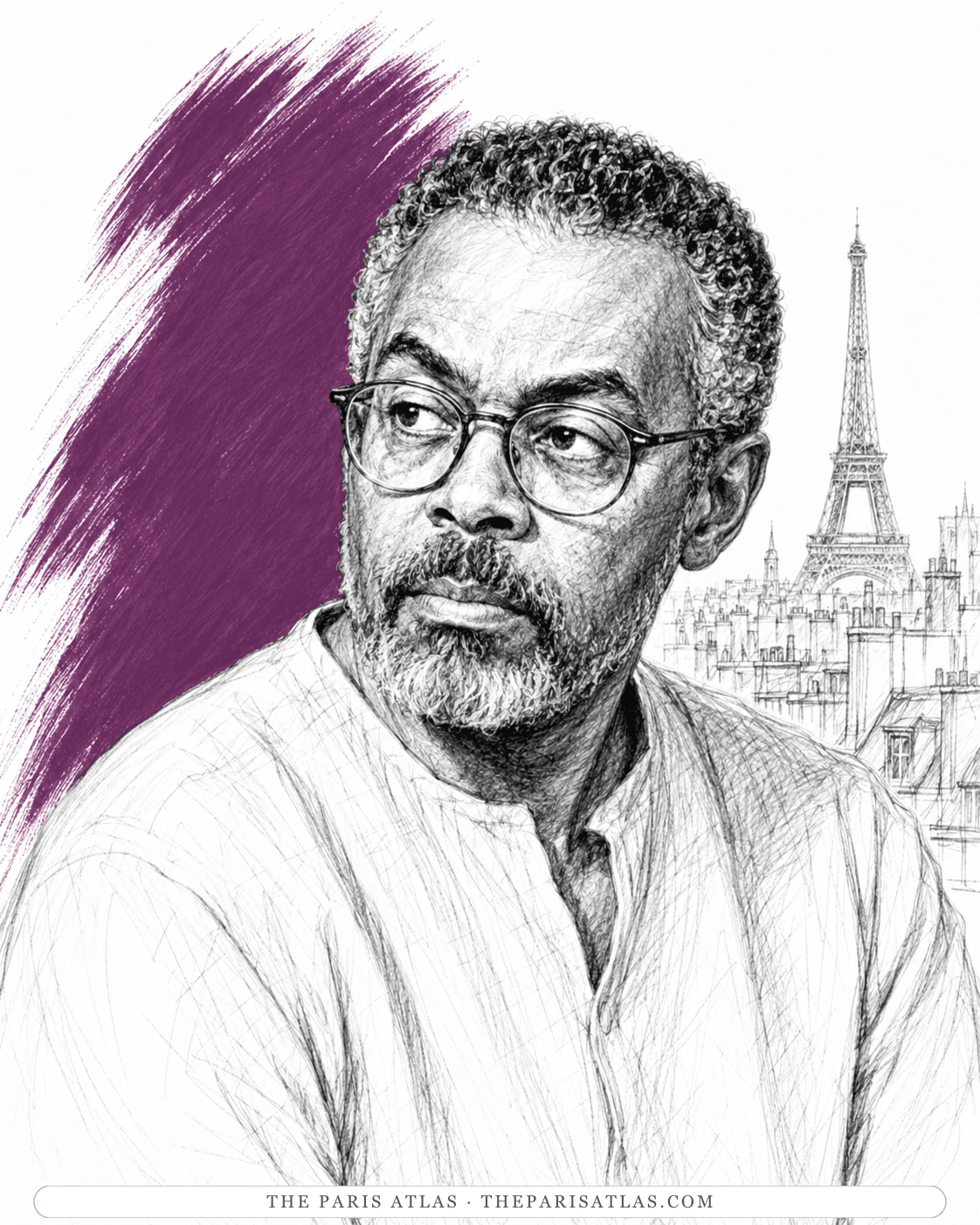
Baraka delivered one of the principal eulogies at Baldwin's funeral at the Cathedral of St. John the Divine in 1987, alongside Maya Angelou. The footage documents the eulogy; the friendship it implies belongs to Baldwin's later political period and is not itself stated by the source.

James Baldwin Funeral Service – Cathedral of St. John the Divine; Comrades in the Struggle

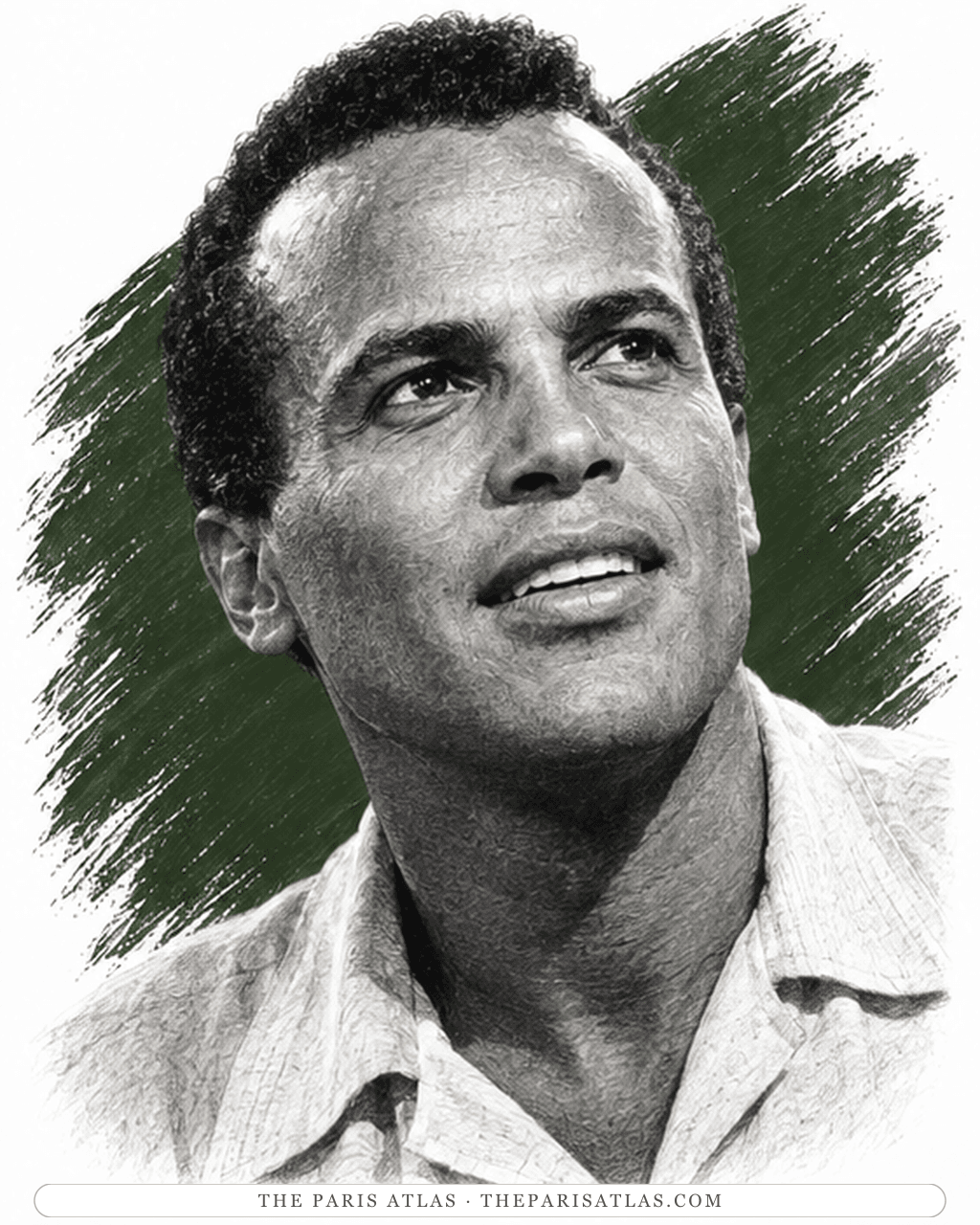
Illustrated portrait of Harry Belafonte

Harry Belafonte

  • Singer
  • Actor

Met · 1963

Belafonte was in the delegation Baldwin assembled to confront Attorney General Robert Kennedy on 24 May 1963 at Kennedy's Manhattan apartment, alongside Lena Horne, Lorraine Hansberry, and the CORE activist Jerome Smith. The meeting turned antagonistic and reached no consensus.

Nicholas Boggs, What Really Happened Inside That Meeting Between James Baldwin and RFK (2025)

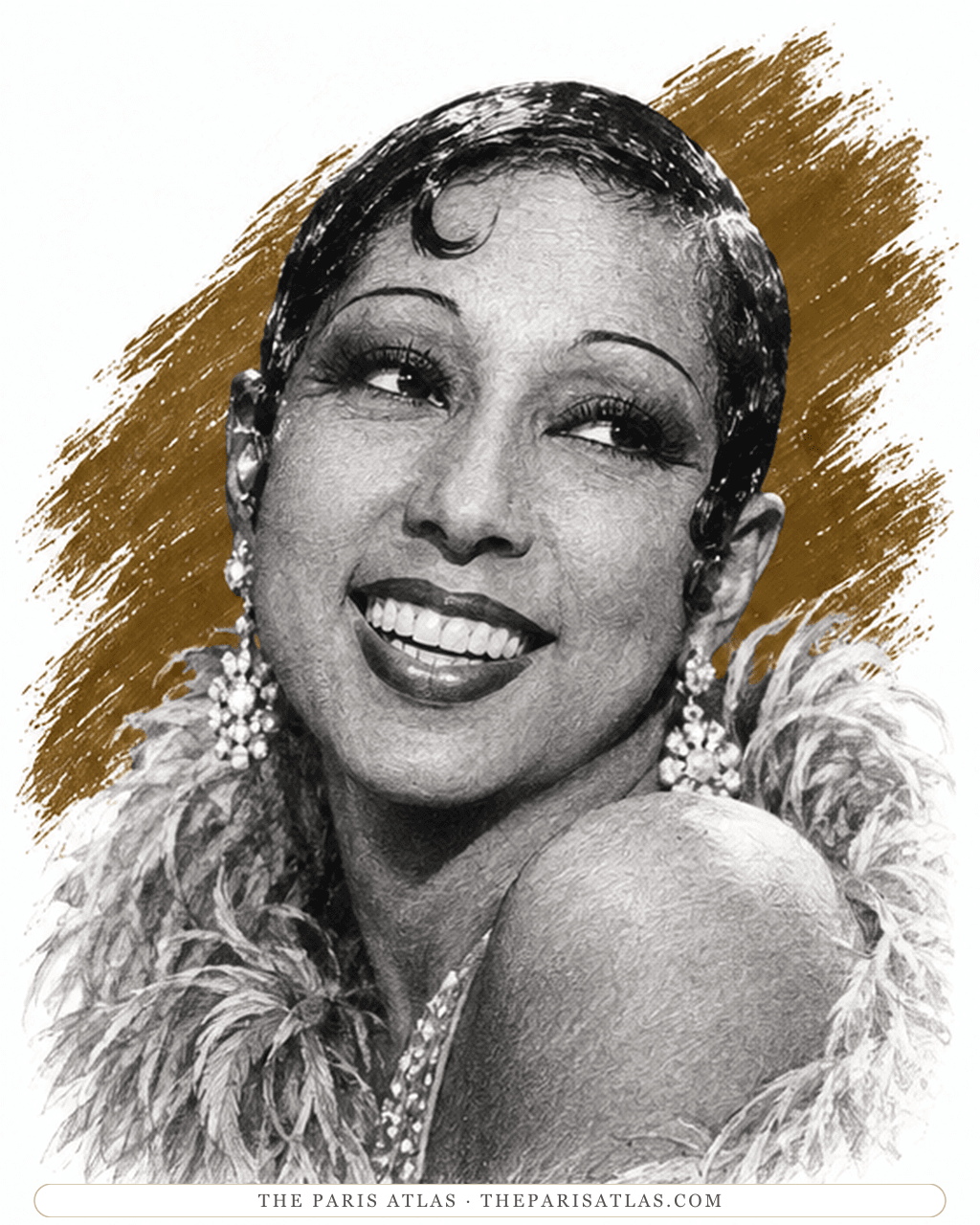
Illustrated portrait of Josephine Baker

Josephine Baker

  • Dancer
  • Singer
  • Actor

Met · 1973

In the summer of 1973 the 22-year-old Henry Louis Gates Jr., on assignment for Time, brought the two expatriates together for a dinner that ran from Baker's favorite Monte Carlo restaurant to the long table at Baldwin's house in Saint-Paul-de-Vence. Time declined the resulting piece, judging both of them passé.

Harmony Holiday, A Dinner in France, 1973: Josephine Baker, James Baldwin, and a Very Young Henry Louis Gates, Jr. (2021)

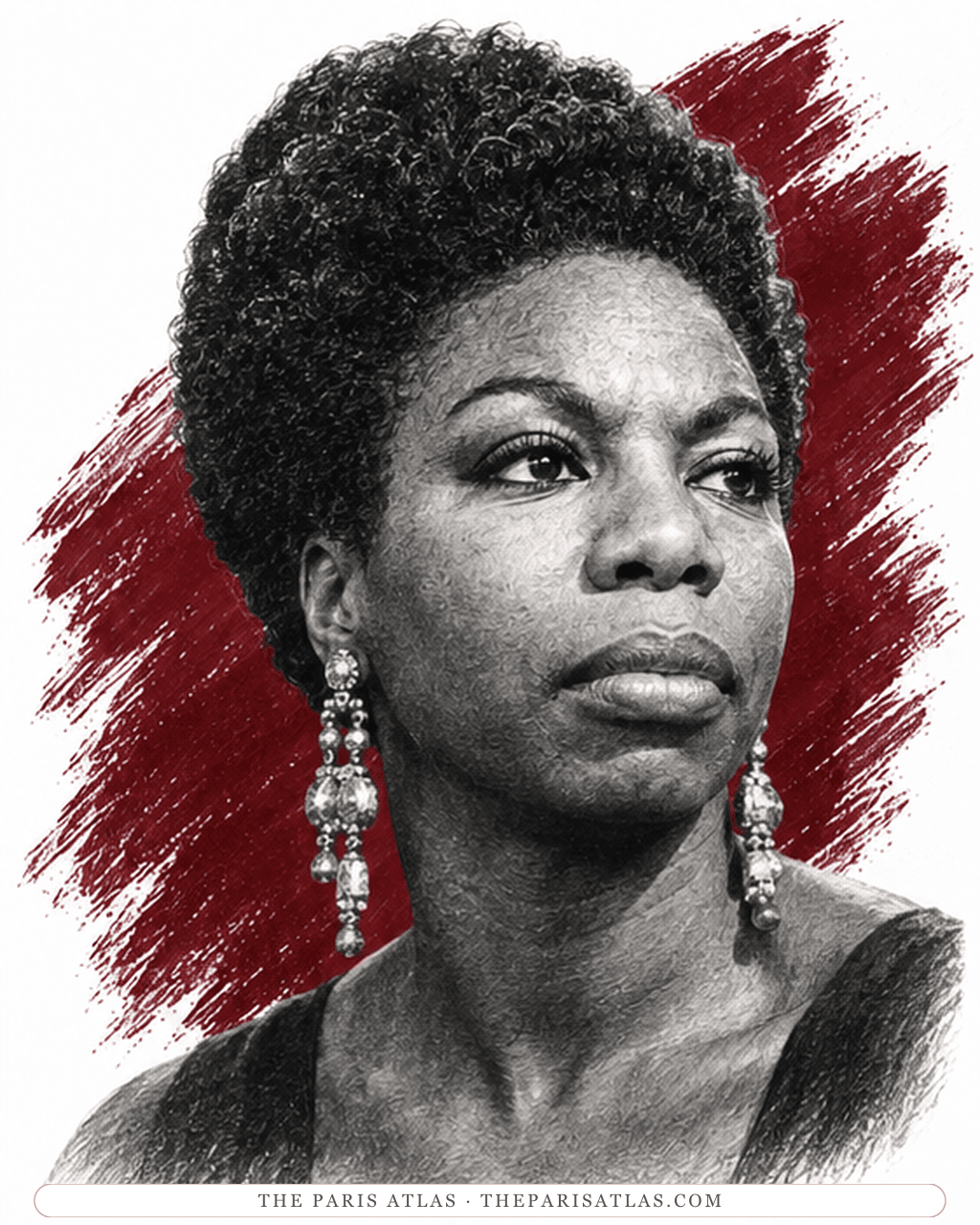
Illustrated portrait of Nina Simone

Nina Simone

  • Singer
  • Musician

Met

Baldwin was among the socially engaged writers — with Lorraine Hansberry and Langston Hughes — whom Simone credited with her political education in the 1960s, the friends of the Black intelligentsia behind her turn to protest songwriting.

Malik Gaines, Young, Gifted, and Black: On the Politicization of Nina Simone (Black Performance on the Outskirts of the Left) (2017)

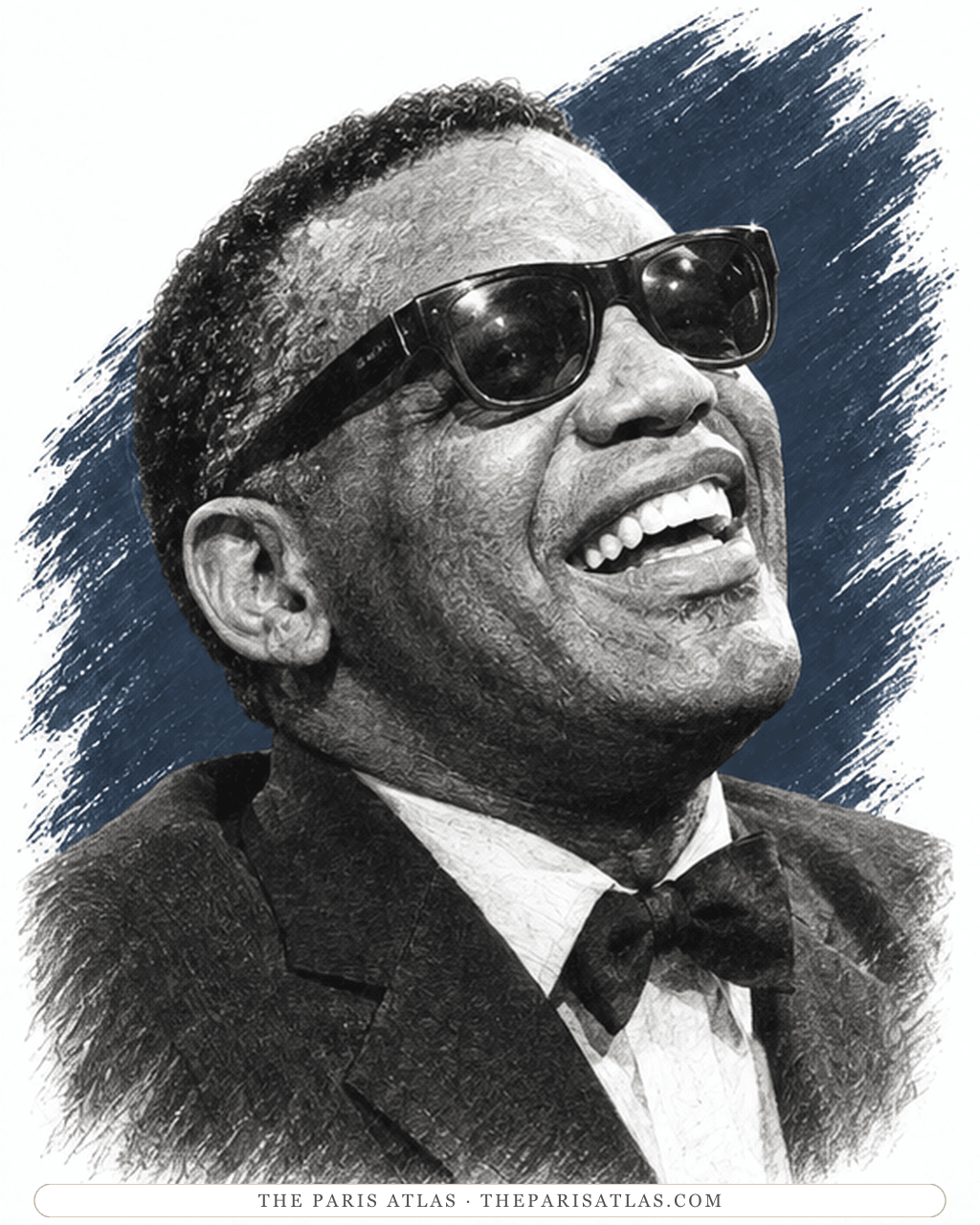
Illustrated portrait of Ray Charles

Ray Charles

  • Singer
  • Musician

Collaborated with · 1973

The Hallelujah Chorus — written, produced, and narrated by Baldwin around Charles's music, with Cicely Tyson performing — played two shows at Carnegie Hall on 1 July 1973. Baldwin's interludes drew on Sonny's Blues; the script resurfaced in an archive four decades later.

Ed Pavlić, “But Amen is the Price”: James Baldwin and Ray Charles in “The Hallelujah Chorus” (2015)

Illustrated portrait of Countee Cullen

Countee Cullen

  • Poet
  • Author
  • Editor
  • +1

Mentored by · 1938–1940

At Frederick Douglass Junior High School, Cullen taught French and encouraged the young Baldwin's interest in writing alongside teacher Herman W. Porter.

This Day in History: James Baldwin (2017)

Who drew from them

Influence running outward — the writers and artists who built on their work.

Illustrated portrait of Miles Davis

Miles Davis

The books came before the friendship. Davis wrote that he had read Baldwin and respected what he had to say, and that the two of them opened up to each other once he knew the man behind them.

Miles Davis with Quincy Troupe, Miles: The Autobiography (1989)

Books by James Baldwin

Cover of Giovanni's Room by James Baldwin

Modernist fiction

An American in Paris, engaged to one person and in love with another, in Baldwin's shortest novel.

4.6
Cover of Nobody Knows My Name by James Baldwin

Essays & criticism

Thirteen essays from the years Baldwin came home: Harlem, the segregated South, a writers' congress at the Sorbonne, and the end of his friendship with Richard Wright.

4.4
Cover of Another Country by James Baldwin

Modernist fiction

A jazz drummer dies in the first act, and the friends he leaves spend four hundred pages failing to explain it.

4.3
Cover of The Fire Next Time by James Baldwin

Essays & criticism

Two letters written for the centenary of emancipation: one to a fifteen-year-old nephew, one about the night Baldwin had dinner with Elijah Muhammad.

4.9
Cover of Blues for Mister Charlie by James Baldwin

Drama

James Baldwin's play about the murder of a young Black man in a Southern town and the all-white jury that lets his killer go, written after Emmett Till and dedicated to Medgar Evers.

4.3
Cover of Nothing Personal by James Baldwin, Richard Avedon

Essays & criticism

James Baldwin and the photographer Richard Avedon had been at the same Bronx high school. Thirty years later they made a book about what America looked like in 1964.

4.1
Cover of Going to Meet the Man by James Baldwin

Short stories

The only book of stories he wrote, containing "Sonny's Blues" and, at the end, a title story told from inside a white deputy's head.

4.6
Cover of The Amen Corner by James Baldwin

Drama

James Baldwin's first play: a woman pastors a Harlem storefront church, and then the husband she has told the congregation nothing about walks in.

4.2
Cover of No Name in the Street by James Baldwin

Essays & criticism

The book Baldwin wrote after the funerals: Medgar Evers, Malcolm X, Martin Luther King, and a friend he could not get out of jail.

4.2
Cover of One Day When I Was Lost by James Baldwin

Drama

The Malcolm X film Columbia Pictures hired James Baldwin to write and never made. He published the screenplay as a book instead.

3.8
Cover of A Dialogue by James Baldwin, Nikki Giovanni

Essays & criticism

James Baldwin was forty-seven, Nikki Giovanni twenty-eight. A London television studio, one evening in November 1971, and neither of them willing to let the other off easily.

4.0
Cover of The Devil Finds Work by James Baldwin

Essays & criticism

Baldwin on the movies he grew up on, beginning with the film he was taken to at seven and ending with The Exorcist.

4.5
Cover of Little Man, Little Man by James Baldwin

Children's books

James Baldwin's only children's book: a four-year-old named TJ on a Harlem block, written for his nephew and illustrated by a French painter he had known since 1959.

4.0
Cover of Just Above My Head by James Baldwin

Modernist fiction

A gospel singer is dead in a London basement, and his brother spends six hundred pages telling you who he was.

4.1
Cover of Jimmy's Blues by James Baldwin

Poetry

The only book of poems James Baldwin published, brought out in London in 1983 when he was fifty-nine and almost nobody knew he wrote them.

3.9
Cover of The Evidence of Things Not Seen by James Baldwin

Essays & criticism

Baldwin goes to Atlanta to report on the murders of twenty-eight Black people, most of them children, and comes back unconvinced by the conviction.

4.0
Cover of The Price of the Ticket by James Baldwin

Essays & criticism

Thirty-seven years of essays in one volume, assembled by Baldwin two years before he died — the single book to own if you are only owning one.

4.7
Cover of Native Sons by James Baldwin, Sol Stein

Essays & criticism

James Baldwin and Sol Stein were classmates at DeWitt Clinton High School in the Bronx. Fifty years later Stein opened the file drawer that held their letters.

3.8
Cover of The Cross of Redemption by James Baldwin

Essays & criticism

Everything James Baldwin published and never put in a book, gathered twenty-three years after he died: reviews from his early twenties, speeches, open letters, and one short story.

4.0

James Baldwin’s Places

The cataloged places connected to James Baldwin — through the books, and through the documented record.

Places you can enter today appear first, followed by addresses to see from outside and sites that have vanished.

The Café de Flore today, white awning and red seats behind the terrace planters

Café · Saint-Germain-des-Prés

Open — go in

Café de Flore

Baldwin's Paris rooms were unheated and the cafés were not, which is the plain reason he worked in them, and the Flore is the one his early Paris years are most consistently attached to. The City of Paris's account of those years places his meetings with Simone de Beauvoir and Jean-Paul Sartre here, and a popular account has Go Tell It on the Mountain taking shape at its tables.

Visit the place
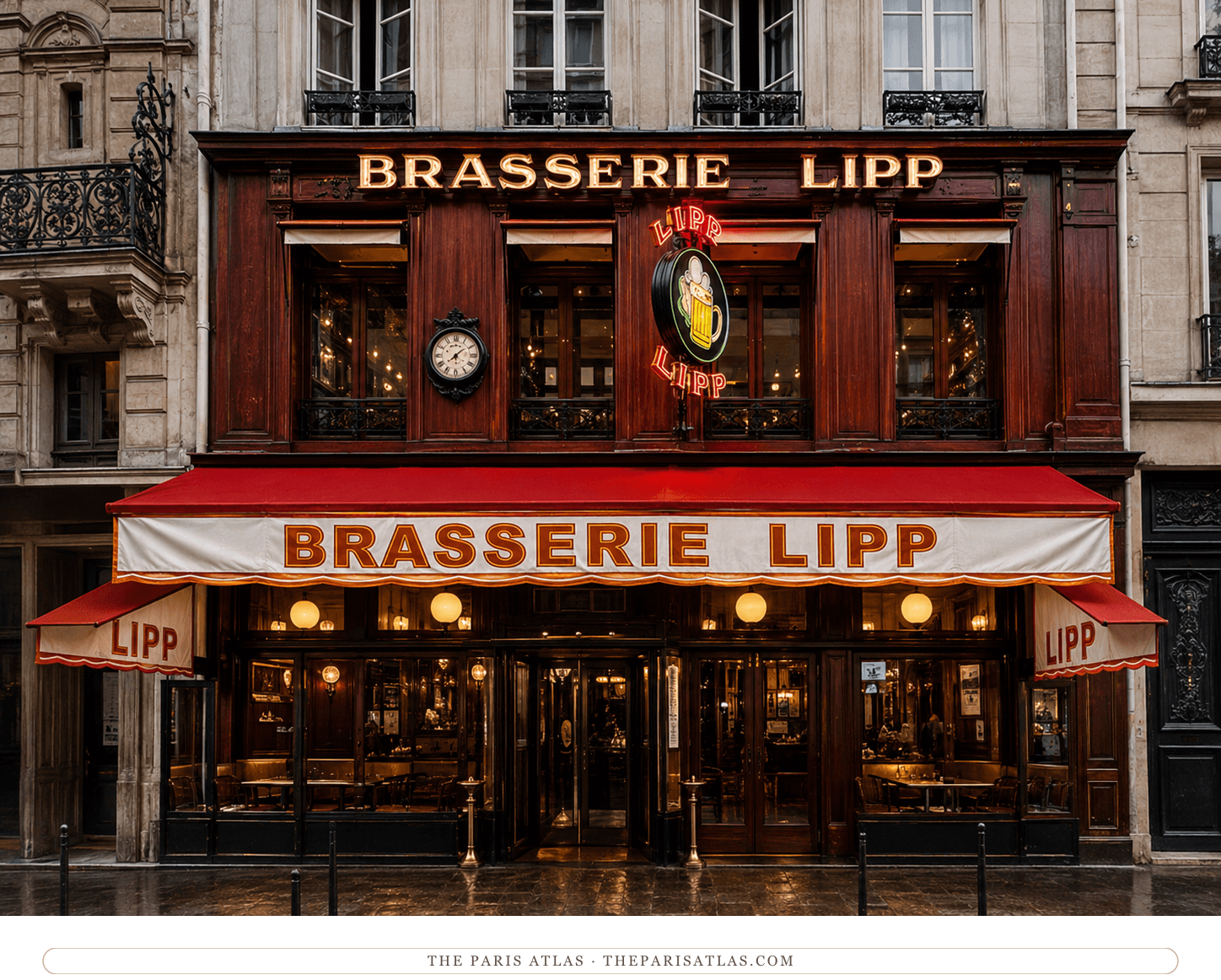
Brasserie Lipp today, red awning lit at dusk with the neon LIPP sign above the door

Restaurant · Saint-Germain-des-Prés

Open — go in

Brasserie Lipp

Held at probable as a habit: France Revisited has Baldwin stopping in occasionally rather than as a regular, usually before eating somewhere cheaper. That he was in the room at all is documented — he put himself there in "Alas, Poor Richard", walking in on the day Zero published "Everybody's Protest Novel" and finding Richard Wright waiting.

Visit the place
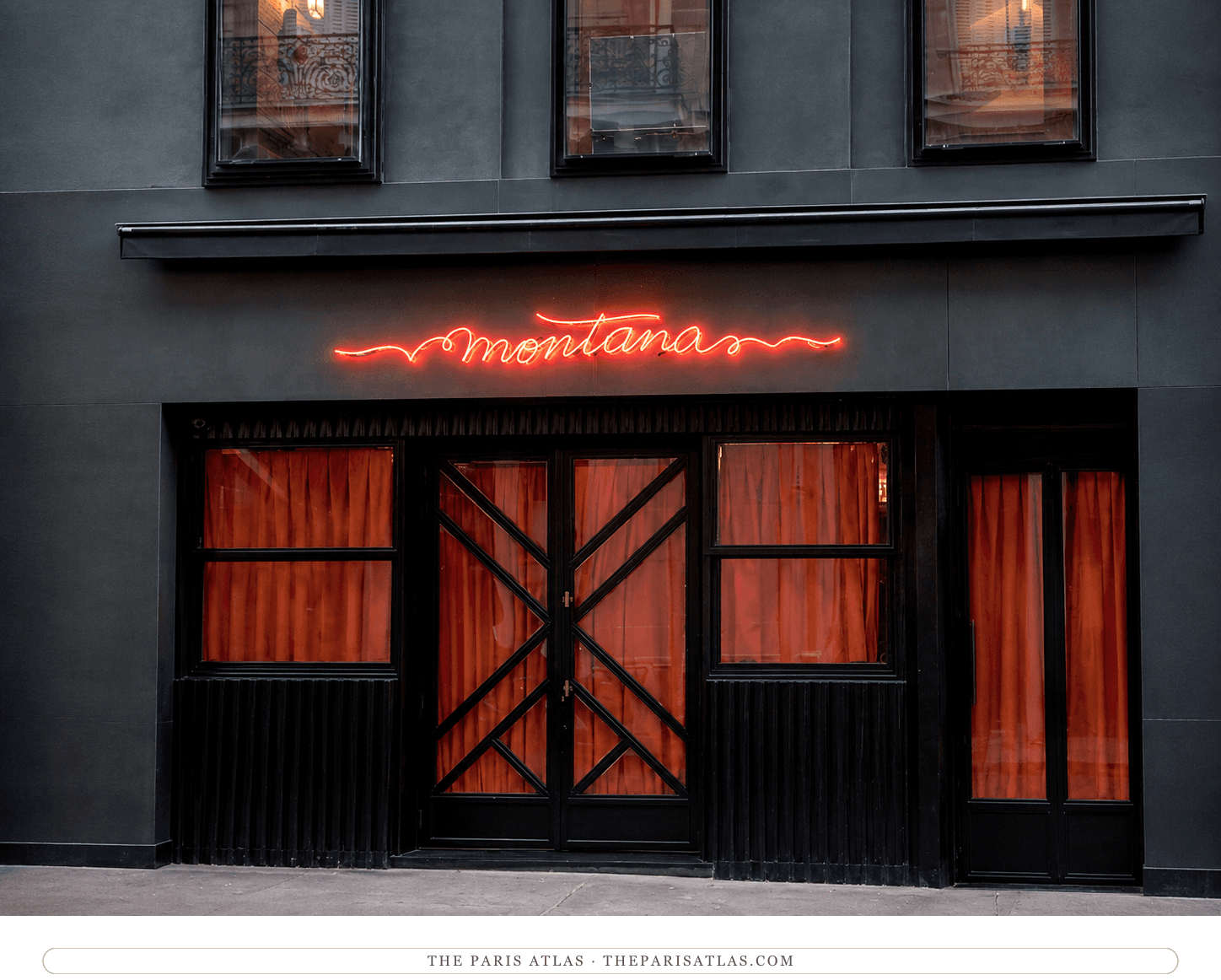
The Montana today, dark grey façade with a red cursive neon sign and red curtains behind black window frames

Nightclub · Saint-Germain-des-Prés

Open — go in

Le Montana

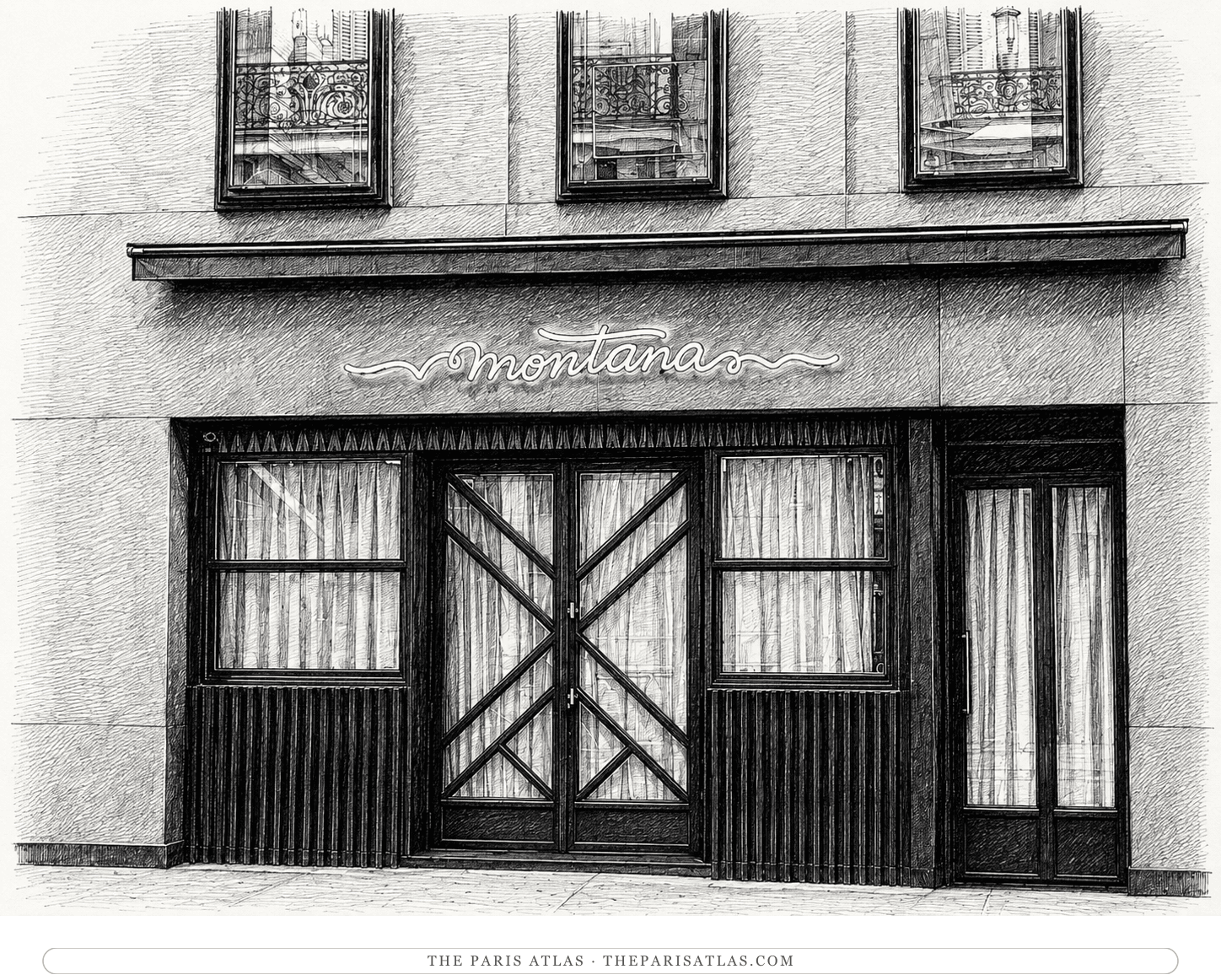
The City of Paris names Le Montana among the gay clubs Baldwin frequented in his early Paris years, alongside L'Abbaye and La Reine Blanche. Of the group, the Montana is the only address where a successor venue still trades under the name.

Visit the place
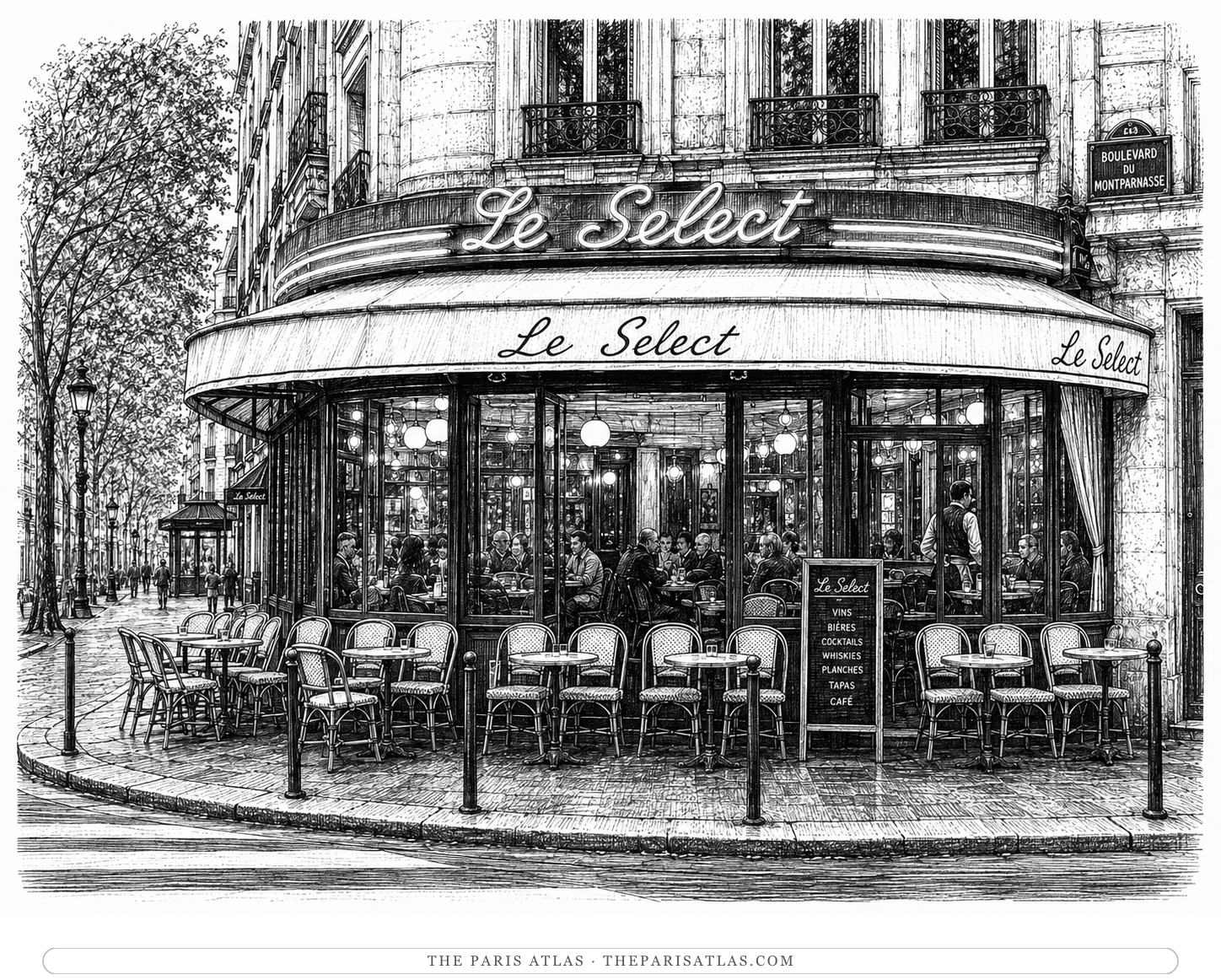
Le Select at dusk, its name in lights above the awning and the terrace chairs lined up under a warm glow

Café · Montparnasse

Open — go in

Le Select

Held at probable: a secondary account in Bonjour Paris has Baldwin at work on Giovanni's Room at the Select, his one recorded tie to Montparnasse café life. The actor and Baldwin scholar Charles Reese says the same, that the Select is where Baldwin finished the novel. Neither account rests on a letter, a diary entry, an interview, or a page, and a check of the searchable Leeming biography in August 2026 found no Select reference. A better source would replace this one; until one appears the site does not state it as fact.

Visit the place
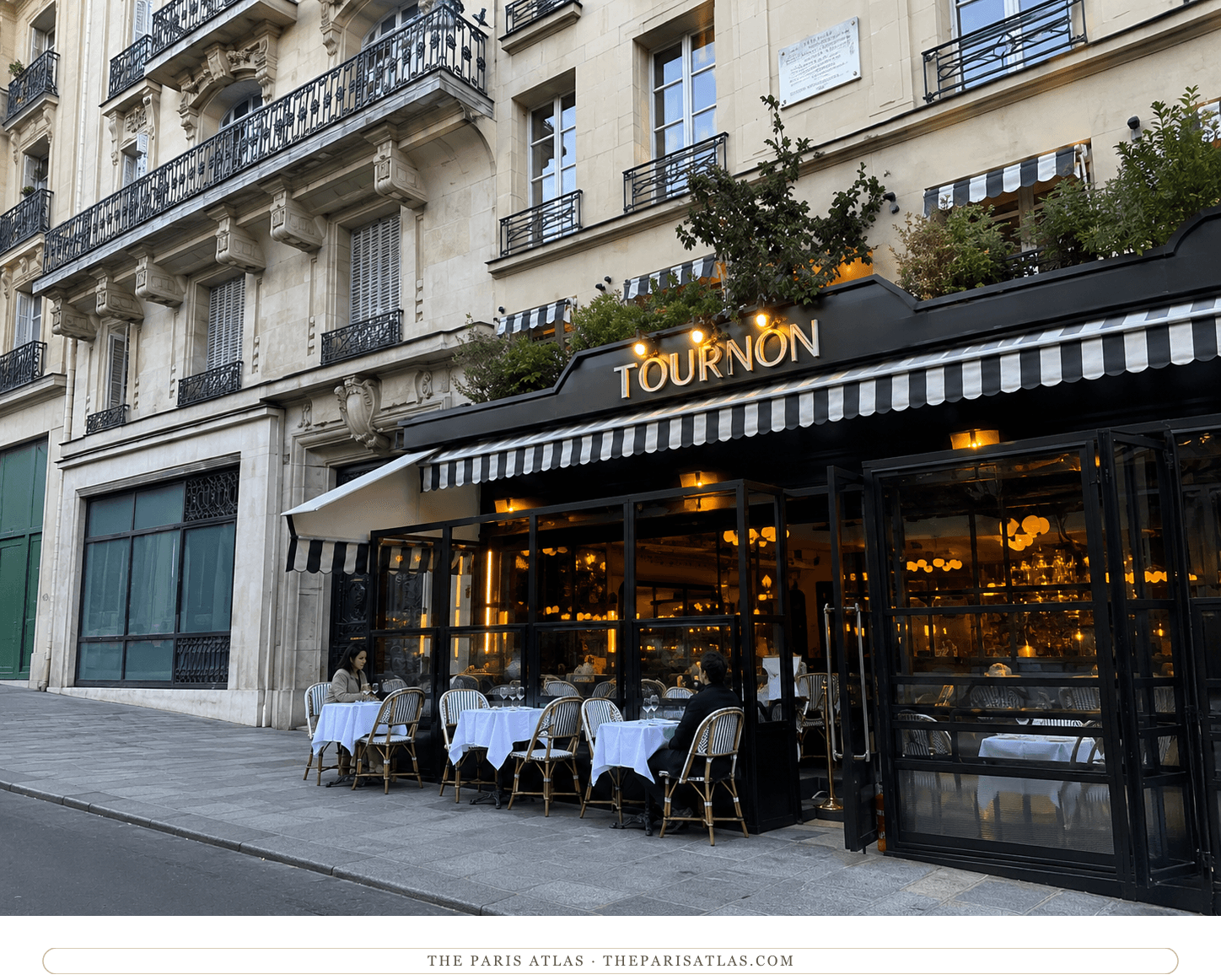
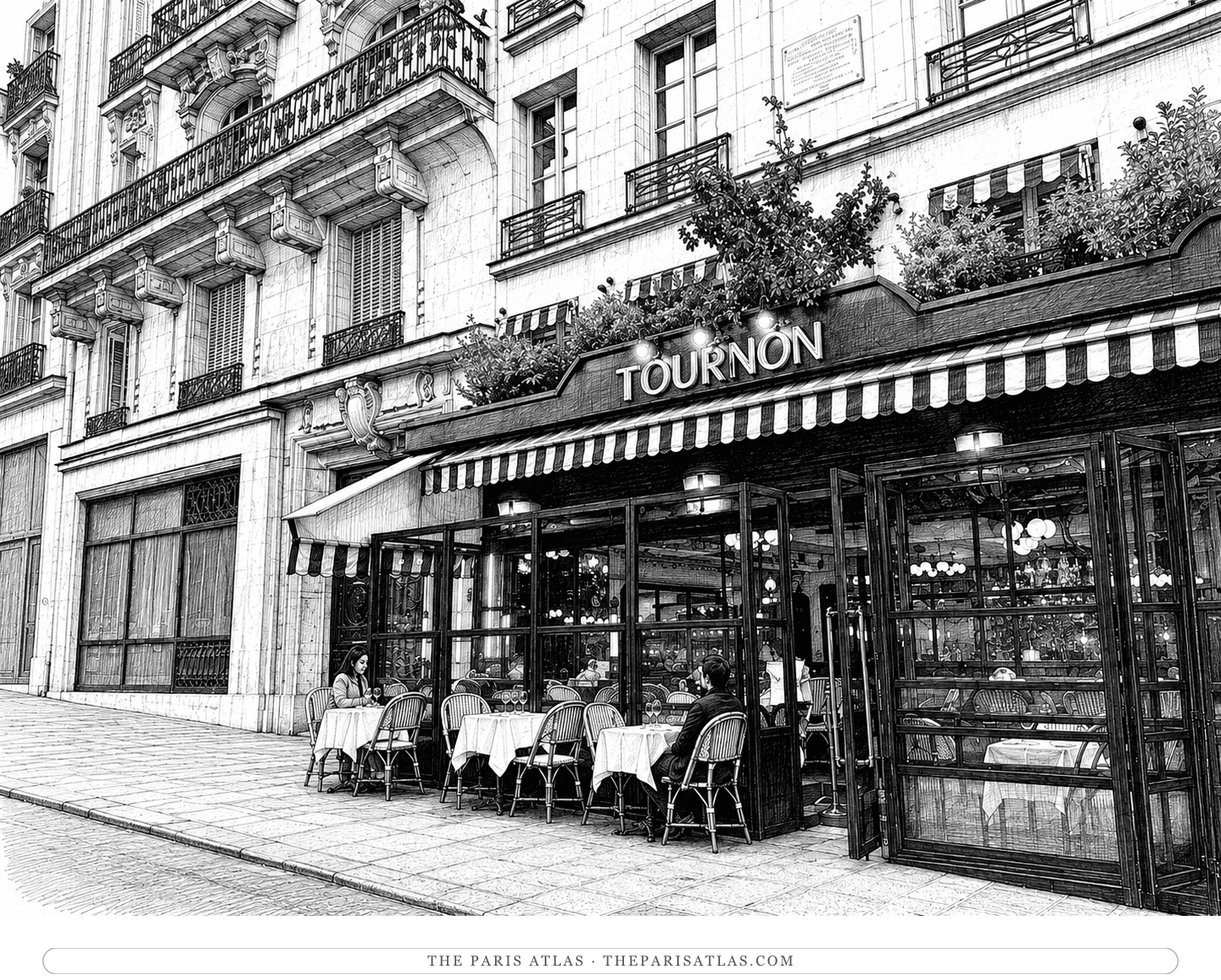
Le Tournon today, black and white striped awning over terrace tables, warmly lit dining room behind the glass

Café · Odéon

Open — go in

Le Tournon

The City of Paris names Le Tournon among Baldwin's favorite cafés. The room was also the daily headquarters of the Black American writers around Richard Wright in the early 1950s, which made it complicated ground for Baldwin after their public break.

Visit the place
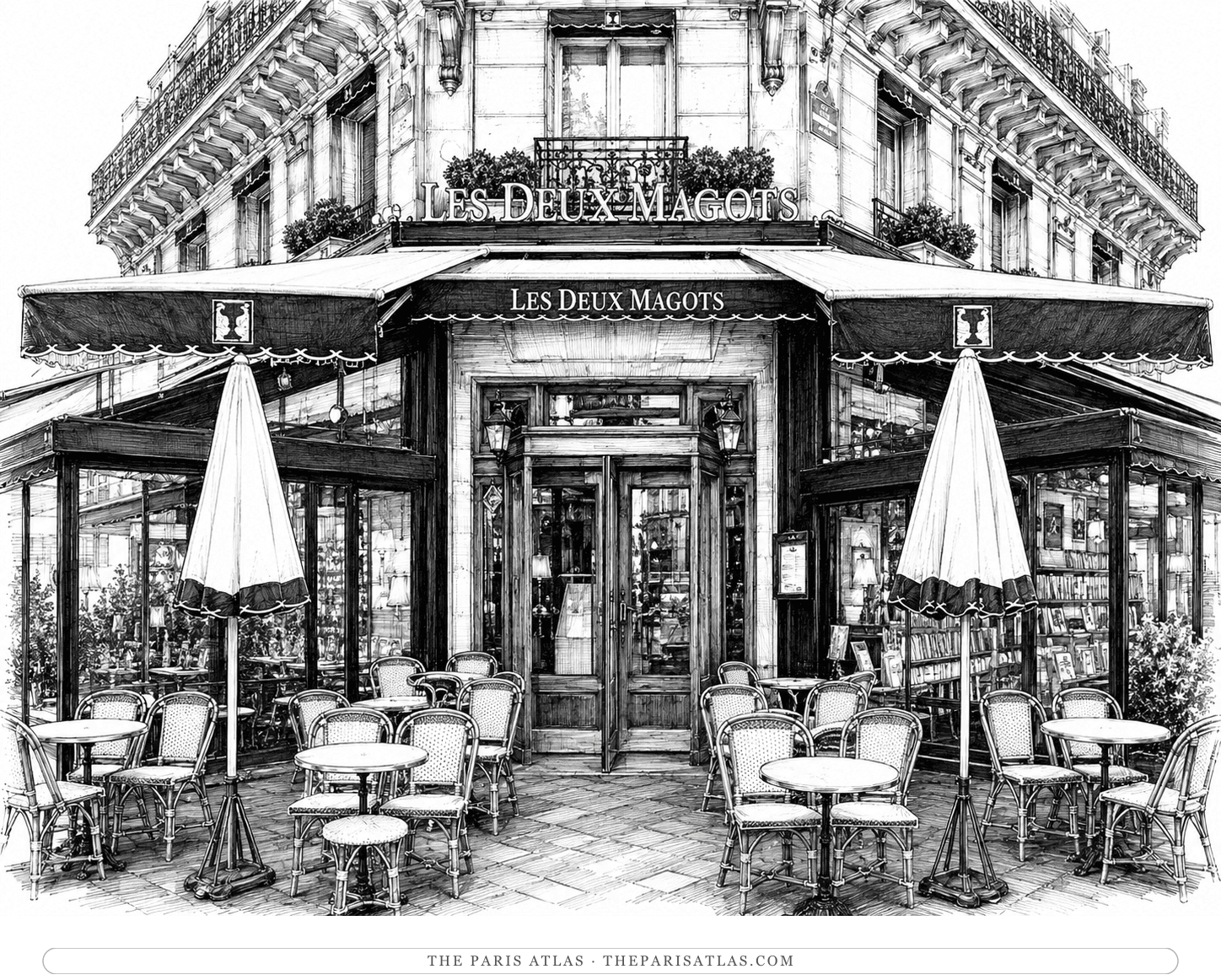
Les Deux Magots today, green and white awnings and rattan café chairs facing the church

Café · Saint-Germain-des-Prés

Open — go in

Les Deux Magots

The City of Paris names Les Deux Magots among Baldwin's favorite cafés, and accounts of his first day in Paris in November 1948 put him at this terrace being greeted by Richard Wright, who had helped him get there.

Visit the place
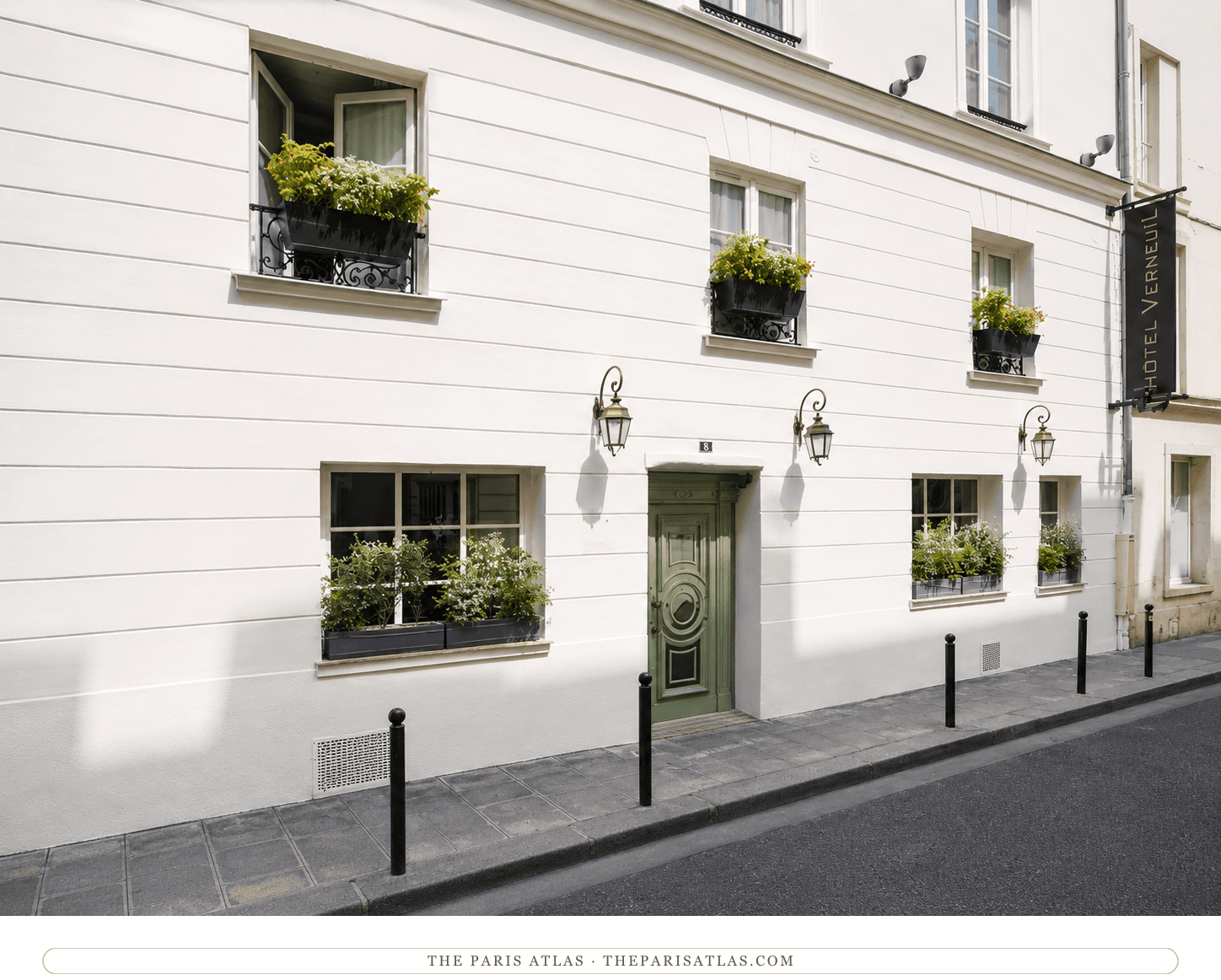
The Hôtel Verneuil today, white façade with a green front door, planted window boxes, and lanterns along the rue de Verneuil

Hotel · Saint-Germain-des-Prés

Open — go in

Hôtel Verneuil

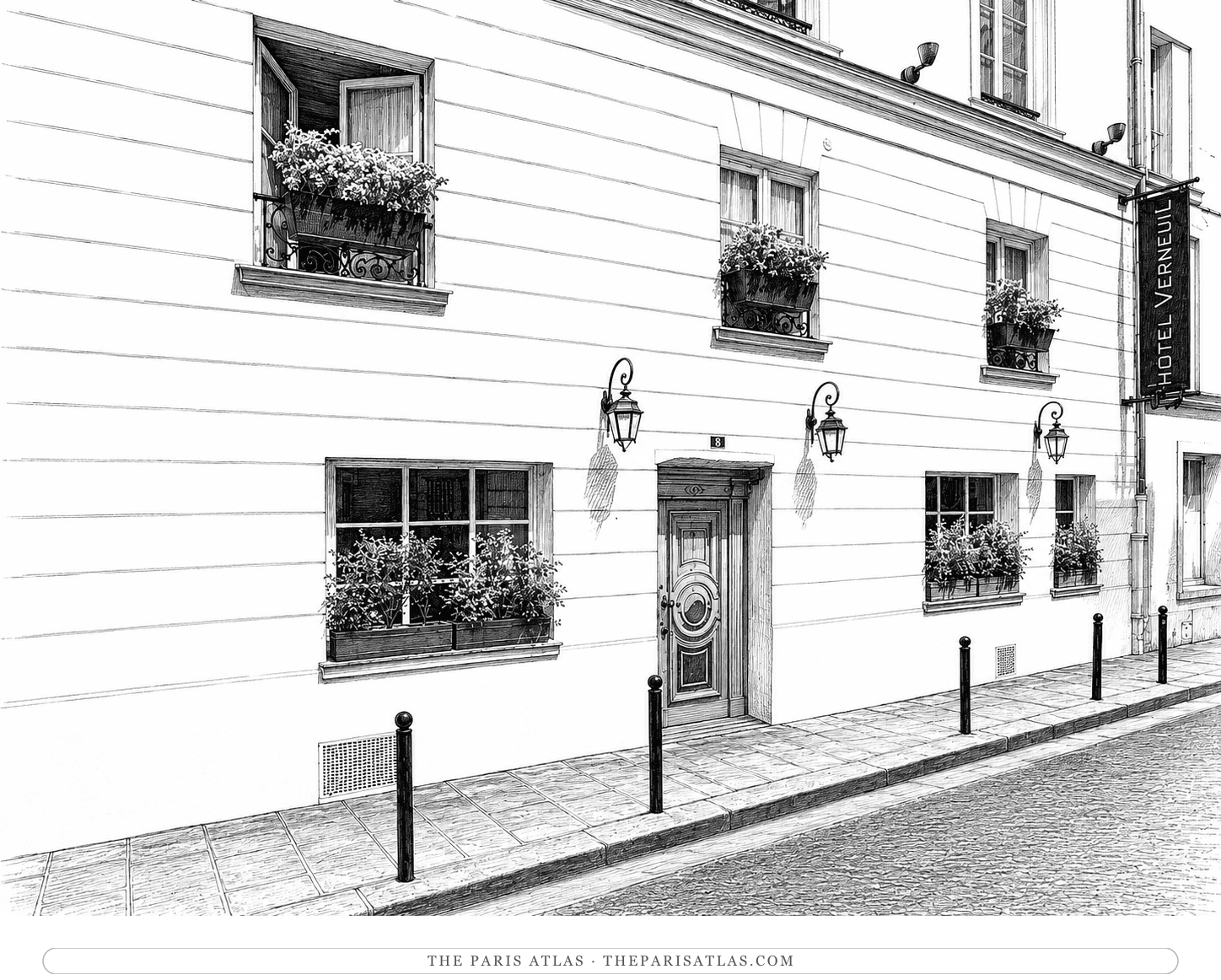
The City of Paris's account of Baldwin's Paris years has him settling durably at the hôtel de Verneuil after first nights in a cheap hotel on the rue du Dragon, and the hotel's own history counts him among its residents. These were his poorest years; the room went unheated and the writing happened in cafés.

Visit the place
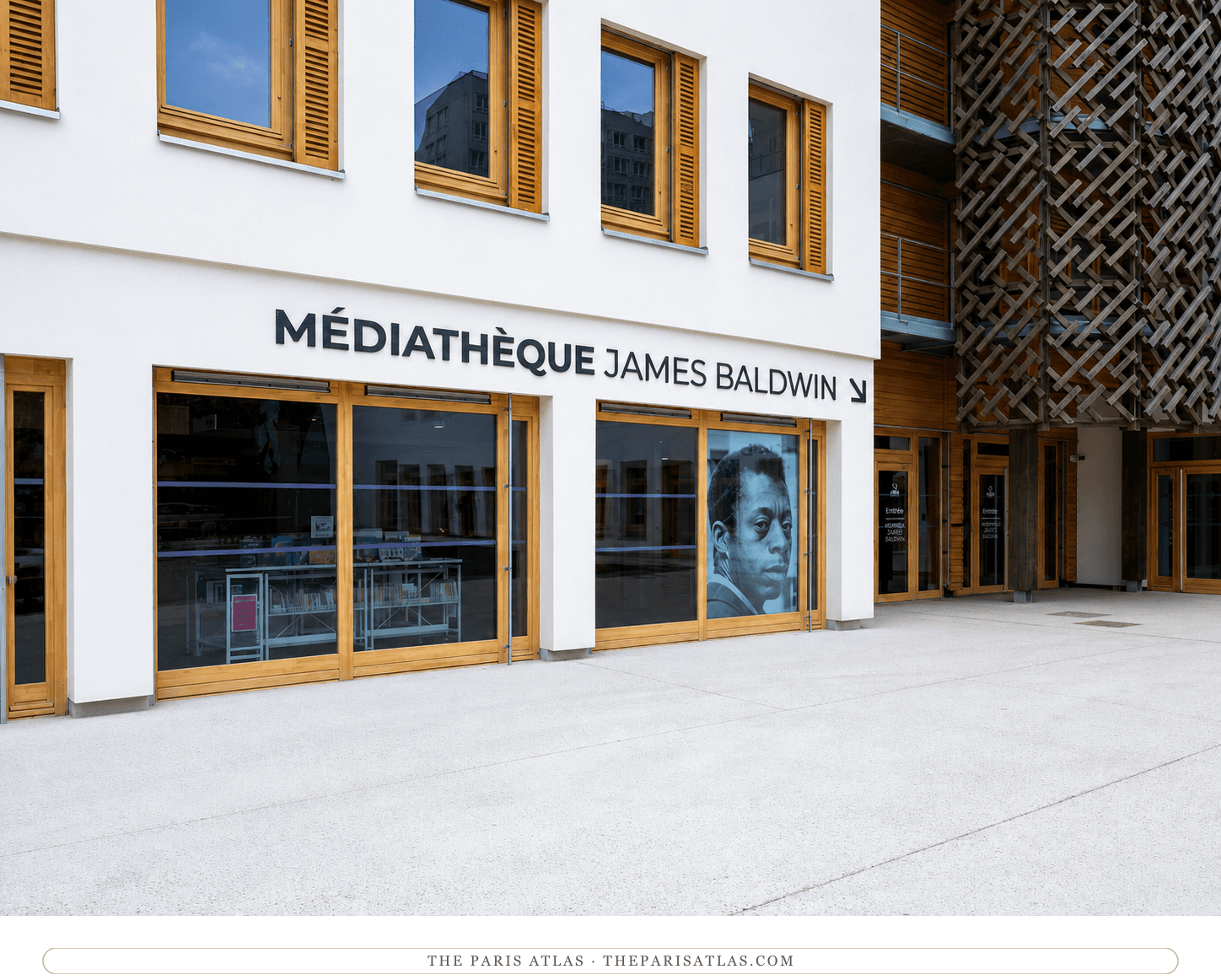
The Médiathèque James Baldwin today, white render and timber window frames with Baldwin's portrait in a glass bay and a woven timber screen on the neighbouring wing

Library · Place des Fêtes

Open — go in

Médiathèque James Baldwin

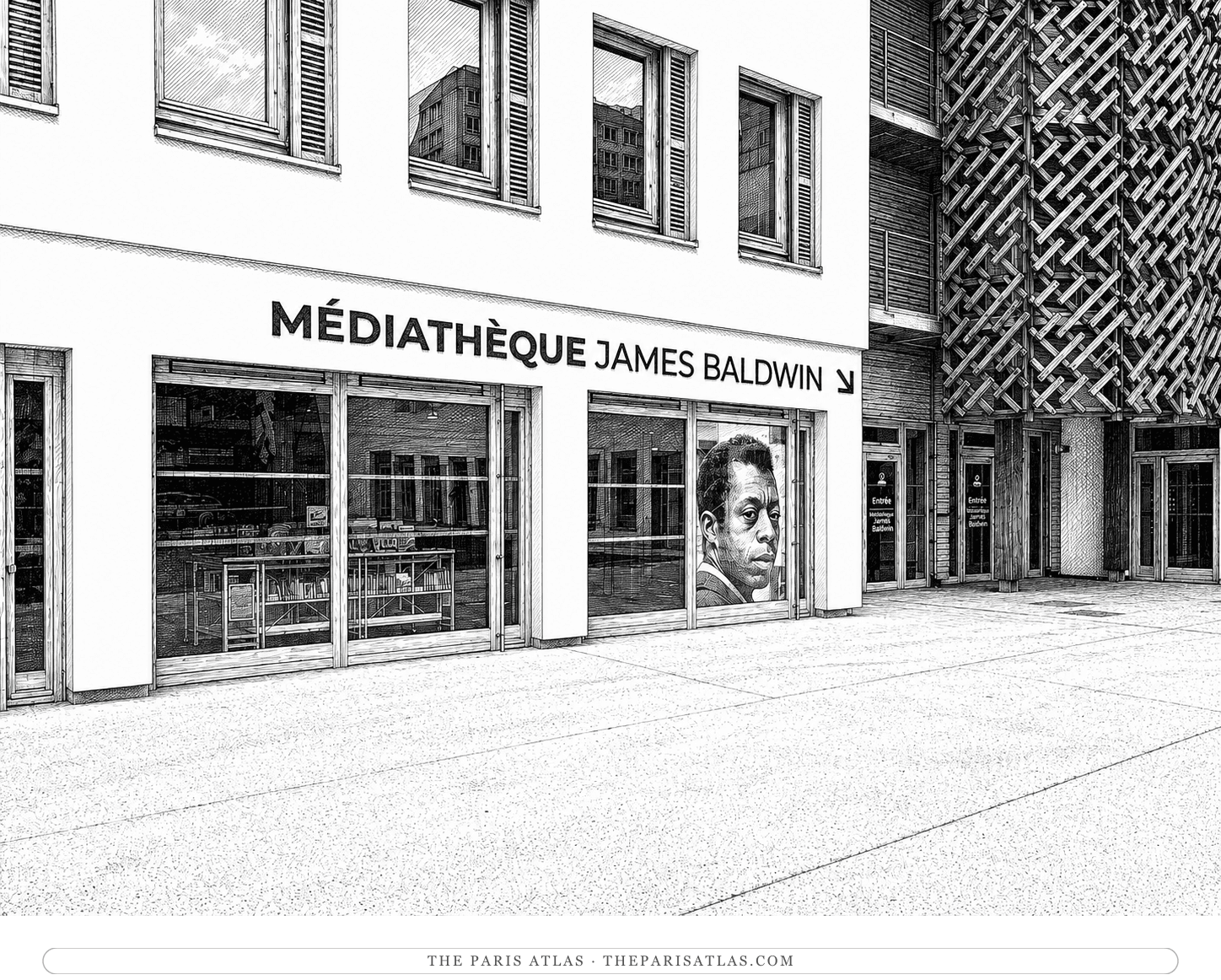
The City of Paris médiathèque at Place des Fêtes, opened 19 July 2024 in the former lycée Jean-Quarré, is named for Baldwin, with collections themed around exile and migration, LGBT culture, feminisms and ecology. It commemorates the writer thirty-seven years after his death; he never visited the site.

Visit the place
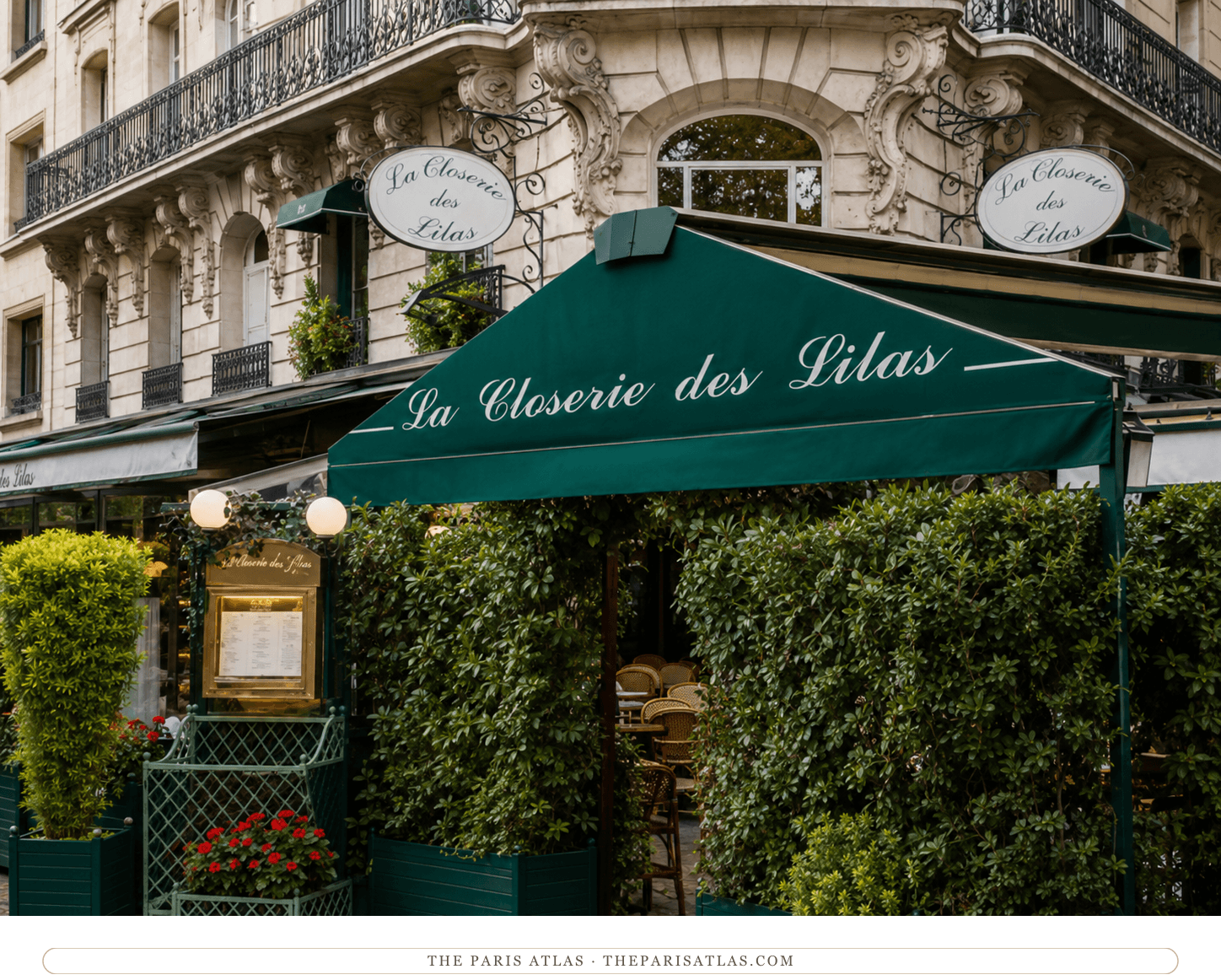
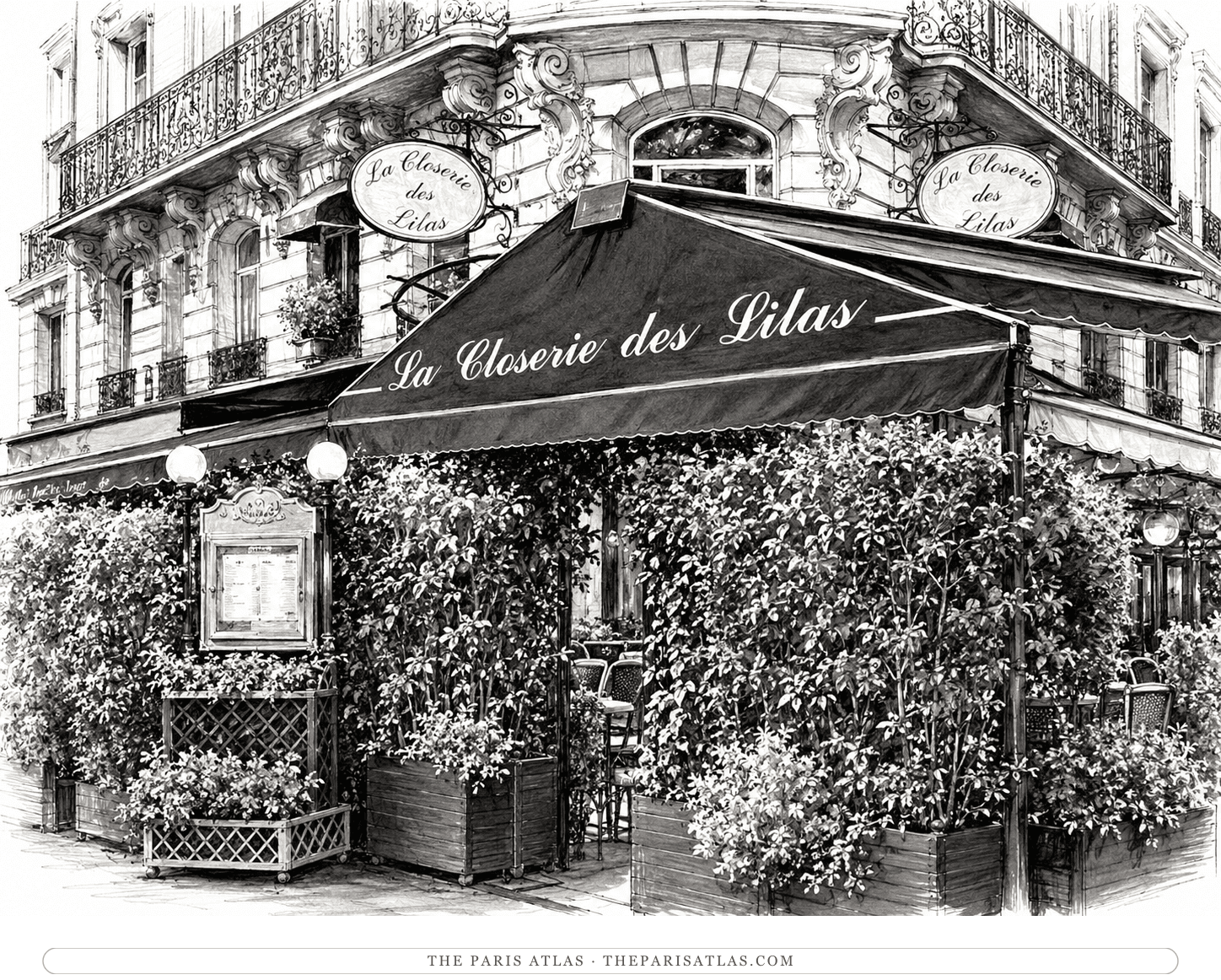
The terrace of La Closerie des Lilas today, its green awning and menu board framed by planters

Café · Montparnasse

Open — go in

La Closerie des Lilas

James Baldwin wrote about La Closerie des Lilas in Giovanni's Room.

Visit the place
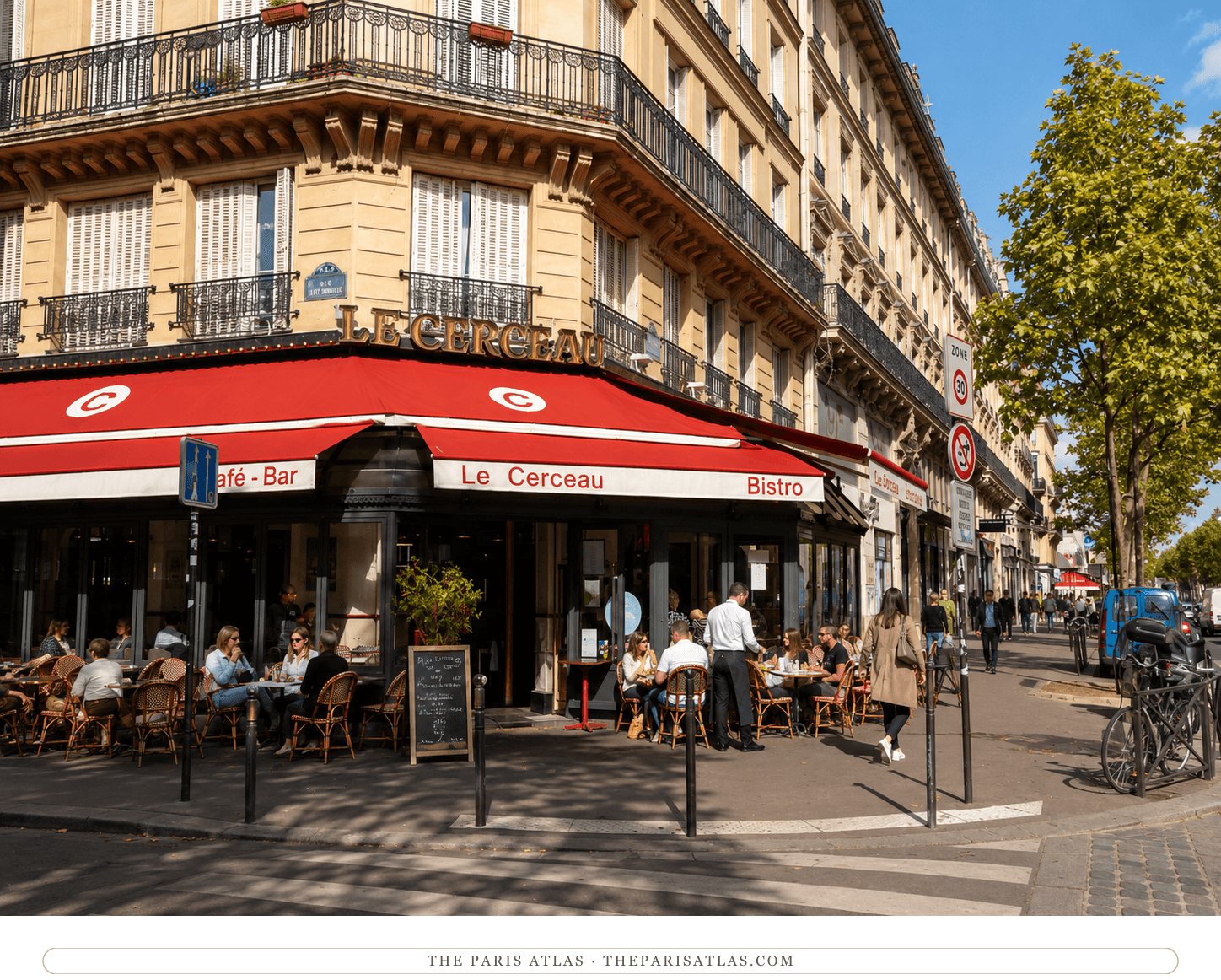
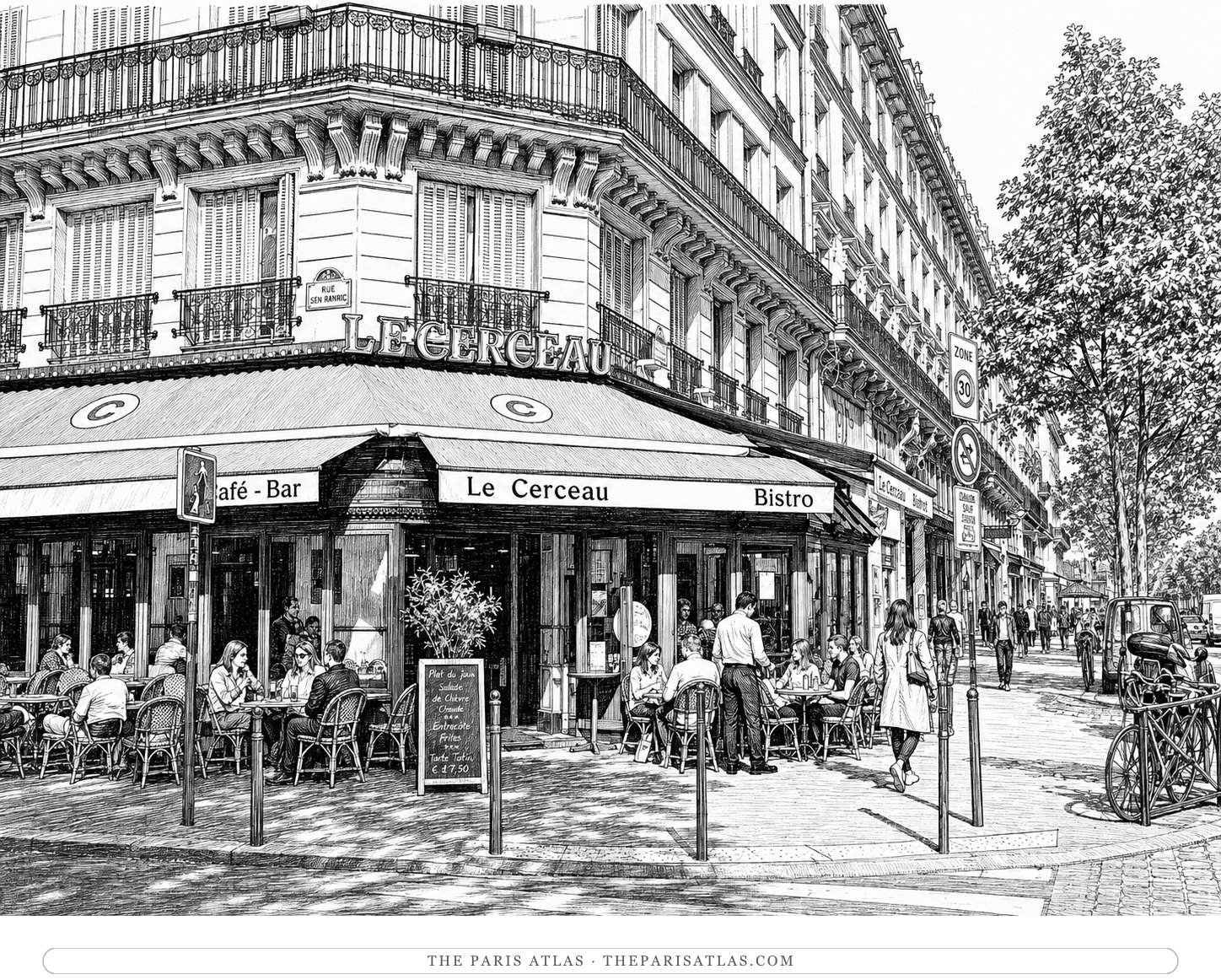
The same corner in colour, the awning red and gold, the terrace full in September sun

Street · Les Halles / Châtelet

Boulevard de Sébastopol

James Baldwin wrote about Boulevard de Sébastopol in Giovanni's Room.

Visit the place
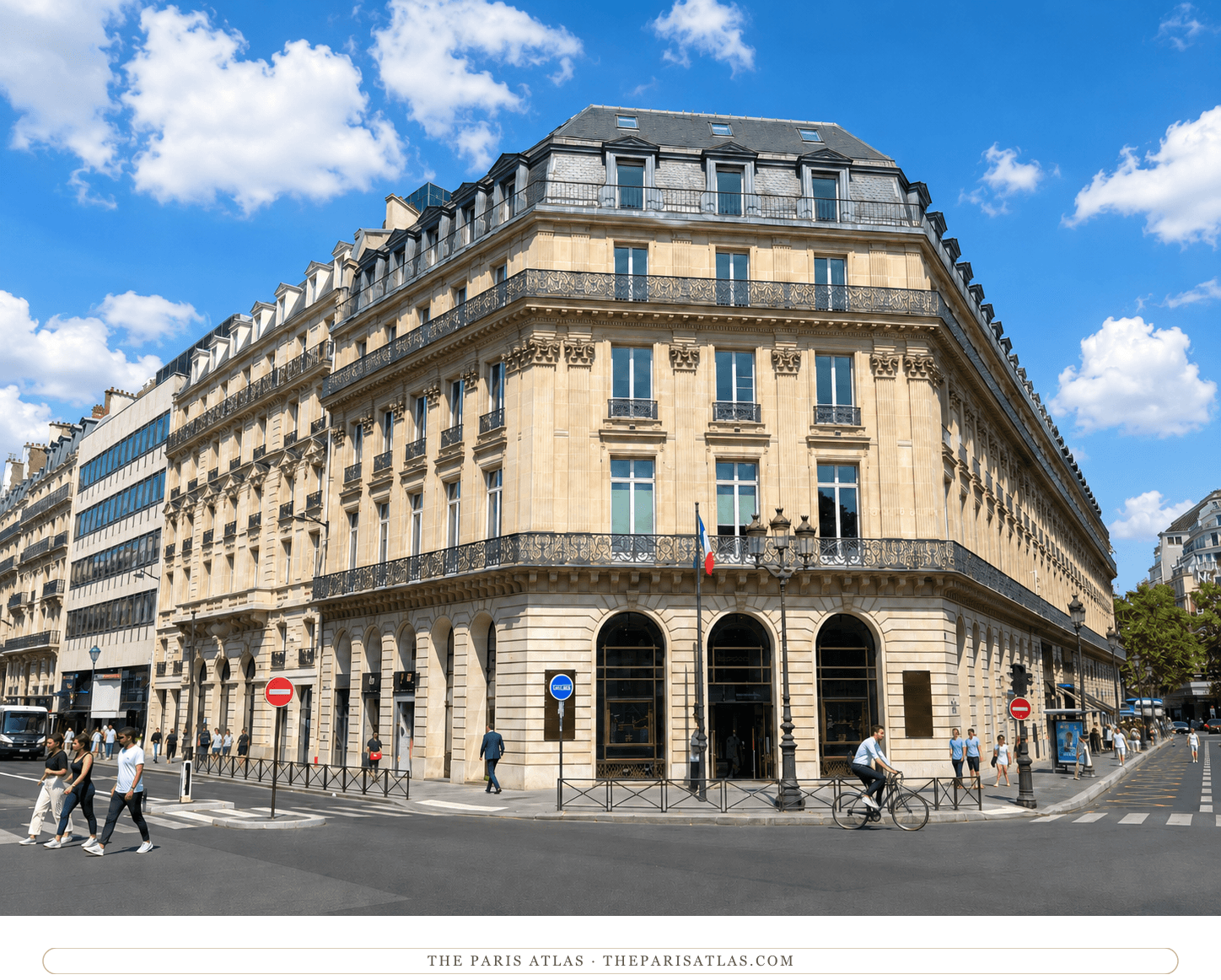
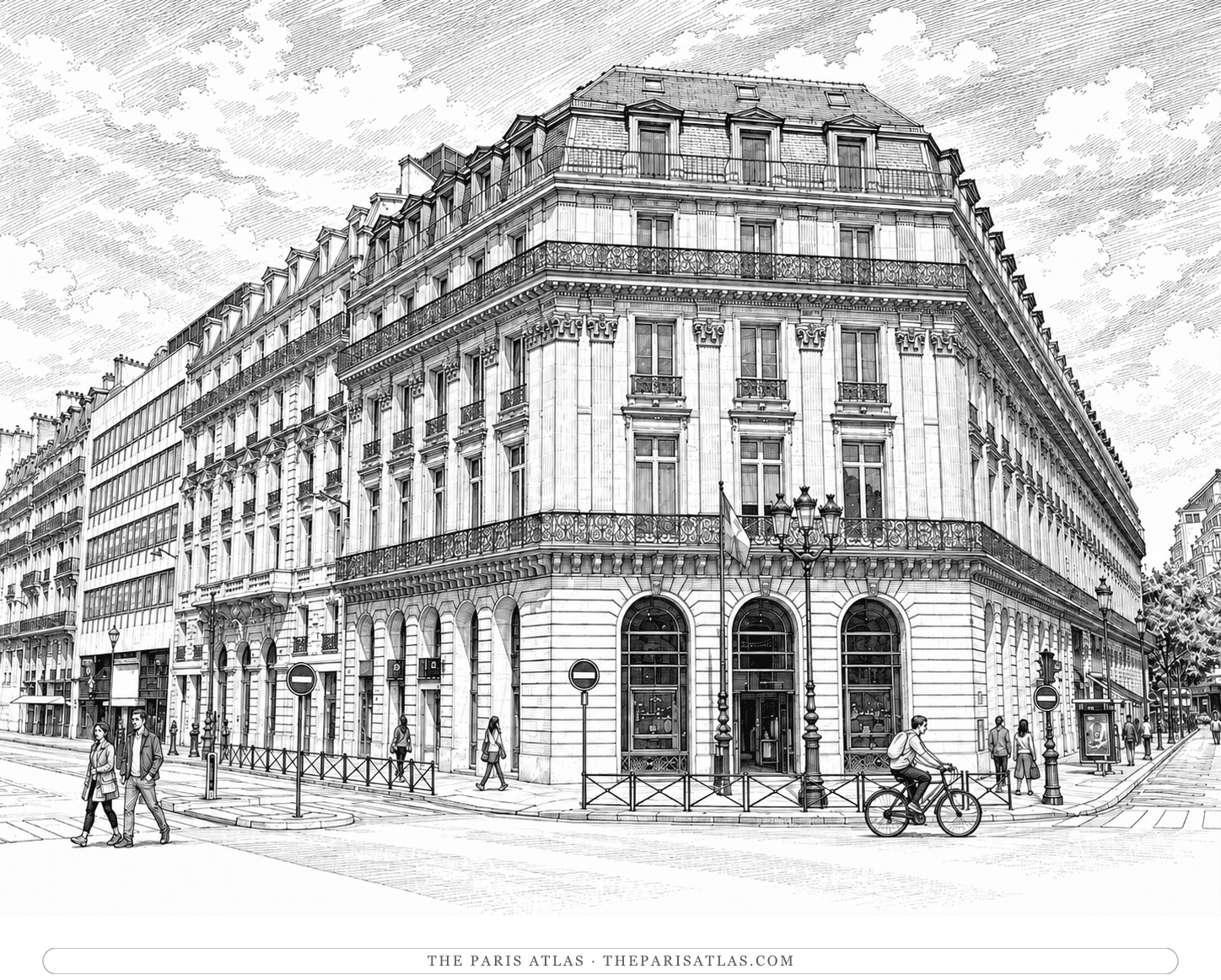
Present-day color view of the surviving honey-stone corner building at 11 rue Scribe under a blue sky, with the Nespresso boutique at street level

Office · Opéra

Open — go in

American Express Office at Opéra

James Baldwin wrote about American Express Office at Opéra in Giovanni's Room.

Visit the place
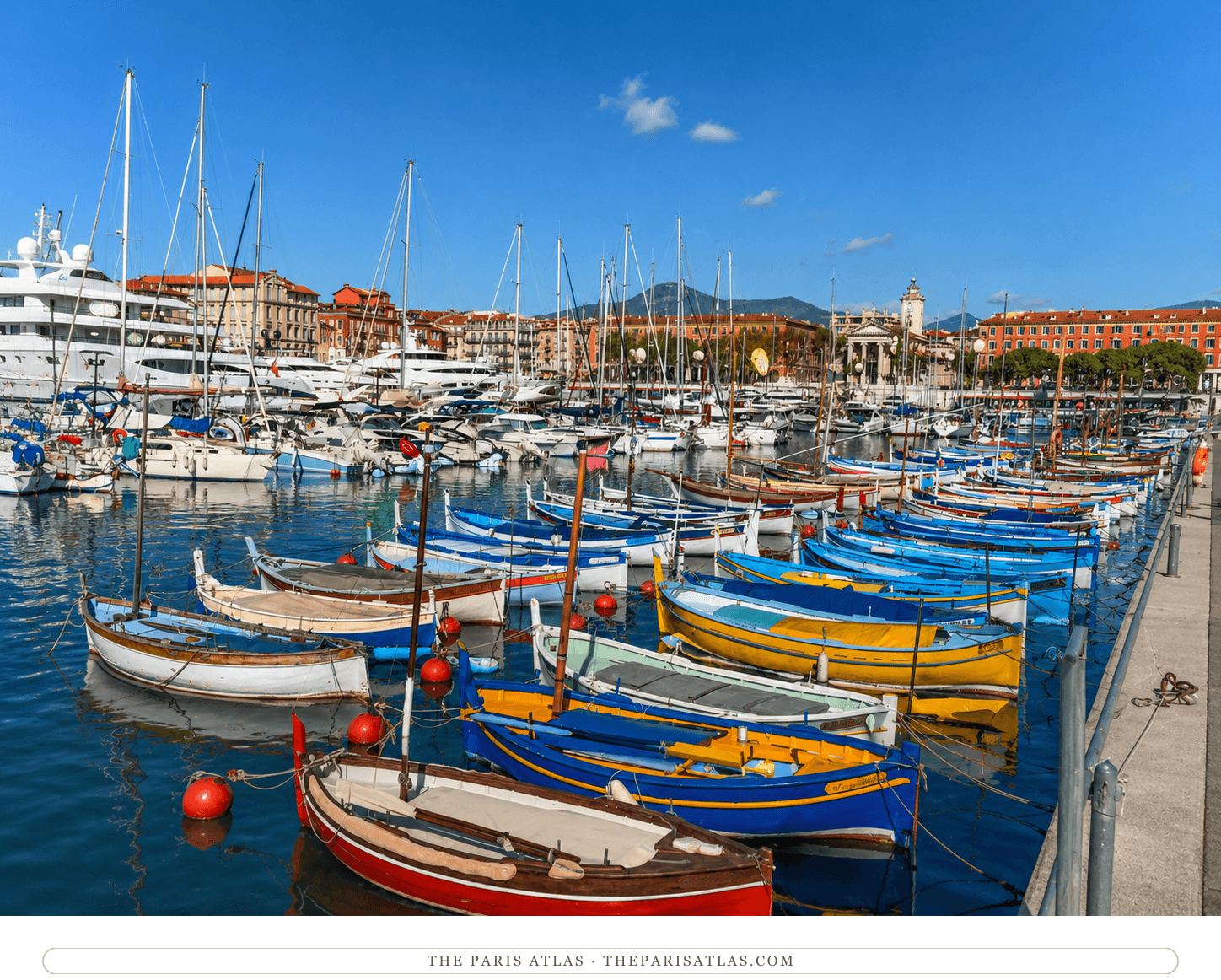
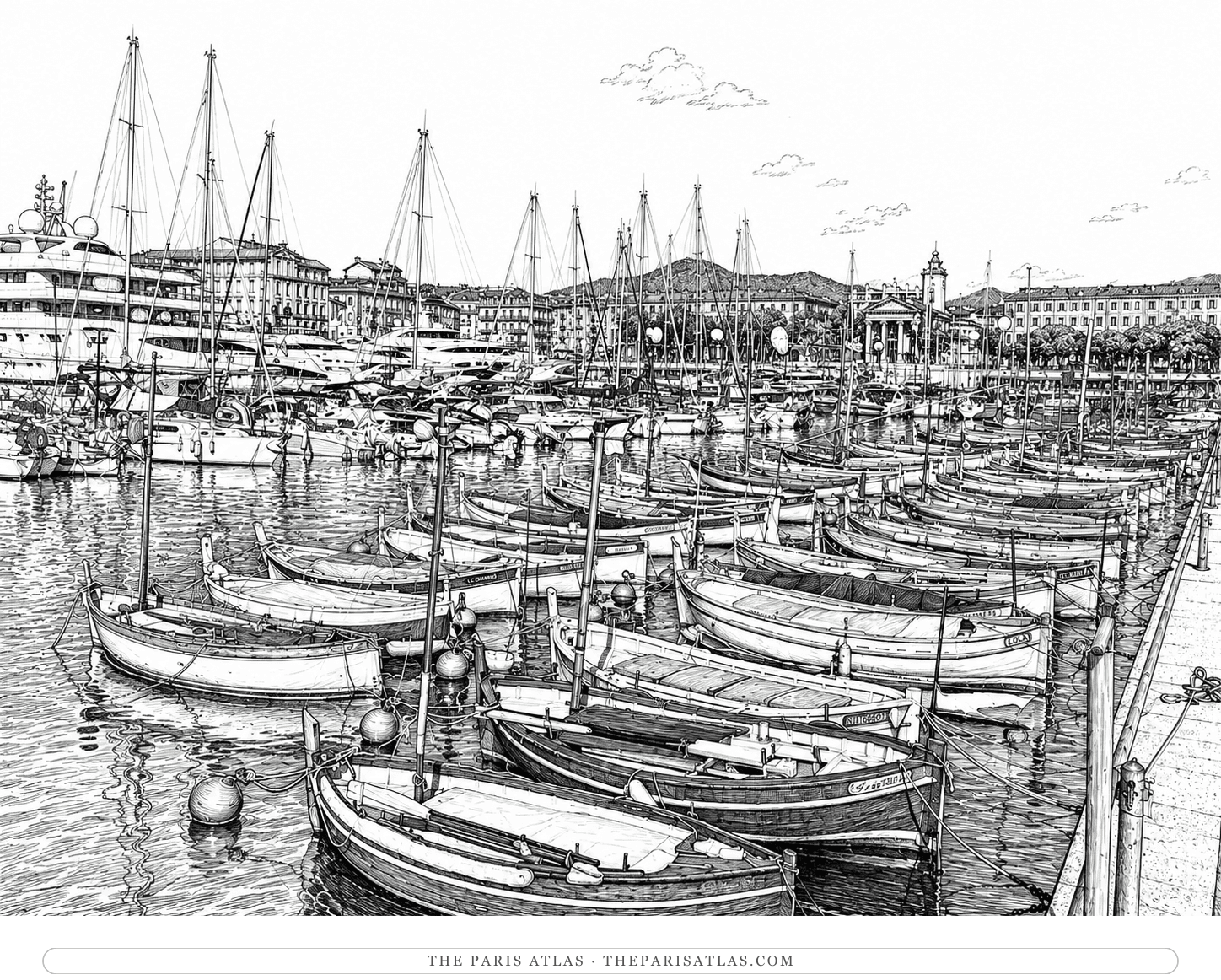
The same view of the port of Nice in colour, ochre and pink houses along the quay under a blue sky

Landmark · Vieux-Port

The Old Port of Nice

James Baldwin wrote about The Old Port of Nice in Giovanni's Room.

Visit the place
The same view of the Seine in colour, green water under a pale sky

River · Central Paris

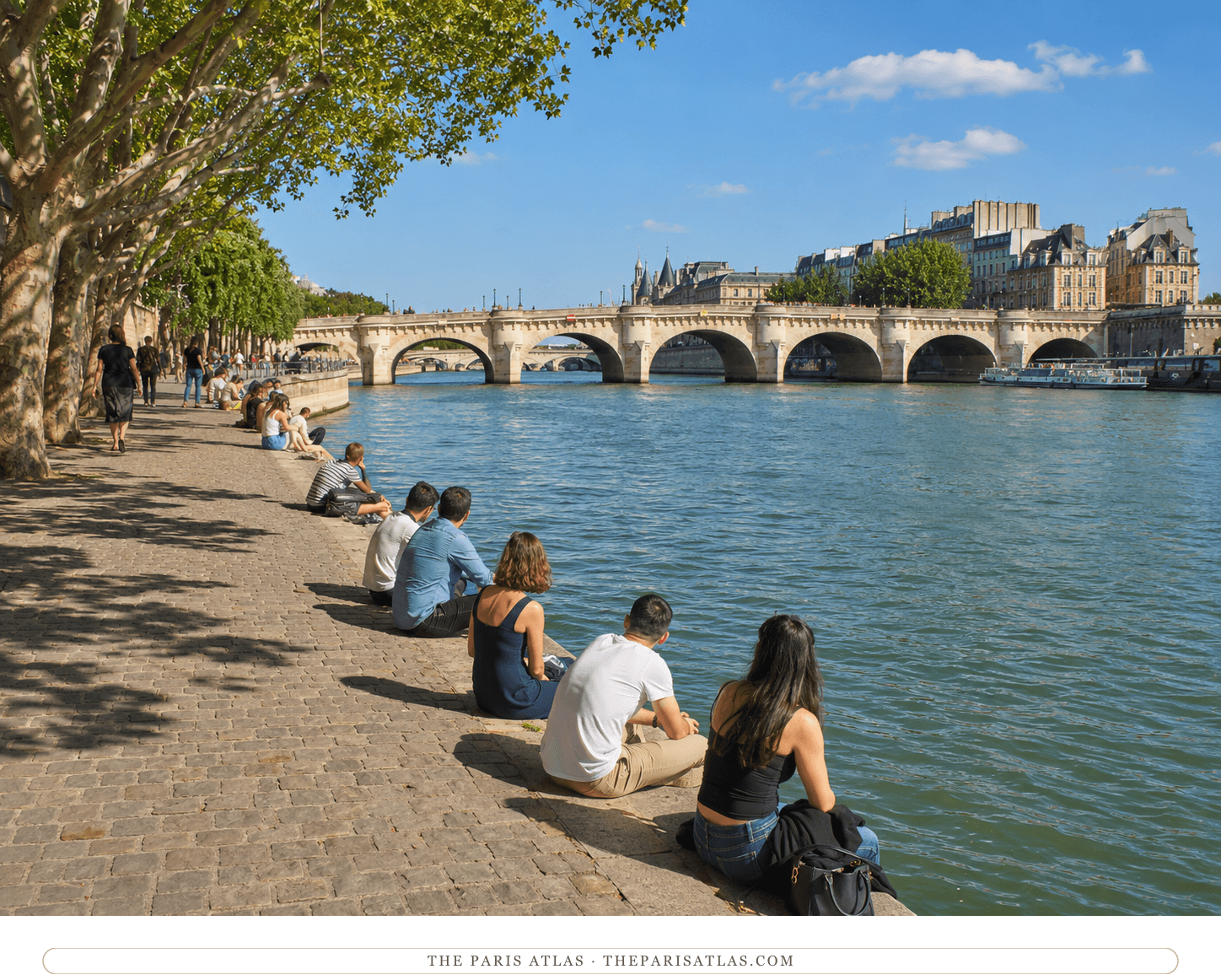
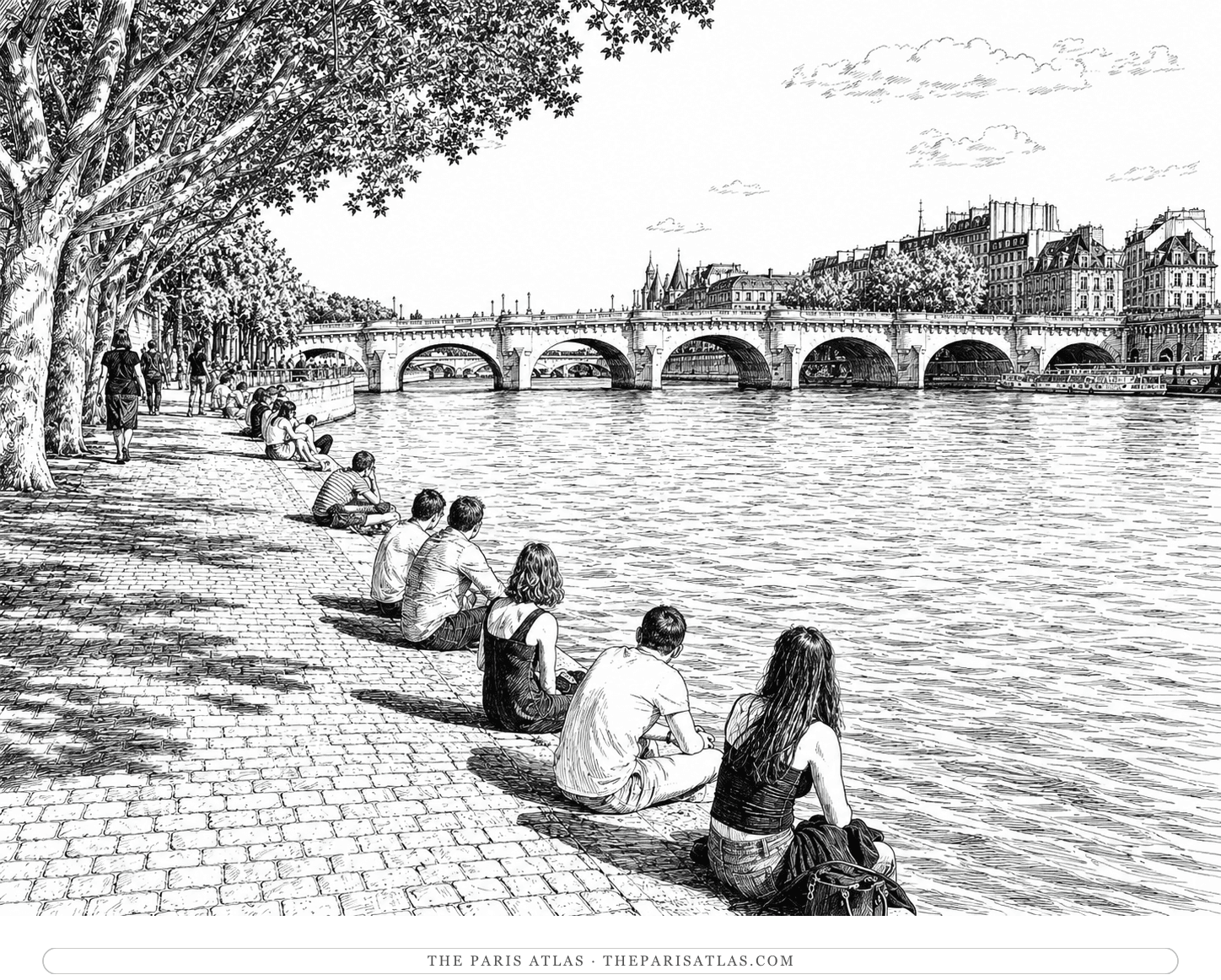
The Seine

James Baldwin wrote about The Seine in Giovanni's Room.

Visit the place
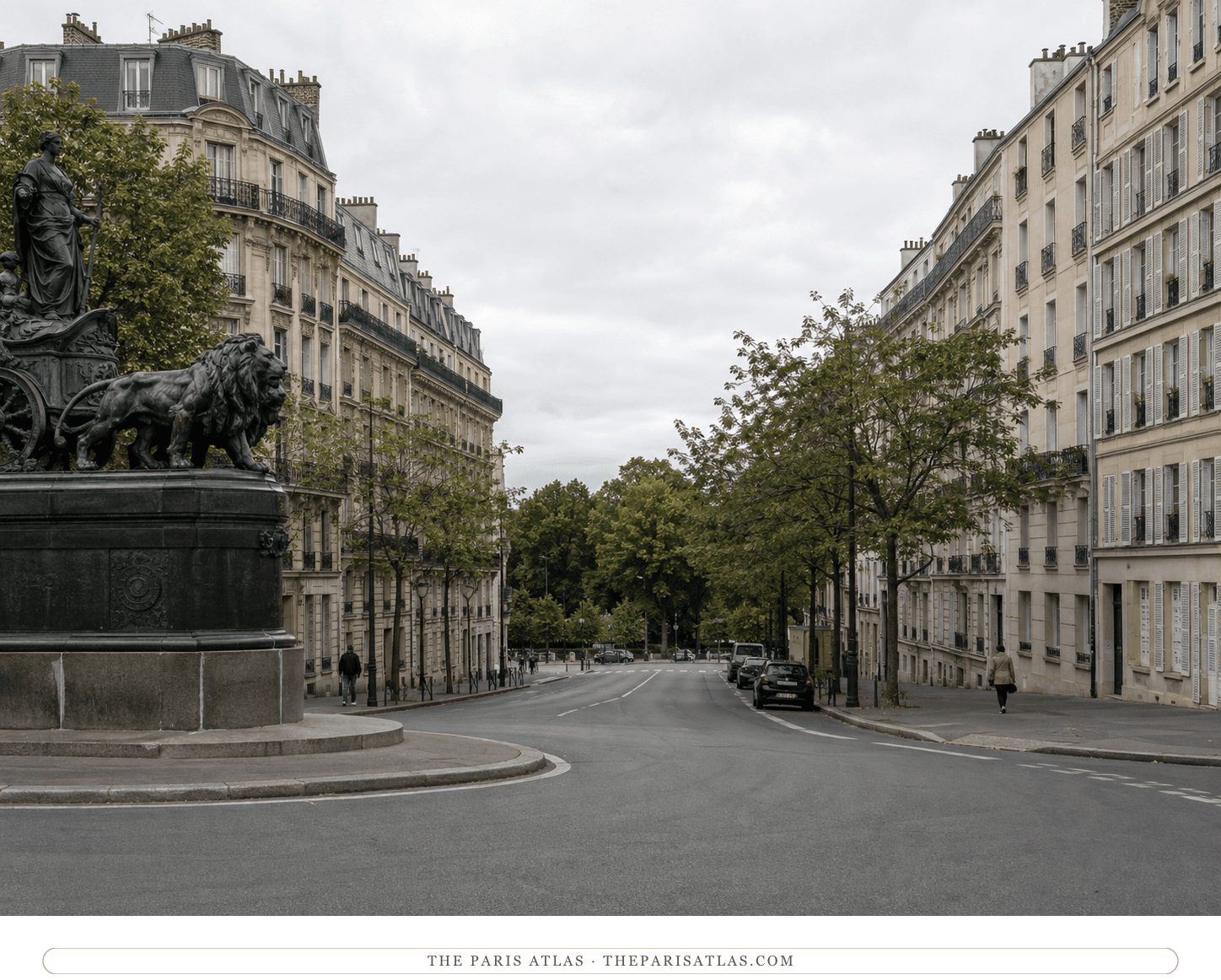
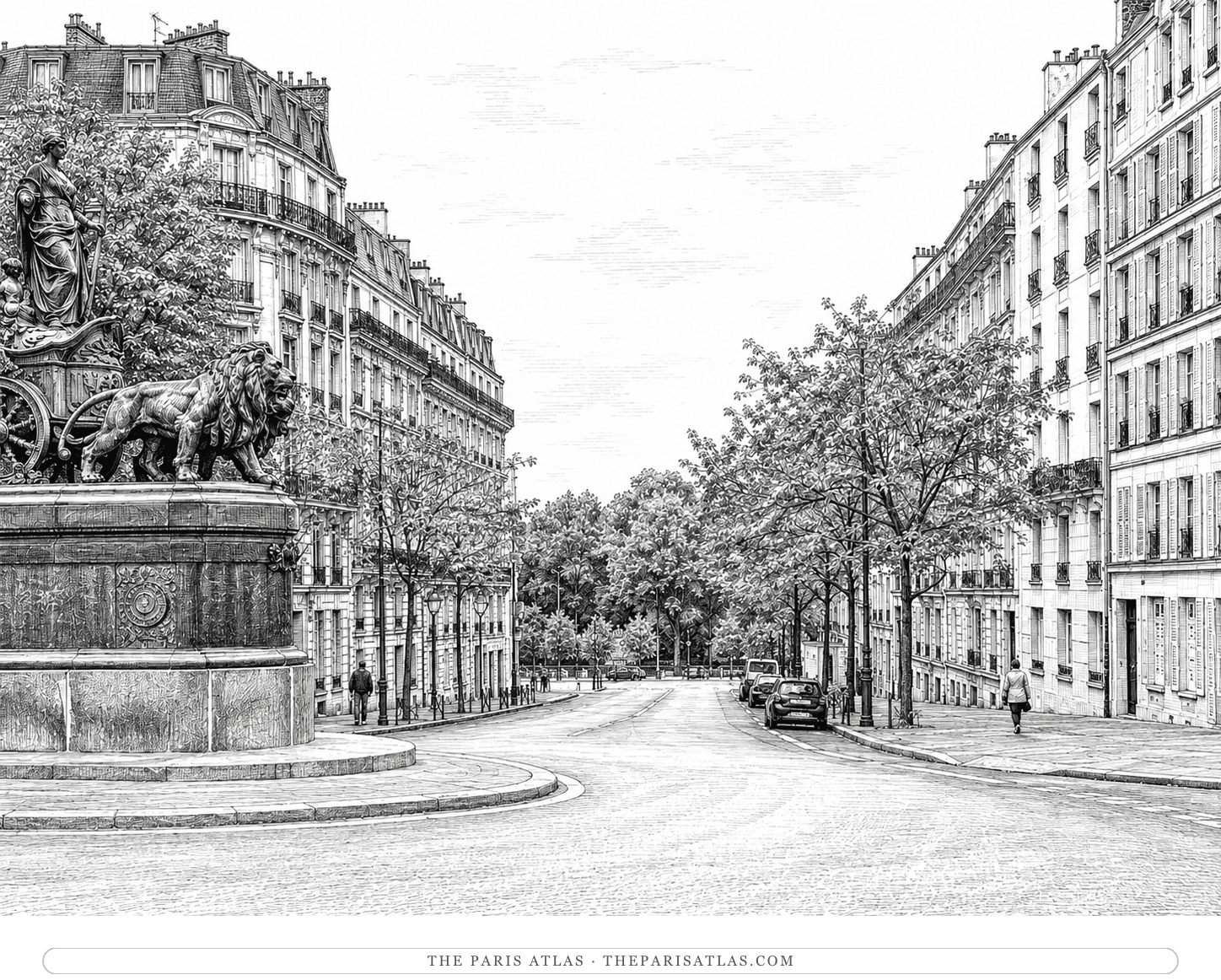
The same view in colour, pale stone facades and grey roofs under an overcast sky, the green-black bronze lions at the left edge

Square · Nation

Place de la Nation

James Baldwin wrote about Place de la Nation in Giovanni's Room.

Visit the place
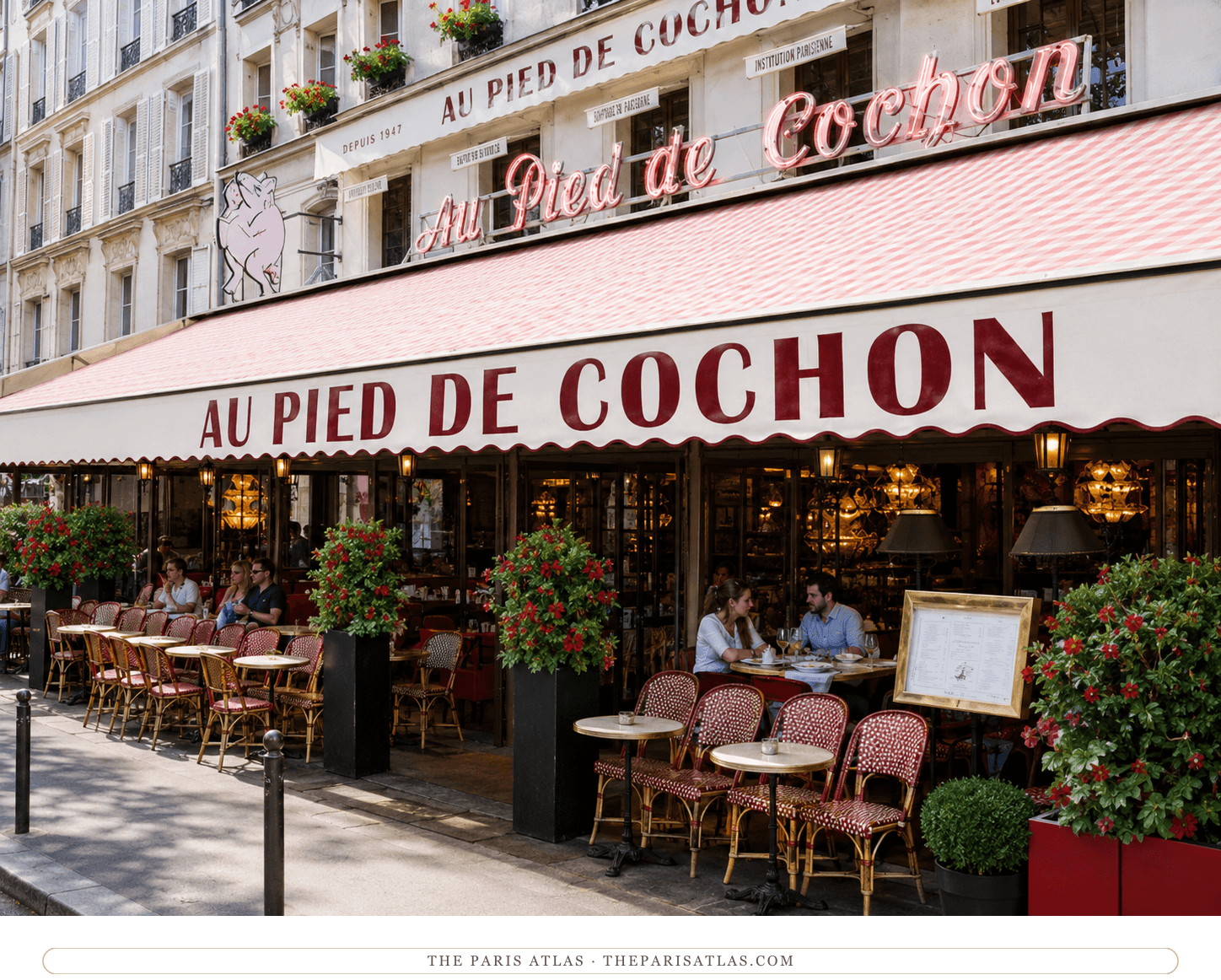
The same façade in colour, the awning red and cream under a neon script sign, geraniums in the planters and the terrace full in afternoon sun

Restaurant · Les Halles

Open — go in

Au Pied de Cochon

James Baldwin wrote about Au Pied de Cochon in Giovanni's Room.

Visit the place
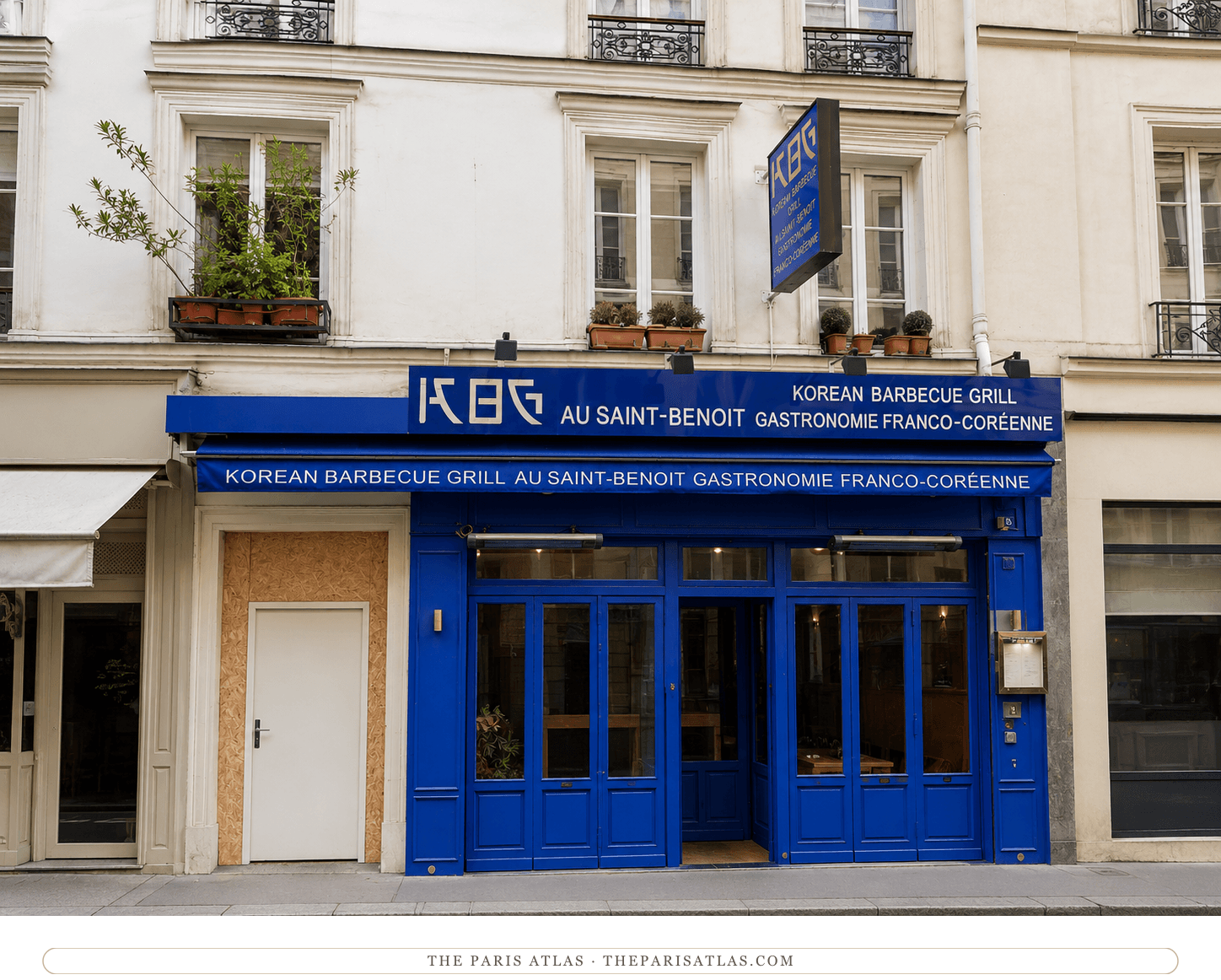
26 rue Saint-Benoît today, a cream Haussmann façade with plants at the balconies and a bright blue restaurant frontage at street level

Apartment · Saint-Germain-des-Prés

Outside only

26 rue Saint-Benoît

The City of Paris's walking account of Baldwin's years here lists 26 rue Saint-Benoît as his likely address in the period around the publication of Go Tell It on the Mountain in 1953. Held at probable: the city's own phrasing is conditional, and no biographer fixes the tenancy precisely.

Visit the place
The same cellar bar in colour, the neon sign red and green, lamplight on the stone vault and on wine glasses across the tables

Bar · Saint-Germain-des-Prés

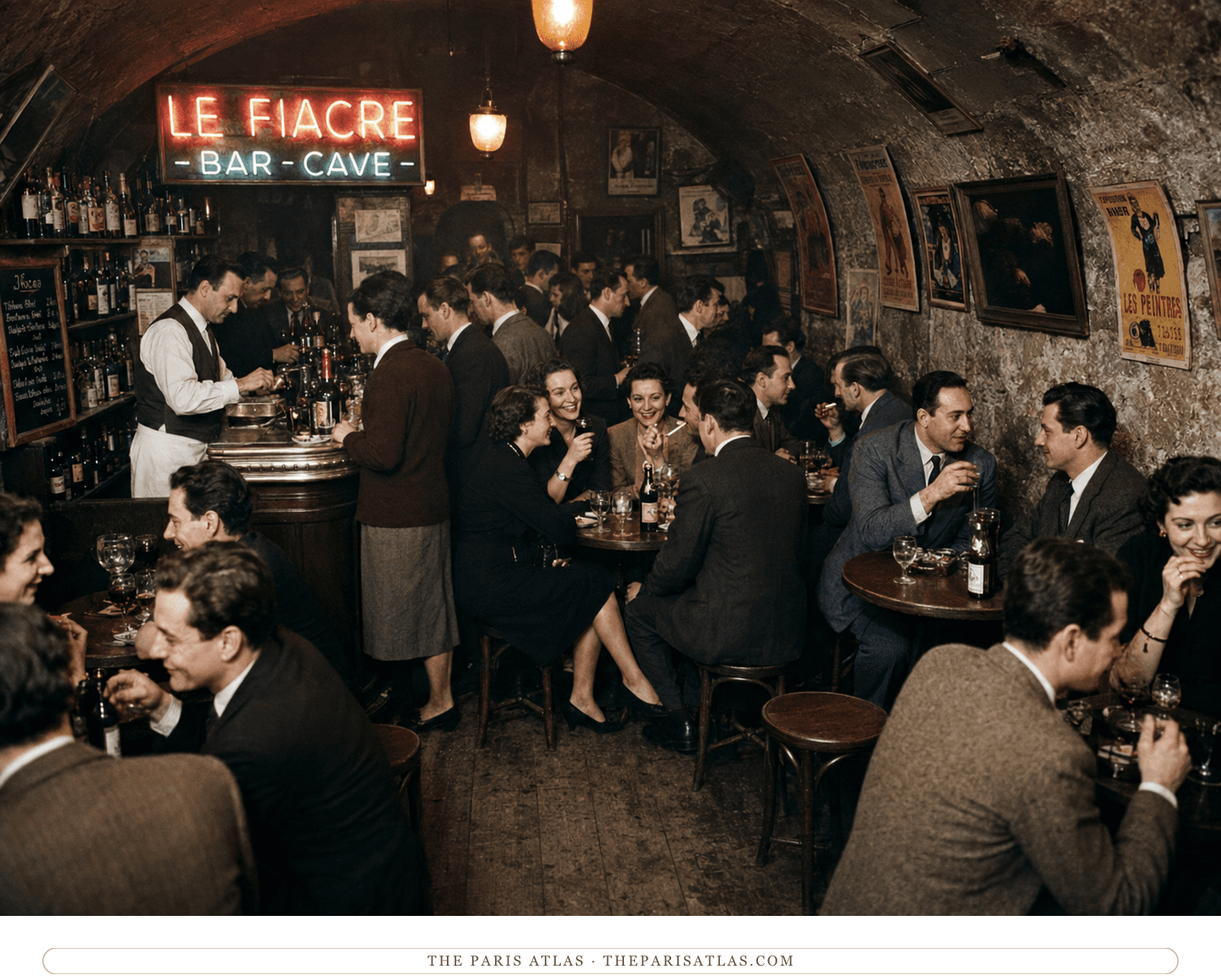
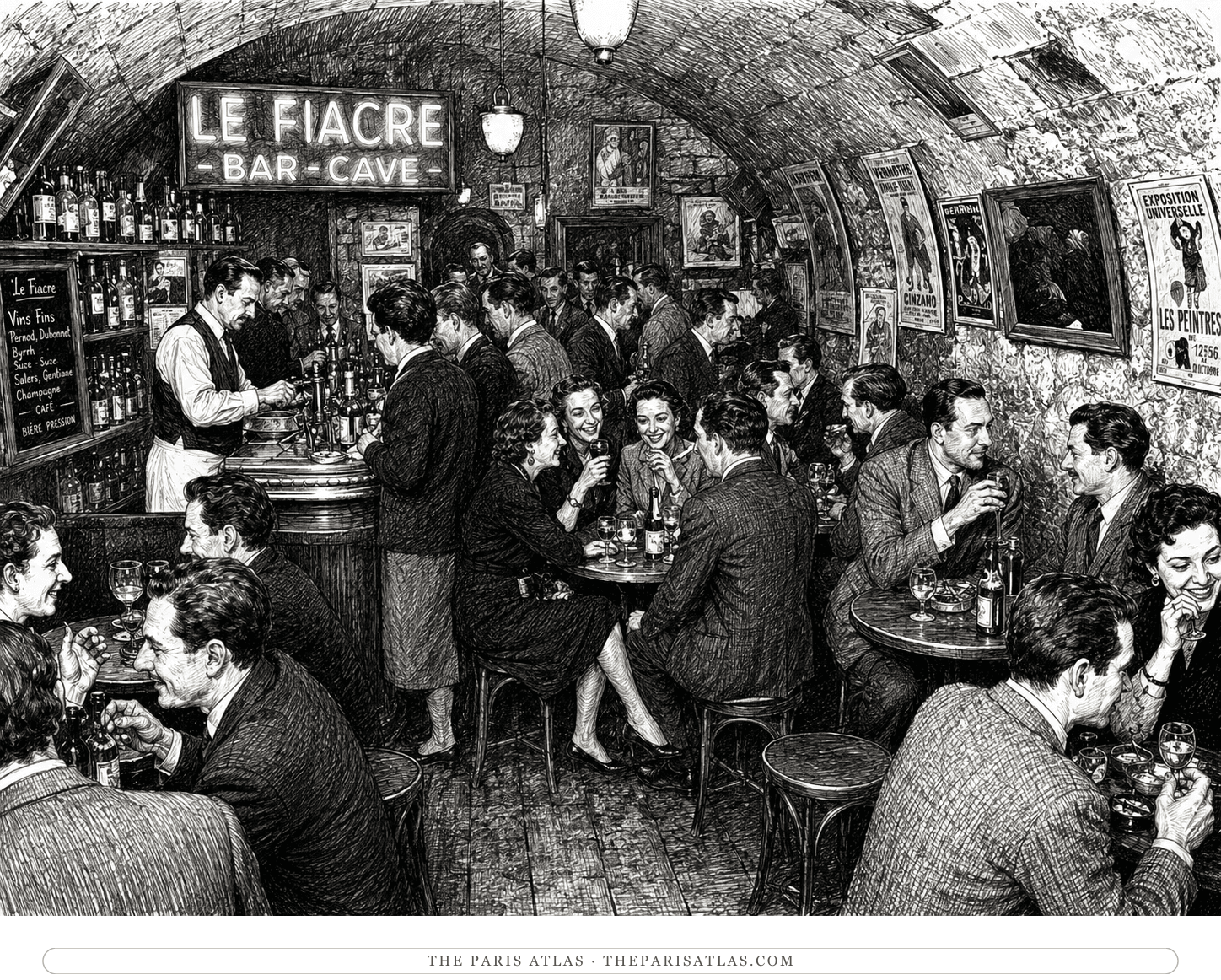
Le Fiacre (4 rue du Cherche-Midi)

Le Fiacre is named, with La Reine Blanche, among the bars Baldwin drank in during his Paris years and among the models for Guillaume's bar in Giovanni's Room. The novel's bar is invented and unnamed, so the identification cannot be checked against the text; what can be said is that Le Fiacre's two-floor arrangement — a gay bar at street level, private rooms above — matches the bar Baldwin wrote, where Guillaume humiliates Giovanni downstairs and is later found dead in his quarters upstairs.

Visit the place
The same terrace in colour, the awning cream and green, glasses of beer on the tables in afternoon sun

Bar · Saint-Germain-des-Prés

Outside only

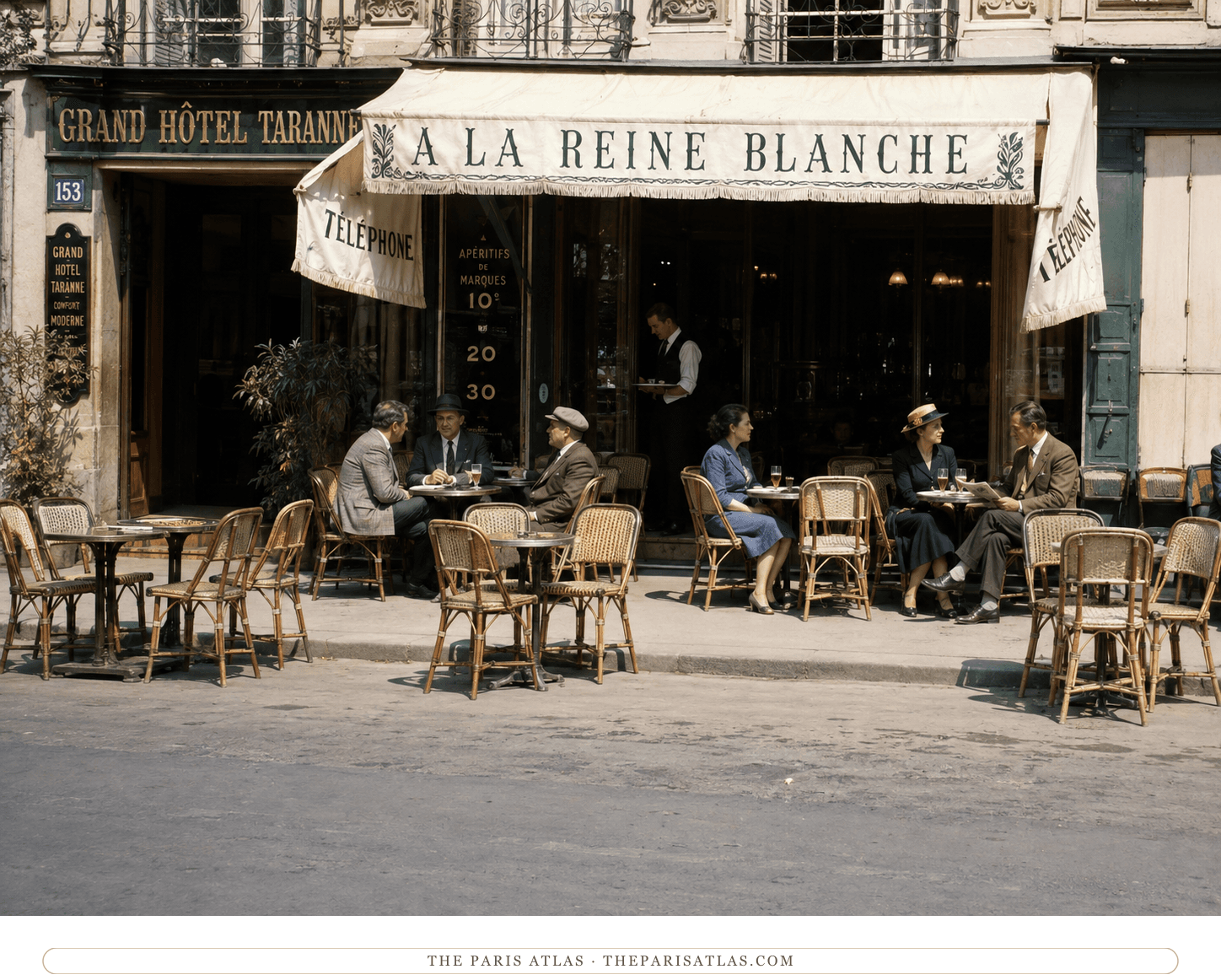
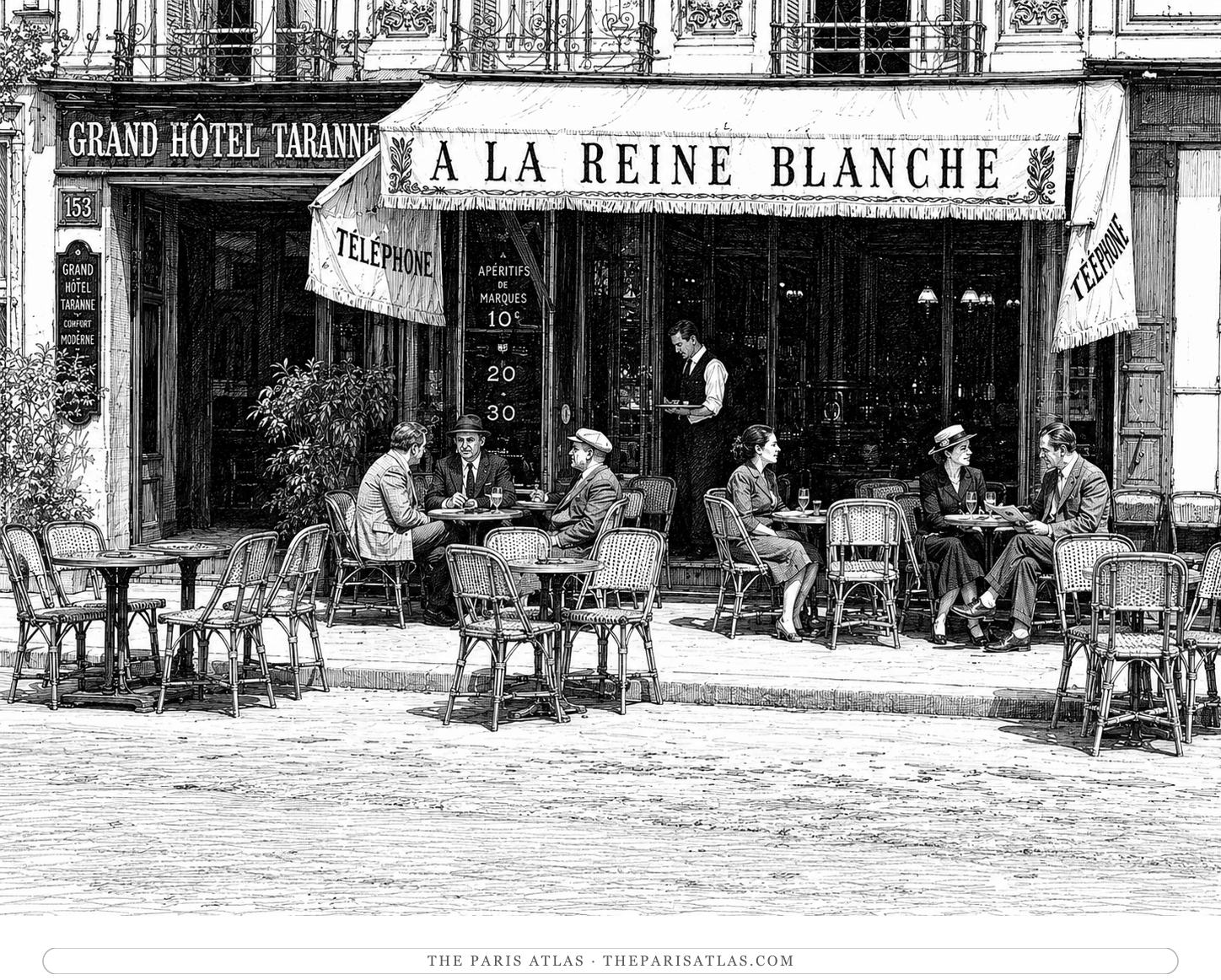
La Reine Blanche

Campbell names La Reine Blanche as the bar Baldwin and his circle used in his first Paris years, and describes the crowd there as the people who kept him fed. He met Lucien Happersberger in it in 1949. The habit is documented; the street number is not, and is worked out from a photograph of the café at the Grand Hôtel Taranne.

Visit the place
The same view in colour, pale stone facades and a grey-green awning under an overcast sky, the spire showing above the roofs

Quarter · Saint-Germain-des-Prés

Saint-Germain-des-Prés

The quarter Baldwin landed in when he reached Paris in November 1948, and the one he drank in for years afterwards. La Reine Blanche, where he met Lucien Happersberger, and Le Fiacre, the other bar named as a model for Guillaume's, are both a few minutes from the abbey church.

Visit the place
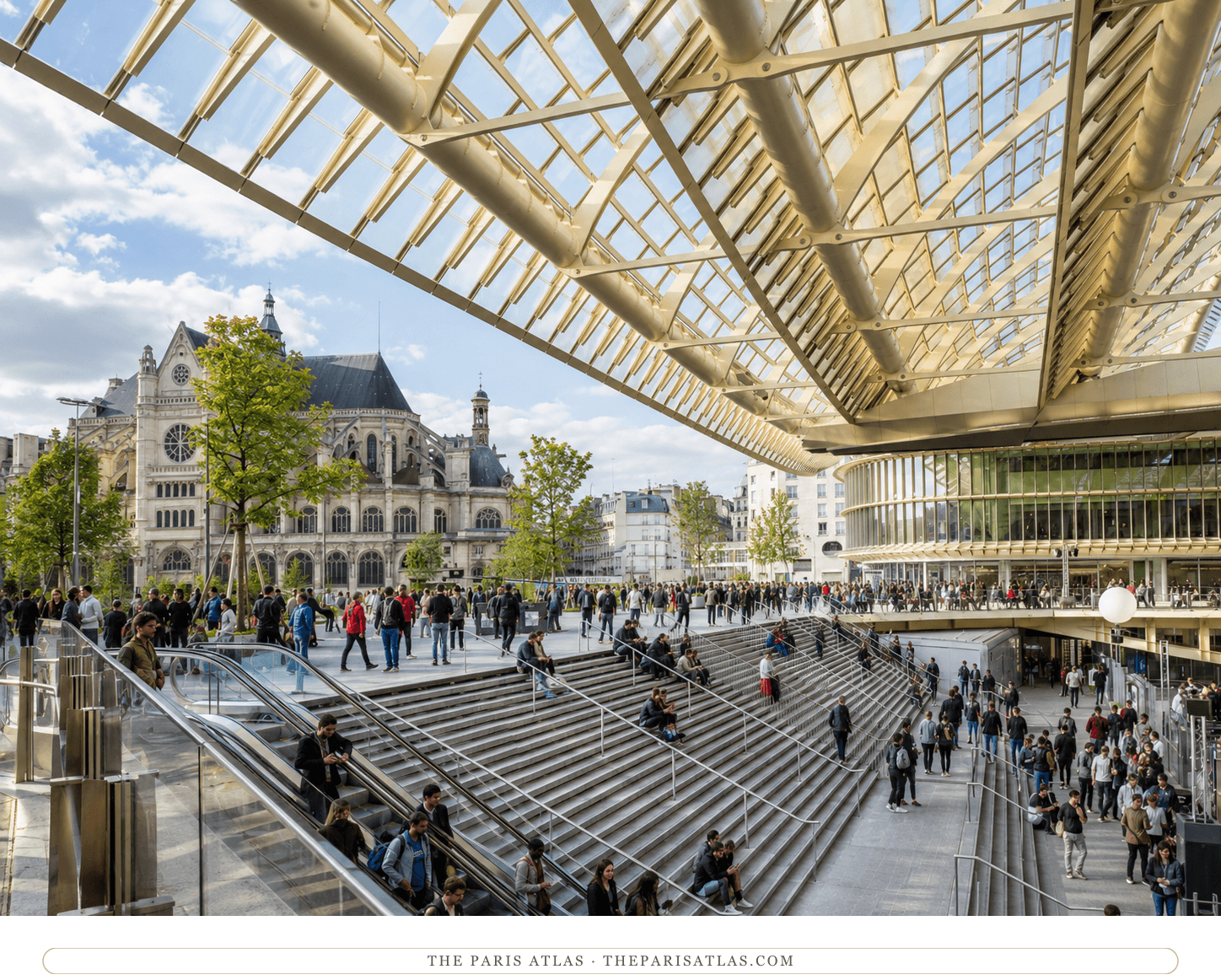
The same view in colour, the roof pale gold against a blue sky, trees and crowds on the steps

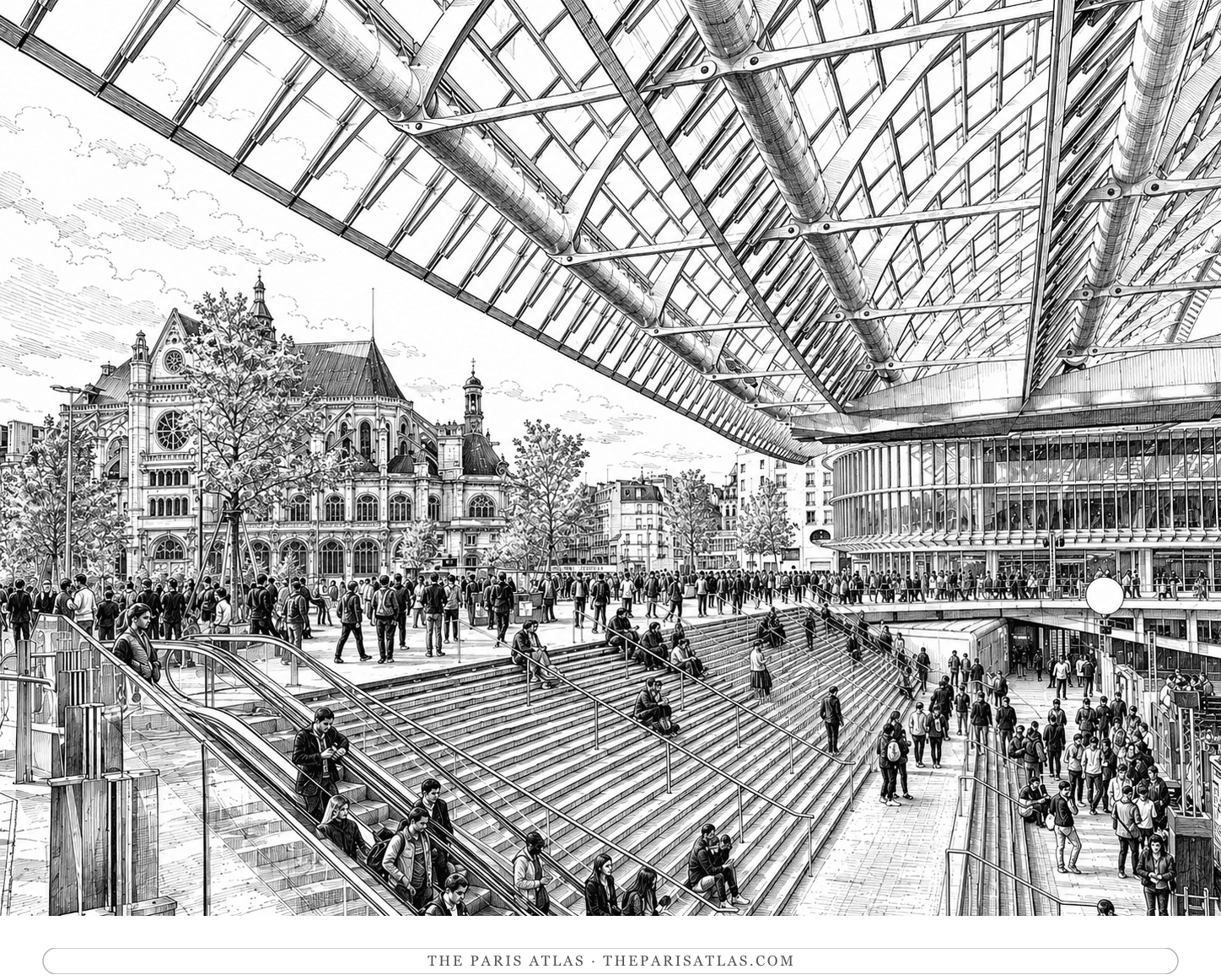
Quarter · Les Halles

Les Halles

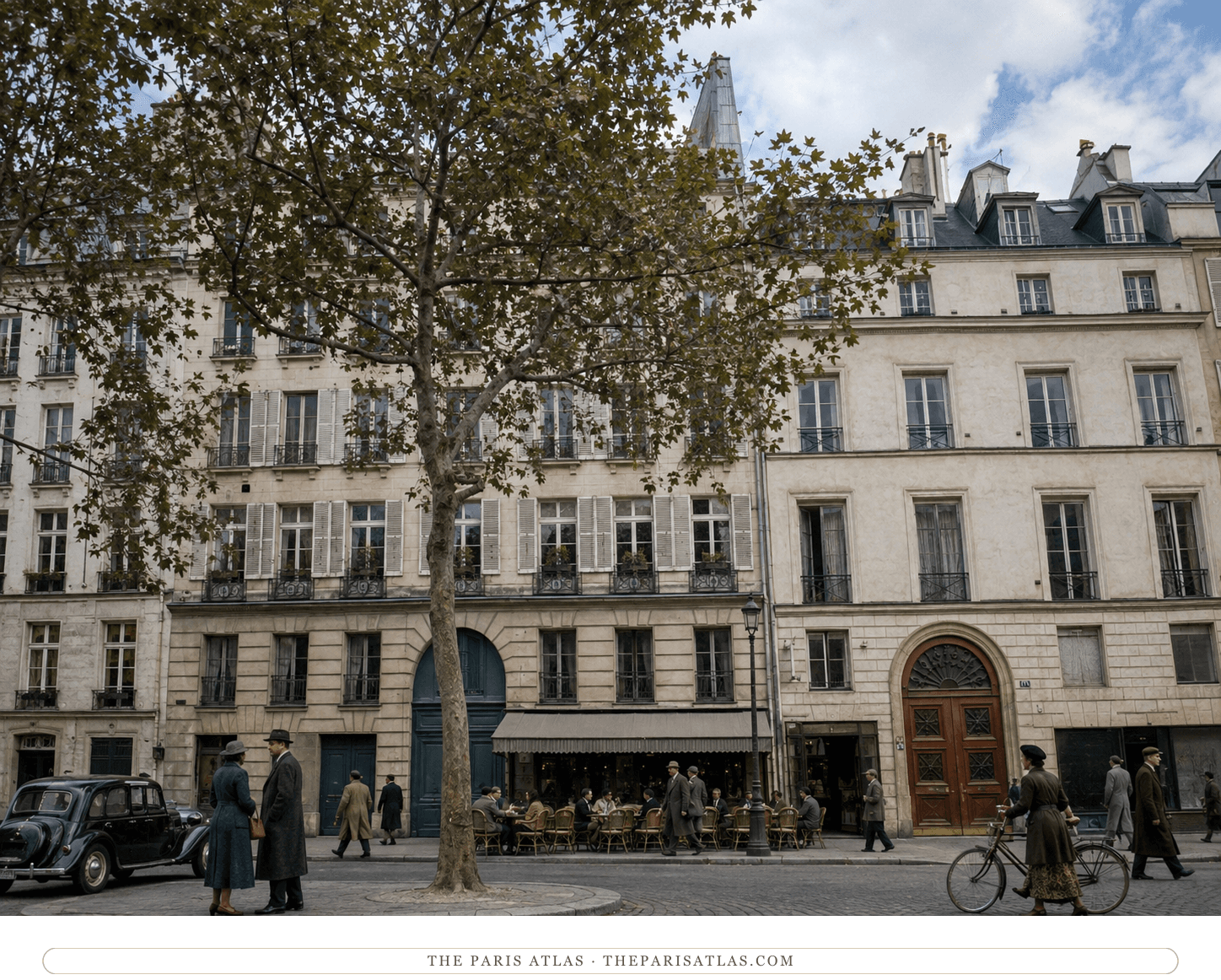
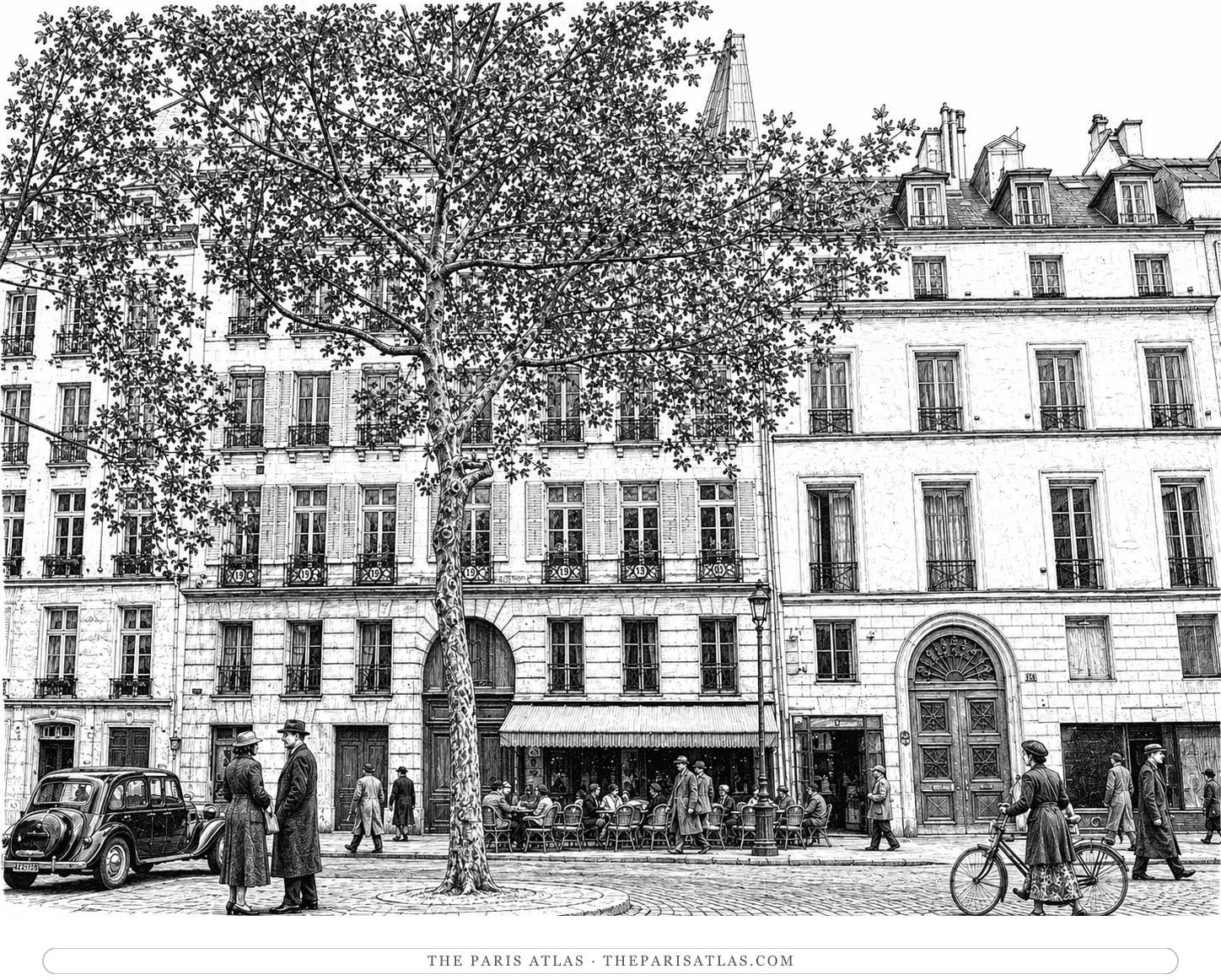
In the same sentence that remembers the Pigalle jam sessions, Baldwin remembers walking through Les Halles singing. Five years later he sent David and Giovanni there for oysters.

Visit the place
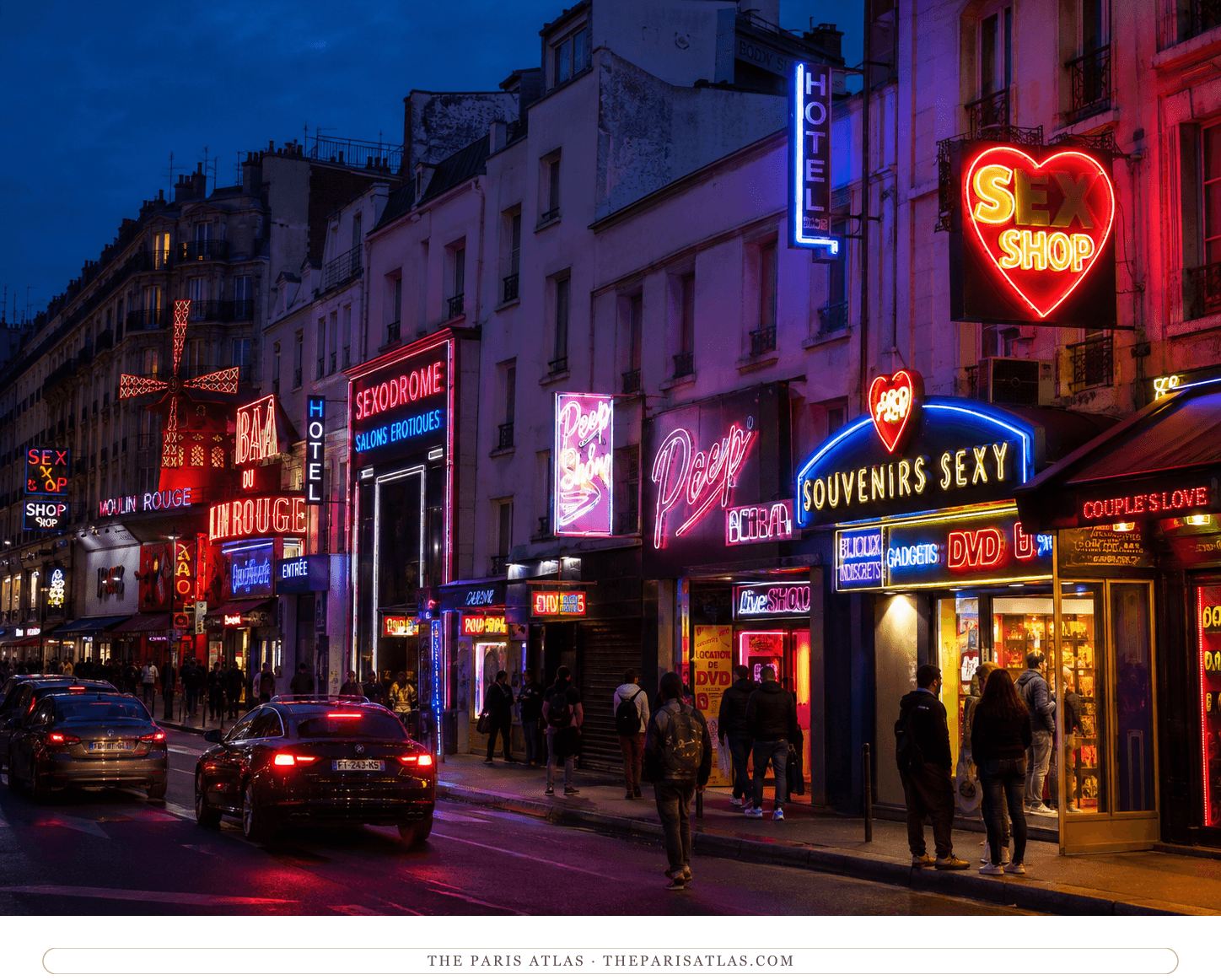
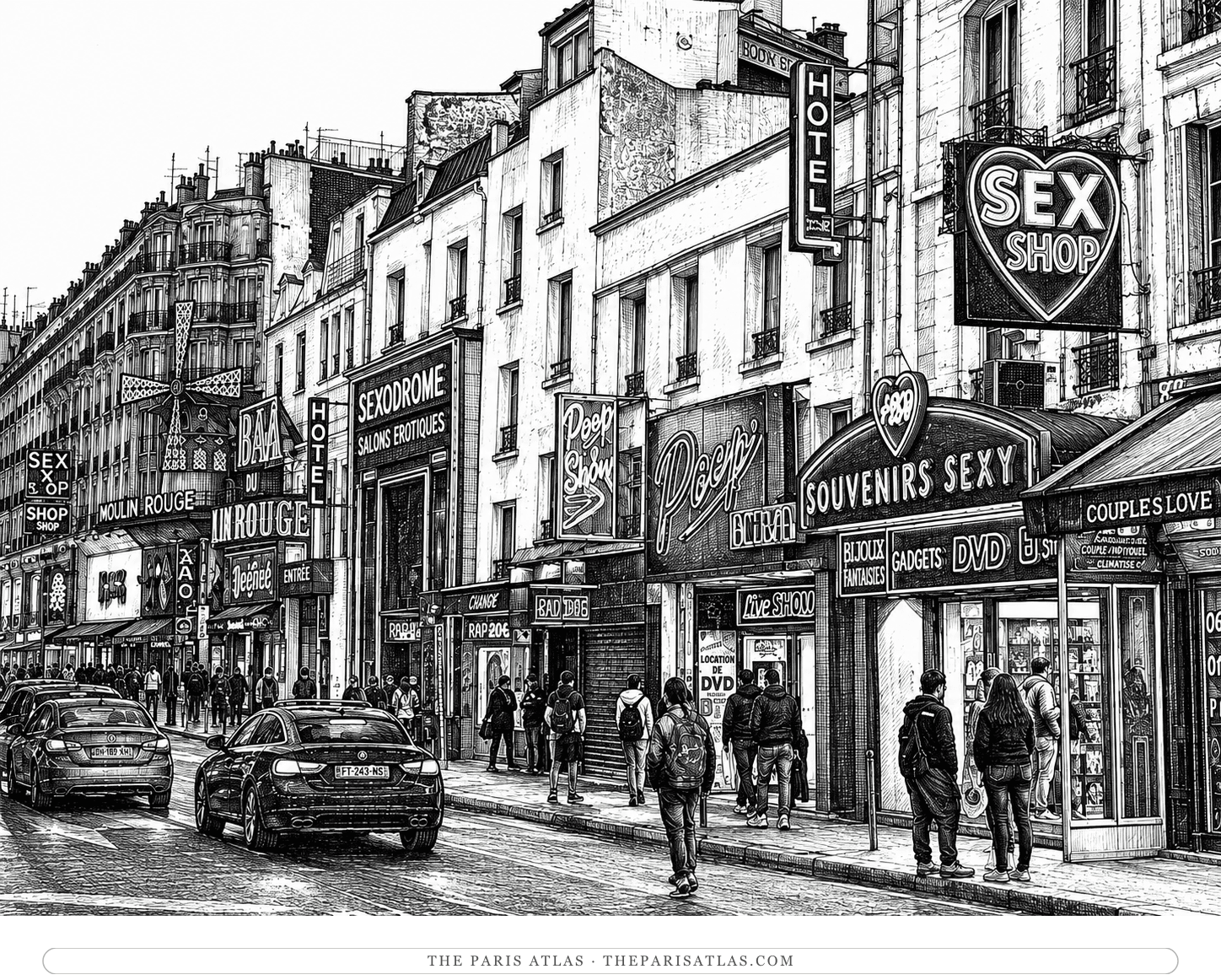
Colour drawing of the boulevard de Clichy at night, neon signs for sex shops and peep shows along the frontages with the Moulin Rouge windmill beyond

Quarter · Pigalle

Outside only

Pigalle

Baldwin remembered the jam sessions in Pigalle among the good nights of his first Paris years. The novel never comes here; he did.

Visit the place
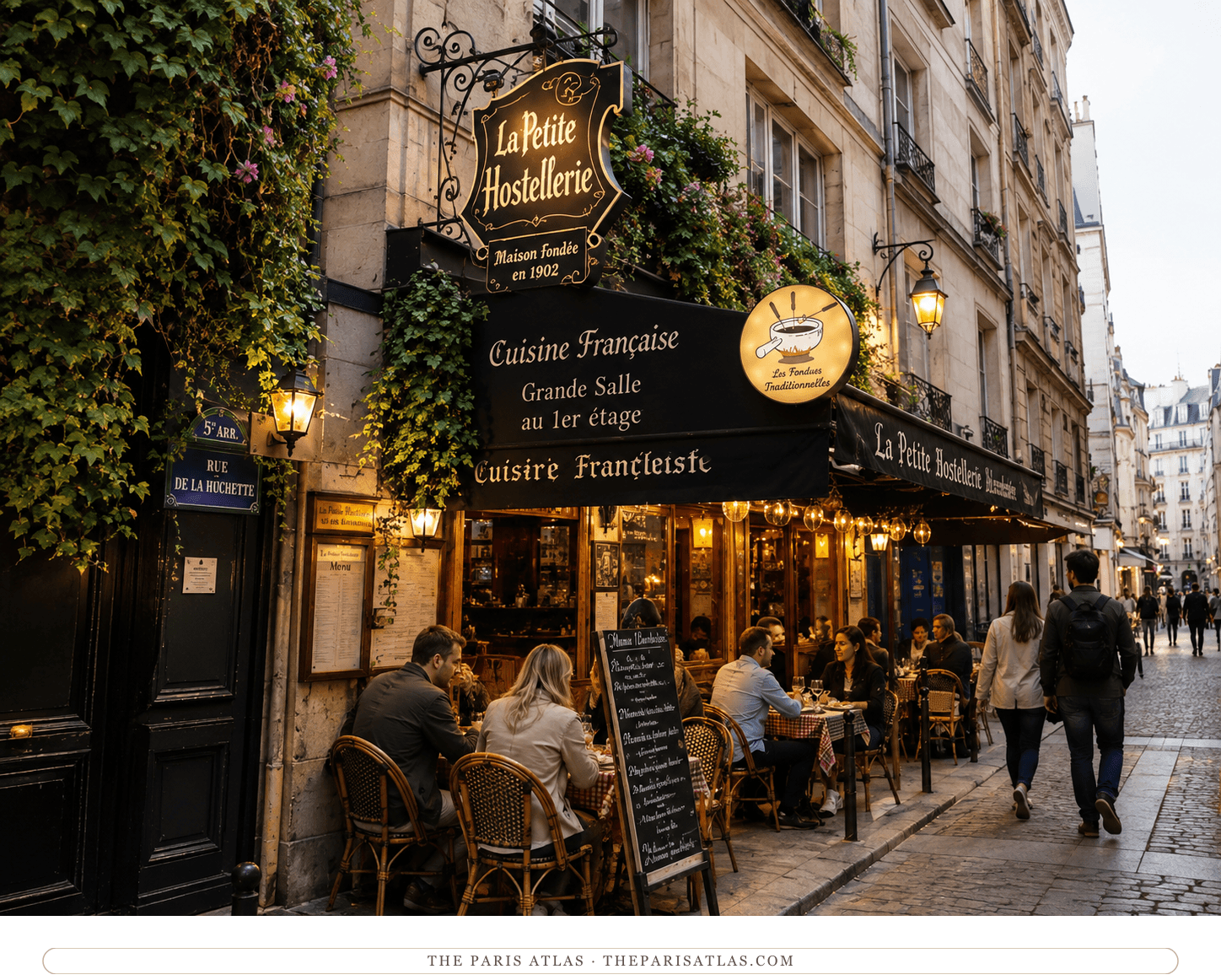
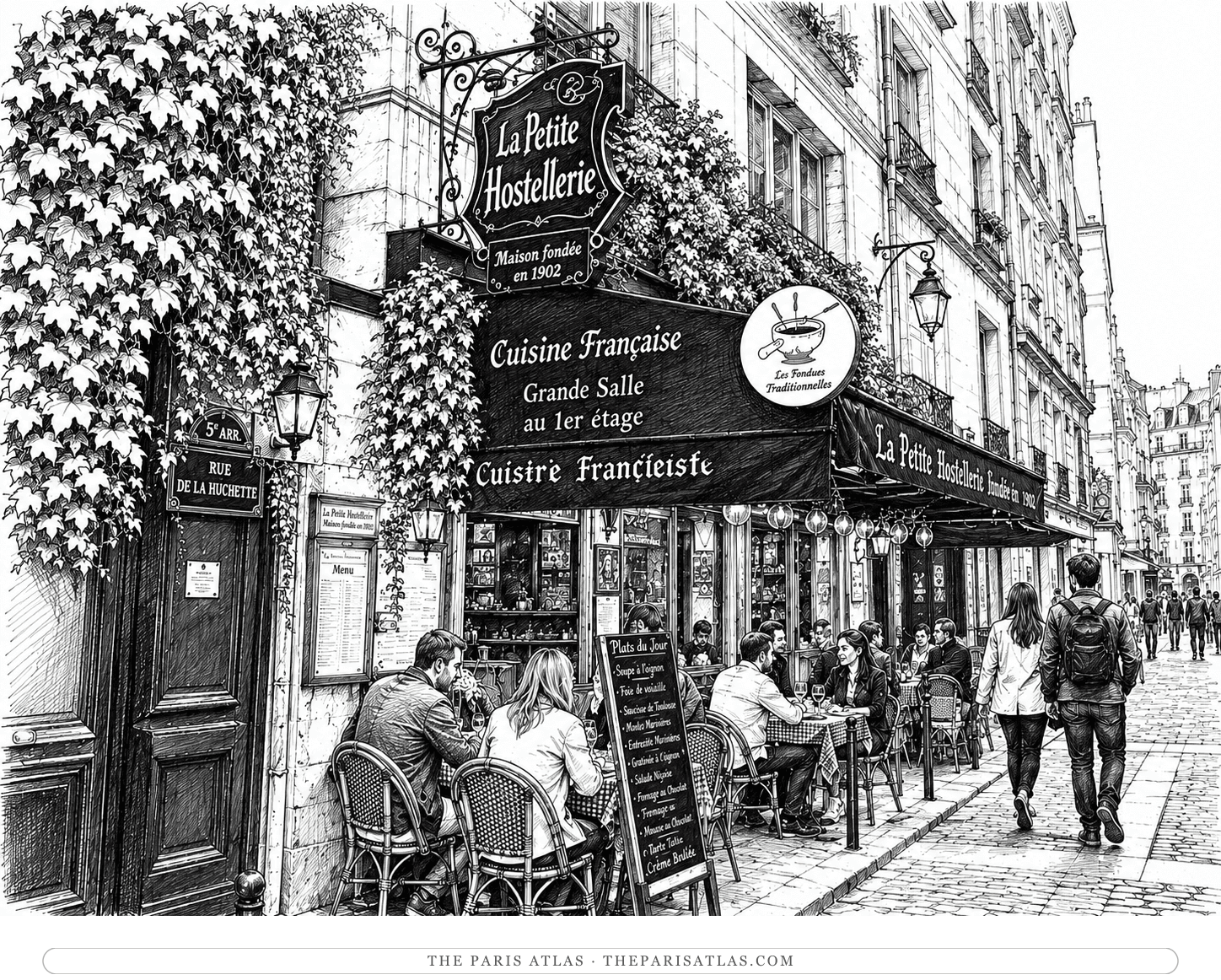
Colour drawing of a narrow Latin Quarter street, restaurant terraces under ivy and awnings, diners at pavement tables

Quarter · Latin Quarter

The Latin Quarter

James Baldwin wrote about The Latin Quarter in Giovanni's Room.

Visit the place
Colour drawing of the Montparnasse crossroads, café terraces under awnings and plane trees along the boulevard

Quarter · Montparnasse

Montparnasse

James Baldwin wrote about Montparnasse in Giovanni's Room.

Visit the place

Guides featuring James Baldwin

Take them with you.

Questions about James Baldwin

What should I read by James Baldwin first?

Notes of a Native Son (1955), his first essay collection. Baldwin is a greater essayist than novelist, and the essays are shorter. If you would rather read one short book than a collection, read The Fire Next Time (1963), which is about a hundred pages. For a novel, Giovanni's Room is the shortest and Go Tell It on the Mountain is the most revealing about him.

Why did James Baldwin move to Paris?

He left New York in November 1948, aged twenty-four, because he believed staying would destroy him — as a Black man, as a homosexual, and as a writer who would only ever be allowed to write about being Black. A Rosenwald Foundation fellowship paid his passage. He said afterwards that leaving America was what finally let him see it.

How many books did James Baldwin write?

Six novels, seven collections of essays, one book of short stories, two plays and a screenplay, plus three collaborative books and a children's book. The novels are Go Tell It on the Mountain, Giovanni's Room, Another Country, Tell Me How Long the Train's Been Gone, If Beale Street Could Talk and Just Above My Head.

Was James Baldwin gay?

Yes. He wrote openly about desire between men from Giovanni's Room in 1956, which was extraordinarily early, and he lived with the fact publicly at a time when it cost him readers and allies. He disliked the labels available to him and refused to be filed as a gay writer, on the grounds that it narrowed what he would be permitted to write next. His longest attachment was to the Swiss painter Lucien Happersberger, whom he met in Paris in 1949.

Was James Baldwin ever married?

No. Baldwin never married. His longest attachment was to Lucien Happersberger, the Swiss painter he met in Paris in 1949, who was at the house in Saint-Paul-de-Vence when he died in 1987. Giovanni's Room is dedicated to him.

Did James Baldwin have children?

No. He was the eldest of nine children and had none of his own, and he stayed closely involved with his nieces and nephews instead. His only children's book, Little Man, Little Man (1976), follows a four-year-old on a Harlem block and was written for his nephew Tejan Karefa-Smart, who wrote the foreword when Duke University Press reissued it in 2018.

What is James Baldwin best known for?

The essays. The Fire Next Time (1963) made him nationally famous and Notes of a Native Son (1955) is the collection most readers are sent to first. Among the novels, Giovanni's Room and Go Tell It on the Mountain are the two that stayed in print and on syllabuses. He is also remembered for how he argued in public — the 1965 Cambridge Union debate against William F. Buckley Jr. and a decade of television appearances made him one of the most recognisable voices of the civil rights years.

Did James Baldwin know Malcolm X and Martin Luther King Jr.?

Yes, and Medgar Evers as well. Baldwin held no position in any civil rights organisation, but he knew the people running the movement and was close enough to assemble the delegation that confronted Attorney General Robert Kennedy in May 1963. All three men were murdered between 1963 and 1968, and the damage runs through No Name in the Street (1972). At his death he was thirty pages into Remember This House, a book about the three of them; Raoul Peck built the documentary I Am Not Your Negro out of that unfinished manuscript.

Where is James Baldwin buried?

At Ferncliff Cemetery in Hartsdale, New York. He died at Saint-Paul-de-Vence in the south of France on 1 December 1987 and was brought back to New York, where his funeral was held at the Cathedral of St John the Divine. Maya Angelou and Amiri Baraka both spoke.

What is Giovanni's Room about?

A young white American in Paris, engaged to a woman, falls in love with an Italian bartender named Giovanni and cannot admit it. The refusal ruins them both. It has no Black characters, which is why Baldwin's American publisher rejected it and told him to burn the manuscript; he published it in England instead, in 1956.

Why did James Baldwin and Richard Wright fall out?

Wright had helped Baldwin win the fellowship that got him to Paris. In 1949 Baldwin published "Everybody's Protest Novel" in the magazine Zero, arguing that fiction written to protest racism reduces its Black characters to cases rather than people — and using Wright's Native Son as the example. Wright took it as a betrayal and the friendship never recovered.

How did James Baldwin die?

Of stomach cancer, diagnosed in the spring of 1987. He died at his house in Saint-Paul-de-Vence in the south of France on 1 December 1987, aged sixty-three, with his brother David and his friend Lucien Happersberger present.

Where did James Baldwin live in France?

In Paris from 1948, in cheap hotels around Saint-Germain-des-Prés, writing in cafés including the Café de Flore. From the start of the 1970s he lived in a seventeenth-century house at Saint-Paul-de-Vence, a hill village between Nice and Cannes, where he stayed until his death. The property has since been largely redeveloped despite a campaign to preserve it.

What is the Baldwin–Buckley debate?

A televised debate at the Cambridge Union on 18 February 1965 between Baldwin and the conservative writer William F. Buckley Jr., on the motion that the American dream had been achieved at the expense of the American Negro. Baldwin spoke for the motion and won the vote 544 to 164. The recording is still widely circulated.

Sourced claims

Every connection the graph holds for James, with the evidence behind it.

Frequented · 1948

Café de Flore

Baldwin's Paris rooms were unheated and the cafés were not, which is the plain reason he worked in them, and the Flore is the one his early Paris years are most consistently attached to. The City of Paris's account of those years places his meetings with Simone de Beauvoir and Jean-Paul Sartre here, and a popular account has Go Tell It on the Mountain taking shape at its tables.

Sur les traces de l'écrivain James Baldwin à Paris; Americans in Paris, James Baldwin: A Freedom Fighter Without a Home; Wikipedia — James Baldwin in France

Influenced

Miles Davis

The books came before the friendship. Davis wrote that he had read Baldwin and respected what he had to say, and that the two of them opened up to each other once he knew the man behind them.

Miles Davis with Quincy Troupe, Miles: The Autobiography (1989)

Frequented

Brasserie Lipp

Held at probable as a habit: France Revisited has Baldwin stopping in occasionally rather than as a regular, usually before eating somewhere cheaper. That he was in the room at all is documented — he put himself there in "Alas, Poor Richard", walking in on the day Zero published "Everybody's Protest Novel" and finding Richard Wright waiting.

James Baldwin: Scrutinizing America from Paris (2020); James Baldwin, Nobody Knows My Name (1961), "Alas, Poor Richard", pp. 196–197 (Vintage International, 1993)

Frequented

Le Montana

The City of Paris names Le Montana among the gay clubs Baldwin frequented in his early Paris years, alongside L'Abbaye and La Reine Blanche. Of the group, the Montana is the only address where a successor venue still trades under the name.

Sur les traces de l'écrivain James Baldwin à Paris

Frequented

Le Select

Held at probable: a secondary account in Bonjour Paris has Baldwin at work on Giovanni's Room at the Select, his one recorded tie to Montparnasse café life. The actor and Baldwin scholar Charles Reese says the same, that the Select is where Baldwin finished the novel. Neither account rests on a letter, a diary entry, an interview, or a page, and a check of the searchable Leeming biography in August 2026 found no Select reference. A better source would replace this one; until one appears the site does not state it as fact.

Americans in Paris, James Baldwin: A Freedom Fighter Without a Home

Frequented

Le Tournon

The City of Paris names Le Tournon among Baldwin's favorite cafés. The room was also the daily headquarters of the Black American writers around Richard Wright in the early 1950s, which made it complicated ground for Baldwin after their public break.

Sur les traces de l'écrivain James Baldwin à Paris; What has become of the Café Tournon?

Frequented · 1948

Les Deux Magots

The City of Paris names Les Deux Magots among Baldwin's favorite cafés, and accounts of his first day in Paris in November 1948 put him at this terrace being greeted by Richard Wright, who had helped him get there.

Sur les traces de l'écrivain James Baldwin à Paris; Americans in Paris, James Baldwin: A Freedom Fighter Without a Home

Lived at · 1948

Hôtel Verneuil

The City of Paris's account of Baldwin's Paris years has him settling durably at the hôtel de Verneuil after first nights in a cheap hotel on the rue du Dragon, and the hotel's own history counts him among its residents. These were his poorest years; the room went unheated and the writing happened in cafés.

Sur les traces de l'écrivain James Baldwin à Paris; Hôtel Verneuil Saint-Germain — official site

Collaborated with

Richard Avedon

Classmates on the Magpie editorial board at DeWitt Clinton High School in the Bronx. In 1964 they published Nothing Personal, Avedon's photographs alongside Baldwin's text on American identity in the civil rights era.
Back to School with the Berg Collection (2023); Richard Avedon, Members of the Student Nonviolent Coordinating Committee, Atlanta, Georgia (object 2018.40)

Collaborated with

Sol Stein

Friends from the editorial board of the Magpie at DeWitt Clinton High School. In the summer of 1954, at the MacDowell Colony together, Stein convinced Baldwin to publish the essays that became Notes of a Native Son, and edited the book. Their letters were published as Native Sons in 2005.

A Century of Creativity: The MacDowell Colony — Giovanni's Room featured object; Back to School with the Berg Collection (2023)

Collaborated with

Yoran Cazac

Cazac illustrated Little Man, Little Man, Baldwin's only children's book, published by Dial Press in 1976 and reissued by Duke University Press in 2018.

Little Man, Little Man: A Story of Childhood – Another View of James Baldwin

Met · 1980

Chinua Achebe

They met at the 1980 African Literature Association conference in Gainesville, Florida, where Baldwin greeted Achebe with the words: this is my brother who I'm meeting 400 years after. A University of Florida exhibition calls it their first and only meeting, though its own archive holds photos of the two together in St. Augustine around 1982.

Achebe–Baldwin at 40: An Online Exhibition

Met · 1970

Jean Genet

The two writers sat on a panel together at the American Center for Students and Artists in Paris in 1970. A contact sheet by the photographer Jacques Robert, held at the Schomburg Center, records the occasion.

Jacques Robert, Contact sheet of James Baldwin with Jean Genet at American Center (1970)

Met · 1961

Langston Hughes

In January 1961 the two sat on the same WBAI radio panel on the Black writer in America, alongside Lorraine Hansberry, Alfred Kazin, and Emile Capouya, with Nat Hentoff moderating. The recording survives in the American Archive of Public Broadcasting.

The Negro in American Culture; No. 3; The Negro Writer In America (WBAI, 1961) (1961)

Met · 1958

Lorraine Hansberry

They first met in the winter of 1958 at a workshop production of Giovanni's Room and stayed close until Hansberry's death from cancer in 1965, at thirty-four. In his tribute essay Sweet Lorraine, Baldwin wrote: I loved her, she was my sister and my comrade.

Comrades in the Struggle; Typescript letter signed, to Lorraine Hansberry from James Baldwin, ca. 1961

Met

Maya Angelou

They met in the 1950s, when Angelou came through France with the touring production of Porgy and Bess. They called each other brother and sister; Baldwin wrote the liner notes for her 1969 poetry album, and Angelou gave a eulogy at his funeral in 1987.

The Wisdom & Stories of Maya Angelou at the Schomburg Center (2024); Comrades in the Struggle

Met · 1971

Nikki Giovanni

In November 1971 the two taped a two-part conversation in London for the WNET program Soul! — Baldwin was forty-seven, Giovanni twenty-eight. The exchange was published as the book A Dialogue in 1973.

Soul!; 53; Conversation Between Giovanni and Baldwin. Part 1 (1971)

Met

Toni Morrison

Morrison is named among the significant correspondents in Baldwin's papers at the Schomburg Center. Baldwin said she was literally his ally; Morrison gave a eulogy at his 1987 funeral in which she said he had given the Black literary world three gifts — language, courage, and tenderness.

James Baldwin papers, 1936–1992 (Sc MG 936), finding aid; Comrades in the Struggle

Partner of · 1949–1987

Lucien Happersberger

They met in Paris in 1949, a year after Baldwin arrived. In 1950 they left for the Happersberger family's village in the Swiss Alps, where Baldwin — pulled back from the edge of a ravine by Lucien on a hike — settled on the title Go Tell It on the Mountain. Giovanni's Room is dedicated to him, and Baldwin called him the love of his life. The partnership, in its shifting forms, ran to Baldwin's death in 1987.

Brandon Tensley, A New Biography Offers the Most Intimate Portrait Yet of One of the 20th Century's Greatest Authors (2025)

Lived at · 1953

26 rue Saint-Benoît

The City of Paris's walking account of Baldwin's years here lists 26 rue Saint-Benoît as his likely address in the period around the publication of Go Tell It on the Mountain in 1953. Held at probable: the city's own phrasing is conditional, and no biographer fixes the tenancy precisely.

Sur les traces de l'écrivain James Baldwin à Paris

Frequented

Le Fiacre (4 rue du Cherche-Midi)

Le Fiacre is named, with La Reine Blanche, among the bars Baldwin drank in during his Paris years and among the models for Guillaume's bar in Giovanni's Room. The novel's bar is invented and unnamed, so the identification cannot be checked against the text; what can be said is that Le Fiacre's two-floor arrangement — a gay bar at street level, private rooms above — matches the bar Baldwin wrote, where Guillaume humiliates Giovanni downstairs and is later found dead in his quarters upstairs.

Gary Lee Kraut, James Baldwin: Scrutinizing America from Paris (2020)

Frequented

La Reine Blanche

Campbell names La Reine Blanche as the bar Baldwin and his circle used in his first Paris years, and describes the crowd there as the people who kept him fed. He met Lucien Happersberger in it in 1949. The habit is documented; the street number is not, and is worked out from a photograph of the café at the Grand Hôtel Taranne.

James Campbell, Exiled in Paris: Richard Wright, James Baldwin, Samuel Beckett, and Others on the Left Bank (1995)

Frequented

Saint-Germain-des-Prés

The quarter Baldwin landed in when he reached Paris in November 1948, and the one he drank in for years afterwards. La Reine Blanche, where he met Lucien Happersberger, and Le Fiacre, the other bar named as a model for Guillaume's, are both a few minutes from the abbey church.

James Campbell, Exiled in Paris: Richard Wright, James Baldwin, Samuel Beckett, and Others on the Left Bank (1995)

Frequented

Les Halles

In the same sentence that remembers the Pigalle jam sessions, Baldwin remembers walking through Les Halles singing. Five years later he sent David and Giovanni there for oysters.

James Baldwin, The New Lost Generation (1961)

Frequented

Pigalle

Baldwin remembered the jam sessions in Pigalle among the good nights of his first Paris years. The novel never comes here; he did.

James Baldwin, The New Lost Generation (1961)

Mentored by · 1940

Beauford Delaney

Baldwin was about fifteen when a school friend sent him to Delaney's room in Greenwich Village. He credited the painter with two things for the rest of his life: proof that a Black person could live as an artist, and his own way of looking at the physical world.

David Zwirner — James Baldwin on Beauford Delaney; Comrades in the Struggle

Mentored by · 1944

Richard Wright

Wright read the twenty-year-old Baldwin's unfinished first novel and backed him for the Eugene F. Saxton fellowship he won in 1945. The support is what put Baldwin on a ship to Paris three years later, and it is also what made the 1949 Zero essay read as a betrayal.

Chicago Public Library — James Baldwin Biography

Met

Miles Davis

They became close friends. Davis wrote in his autobiography that whenever he played the festival at Antibes he would spend a day or two at Baldwin's house in Saint-Paul-de-Vence, sitting in the house and then in the garden while Baldwin talked.

Miles Davis with Quincy Troupe, Miles: The Autobiography (1989); Commune de Saint-Paul de Vence — James Baldwin

Clashed with · 1949

Richard Wright

Baldwin's 1949 essay Everybody's Protest Novel, published in the Paris magazine Zero, used Wright's Native Son as its example. Baldwin's own account, in "Alas, Poor Richard", puts the confrontation at Brasserie Lipp on the day Zero published the essay. The friendship never fully recovered; he returned to the break in two later essays and regretted the parting without retracting the argument. A separate 1953 quarrel involving Chester Himes happened at Les Deux Magots and is often merged with this one — Wright and Himes later gave conflicting accounts of that evening.

James Baldwin, Nobody Knows My Name (1961), "Alas, Poor Richard", pp. 196–197 (Vintage International, 1993); Baldwin in France

Met

Amiri Baraka

Baraka delivered one of the principal eulogies at Baldwin's funeral at the Cathedral of St. John the Divine in 1987, alongside Maya Angelou. The footage documents the eulogy; the friendship it implies belongs to Baldwin's later political period and is not itself stated by the source.

James Baldwin Funeral Service – Cathedral of St. John the Divine; Comrades in the Struggle

Collaborated with · 1971–1973

Nikki Giovanni

The conversation they taped in London on 4 November 1971 for the television program Soul! became a book: J. B. Lippincott published the full transcript as A Dialogue in 1973, with a foreword by Ida Lewis and an afterword by Orde M. Coombs.

Soul!; 53; Conversation Between Giovanni and Baldwin. Part 1 (1971); A Dialogue

Met

Sol Stein

The friendship began at DeWitt Clinton High School in the Bronx, where both were students and budding writers on The Magpie, the school's literary magazine — the same school that produced Richard Avedon. Native Sons (2004) collects what the friendship left on paper.

Native Sons: A Friendship That Created One of the Greatest Works of the 20th Century (review) (2004)

Met · 1963

Harry Belafonte

Belafonte was in the delegation Baldwin assembled to confront Attorney General Robert Kennedy on 24 May 1963 at Kennedy's Manhattan apartment, alongside Lena Horne, Lorraine Hansberry, and the CORE activist Jerome Smith. The meeting turned antagonistic and reached no consensus.

Nicholas Boggs, What Really Happened Inside That Meeting Between James Baldwin and RFK (2025)

Met · 1973

Josephine Baker

In the summer of 1973 the 22-year-old Henry Louis Gates Jr., on assignment for Time, brought the two expatriates together for a dinner that ran from Baker's favorite Monte Carlo restaurant to the long table at Baldwin's house in Saint-Paul-de-Vence. Time declined the resulting piece, judging both of them passé.

Harmony Holiday, A Dinner in France, 1973: Josephine Baker, James Baldwin, and a Very Young Henry Louis Gates, Jr. (2021)

Met

Nina Simone

Baldwin was among the socially engaged writers — with Lorraine Hansberry and Langston Hughes — whom Simone credited with her political education in the 1960s, the friends of the Black intelligentsia behind her turn to protest songwriting.

Malik Gaines, Young, Gifted, and Black: On the Politicization of Nina Simone (Black Performance on the Outskirts of the Left) (2017)

Collaborated with · 1973

Ray Charles

The Hallelujah Chorus — written, produced, and narrated by Baldwin around Charles's music, with Cicely Tyson performing — played two shows at Carnegie Hall on 1 July 1973. Baldwin's interludes drew on Sonny's Blues; the script resurfaced in an archive four decades later.

Ed Pavlić, “But Amen is the Price”: James Baldwin and Ray Charles in “The Hallelujah Chorus” (2015)

Commemorated in · 2024

Médiathèque James Baldwin

The City of Paris médiathèque at Place des Fêtes, opened 19 July 2024 in the former lycée Jean-Quarré, is named for Baldwin, with collections themed around exile and migration, LGBT culture, feminisms and ecology. It commemorates the writer thirty-seven years after his death; he never visited the site.

Médiathèque James Baldwin; La médiathèque James-Baldwin séduit ses premiers lecteurs

Mentored by · 1938–1940

Countee Cullen

At Frederick Douglass Junior High School, Cullen taught French and encouraged the young Baldwin's interest in writing alongside teacher Herman W. Porter.

This Day in History: James Baldwin (2017)

Browse all authors