The Paris AtlasCharting the artists, works, and places worth returning to.

Café · Odéon · 6e arrondissement

Le Tournon

The buildingStill standing
Getting inIn, as a customer
What's there nowStill the same

Reopened after the renovation that closed it in 2021; operating weekdays as of August 2026, though stale map listings still mark it temporarily closed.

The café below the Senate that served as the unofficial headquarters of Black American writers in postwar Paris, with Richard Wright at the center and James Baldwin among the regulars.

Address
18 Rue de Tournon, 75006 Paris
Years
late 1940s–1950s
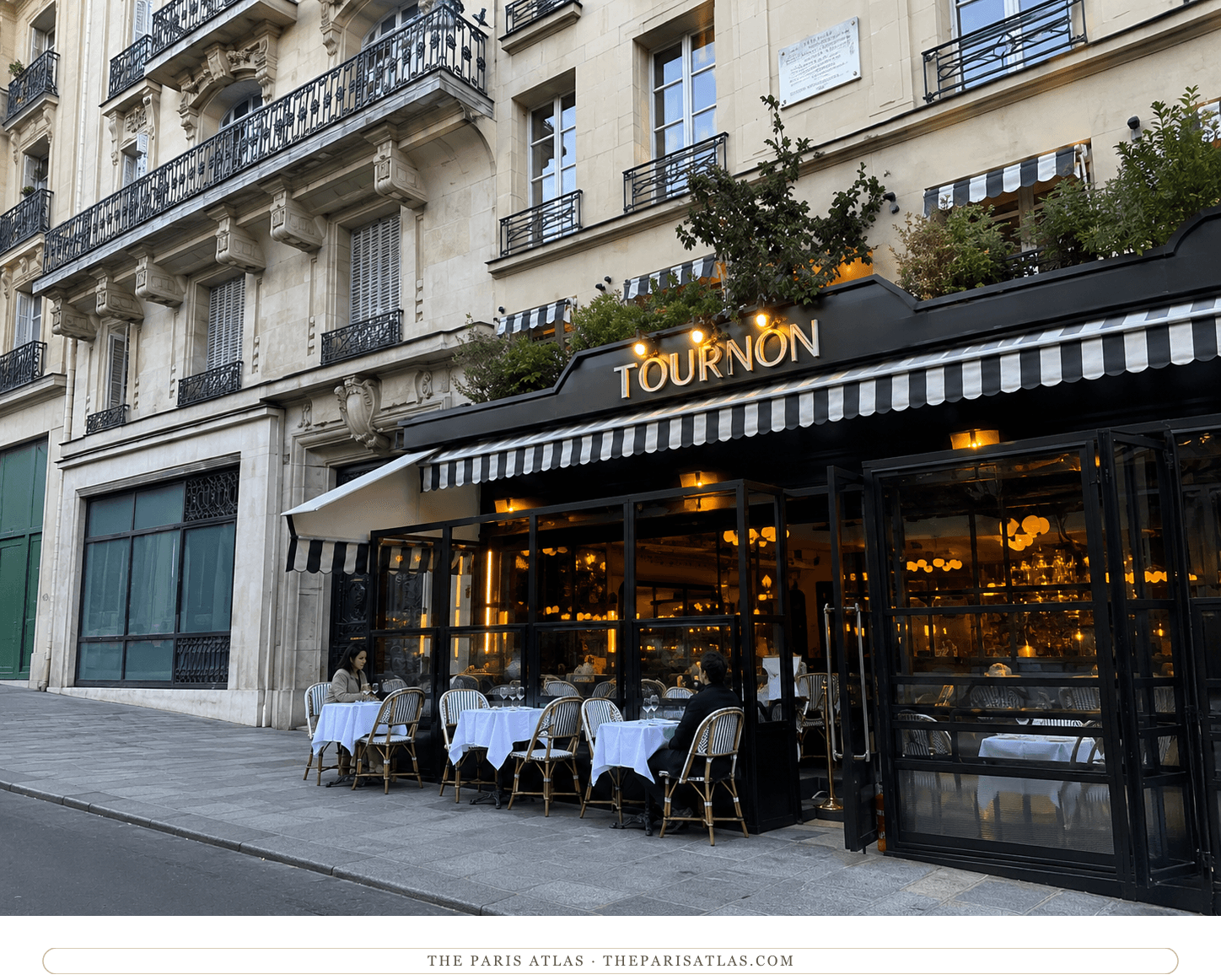
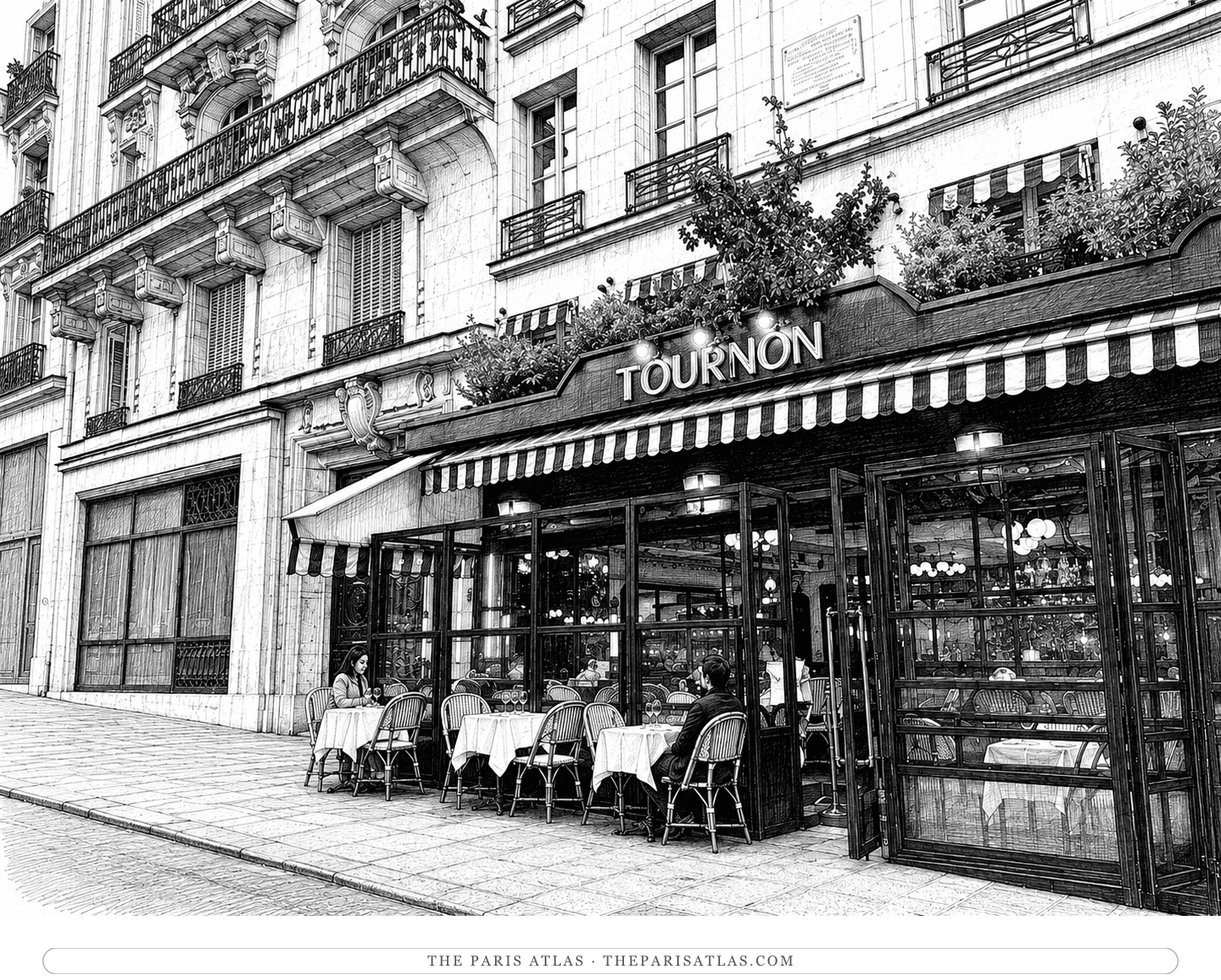
IllustrationLe Tournon today, black and white striped awning over terrace tables, warmly lit dining room behind the glass

The café after its renovation, lit for the evening.

Editorial illustration

The story

James Baldwin at the Tournon

Baldwin reached Paris in November 1948, at twenty-four, with essays and reviews behind him and no book; the Tournon circle assembled during exactly the years he was becoming a name. What he did here is less minutely recorded than what Richard Wright did, because the room's chroniclers — the novelist William Gardner Smith among them — sat at Wright's table. His documented tie is plainer: the city's listing of the café among his favorites, and friendships that ran through the room, above all with Beauford Delaney, his mentor since his New York teens.

The complication was the king. "Everybody's Protest Novel" had appeared in 1949 and the essays that followed kept the wound open, so Baldwin's seat at the Tournon was never quite inside Wright's court and never quite outside it. He wrote about that uneasy position for the rest of his life, most directly in the essays he published after Wright's death.

Joseph Roth's table

The café's literary history did not begin with the Americans. Joseph Roth, the Austrian novelist of the vanished Habsburg empire, had lived in exile at the Hôtel Foyot across the street; when the Foyot was condemned and demolished, he moved into the Hôtel de la Poste at number 18 in 1938 and made the café below his writing room. At his table he produced articles and polemics for the émigré press, argued with a circle of Austrian monarchists about the old world, and drew from the café's conversations the material of his last fiction, The Legend of the Holy Drinker among it.

Roth died in Paris in May 1939, months before the war he had spent six years predicting. The plaque on the façade remembers him.

The Gibson Affair

The circle's worst hour is remembered as the Gibson Affair. In the late 1950s a dispute between the writer Richard Gibson and Ollie Harrington — it began over a sublet apartment — escalated into something stranger: a letter on the Algerian war published over Harrington's name that he had not written, accusations of informing in every direction, and a fog of Cold War suspicion that settled over the tables. Who had done what for whom, and whether any of it involved the intelligence services, has been argued about ever since.

Richard Wright, by then convinced the community was watched, put the poisoned atmosphere into a novel set largely at the Tournon, Island of Hallucination. It has never been published. The affair scattered the circle it described; Wright died in 1960, and the café's great decade ended with him.

What it was like then

The room the writers knew was the ground floor of a modest hotel, not a landmark. The walls carried hand-painted views of the Luxembourg gardens that William Gardner Smith called "hideous" and nobody painted over; visitors decades later found the same murals, moleskin banquettes and zinc-topped bar still in place. It was cheaper than the famous cafés to the north, which was part of the point — a coffee bought a seat for the afternoon.

The arguments were about America, politics, and each other's pages, and by Smith's account the loudest sound in the room was laughter at Harrington's stories. The café's reach ran past literature: a photograph the waiters liked to show visitors caught Duke Ellington and Beauford Delaney together at one of the tables.

  • ThenThe ground floor of a modest hotel, cheaper than the famous cafés to the north
    NowA renovated café-restaurant serving French classics on weekdays
  • ThenHand-painted Luxembourg-gardens murals, moleskin banquettes, a zinc-topped bar
    NowA new interior; whether the murals survive behind it is unresolved
  • ThenRichard Wright's daily table, with Himes, Harrington and Delaney around it
    NowThe address and the room's footprint remain; Joseph Roth's plaque marks the façade

Visiting today

The Tournon still trades at the original address, a two-minute walk from the Luxembourg gardens and about ten minutes from the Odéon métro.

  • Current name: Le Tournon, 18 rue de Tournon, 6th arrondissement
  • Métro: Odéon (lines 4 and 10) or RER B Luxembourg
  • Open weekdays as of August 2026; listings for evenings and weekends have been unreliable since the renovation, so check before a special trip
  • What remains: the address, the room's footprint, and Joseph Roth's plaque outside; whether the postwar murals survive behind the new interior is unresolved
  • Worth the stop? Yes, for anyone tracing Black literary Paris — no other café held more of it

Last verified: August 2026.

Key facts

Address
18 rue de Tournon, 6th arrondissement, below the Senate
What it was
The daily gathering place of Black American writers in 1950s Paris
Notable regulars
Richard Wright, Chester Himes, Ollie Harrington, James Baldwin, Beauford Delaney, and the founders of The Paris Review
Today
Open weekdays as a café-restaurant after a long renovation; some map listings still show it temporarily closed
Prewar chapter
Joseph Roth wrote at the café in exile from 1938 until his death in 1939
The terrace on the rue de Tournon, below the Hôtel de la Poste's old rooms.Editorial illustration
The café after its renovation, lit for the evening.Editorial illustration

Timeline

  1. 1938

    Joseph Roth, exiled from Austria, moves into the Hôtel de la Poste above the café after the demolition of the Hôtel Foyot opposite, and writes at its tables.

  2. 1939

    Roth dies in Paris in May.

  3. 1950s

    Richard Wright makes the café his headquarters; the circle of Black American expatriate writers and artists forms around him.

  4. 1953

    The newly founded Paris Review's editors adopt the café as a gathering spot.

  5. late 1950s

    The Gibson Affair — a quarrel over a sublet entangled with Algerian-war politics and Cold War suspicion — breaks up the expatriate circle.

  6. 2021

    Closes for a renovation that drags on with no posted reopening date.

  7. Today

    Reopened as a café-restaurant; whether the postwar murals survived the new interior is unclear.

On the map

Writers who knew this place

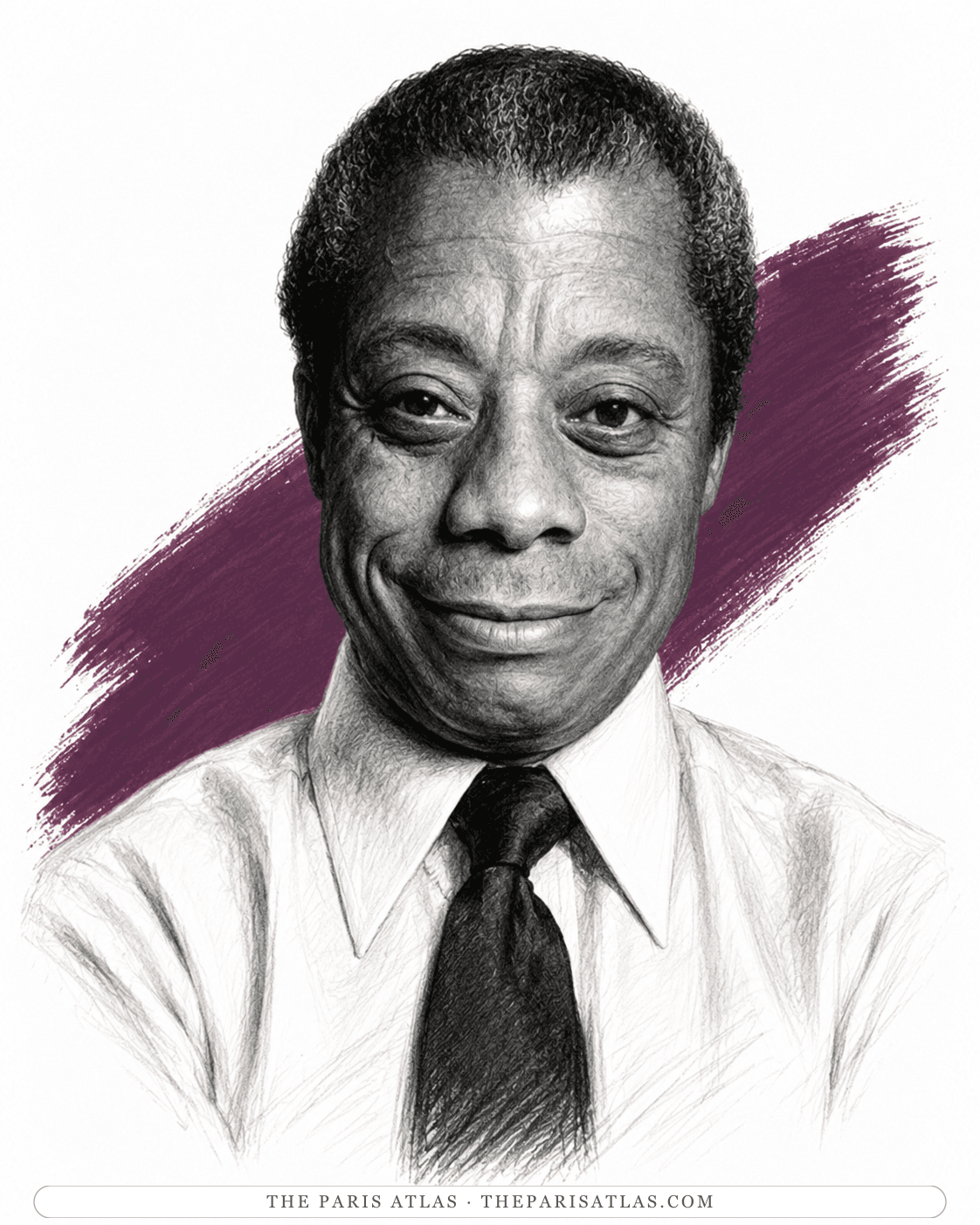
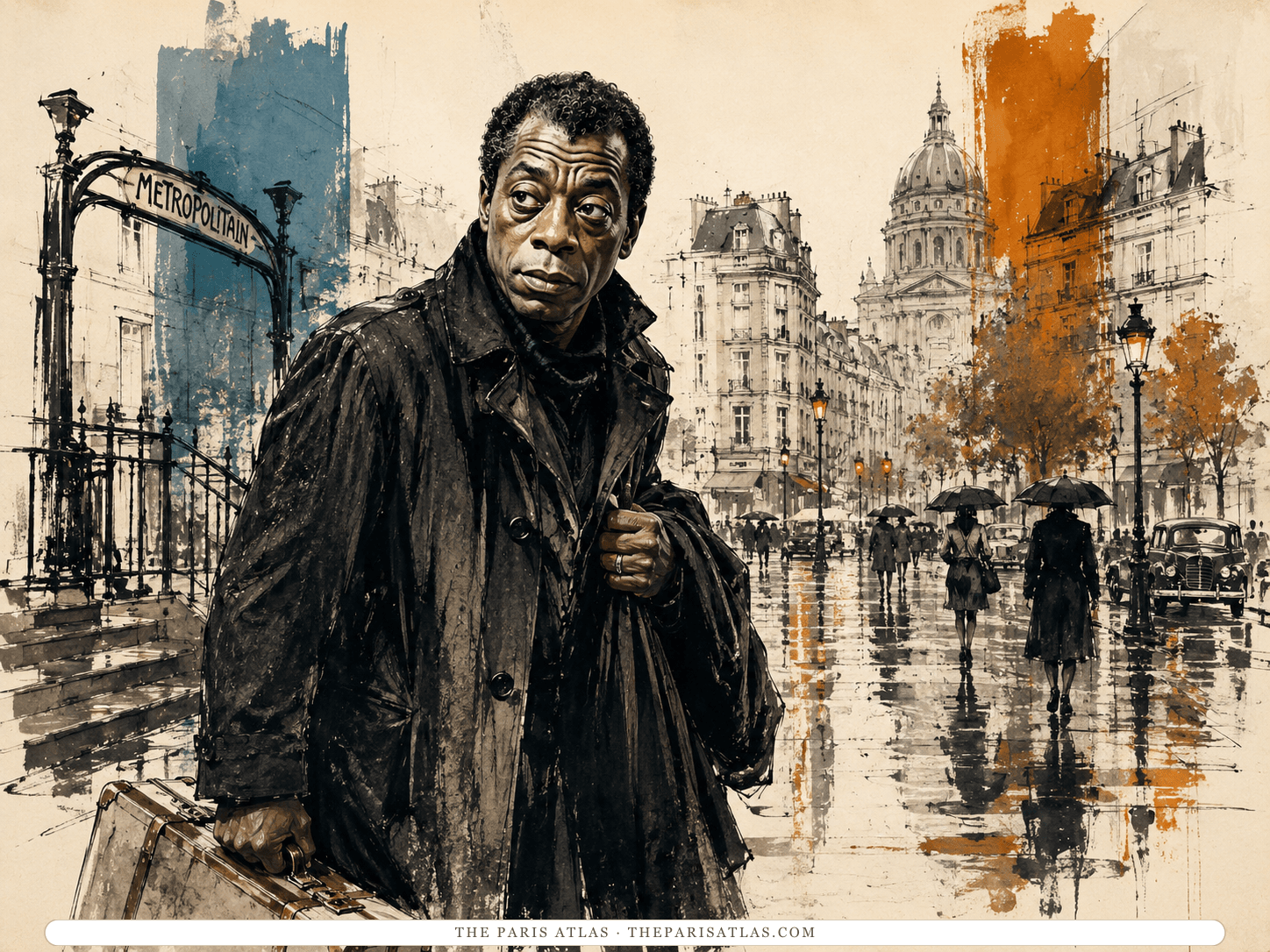
Illustrated portrait of James Baldwin

James Baldwin

American · American novelist and essayist who left Harlem for Paris at twenty-four with forty dollars, and wrote the books that made him the most quoted witness to race, sex and belonging in twentieth-century America.

Frequented by

The City of Paris names Le Tournon among Baldwin's favorite cafés. The room was also the daily headquarters of the Black American writers around Richard Wright in the early 1950s, which made it complicated ground for Baldwin after their public break.
Sur les traces de l'écrivain James Baldwin à Paris; What has become of the Café Tournon?

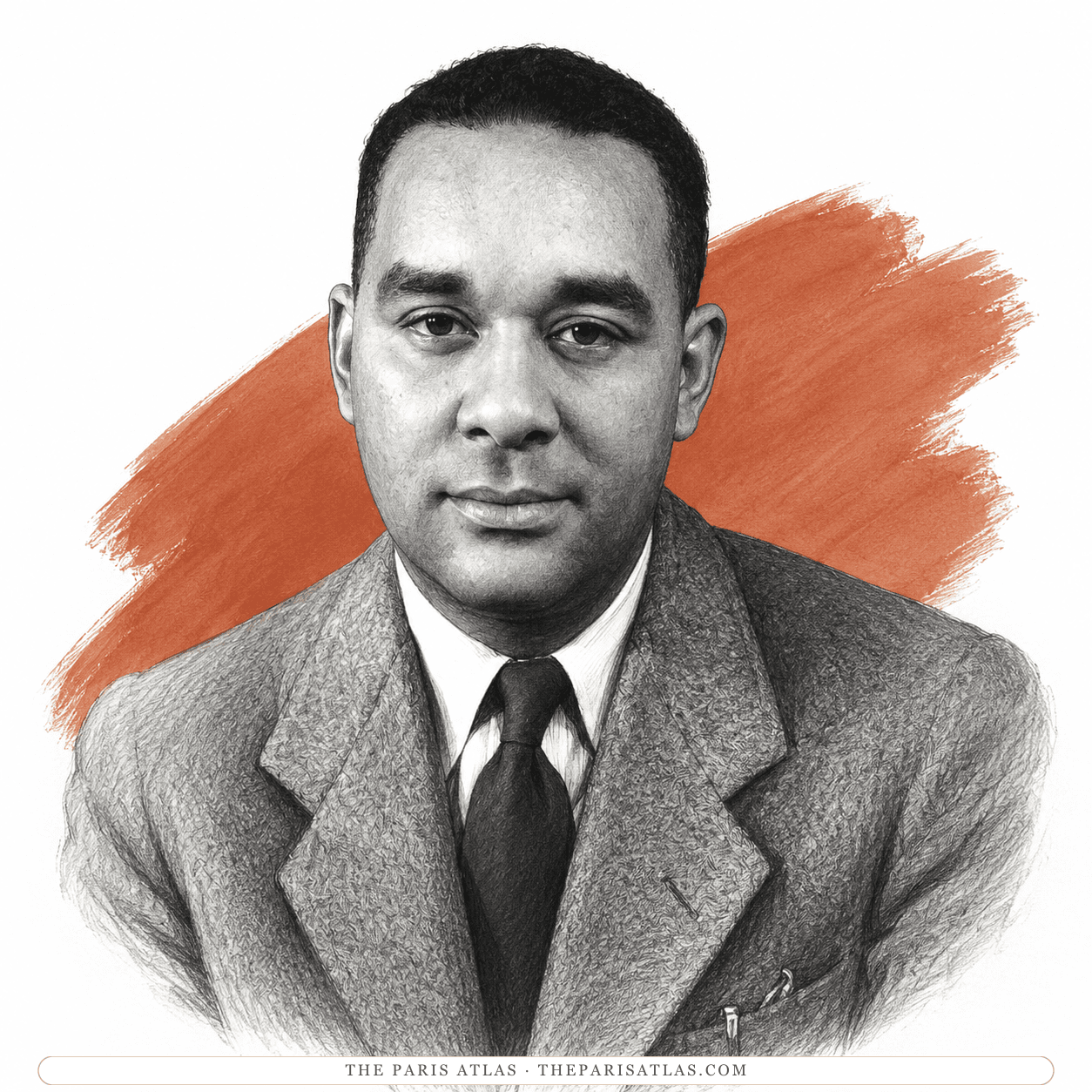
Illustrated portrait of Richard Wright

Richard Wright

American · American novelist whose Native Son made him the most famous Black writer in the country, and who moved to Paris in 1946; he helped the young James Baldwin win the fellowship that got him there, then never forgave him for the essay that followed.

Frequented by · 1950

Wright held court at the café below the Senate nearly every day in the early 1950s, and the circle of Black American expatriate writers and artists — Chester Himes, Ollie Harrington, Beauford Delaney among them — formed around his table.

What has become of the Café Tournon?

Guides featuring Le Tournon

Take them with you.

Within walking distance

The Friday Letter

Paris, one address at a time.

The cafés, studios, and walk-up flats where the work was made — one story from the map in every letter.

One email a week. No spam, no selling your address. Unsubscribe anytime.