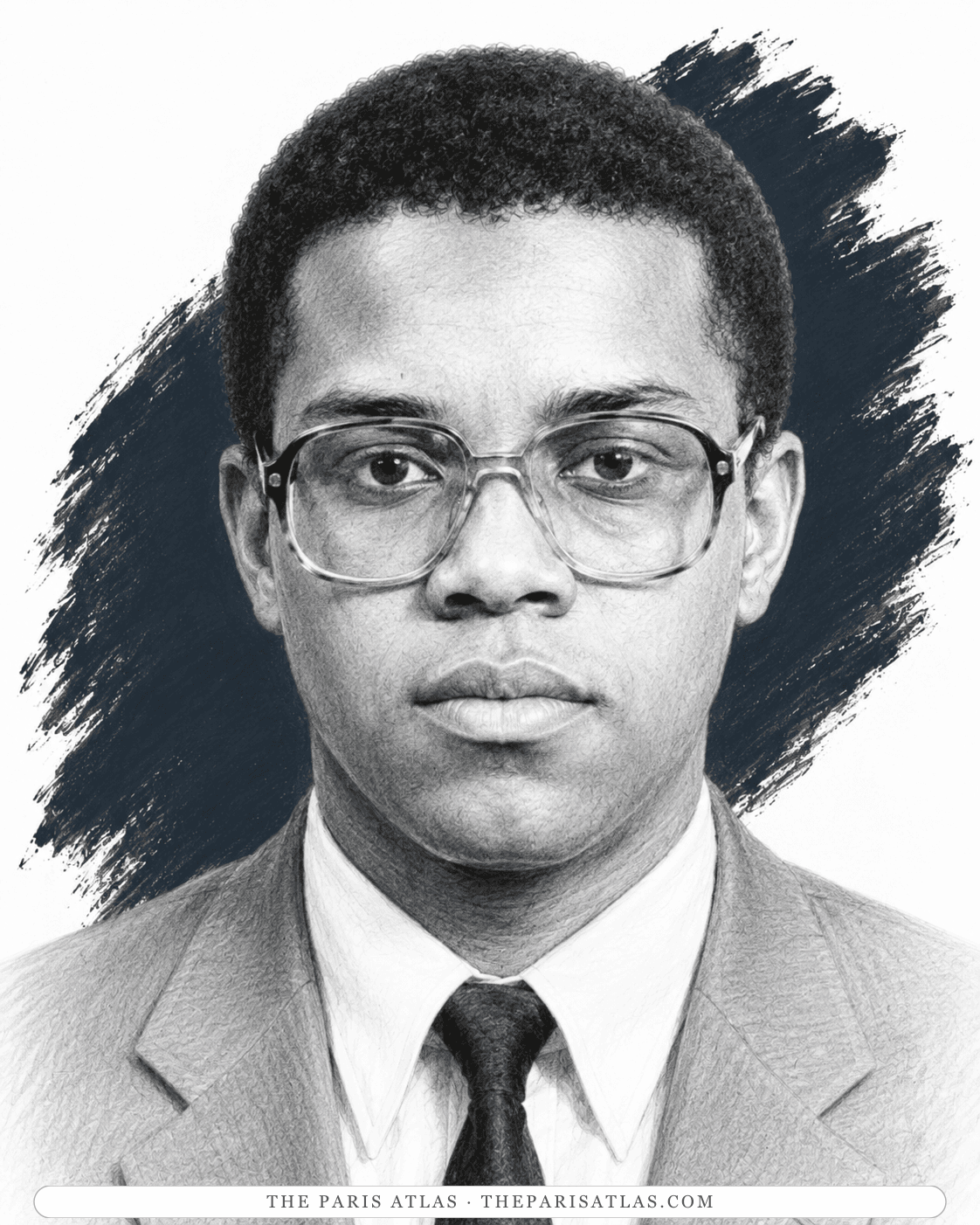
Wayne Williams
- Photographer
Depicts
Baldwin's last book of non-fiction is about the Williams trial and what Atlanta did with the verdict — not an argument that Williams was innocent, but that two convictions were used to close twenty-eight cases.

Baldwin goes to Atlanta to report on the murders of twenty-eight Black people, most of them children, and comes back unconvinced by the conviction.
James Baldwin's last book of non-fiction, published by Holt, Rinehart and Winston in 1985. Between 1979 and 1981, twenty-eight Black people were murdered in Atlanta, most of them children and adolescents. Wayne Williams was arrested in June 1981, tried the following January, convicted of killing two adult men, and given two life sentences; the remaining cases were closed on the strength of that verdict. Baldwin went to Atlanta on a magazine assignment, spoke to the families, and wrote a book about what the trial did and did not settle.
The assignment came from Playboy. Walter Lowe, the magazine's first Black editor, proposed that Baldwin cover the case, and the article grew into a book.[1]
Baldwin was sixty and had not lived in the United States full time for years, which he says plainly. The book is written from the position of someone returning to a city he did not know, asking questions of people who had been answering them for two years already. Among those he spoke to was Camille Bell, whose nine-year-old son Yusuf was one of the victims.[1]
He does not argue that Wayne Williams was innocent. He argues that a conviction on two adult victims was used to close twenty-eight cases, and that the speed of the closing had more to do with what Atlanta needed to be true than with what had been shown.[1]
It was his last major work of non-fiction. He died two years after it appeared.[1]
In the account of meeting Camille Bell quoted by Holly Lowe Jones, Baldwin cannot turn a bereaved mother into a conventional interview subject. His fear of intrusive curiosity interrupts the professional routine of asking questions. Listening instead gives Bell room to explain what she thinks the authorities have failed to understand. The writer's hesitation matters: sharing a racial history does not give him automatic knowledge of her loss. By showing the limits of his position, the passage asks the reader to attend to a particular person's knowledge before fitting her grief into an account of the case.
Discussing the book with Studs Terkel in 1985, Baldwin describes a reader's task: to examine with him what the state has established. He also admits his own wish for an explanation that would make the case easier to bear. That admission complicates the authority of the reporter, who must question his desire for reassurance as well as other people's conclusions. Read in this light, the book's invitation is demanding rather than comforting. An official ending cannot by itself resolve the questions of those whose lives the investigation has entered.
Names, dates, a courtroom, a defendant. His other late work argues; this one is tied to twenty-eight deaths and a single trial, and the constraint suits him.
Baldwin had lived in France for years and says so early, which is unusual in a book of this kind and gives the reporting its particular caution.
It is the final substantial thing he published in his lifetime, and it reads like a man checking whether anything he had argued for thirty years had held.
Depicts
Baldwin's last book of non-fiction is about the Williams trial and what Atlanta did with the verdict — not an argument that Williams was innocent, but that two convictions were used to close twenty-eight cases.
1979
The first of the Atlanta murders. Over roughly two years, twenty-eight Black people are killed, most of them children and adolescents.
1981
Wayne Williams is arrested on 21 June.
1982
His trial opens on 6 January. He is convicted of two adult murders and sentenced to two life terms; the remaining cases are closed.
1985
Holt, Rinehart and Winston publishes The Evidence of Things Not Seen, grown out of a Playboy assignment.
2023
Holt Paperbacks reissues it with a foreword by Stacey Abrams.


The other late book, and the one where he first writes at length about the courts through a case he followed personally.
Read our take
The book from twenty-two years earlier whose questions this one returns to, with the answers in.
Read our take
His earlier reporting from the American South, done when he was thirty-two rather than sixty.
Read our takeThe Atlanta murders of 1979 to 1981, in which twenty-eight Black people were killed, most of them children and adolescents. James Baldwin travelled to Atlanta on a magazine assignment, spoke to victims' families and observers, and wrote about the investigation, the trial of Wayne Williams, and what the city did with the verdict. It was published in 1985.
Wayne Williams, arrested in June 1981. At trial in early 1982 he was convicted of murdering two adults, Nathaniel Cater and Jimmy Payne, and sentenced to two consecutive life terms. He was never tried for the deaths of any of the children. Police nonetheless closed most of the remaining cases after the verdict, and that decision is Baldwin's subject.
No. He does not make that claim. His argument is about the closing of twenty-six further cases on the strength of a conviction for two others, and about how quickly a city under national attention accepted an ending.
Hebrews 11:1: "Now faith is the substance of things hoped for, the evidence of things not seen." Baldwin applies the phrase to a prosecution built on what could not be shown directly.
It is his last book of non-fiction, published in 1985, two years before he died at Saint-Paul-de-Vence. A volume of poems, Jimmy's Blues, had appeared in 1983, and The Price of the Ticket, collecting his non-fiction to that point, came out the same year as this one.
About 125 pages in the first edition, 144 in the current Holt Paperbacks reissue, which adds a foreword by Stacey Abrams.
Explore authors with a similar voice, perspective, and influence.

The doctor of the Paris slums who wrote the century's blackest, funniest novel — and changed the sound of French prose.
View author
The Brooklyn dropout who arrived in Paris broke at thirty-eight and wrote the exuberant, banned books that ended American censorship.
View author
Author of The Sun Also Rises and A Moveable Feast; his pared-down style, developed in 1920s Paris, became the most imitated in American prose.
View authorThe sources below include the primary text, editions, scholarship, archival materials, and other records that informed this page. They document The Evidence of Things Not Seen, its publication, and its place in literary history.


Used for the primary Bell passages quoted by Lowe Jones, not a claim to have read the complete book or collated its first edition.
Public interview transcript, broadcast 22 November 1985; used for Baldwin's explanation of the reader's task and his own desire for reassurance, not an independent verdict on the case.

Used for archival and bibliographic context surrounding The Evidence of Things Not Seen within Baldwin's papers and career.
Used for independent biographical and publication context for The Evidence of Things Not Seen.
Used to connect The Evidence of Things Not Seen to Baldwin's transatlantic life and intellectual development.
Used to verify James Baldwin's bibliography and place The Evidence of Things Not Seen within the broader chronology of James Baldwin's career.
The primary text is the baseline reference for every book page. Additional references document publication history, interpretation, and historical context where that evidence is available.
 Explore more resources