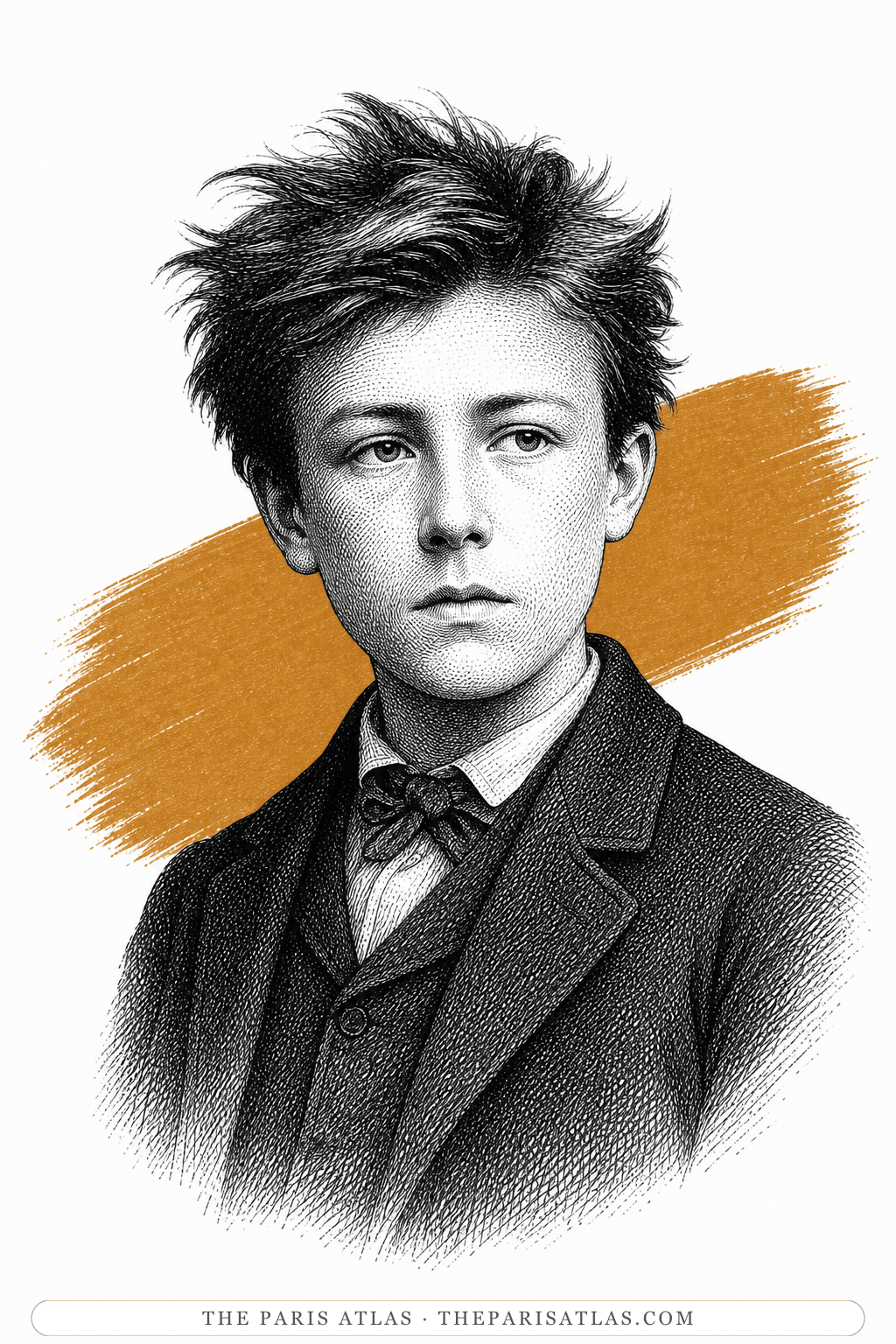
The Paris AtlasCharting the artists, works, and places worth returning to.
  • Poet
  • Critic
· French · 1844–1896

Paul Verlaine

The Symbolist poet — one of the generation who wanted verse to suggest rather than state — whose musical, atmospheric lines became one of the composer Claude Debussy's richest sources for song. His life was the opposite of delicate: a marriage burned down for the teenage Arthur Rimbaud, two years in a Belgian prison for shooting him, a conversion to Catholicism, and a long decline on absinthe, the strong green spirit that was the era's cheap ruin, through the cafés of the Latin Quarter — the student district on the Left Bank — that ended in a rented room on the rue Descartes.

Details

Lived
1844–1896
Born
30 March 1844
Birthplace
Metz, Moselle, France
Died
8 January 1896 · aged 51
Place of death
Paris, France
Nationality
French
Profession
Poet and critic
Major works
Poèmes saturniens ("Saturnine Poems"), Fêtes galantes ("Gallant Festivities"), Romances sans paroles ("Songs Without Words"), Sagesse ("Wisdom"), Les Poètes maudits ("The Accursed Poets"), Jadis et naguère ("Long Ago and Not So Long Ago")
Married
Mathilde Mauté de Fleurville · 1870–1885
Partner
Arthur Rimbaud · 1871–1873
Roles
PoetCritic

About Paul Verlaine

Paul Verlaine was born in Metz, in eastern France, on 30 March 1844, and died in Paris on 8 January 1896. He is the poet French readers hear before they understand — verse built for the ear, full of half-tones, hesitations and lines that will not sit squarely on the beat. His own slogan for it, from the poem "Art poétique", is the most quoted line of French poetics after Charles Baudelaire, the poet of Les Fleurs du mal ("The Flowers of Evil") from whom modern French verse is usually dated: "De la musique avant toute chose" — "music before everything else". Composers agreed. The composers Claude Debussy, Gabriel Fauré and Reynaldo Hahn all built songs on his poems, and the Bibliothèque nationale de France — France's national library, which keeps the official record of every French author — lists those settings as part of his identity.

The life ran the other way. A clerk at the Paris city hall who drank, he married nineteen-year-old Mathilde Mauté in 1870 and had a son; a year later the sixteen-year-old Arthur Rimbaud arrived in the house at Verlaine's own invitation, and the marriage was over within months. The two poets wandered Belgium and England together until 10 July 1873, when Verlaine, drunk in a Brussels hotel room, shot Rimbaud in the wrist and was sentenced to two years in the prison at Mons. He came out a Catholic convert and a better poet, taught school, drank again, and spent his last decade as the most famous ruin in the Latin Quarter — moving between cafés, cheap rooms and public hospital wards while young poets elected him Prince of Poets — an honorary title with no money attached — and came to look at him.

The clerk at the Hôtel de Ville

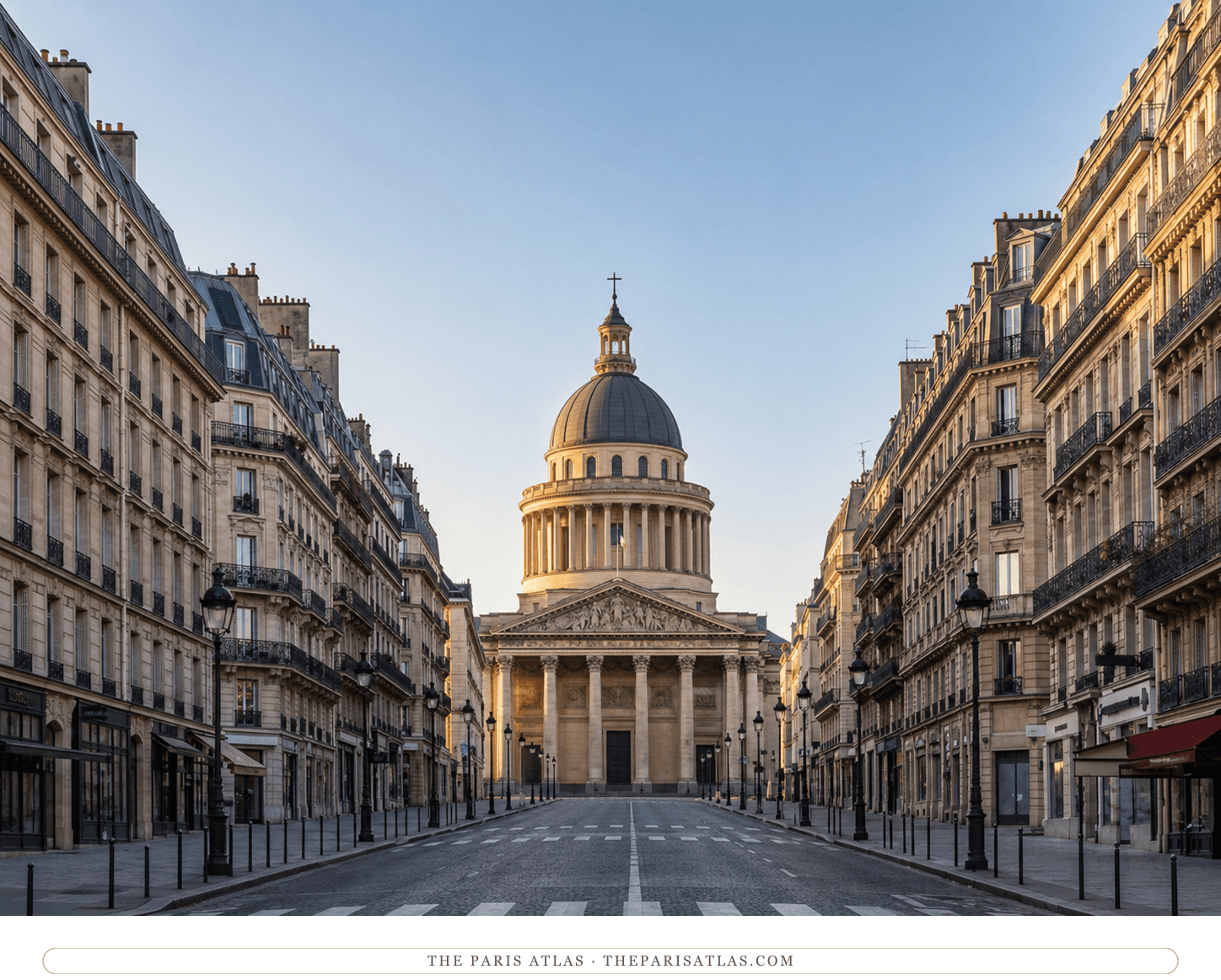
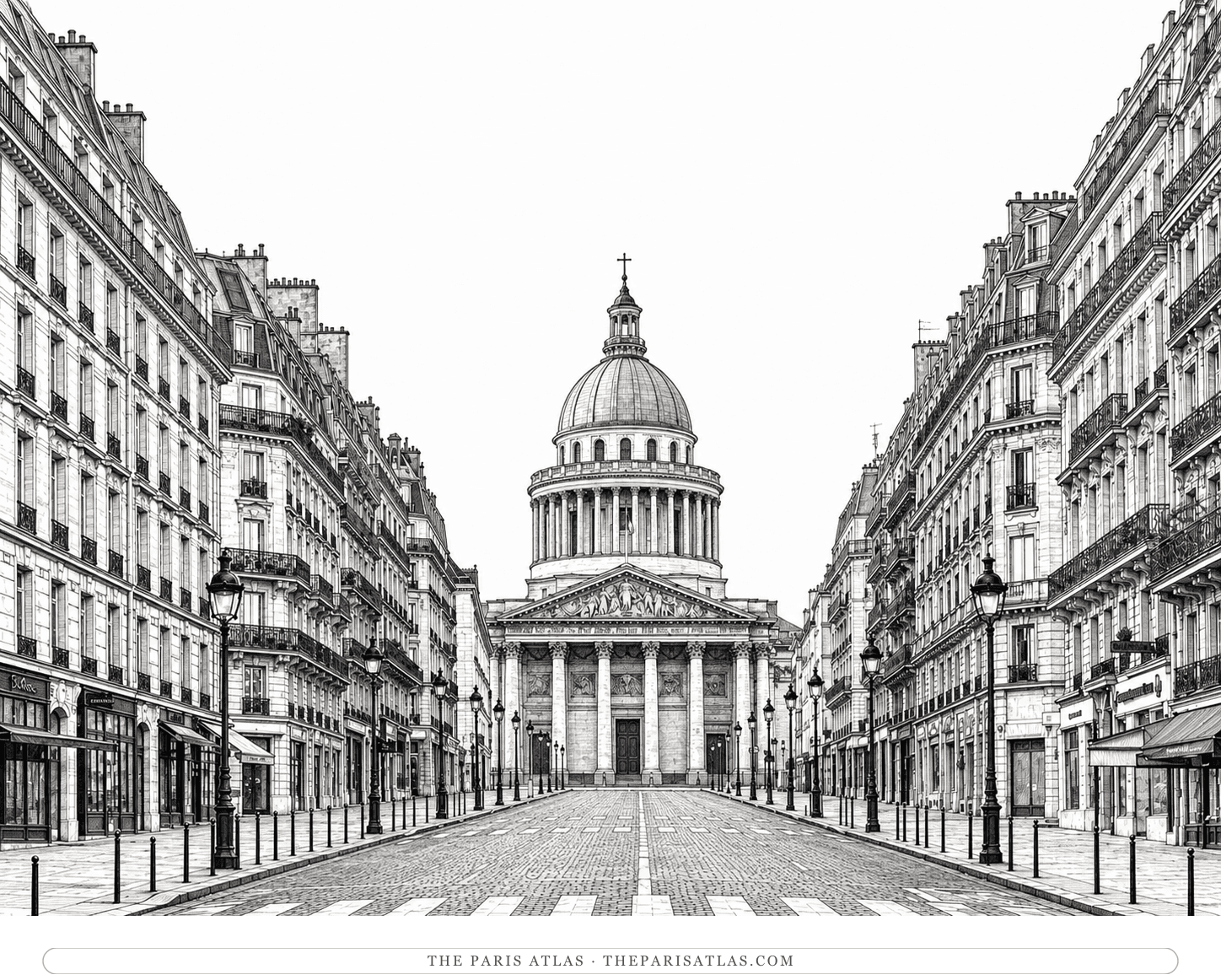
Verlaine was born on 30 March 1844 at Metz, where his father was an army officer, and the family moved to Paris in 1851 — so he was a Paris child from the age of seven. He took his baccalauréat, the French school leaving certificate, in 1862, and at twenty went into the civil service as an expéditionnaire, a copying clerk, at the Hôtel de Ville, the city hall of Paris. It was a job for a young man with evenings free, and he spent them in the ale houses of the rue Soufflot, the short street that runs from the Luxembourg gardens up to the Panthéon — the domed monument where France buries its national figures — in the Latin Quarter, the student and publishing district on the Left Bank, among the young poets of the day.

What set him writing was Charles Baudelaire's Les Fleurs du mal ("The Flowers of Evil", 1857), the book that had been prosecuted for obscenity and had made modern city life a subject for poetry. Verlaine's first collection, Poèmes saturniens ("Saturnine Poems", 1866), appeared while he was still clerking, and he published alongside the Parnassians — the group of poets who wanted verse impersonal, sculpted and exact. He was never really one of them. Fêtes galantes ("Gallant Festivities", 1869), a set of small poems about masked figures in eighteenth-century parkland, is already unmistakably his: nothing quite stated, everything shaded, the whole thing hovering.

Music before everything

Verlaine's poems ask to be heard rather than parsed. He liked lines with an odd number of syllables, which never fall into a marching rhythm; he blurred rhyme where French poetry demanded it crisp; he preferred a mood at dusk to a statement at noon. He set out the programme in "Art poétique", written in prison in the 1870s and printed in Jadis et naguère ("Long Ago and Not So Long Ago", 1884), and its opening line became the motto of the Symbolists, the generation of poets who wanted suggestion instead of description.

Music before everything else

De la musique avant toute chose

Paul Verlaine, "Art poétique", published in Jadis et naguère (1884)

Composers took him at his word. Claude Debussy, who set him repeatedly, found in these poems the loose, floating relation between words and harmony that he was after; Gabriel Fauré and Reynaldo Hahn set him too, and the national library's own catalogue notes the settings as a defining fact of the work. It is why a reader who knows no French poetry at all has probably heard Verlaine — as the words under a mélodie, the French art song, in a concert hall.

The marriage he burned down

On 11 August 1870 Verlaine married Mathilde Mauté de Fleurville, sixteen when they met and nineteen at the wedding, and gave her La Bonne Chanson ("The Good Song"), a book of gentle poems written in the courtship. They lived in her parents' house; a son, Georges, was born in October 1871. Verlaine's drinking was already violent, and the collapse of the Paris Commune — the revolutionary city government of spring 1871, which he had served under as a press officer at the Hôtel de Ville — had left him without a job and afraid of reprisals.

Into that household, in September 1871, came a sixteen-year-old from the Ardennes whom Verlaine had invited on the strength of poems sent by post. Arthur Rimbaud was rude, unwashed and better than anyone at the table; Mathilde's parents, the Mautés, threw him out within weeks, and Verlaine took rooms for him elsewhere. By the following summer Verlaine had left his wife and infant son to travel with him. Mathilde pursued a legal separation; the divorce came through in 1885, and she published her side of it, Mémoires de ma vie ("Memories of My Life"), long after his death.

Brussels, and two years in a Belgian prison

The two poets spent about two years moving between Paris, Brussels and London, teaching a little French, quarrelling and separating and coming back. On 10 July 1873, in a Brussels hotel room, Verlaine — drunk, and certain that Rimbaud was leaving for good — bought a revolver and fired two shots, wounding him in the wrist. Rimbaud was treated at hospital and appealed to a policeman when Verlaine followed him through the street. The Belgian court sentenced Verlaine to two years; he served about eighteen months, most of it at Mons, and was released in January 1875.

Prison made him a Catholic — a genuine conversion, not a pose, and the source of the religious poems of Sagesse ("Wisdom", 1881), which many readers still think his best book. It also gave him time to write: Romances sans paroles ("Songs Without Words", 1874), the collection that came out of the wandering years with Rimbaud, was published while he was inside, and he read Shakespeare and Cervantes in his cell. He came out at thirty, sober, devout and unemployable, and went to teach English schoolboys — first in Lincolnshire, then in the Ardennes, where a pupil named Lucien Létinois became the great attachment of his middle life. Létinois died of typhoid in 1883, and Verlaine wrote the book Amour ("Love", 1888) around the loss.

The Latin Quarter's famous ruin

Back in Paris in the 1880s, broke and drinking again, Verlaine did the single most consequential thing of his later career: he wrote about other people. Les Poètes maudits ("The Accursed Poets", 1884) is a set of essays introducing poets almost nobody had read — Tristan Corbière, Stéphane Mallarmé, and above all Rimbaud, whose work Verlaine quoted at length and effectively launched. He included himself in the last chapter as "Pauvre Lélian" ("Poor Lélian"), a name whose letters are an anagram of Paul Verlaine. The book invented a category the French language still uses: the poète maudit, the doomed poet whose life wrecks itself while the work survives.

He then became one. The last decade was lived in public in the Latin Quarter: absinthe — the strong green anise spirit that was the era's cheap ruin — in the cafés of the boulevard Saint-Michel, rented rooms he could not pay for, stretches in the public hospitals (Broussais, Saint-Louis, Bichat) where he was treated for the leg ulcers, diabetes and drink, and wrote while in the ward. Two women, Philomène Boudin and Eugénie Krantz, kept and fought over him by turns. Young writers made pilgrimages to whichever café he was in, and in August 1894, after the death of the poet Leconte de Lisle, who had held the title before him, his fellow writers voted him Prince des Poètes, Prince of Poets — an honorary title, carrying no money, given to a man living on charity.

39 rue Descartes

He died on 8 January 1896 of pulmonary congestion, in a rented room at 39 rue Descartes, a steep street on the Montagne Sainte-Geneviève — the hill that carries the Latin Quarter up behind the Panthéon — in the 5th arrondissement, a few minutes' walk from the ale houses of his twenties. Eugénie Krantz was with him. The Bibliothèque nationale de France records the death simply: Paris, 5e arrondissement, 8 January 1896.

The funeral, two days later, was enormous. The coffin went to the church of Saint-Étienne-du-Mont beside the Panthéon — Gabriel Fauré played the organ — and then across Paris to the cimetière des Batignolles, the Batignolles cemetery in the north-west of the city, followed by a crowd of writers and readers, with speeches at the grave from the poets who had made him their prince. It was the largest literary funeral Paris had seen in years, for a man who had spent the previous winter in a hospital bed and who had, by his own arithmetic, ruined nearly everything except the poems.

Life events

  1. 1844

    Born on 30 March at Metz, in eastern France, the son of an army officer.

    Verlaine, Paul (1844-1896); Paul Verlaine

  2. 1851

    The family moves to Paris, where he is schooled; he takes his baccalauréat in 1862 and at twenty becomes a copying clerk at the Hôtel de Ville, the city hall.

    Paul Verlaine; Paul Verlaine

  3. 1866

    Publishes his first collection, Poèmes saturniens ("Saturnine Poems"), written under the influence of Charles Baudelaire's Les Fleurs du mal ("The Flowers of Evil"), and appears alongside the Parnassian poets, who wanted verse impersonal and exactly carved.

    Paul Verlaine; Paul Verlaine

  4. 1869

    Fêtes galantes ("Gallant Festivities") — masked figures in eighteenth-century parkland — confirms the shaded, musical manner that becomes his signature.

    Paul Verlaine

  5. 1870

    Marries Mathilde Mauté de Fleurville on 11 August and dedicates La Bonne Chanson ("The Good Song") to her.

    Paul Verlaine; Paul Verlaine

  6. 1871

    Arthur Rimbaud, sixteen and invited by Verlaine on the strength of poems sent by post, arrives at the couple's household in September; the marriage does not survive it.

    Paul Verlaine; Paul Verlaine

  7. 1872

    Leaves his wife and infant son to travel with Rimbaud through Belgium and England.

    Paul Verlaine

  8. 1873

    On 10 July, drunk in a Brussels hotel room, fires two revolver shots at Rimbaud and wounds him in the wrist; he is sentenced to two years and imprisoned at Mons.

    Paul Verlaine; Paul Verlaine

  9. 1874

    Romances sans paroles ("Songs Without Words"), written across the Rimbaud years, is published while he is in prison; in his cell he converts to Catholicism.

    Paul Verlaine; Paul Verlaine

  10. 1881

    Sagesse ("Wisdom") gathers the religious poems of the conversion — for many readers the summit of his work.

    Paul Verlaine

  11. 1883

    Lucien Létinois, his former pupil and the great attachment of his middle years, dies of typhoid; the book Amour (1888) comes out of the loss.

    Paul Verlaine

  12. 1884

    Les Poètes maudits ("The Accursed Poets") introduces the poets Tristan Corbière, Stéphane Mallarmé and Arthur Rimbaud to readers who had never heard of them, and adds himself under the anagram "Pauvre Lélian"; Jadis et naguère ("Long Ago and Not So Long Ago") prints "Art poétique" and its line "De la musique avant toute chose" — "music before everything else".

    Paul Verlaine

  13. 1894

    Elected Prince des Poètes — Prince of Poets — by his fellow writers in August, while living on charity between cafés and hospital wards.

    Paul Verlaine; Paul Verlaine

  14. 1896

    Dies of pulmonary congestion on 8 January in a rented room at 39 rue Descartes, in the 5th arrondissement; two days later a large public funeral goes from Saint-Étienne-du-Mont to the cimetière des Batignolles.

    Verlaine, Paul (1844-1896); Paul Verlaine; Joanna Richardson, Verlaine (1971)

People they knew

Documented connections — every one carries its source.

Arthur Rimbaud

  • Poet

Partner of · 1871–1873

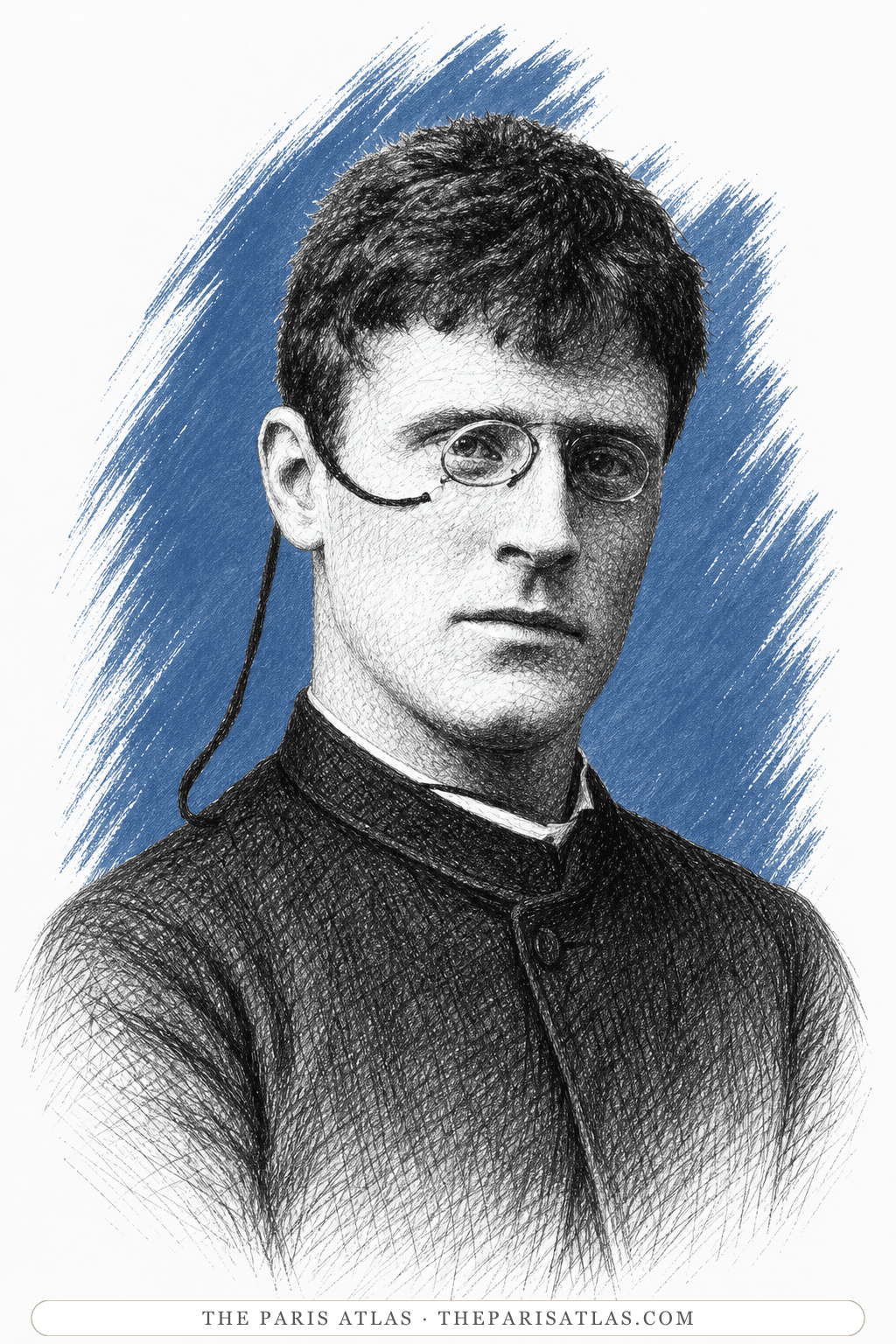
The most consequential love affair in French poetry, and one of the shortest. Verlaine, married in August 1870 and a father by October 1871, left his wife Mathilde and their infant son in 1872 to travel with Rimbaud, ten years his junior; the two lived between Paris, Brussels and London for roughly two years, writing the poems that became Romances sans paroles and Illuminations. It ended on 10 July 1873, when Verlaine, drunk in a Brussels hotel room, fired two revolver shots and wounded Rimbaud in the wrist — for which he served about eighteen months of a two-year sentence in the Belgian prison at Mons.

Paul Verlaine; Arthur Rimbaud; Arthur Rimbaud; Paul Verlaine

Met · 1871

They met by post before they met in person: in the summer of 1871 the sixteen-year-old Rimbaud sent poems from Charleville to Verlaine, an established Paris poet of twenty-seven, who answered with an invitation to come and stay. Rimbaud arrived in Paris in September 1871 carrying the manuscript of "Le Bateau ivre" and read it to the Vilains Bonshommes, the monthly dinner club of Paris poets Verlaine brought him to.
Arthur Rimbaud; Paul Verlaine; Paul Verlaine

Who they drew from

Influence running inward — the writers and artists whose work fed theirs. Admiration is not acquaintance; these edges claim neither a meeting nor a friendship.

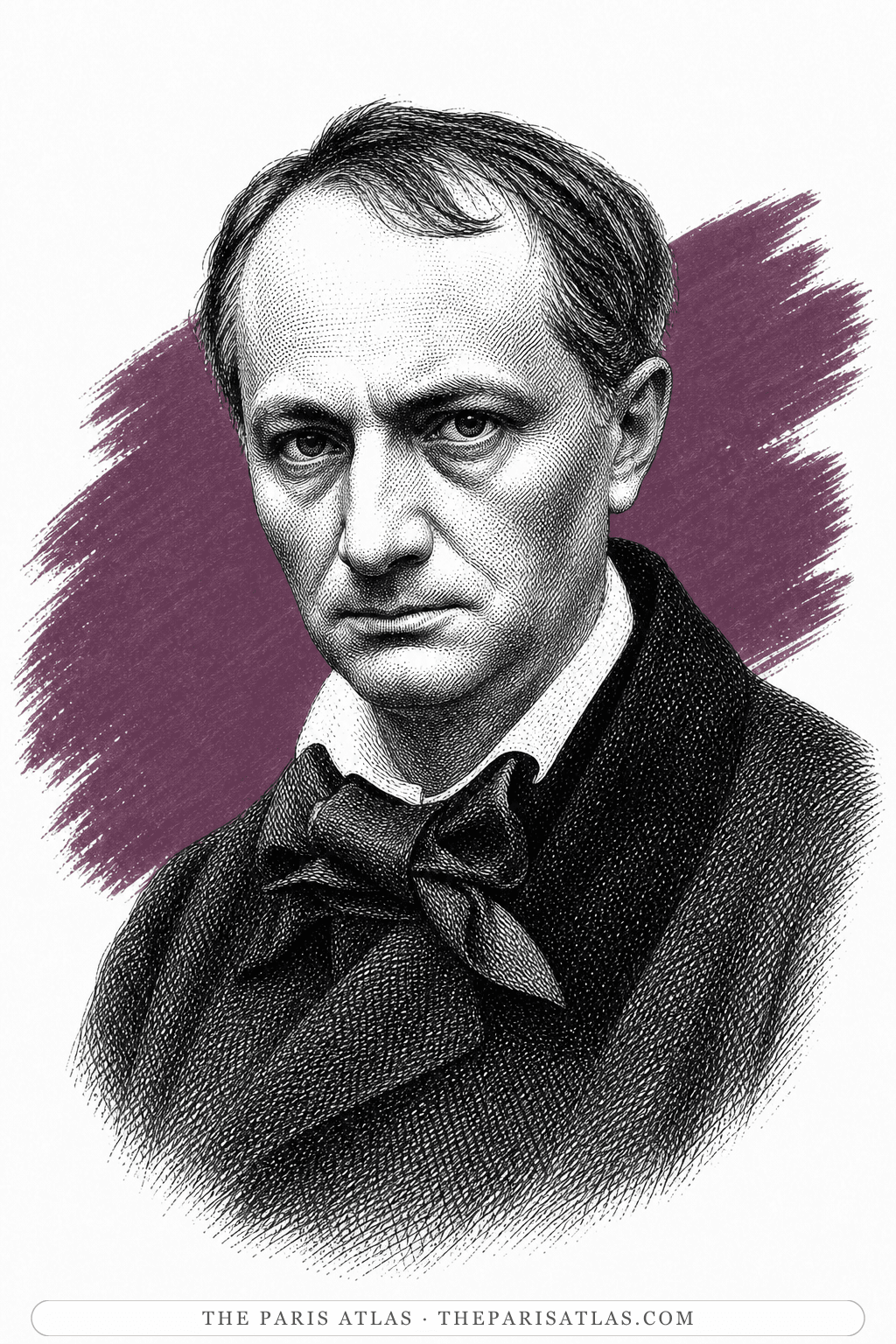
Charles Baudelaire

Verlaine's first collection, Poèmes saturniens (1866), was written under the direct impression of Baudelaire's Les Fleurs du mal (1857) — the book that had been prosecuted for obscenity and had made modern city life a subject for serious poetry. Larousse records Baudelaire as "admiré d'emblée par Rimbaud, Verlaine et Mallarmé" and as the poet who turned French verse towards Symbolism, the movement that would later take Verlaine's "Art poétique" for its motto.

Paul Verlaine; Charles Baudelaire

Who drew from them

Influence running outward — the writers and artists who built on their work.

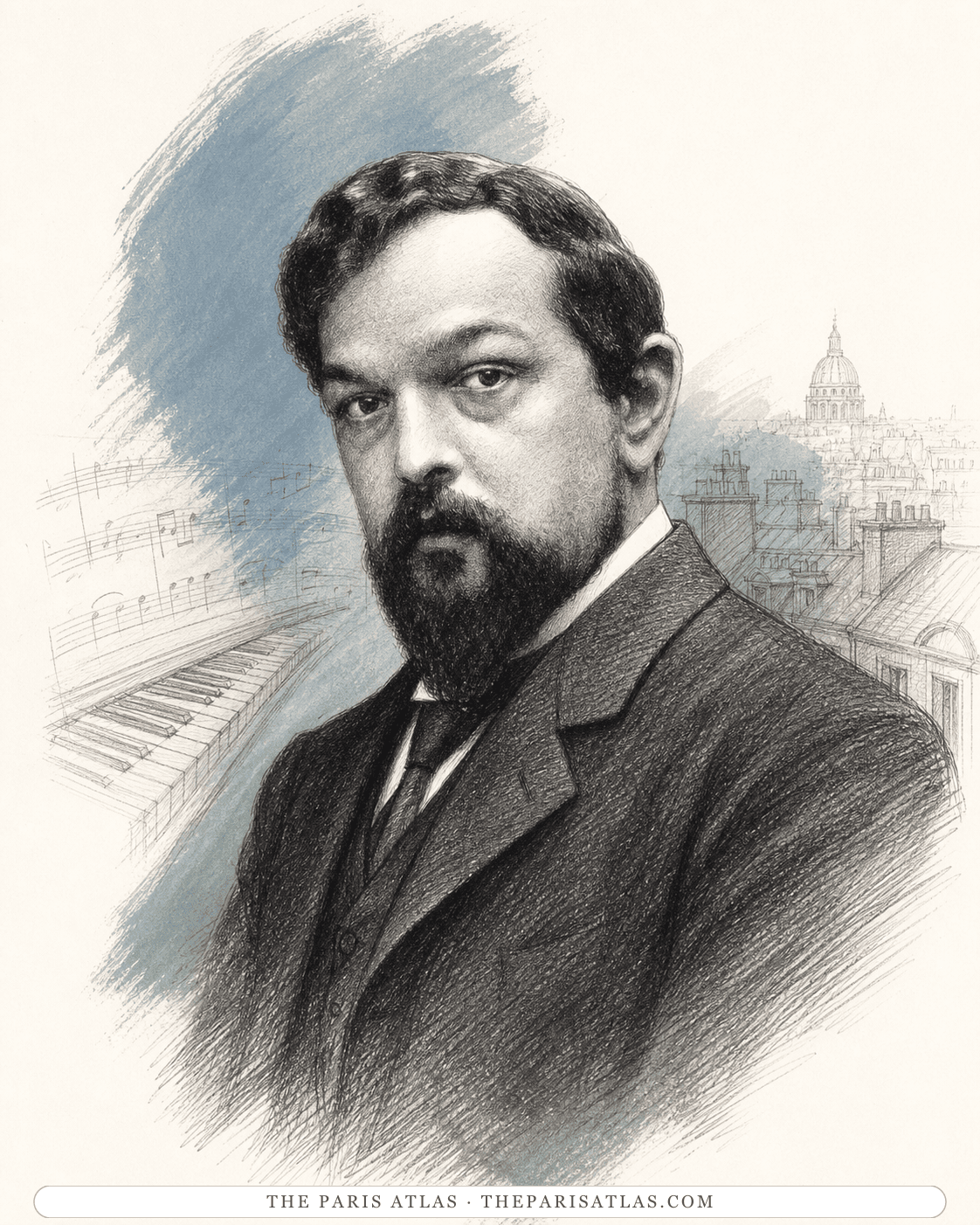
Illustrated portrait of Claude Debussy

Claude Debussy

Verlaine's musical, atmospheric poetry became one of Debussy's richest sources for song. Debussy repeatedly returned to his poems while developing the subtle relationship between language and harmony that became central to his vocal style.

Caroline Potter, Relationships with Poets and Other Literary Figures — Debussy in Context (2024)

Paul Verlaine’s Places

The cataloged places connected to Paul Verlaine — through the books, and through the documented record.

Places you can enter today appear first, followed by addresses to see from outside and sites that have vanished.

Questions about Paul Verlaine

What does "De la musique avant toute chose" mean?

"Music before everything else" — the opening line of Verlaine's poem "Art poétique", printed in Jadis et naguère (1884). It is an instruction to poets: put sound and suggestion first, prefer the shaded word to the exact one, use rhythms that do not march, and leave rhetoric out. The line became the motto of the Symbolist generation and is still the standard shorthand for what Verlaine's own verse does.

Did Paul Verlaine shoot Rimbaud?

Yes. On 10 July 1873, in a Brussels hotel room, Verlaine — drunk and desperate that Arthur Rimbaud was leaving him — bought a revolver and fired two shots, wounding Rimbaud in the wrist. Rimbaud was treated at hospital, and when Verlaine followed him through the street afterwards he appealed to a policeman. Verlaine was arrested, tried, and sentenced to two years' imprisonment; he served about eighteen months, mostly at Mons in Belgium.

Were Verlaine and Rimbaud lovers?

Yes, and it was the central scandal of both lives. Verlaine, twenty-seven and newly married, invited the sixteen-year-old Rimbaud to Paris in September 1871 after reading poems he had posted; within a year Verlaine had left his wife and baby son and the two were travelling together through Belgium and England. The relationship lasted roughly two years and ended with the Brussels shooting in July 1873.

Why did Verlaine go to prison?

For shooting Rimbaud in Brussels on 10 July 1873. The Belgian court gave him two years, and he served about eighteen months, chiefly in the prison at Mons. It was the most productive confinement in French poetry: he converted to Catholicism there, wrote the poems that became Sagesse (1881) and "Art poétique", and saw Romances sans paroles published (1874) while he was still inside.

What are Les Poètes maudits?

A short book of essays Verlaine published in 1884 — the title means "The Accursed Poets" — introducing poets who were then almost unknown: Tristan Corbière, Stéphane Mallarmé, Marceline Desbordes-Valmore, Villiers de l'Isle-Adam, and Arthur Rimbaud, whom he quoted at length. He put himself in it too, under the anagram "Pauvre Lélian". The book made Rimbaud's reputation in Paris, and gave French the phrase poète maudit for a poet whose life destroys itself while the work lasts.

Where did Paul Verlaine die, and where is he buried?

He died on 8 January 1896, of pulmonary congestion, in a rented room at 39 rue Descartes in the 5th arrondissement — the Latin Quarter he had drunk his way through since he was twenty. The Bibliothèque nationale de France records the death in the 5th arrondissement on that date. The funeral, two days later, was held at Saint-Étienne-du-Mont near the Panthéon, with Gabriel Fauré at the organ, and he was buried in the cimetière des Batignolles in the north-west of Paris.

Did Debussy set Verlaine's poems to music?

Repeatedly — Verlaine is one of the poets Claude Debussy returned to most, and the songs are where many listeners first meet him. Gabriel Fauré and Reynaldo Hahn set him as well, and the Bibliothèque nationale de France's authority record for Verlaine names all three composers, which tells you how inseparable the settings are from his reputation. It is the practical proof of "music before everything": the verse was already halfway to song.

Was Verlaine a Symbolist?

He is always filed there, and the Symbolists — the poets of the 1880s who wanted suggestion rather than statement — took "Art poétique" as their manifesto and elected him Prince of Poets in 1894. But Verlaine started out publishing with the Parnassians, who wanted the opposite (impersonal, precisely carved verse), joined no school, and signed no programme. Like Baudelaire before him, he was adopted by a movement rather than founding one.

Sourced claims

Every connection the graph holds for Paul, with the evidence behind it.

Influenced

Claude Debussy

Verlaine's musical, atmospheric poetry became one of Debussy's richest sources for song. Debussy repeatedly returned to his poems while developing the subtle relationship between language and harmony that became central to his vocal style.

Caroline Potter, Relationships with Poets and Other Literary Figures — Debussy in Context (2024)

Frequented · 1864

Rue Soufflot

As a young copying clerk at the Hôtel de Ville in the mid-1860s, Verlaine spent his evenings in the ale houses of the rue Soufflot — the short street running from the Luxembourg gardens up to the Panthéon — among the poets who would publish him in the Parnassian anthologies. It was the start of a lifelong Latin Quarter habit that ended thirty years later in a rented room a few streets away, on the rue Descartes.

Paul Verlaine

Partner of · 1871–1873

Arthur Rimbaud

The most consequential love affair in French poetry, and one of the shortest. Verlaine, married in August 1870 and a father by October 1871, left his wife Mathilde and their infant son in 1872 to travel with Rimbaud, ten years his junior; the two lived between Paris, Brussels and London for roughly two years, writing the poems that became Romances sans paroles and Illuminations. It ended on 10 July 1873, when Verlaine, drunk in a Brussels hotel room, fired two revolver shots and wounded Rimbaud in the wrist — for which he served about eighteen months of a two-year sentence in the Belgian prison at Mons.

Paul Verlaine; Arthur Rimbaud; Arthur Rimbaud; Paul Verlaine

Met · 1871

Arthur Rimbaud

They met by post before they met in person: in the summer of 1871 the sixteen-year-old Rimbaud sent poems from Charleville to Verlaine, an established Paris poet of twenty-seven, who answered with an invitation to come and stay. Rimbaud arrived in Paris in September 1871 carrying the manuscript of "Le Bateau ivre" and read it to the Vilains Bonshommes, the monthly dinner club of Paris poets Verlaine brought him to.
Arthur Rimbaud; Paul Verlaine; Paul Verlaine

Influenced by

Charles Baudelaire

Verlaine's first collection, Poèmes saturniens (1866), was written under the direct impression of Baudelaire's Les Fleurs du mal (1857) — the book that had been prosecuted for obscenity and had made modern city life a subject for serious poetry. Larousse records Baudelaire as "admiré d'emblée par Rimbaud, Verlaine et Mallarmé" and as the poet who turned French verse towards Symbolism, the movement that would later take Verlaine's "Art poétique" for its motto.

Paul Verlaine; Charles Baudelaire

References

References

The sources below include biographies, scholarly essays, interviews, and primary materials that informed this page. They reflect both the historical record and ongoing critical conversations about Paul Verlaine and their work.

  1. 1Paul Verlaine

    Encyclopédie Larousse

    The standard French encyclopedia life, used throughout for dates, works and the prison years.

    View source
  2. 2Verlaine, Paul (1844-1896)

    Bibliothèque nationale de France

    The Bibliothèque nationale de France authority record: birth at Metz, death in the 5th arrondissement, the composers who set him.

    View source
  1. 3Paul Verlaine

    Academy of American Poets (poets.org)

    The Academy of American Poets biography, in English.

    View source
  2. 4Verlaine

    Weidenfeld & Nicolson, 1971

    Joanna Richardson's biography, the standard English-language life, for the last years, the rue Descartes room and the funeral.

i
Why these sources are here

These references anchor the page in the documented record and in the scholarly conversations around Paul Verlaine. Every claim on this page traces back to one or more of the works listed here.

Explore more resources