Associated with · 1903
Symbolism
The Art Institute of Chicago hung the pastel in its 2025 exhibition Strange Realities: The Symbolist Imagination, and describes Redon as drawing his subjects from his own imagination rather than from observation.
by Odilon Redon
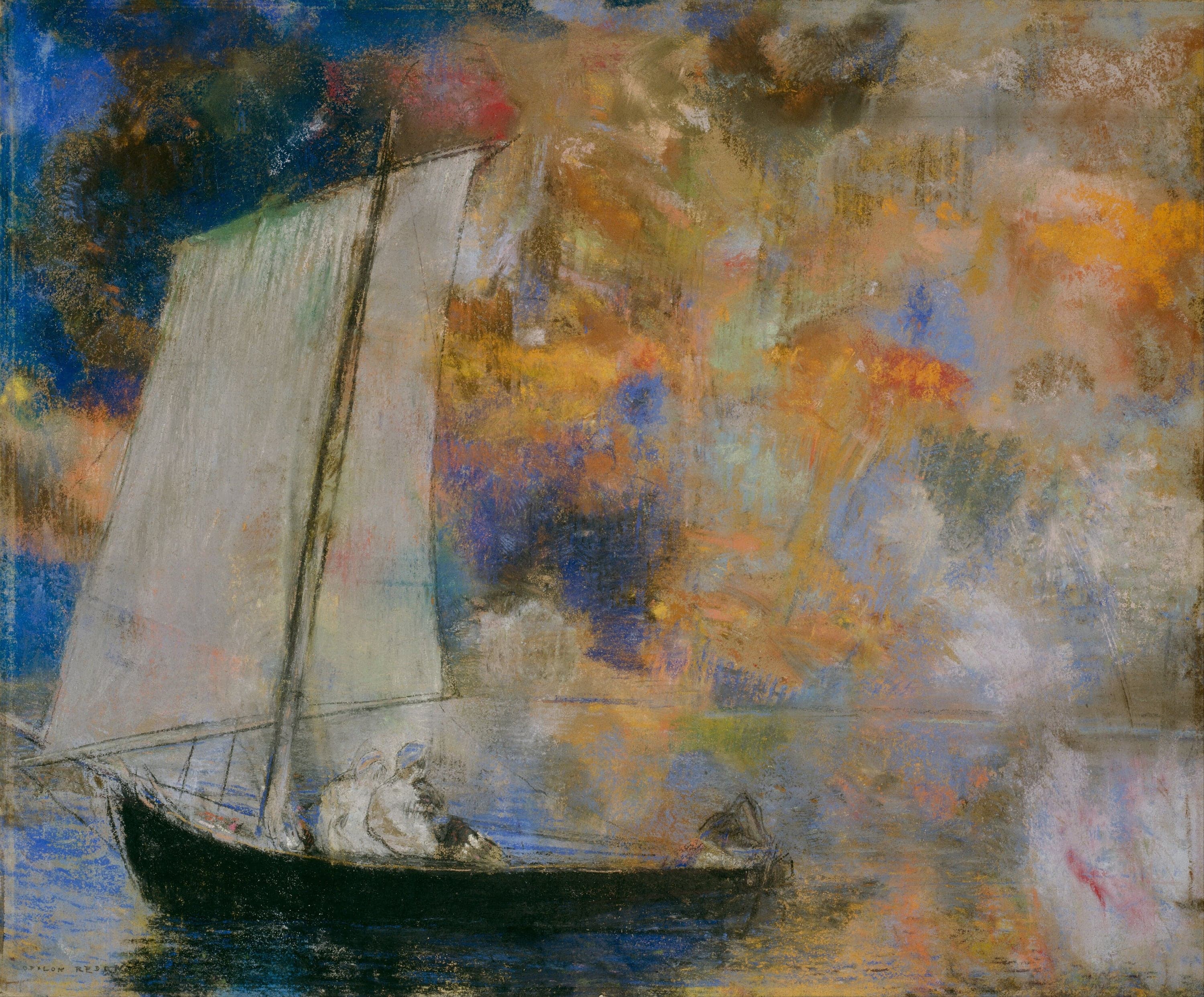
A small boat with a tall pale sail carries two seated figures in white, and a darker third shape at the stern, across colored water under a sky broken into patches of orange, blue and white. Odilon Redon drew it in pastel around 1903 and sold it to Charles Waltner in Paris in February 1904. It is at the Art Institute of Chicago, which bought it in 1990.
A dark-hulled sailing boat sits in the lower left of the sheet. Its sail rises almost the full height of the picture, pale gray with a green cast along the leading edge, and the mast and rigging are drawn in thin dark lines. Two figures sit in the boat, both wrapped in white, both with the head covered in pale blue. At the stern a third, darker shape is sketched in a few black lines, hunched where a steersman would sit.
Everything around them is color without hard edges. The water beneath the hull is blue and violet. The upper left corner is a deep blue mass; from there across the whole right half the sky breaks into patches of orange, yellow, pale blue and white, worked in short strokes that do not resolve into clouds or land. Redon signed the sheet at the lower left in black conté crayon.
The Art Institute of Chicago counts two figures in the boat and reads them as possibly saintly women on a journey; it says nothing about the darker shape at the stern. It describes the picture as one of a group of pastels from these years with spiritual overtones. The museum makes the reading conditional, and Redon left no title that settles it.
Flower Clouds is the name the Art Institute of Chicago uses. It is not the name the picture carried in Redon's lifetime, and the museum's own exhibition record tracks the changes.
At the Salon d'automne in the Grand Palais, which ran from 18 October to 25 November 1905, it hung as number 1311 under the title Marine — a seascape. In June 1906 it went to the Cercle d'art moderne at the Hôtel de Ville as number 27, titled Barque, meaning boat. At the Galerie Barbazanges in Paris in 1920, four years after Redon's death, it was number 136 as Barque au soleil couchant: boat at sunset.
Each title points at a different part of the same sheet. Two of them treat the picture as a scene on water. The one in use now puts the weight on the sky.
Redon sold the pastel himself, in February 1904, to Charles Waltner in Paris, who kept it until 1926. It then passed to Marcel Kapferer, a Paris collector who also owned the Redon pastel now in Cleveland, the 1910 portrait of his niece Violette Heymann.
After Kapferer the sheet went to a collector named Vogel in Versoix, Switzerland, in 1947, and stayed in Swiss hands until the end of the 1980s. It was sold at the Hôtel des Ventes in Enghien, outside Paris, on 21 November 1989 as lot 8. The Art Institute of Chicago bought it the following year from Altman-Burke Fine Art in New York.
The Art Institute's medium line describes more than dry pigment on paper. Redon stumped the pastel, rubbing it with a tool to smear one color into another; he incised it, scratching lines through the color; and he worked parts of it with a brush. The support is blue-gray wove paper whose colored fibers have since faded toward tan, mounted around its edges to cardboard.
The sheet measures 44.5 by 54.2 centimeters, a little under a foot and a half wide. Alec Wildenstein's catalogue of Redon's paintings and drawings lists it in volume three as number 1954.
Close reading
The boat occupies the lower left of the sheet and the sky takes the rest. Follow the sail down to the passengers, the stern and the hull, then out into the color that gives the pastel its name.
1.The sail, drawn in long strokes
The sail is pulled downward in long parallel strokes of gray and green, the only large flat shape in the picture. Its straight leading edge and thin mast supply the one firm structure on the sheet.
2.Two figures in white
Two figures sit low in the hull, wrapped in white, both with the head covered in pale blue. Their faces are barely marked. The Art Institute of Chicago suggests they may be saintly women, and does not state it as fact.
3.The black hull on colored water
The hull is the darkest mass in the picture and the only shape with a clean outline. Below it the water is worked in horizontal blue and violet strokes, darkest directly under the hull, where the black of the boat spreads into the water.
4.The dark shape at the stern
At the stern, where a steersman would sit, a hunched shape is drawn in a few black lines over the blue. It is darker and rougher than the two figures in white, and the Art Institute of Chicago's account of the picture does not count it.
5.Where the flower clouds are
The right half of the sheet is short strokes of orange, yellow, pale blue and white with no edges between them. Nothing here reads as a cloud shape; the title treats the patches as blossoms.
6.The dark blue corner
The upper left corner is a deep blue mass laid on heavily. It weighs the sheet down on the same side as the boat and keeps the pale sail from floating free of the design.
7.A second pale shape at the right edge
A soft pale shape with pink touches stands at the right edge, rising from the bottom to about half the height of the sail. Redon leaves it unresolved, so it can be read as a second sail or as more of the sky.
1904
Redon sells the pastel to the engraver Charles Waltner in Paris, in February.
1905
Shown at the Salon d'automne in the Grand Palais, 18 October to 25 November, as number 1311 under the title Marine.
1906
Shown at the Cercle d'art moderne at the Hôtel de Ville, Paris, in June, as number 27 under the title Barque.
1920
Shown at the Galerie Barbazanges, Paris, 18 May to 15 June, as number 136 under the title Barque au soleil couchant.
1989
Sold at the Hôtel des Ventes in Enghien, France, on 21 November, as lot 8.
1990
Bought by the Art Institute of Chicago from Altman-Burke Fine Art, New York; accession 1990.165.
1994–95
Shown as number 137 in Odilon Redon: Prince of Dreams, 1840–1916, which opened at the Art Institute of Chicago and travelled to the Van Gogh Museum in Amsterdam and the Royal Academy of Arts in London.
2025–26
Shown at the Art Institute of Chicago in Strange Realities: The Symbolist Imagination, 4 October to 5 January.
Art Institute of Chicago
111 South Michigan Avenue, Chicago, IL 60603, United States
Displays and loans can change. Check whether this work is on view before making a special trip.
Plan your visit on the museum’s official website (opens in a new tab)A small sailing boat carrying two white-robed figures, with a darker third shape sketched at the stern, across colored water under a sky broken into patches of orange, blue and white. The Art Institute of Chicago suggests the two may be saintly women on a journey, without stating it as fact.
The title comes from the sky, which is worked in short strokes of orange, yellow and blue that read as blossoms as much as weather. Redon did not use the name himself; the picture was exhibited in his lifetime as Marine and as Barque.
The Art Institute of Chicago, accession number 1990.165, in the Prints and Drawings department. The museum bought it in 1990 from Altman-Burke Fine Art in New York.
44.5 by 54.2 centimeters, or 17 9/16 by 21 3/8 inches. It is a horizontal sheet, a little under a foot and a half wide.
It is a pastel on paper, which the Art Institute of Chicago files under drawings. Redon also stumped, incised and brushed the surface, so the sheet carries marks from several different tools.
About 1903. The Art Institute of Chicago gives a range of 1898 to 1908 for the work and a display date of around 1903; Redon sold it in February 1904, which sets the latest possible date.
Charles Waltner from 1904 to 1926, then the Paris collector Marcel Kapferer, then a collector named Vogel in Versoix, Switzerland, from 1947, and a Swiss private collection until 1989. It was auctioned at Enghien in November 1989.
Associated with · 1903
The Art Institute of Chicago hung the pastel in its 2025 exhibition Strange Realities: The Symbolist Imagination, and describes Redon as drawing his subjects from his own imagination rather than from observation.
Explore painters from the same movements and circles.
French painter, printmaker and illustrator whose intimate rooms, Paris streets, gardens and bathing figures transformed everyday life into complex fields of color, memory and perception.
View artist
Stockbroker turned painter who came into art through Camille Pissarro, showed with the Impressionists, and left Europe for Polynesia.
View artist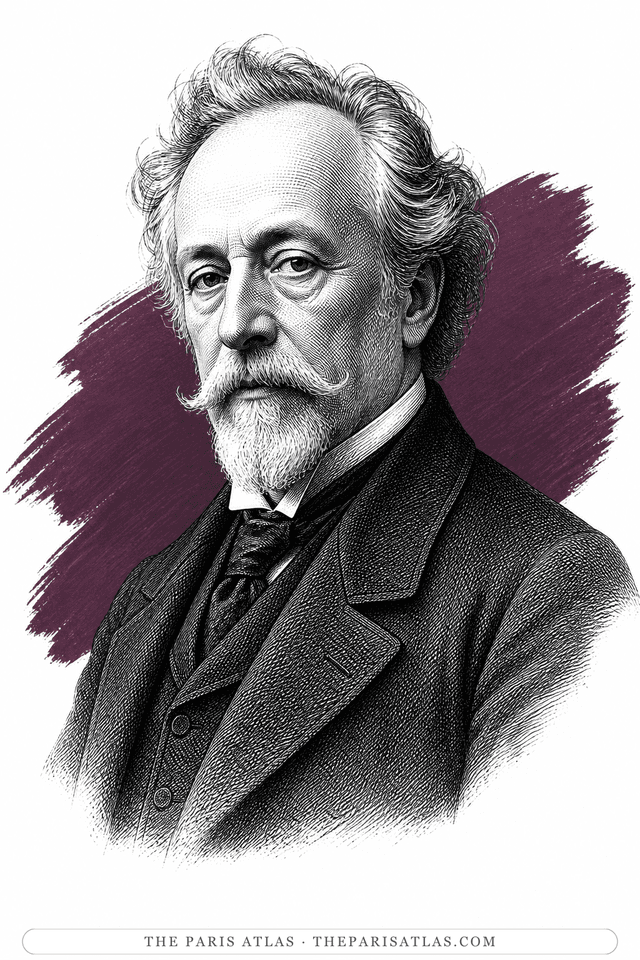
Painter of jewelled myths — Salome, Oedipus, floating severed heads — who lived nearly his whole life in one Paris house, taught Henri Matisse and Georges Rouault at the Beaux-Arts, and turned the house into a museum before he died so the state would have to keep everything.
View artistThe sources below include collection records, catalogues, scholarly research, and primary materials that informed this page. They document Flower Clouds, its making, and its place in cultural history.


The holding museum's catalogue entry: medium, dimensions, inscription, provenance, and the exhibition titles of 1905, 1906 and 1920.

The standard catalogue of Redon's paintings and drawings, cited by the Art Institute for this sheet.

The 1994 exhibition catalogue, in which the pastel was number 137.
Biographical outline: the charcoal and lithograph years and the turn to color in the 1890s.
These references provide the documented foundation for this work's history and interpretation. Claim-level citations remain attached to the specific claims they support.
 Explore more resources