Associated with · 1929
Surrealism
Painted in the year Dalí joined the group, and hung in the Reina Sofía's surrealism rooms. The museum reads it as autobiography rather than as an inventory of the movement's symbols.
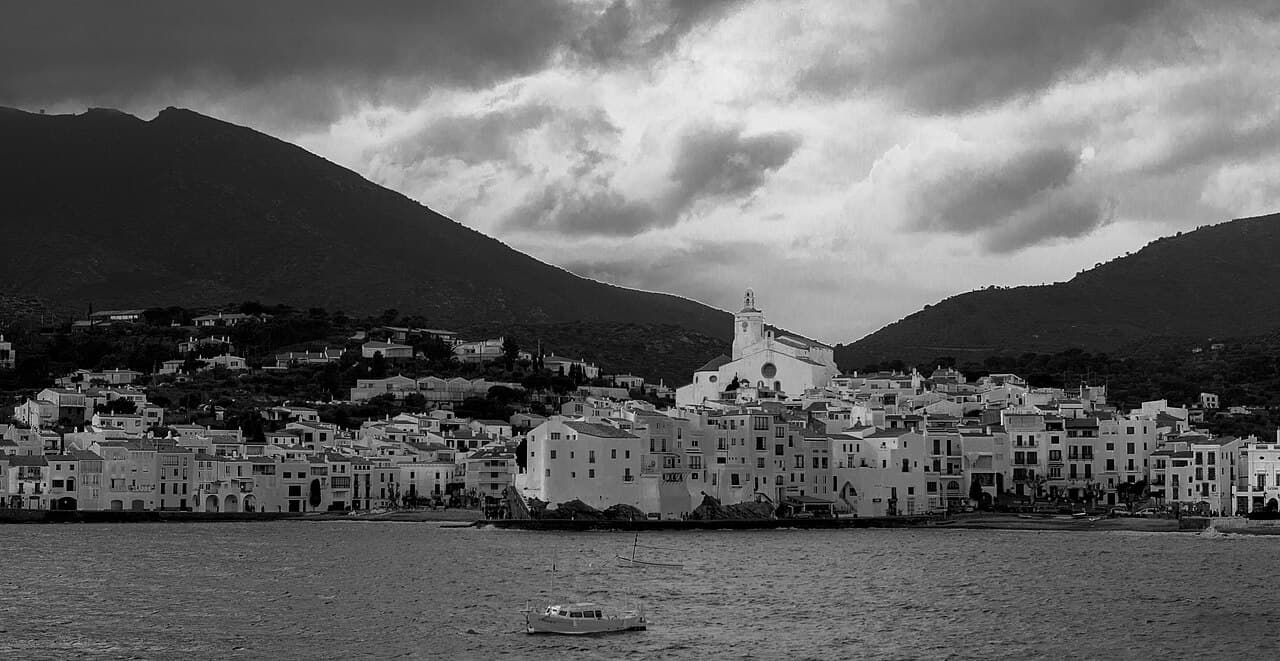
Dalí painted it at Cadaqués at the end of the summer Gala stayed. The Reina Sofía in Madrid has held it since the 1990 bequest.
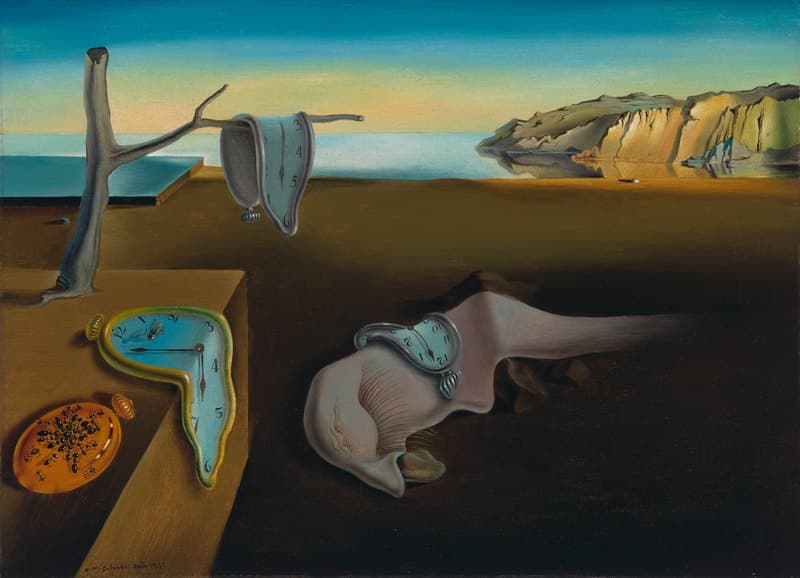
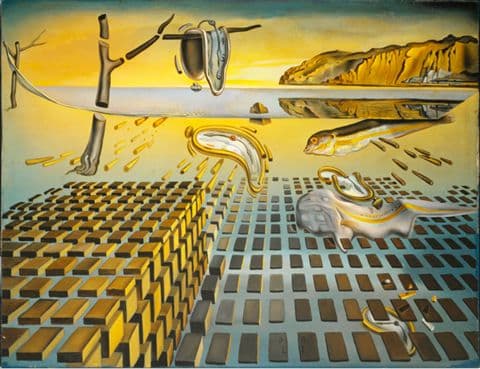
The soft self-profile dominating this painting returns two years later beneath a melting watch in The Persistence of Memory. Reading the two together shows Dalí carrying a private, autobiographical image into the small canvas that became his public emblem.
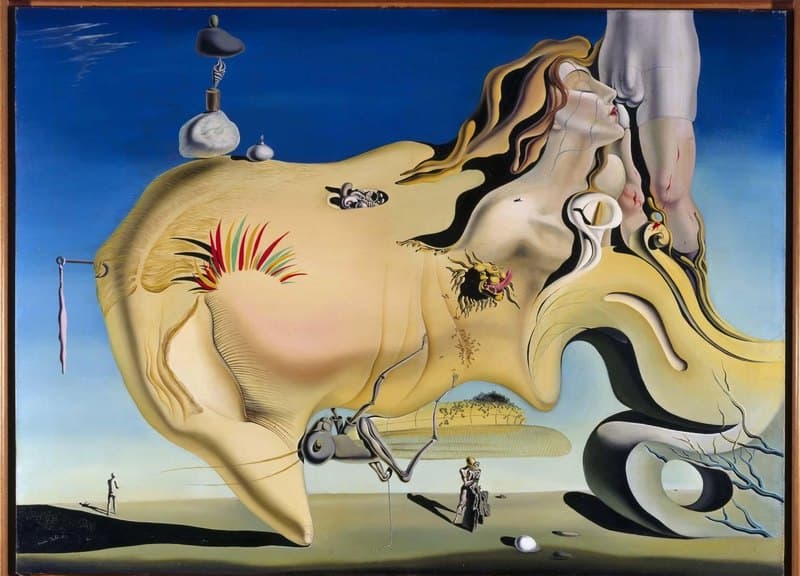
A yellow head fills most of the canvas, lying on its side against a blue sky, its nose pushed into the ground and its eye closed under a long lash. It has no mouth. In its place a grasshopper clings to the face, and the insect's abdomen is covered in ants.
Out of the back of the head a woman rises, auburn-haired, her face lifted toward the lower body of a man who is cut off by the top edge of the picture. His knee is grazed and bleeding. Below them a lion's head opens its mouth. To the left a hook holds a soft form that hangs and drips.
The ground is a flat plain with a long horizon. A small couple stand embracing on it, one of the pair half turned to rock, casting a shadow much longer than they are; a solitary figure walks in the far distance; and furthest away of all, very small, a child stands beside an adult. A white egg-shaped stone lies near the centre. On the right the yellow mass curls into a black hollow with dead branches growing out of it.
The Museo Reina Sofía, which owns the painting, describes it as the definitive symbol of Dalí's sexual obsessions.[1]
Dalí painted this at the end of the summer of 1929. That August, Paul Éluard had come to Cadaqués with his wife Gala and their daughter, along with René Magritte and the dealer Camille Goemans. Éluard went back to Paris alone. Gala stayed.[2]
Nothing else in Dalí's life changed as fast. He was twenty-five, had just been expelled from the Madrid academy, had premiered Un Chien Andalou in June, and had joined the Surrealists that year. The picture belongs to the weeks immediately after the woman he lived with for the next fifty-three years decided not to go home.
The museum's reading, following the Catalan critic Rafael Santos Torroella, is that the painting is eminently autobiographical and that the great head is one of the artist's personifications of himself, appearing in several simultaneous scenes at once. The transformation the scenes describe is the emotional and erotic one that Gala's arrival had just produced.[1]
It was not a new face. By Dalí's own account in The Secret Life, he painted it first in The First Days of Spring, earlier in 1929, and it appears the same year in The Lugubrious Game, The Enigma of Desire, Illuminated Pleasures and the Portrait of Paul Éluard — the husband of the woman who had just stayed. In none of those does it fill the canvas, and in none of them does it get the name. Here Dalí gave the face the leading role and told everyone what it was called.[3]
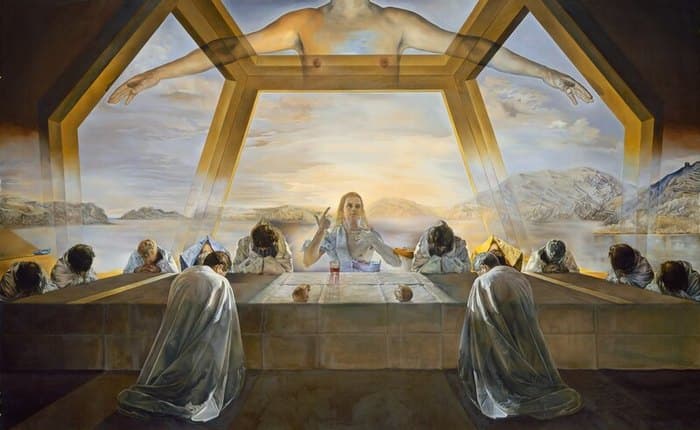
The soft profile — nose down, eye shut, no jaw — kept turning up in his paintings for the next several years, and it lies on the ground again in the middle of The Persistence of Memory two years later.
Dalí insisted for the rest of his life that the face began as geology. The model, he said, was a promontory of Cap de Creus, the headland of wind-cut rock beyond Cadaqués, and in Confessions inconfessables he put it grandly: when he painted that rock and titled it The Great Masturbator, he was rendering homage to one of the promontories of his kingdom, and the painting was a hymn to one of the jewels of his crown.[3]
So the anguished head is also a landscape portrait: a rock that becomes a face that contains a fantasy. The composition around it, the Fundació's essay notes, keeps other company — the low horizon, empty terrain and long hard shadows recall Giorgio de Chirico, the shallow floating space is the kind Joan Miró was building in the same years, and recent scholarship relates the whole crowded dream-field to Hieronymus Bosch's The Garden of Earthly Delights, which Dalí had studied first-hand at the Prado as a student in Madrid.[3]
The museum identifies the insect fastened where the mouth should be as a grasshopper, describes it as sucking at the body of the metamorphosed figure and, citing the art historian Dawn Ades, records that grasshoppers had terrified Dalí in a specific and lifelong way, from childhood onwards.[1]
Dalí himself said lobster. His description in The Secret Life runs: a large head, yellow like wax, with very red cheeks, long eyelashes and an imposing nose compressed against the ground; no mouth, and in its place "an enormous lobster was hooked", its belly decomposing and full of ants, some of them scurrying across the space where the mouth should have been. The discrepancy is worth keeping: the painter's memory and the museum's entomology disagree about what is attached to his own face.[3]
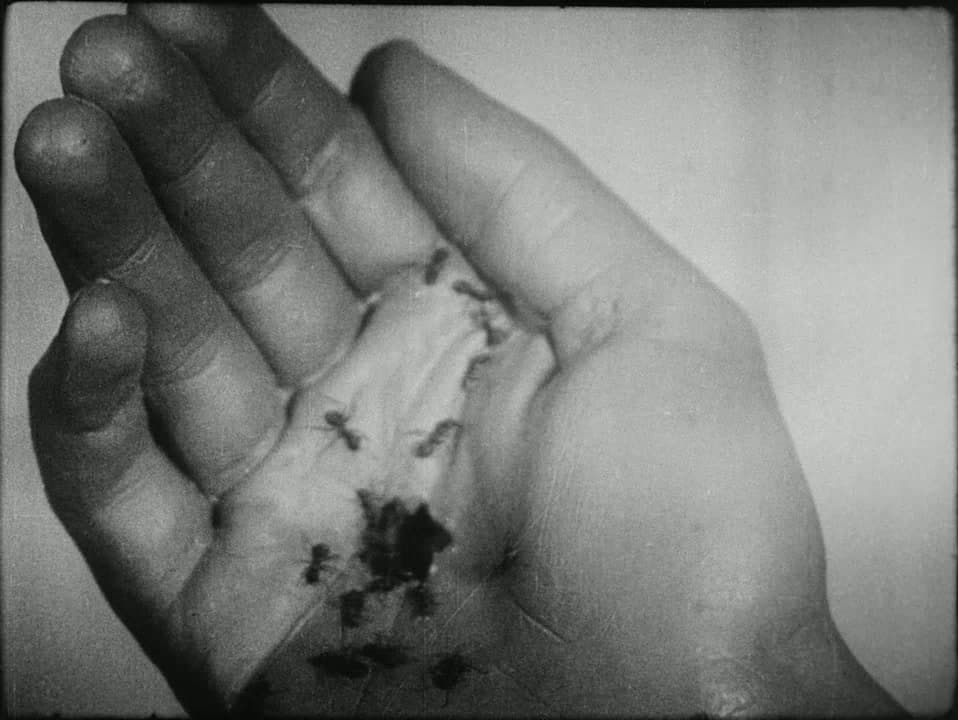
The ants, at least, are constant. They swarm in The Lugubrious Game the same year, fill a hand in Un Chien Andalou that June, and cover a watch in The Persistence of Memory two years later — Dalí's shorthand, across paint and film at once, for desire and putrefaction arriving together.
This is the useful thing about the picture as evidence. Its imagery is not a general inventory of Surrealist symbols; several parts of it are things Dalí was personally afraid of or preoccupied by, painted at close to life size and given a title that names the subject without any evasion at all.
The museum catalogues the work under its French title, Visage du Grand Masturbateur, with the Spanish Rostro del Gran Masturbador beside it; in English it is generally The Great Masturbator. Dalí signed and dated it in the lower left corner.[1]
He wrote about the painting himself in The Secret Life of Salvador Dalí, published in 1942. That book is reliable evidence of what Dalí wanted said about his work in 1942 and unreliable evidence of what happened in 1929, and the distinction is worth holding on to for a painter who spent sixty years editing his own story.
The title also outgrew the canvas. In the summer of 1930, at Portlligat, Dalí wrote a poem called The Great Masturbator and published it that year in La femme visible — The Visible Woman — alongside the essays Love, The Sanitary Goat and The Rotting Donkey. The book was dedicated to Gala. Within a year of the painting, the great masturbator had become a Dalí concept moving between paint and print.[3]
The painting reached Paris within weeks. Dalí's first one-man exhibition in the city ran at Camille Goemans's gallery from 20 November to 5 December 1929, and Visage du grand masturbateur was catalogue number 6. The sequence of that year could hardly be tighter: Un Chien Andalou in June, Gala in August, the painting at the end of the summer, and its public debut in Paris as Dalí formally entered the Surrealist group.[4]
It kept appearing at the movement's set pieces afterwards — the Exposition Minotaure at the Palais des Beaux-Arts in Brussels in 1934 as number 33, and the Exposition Internationale du Surréalisme at the Galerie Beaux-Arts in Paris in 1938 as number 43.[4]
What it never did was sell. The Fundació's catalogue raisonné lists the provenance in two words: artist's collection. Dalí kept the painting for sixty years, from the easel at Cadaqués to the 1990 bequest that carried it into the Reina Sofía. Whatever else the picture was, it was not for sale.[4][5]
The Museo Nacional Centro de Arte Reina Sofía in Madrid, register number AS11140, entered in 1990 under the Salvador Dalí bequest. At the last check of the museum's record it was on display in room 205.13.[5][1]
Close reading
The central form is a face, a rock, and a soft body at once. Enlargement shows Dalí building private anxiety from precise substitutions rather than from loose dreaminess.
1.The profile is recognizable because it is incomplete
Nose, eyelid, and lashes are enough to establish a face even though no skull holds them together. The closed eye turns the huge form inward, making the landscape read as a mental image projected outward.
2.Desire and disgust share the same contour
The erotic figure emerges from one side of the profile while the grasshopper clings to another. Their proximity prevents a clean division between attraction and revulsion. The body becomes the place where both reactions are stored.
3.Small crawling forms activate the empty ground
Ants puncture the smooth surfaces with clustered movement. Against the barren Catalan ground they read as decay, irritation, and compulsive detail—the opposite of the great sleeping stillness above them.
4.Small forms balance above the enormous head
The small objects seem to balance on the upper edge of the enormous yellow form. Their narrow contacts make that smooth surface read momentarily as solid ground. Dalí changes the scale of the picture again: a shape large enough to be a landscape supports a precarious miniature arrangement.
5.A tiny figure measures the empty foreground
A slight standing figure is almost swallowed by the broad shadow beside it. Its small scale makes the yellow mass above seem immense, while the open strip of ground gives the viewer somewhere to measure the distance. The lone figure provides a small point of comparison within the broad empty ground.
6.The raised face meets a cropped body
The woman's face tilts upward beside a body that continues beyond the top edge. Dark channels wind through her hair and neck, connecting her to the larger yellow form below. The careful modeling makes the face appear tangible even as its attachment to an ordinary body becomes uncertain.
1929
Un Chien Andalou, written with Luis Buñuel, premieres in Paris on 6 June.
1929
In August, Paul and Gala Éluard visit Cadaqués with René Magritte and Camille Goemans. Gala stays.
1929
The painting is made at the end of the summer, and signed lower left "Salvador Dalí -29-".
1929
Shown as catalogue number 6, under the title Visage du grand masturbateur, in Dalí's first one-man Paris exhibition at the Galerie Goemans, 20 November to 5 December.
1930
Dalí writes a poem of the same name at Portlligat and publishes it in La femme visible, dedicated to Gala.
1934
Exhibited in the Exposition Minotaure at the Palais des Beaux-Arts, Brussels, as number 33.
1938
Exhibited in the Exposition Internationale du Surréalisme at the Galerie Beaux-Arts, Paris, as number 43.
1942
Dalí writes about the picture in The Secret Life of Salvador Dalí.
1990
Having remained in the artist's own collection all his life, it enters the Museo Reina Sofía under the Salvador Dalí bequest; register number AS11140.
Museo Nacional Centro de Arte Reina Sofía
Calle Santa Isabel 52, 28012 Madrid, Spain
Displays and loans can change. Check whether this work is on view before making a special trip.
Plan your visit on the museum’s official website (opens in a new tab)The Museo Reina Sofía, which owns it, calls it the definitive symbol of Dalí's sexual obsessions and, following Rafael Santos Torroella, an eminently autobiographical picture in which the large head is Dalí himself. It was painted immediately after Gala decided to stay with him at Cadaqués, and the museum reads the scenes in it as the emotional and erotic change that followed.
At the end of the summer of 1929, in Cadaqués, in the weeks after the August visit at which Paul Éluard returned to Paris without Gala. Dalí was twenty-five.
The Reina Sofía identifies it as a grasshopper, fixed where the mouth should be with ants across its abdomen, and records — citing Dawn Ades — that grasshoppers frightened Dalí throughout his life, from childhood. Dalí's own description in The Secret Life calls it an enormous lobster with a decomposing belly full of ants. The museum's entomology and the painter's memory disagree, and both are part of the record.
The painting does not name her, and we will not either. She is generally identified with Gala, on the grounds of when the picture was made, and the museum's own text ties the work directly to Gala's arrival in Dalí's life. That is an identification rather than a documented fact.
110 by 150 centimetres — about five feet across, and roughly twenty times the area of The Persistence of Memory.
At Dalí's first one-man exhibition in Paris, at the Galerie Goemans, 20 November to 5 December 1929, as catalogue number 6 under the French title Visage du grand masturbateur. It later appeared in the Exposition Minotaure in Brussels in 1934 and the Exposition Internationale du Surréalisme in Paris in 1938.
No. The Fundació Gala-Salvador Dalí's catalogue raisonné lists the provenance simply as the artist's collection. Dalí kept the painting his whole life, and it entered the Museo Reina Sofía through his bequest in 1990.
The Museo Nacional Centro de Arte Reina Sofía in Madrid, which has held it since the 1990 Dalí bequest. At the last check of the museum's record it was on display in room 205.13.
Associated with · 1929
Painted in the year Dalí joined the group, and hung in the Reina Sofía's surrealism rooms. The museum reads it as autobiography rather than as an inventory of the movement's symbols.
Created at · 1929
Salvador Dalí painted The Great Masturbator at Cadaqués at the end of the summer of 1929, after Gala decided to stay with him.
Explore painters from the same movements and circles.

Strasbourg-born sculptor and poet — Hans in German, Jean in French, both all his life — who co-founded Dada at the Cabaret Voltaire in 1916, composed collages by dropping torn paper 'according to the laws of chance', and settled at Meudon outside Paris in a house his wife Sophie Taeuber-Arp designed.
View artist
French photographer who turned a pocket-sized 35mm camera into an instrument of split-second composition — the idea the world knows as 'the decisive moment'. He trained as a painter, was taken prisoner in 1940 and escaped on his third try, photographed the Liberation of Paris in August 1944, co-founded the photographer-owned agency Magnum Photos in 1947, gave up reporting for drawing in the 1970s, and left Paris a foundation in the Marais that deliberately hangs no permanent display of his own pictures.
View artist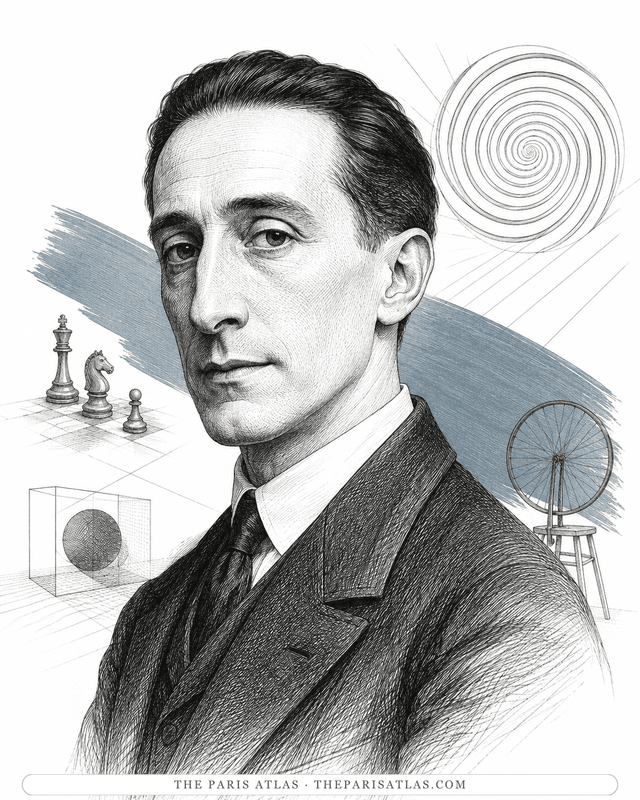
The century's quietest revolutionary — readymades, the abandonment of painting, chess on a Paris rooftop in Entr'acte, and one anemic film of spinning puns signed Rrose Sélavy.
View artistThe sources below include collection records, catalogues, scholarly research, and primary materials that informed this page. They document The Great Masturbator, its making, and its place in cultural history.


Web source consulted for documented facts and historical context presented on the The Great Masturbator page.
These references provide the documented foundation for this work's history and interpretation. Claim-level citations remain attached to the specific claims they support.
 Explore more resources