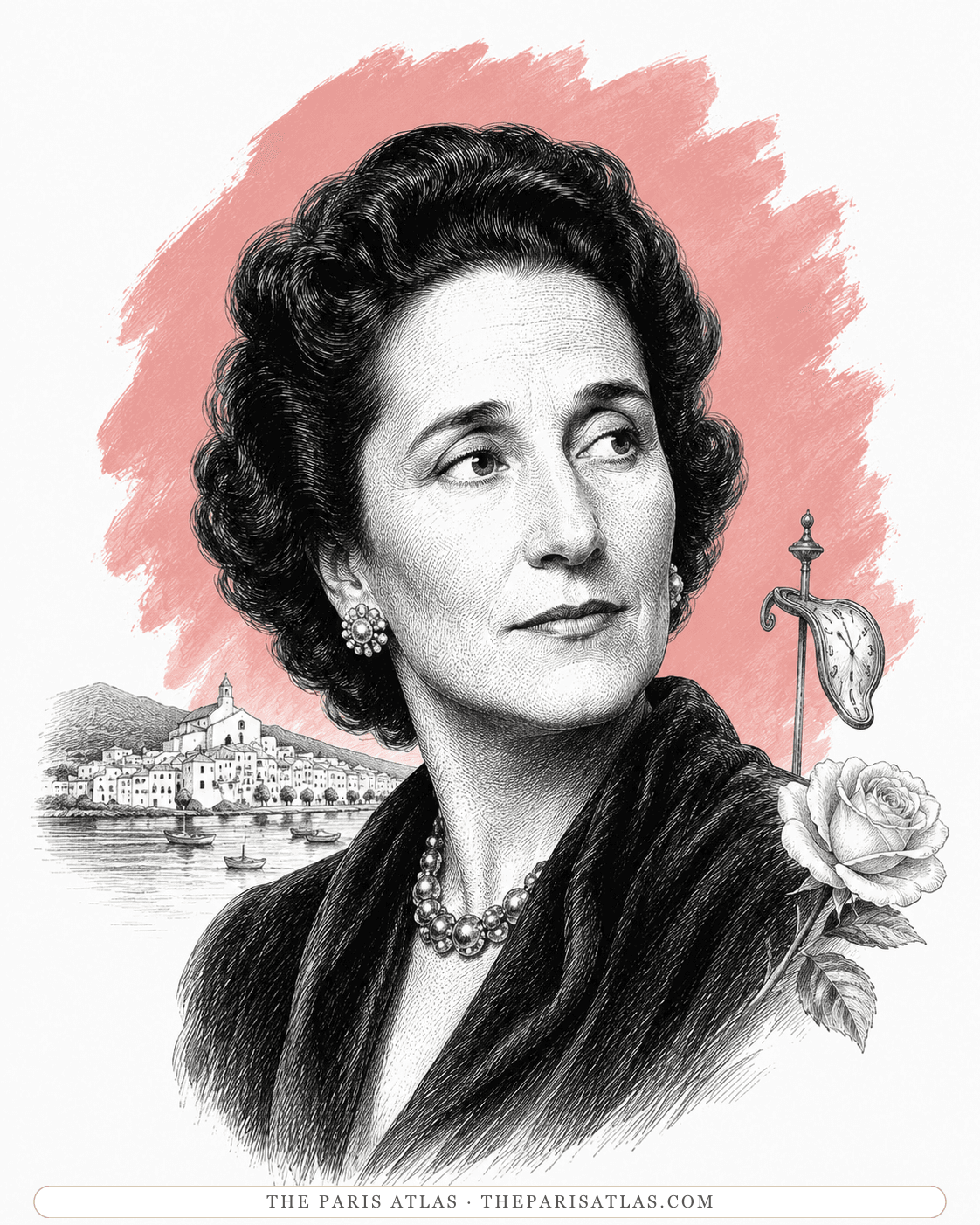
Depicts · 1934
Gala Dalí
A small profile portrait of Gala with two lamb chops balanced on her shoulder.
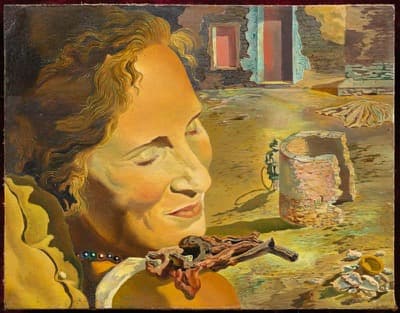
Dalí compressed Gala, two lamb chops and a sunlit stone courtyard into a panel smaller than a credit card. His later explanation connected the meat with a desire to devour her.
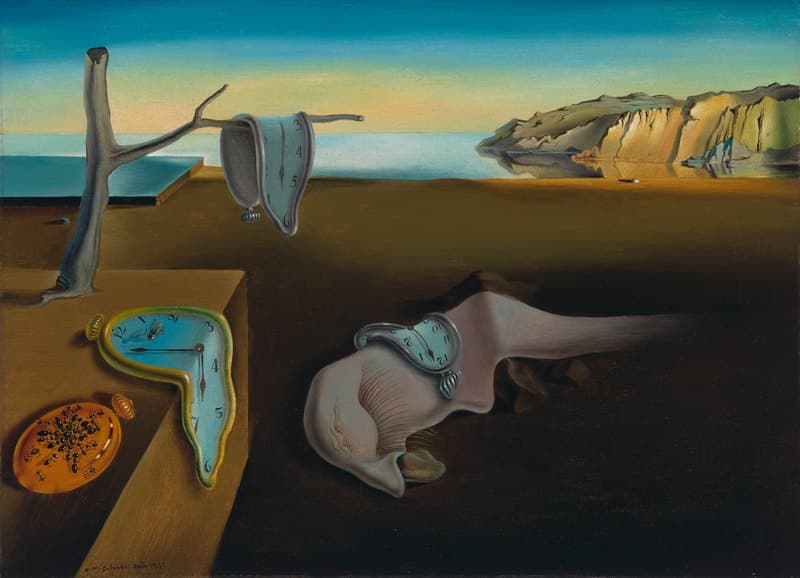
This portrait followed The Persistence of Memory by two years. Both use exact, controlled painting to make an irrational arrangement look physically present, but here Gala replaces the empty Catalan dream landscape as the centre of the image.
Gala fills the left half of the panel in close profile, her eyes lowered and her mouth almost smiling. Behind her is a sunlit stone courtyard with a circular well. Two cooked lamb chops rest across the shoulder nearest the viewer.
Nothing is painted loosely. Gala's hair, the stones, the meat and the cast shadows are described with miniature precision. The impossible part is the arrangement, not the technique.
The wood panel measures 6.8 by 8.8 centimetres. A standard credit card is 5.4 by 8.6. Dalí therefore asks a viewer to inspect a deliberately absurd image at the scale of a private object. That scale separates it from a conventional society portrait: the head is intimate and carefully finished, while the lamb chops turn the likeness into a Surrealist encounter between a person and an ordinary object that does not belong on her body.
Dalí supplied an explanation eleven years later. In the 1945 exhibition text for Galarina, he recalled having painted Gala with two lamb chops as an expression of his subconscious desire to devour her. That statement is the artist's retrospective interpretation, not a neutral key that settles every meaning in the picture.
The food can be read as appetite made literal: Gala is both the person desired and the formal sitter, while the meat is both dinner and a blunt emblem of consumption. The force of the image comes from refusing to turn those two registers into a normal scene.
By about 1934, Gala had become Dalí's principal model, partner and manager. Here he does not idealize her as the Madonna or classical deity found in his paintings of the 1940s and 1950s. She remains recognizably human while the object placed on her body makes the portrait psychologically charged.
The work belongs to Surrealism through its conjunction rather than through abstraction. A precisely observed face and two pieces of meat are made strange by being placed together, with no narrative offered to explain the balance.
The painting is unsigned and undated. The Fundació Gala-Salvador Dalí's current catalogue raisonné dates it to about 1934, while older exhibition and museum texts have sometimes used 1933. We follow the current catalogue entry and keep the approximation visible. Its familiar English title comes from the catalogue for Dalí's 1936 exhibition at Alex. Reid & Lefevre in London. A French title appeared in his 1935 book La Conquête de l'irrationnel.
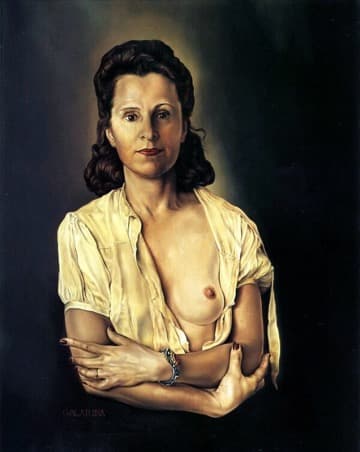
The picture establishes a line that runs through Dalí's representations of Gala. In this early work she is a desired body joined to an irrational object. In Galarina, Leda Atomica and The Madonna of Portlligat, she becomes a Renaissance sitter, a mythological figure and a sacred presence.
Dalí himself later linked this miniature to Galarina. That makes it more than a curiosity: it records the earlier, explicitly Surrealist end of a transformation he was still interpreting in 1945.
Close reading
Dalí treats Gala's portrait with almost ceremonial stillness, then places two raw chops where adornment might be expected. The details show how the disruption depends on everything else remaining controlled.
1.The sitter refuses the picture's joke
Gala's expression is grave and steady. She neither reacts to nor explains the objects on her shoulder. Her composure prevents the chops from becoming slapstick and makes their presence more difficult to absorb.
2.The chops behave like grotesque jewelry
Their fatty edges and red centers are painted with the same care as flesh and fabric. Balanced rather than attached, they turn portrait ornament into meat while remaining stubbornly literal objects.
3.The shoulder becomes a display ledge
The smooth arc of the shoulder is drawn clearly enough to work like a shelf. Dalí exploits the portrait pose's own geometry: the body provides the stage on which the irrational addition can appear perfectly balanced.
4.The meat projects across the bottom of the portrait
The long bones point away from the darker, irregular pieces of meat. Their jagged edges contrast with the smooth curve of the shoulder supporting them. Seen closely, the chops are awkward objects with weight and texture; the portrait's calm lighting gives their unlikely placement the clarity of a still life.
5.The hair shares the colors of the setting
Fine, bending lines carry the light through Gala's hair. Brown and gold also appear in the ground and walls behind her, so color alone does not separate the portrait from its setting. The direction of the hair's waves gives this part of the head its distinct surface.
6.Bright doorways pull the eye past the portrait
Small areas of pink and turquoise brighten the doorways behind the sitter. Their straight edges contrast with the curved forehead and waving hair nearer the viewer. These narrow openings imply rooms beyond the sunlit ground, adding another distance to a portrait already crowded close to its frame.
c. 1934
Dalí paints Gala in profile with two lamb chops balanced on her shoulder.
1936
Shown in Dalí's exhibition at Alex. Reid & Lefevre in London.
1954
Included in Dalí's exhibition at the Sale dell'Aurora Pallavicini in Rome.
1979–80
Shown in the major Dalí retrospective at the Centre Georges Pompidou in Paris.
Fundació Gala-Salvador Dalí, Figueres
The foundation manages several museums. A specific viewing address for this work has not been confirmed here; check with the foundation before travelling.
Plan your visit on the museum’s official website (opens in a new tab)In a 1945 exhibition text, Dalí said the earlier image expressed his subconscious desire to devour Gala. That is his retrospective explanation. The painting also works more broadly as a Surrealist collision between a formal portrait, bodily desire and ordinary food.
It measures 6.8 by 8.8 centimetres, only slightly larger in area than a standard credit card and smaller than most postcards.
Gala Dalí, Salvador Dalí's wife, principal model, manager and working partner. The Fundació Gala-Salvador Dalí owns the painting.
The current catalogue raisonné dates the unsigned and undated panel to about 1934. Some older texts give 1933, which is why the date should remain approximate.
Yes. Its Surrealism lies in the irrational but meticulously painted conjunction of Gala's portrait and two pieces of meat balanced on her shoulder.
It belongs to the Fundació Gala-Salvador Dalí in Figueres and came from the artist's own collection.
Depicts · 1934
A small profile portrait of Gala with two lamb chops balanced on her shoulder.
Explore painters from the same movements and circles.
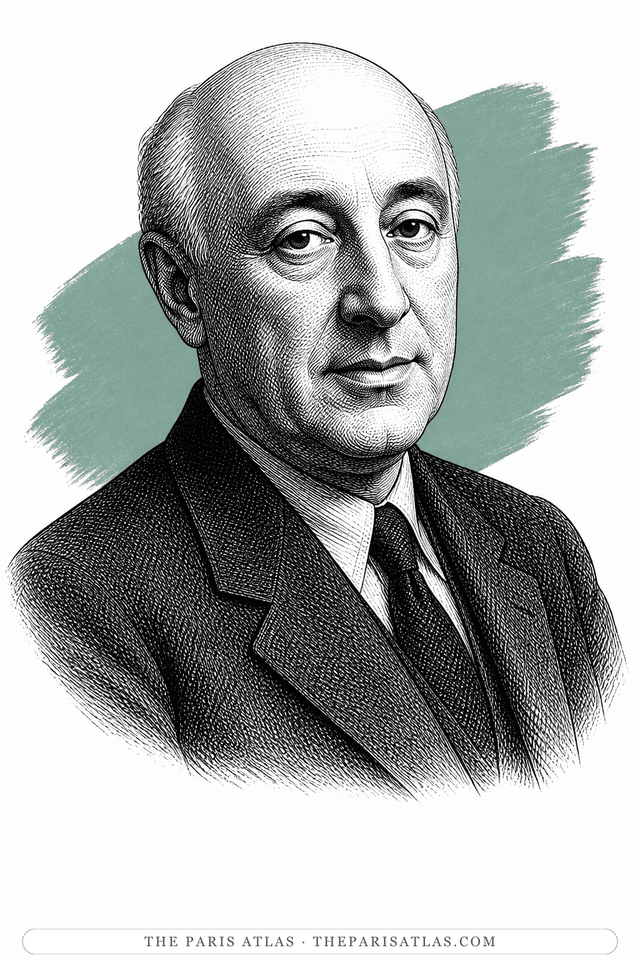
Strasbourg-born sculptor and poet — Hans in German, Jean in French, both all his life — who co-founded Dada at the Cabaret Voltaire in 1916, composed collages by dropping torn paper 'according to the laws of chance', and settled at Meudon outside Paris in a house his wife Sophie Taeuber-Arp designed.
View artist
French photographer who turned a pocket-sized 35mm camera into an instrument of split-second composition — the idea the world knows as 'the decisive moment'. He trained as a painter, was taken prisoner in 1940 and escaped on his third try, photographed the Liberation of Paris in August 1944, co-founded the photographer-owned agency Magnum Photos in 1947, gave up reporting for drawing in the 1970s, and left Paris a foundation in the Marais that deliberately hangs no permanent display of his own pictures.
View artist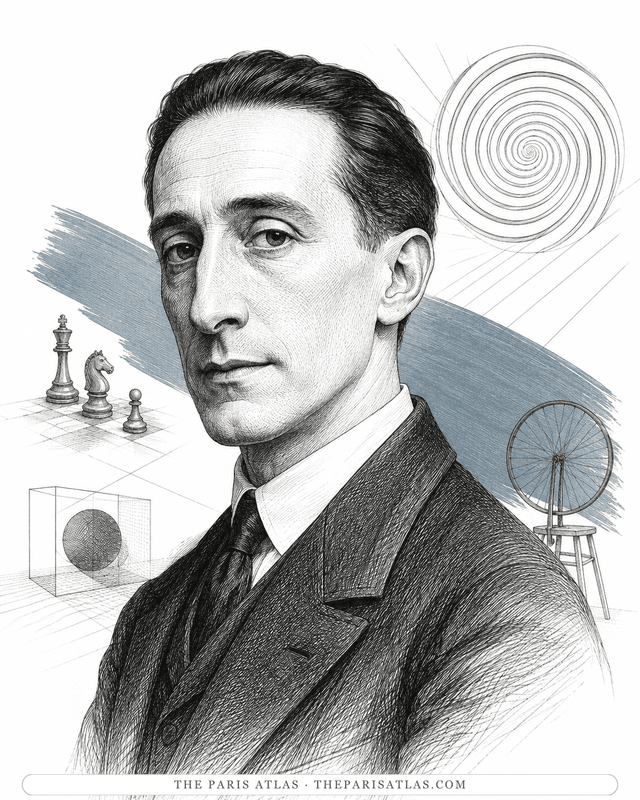
The century's quietest revolutionary — readymades, the abandonment of painting, chess on a Paris rooftop in Entr'acte, and one anemic film of spinning puns signed Rrose Sélavy.
View artistThe sources below include collection records, catalogues, scholarly research, and primary materials that informed this page. They document Portrait of Gala with Two Chops Balanced on Her Shoulder, its making, and its place in cultural history.


Web source consulted for documented facts and historical context presented on the Portrait of Gala with Two Chops Balanced on Her Shoulder page.
Web source consulted for documented facts and historical context presented on the Portrait of Gala with Two Chops Balanced on Her Shoulder page.
Web source consulted for documented facts and historical context presented on the Portrait of Gala with Two Chops Balanced on Her Shoulder page.

Independent museum context for Gala’s identity and central role as Dalí’s companion and muse.
Official record used to verify names, dates, institutional details, or other factual information on this page.
These references provide the documented foundation for this work's history and interpretation. Claim-level citations remain attached to the specific claims they support.
 Explore more resources