
Associated with · 1931
Surrealism
The Museum of Modern Art files it under Surrealism and hung it in Fantastic Art, Dada, Surrealism in 1936, five years after it was painted. It is the movement's most widely reproduced painting.
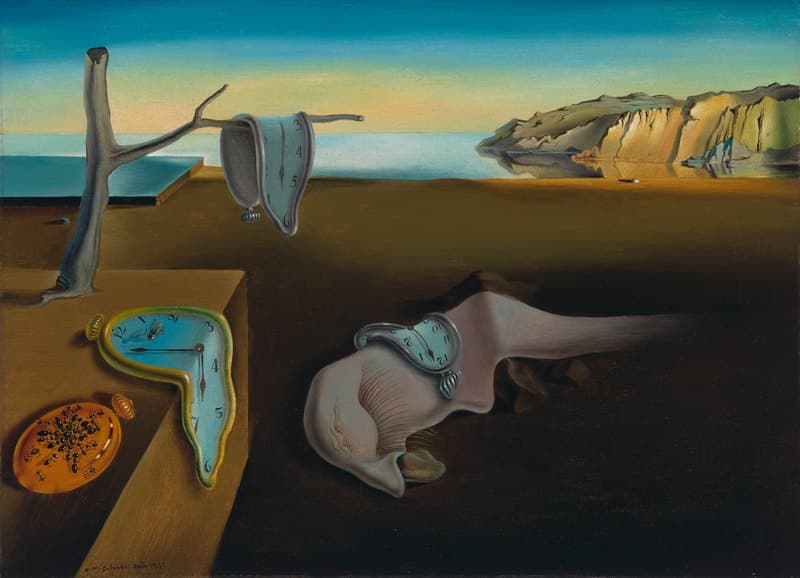
Dalí painted the melting watches in 1931, on a canvas smaller than a sheet of paper. The Museum of Modern Art has had it since 1934.
The painting most often described as the melting clocks painting is The Persistence of Memory, painted by Salvador Dalí in 1931. Its original French title is La persistance de la mémoire. The Fundació Gala-Salvador Dalí also records the informal name The Soft Watches.[1]
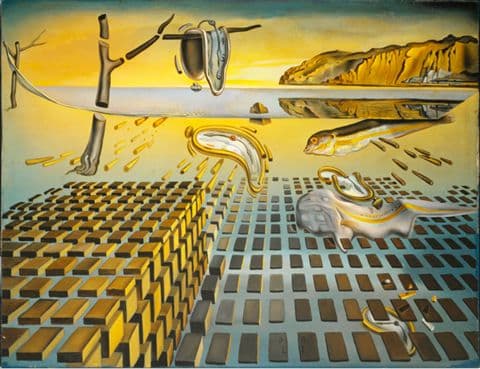
The original is an oil painting, not a print or a later variation. It belongs to the Museum of Modern Art in New York. Dalí returned to the image more than twenty years later in The Disintegration of the Persistence of Memory, but that is a separate painting in St. Petersburg, Florida.[2]
A bay at evening, seen from a shelf of bare ground. On the right, cliffs of yellow rock catch the last light above still water. Everything else is in shadow.
Four watches are in the picture. One hangs over the branch of a dead tree, one droops off the edge of a wooden block, one lies over a soft grey form on the ground, and one, a closed orange pocket watch, sits on the block covered in ants. Three of the four have gone limp. The fourth has not, and it is the one being eaten.
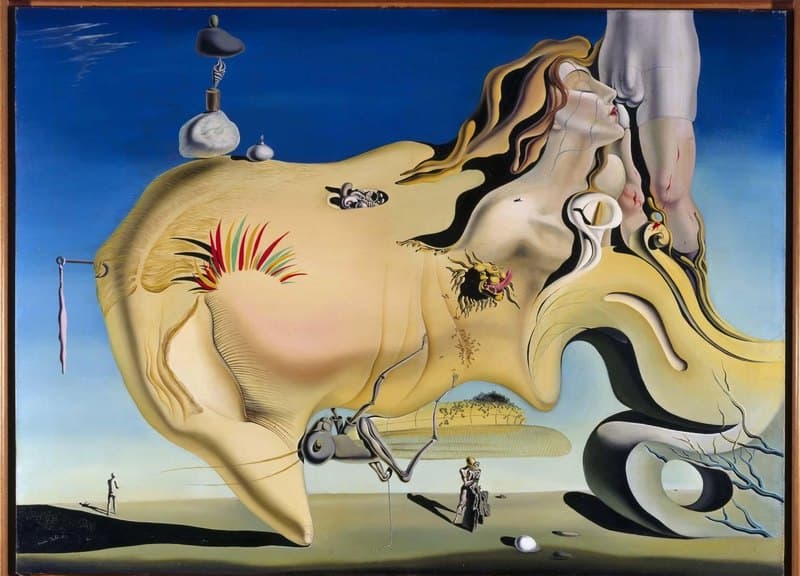
The grey form in the centre is a head, seen in profile, lying on its side with its eye shut and one long lash trailing. It has a nose, a closed eyelid and a tongue, and no skull to hold them. The same profile appears across Dalí's paintings of these years, including The Great Masturbator, painted two summers earlier.
The cliffs are not invented. The Museum of Modern Art's catalogue identifies them as the coast of Catalonia, which is where Dalí lived and painted for most of his life.[1]
The Persistence of Memory is small enough that the whole painting fits at true size on a laptop screen. At that scale the impossible objects (soft watches, a head with no skull) are painted at the same size as the observed ones (the cliffs, the ants), and the mixture is easier to read. Six passages are worth looking at closely.
The watch draped over the dead tree branch is the clearest demonstration of Dalí's method. The gold case has softened until it hangs on both sides of the branch like a piece of fabric, but the Roman numerals on the face are painted precisely, in the academic miniature technique Dalí was trained in. The outside of the watch has gone soft while the inside remains rigid — a mismatch that keeps the melting from looking symbolic and makes it look observed.
The dead olive tree is drawn from the trees around Dalí's house at Port Lligat. The Fundació Gala-Salvador Dalí's catalogue records that the tree in the painting is a real olive; the branch has snapped and the bark is split. Dalí spent his life painting Cap de Creus, and every element here that is not impossible is copied from what he could see out his window.[3]
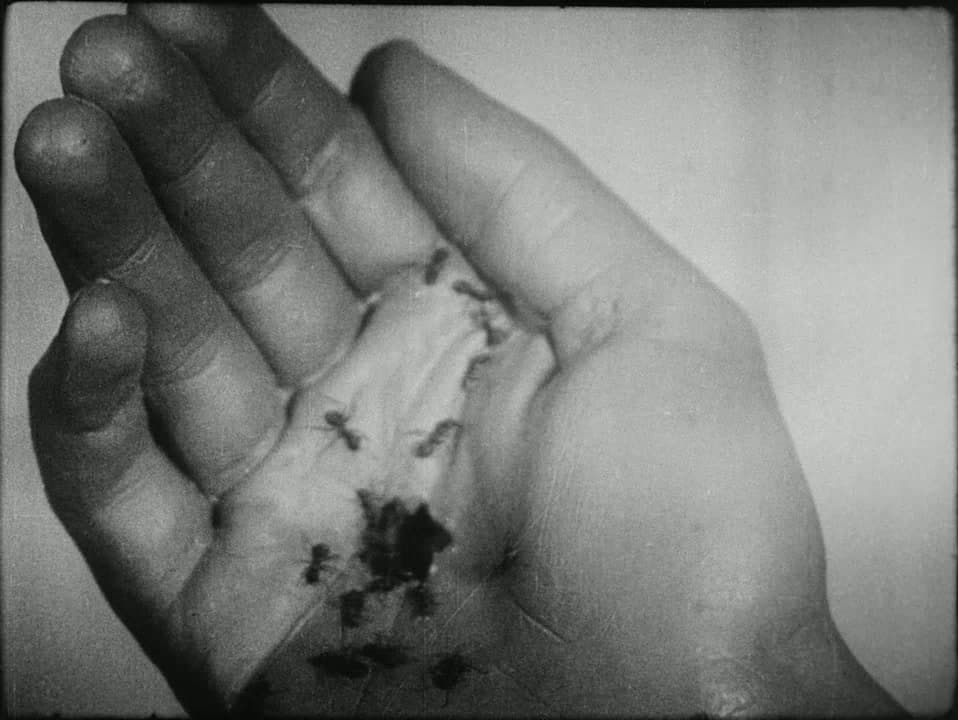
The ants on the closed pocket watch are painted so small — each one perhaps two millimetres across — that the whole colony reads at a glance as a rust-coloured stain on the watch's back. Up close each ant is drawn with legs and thorax. Ants recur in Dalí's paintings of these years and consistently mark decay: they appear on a hand in the film Un Chien Andalou (1929), which Dalí made with Luis Buñuel, and they cover the mouth in The Great Masturbator (1929). Here they are eating the one watch that has not gone soft.
The soft head in the centre is Dalí's recurring self-profile: the same closed eye, single long lash, limp nose, and open mouth with a tongue that had appeared in The Great Masturbator two summers earlier. Here it lies on its side on the ground with no skull under it, its cheek pressed into the sand, one soft watch draped across its temple. It is a portrait of the painter asleep, or unconscious, with time melting over him.
The cliffs on the right are the Cap de Creus headland at the north end of Dalí's coast — the specific yellow rock formation that had been the subject of his paintings since he was a teenager. He painted them in Port Lligat itself, from a window that faced them. The light is the low horizontal light of late afternoon in early spring, when the yellow rock takes the sun and the water is already in shadow — the exact hour Dalí spent his whole life photographing and painting.[3]
The still water of the bay stretches from the base of the cliffs almost to the foreground — no waves, no ripples, the surface completely flat. Dalí was painting the specific stillness of the Port Lligat bay at late afternoon, when the wind that had blown through the day drops and the water reflects the sky. He treated the still water as one of the picture's most stable elements. Nothing in the water melts, decays, or bends: the water alone in the painting behaves the way water behaves.
The foreground is bare packed earth, a flat golden-brown plane running from the shore back to the wooden block. Nothing grows there. Dalí painted the long shadow of the wooden block stretching across the ground toward the viewer, using the low-angle late-afternoon light to give the whole scene the feel of an empty stage. The soft head and the watches sit on this ground as if placed there by someone who has since walked out of frame.
The signature at the lower left reads 'Olive Salvador Dalí 1931.' Dalí signed almost none of his paintings with the word 'Olive' — the exception is this canvas and a small cluster of works from the same summer at Port Lligat. The best reading is that 'Olive' refers to the olive tree in the picture and the olive groves outside his door, so the signature is Dalí's private inscription of the place where the painting was made.[3]
The canvas is 24.1 by 33 centimetres. A sheet of A4 paper is 21 by 29.7. The image is known worldwide from reproductions printed larger than the painting.[1]
The scale matters to how it was made. At this size the ants are a few millimetres across and the watch faces are the width of a thumbnail, which is the sort of precision Dalí wanted: the technique of an academic miniature applied to an image that cannot be true.
Dalí's own explanation was food. MoMA's catalogue quotes him calling the limp watches "the camembert of time".[1]
The other explanation, repeated everywhere, is that the watches illustrate Einstein's relativity. This is worth stating plainly: it appears in no statement by Dalí, in no line of MoMA's record of the painting, and in no entry of the Fundació's catalogue raisonné. The version usually cited, in which Dalí is asked directly and answers that the watches are camembert rather than relativity, circulates without a primary source attached to it.[4]
What can be said is that the painting was made in a year when the softening of hard objects was already Dalí's working method, and that the first published explanation of it came from him and was about cheese.
Dalí arrived at what he called the paranoiac-critical method around 1930, the year before this painting. The idea was to induce the state in which a mind under delusion sees one thing as another, hold that state deliberately, and then paint the result with the discipline of a nineteenth-century academic.[5]
The Persistence of Memory is the method's clearest small demonstration. Nothing in it is loosely painted. The impossible part is not the handling; it is the fact that watches behave like cloth and a face lies on the ground without a body, rendered with exactly the care a still life would get.
The painting was shown in Paris at the Galerie Pierre Colle between 3 and 15 June 1931, as number 23 in the catalogue. From Colle it went to the Julien Levy Gallery in New York, which through the thirties was the main American route for Surrealism, and it was exhibited there in 1932 alongside a showing at the Harvard Society for Contemporary Art in Cambridge.[3]
In 1934 Helen Resor bought it from Levy, and in the same year it entered the Museum of Modern Art as object 162.1934 with the credit line "Given anonymously". Dalí was thirty.[1]
The canvas had remained unsold when it was first shown in Paris. Its first New York exhibition, in January 1932, changed the scale of its reputation almost immediately. MoMA's account calls it an overnight sensation. The dealer Julien Levy described it as "10 by 14 inches of Dalí dynamite," and an image of the painting appeared in nearly every review.[4]
That reception helps explain a strange fact about the work: the reproduction became large before the object did. Long before posters and book covers made the soft watches universal, reviews had already turned a canvas smaller than a sheet of paper into the image through which many viewers first met Dalí.
The original belongs to the Museum of Modern Art in New York. At the latest check of MoMA's collection record, it was on view on Floor 5 in Gallery 517, the Alfred H. Barr, Jr. Galleries. Displays can change, so check the museum's object page before making a special trip.[2]
It is not normally at the Dalí Theatre-Museum in Figueres. The painting travelled there for the first time on a temporary loan from 16 January to 18 March 2009. The Fundació noted that MoMA rarely lends it—a useful correction for visitors who reasonably expect Dalí's most famous painting to be in the museum he built around his own work.[6]
The Persistence of Memory is the picture most people see when they picture Surrealism. Reproduced on posters, book covers and mugs, the soft watches long ago left the canvas and became a general sign for the dreamlike and the strange — used, often, by people who could not name the painter.
Two things carry that reach. The image is instantly legible: everyone knows what a watch is, and what it means for one to melt. And it is executed with a control that makes the impossible look observed rather than invented. The Surrealists prized dream imagery; here the movement got a picture a person could grasp in a second and not forget.
The title is Dalí's own, and it does not mention clocks. "The Persistence of Memory" names the one thing in the picture that does not soften — memory — holding its shape while time, in the watches, goes limp.[1]
We leave the reading there. Anything tighter — the watches as mortality, as relativity, as the unconscious — is interpretation laid over a title Dalí left deliberately open.
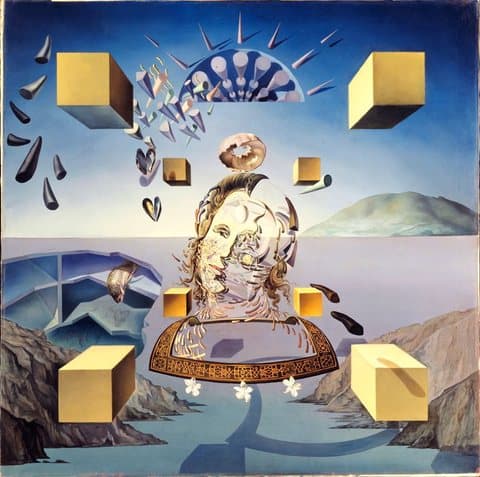
Dalí returned to the scene two decades on. The Disintegration of the Persistence of Memory, painted between 1952 and 1954, breaks the same bay, dead tree and watches into floating blocks and horn-like forms — the earlier dream re-seen through the atomic physics of his later "nuclear mysticism".[3]
It hangs at the Salvador Dalí Museum in St. Petersburg, Florida, and is the reason the 1931 canvas is sometimes called the original melting-clocks painting.
c. 1930
Dalí worked out what he called the paranoiac-critical method, the year before the painting.
1931
Painted and signed lower left "Olive Salvador Dali 1931".
1931
Shown at the Galerie Pierre Colle, Paris, 3–15 June, as catalogue number 23.
1932
Exhibited in New York at the Julien Levy Gallery, and at the Harvard Society for Contemporary Art in Cambridge.
1934
Bought from Levy by Helen Resor; enters the Museum of Modern Art the same year, given anonymously. Object number 162.1934.
1936
Included in MoMA's Fantastic Art, Dada, Surrealism.
1952–54
Dalí paints a sequel, The Disintegration of the Persistence of Memory, now at the Salvador Dalí Museum in St. Petersburg, Florida.
1968
Included in MoMA's Dada, Surrealism, and Their Heritage.
The Museum of Modern Art
11 West 53 Street, New York, NY 10019, United States
Displays and loans can change. Check whether this work is on view before making a special trip.
Plan your visit on the museum’s official website (opens in a new tab)They are pocket watches. Four appear in the painting: three have gone soft, while the fourth remains closed and is covered in ants. Calling them melting clocks is common shorthand—and the phrase most people use to find the painting—but watches is the more precise description.
No. The original belongs to the Museum of Modern Art in New York. It travelled to the Dalí Theatre-Museum in Figueres on a rare temporary loan from 16 January to 18 March 2009, but it is not normally displayed there. The Dalí Museum in St. Petersburg, Florida, owns the later sequel, The Disintegration of the Persistence of Memory, not the 1931 original.
Yes. When people search for the “melting clocks painting” or “Dalí's clock painting,” this is the work they mean — Salvador Dalí's small 1931 canvas of soft watches draped over a dead tree branch and a wooden block. Strictly the objects are pocket watches rather than clocks, and three of the four have gone limp while the fourth, closed and swarming with ants, has not. It is his best-known painting and one of the defining images of Surrealism.
Dalí never published a single meaning for it, and we will not invent one. What the painting reliably does is put decay and impossibility inside an otherwise ordinary Catalan landscape: watches that will not keep time, ants eating metal, a face without a skull, and a real coastline behind all of it. Readings that go further than that — time as relative, the clocks as mortality — are interpretations, and worth labelling as such.
The explanation Dalí gave was a runny camembert. MoMA's catalogue quotes him describing the limp watches as "the camembert of time". He was also, in 1930 and 1931, systematically painting hard things soft, so the watches are the method as much as the anecdote.
There is no evidence that it is. The relativity reading appears in no statement by Dalí, in MoMA's record of the painting, or in the Fundació Gala-Salvador Dalí's catalogue raisonné entry. It is a later interpretation that has been repeated until it sounds like provenance.
24.1 by 33 centimetres, smaller than a sheet of A4 paper. Almost every reproduction of it is printed larger than the painting.
The Museum of Modern Art in New York, which has held it since 1934. At the last check of MoMA's object record it was on view on Floor 5 in gallery 517, the Alfred H. Barr, Jr. Galleries.
A head lying on its side in profile, with a closed eye, long lashes and a tongue, and no skull under it. The same soft profile runs through Dalí's paintings of 1929 to 1931, most conspicuously in The Great Masturbator. It is usually read as a self-portrait.
The fourth watch is closed, orange and swarming. Ants recur through Dalí's work of this period, including the hand they pour out of in Un Chien Andalou, and they consistently mark decay. Here they cover the one object in the picture that has not gone soft.
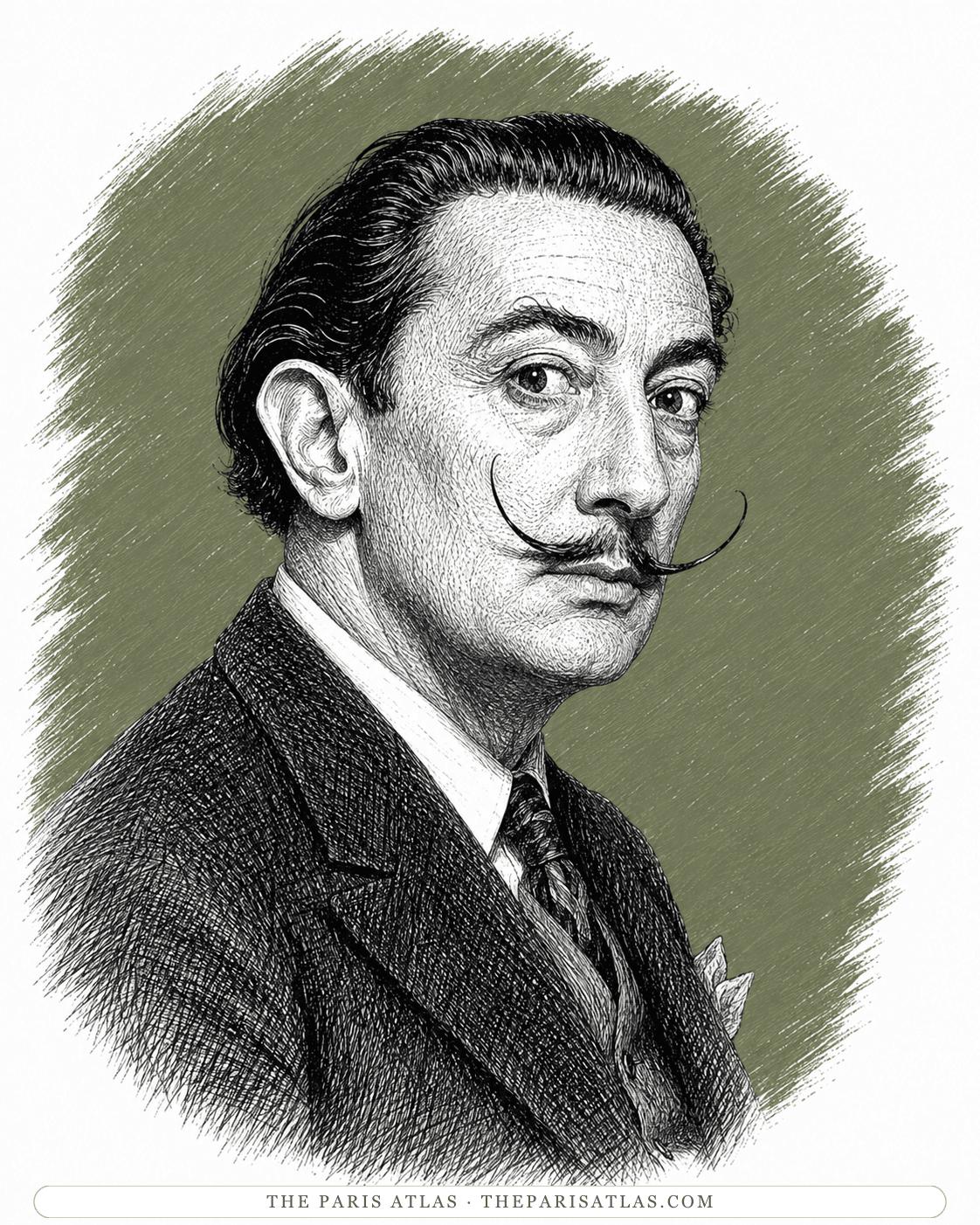
Salvador Dalí, the Catalan Surrealist, painted The Persistence of Memory in 1931, when he was twenty-seven. It is the work people mean by “Dalí's clock painting.”
In 1931, on the coast of Catalonia where he lived. The yellow cliffs behind the watches are that real coastline — MoMA's catalogue identifies them as the coast of Catalonia.
Surrealism, and one of the movement's defining images. Dalí made it with his paranoiac-critical method: dream imagery painted with the precision of a nineteenth-century academic.
Because it is legible and impossible at once. Everyone knows a watch, and a melting one is unforgettable — painted with a control that makes it look observed rather than invented. The soft watches became popular shorthand for Surrealism and for dreams.
Yes. The Disintegration of the Persistence of Memory (1952–54) breaks the same scene into floating blocks in his later “nuclear mysticism” manner. It hangs at the Salvador Dalí Museum in St. Petersburg, Florida.
It is Dalí's own title, and it names the one thing in the picture that does not soften — memory — while time, in the watches, goes limp. Readings beyond that are interpretation, which we keep separate from what Dalí and the museums actually record.
Most often they are read as time made unreliable — clocks that cannot keep time — and, by extension, dreams, memory or mortality. Dalí himself gave no fixed symbolism; his one recorded gloss was that the soft watches were “the camembert of time.” We present the rest as interpretation rather than the artist's stated intent.
It is not for sale and has no market price. The Museum of Modern Art has owned it since 1934, and like other masterworks held by major public museums it is effectively priceless — it would never come to auction, so any dollar figure attached to it is guesswork.
Associated with · 1931
The Museum of Modern Art files it under Surrealism and hung it in Fantastic Art, Dada, Surrealism in 1936, five years after it was painted. It is the movement's most widely reproduced painting.
Explore painters from the same movements and circles.

Strasbourg-born sculptor and poet — Hans in German, Jean in French, both all his life — who co-founded Dada at the Cabaret Voltaire in 1916, composed collages by dropping torn paper 'according to the laws of chance', and settled at Meudon outside Paris in a house his wife Sophie Taeuber-Arp designed.
View artist
French photographer who turned a pocket-sized 35mm camera into an instrument of split-second composition — the idea the world knows as 'the decisive moment'. He trained as a painter, was taken prisoner in 1940 and escaped on his third try, photographed the Liberation of Paris in August 1944, co-founded the photographer-owned agency Magnum Photos in 1947, gave up reporting for drawing in the 1970s, and left Paris a foundation in the Marais that deliberately hangs no permanent display of his own pictures.
View artist
The century's quietest revolutionary — readymades, the abandonment of painting, chess on a Paris rooftop in Entr'acte, and one anemic film of spinning puns signed Rrose Sélavy.
View artistThe sources below include collection records, catalogues, scholarly research, and primary materials that informed this page. They document The Persistence of Memory, its making, and its place in cultural history.


Web source consulted for documented facts and historical context presented on the The Persistence of Memory page.
Web source consulted for documented facts and historical context presented on the The Persistence of Memory page.
These references provide the documented foundation for this work's history and interpretation. Claim-level citations remain attached to the specific claims they support.
 Explore more resources