Painting
Crucifixion (Corpus Hypercubus)
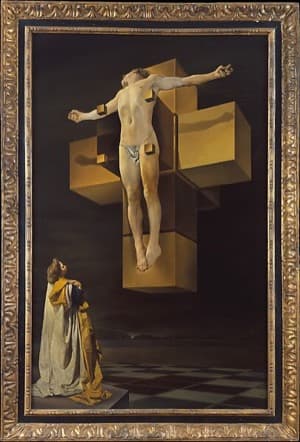
Dalí suspends an unwounded Christ before the unfolded net of a four-dimensional cube while Gala witnesses the scene below.
- 1954
- Oil on canvas
About Salvador Dalí
A route through Dalí's work
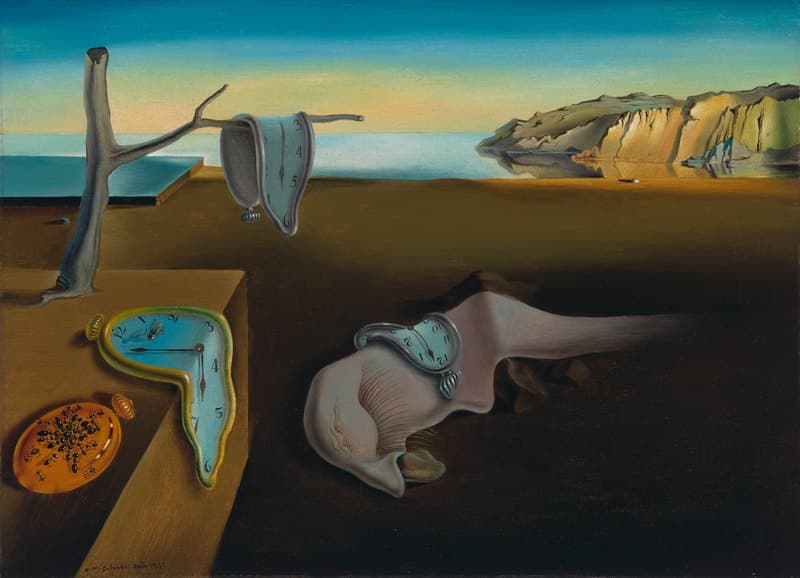
For the early Surrealist starting point behind Dalí's later religious and mathematical painting, see The Persistence of Memory. The two works make clear how he carried meticulous illusionism from melting watches into nuclear mysticism.
What the painting shows
Christ rises high above a black-and-white tiled platform. His arms extend across a geometric structure made of eight cubes, but no nails attach him to it. The body is athletic and intact, without blood, wounds or a crown of thorns.
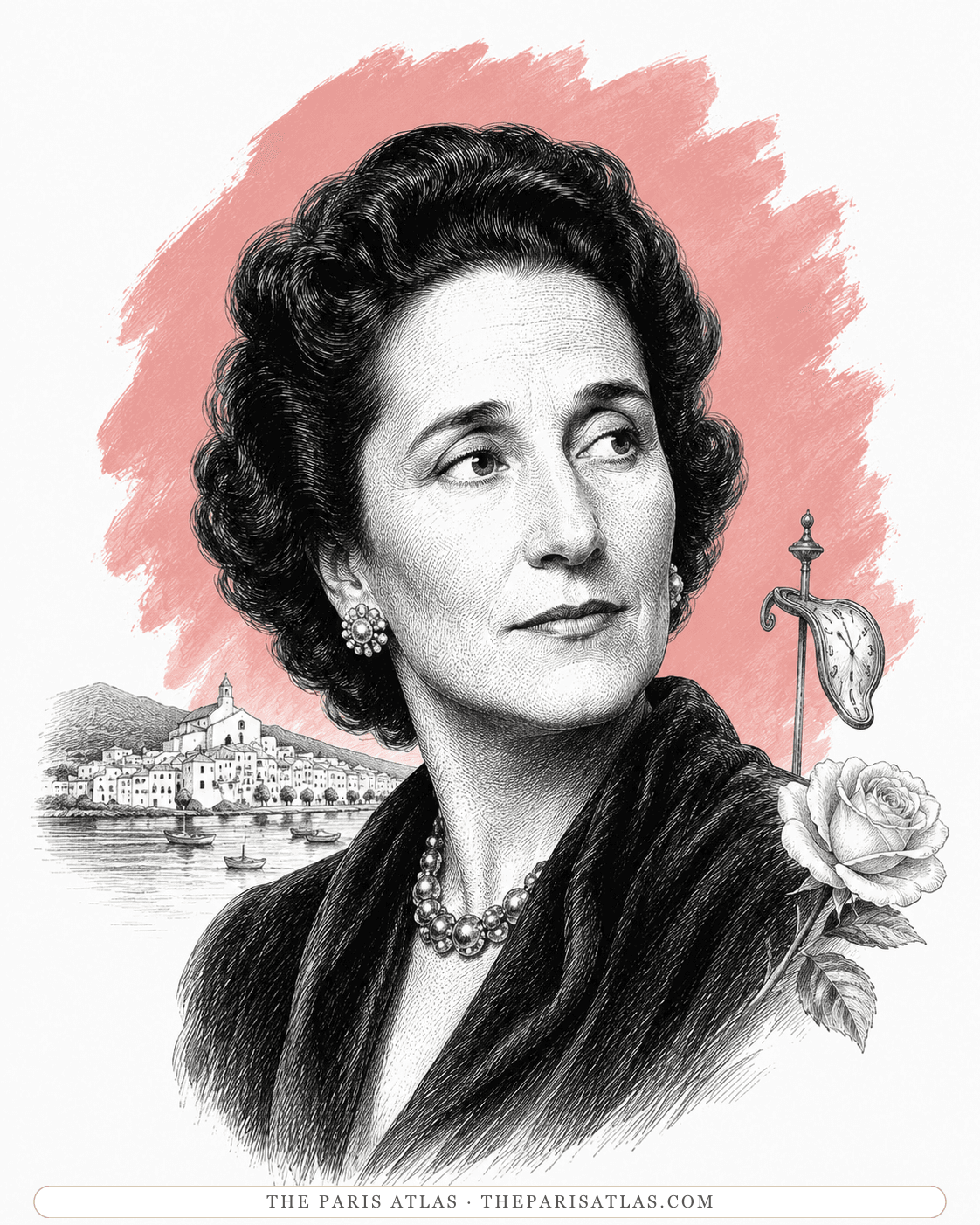
Below, Gala stands in a long robe with her back partly turned to the viewer. She looks upward across a wide, barren space. The sea and low horizon beyond the platform recall the landscapes of Portlligat.
What the hypercube is
A hypercube, or tesseract, is the four-dimensional analogue of a cube. Just as six squares can be unfolded into a flat net that forms a cube, eight cubes can be arranged as a three-dimensional net for a four-dimensional hypercube.
Dalí places Christ in front of that unfolded form. The geometry does not illustrate Christian doctrine in any standard way. It is his attempt to give the crucifixion a structure that points beyond ordinary three-dimensional space.
A crucifixion without torture
The missing nails, thorns and wounds shift attention away from physical suffering. The Metropolitan Museum interprets the healthy, levitating body as Christ's spiritual triumph over corporeal harm.[1]
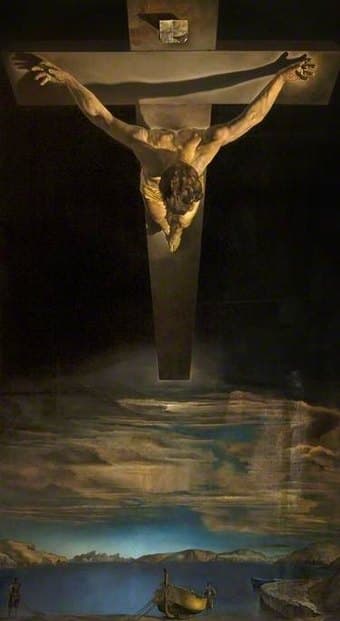
Dalí had already removed blood and nails from Christ of Saint John of the Cross in 1951. Corpus Hypercubus develops that earlier aerial crucifixion through mathematics: bodily perfection is joined to a form the viewer can see but cannot fully realize in ordinary space.
Gala as the devotional witness
Gala occupies the position traditionally given to a saint, donor or worshipper. The Met calls her a devotional figure witnessing Christ's triumph. Her presence turns the public religious subject back toward Dalí's private world.[1]
A smaller related painting, Gala Looking at the Hypercubic Christ, shows how deliberately Dalí developed her role around the project. In the final canvas she is both the human scale of the scene and the viewer's surrogate, looking toward the geometry that the audience is also trying to understand.[2]
Catholicism, mathematics and science
The Met defines Dalí's nuclear mysticism as a fusion of Catholicism, mathematics and science. Corpus Hypercubus makes that program literal: a canonical Christian image is reorganized around higher-dimensional geometry and suspension.[1]
The Fundació's research notes that the painting required substantial mathematical preparation. Its fuller catalogue title also refers to a treatise on cubic form by Juan de Herrera, the architect associated with El Escorial. Modern mathematics and Spanish architectural history therefore enter the same devotional image.[3][4]
What remains from Surrealism
The work belongs to nuclear mysticism rather than Dalí's central Surrealist period. Yet the Met identifies several continuities with his earlier Surrealism: levitation, a vast barren landscape and the chessboard pattern. The change lies in what those devices serve. Dream imagery once staged anxiety, desire and decay. Here it supports an ordered religious vision in which an impossible object becomes a sign of transcendence.[1]
The Metropolitan Museum's first Dalí
The painting was exhibited in New York in 1954 and entered the Metropolitan Museum of Art the following year as a gift of the Chester Dale Collection. The acquisition gave the Met its first painting by Dalí. Its object number is 55.5, and the canvas is currently displayed at The Met Fifth Avenue.[1][5]
Why Corpus Hypercubus matters
Corpus Hypercubus is one of Dalí's most concise statements that religious painting could absorb twentieth-century knowledge without abandoning the old-master body. Christ is traditional in subject and meticulously modelled, while the cross has become a structure from four-dimensional geometry.
Gala's presence is essential to that synthesis. She connects the abstract form to a lived relationship and carries the role Dalí repeatedly gave her in the 1950s: witness, Madonna, saint and organizing figure within his personal theology.
Close reading
Reading the work, detail by detail
The painting asks Christian iconography to occupy a mathematical structure. Enlargement separates the three systems Dalí forces together: body, hypercube, and the sharply ordered world below.
1.The cross unfolds into eight cubes
The cross is not a flat beam but a net of projecting cubes, an attempt to picture a four-dimensional form in three dimensions. Christ appears attached to the geometry without ordinary nails, as if faith and mathematics shared one suspension.
2.Gala occupies the witness position
Her upward gaze gives the viewer an entry into the impossible construction. She is monumental enough to answer Christ's scale, but placed firmly on the tiled floor—the human witness between vision and measured space.
3.The floor measures what the bay dissolves
The chessboard grid fixes perspective with almost aggressive clarity. Beyond it, sea and horizon soften into atmosphere. Dalí stages exact calculation against the limitless landscape it cannot contain.
4.The raised head carries the body beyond the cubes
The head turns upward while the arms extend beyond the central stack of cubes. Rounded flesh and bent fingers interrupt the structure's repeated straight edges. These irregularities matter: the body remains visually distinct from the geometry even where its pose follows the broad shape of a cross.
5.The robe spreads across the platform
The robe falls into long pale folds, then spreads outward near the platform. Dark intervals between those folds give the fabric weight and make its lower edge seem gathered against the ground. This contact is especially clear beneath a body and cubic construction that appear suspended above it.
6.One projecting cube makes the construction tangible
The upper and side faces of the projecting cube differ sharply in brightness. Its clean corners make the block seem solid enough to handle, even within the improbable structure. Concentrating on one cube reveals how Dalí makes the larger mathematical construction persuasive through ordinary light on a simple volume.
Timeline
1954
Dalí paints the crucifixion with Gala as the witnessing figure and exhibits it in New York.
1955
The painting enters the Metropolitan Museum of Art as a gift of the Chester Dale Collection.
Where to see it
The Metropolitan Museum of Art, New York
1000 Fifth Avenue, New York, NY 10028, United States
Displays and loans can change. Check whether this work is on view before making a special trip.
Plan your visit on the museum’s official website (opens in a new tab)Frequently asked questions
What does Corpus Hypercubus mean?
The title joins the body of Christ to a hypercube, the four-dimensional analogue of a cube. Dalí uses its unfolded geometric net as a cross in a nuclear-mystical fusion of Catholicism, mathematics and science.
What is the shape behind Christ?
A three-dimensional net of a hypercube or tesseract, made from eight cubes. It is analogous to the flat six-square net that can be folded into an ordinary cube.
Why are there no nails or wounds?
Dalí deliberately presents an intact, athletic body. The Metropolitan Museum interprets it as Christ's spiritual triumph over physical harm rather than a depiction of torture.
Who is the woman below Christ?
Gala Dalí. She poses as a devotional witness and provides the human viewpoint from which the hypercubic crucifixion is contemplated.
Is Corpus Hypercubus Surrealist?
It belongs to Dalí's later nuclear mysticism, not his core Surrealist period. It nevertheless retains Surrealist devices including levitation, an empty dream landscape and a chessboard floor.
How large is Corpus Hypercubus?
The oil painting measures 194.3 by 123.8 centimetres, a little under two metres high.
Where is Corpus Hypercubus?
The Metropolitan Museum of Art in New York. It entered the collection in 1955 as a gift of the Chester Dale Collection, object number 55.5.
In the atlas
More by Salvador Dalí
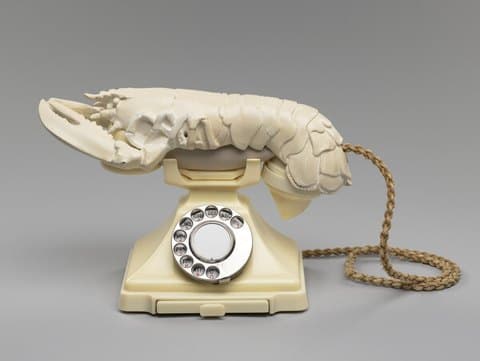
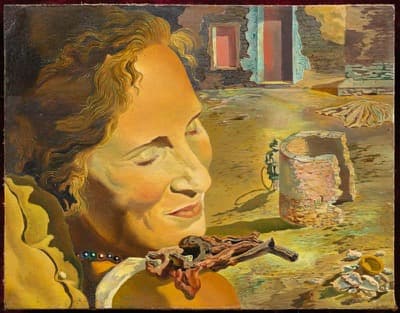
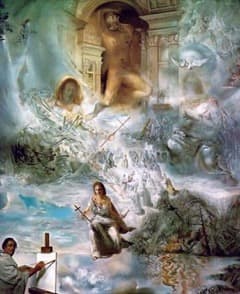
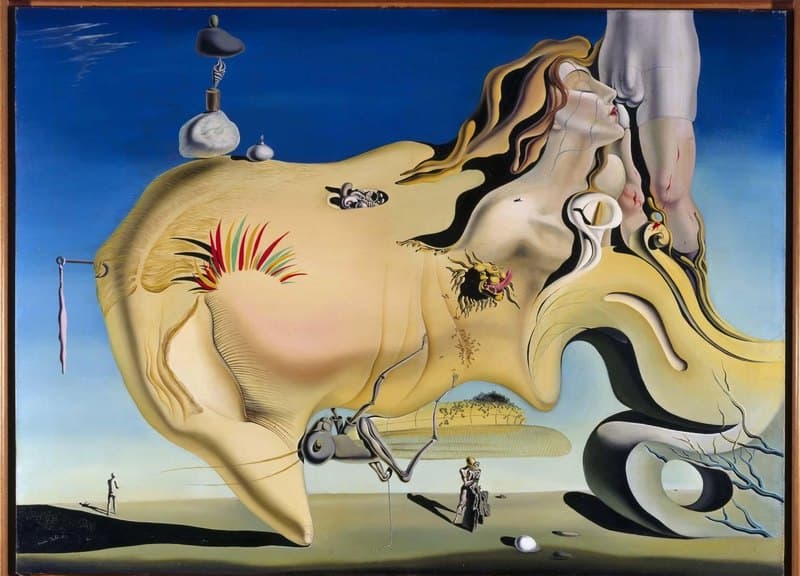
Painting · Nuclear mysticismChrist of Saint John of the CrossPainting · Return to classicismGalarinaPainting · Nuclear mysticismGalatea in CreationPainting · Nuclear mysticismGalatea of the SpheresPainting · Nuclear mysticismLeda AtomicaSculpture · SurrealismLobster TelephonePainting · SurrealismPortrait of Gala with Two Chops Balanced on Her ShoulderPainting · Nuclear mysticismThe Ecumenical CouncilPainting · SurrealismThe Great MasturbatorPainting · Nuclear mysticismThe Madonna of PortlligatPainting · Nuclear mysticismThe Meditative RosePainting · SurrealismThe Persistence of MemoryPainting · Nuclear mysticismThe Sacrament of the Last SupperFilm · SurrealismUn Chien AndalouPainting · SurrealismMetamorphosis of NarcissusPainting · SurrealismSwans Reflecting ElephantsPainting · SurrealismThe Burning GiraffePainting · Nuclear mysticismThe Disintegration of the Persistence of MemoryPainting · Late double-image paintingThe Hallucinogenic Toreador
If you like Salvador Dalí
Explore painters from the same movements and circles.
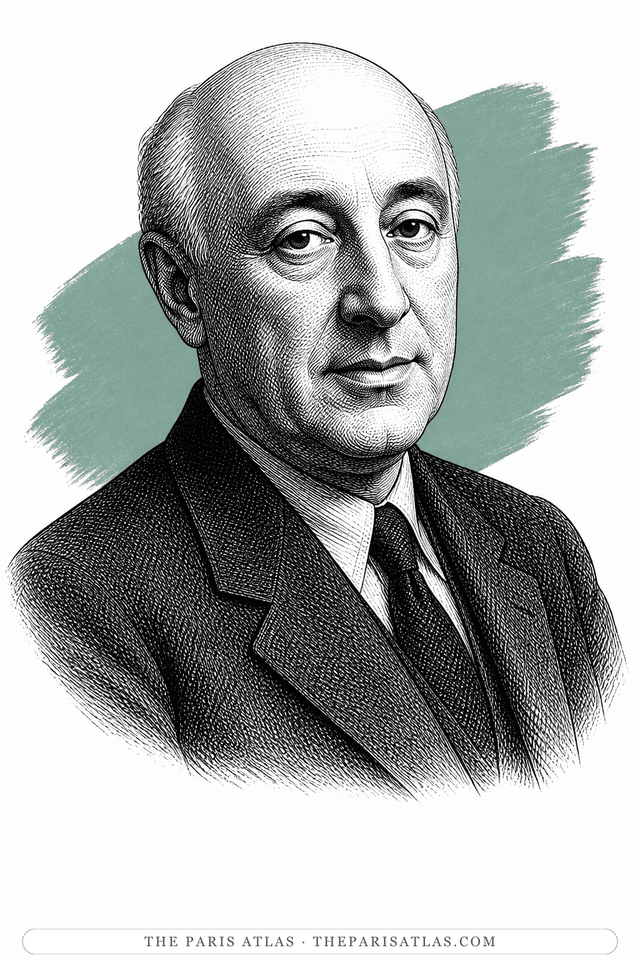
Jean Arp
Strasbourg-born sculptor and poet — Hans in German, Jean in French, both all his life — who co-founded Dada at the Cabaret Voltaire in 1916, composed collages by dropping torn paper 'according to the laws of chance', and settled at Meudon outside Paris in a house his wife Sophie Taeuber-Arp designed.
View artist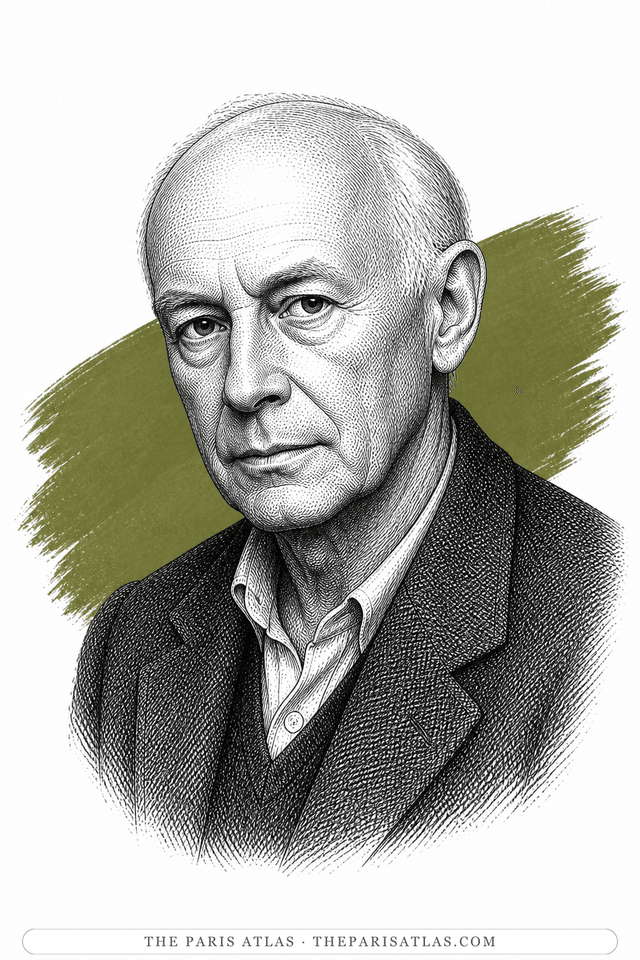
Henri Cartier-Bresson
French photographer who turned a pocket-sized 35mm camera into an instrument of split-second composition — the idea the world knows as 'the decisive moment'. He trained as a painter, was taken prisoner in 1940 and escaped on his third try, photographed the Liberation of Paris in August 1944, co-founded the photographer-owned agency Magnum Photos in 1947, gave up reporting for drawing in the 1970s, and left Paris a foundation in the Marais that deliberately hangs no permanent display of his own pictures.
View artist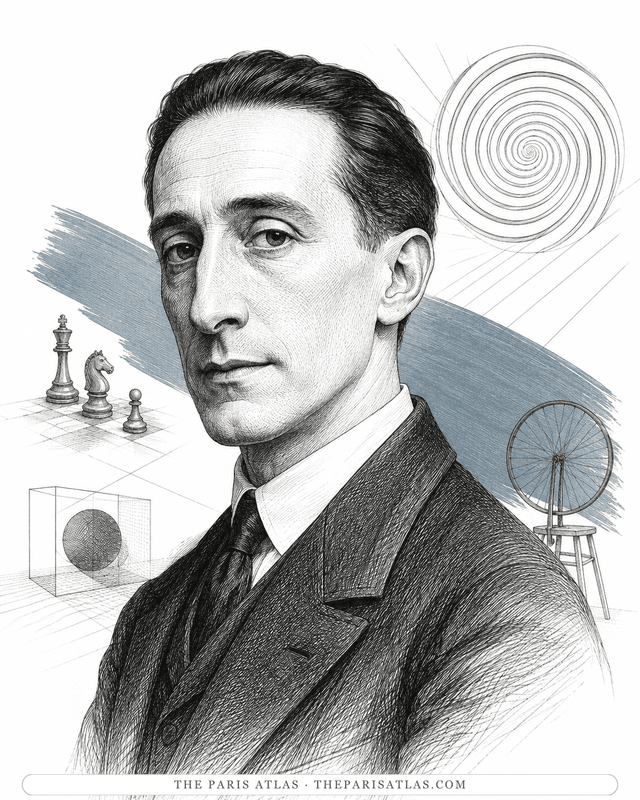
Marcel Duchamp
The century's quietest revolutionary — readymades, the abandonment of painting, chess on a Paris rooftop in Entr'acte, and one anemic film of spinning puns signed Rrose Sélavy.
View artist
References
References
The sources below include collection records, catalogues, scholarly research, and primary materials that informed this page. They document Crucifixion (Corpus Hypercubus), its making, and its place in cultural history.


2↑Fundació Gala-Salvador Dalí — catalogue raisonné of paintings
WebsiteUsed forWeb source consulted for documented facts and historical context presented on the Crucifixion (Corpus Hypercubus) page.
3↑Salvador Dalí and Science
WebsiteCentre for Dalinian Studies, Fundació Gala-Salvador Dalí, 2000Used forWeb source consulted for documented facts and historical context presented on the Crucifixion (Corpus Hypercubus) page.

4↑Salvador Dalí and the Spanish Baroque: From Still Life to Velázquez
EssaysThe Dalí Museum, Avant-garde Studies, 2007Used forPublished analysis and historical context used in preparing the Crucifixion (Corpus Hypercubus) page.
5↑The Metropolitan Museum of Art — collection records
WebsiteUsed forWeb source consulted for documented facts and historical context presented on the Crucifixion (Corpus Hypercubus) page.
i
Why these sources are here
These references provide the documented foundation for this work's history and interpretation. Claim-level citations remain attached to the specific claims they support.
 Explore more resources