The Paris AtlasCharting the artists, works, and places worth returning to.
  • Artists' model
  • Muse
  • Agent
· Russian · 1894–1982

Gala Dalí

Russian-born member of the Surrealist circle who worked with Paul Éluard before becoming Salvador Dalí's business manager, collaborator, and most frequent model.

In images

Details

Lived
1894–1982
Born
1894
Birthplace
Kazan, Russian Empire
Died
10 June 1982
Place of death
Port Lligat, Catalonia
Nationality
Russian
Married
Paul Éluard · from 1917Salvador Dalí · 1934–1982
Children
Cécile Éluard
Roles
Artists' modelMuseAgent
Also known as
Elena Ivanovna Diakonova · Gala Éluard

About Gala Dalí

Gala Dalí was born Elena Diakonova in Kazan in 1894. She entered the Paris avant-garde through her first husband, Paul Éluard, and became part of Surrealism's social and working circle before she met Salvador Dalí in 1929.

She is remembered as Dalí's wife, muse, and model. Those descriptions are accurate but incomplete. She managed his money, negotiated with galleries and patrons, organized his working life, researched materials, sold paintings, and took part in several creative projects. Dalí's career was a joint enterprise even when only his name appeared on the work.

Kazan, Clavadel, and Paul Éluard

Diakonova was the third of four children. After her father died, the family lived in Moscow, where she received a strong education and read widely. Sources disagree about her exact birthday. The Fundació Gala-Salvador Dalí gives 26 August 1894. The Dalí Museum records 18 August as the date given by her daughter, while two biographers use 26 August in the Julian calendar, equivalent to 7 September in the Gregorian calendar.

A respiratory illness took her to the Clavadel sanatorium in Switzerland in 1912. There she met Paul-Eugène Grindel, the future Paul Éluard. They read and wrote together, and she copied and proofread his work. In 1914 she supplied a preface to his Dialogue des inutiles under the pseudonym Reine de Paleùglnn, her first known published text.

She returned to Russia when they left the sanatorium, completed her schooling, and crossed wartime Europe to join Éluard in Paris in 1916. They married the following February. Their only child, Cécile, was born in 1918.

Inside the Surrealist circle

Éluard moved from Dada into the group around André Breton, and Gala moved through the same rooms, friendships, and publications. In 1922 the couple met Max Ernst. Ernst later lived with them at Eaubonne, and he painted Gala into Au rendez-vous des amis among the men of the emerging Surrealist circle.

Gala's work in these years was often private: reading, encouraging, editing, arranging, and judging. That makes it harder to catalogue than a signed book or painting. The surviving preface, photographs, correspondence, and Surrealist objects document her participation in the movement.

In 1924 Éluard left Europe without warning. Gala travelled to Saigon to persuade him to return, and her relationship with Ernst ended. The episode shows how actively she managed the relationships around her well before she took charge of Dalí's career.

Cadaqués, 1929

In August 1929 Gala, Éluard, and Cécile travelled to Cadaqués with René Magritte, Georgette Magritte, and the dealer Camille Goemans. Their host was Salvador Dalí, ten years younger than Gala and newly connected to the Paris Surrealists. Gala and Dalí began a relationship during the visit. She remained after Éluard left and returned to Paris with Dalí and several of his paintings.

The Dalí Museum says that she used Dalí's notes on his paranoiac-critical method to persuade Breton of the painter's importance to Surrealism. The Fundació's chronology places the couple's shared life and Dalí's establishment in the group in the same year. Gala's marriage to Éluard ended before she and Dalí married civilly in Paris on 30 January 1934.

The business of Dalí

By the late 1930s Gala was Dalí's business manager. The Dalí Museum's chronology describes the duties in concrete terms:

  • Managing the couple's money and keeping the business side of the studio in order.
  • Negotiating with galleries, collectors, and patrons about Dalí's work.
  • Organizing travel and daily arrangements so that Dalí could paint.
  • Researching paints, varnishes, and brushes, and finding older frames for exhibitions.

When France was about to fall in 1940, she returned to Paris to secure paintings before the couple left for the United States. They remained in America until 1948, moving between patrons, hotels, exhibitions, and commercial commissions. Gala handled much of the practical network behind that expansion. She reduced her travel and contract work from 1960 but retained control of painting sales.

Gala Dalí in an undated photograph. (Fen Labalme, via Wikimedia Commons; Commons crop converted to PNG and watermarked by The Paris Atlas · CC BY-SA 2.0)

Creative work and shared authorship

Gala also worked on creative and publishing projects. In 1936 she contributed a maquette for a Surrealist apartment to the International Surrealist Exhibition in London. Photographs from 1939 show her working on Dalí's Dream of Venus pavilion for the New York World's Fair. She filed and corrected the long manuscripts that became several of his books.

A 2018 exhibition organized by the Museu Nacional d'Art de Catalunya and the Fundació Gala-Salvador Dalí presented Gala as a creator of texts, sketches, and Surrealist objects. Its curators argued that some of the couple's work should be understood as shared authorship. Gala did not maintain an independent body of paintings comparable to Dalí's. The exhibition connects its interpretation to the double signature he later used: Gala Salvador Dalí.

She also remained the recurring subject of Dalí's art. Across three decades she appears as an intimate sitter, a Renaissance portrait subject, a mythological woman, a Madonna, a devotional witness, and a face reconstructed through atomic imagery:

Calling Gala a muse describes her presence in these paintings, but it does not describe the whole arrangement. She posed and supplied a recurring image while also managing sales, materials, negotiations, and the daily conditions in which the work was produced.

Fashion and the public image

Gala treated clothing as part of her public presentation. The fashion archive preserved by the Fundació follows the changes: practical androgyny in 1920s Paris, Surrealist display in the 1930s, Hollywood polish in the United States, couture in the postwar years, and looser forms at Púbol. This was another way of controlling how she appeared in photographs and in the Dalí mythology.

  • Paris: a practical Chanel style, followed in the 1930s by Elsa Schiaparelli designs that also publicized Schiaparelli's work with Dalí.
  • The American years: Arthur Falkenstein for everyday wear and Howard Greer for a more explicitly Hollywood image.
  • The 1950s and 1960s: Christian Dior, Hubert de Givenchy, Jean Dessès, Oleg Cassini, Emilio Pucci, and Pierre Cardin, with jewellery by Mimi di Niscemi and Kenneth Jay Lane.
  • The 1970s: Marc Bohan for Dior, Michel Goma for Lanvin, Elizabeth Arden, and Maurice Renoma.

The archive contains haute couture, ready-to-wear, and unlabelled pieces. Together they record how Gala adjusted her appearance to different cities, decades, and roles.

Gala Dalí at the Hôtel Meurice in Paris, 1972. (Allan Warren, via Wikimedia Commons; Commons crop converted to PNG and watermarked by The Paris Atlas · CC BY 3.0)

Cadaqués, Portlligat, and Púbol

Three places organize the second half of Gala's life:

  • Cadaqués was the coastal town where she met Dalí during the Éluard party's visit in August 1929.
  • Portlligat became the couple's principal European home and Dalí's main studio. Gala had private rooms there, including the Oval Room recorded in the Fundació's chronology.
  • Púbol Castle became Gala's separate retreat around the turn of the 1970s and the place where she was buried.

Dalí acquired and transformed the ruined medieval castle at Púbol for Gala during the late 1960s and early 1970s. The couple re-imagined its rooms and garden together, and Gala gave instructions during the restoration. Dalí designed decorative elements and painted illusionistic architectural details. He could visit only when she invited him in writing, a rule recorded by both the Dalí Museum and the Fundació.

The Dalí Museum records that Gala and Cécile were estranged for most of their lives. Cécile had accompanied her parents to Cadaqués in 1929 and later supplied one of the competing dates for her mother's birth.

Gala died at Port Lligat on 10 June 1982 and was buried at Púbol. The castle became her memorial and, later, one of the three museums maintained by the Fundació Gala-Salvador Dalí.

Life events

  1. 1894

    Born Elena Diakonova in Kazan. The exact day is disputed: institutional sources give 18 August, 26 August, or 7 September depending on the testimony and calendar used.

    Gala's Origins and Education — Fundació Gala-Salvador Dalí; The Dalí Museum, St. Petersburg — Gala Dalí

  2. 1912

    Sent to the Clavadel sanatorium in Switzerland for a respiratory illness. Meets Paul-Eugène Grindel, later Paul Éluard.

    Gala's Origins and Education — Fundació Gala-Salvador Dalí; The Dalí Museum, St. Petersburg — Gala Dalí

  3. 1914

    Returns to Russia after leaving Clavadel. Her preface to Éluard's Dialogue des inutiles appears under the pseudonym Reine de Paleùglnn.

    Gala's Origins and Education — Fundació Gala-Salvador Dalí

  4. 1917–1918

    Marries Paul Éluard in Paris in February 1917. Their daughter Cécile is born the following year.

    Salvador Dalí and Gala: Dual Timeline — Fundació Gala-Salvador Dalí, 1917; The Dalí Museum, St. Petersburg — Gala Dalí, 1917

  5. 1922

    Gala and Éluard meet Max Ernst. Ernst paints her into Au rendez-vous des amis and later lives with the couple at Eaubonne.

    Salvador Dalí and Gala: Dual Timeline — Fundació Gala-Salvador Dalí, 1922; The Visible Woman — Fundació Gala-Salvador Dalí; The Dalí Museum, St. Petersburg — Gala Dalí, 1922

  6. 1924

    Travels to Saigon to persuade Éluard to return from his self-imposed absence. Her relationship with Max Ernst ends.

    The Dalí Museum, St. Petersburg — Gala Dalí, 1924

  7. 1929

    Travels to Cadaqués with Éluard and their daughter, meets Salvador Dalí, and begins a relationship and working partnership with him.

    Salvador Dalí and Gala: Dual Timeline — Fundació Gala-Salvador Dalí, 1929; Gala-Salvador Dalí — Fundació Gala-Salvador Dalí; The Dalí Museum, St. Petersburg — Gala Dalí, 1929

  8. 1934

    Marries Dalí in a civil ceremony in Paris on 30 January.

    Salvador Dalí and Gala: Dual Timeline — Fundació Gala-Salvador Dalí, 1934; The Dalí Museum, St. Petersburg — Gala Dalí, 1934

  9. 1936

    Contributes a maquette for a Surrealist apartment to the International Surrealist Exhibition in London.

    The Dalí Museum, St. Petersburg — Gala Dalí, 1936

  10. 1937–1939

    Takes formal charge of Dalí's business affairs. In 1939 she works on his Dream of Venus pavilion for the New York World's Fair.

    Gala-Salvador Dalí — Fundació Gala-Salvador Dalí; The Dalí Museum, St. Petersburg — Gala Dalí, 1937; Estrella de Diego, Gala Salvador Dalí: A Room of One's Own in Púbol (2018), pp. 6, 12

  11. 1930s–1970s

    Uses clothing as a deliberate part of her public image, from Schiaparelli and Hollywood designers to postwar couture and the looser wardrobe of Púbol.

    The Fashion Archive — Fundació Gala-Salvador Dalí

  12. 1940–1948

    The Dalís live in the United States during the war, while Gala manages travel, patrons, sales, and working arrangements.

    The Dalí Museum, St. Petersburg — Gala Dalí, 1940–1948

  13. 1942

    Proofreads and typesets The Secret Life of Salvador Dalí, one of the publishing projects she managed for the couple.

    Gala-Salvador Dalí — Fundació Gala-Salvador Dalí

  14. 1948

    Returns with Dalí to Portlligat after the American years. The couple continues to divide its time between Europe and the United States.

    Salvador Dalí and Gala: Dual Timeline — Fundació Gala-Salvador Dalí, 1948; The Dalí Museum, St. Petersburg — Gala Dalí, 1948

  15. 1952

    Dalí paints Galatea of the Spheres, constructing Gala's portrait from a lattice of suspended particles.

    Galatea of the Spheres: the bust of Gala assembled from dozens of suspended spheres against a blue-grey ground, signed lower centre.Painting · in the catalogGalatea of the Spheres1952 · Oil on canvas

    Fundació Gala-Salvador Dalí — catalogue raisonné of paintings, catalogue no. P 672

  16. 1958

    Gala and Dalí marry again in a private religious ceremony near Girona.

    Salvador Dalí and Gala: Dual Timeline — Fundació Gala-Salvador Dalí, 1958; The Dalí Museum, St. Petersburg — Gala Dalí, 1958

  17. 1961

    The Oval Room at Portlligat gives Gala a private space within the couple's principal home and studio.

    Salvador Dalí and Gala: Dual Timeline — Fundació Gala-Salvador Dalí, 1961

  18. Late 1960s–early 1970s

    Dalí acquires and transforms Púbol Castle for Gala as her private retreat. He may visit only with her written invitation.

    Gala Dalí Castle — Fundació Gala-Salvador Dalí; Salvador Dalí and Gala: Dual Timeline — Fundació Gala-Salvador Dalí, 1969; The Dalí Museum, St. Petersburg — Gala Dalí, 1969

  19. 1982

    Dies at Port Lligat on 10 June and is buried at Púbol Castle.

    Salvador Dalí and Gala: Dual Timeline — Fundació Gala-Salvador Dalí, 1982; The Dalí Museum, St. Petersburg — Gala Dalí, 1982

Featured in these books

Cover of Critical Essays by George Orwell

Critical Essays

by George Orwell

How Gala appears in its pages: Salvador Dalí's wife, who reaches "Benefit of Clergy" only through the pages of her husband's autobiography. Orwell relays two moments from it: that Dalí was tempted to push her off a precipice when they first met, and the exchange after their first kiss, quoted at length, in which he demanded to be told what she wanted done to her and she answered that she wanted him to kill her.

In art

Works in our catalog with Gala as their subject.

Portrait of Gala with Two Chops Balanced on Her Shoulder: Gala shown in profile before a Portlligat landscape with two lamb chops resting on her shoulder.

Artwork reproduction

Painting · Surrealism

Portrait of Gala with Two Chops Balanced on Her Shoulder

Salvador Dalí · c. 1934 · Oil on wood panel

Dalí compressed Gala, two lamb chops and a sunlit stone courtyard into a panel smaller than a credit card. His later explanation connected the meat with a desire to devour her.

Fundació Gala-Salvador Dalí, Figueres

Salvador Dalí, Portrait of Gala with Two Chops Balanced on Her Shoulder, c. 1934. Fundació Gala-Salvador Dalí, Figueres. Image © the rights holder, shown under fair use.

Galarina: Gala seated against a dark ground with her blouse open, arms crossed and gaze directed at the viewer.

Artwork reproduction

Painting · Return to classicism

Galarina

Salvador Dalí · 1945 · Oil on canvas

Dalí worked for six months on this 1945 portrait of Gala, recasting her through Raphael's La Fornarina and signing the canvas with both of their names.

Dalí Theatre-Museum, Figueres

Salvador Dalí, Galarina, 1945. Dalí Theatre-Museum, Figueres. Image © the rights holder, shown under fair use.

Leda Atomica: Gala posed nude as Leda beside a swan, with the figures, books, furniture and other objects suspended above a coastal landscape.

Artwork reproduction

Painting · Nuclear mysticism

Leda Atomica

Salvador Dalí · 1947–49 · Oil on canvas

Gala becomes the mythological Leda in a composition ordered by a pentagon and the golden ratio. Figure, swan, books, egg and sea remain suspended without touching.

Dalí Theatre-Museum, Figueres

Salvador Dalí, Leda Atomica, 1947–49. Dalí Theatre-Museum, Figueres. Image © the rights holder, shown under fair use.

The Madonna of Portlligat: Gala as the Virgin Mary holding the Christ Child within fragmented architecture above a coastal landscape.

Artwork reproduction

Painting · Nuclear mysticism

The Madonna of Portlligat

Salvador Dalí · 1950 · Oil on canvas

Gala appears as the Virgin Mary in Dalí's monumental 1950 fusion of Renaissance altarpiece, atomic disintegration and the landscape of Portlligat.

Fukuoka Art Museum, Japan

Salvador Dalí, The Madonna of Portlligat, 1950. Fukuoka Art Museum, Japan. Image © the rights holder, shown under fair use.

Galatea of the Spheres: the bust of Gala assembled from dozens of suspended spheres against a blue-grey ground, signed lower centre.

Artwork reproduction

Painting · Nuclear mysticism

Galatea of the Spheres

Salvador Dalí · 1952 · Oil on canvas

Dalí reconstructs Gala's face from suspended spheres in this 1952 portrait, a compact statement of the atomic or corpuscular painting he called nuclear mysticism.

Teatre-Museu Dalí, Figueres (Fundació Gala-Salvador Dalí)

Salvador Dalí, Galatea of the Spheres, 1952. Teatre-Museu Dalí, Figueres (Fundació Gala-Salvador Dalí). Image © the rights holder, shown under fair use.

Crucifixion (Corpus Hypercubus): Christ suspended before the geometric net of a hypercube while Gala stands below and looks upward.

Artwork reproduction

Painting · Nuclear mysticism

Crucifixion (Corpus Hypercubus)

Salvador Dalí · 1954 · Oil on canvas

Dalí suspends an unwounded Christ before the unfolded net of a four-dimensional cube while Gala witnesses the scene below.

The Metropolitan Museum of Art, New York

Salvador Dalí, Crucifixion (Corpus Hypercubus), 1954. The Metropolitan Museum of Art, New York. Image © the rights holder, shown under fair use.

The Ecumenical Council: a large vertical religious composition with the Trinity above, Gala near the centre and Dalí painting at lower left.

Artwork reproduction

Painting · Nuclear mysticism

The Ecumenical Council

Salvador Dalí · c. 1960 · Oil on canvas

Dalí's three-metre canvas combines the Trinity, Gala as Saint Helena, Pope John XXIII, a Catalan landscape and a self-portrait modelled on Velázquez.

The Dalí Museum, St. Petersburg, Florida

Salvador Dalí, The Ecumenical Council, c. 1960. The Dalí Museum, St. Petersburg, Florida. Image © the rights holder, shown under fair use.

People they knew

Documented connections — every one carries its source.

Illustrated portrait of Paul Éluard

Paul Éluard

  • Poet

Married to · 1917

They met as patients at the Clavadel sanatorium above Davos in 1912, were discharged in February 1914, and married in Paris in February 1917. She left him at Cadaqués in 1929; he went on writing about her for years afterwards.

Gala's Origins and Education — Fundació Gala-Salvador Dalí, Clavadel and Paris, 1912–1917; The Dalí Museum, St. Petersburg — Gala Dalí, 1912–1917

Illustrated portrait of Salvador Dalí

Salvador Dalí

  • Painter
  • Filmmaker
  • Sculptor

Married to · 1934–1982

Civil ceremony in Paris on 30 January 1934, and a private religious ceremony at the Els Àngels shrine near Girona in 1958. She ran the money and the negotiations with galleries and patrons for the whole of it.

The Dalí Museum, St. Petersburg — Gala Dalí; Salvador Dalí and Gala: Dual Timeline — Fundació Gala-Salvador Dalí, 1934 and 1958

Met · 1929

She arrived at Cadaqués in August 1929 as Paul Éluard's wife, on a holiday visit to a painter ten years younger than her. She stayed on after her husband went back to Paris.

The Dalí Museum, St. Petersburg — Gala Dalí; Salvador Dalí and Gala: Dual Timeline — Fundació Gala-Salvador Dalí, 1929

Illustrated portrait of Luis Buñuel

Luis Buñuel

  • Filmmaker

Clashed with

The MNAC's 2018 exhibition describes Buñuel's hostility toward Gala. This was an antagonistic connection within the Surrealist circle, not a close friendship.

Estrella de Diego, Gala Salvador Dalí: A Room of One's Own in Púbol (2018), p. 2

Illustrated portrait of Brassaï

Brassaï

  • Photographer
  • Author

Collaborated with

Brassaï photographed Gala. He later described her combined roles as Dalí's inspiration, teacher, muse and businesswoman.

Estrella de Diego, Gala Salvador Dalí: A Room of One's Own in Púbol (2018), p. 2; Gala-Salvador Dalí — Fundació Gala-Salvador Dalí

Illustrated portrait of Cecil Beaton

Cecil Beaton

  • Photographer

Collaborated with

Gala sat for Cecil Beaton, one of several photographers who made portraits of her.

Estrella de Diego, Gala Salvador Dalí: A Room of One's Own in Púbol (2018), p. 2

Illustrated portrait of Man Ray

Man Ray

  • Photographer
  • Painter
  • Filmmaker

Collaborated with

Gala sat for Man Ray. One of his portraits appeared in Dalí's 1930 promotional leaflet and book La Femme visible.

Estrella de Diego, Gala Salvador Dalí: A Room of One's Own in Púbol (2018), p. 2; The Visible Woman — Fundació Gala-Salvador Dalí

Illustrated portrait of André Breton

André Breton

  • Author
  • Poet
  • Critic
  • +1

Met

Gala knew Breton through Éluard's Surrealist circle. The Dalí Museum credits her with using Dalí's notes on the paranoiac-critical method to persuade Breton of the painter's importance in 1929.

Estrella de Diego, Gala Salvador Dalí: A Room of One's Own in Púbol (2018), pp. 2–5; The Dalí Museum, St. Petersburg — Gala Dalí, 1929

Illustrated portrait of Camille Goemans

Camille Goemans

  • Poet
  • Agent

Met · 1929

Goemans introduced Dalí to Gala and Paul Éluard in Paris and joined their group visit to Cadaqués in August 1929.

The Dalí Museum, St. Petersburg — Gala Dalí, 1929

Illustrated portrait of Georgette Magritte

Georgette Magritte

  • Artists' model

Met · 1929

Georgette and René Magritte travelled with Gala, Paul Éluard, Cécile and Camille Goemans to visit Salvador Dalí at Cadaqués in August 1929.

The Dalí Museum, St. Petersburg — Gala Dalí, 1929

Illustrated portrait of Giorgio de Chirico

Giorgio de Chirico

  • Painter

Met

The MNAC's 2018 exhibition records that de Chirico valued Gala's practical intelligence and asked her to act as his agent.

Estrella de Diego, Gala Salvador Dalí: A Room of One's Own in Púbol (2018), p. 5

Illustrated portrait of Max Ernst

Max Ernst

  • Painter
  • Sculptor

Met · 1922

Gala and Paul Éluard met Ernst in 1922. Ernst became Gala's lover, lived with the couple at Eaubonne, and painted her as the only woman in Au rendez-vous des amis. The affair ended in 1924.

Salvador Dalí and Gala: Dual Timeline — Fundació Gala-Salvador Dalí, 1922; Estrella de Diego, Gala Salvador Dalí: A Room of One's Own in Púbol (2018), pp. 2–5; The Dalí Museum, St. Petersburg — Gala Dalí, 1922–1924

Illustrated portrait of René Crevel

René Crevel

  • Author

Met

The MNAC's 2018 exhibition identifies the Surrealist writer René Crevel as Gala's friend.

Estrella de Diego, Gala Salvador Dalí: A Room of One's Own in Púbol (2018), pp. 2, 5

Illustrated portrait of René Magritte

René Magritte

  • Painter

Met · 1929

René and Georgette Magritte travelled with Gala, Paul Éluard, Cécile and Camille Goemans to visit Salvador Dalí at Cadaqués in August 1929.

The Dalí Museum, St. Petersburg — Gala Dalí, 1929

Movements

The artistic and literary currents this life ran through.

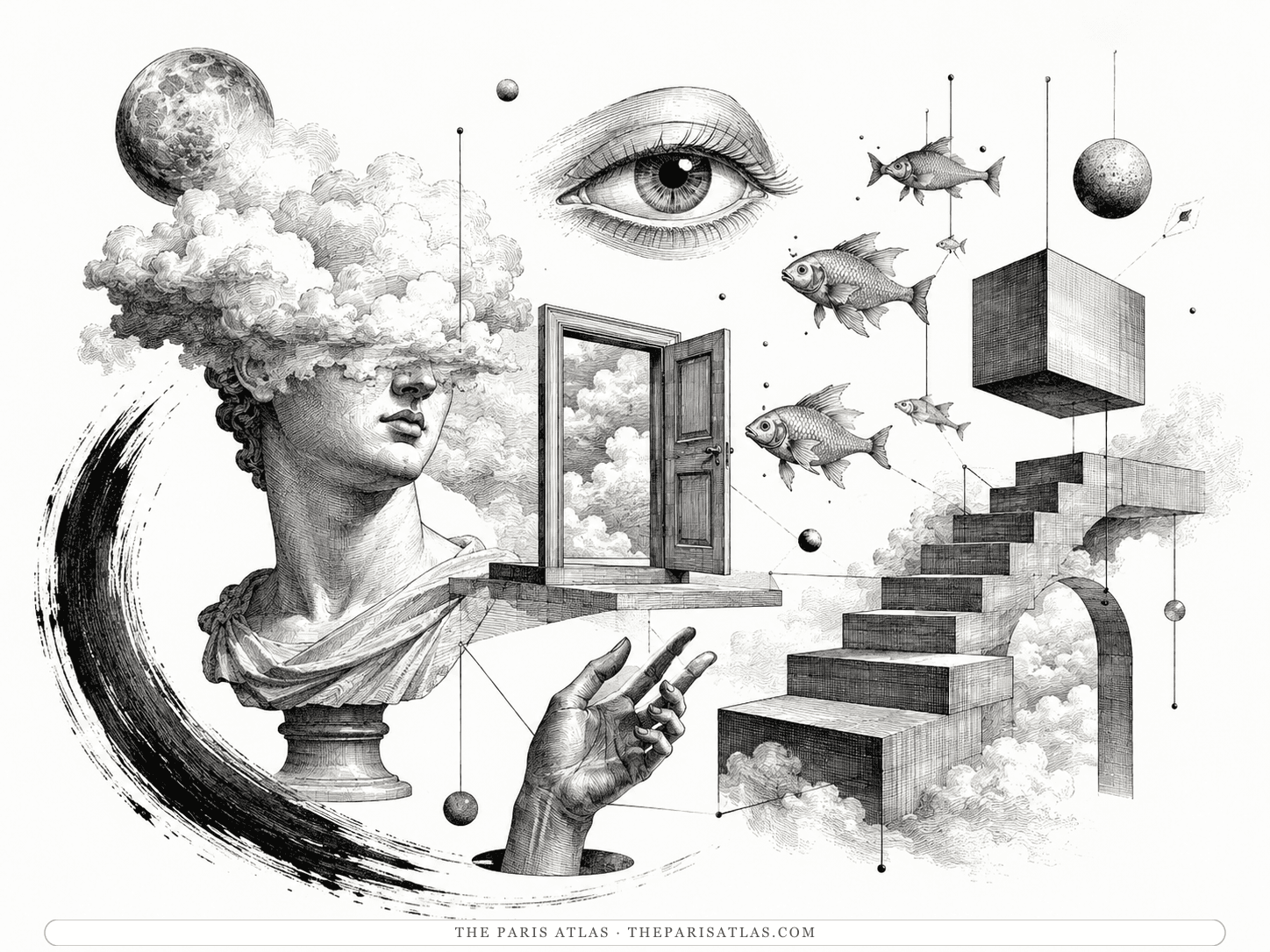
Pen-and-ink dream collage — a classical bust with clouds for eyes, a floating eye, a door opening onto sky, fish swimming through air, and an impossible staircase

Art & literary movement · 1924–1966

Surrealism

Gala belonged to the Paris Surrealist circle through Paul Éluard and Max Ernst, contributed a maquette to the 1936 International Surrealist Exhibition, and worked on Dalí's Dream of Venus pavilion in 1939.

The Dalí Museum, St. Petersburg — Gala Dalí, 1922–1939; Estrella de Diego, Gala Salvador Dalí: A Room of One's Own in Púbol (2018), pp. 2–9

Gala Dalí’s Places

The cataloged places connected to Gala Dalí — through the books, and through the documented record.

Places you can enter today appear first, followed by addresses to see from outside and sites that have vanished.

Questions about Gala Dalí

Who was Gala Dalí?

Gala Dalí was a Russian-born member of the Surrealist circle who became Salvador Dalí's wife, business manager, collaborator, and most frequent model. She was born Elena Diakonova in 1894 and died in 1982.

What was Gala Dalí's real name?

Her birth name was Elena Diakonova. She was also known as Gala Éluard during her marriage to the French poet Paul Éluard.

When was Gala Dalí born?

She was born in Kazan in 1894, but the exact day is disputed. The Fundació Gala-Salvador Dalí gives 26 August. The Dalí Museum records 18 August from her daughter and also notes the Gregorian equivalent of 7 September used by biographers.

What did Gala do for Salvador Dalí?

She managed his money, negotiated with galleries and patrons, organized travel and daily work, researched art materials and frames, sold paintings, and helped edit and preserve his writing.

Was Gala Dalí an artist?

She made texts, sketches, and Surrealist objects and contributed to projects including the 1939 Dream of Venus pavilion. A 2018 museum exhibition argued for her partial authorship of the Gala-Salvador Dalí project, while acknowledging that she left few signed works.

Why is Gala Dalí's fashion archive important?

It documents how deliberately she managed her public image. Her surviving wardrobe moves from Chanel-style practicality and Schiaparelli's Surrealist designs to American fashion, postwar couture, and the looser clothes she wore at Púbol.

Who were the important people in Gala Dalí's circle?

Her closest artistic relationships were with Paul Éluard, Max Ernst, and Salvador Dalí. The sourced relationship section on this page documents her other direct contacts across the Surrealist circle.

Was Gala married to Paul Éluard?

Yes. They met at a Swiss sanatorium in 1912, married in Paris in 1917, and had one daughter, Cécile. Their marriage ended before she married Salvador Dalí in a civil ceremony in 1934.

Why could Dalí visit Gala at Púbol only by invitation?

Púbol was Gala's private retreat. She required Dalí to obtain a written invitation before visiting, a rule recorded by the Dalí Museum and the Fundació Gala-Salvador Dalí.

When and where did Gala Dalí die?

She died at Port Lligat on 10 June 1982. She was buried at her castle in Púbol.

Sourced claims

Every connection the graph holds for Gala, with the evidence behind it.

Married to · 1917

Paul Éluard

They met as patients at the Clavadel sanatorium above Davos in 1912, were discharged in February 1914, and married in Paris in February 1917. She left him at Cadaqués in 1929; he went on writing about her for years afterwards.

Gala's Origins and Education — Fundació Gala-Salvador Dalí, Clavadel and Paris, 1912–1917; The Dalí Museum, St. Petersburg — Gala Dalí, 1912–1917

Married to · 1934–1982

Salvador Dalí

Civil ceremony in Paris on 30 January 1934, and a private religious ceremony at the Els Àngels shrine near Girona in 1958. She ran the money and the negotiations with galleries and patrons for the whole of it.

The Dalí Museum, St. Petersburg — Gala Dalí; Salvador Dalí and Gala: Dual Timeline — Fundació Gala-Salvador Dalí, 1934 and 1958

Met · 1929

Salvador Dalí

She arrived at Cadaqués in August 1929 as Paul Éluard's wife, on a holiday visit to a painter ten years younger than her. She stayed on after her husband went back to Paris.

The Dalí Museum, St. Petersburg — Gala Dalí; Salvador Dalí and Gala: Dual Timeline — Fundació Gala-Salvador Dalí, 1929

Associated with · 1920

Surrealism

Gala belonged to the Paris Surrealist circle through Paul Éluard and Max Ernst, contributed a maquette to the 1936 International Surrealist Exhibition, and worked on Dalí's Dream of Venus pavilion in 1939.

The Dalí Museum, St. Petersburg — Gala Dalí, 1922–1939; Estrella de Diego, Gala Salvador Dalí: A Room of One's Own in Púbol (2018), pp. 2–9

Clashed with

Luis Buñuel

The MNAC's 2018 exhibition describes Buñuel's hostility toward Gala. This was an antagonistic connection within the Surrealist circle, not a close friendship.

Estrella de Diego, Gala Salvador Dalí: A Room of One's Own in Púbol (2018), p. 2

Collaborated with

Brassaï

Brassaï photographed Gala. He later described her combined roles as Dalí's inspiration, teacher, muse and businesswoman.

Estrella de Diego, Gala Salvador Dalí: A Room of One's Own in Púbol (2018), p. 2; Gala-Salvador Dalí — Fundació Gala-Salvador Dalí

Collaborated with

Cecil Beaton

Gala sat for Cecil Beaton, one of several photographers who made portraits of her.

Estrella de Diego, Gala Salvador Dalí: A Room of One's Own in Púbol (2018), p. 2

Collaborated with

Man Ray

Gala sat for Man Ray. One of his portraits appeared in Dalí's 1930 promotional leaflet and book La Femme visible.

Estrella de Diego, Gala Salvador Dalí: A Room of One's Own in Púbol (2018), p. 2; The Visible Woman — Fundació Gala-Salvador Dalí

Met

André Breton

Gala knew Breton through Éluard's Surrealist circle. The Dalí Museum credits her with using Dalí's notes on the paranoiac-critical method to persuade Breton of the painter's importance in 1929.

Estrella de Diego, Gala Salvador Dalí: A Room of One's Own in Púbol (2018), pp. 2–5; The Dalí Museum, St. Petersburg — Gala Dalí, 1929

Met · 1929

Camille Goemans

Goemans introduced Dalí to Gala and Paul Éluard in Paris and joined their group visit to Cadaqués in August 1929.

The Dalí Museum, St. Petersburg — Gala Dalí, 1929

Met · 1929

Georgette Magritte

Georgette and René Magritte travelled with Gala, Paul Éluard, Cécile and Camille Goemans to visit Salvador Dalí at Cadaqués in August 1929.

The Dalí Museum, St. Petersburg — Gala Dalí, 1929

Met

Giorgio de Chirico

The MNAC's 2018 exhibition records that de Chirico valued Gala's practical intelligence and asked her to act as his agent.

Estrella de Diego, Gala Salvador Dalí: A Room of One's Own in Púbol (2018), p. 5

Met · 1922

Max Ernst

Gala and Paul Éluard met Ernst in 1922. Ernst became Gala's lover, lived with the couple at Eaubonne, and painted her as the only woman in Au rendez-vous des amis. The affair ended in 1924.

Salvador Dalí and Gala: Dual Timeline — Fundació Gala-Salvador Dalí, 1922; Estrella de Diego, Gala Salvador Dalí: A Room of One's Own in Púbol (2018), pp. 2–5; The Dalí Museum, St. Petersburg — Gala Dalí, 1922–1924

Met

René Crevel

The MNAC's 2018 exhibition identifies the Surrealist writer René Crevel as Gala's friend.

Estrella de Diego, Gala Salvador Dalí: A Room of One's Own in Púbol (2018), pp. 2, 5

Met · 1929

René Magritte

René and Georgette Magritte travelled with Gala, Paul Éluard, Cécile and Camille Goemans to visit Salvador Dalí at Cadaqués in August 1929.

The Dalí Museum, St. Petersburg — Gala Dalí, 1929

Lived at · 1930–1982

Cadaqués

Gala arrived in Cadaqués with Paul Éluard's party in August 1929, stayed with Salvador Dalí, and from 1930 shared the Portlligat house within the municipality as their principal home, apart from the couple's years abroad, until her death in 1982.

Salvador Dalí House-Museum Portlligat; Museo Nacional Centro de Arte Reina Sofía — collection records, The Great Masturbator, AS11140

Depicted in · 1952

Galatea of the Spheres

Dalí paints Gala's face and shoulders dissolved into a lattice of spheres — atoms — in his nuclear-mysticism years. The portrait hangs in his own museum in Figueres.

Fundació Gala-Salvador Dalí — catalogue raisonné of paintings, catalogue no. P 672

Depicted in · 1954

Crucifixion (Corpus Hypercubus)

Gala stands below the levitating Christ as a devotional witness.

The Metropolitan Museum of Art — collection records, object 488880

Depicted in · 1960

The Ecumenical Council

Gala appears within Dalí's large religious composition.

Gala Dalí library guide — The Dalí Museum, St. Petersburg, Gala.Album entry

Depicted in · 1945

Galarina

Dalí's classical half-length portrait of Gala, titled in comparison with Raphael's La Fornarina.

Fundació Gala-Salvador Dalí — catalogue raisonné of paintings, catalogue no. P 597; The Dalí Museum, St. Petersburg — Gala Dalí, 1945

Depicted in · 1949

Leda Atomica

Gala appears as the mythological Leda in Dalí's weightless, mathematically ordered composition.

Fundació Gala-Salvador Dalí — catalogue raisonné of paintings, catalogue no. P 642; The Visible Woman — Fundació Gala-Salvador Dalí

Depicted in · 1950

The Madonna of Portlligat

Gala is the central Madonna figure in the large 1950 version of Dalí's painting.

The Madonna of Portlligat: An Oneiric Explosion — Fundació Gala-Salvador Dalí; Fundació Gala-Salvador Dalí — catalogue raisonné of paintings, catalogue no. P 660