
Depicts · 1952
Gala Dalí
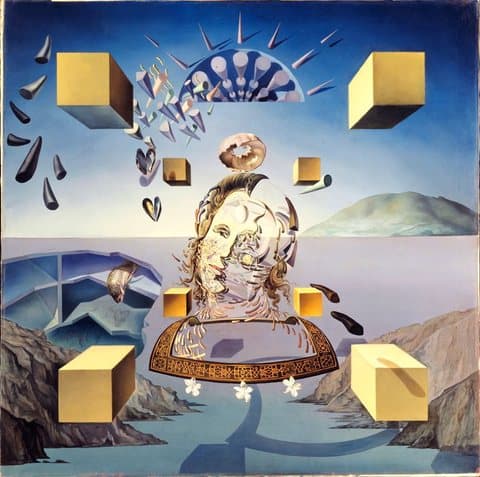
Dalí paints Gala's face and shoulders dissolved into a lattice of spheres — atoms — in his nuclear-mysticism years. The portrait hangs in his own museum in Figueres.
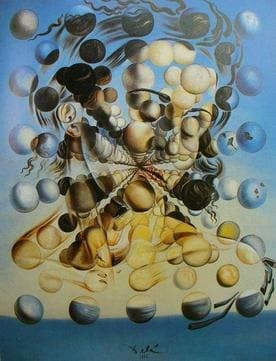
Dalí reconstructs Gala's face from suspended spheres in this 1952 portrait, a compact statement of the atomic or corpuscular painting he called nuclear mysticism.
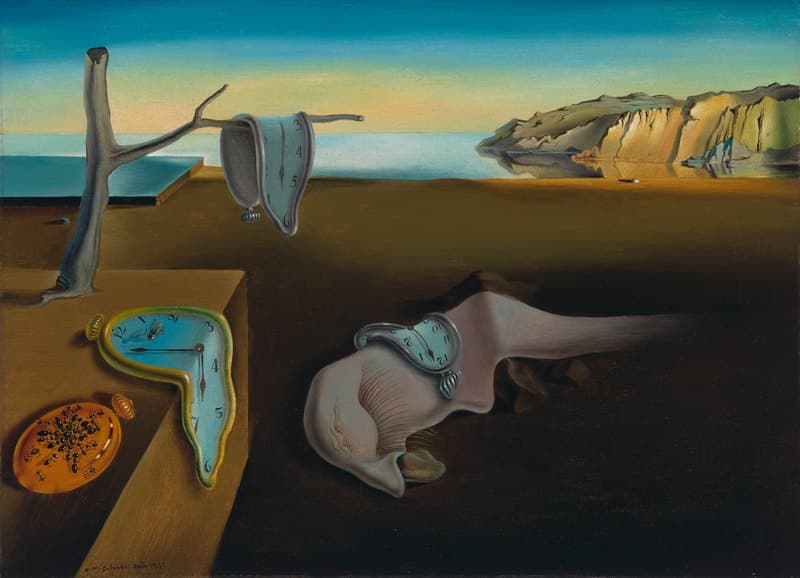
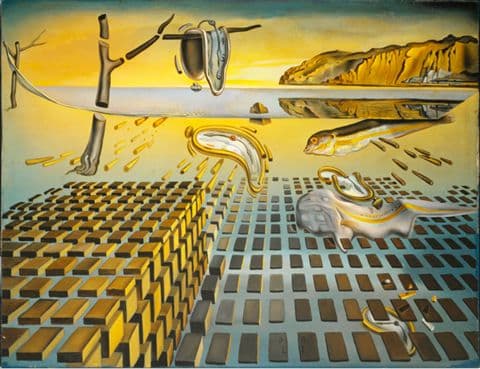
Compare this atomic portrait with The Persistence of Memory, Dalí's defining early Surrealist painting. One softens the ordinary solidity of watches; the other separates Gala's face into suspended spheres.
Gala's head and shoulders face the viewer against a blue-grey field. Dozens of spheres describe her brow, eyes, nose, mouth, hair and neckline. The balls are sharply modelled near the face and dissolve into smaller particles and empty space at the edges.[1]
The portrait remains immediately legible even though no continuous skin is painted. Dalí makes likeness depend on spacing, light and the viewer's ability to assemble separate units into a face.
The Fundació places the painting among the “corpuscular” works that followed Dalí's post-1945 interest in atomic theory. The spheres are his visual shorthand for particles and discontinuous matter. They are not a literal model of how an atom is structured.[1][2]
This distinction matters. Dalí read science avidly, but he used its language analogically. In Galatea of the Spheres, the idea that apparently solid matter consists of separated units becomes a way to paint the person he knew most closely.[2]
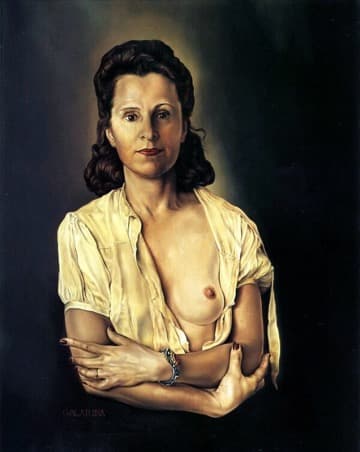
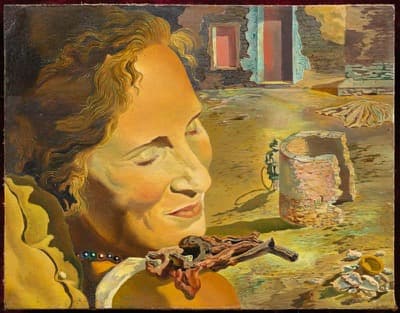
Gala had appeared in Dalí's work as lover, Renaissance sitter, Leda and Madonna. Here she is neither placed in a narrative nor given a full body. Recognition itself is the subject: a face persists across gaps.[3]
The image can therefore support a reading of Gala as unity within Dalí's private mythology, but that is an interpretation rather than a statement the painting proves. What is documented is that he made her likeness the central test of his new corpuscular language.
The Fundació's catalogue raisonné gives Gala Placidia as the principal title and Galatea of the Spheres as a known title. Gala Placidia was also the title recorded for the painting's first New York exhibition in 1952–53. The later title clearly turns Gala's name into “Galatea,” but the catalogue does not assign one definitive classical myth to the word. The common claim that the title specifically invokes Pygmalion's statue should therefore be treated as an interpretation, not established intent.[1][4]
By 1952 Dalí was combining his atomic imagery with Renaissance composition and Catholic subjects under the name nuclear mysticism. Galatea of the Spheres is one of the clearest secular examples. It has the symmetry and stillness of a formal portrait, but its sitter is made of suspended particles.[2]
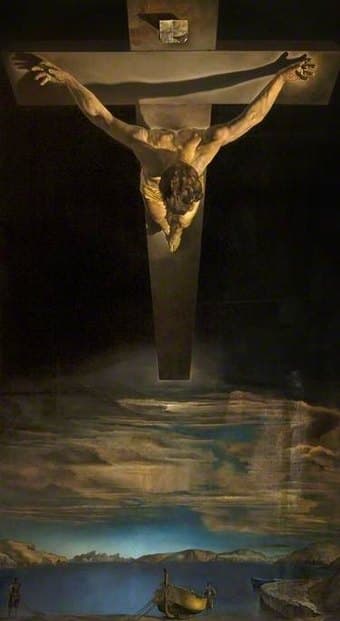
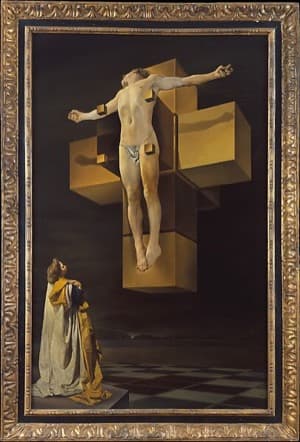
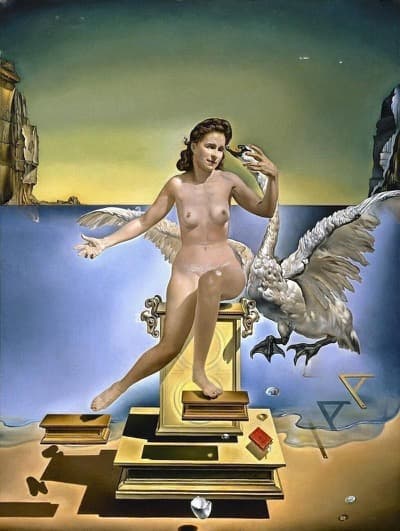
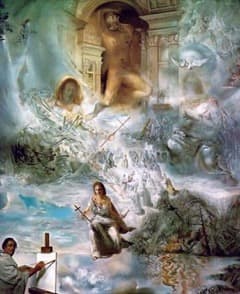
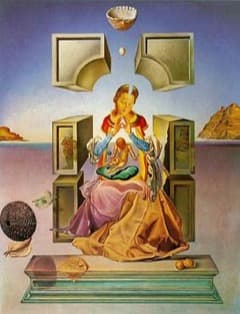
The painting belongs beside Leda Atomica, The Madonna of Portlligat and Crucifixion (Corpus Hypercubus). Across those works, levitation and separated matter move from mythological scene to sacred architecture, portrait and crucifixion.[2]
Photographs by Ricardo Sans document Dalí working around these canvases in the expanded Portlligat studio during the early 1950s. The coast is not visible in Galatea of the Spheres, but the painting belongs to the same work environment as The Madonna of Portlligat and Corpus Hypercubus. The atomic portrait came from a house and studio where Gala was both the model before the canvas and the person organizing the life around its production.[5]
The canvas was exhibited at the Carstairs Gallery in New York from December 1952 to January 1953 in Dalí: The First Mystico-Nuclear Paintings and the Assumpta Corpuscularia Lapislazulina. It appeared as catalogue number 4.[1]
Dalí kept the work in his own collection. It later entered the Fundació Gala-Salvador Dalí and is displayed in the Dalí Theatre-Museum in Figueres.[1]
Dalí placed the portrait in the Theatre-Museum he created in his home town of Figueres. It is shown on an easel associated with the nineteenth-century French painter Ernest Meissonier, in the rooms known as the Palace of the Wind.[5]
The installation adds another historical claim to the image. A portrait built from a modern particle metaphor is presented on the working furniture of an academic painter Dalí admired.
The painting reduces nuclear mysticism to a form that can be grasped at a glance: a familiar face held together across empty space. It is smaller and more concentrated than Dalí's monumental religious canvases, which makes the method unusually clear.
It also preserves Gala's centrality without repeating the passive conventions of the muse portrait. Her likeness is the structure of the work, the thing through which Dalí asks whether matter, identity and an image can remain whole while visibly divided.
Close reading
A familiar face is distributed across dozens of suspended spheres. The close views reveal how Dalí balances optical coherence with the insistence that every piece remain separate.
1.Likeness survives discontinuity
The most recognizable features are never drawn with one continuous outline. Instead, differently lit spheres line up long enough to make eyes and lips. The face exists in the relationship among objects, not in any one of them.
2.Every sphere is a tiny independent world
Highlights and cast shadows give each unit volume. Repetition could have flattened the image into pattern, but the separate lighting keeps it particulate and spatial—the portrait as a constellation of matter.
3.The blue void enters the body
Background color passes uninterrupted between the particles. There is no sealed contour where the figure ends. Dalí turns the boundary between body and space into the subject rather than hiding it.
4.The hair is repeated in separate rounded pieces
Dark spheres gather where a continuous mass of hair might be expected. Thin curls carry the eye from one rounded piece toward another without completely closing the blue intervals. The edge of the head alternates between soft strands and hard volumes, giving the portrait two different kinds of surface.
5.The bottom row becomes an arc of separate volumes
The lowest spheres form a loose arc across the blue ground. Pale upper surfaces and dark lower bands make the units appear rounded, yet several are crossed by fragments of the larger image. The portrait continues into this row as color and contour even where recognizable anatomy has fallen away.
6.Light gathers across the upper spheres
The pale spheres near the forehead create a broad area of light from many small highlights. Each retains a darker edge, so the bright region never becomes a continuous surface. The effect depends on reading at two scales: individual rounded objects close up and the illuminated forehead farther away.
1952
Dalí paints and signs the portrait of Gala assembled from suspended spheres.
1952–53
Shown at the Carstairs Gallery in New York as Gala Placidia in Dalí's exhibition of his first mystico-nuclear paintings.
1974
He installed it in his own Teatre-Museu at Figueres on an easel that had once belonged to the painter Meissonier, where it still hangs.
Teatre-Museu Dalí, Figueres (Fundació Gala-Salvador Dalí)
Plaça Gala i Salvador Dalí 5, 17600 Figueres, Girona, Spain
Displays and loans can change. Check whether this work is on view before making a special trip.
Plan your visit on the museum’s official website (opens in a new tab)A 1952 painting by Salvador Dalí of Gala's face and shoulders assembled from floating spheres. It is one of his clearest corpuscular or nuclear-mystical portraits and hangs in the Dalí Theatre-Museum in Figueres.
Gala Dalí, the painter's wife, muse and business manager, and the recurring face of his work. She has her own page here.
The spheres are Dalí's visual shorthand for particles and discontinuous matter after his post-1945 interest in atomic physics. They should not be read as a literal scientific diagram.
Dalí's name for his postwar fusion of atomic ideas, Renaissance composition and Catholic or metaphysical subjects. Galatea of the Spheres applies that program to a formal portrait.
The Fundació's catalogue gives Gala Placidia as the principal title and Galatea of the Spheres as a known title. Gala Placidia was used at the first New York exhibition. The later title plays on Gala's name, but the catalogue does not specify one definitive mythological meaning.
It is 65 by 54 centimetres, oil on canvas. It is catalogue raisonné number P 672 in the Fundació Gala-Salvador Dalí's catalogue of Dalí's paintings.
The Dalí Theatre-Museum in Figueres, on an easel that once belonged to the painter Meissonier, in the rooms called the Palace of the Wind.
Depicts · 1952
Dalí paints Gala's face and shoulders dissolved into a lattice of spheres — atoms — in his nuclear-mysticism years. The portrait hangs in his own museum in Figueres.
Explore painters from the same movements and circles.
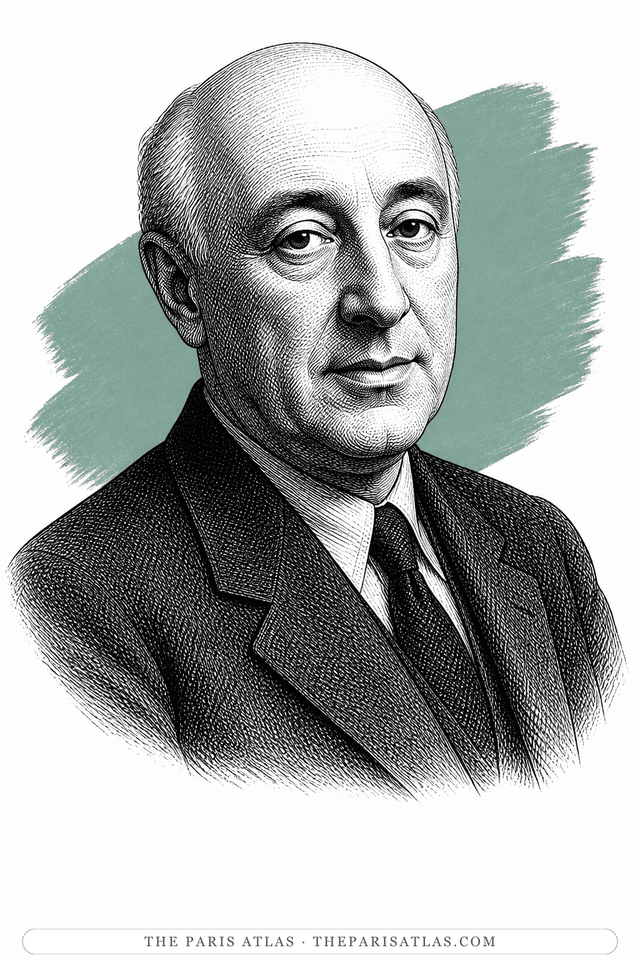
Strasbourg-born sculptor and poet — Hans in German, Jean in French, both all his life — who co-founded Dada at the Cabaret Voltaire in 1916, composed collages by dropping torn paper 'according to the laws of chance', and settled at Meudon outside Paris in a house his wife Sophie Taeuber-Arp designed.
View artist
French photographer who turned a pocket-sized 35mm camera into an instrument of split-second composition — the idea the world knows as 'the decisive moment'. He trained as a painter, was taken prisoner in 1940 and escaped on his third try, photographed the Liberation of Paris in August 1944, co-founded the photographer-owned agency Magnum Photos in 1947, gave up reporting for drawing in the 1970s, and left Paris a foundation in the Marais that deliberately hangs no permanent display of his own pictures.
View artist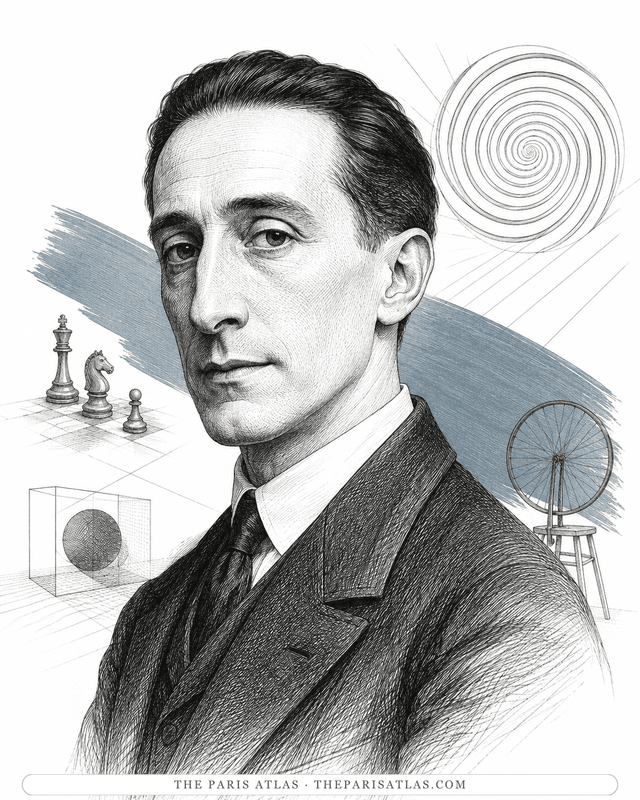
The century's quietest revolutionary — readymades, the abandonment of painting, chess on a Paris rooftop in Entr'acte, and one anemic film of spinning puns signed Rrose Sélavy.
View artistThe sources below include collection records, catalogues, scholarly research, and primary materials that informed this page. They document Galatea of the Spheres, its making, and its place in cultural history.


Catalogue scholarship used to verify attribution, provenance, chronology, and interpretive context for Galatea of the Spheres.

Web source consulted for documented facts and historical context presented on the Galatea of the Spheres page.
These references provide the documented foundation for this work's history and interpretation. Claim-level citations remain attached to the specific claims they support.
 Explore more resources