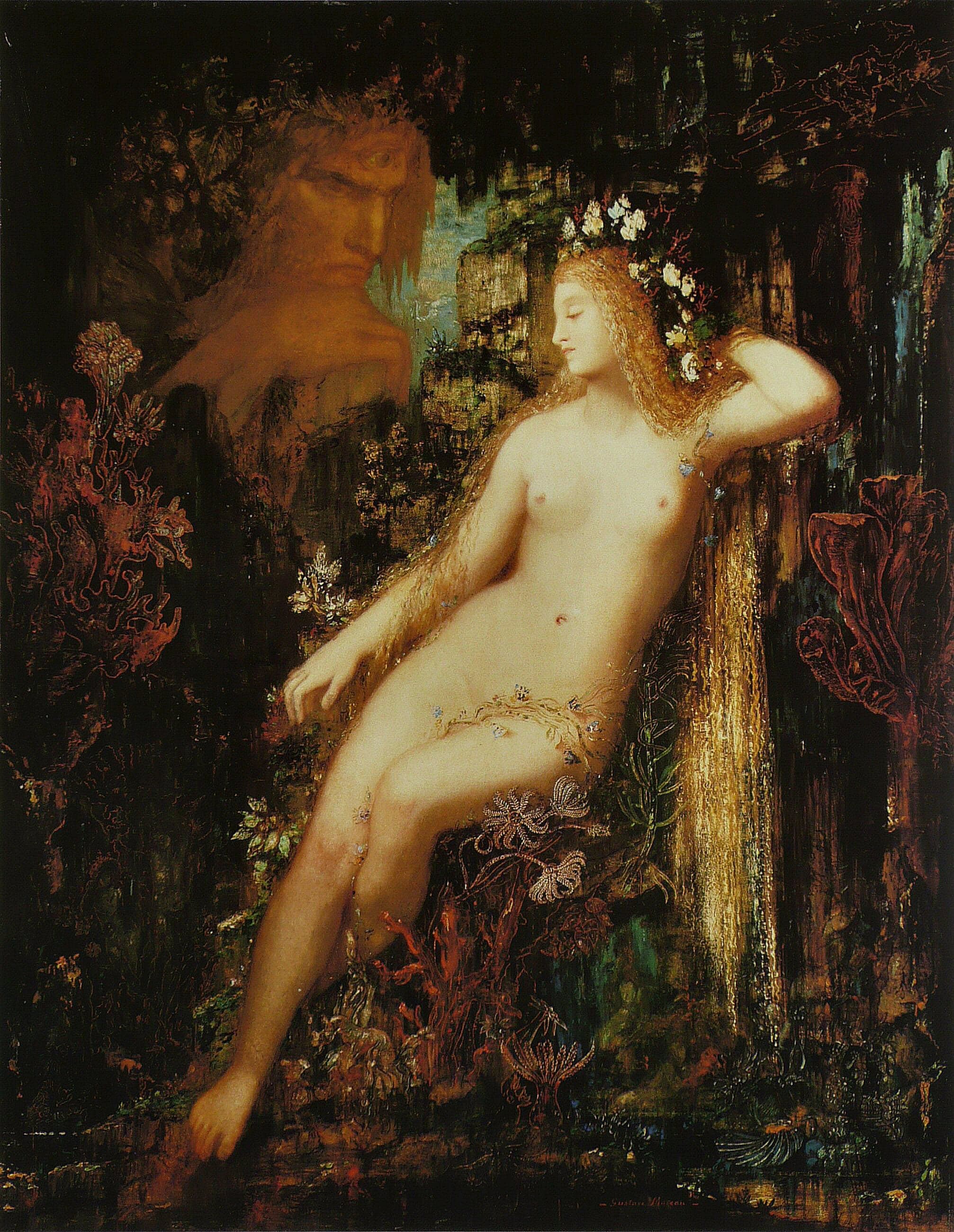
Galatea
A naked nymph reclines in a grotto of coral and sea plants while the giant Polyphemus watches her from the shadows above, a single eye in the middle of his forehead. Gustave Moreau took the subject from Ovid and showed the panel at the Salon of 1880, the last Salon he entered. It passed through the Taigny family, the Berlin collection of Joachim von Ribbentrop and a French state sale before the Musée d'Orsay bought it in 1997.
- c. 1880
- Oil on panel
- Musée d'OrsayParis, France
About Gustave Moreau

What the painting shows
Galatea lies back against the rock at the center, her left arm bent behind her head and her right arm resting along her thigh, the hand near a spray of flowers. Her red-gold hair is crowned with white flowers and sprigs of red coral and falls in a long sheet down the right side of the panel. A fine garland of gold with small blue and pink stones is painted across her hips, and her eyes are lowered.
Polyphemus is a face and shoulders in the upper left, painted thinly in reddish brown so that the rock shows through. One eye sits in the middle of his forehead, under a heavy brow and a tangle of hair and leaves. He is enormous beside her, and he does not enter the cave.
The cave is furnished like a rock pool. Branching red coral climbs both sides, silvery anemones with feathered arms cluster beside her legs, and green weed and gold plants cover the floor. One foot reaches down to a dark rock at the lower left. Moreau signed the panel at the lower right, and it measures 85.5 by 66 centimeters.[1]
Ovid, Raphael and two photographs
The story is in the thirteenth book of Ovid's Metamorphoses, where Galatea herself tells how the Cyclops Polyphemus courted her and killed her lover, the shepherd Acis.[2] The Musée d'Orsay notes that Moreau hung two photographs in his dining room, Raphael's Triumph of Galatea and Sebastiano del Piombo's Polyphemus.[1]
He painted none of the plot. The Orsay says he went no further than Ovid's first line, a terrible giant who loves a beautiful nymph, and built the picture on contrasts: beauty and ugliness, light and shadow, mineral and liquid. It describes his Polyphemus as a melancholy being rather than an ogre, lost in one-eyed contemplation of a woman he cannot reach, and Galatea in her narrow cave as a pearl in its setting.[1]
The museum also mentions tiny nereids almost invisible among the plants and coral. They are hard to find in reproduction; the coral is far easier to see than any figure inside it.[1]
Plants from the natural history museum
The vegetation looks invented, but the Orsay traces it to drawings Moreau copied from a book of marine botany at the Muséum d'Histoire naturelle in Paris, where he had registered as an unofficial student in 1879. He rubbed and scratched the oil paint until the surface looked like enamel.[1]
The Salon of 1880, his last
Galatea hung at the Salon of 1880 as number 2711, alongside Helen. It was the last Salon Moreau entered, and the Orsay calls the painting a triumph there and the height of his career.[1][3]
Georges Lafenestre described it that year in the Livre d'or du Salon, the catalogue of the prizewinning and leading works. The nymph, white and naked, lets the fine braids of her golden hair run down to her feet inside a sea grotto full of strange vegetation. She dreams, half asleep, leaning on her left arm and idly caressing flowers with her right hand, while the enormous fixed eye of the Cyclops watches her from the left. It was, he wrote, like a dream of Shakespeare interpreted by a Florentine painter of the fifteenth century.[4]
Not every critic was won over. Maurice Du Seigneur opened his notice on Galatea and Helen by saying that no man or artist had stirred up as many passions for and against him as Gustave Moreau. He then answered his own questions: a colorist, yes; a painter, no.[5]
It went on to the Exposition Universelle of 1889 and to the Moreau exhibitions at the Galerie Georges Petit in 1906 and 1926, where it was number 1 in the centenary show. Later loans include the Grand Palais retrospective of 1998 and the Orsay's 2019 exhibition on Joris-Karl Huysmans as an art critic.[1]
From the Taigny family to the Orsay
Its first owner was Edmond Taigny in Paris, who kept it until 1906, when it passed to his widow. From 1918 it belonged to his son Olivier Taigny, and in 1941 to a niece of Olivier's, Françoise Lejeune.[1]
The next entry in the museum's provenance is the collection of Joachim von Ribbentrop in Berlin, probably bought at a public sale in Paris. After the war the painting was recovered in Germany by the French Office des biens et intérêts privés and handed to the state property administration on 19 December 1950. It was sold at the Vente des Domaines at the Crédit municipal in Paris on 7 June 1951.[1]
The buyer was Robert Lebel, who kept it until 1991. By 1995 it was with Eric Turquin in Paris, and in 1997 the Musées nationaux bought it for the Orsay with help from Philippe Meyer, a Japanese sponsorship organized by the newspaper Nikkei, and the Fonds du Patrimoine.[1]
Close reading
Reading the work, detail by detail
The panel is small and the detail is fine, so it rewards close looking. These nine views take in the giant's single eye, the nymph's face and hair, the coral and sea creatures, and the signature hidden among them.
1.The single eye of Polyphemus
Polyphemus is barely there. Moreau paints him as a stain of red-brown over the rock, with one eye in the center of the forehead and hair and leaves around it. The Orsay describes him as melancholy rather than monstrous, and the thin paint keeps him a shadow.
2.Galatea's face
Galatea's face is turned to the left in profile, with the eyes lowered and the mouth closed. White flowers and twigs of red coral are wound into her hair, which is painted in fine gold lines. The Orsay calls her a pearl in its setting, and the setting here is the dark rock behind.
3.The raised arm
Her left arm is folded behind her head, the pose of a figure at rest; Georges Lafenestre, describing the picture at the Salon of 1880, also has her leaning on her left arm. A blue jewel sits on her shoulder, and from behind her head the hair pours down the right side of the panel in a sheet of gold, painted in long vertical strokes.
4.The red coral
The left side of the grotto is a thicket of red coral, drawn as a lace of lines over the dark ground. The Orsay says tiny nereids hide almost invisibly in the plants and coral. In this passage something like a small figure can be made out among the branches, but it is not certain.
5.The garland across her hip
A garland of gold thread and small stones is painted straight across her hip, with a silvery star-shaped creature at the end of it. The stones are single touches of blue, pink and yellow. This is the enameled surface the Orsay describes, made by rubbing and scratching the paint.
6.The sea creatures by her leg
Beside her leg the sea creatures are drawn in fine silver-white lines, with arms that curl like feathers. Below them the coral turns from red to orange over green weed. The Orsay traces these forms to drawings Moreau copied from a marine botany book at the Muséum d'Histoire naturelle.
7.The foot on the rock
One foot reaches down out of the light to a dark rock at the bottom of the cave. It is the lowest point of the figure and the place where the pale flesh meets the darkest paint in the panel.
8.The signature among the plants
Moreau signed at the lower right, in the red-brown of the coral, so the signature reads as one more plant until you look for it. The Orsay records it as signed lower right, Gustave Moreau.
9.The sheet of gold hair
The sheet of gold falling down the right side is her hair, continued far below her shoulders until it reaches the floor of the grotto. Lafenestre saw the same thing in 1880: the braids of her golden hair run down to her feet. It is the brightest passage in the picture and is painted in long dragged strokes, unlike the fine lines of the coral.
Timeline
1879
Moreau registers as an unofficial student at the Muséum d'Histoire naturelle and copies marine plants from a botany book there.
1880
Shown at the Salon as number 2711, with Helen; the last Salon Moreau enters.
1889
Shown at the Exposition Universelle in Paris, number 532.
1906
Number 199 in the Moreau exhibition at the Galerie Georges Petit. Passes from Edmond Taigny to his widow.
1926
Number 1 in the Moreau centenary exhibition at the Galerie Georges Petit.
1941
Passes to Françoise Lejeune, niece of Olivier Taigny; later in the Berlin collection of Joachim von Ribbentrop.
1950–51
Recovered in Germany, handed to the Domaines on 19 December 1950 and sold at the Crédit municipal, Paris, on 7 June 1951 to Robert Lebel.
1997
Bought by the Musées nationaux for the Musée d'Orsay by order of 8 July 1997, as RF 1997 16.
Where to see it
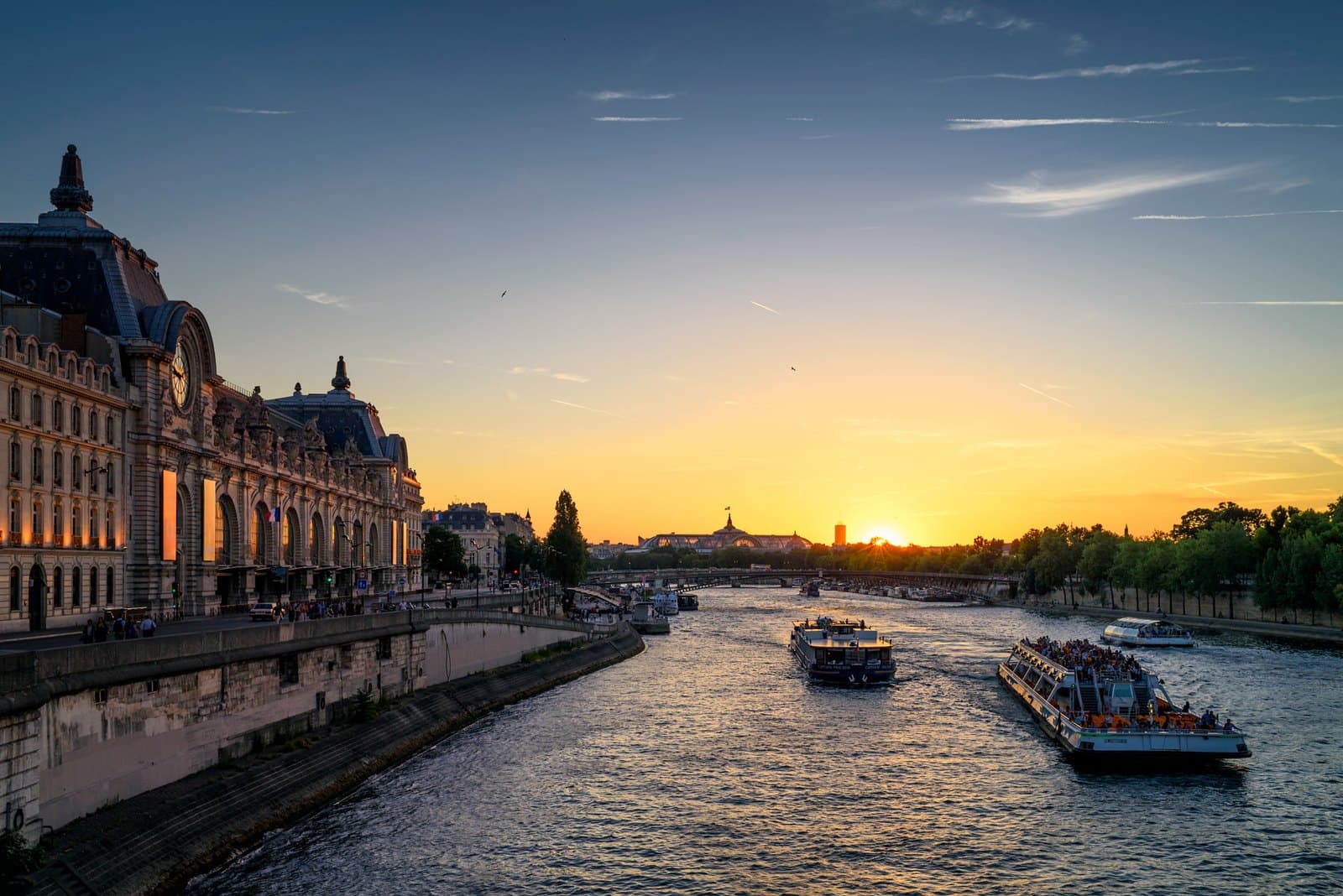
Musée d'Orsay
Esplanade Valéry Giscard d’Estaing, 75007 Paris, France
The Orsay's object record places it in room 59 on the middle level. Displays change, so check the record before a special visit.
Plan your visitFrequently asked questions
Where is Galatea by Gustave Moreau?
At the Musée d'Orsay in Paris, accession number RF 1997 16. The Orsay's object record places it in room 59 on the middle level. Displays change, so check the record before a special visit.
Whose face is in Moreau's Galatea?
The Cyclops Polyphemus, painted in the upper left as a thin reddish-brown head with a single eye in the middle of his forehead. In Ovid he loves the nymph Galatea, who loves the shepherd Acis. The Orsay describes Moreau's giant as melancholy rather than monstrous, watching a woman he cannot reach.
What story does Galatea tell?
Almost none of it. The subject comes from the thirteenth book of Ovid's Metamorphoses, but the Musée d'Orsay says Moreau stopped at the first line, a terrible giant who loves a beautiful nymph, and left out Acis and the rest of the plot.
Why was Galatea important for Moreau?
It was his last Salon painting. He showed it in 1880 with Helen and never entered the Salon again, and the Musée d'Orsay calls it a triumph and the height of his career. Huysmans was among the critics who wrote about it, and the Orsay included it in its 2019 exhibition on Huysmans as an art critic.
Are the sea plants in Galatea real?
They were copied from real ones. The Musée d'Orsay traces the coral and weed to drawings Moreau made from a book of marine botany at the Muséum d'Histoire naturelle in Paris, where he registered as an unofficial student in 1879.
How did Galatea reach the Musée d'Orsay?
By a long route. The Taigny family owned it from the beginning until 1941, after which the Orsay's provenance lists the Berlin collection of Joachim von Ribbentrop. Recovered in Germany after the war, it was sold by the French state in 1951 to Robert Lebel, who kept it forty years. The Musées nationaux bought it in 1997 with help from Philippe Meyer, Japanese sponsors organized by the newspaper Nikkei and the Fonds du Patrimoine.
How big is Galatea?
85.5 by 66 centimeters, oil on a wooden panel, signed at the lower right. The Orsay gives the framed size as 115 by 105 centimeters and the weight, with its frame, as 112 kilograms.
More by Gustave Moreau
If you like Gustave Moreau
Explore painters from the same movements and circles.

Pierre Bonnard
French painter, printmaker and illustrator whose intimate rooms, Paris streets, gardens and bathing figures transformed everyday life into complex fields of color, memory and perception.
View artist
Paul Gauguin
Stockbroker turned painter who came into art through Camille Pissarro, showed with the Impressionists, and left Europe for Polynesia.
View artist
Edvard Munch
Norwegian painter of The Scream, who arrived in Paris in 1889 on a state scholarship to learn academic drawing from an anti-Impressionist professor, lost his father that November, and spent a bleak winter in the riverside suburb of Saint-Cloud writing down the vow that redirected his art — paint the moments when people are most alive, not the furniture around them.
View artist
References
The sources below include collection records, catalogues, scholarly research, and primary materials that informed this page. They document Galatea, its making, and its place in cultural history.


2↑The Metamorphoses of Ovid, Books VIII–XV, translated by Henry T. Riley
PoetryProject Gutenberg, ebook 26073Used forPrimary text included as part of the documented record for Galatea.

3↑Biography of Gustave Moreau — Musée Gustave Moreau
WebsiteMusée Gustave Moreau, ParisUsed forWeb source consulted for documented facts and historical context presented on the Galatea page.

4↑Le Livre d'or du Salon de peinture et de sculpture: catalogue descriptif des œuvres récompensées et des principales œuvres hors concours, 1880
Exhibition catalogueLibrairie des bibliophiles, Paris; Internet Archive copy, 1880Used forCatalogue scholarship used to verify attribution, provenance, chronology, and interpretive context for Galatea.
5↑L'Art et les artistes au Salon de 1880
NonfictionPaul Ollendorff, Paris; Internet Archive copy, 1880Used forPublished analysis and historical context used in preparing the Galatea page.
These references provide the documented foundation for this work's history and interpretation. Claim-level citations remain attached to the specific claims they support.
 Explore more resources