Orpheus
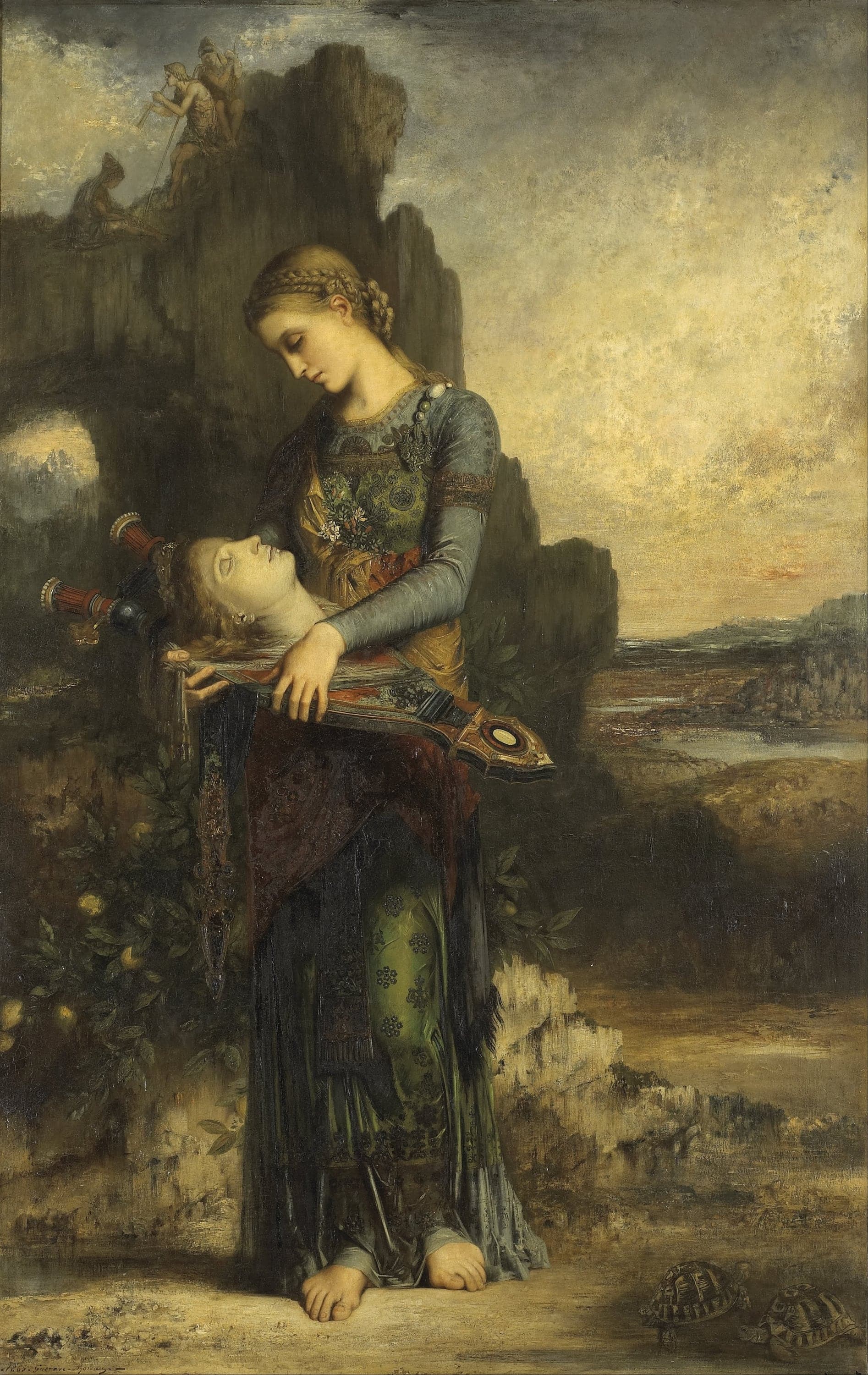
A young woman in embroidered Eastern dress holds a lyre against her body, and on the lyre lies the severed head of Orpheus, eyes closed. Gustave Moreau invented the scene: the myth says the poet was torn apart by the Maenads, and Moreau added a girl who gathers up the head. He showed it at the Salon of 1866, the State bought it for 8,000 francs that July, and it hangs at the Musée d'Orsay as RF 104.
- 1865
- Oil on panel
- Musée d'OrsayParis, France
About Gustave Moreau

What the painting shows
The girl stands on a rock ledge, barefoot, looking down at the head. Her blonde hair is braided and wound around her head. She wears a gray-blue dress with an embroidered green bodice, a white oval clasp at the shoulder and a small bunch of flowers tucked at her chest. A dark red cloth with tassels hangs from the lyre.
Orpheus's head lies face up on the lyre, tilted back, eyes shut and mouth slightly open, with red-gold hair. The lyre itself is a lacquered red-and-black box with a round medallion, and a laurel branch stands behind it. Her right hand holds the lyre's arm and her left holds its lower edge.
The setting is a rocky gorge at dusk. Three small figures sit on the crag at the upper left, one of them playing a double pipe. To the right the ground drops to a lake and a plain under a pale yellow sky with one pink cloud. Two tortoises walk along the ledge at the lower right. A tree with round yellow fruit grows at the left edge.
Moreau signed and dated the panel at the lower left: 1865. Gustave Moreau. It is painted on wood, not canvas, and measures 154 by 99.5 centimeters.[1]
An ending Moreau added to the myth
In Greek myth Orpheus played and sang so well that wild beasts stopped to listen. After the death of his wife Eurydice he rejected the Maenads, the women who followed Dionysus, and they tore him to pieces. In Ovid's telling the women of Thrace kill him, and his head and his lyre float down the river Hebrus. That is where the story ends.[1][2]
Moreau continued it. The Musée d'Orsay describes the girl in her Eastern finery as his invention, a figure who rescues the poet's head, and asks whether she is a wise virgin meant to wipe out the memory of the Bacchantes. The two faces look alike, with their closed eyes, as if absorbed in the same contemplation.[1]
The museum reads the composition as a diagonal, like a playing card: the musicians at the top left balance the tortoises at the bottom right. The tortoise matters because, in the myth, its shell was used to make the first lyre. The Orsay also points to the golden half-light and the fantastic landscape, which it compares to Leonardo da Vinci, as signs of the style Moreau reached around 1870.[1]
Bought by the State at the Salon of 1866
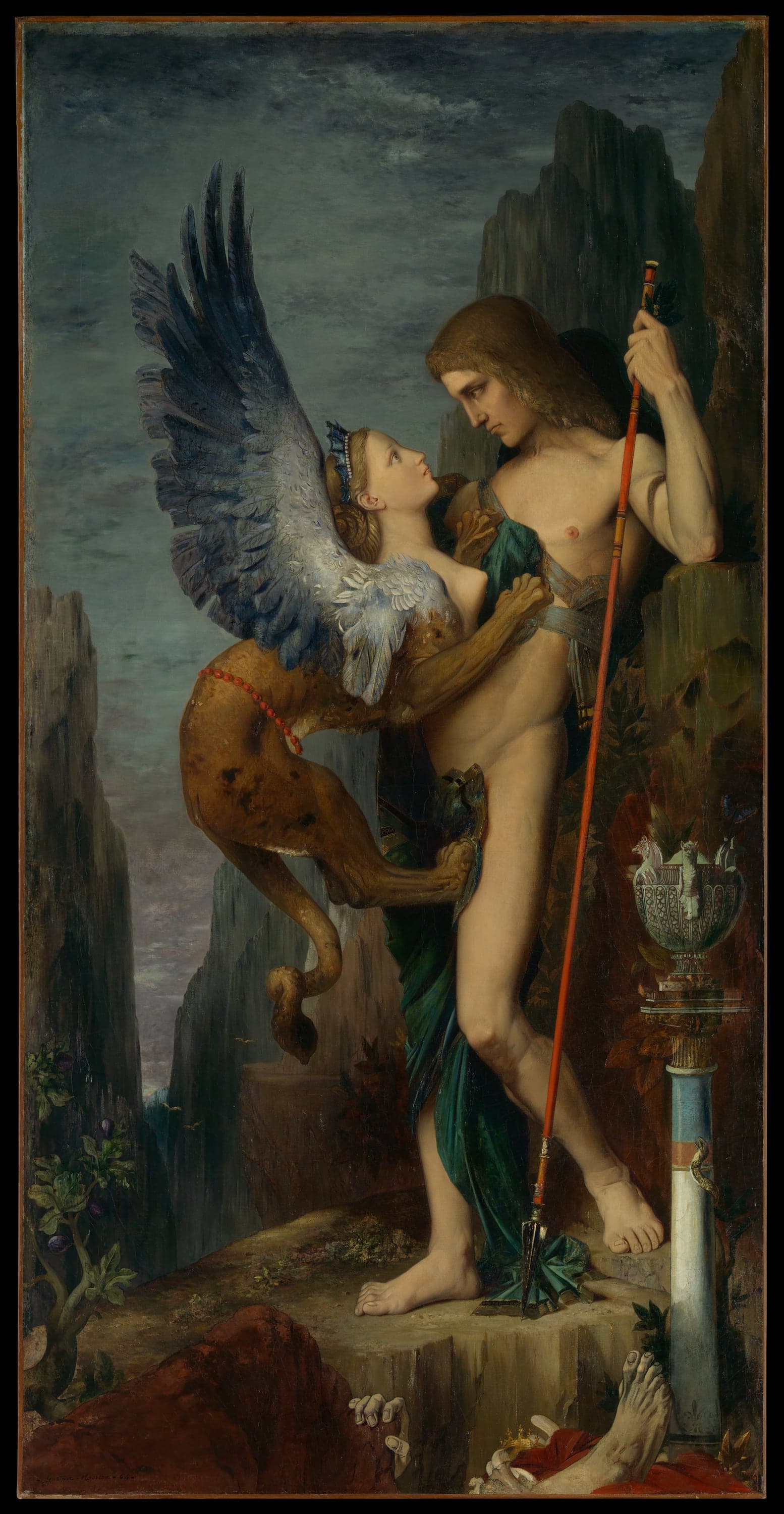
Moreau had made his name at the Salon of 1864 with Oedipus and the Sphinx.[3] The Metropolitan Museum of Art's catalogue entry on that picture groups Orpheus with it and with Jason, shown in 1865, as scenes of women and beasts overpowering men. It reads the girl's discovery of the head as a reminder of the poet's dismemberment by the maenads.[4] Orpheus went to the Salon of 1866 at the Palais des Champs-Élysées as number 1404.[1]
The State bought it from the artist on 3 July 1866 for 8,000 francs and placed it in the Musée du Luxembourg in 1867, the museum for living artists. It was inventoried as RF 104 in 1874, moved to the Louvre on 30 January 1926, and was assigned to the Musée d'Orsay in 1986.[1]
It has traveled since. The Orsay's exhibition list begins with the Exposition Universelle of 1867 in Paris and the Glaspalast in Munich in 1879. It runs on to the Moreau retrospective at the Grand Palais in 1998, San Francisco in 2010 and the Louvre's exhibition on the Thracian kings in 2015.[1]
Orpheus again, in 1890
Moreau returned to the poet after the death in 1890 of Alexandrine Dureux, the woman he called his best and only friend. He painted Orpheus at the Tomb of Eurydice in her memory; it is at the Musée Gustave Moreau.[3]
Close reading
Reading the work, detail by detail
The figure fills the panel and the landscape is painted thin around her. These nine views run from her face and the head on the lyre to the musicians, the tortoises, the feet and the signature.
1.The girl's face
She looks down at the head with her eyes almost closed. The braids are wound around her head and pinned, and the face is painted as smoothly as porcelain, with no visible brushwork. The Orsay notes how alike her face and the poet's are, both with closed eyes.
2.The head of Orpheus
Orpheus's head rests on the lyre as if on a pillow, tipped back so that the throat shows. The eyes are shut and the mouth slightly open. The lyre's arm beside it is lacquered red and black with a gold cap, and her right hand holds the frame under his hair.
3.The lyre
The instrument is built like a jewel box rather than a Greek lyre: a lacquered case with a medallion on its side and a dark red cloth hanging from it. Her left hand steadies it from above. The Orsay's text points out that, in the myth, the first lyre was made from a tortoise shell, which is why the tortoises appear at the lower right.
4.The musicians on the crag
The musicians the Orsay mentions sit on the crag at the upper left, painted small and loose against the sky. One plays the aulos, the double pipe. They balance the tortoises in the opposite corner, and the museum reads the whole composition as a diagonal like a playing card.
5.The tortoises
Two tortoises, not one, cross the ledge at the bottom right. They are painted in more detail than the landscape behind them. The Orsay links them to the myth of the first lyre, made from a tortoise shell.
6.The bare feet
She stands barefoot on the rock. The dress ends in a fringed gray-green skirt with dark flower rosettes, and the feet are the most naturalistic passage in the lower half of the panel.
7.The landscape at dusk
To the right of the figure the ground drops away to water and a plain under a yellow evening sky. The Orsay calls the landscape fantastic and compares it to Leonardo da Vinci. It is painted much more thinly than the figure.
8.The signature and date
Moreau signed and dated the panel at the lower left, and the Orsay records the inscription as 1865. Gustave Moreau. The date is the year before the Salon at which the State bought the picture.
9.The clasp and the nosegay
The costume is where the Eastern finery the Orsay describes is concentrated: a white cabochon and a gold pendant at the shoulder, gold embroidery over the green bodice, and a small bunch of white flowers pushed into the neckline.
Timeline
1864
Oedipus and the Sphinx makes Moreau's name at the Salon.
1865
Orpheus is painted, signed and dated.
1866
Shown at the Salon as number 1404. Bought from the artist by the State on 3 July for 8,000 francs.
1867
Enters the Musée du Luxembourg. Shown at the Exposition Universelle in Paris, group I, number 485.
1874
Assigned to the Musées nationaux and inventoried as RF 104.
1926
Transferred to the Musée du Louvre on 30 January.
1986
Assigned to the Musée d'Orsay.
1998–99
Shown in the Gustave Moreau retrospective at the Galeries nationales du Grand Palais.
Where to see it

Musée d'Orsay
Esplanade Valéry Giscard d’Estaing, 75007 Paris, France
The Orsay's object record places it in room 59 on the middle level. Displays change, so check the record before a special visit.
Plan your visitFrequently asked questions
Where is Orpheus by Gustave Moreau?
At the Musée d'Orsay in Paris, accession number RF 104. The Orsay's object record places it in room 59 on the museum's middle level. Displays change, so check the record before a special visit.
What is happening in Moreau's Orpheus?
A young Thracian woman has gathered up the severed head of Orpheus and holds it on his lyre. In the myth the Maenads tore the poet apart after he rejected them; the girl who rescues the head is Moreau's own addition, and the Musée d'Orsay describes her as a wise virgin set against the mad Bacchantes.
Who is the woman in Orpheus?
Nobody in particular. The Musée d'Orsay calls her a girl dressed in Oriental finery and treats her as Moreau's invention rather than a figure from the myth. Her face and the poet's are painted to look alike, both with closed eyes.
Why are there tortoises in Orpheus?
They sit at the lower right, balancing the musicians at the upper left. In the myth the first lyre was made from a tortoise shell, so the animals point back to the instrument on which the head rests.
How big is Orpheus, and what is it painted on?
154 by 99.5 centimeters, about five feet by three, in oil on a wooden panel. Moreau signed and dated it at the lower left.
How did Orpheus reach the Musée d'Orsay?
The State bought it from Moreau on 3 July 1866 for 8,000 francs after the Salon of that year and sent it to the Musée du Luxembourg. It moved to the Louvre in 1926 and to the Musée d'Orsay when that museum's collections were assembled in 1986.
Is Orpheus a Symbolist painting?
The Musée d'Orsay treats it as the beginning of one. The museum sees the golden half-light, the complex composition and the sensual, mystic mood of Moreau's mature style, which it dates to about 1870, already in place here, and counts him as a decisive figure in the Symbolist movement.
More by Gustave Moreau
If you like Gustave Moreau
Explore painters from the same movements and circles.

Pierre Bonnard
French painter, printmaker and illustrator whose intimate rooms, Paris streets, gardens and bathing figures transformed everyday life into complex fields of color, memory and perception.
View artist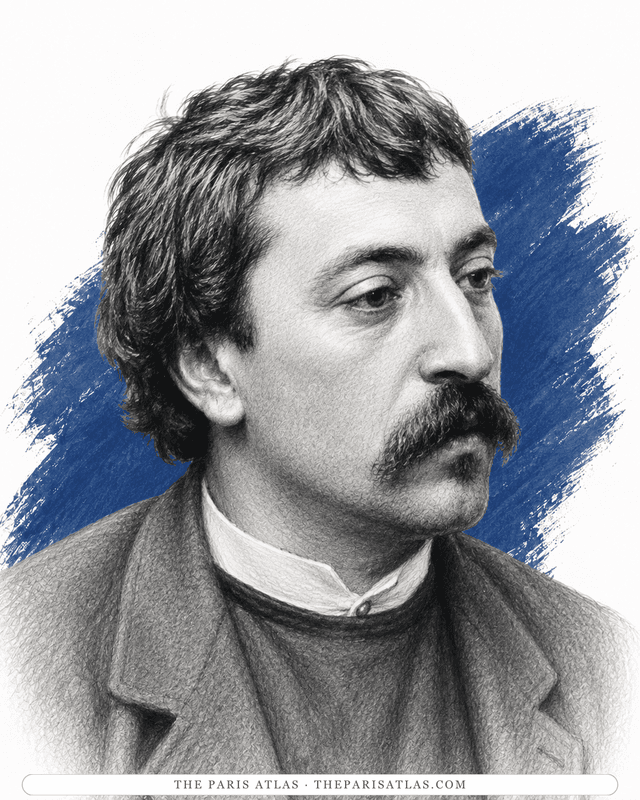
Paul Gauguin
Stockbroker turned painter who came into art through Camille Pissarro, showed with the Impressionists, and left Europe for Polynesia.
View artist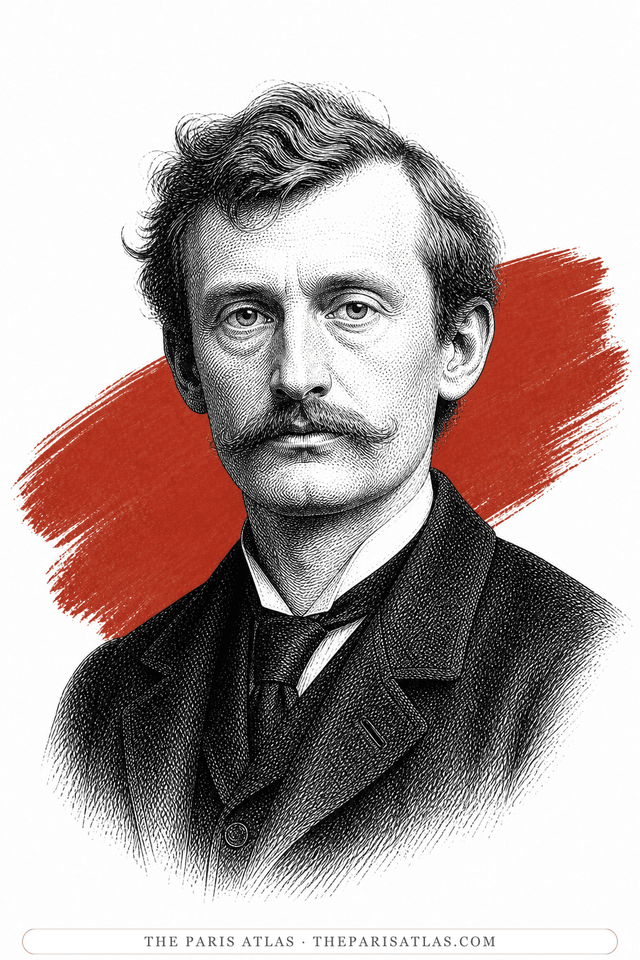
Edvard Munch
Norwegian painter of The Scream, who arrived in Paris in 1889 on a state scholarship to learn academic drawing from an anti-Impressionist professor, lost his father that November, and spent a bleak winter in the riverside suburb of Saint-Cloud writing down the vow that redirected his art — paint the moments when people are most alive, not the furniture around them.
View artist
References
The sources below include collection records, catalogues, scholarly research, and primary materials that informed this page. They document Orpheus, its making, and its place in cultural history.


2↑The Metamorphoses of Ovid, Books VIII–XV, translated by Henry T. Riley
PoetryProject Gutenberg, ebook 26073Used forPrimary text included as part of the documented record for Orpheus.

4↑Gustave Moreau, Oedipus and the Sphinx
WebsiteThe Metropolitan Museum of ArtUsed forWeb source consulted for documented facts and historical context presented on the Orpheus page.
These references provide the documented foundation for this work's history and interpretation. Claim-level citations remain attached to the specific claims they support.
 Explore more resources