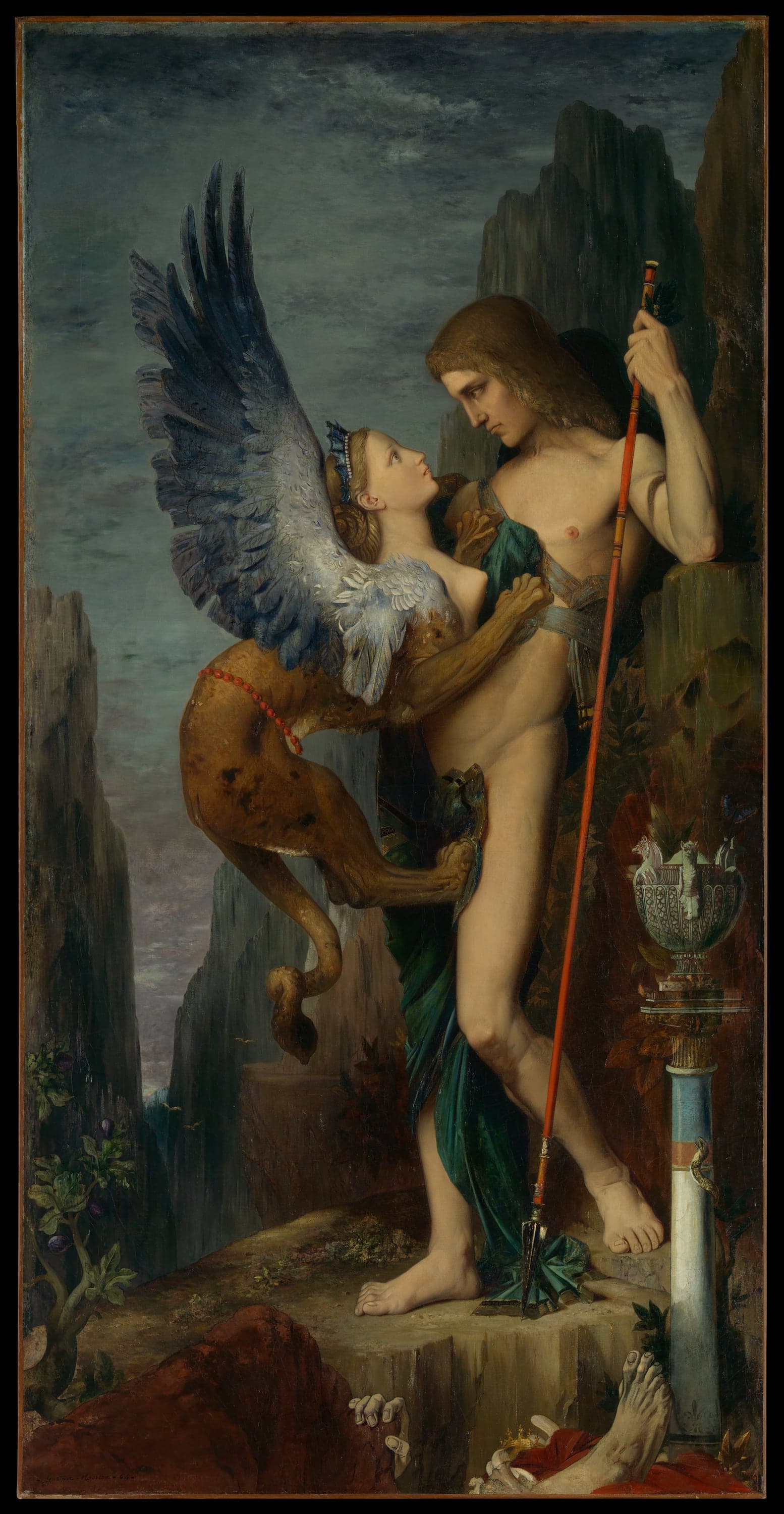
Oedipus and the Sphinx
A winged sphinx with a woman's head and a lion's body clings to the chest of Oedipus, and the two stare into each other's eyes. Gustave Moreau showed the canvas at the Paris Salon of 1864, where it won a medal and was bought by Prince Napoléon. The collector William H. Herriman acquired it in 1868, kept it in Rome for the rest of his life, and left it to the Metropolitan Museum of Art, where it hangs in Gallery 800.
- 1864
- Oil on canvas
- The Metropolitan Museum of ArtNew York, United States
About Gustave Moreau
What the painting shows
Oedipus stands on a rock ledge at the right, naked except for a green cloth over one shoulder and a dark cloak behind his head, his long hair falling to his shoulders. He holds a red-shafted spear upright in his right hand, with a sprig of laurel tied below its gold cap. He leans back and looks down into the Sphinx's face without flinching.
The Sphinx has the head of a young woman with blonde hair and a blue diadem strung with pearls, blue-gray wings raised behind her, and the tawny body of a lioness with a string of red beads around her chest. Her forepaws press into his chest and side. Her tail curls down over the edge of the rock.
At the right a pale urn with griffin handles stands on a white column, and a snake climbs the column toward it. The bottom of the canvas holds the Sphinx's leavings: a dead hand gripping the ledge, a foot, and a gold crown lying on red cloth. A fig tree with purple fruit grows from the cliff at the left, and two birds fly through the gorge. Moreau signed and dated the picture at the lower left.[1]
The canvas is 206.4 by 104.8 centimeters, about six feet nine inches high by three feet five wide.[1]
The riddle, and what Moreau said it meant
The Sphinx sat on the road to Thebes and asked travelers what walks on four legs in the morning, two at noon and three in the evening, killing those who could not answer. Oedipus answered: a human being, who crawls as a baby, walks upright as an adult and leans on a stick in old age. The Met's label points out that the remains of earlier travelers lie in the foreground.[1]
Moreau kept his own notes on the picture, and the Met's catalogue entry quotes them. The painter imagines man "having attained the serious and momentous hour of his life and finding himself in the presence of the eternal enigma". The Sphinx "clutches him in an embrace with her terrible claws", but the pilgrim, "noble and calm in his moral power, regards her without trembling".[1]
Later scholars read the objects as symbols, and the Met's entry records their readings. The crown and purple cloth stand for political power, the gold laurel for official honors and the fig tree for sin. The snake is death, and a butterfly near the urn is the soul escaping it.[1]
The Salon of 1864
The painting was the event of the Salon of 1864, which opened on 1 May at the Palais des Champs-Élysées; it hung as number 1388 under the title Œdipe et le sphinx. It won a medal, critics argued over it in the newspapers for weeks, and Prince Napoléon, a cousin of the emperor Napoleon III, bought it during the exhibition.[1][2] The livret itself lists the painter as a pupil of François-Édouard Picot and gives his address as rue de La Rochefoucauld 14, the house that later became his museum.[3]
Scott C. Allan's study of the reception records the critic Jean Rousseau writing that Moreau had passed straight to the first rank, and Théophile Thoré complaining that the sphinx would be the lion of the Salon and of idealist criticism. The Met's own summary is shorter: the painting made Moreau's name.[4][1]
The Met adds that Moreau's otherworldly imagery attracted a younger generation that included Odilon Redon and Oscar Wilde. Its references note a letter of 1900 in which Redon recalled the deep impression the painting had made on him at the Salon of 1864.[1]
Ingres, Piranesi and the sources
The subject was already famous from Jean-Auguste-Dominique Ingres's Oedipus Explaining the Enigma of the Sphinx of 1808, now in the Louvre. Moreau would have seen it exhibited in Paris in 1846, the year he entered the École des Beaux-Arts, and again at Ingres's retrospective at the Universal Exposition of 1855. Around 1860 he made four small drawings that shift the composition from Ingres's to his own.[1]
Where Ingres's hero dominates a retreating monster, Moreau's Sphinx lunges and his Oedipus stands still. The Met's entry traces the urn with griffin handles to engravings by Giovanni Battista Piranesi that Moreau inherited from his father. It also records that he made more than thirty preparatory sketches, ten of them studies of a large bird's wing for the Sphinx.[1]
From Rome to Fifth Avenue
Prince Napoléon sold the painting on 3 February 1868 to the dealer Durand-Ruel for 14,000 francs. A month later, on 6 March, Durand-Ruel and Brame sold it for 15,000 francs to William H. Herriman, who had it installed in his apartment at 93 Piazza di Spagna in Rome by January 1869.[1]
Herriman kept it for the rest of his life. It came to the Metropolitan Museum of Art as his bequest, credited to 1920 and accessioned in 1921 as 21.134.1. The museum lists it as on view in Gallery 800 and marks it as a highlight of the collection.[1][5]
Close reading
Reading the work, detail by detail
The Met's Open Access photograph is sharp enough to read the canvas inch by inch. These nine views follow the stare, the claws and the wing, then the urn, the snake and the remains at the bottom.
1.The two faces
The whole picture is this stare. Oedipus looks down, the Sphinx looks up, and the two faces almost touch. Moreau wrote that the pilgrim regards her without trembling, and the Met's label describes the same standoff. Her diadem is blue with a row of pearls along its edge.
2.The claws on his chest
Her claws dig into his chest beside the green cloth over his shoulder. The Met's entry contrasts this with Ingres's version, where the hero dominates and the Sphinx keeps her distance. Here she has hold of him, and he does not move.
3.The wing
The wing is painted feather by feather, gray-blue on the outer side and white underneath. The Met records that Moreau made ten studies of a large bird's wing among his thirty preparatory sketches, and this is where they went.
4.The lioness's body
Below the woman's head and the wings, the Sphinx is a lioness. Red beads hang around her chest, and her tail curls down over the edge of the rock. The tawny fur and the red beads are the only warm colors on the left side of the canvas.
5.The urn with griffins
The urn on its column is the most carefully painted object in the picture. The Met traces it to engravings by Giovanni Battista Piranesi that Moreau inherited from his father. A blue butterfly hovers just above it at the right, which later readers took for the soul.
6.The snake on the column
The snake climbs the column toward the urn. The Met's entry records a reading of it as death, set against the butterfly above as the soul. Oedipus's right foot stands just beside the column, and the spear's dark tip rests on the rock.
7.The remains at the bottom
The Sphinx's earlier victims lie under the ledge. A hand still grips the rock, a foot juts out at the right, and a gold crown lies on a red cloth. The Met's label says the remains belong to travelers who answered the riddle wrongly, and its entry records a reading of the crown and purple cloth as political power.
8.The fig tree
A fig tree grows out of the cliff at the left with purple fruit on it, and two birds fly through the gorge behind. The Met's entry records a reading of the fig as a traditional symbol of sin. The gorge itself is painted in thin gray-green washes.
9.The spear
Oedipus holds a red spear with a gold cap, and a small laurel sprig is tied under the cap. His cloak is a dark wedge behind his head. The upright spear runs almost the full height of the right side of the canvas, from above his head to the ground beside the column.
Timeline
1862
Moreau writes to Eugène Fromentin on 18 October that he has been working seriously on the painting for fifteen days.
1864
Shown at the Salon, which opens on 1 May, as number 1388. Wins a medal and is bought by Prince Napoléon for 8,000 francs.
1865
Shown at the Salon des amis des arts de Bordeaux, number 395.
1868
Sold by Prince Napoléon to Durand-Ruel on 3 February for 14,000 francs, and by Durand-Ruel and Brame to William H. Herriman on 6 March for 15,000 francs.
1869
Installed in Herriman's apartment at 93 Piazza di Spagna, Rome, by 18 January.
1920–21
Bequeathed by Herriman to the Metropolitan Museum of Art and accessioned in 1921 as 21.134.1.
1961–62
Number 10 in the Louvre's Gustave Moreau exhibition, then number 175 in Odilon Redon, Gustave Moreau, Rodolphe Bresdin at the Museum of Modern Art, New York.
1998–99
Number 28 in Gustave Moreau: Between Epic and Dream at the Grand Palais, the Art Institute of Chicago and the Met.
Where to see it
The Metropolitan Museum of Art
1000 Fifth Avenue, New York, NY 10028, United States
The Met lists it as on view in Gallery 800 of The Met Fifth Avenue. Displays change, so check the object record before a special visit.
Plan your visit on the museum’s official website (opens in a new tab)Frequently asked questions
Where is Oedipus and the Sphinx by Gustave Moreau?
At the Metropolitan Museum of Art in New York, object number 21.134.1. The Met lists it as on view in Gallery 800 of The Met Fifth Avenue. Displays change, so check the museum's object record before a special visit.
What is the riddle of the Sphinx?
What walks on four legs in the morning, two at noon and three in the evening? The answer is a human being: a baby crawls, an adult walks upright, and an old person leans on a stick. Travelers who failed the riddle were killed, and their remains lie at the bottom of Moreau's picture.
Who bought Oedipus and the Sphinx at the Salon of 1864?
Prince Napoléon, a cousin of the emperor Napoleon III, for 8,000 francs. He sold it in 1868 to the dealer Durand-Ruel, who passed it within a month to William H. Herriman in Rome. Herriman's bequest brought it to the Metropolitan Museum of Art in 1920.
What do the objects in Oedipus and the Sphinx mean?
Moreau wrote that the picture shows man facing the eternal enigma and staring it down without trembling. The Met's catalogue entry records later readings of the details. The crown and purple cloth stand for political power, the gold laurel for official honors and the fig tree for sin. The snake on the column is death, and the butterfly near the urn is the soul escaping it.
How is Moreau's Oedipus different from Ingres's?
In Ingres's painting of 1808 Oedipus dominates the scene and the Sphinx retreats into shadow. Moreau reverses the balance: his Sphinx lunges at the hero and digs her claws into his chest, while Oedipus stands still and holds her gaze. The Met's entry also notes that Moreau filled the foreground with more of the victims' remains than Ingres did.
How big is Oedipus and the Sphinx?
206.4 by 104.8 centimeters, oil on canvas, about six feet nine inches high by three feet five wide. Moreau signed and dated it at the lower left: .Gustave Moreau .64.
Did Moreau paint the subject again?
Yes. The Met's entry records that after the Salon he repeated the composition in a number of watercolors and in two paintings that look like sketches but are dated May 1864. He returned to the subject several times in the 1880s. The 1864 canvas in New York is the first version.
More by Gustave Moreau
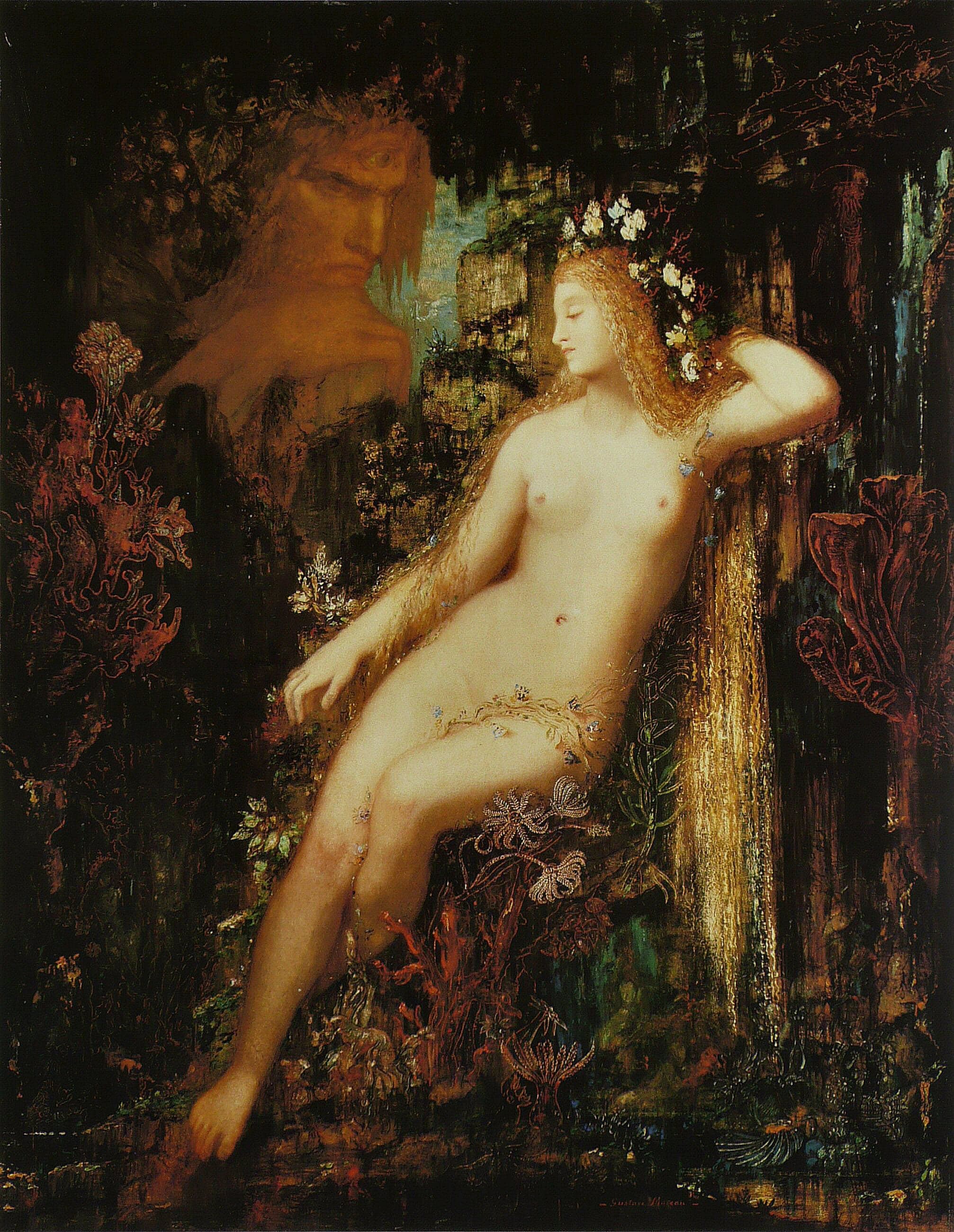
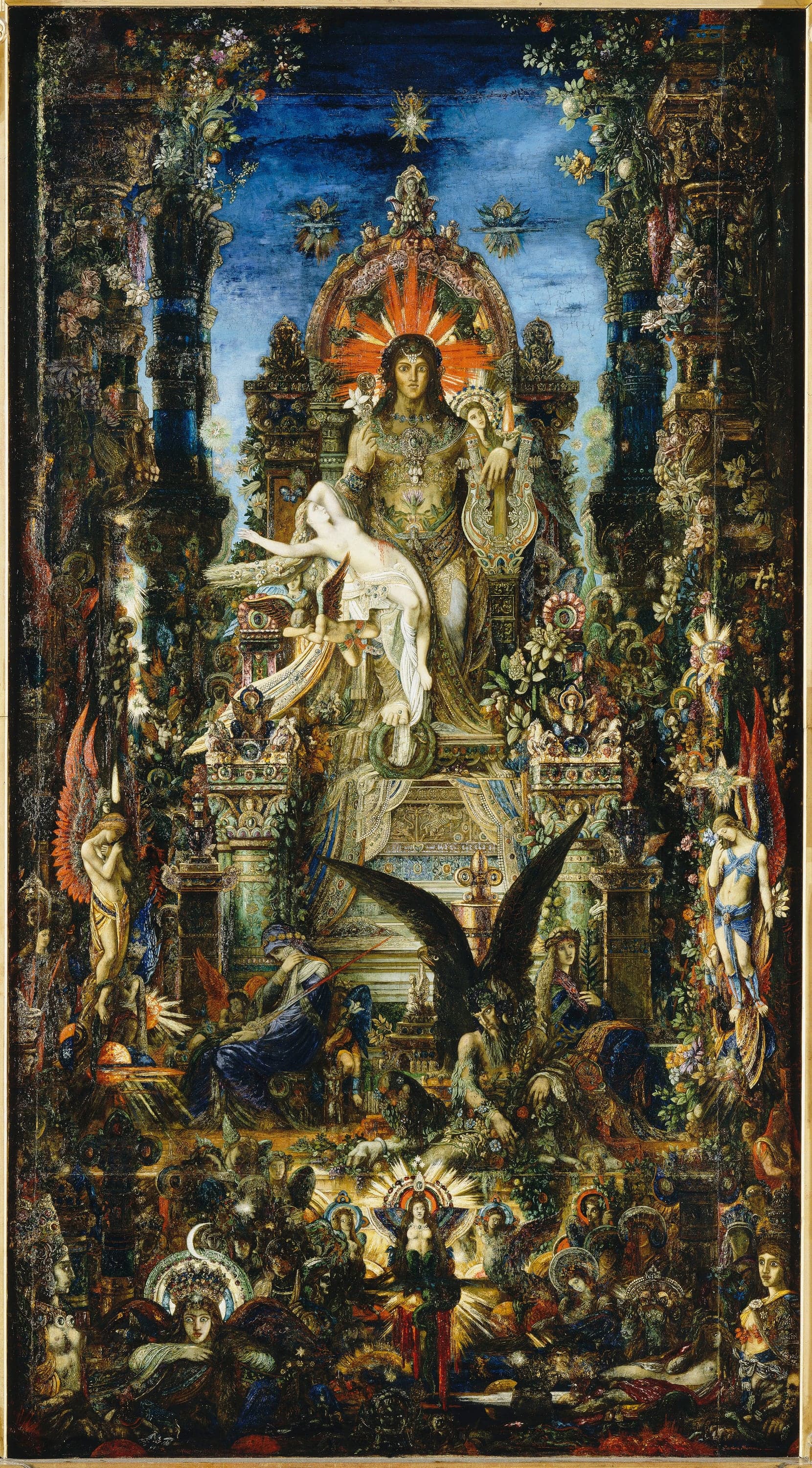
If you like Gustave Moreau
Explore painters from the same movements and circles.

Pierre Bonnard
French painter, printmaker and illustrator whose intimate rooms, Paris streets, gardens and bathing figures transformed everyday life into complex fields of color, memory and perception.
View artist
Paul Gauguin
Stockbroker turned painter who came into art through Camille Pissarro, showed with the Impressionists, and left Europe for Polynesia.
View artist
Edvard Munch
Norwegian painter of The Scream, who arrived in Paris in 1889 on a state scholarship to learn academic drawing from an anti-Impressionist professor, lost his father that November, and spent a bleak winter in the riverside suburb of Saint-Cloud writing down the vow that redirected his art — paint the moments when people are most alive, not the furniture around them.
View artist
References
The sources below include collection records, catalogues, scholarly research, and primary materials that informed this page. They document Oedipus and the Sphinx, its making, and its place in cultural history.


2↑Biography of Gustave Moreau — Musée Gustave Moreau
WebsiteMusée Gustave Moreau, ParisUsed forWeb source consulted for documented facts and historical context presented on the Oedipus and the Sphinx page.

3↑Explication des ouvrages de peinture, sculpture, architecture, gravure et lithographie des artistes vivants exposés au Palais des Champs-Élysées le 1er mai 1864 (Salon livret)
Exhibition catalogueCharles de Mourgues frères, Paris; Internet Archive copy, 1864Used forCatalogue scholarship used to verify attribution, provenance, chronology, and interpretive context for Oedipus and the Sphinx.
4↑Interrogating Gustave Moreau's Sphinx: Myth as Artistic Metaphor in the 1864 Salon
PeriodicalNineteenth-Century Art Worldwide, vol. 7, no. 1 (Spring 2008), 2008Used forContemporary reporting or criticism used to document the historical reception and context of Oedipus and the Sphinx.
5↑Oedipus and the Sphinx, Gustave Moreau — The Met Collection API record, object 437153
Official recordThe Metropolitan Museum of ArtUsed forOfficial record used to verify names, dates, institutional details, or other factual information on this page.
These references provide the documented foundation for this work's history and interpretation. Claim-level citations remain attached to the specific claims they support.
 Explore more resources