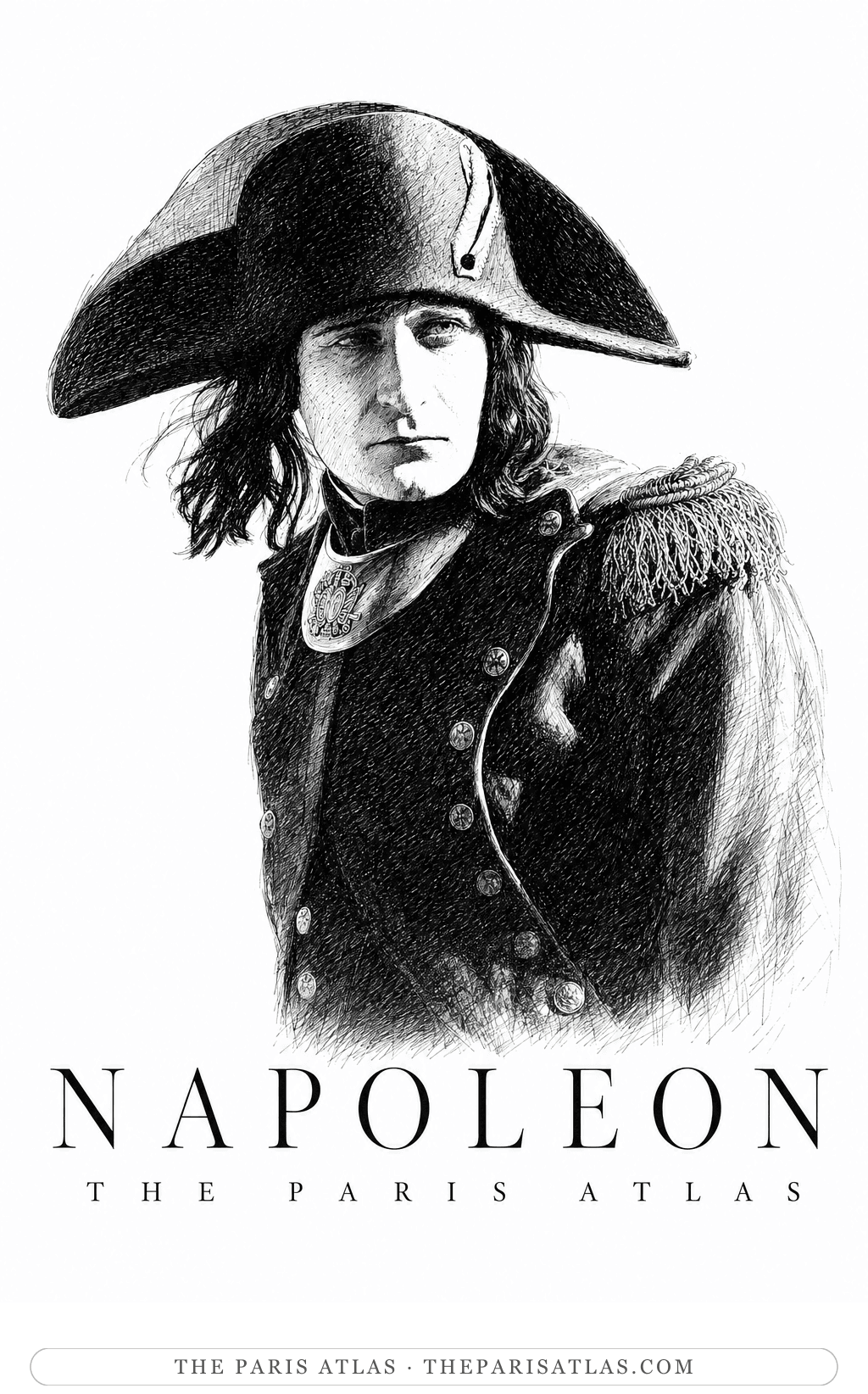
Gance's colossal biography of Bonaparte from schoolyard snowball fight to the Italian campaign — cameras strapped to horses, swung on pendulums, and thrown like snowballs, ending in Polyvision: three projectors opening the screen into a triptych. The most technically audacious film of the silent era, premiered at the Paris Opéra two years before the talkies made its inventions orphans.
“The destiny of an empire often rests upon a single man.”
Winter at the Brienne military school, 1783. The first Napoleon the film shows is not an emperor or a general or even an officer — he is a Corsican scholarship boy with an accent, no friends, and an instinct for turning disadvantage into geometry. The schoolboys divide for a snowball fight. Commanding the smaller side, the child studies the ground, concentrates his fire, and takes the enemy position; when the older boys start packing stones into their snowballs, the game shows the blood underneath its pageantry. Victory does not make him belong. It makes his difference visible.
The Brienne snowball fight — the film's opening battle, shot on location in real snow. The smaller army wins because one boy treats the schoolyard as a map. — Abel Gance — film frame, Brownlow/BFI restoration copy
The scene's real protagonist is the camera. It runs beside the boys, spins, plunges, takes hits from the missiles it records; Gance had a camera sealed in padding and thrown back and forth like a projectile.
“The camera becomes a snowball.”
The dormitory pillow fight that follows goes further: as the feathers fly, the frame splits into four, then nine simultaneous compartments — masks and rewound film, every exposure built inside the camera. Before the film tells you what its hero will do, it teaches you how it wants cinema to feel: fast, physical, excessive, and convinced that technique can manufacture destiny.
Vladimir Roudenko as the boy Napoléon, snow-flecked and unbeaten. Gance matches this face to Dieudonné's across the film — character as prophecy remembered. — Abel Gance — film frame, Brownlow/BFI restoration copy
Six films, one beginning
In 1923 Gance proposed a cycle of six films that would carry Bonaparte from school to the grave at Saint Helena. The first installment was meant to be an ordinary feature. Instead the screenplay grew, the shoot ran from January 1925 to September 1926, and the production exposed some 400,000 meters of negative — roughly 290 hours of film — while covering only the opening chapter of the life. Gance spent the resources of six movies making the first one.
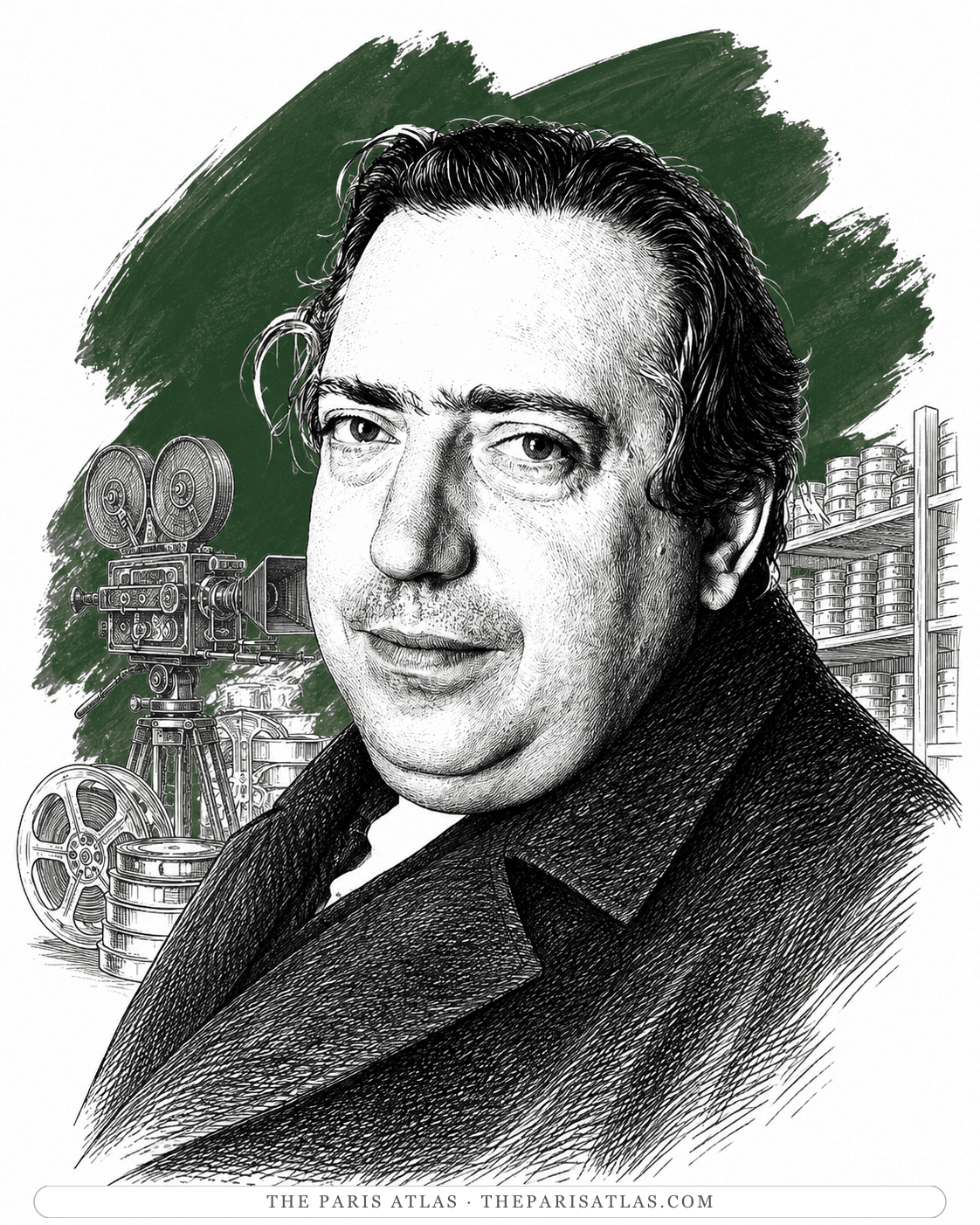
Gance in 1924, the year the Napoléon financing came together — after La Roue, before the twenty-month shoot that would consume the budget of six films. — Unattributed press photograph — via Wikimedia Commons
What the surviving epic actually covers:
Brienne, and the snowball fight that rehearses a career
The Revolution at the Club des Cordeliers, where La Marseillaise is sung for the first time
Corsica, the break with Paoli, and an escape by sea under a tricolor sail
The assassination of Marat, and the Terror's paperwork
The siege of Toulon, where the artillery officer becomes a commander
The royalist rising of 13 Vendémiaire, put down with cannon in the streets of Paris
Joséphine, courtship and marriage
The Army of Italy, and the opening of the 1796 campaign
There is no Egypt, no coup, no coronation, no Austerlitz, no Moscow, no Waterloo, no exile.
That incompleteness shapes the film's politics. Gance never has to show the revolutionary general becoming an autocrat, or glory collapsing into catastrophe. The story stops at the exact moment when possibility is widest and every consequence still belongs to prophecy.
Revolution as a crowd
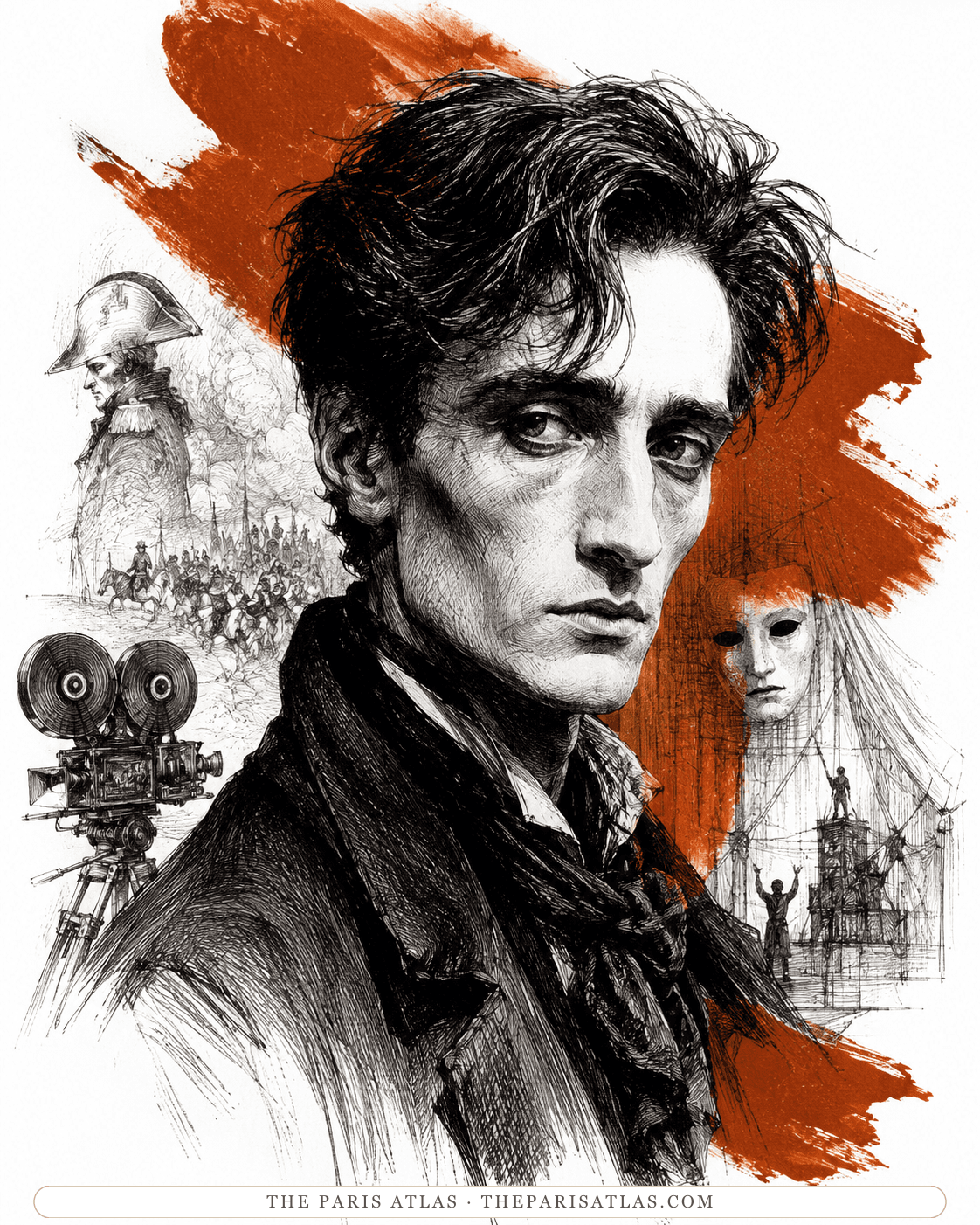
At the Club des Cordeliers, Danton roars, Robespierre watches, and Marat — Antonin Artaud, gaunt and already half-consumed — burns through the film's middle passages. Rouget de Lisle arrives with a new song. Making the first performance of La Marseillaise the climax of a silent sequence is typical of Gance's nerve: the audience cannot hear a note, yet the cutting moves the anthem from mouth to mouth through the hall until the crowd becomes a chorus. Editing organizes breath. Napoleon stands at the edge of the room, observing the energy he will learn to command.
La Marseillaise arrives at the Club des Cordeliers. The audience cannot hear a note; the cutting moves the anthem from mouth to mouth until the hall becomes a chorus. — Abel Gance — film frame, Brownlow/BFI restoration copy
Gance threads fictional witnesses through the history: Tristan Fleuri, a Brienne kitchen servant carried through successive regimes as France's everyman, and his daughter Violine, whose devotion to Bonaparte turns her into an allegory of the nation itself. When Charlotte Corday kills Marat in his bath, Gance composes the aftermath as Jacques-Louis David's painting made flesh. History reaches us through earlier images, and Gance makes the inheritance spectacular. A year later Artaud sat on the other side of a tribunal, as the sympathetic monk Massieu in The Passion of Joan of Arc — produced by the same Société Générale des Films.
Antonin Artaud's Marat dead in the bath, the frame composed after Jacques-Louis David's painting — a revolutionary icon returned to moving flesh and then back to an icon. — Abel Gance — film frame, Brownlow/BFI restoration copy
The crowd, in Gance's double vision, can create a nation or consume a person. The same mass that learns a song can demand a head.
The Double Tempest
Fleeing Corsica in an open boat, Napoleon rides out a storm using a tricolor as his sail — an image too perfect to be history, and not meant as any. Far away in Paris, the Convention descends into purges. Gance cross-cuts sea and assembly until they become one weather system: to film it, he hung a camera from a giant pendulum and swung it over more than a thousand extras, so the parliament pitches and rolls like a deck.
The escape from Corsica: a tricolor for a sail. An image too perfect to be history, and not meant as any — the flag literally carries him to France. — Abel Gance — film frame, Brownlow/BFI restoration copy
The sequence is the film's central argument compressed into a metaphor. History, for Gance, is not a chain of causes but a climate of force — and Napoleon matters because he is the one figure who stays vertical while everything else pitches.
The Convention from the pendulum camera. Gance swung the machine over more than a thousand extras until the parliament rolled like a deck. — Abel Gance — film frame, Brownlow/BFI restoration copy
Toulon, the Terror, Vendémiaire
At Toulon in 1793, the schoolyard strategist becomes a general. Gance plays command as concentration: while other officers bluster and panic, Dieudonné's Napoleon stares at the harbor until its pattern gives way. The night assault is filmed in rain, mud, and blast light, and the shoot was nearly as dangerous as the battle — an accidental explosion injured crew members and temporarily blinded Gance himself.
Toulon in rain and fire. The night assault refuses the clean geometry of the snowball fight — strategy wins the battle, but the combat is mud, water, and blast light. — Abel Gance — film frame, Brownlow/BFI restoration copy
Then the Terror, staged as administration. Prison dossiers decide who reaches the guillotine; Fleuri and the clerk La Bussière save lives by eating the files. Joséphine and Napoleon both pass through the cells.
Gina Manès, the film's Joséphine de Beauharnais — worldly, socially armed, and the one person in the film Napoleon cannot simply outmaneuver. — Studio portrait — via Wikimedia Commons
In October 1795 the film reaches 13 Vendémiaire, and its darkest turn arrives almost without comment: the artillery genius who drove the British from Toulon now turns his cannon on royalist crowds in the streets of Paris. The myth barely slows down. For admirers, this is order rescued from chaos; for skeptical viewers, it is the moment revolutionary energy begins to authorize military power. Gance's exhilaration and the film's authoritarian temptation occupy the same images.
The camera unchained
Gance had already made J'accuse (1919), summoning real soldiers — many soon to die — to play the war's accusing dead, and La Roue (1923), whose rapid cutting the whole European avant-garde studied. For Napoléon he resolved that the camera should stop observing and start participating. The production strapped motorized cameras to operators' chests and mounted them on sleds, rails, cars, pendulums, and a horse; one was sealed in a waterproof box and hurled into the Mediterranean.
In the snowball fight, the camera attacks and is attacked
In the pillow fight, it fractures into simultaneous views
In Corsica, it pursues on horseback and by car
At the Convention, it swings like a wave over the assembly
At Toulon, it falls into the mud with the infantry
At the ball of the survivors, it sways among the dancers
The pillow fight fractures into simultaneous exposures — masks and rewound film, all of it built inside the camera in 1926. — Abel Gance — film frame, Brownlow/BFI restoration copy
“Make the spectator an actor: mingle him with the action, carry him away in the rhythm of the images.”
That sentence is the key to the whole machine: every rig existed to abolish the spectator's safe distance. Some of the experiments proved impractical; others became ordinary film grammar decades later, from handheld combat photography to the split screen.
One screen becomes three
Napoleon takes command of the Army of Italy and finds it unpaid, starving, and mutinous. He promises movement, victory, history. And as the campaign begins, the ordinary frame can no longer hold what Gance wants the audience to feel — so the curtains draw back and the image opens into three screens.
Dieudonné as Bonaparte on a rocky outcrop, arm outstretched — a production still from the film, and the source of much of its modern re-release artwork. — Société Générale des Films — production still
Polyvision, as the process was later named, ran three synchronized projectors side by side across a field roughly four times wider than it was tall. Sometimes the panels fuse into one panorama; sometimes they carry three different images — armies flanking Bonaparte's face, a horizontal montage too large for any single rectangle. At the climax the three panels are washed blue, white, and red, and the auditorium becomes a moving French flag.
Polyvision as counterpoint: Bonaparte holds the center panel while the sky takes the wings. The panels could fuse, oppose, or echo — a horizontal montage no single frame could carry. — Abel Gance — Polyvision frame, Brownlow/BFI restoration copy
Nothing in commercial cinema would attempt the scale again for a quarter of a century, and when widescreen did arrive, CinemaScope squeezed its image onto a single strip — a different, tamer idea. Gance's triptych had no successor; multi-screen projection waited for Cinerama and the world's fairs.
The last image: the three panels washed blue, white, and red, the auditorium turned into a moving French flag. Cinema's most expansive ending, and an admission that the other five films would never come. — Abel Gance — Polyvision frame, Brownlow/BFI restoration copy
Then it stops.
The finale compresses everything Gance could not afford to film — Joséphine, maps, eagles, campaigns, an empire — into simultaneous prophecy. Polyvision is the ghost of the five unmade films.
The finale's montage: the globe, Joséphine's face, the marching army — romance and conquest occupying the same field of vision. The five unmade films compressed into prophecy. — Abel Gance — Polyvision frame, Brownlow/BFI restoration copy
History, seen by Abel Gance
The full title is unusually honest: Napoléon vu par Abel Gance — Napoleon as seen by Abel Gance. The broad chronology from Brienne through Corsica, Toulon, prison, Vendémiaire, and the Italian command is recognizable history. Almost everything binding it together is not. Napoleon was not present at the first singing of La Marseillaise; the tricolor sail belongs to legend; the ever-present eagle is pure emblem; Fleuri and Violine never existed.
Jacques-Louis David, Napoleon Crossing the Alps (Malmaison version). Bonaparte actually crossed on a mule; David painted the legend on a rearing charger. Gance works in the same tradition — the film quotes the paintings, not the weather. — Jacques-Louis David — Château de Malmaison, via Wikimedia Commons
Gance works the way David worked: the propaganda portrait of the rearing charger over the truthful mule. The film quotes paintings, engravings, and schoolbook legends and never pretends otherwise — cultural memory, not eyewitness neutrality, is its actual subject.
Which leaves the politics. Made in a 1920s Europe fascinated by mass movements and charismatic leadership, the film presents one exceptional man as the answer whenever collective politics becomes frightening. Its form and its story pull in opposite directions: the camera democratizes sensation, diving into crowds with unprecedented freedom, while the narrative channels all that collective force upward into a single heroic body. Form disperses power; story centralizes it.
That tension is a reason to watch the film, not an embarrassment to edit out of it.
Why every runtime is different
There is no useful answer to "how long is Napoléon?" without naming an edition. Gance himself cut different versions for different occasions, distributors recut those, and the footage then scattered across half a century of archives — the film entered the world as a family of versions, never a single stable object.
Maurice Toussaint's poster for the Pathé-Rural release — the film cut into serialized 'époques' for France's small-town circuit. Even at home, Napoléon circulated in pieces. — Maurice Toussaint — via Wikipedia (public domain in the US)
Opéra version, April 1927 — about four hours, with the triptychs, premiered at the Palais Garnier with music by Arthur Honegger
Apollo 'Grande Version', May 1927 — a far longer narrative assembly shown to the trade without the triptychs; contemporary reports stretch toward nine hours
MGM's American release, 1929 — cut to roughly a hundred minutes, triptych discarded; the mutilation most of the world judged the film by
Napoléon Bonaparte, 1935 — Gance's own sound reworking of the material
Coppola roadshow, 1981 — under four hours, with a live orchestral score by Carmine Coppola
Brownlow / Photoplay / BFI, 2000–2016 — five hours thirty-two minutes at 20 frames per second, with Carl Davis's score; the standard English-language restoration
Mourier / Cinémathèque française 'Grande Version', 2024 — about seven hours in two parts at 18 frames per second; the longest authoritative reconstruction
The Apollo-Théâtre during the run of the Grande Version, May 1927 — soldiers in Napoleonic uniform at the doors, a poster wagon at the curb, and Dieudonné's name on the facade. Exhibition as theater of its own. — Charles-Édouard Boesch — La Cinémathèque française (public domain in the US)
The music multiplies the versions again. Honegger scored the 1927 premiere while Gance was still recutting the film under him; Carl Davis built and kept expanding a symphonic score across four decades of Brownlow's editions; Carmine Coppola wrote for his son's roadshow; and for the 2024 restoration Simon Cloquet-Lafollye assembled a musical construction some 1,500 pages long, performed by the orchestras and choir of Radio France.[1]
Gance with the composer Arthur Honegger, who scored the 1927 Opéra premiere while the director was still recutting the film under him. Every later restoration would need its own music — the score is part of the version. — Unattributed press photograph — via Wikimedia Commons
A runtime without an edition name, in other words, is not information.
A century of reassembly
Kevin Brownlow found the film as an English schoolboy in the 1950s, when two reels of a cut-down 9.5 mm print turned up in a street market. Reassembling the rest took him the better part of a lifetime — hunting fragments across archives and attics, comparing variants shot by shot, through successive editions with Photoplay and the BFI.[2]
The revival became public in stages: a triptych screening at Telluride in 1979 with Gance, nearly ninety, in attendance; the triumphant London premiere of the Brownlow restoration with Carl Davis conducting in 1980; and Francis Ford Coppola's roadshow edition at Radio City Music Hall in 1981, which turned a lost film into an event and sent it on tour across America.[3]
The Chicago Theatre, 1981: Francis Ford Coppola's roadshow revival, with Carmine Coppola conducting a live orchestra. Fifty-four years after the Opéra premiere, the film was filling picture palaces again — and Gance, ninety-one, lived to hear about it. — Alan Light — via Wikimedia Commons (CC BY 2.0)
Gance died that November, having lived just long enough to watch the world rediscover him.[4]
The Cinémathèque française then spent sixteen years on the fullest reconstruction yet: a team under Georges Mourier examined nearly a hundred kilometers of surviving film, guided by Gance's editing notes and his correspondence with editor Marguerite Beaugé, to rebuild the Grande Version. The result — about seven hours, with the triptych finale restored — opened Cannes Classics in May 2024 and premiered complete at La Seine Musicale that July, with Radio France's forces performing Simon Cloquet-Lafollye's score; Potemkine brought it to French home video in November 2025.[5]
Nearly a hundred years on, this is a work whose definitive form arrived within living memory of no one who saw it first.[6]
Timeline
1923
Gance proposes a cycle of six Napoleon films, from Brienne to Saint Helena. Only the first will ever be made.
January 1925
Shooting begins at the Billancourt studios; it will run twenty months and expose some 400,000 meters of film.
August 1926
The three-camera material for the Polyvision finale is shot.
Polyvision as panorama: three synchronized projectors fuse into one field roughly four times wider than it is tall, and the Army of Italy's camp becomes a landscape painting in motion. (Abel Gance — Polyvision frame, Brownlow/BFI restoration copy)
7 April 1927
The four-hour Opéra version premieres at the Palais Garnier with the triptychs and Arthur Honegger's music.
Albert Dieudonné as Bonaparte, photographed by Pierre Choumoff for the film's release. The stare is the performance: Dieudonné plays command as concentration, and Gance's editing builds the legend around it. (Pierre Choumoff — via Wikimedia Commons)
May 1927
The far longer 'Grande Version' is shown to trade audiences at the Théâtre Apollo — the assembly whose reconstruction would take a century.
1929
MGM releases an American version cut to roughly a hundred minutes, without the triptych. Reviews judge a film Gance never made.
The 1929 American poster. Metro-Goldwyn-Mayer cut the film to roughly a hundred minutes and discarded the triptych — the version most of the world judged the film by for half a century. (Metro-Goldwyn-Mayer — via Wikimedia Commons)
1935
Gance reworks the material as a sound film, Napoléon Bonaparte.
1950s
A teenage Kevin Brownlow buys two 9.5 mm reels in a London street market and starts asking what the rest of the film looked like.
1979
A full triptych screening at the Telluride Film Festival, with Gance — nearly ninety — in attendance.
1980
Brownlow's five-hour restoration triumphs in London with Carl Davis conducting his new score live.
1981
Coppola's roadshow edition, scored by his father Carmine, fills Radio City Music Hall and tours America's picture palaces. Gance dies in November, rediscovered.
The Chicago Theatre, 1981: Francis Ford Coppola's roadshow revival, with Carmine Coppola conducting a live orchestra. Fifty-four years after the Opéra premiere, the film was filling picture palaces again — and Gance, ninety-one, lived to hear about it. (Alan Light — via Wikimedia Commons (CC BY 2.0))
2000–16
The Brownlow/Photoplay/BFI restoration grows to five hours thirty-two minutes; the BFI's 2016 digital restoration brings it to disc at last.
May 2024
The Cinémathèque française's sixteen-year reconstruction of the Grande Version — seven hours, under Georges Mourier — opens Cannes Classics.
July 2024
The complete two-part version premieres at La Seine Musicale, with Radio France performing Simon Cloquet-Lafollye's score.
November 2025
Potemkine releases the Grande Version on French home video — the closest thing to a definitive edition the film has ever had.
Frequently asked questions
What is the 1927 Napoleon film about?
Abel Gance's silent epic follows Napoleon Bonaparte from military school at Brienne through the French Revolution, Corsica, the siege of Toulon, the Terror, his marriage to Joséphine, and his taking command of the Army of Italy in 1796. It covers only his rise — there is no empire, no Waterloo, and no exile.
How long is Napoléon (1927)?
It depends entirely on the version. The 1929 American cut ran about 100 minutes; the Brownlow/BFI restoration runs 5 hours 32 minutes; the Cinémathèque française's 2024 reconstruction runs about 7 hours in two parts. Historical 1927 running times vary further because silent films were projected at different speeds.
Is there a nine-hour version of Napoléon?
Not one you can watch. The very long 'Grande Version' shown to trade audiences at the Apollo in May 1927 is often reported as nine hours or more, but the surviving evidence does not translate into a modern nine-hour cut. The 2024 reconstruction derived from it runs about seven hours at 18 frames per second.
What is Polyvision?
Gance's three-screen process: three synchronized projectors throw three strips of film side by side, sometimes fusing into one wide panorama, sometimes carrying three separate images as a horizontal montage. It appears in the film's finale, which ends with the three panels tinted blue, white, and red.
Was Napoléon the first widescreen film?
It is one of the earliest and most radical widescreen experiments, though 'first' depends on definition. Polyvision differs from later formats like CinemaScope because it needs three cameras and three projectors, and because its panels can act independently rather than only forming one panorama.
Does a silent film like this have music?
Always in performance. Arthur Honegger scored the 1927 premiere; Carl Davis wrote the monumental score attached to the Brownlow restorations; Carmine Coppola scored the 1981 American roadshow; and Simon Cloquet-Lafollye assembled the music for the 2024 seven-hour version, performed by Radio France. The score you hear is part of which version you are watching.
How historically accurate is Napoléon?
The broad chronology is real; the connective tissue is myth. Gance compresses events, invents characters (Fleuri, Violine), stages symbolic scenes like the tricolor sail, and puts Napoleon where he never was, including the first singing of La Marseillaise. The title says it plainly: this is Napoleon as seen by Abel Gance.
Who plays Napoleon in the 1927 film?
Albert Dieudonné plays the adult Napoleon — a role that consumed his public identity for the rest of his life — and Vladimir Roudenko plays him as a boy at Brienne. Gina Manès is Joséphine, Antonin Artaud is Marat, and Gance himself appears as Saint-Just.
Is this the same film as Ridley Scott's Napoleon?
No. This page covers Abel Gance's silent epic, premiered in Paris in 1927. Ridley Scott's Napoleon (2023), with Joaquin Phoenix as Bonaparte, is a separate, unrelated production. Gance's film also stops much earlier in the life: it ends with the Italian campaign of 1796, before the coronation and the wars Scott's film stages.
Why is Antonin Artaud in Napoléon?
Before his theoretical writing made him famous, Artaud worked steadily as a screen actor. His gaunt, feverish Marat — composed after David's Death of Marat — is one of the film's most striking presences, and one of two great roles he played in 1927–28; the other is the young monk Massieu in The Passion of Joan of Arc.
Why does the film end before Napoleon becomes emperor?
Napoléon was planned as the first of six films covering the whole life, and the first production consumed the money and material intended for the entire cycle. Gance ends at the Italian campaign of 1796 and compresses the unfilmed future — empire, decline, exile — into the Polyvision finale as prophecy.
Is Napoléon (1927) in the public domain?
The 1927 film is public domain in the United States, where copyright in works published in 1927 expired at the start of 2023. That does not free the modern restorations, their scores, or their subtitle translations, which carry their own rights — and the film remains under copyright in France, where terms run from Gance's death in 1981.
Where can I watch Napoléon (1927)?
The Brownlow–Davis restoration is distributed by the BFI on disc and on BFI Player in supported territories. The 2024 Grande Version was released on UHD, Blu-ray, and DVD in France by Potemkine in November 2025 — check subtitle options before importing. Treat unlabeled 'full movie' uploads with suspicion: most are mutilated cuts or unauthorized copies of restored editions.
Which version of Napoléon should I watch?
For English speakers at home, the Brownlow/BFI edition with Carl Davis's score is the accessible landmark. The 2024 Cinémathèque reconstruction is the fullest version that exists and the one to see when it is legally available with subtitles you can read. A live-orchestra triptych screening, if one ever passes within reach, outranks both.
Is Napoléon propaganda?
It is unmistakably heroic and national-mythic: Napoleon appears as the exceptional man who masters revolutionary chaos, and the film never shows the cost of where that mastery led. It also contains some of cinema's most extraordinary images of collective energy. Neither 'propaganda' nor 'innocent' quite covers it — the tension between the two is what keeps the film alive.
Related videos
Official uploads only: trailers, performances, and works this one inspired.
Napoleon — BFI restoration trailer
The BFI's official trailer for the Brownlow–Davis restoration — five and a half hours, Carl Davis's score, and the digitally reassembled triptych.
Napoléon — bande-annonce officielle (Pathé, 2024)
Pathé's official trailer for the seven-hour Grande Version reconstructed by the Cinémathèque française — the film as no audience had seen it since May 1927.
In the atlas
What the graph records about this work — every claim carries its citation.
The Cinémathèque française's full reconstruction and restoration of Napoléon — directed by Georges Mourier with the CNC's support — the modern successor to the Epstein–Langlois Museum Copy, presented as a complete seven-hour version in 2026.
— La Cinémathèque française — Napoléon vu par Abel Gance, enfin reconstruit et restauré
With Marie Epstein, Langlois built the Cinémathèque française's 19-reel “Museum Copy” of Napoléon between 1953 and 1959, the archive's first reference reconstruction of Gance's fragmented film.
— La Cinémathèque française — The “Napoléon” Comet: The Expert Appraisal of a Collection
Reconstructed by · 1953–1959
Marie Epstein
From 1953, Marie Epstein and Henri Langlois established a 19-reel version of the 1927 film at the Cinémathèque française — the “Museum Copy” — and worked to perfect it until 1959. It became the reference reconstruction later restorations built on.
— La Cinémathèque française — The “Napoléon” Comet: The Expert Appraisal of a Collection
— Encyclopaedia Britannica — Napoléon (film by Gance)
If you like Abel Gance
Explore directors from the same movements and circles.
John Cassavetes
The American actor and filmmaker who financed personal films outside the studio system and built them around the difficult, unfinished behavior of people in families and relationships.
American film director who trained as a painter, filmed the life of Henri de Toulouse-Lautrec in Moulin Rouge, and won two Academy Awards for The Treasure of the Sierra Madre.
The Danish-born actor at the center of Jean-Luc Godard's 1960s features — the French New Wave's defining female lead, whose performances carry their own authorship.
The Brienne snowball fight — the film's opening battle, shot on location in real snow. The smaller army wins because one boy treats the schoolyard as a map.1927 · Abel Gance — film frame, Brownlow/BFI restoration copy · Fair useVladimir Roudenko as the boy Napoléon, snow-flecked and unbeaten. Gance matches this face to Dieudonné's across the film — character as prophecy remembered.1927 · Abel Gance — film frame, Brownlow/BFI restoration copy · Fair useThe pillow fight fractures into simultaneous exposures — masks and rewound film, all of it built inside the camera in 1926.1927 · Abel Gance — film frame, Brownlow/BFI restoration copy · Fair useLa Marseillaise arrives at the Club des Cordeliers. The audience cannot hear a note; the cutting moves the anthem from mouth to mouth until the hall becomes a chorus.1927 · Abel Gance — film frame, Brownlow/BFI restoration copy · Fair useThe Convention from the pendulum camera. Gance swung the machine over more than a thousand extras until the parliament rolled like a deck.1927 · Abel Gance — film frame, Brownlow/BFI restoration copy · Fair useThe escape from Corsica: a tricolor for a sail. An image too perfect to be history, and not meant as any — the flag literally carries him to France.1927 · Abel Gance — film frame, Brownlow/BFI restoration copy · Fair useAntonin Artaud's Marat dead in the bath, the frame composed after Jacques-Louis David's painting — a revolutionary icon returned to moving flesh and then back to an icon.1927 · Abel Gance — film frame, Brownlow/BFI restoration copy · Fair useBefore the night assault on Toulon: 'We are about to fight, so you have my permission to sing.' The blue tinting is the restoration's reconstruction of the 1927 release palette.1927 · Abel Gance — film frame, Brownlow/BFI restoration copy · Fair useToulon in rain and fire. The night assault refuses the clean geometry of the snowball fight — strategy wins the battle, but the combat is mud, water, and blast light.1927 · Abel Gance — film frame, Brownlow/BFI restoration copy · Fair usePolyvision as panorama: three synchronized projectors fuse into one field roughly four times wider than it is tall, and the Army of Italy's camp becomes a landscape painting in motion.1927 · Abel Gance — Polyvision frame, Brownlow/BFI restoration copy · Fair usePolyvision as counterpoint: Bonaparte holds the center panel while the sky takes the wings. The panels could fuse, oppose, or echo — a horizontal montage no single frame could carry.1927 · Abel Gance — Polyvision frame, Brownlow/BFI restoration copy · Fair useThe finale's montage: the globe, Joséphine's face, the marching army — romance and conquest occupying the same field of vision. The five unmade films compressed into prophecy.1927 · Abel Gance — Polyvision frame, Brownlow/BFI restoration copy · Fair useThe last image: the three panels washed blue, white, and red, the auditorium turned into a moving French flag. Cinema's most expansive ending, and an admission that the other five films would never come.1927 · Abel Gance — Polyvision frame, Brownlow/BFI restoration copy · Fair useThe Apollo-Théâtre during the run of the Grande Version, May 1927 — soldiers in Napoleonic uniform at the doors, a poster wagon at the curb, and Dieudonné's name on the facade. Exhibition as theater of its own.May 1927 · Charles-Édouard Boesch — La Cinémathèque française (public domain in the US) · Public domain (US)Maurice Toussaint's poster for the Pathé-Rural release — the film cut into serialized 'époques' for France's small-town circuit. Even at home, Napoléon circulated in pieces.1928 · Maurice Toussaint — via Wikipedia (public domain in the US) · Public domain (US)Gance in 1924, the year the Napoléon financing came together — after La Roue, before the twenty-month shoot that would consume the budget of six films.1924 · Unattributed press photograph — via Wikimedia Commons · Public domainGina Manès, the film's Joséphine de Beauharnais — worldly, socially armed, and the one person in the film Napoleon cannot simply outmaneuver.c. 1927 · Studio portrait — via Wikimedia Commons · Public domainAlbert Dieudonné as Bonaparte, photographed by Pierre Choumoff for the film's release. The stare is the performance: Dieudonné plays command as concentration, and Gance's editing builds the legend around it.1927 · Pierre Choumoff — via Wikimedia Commons · Public domainDieudonné as Bonaparte on a rocky outcrop, arm outstretched — a production still from the film, and the source of much of its modern re-release artwork.1927 · Société Générale des Films — production still · Fair useThe 1929 American poster. Metro-Goldwyn-Mayer cut the film to roughly a hundred minutes and discarded the triptych — the version most of the world judged the film by for half a century.1929 · Metro-Goldwyn-Mayer — via Wikimedia Commons · Public domainThe Chicago Theatre, 1981: Francis Ford Coppola's roadshow revival, with Carmine Coppola conducting a live orchestra. Fifty-four years after the Opéra premiere, the film was filling picture palaces again — and Gance, ninety-one, lived to hear about it.1981 · Alan Light — via Wikimedia Commons (CC BY 2.0) · CC BY 2.0Gance with the composer Arthur Honegger, who scored the 1927 Opéra premiere while the director was still recutting the film under him. Every later restoration would need its own music — the score is part of the version.c. 1923 · Unattributed press photograph — via Wikimedia Commons · Public domainJacques-Louis David, Napoleon Crossing the Alps (Malmaison version). Bonaparte actually crossed on a mule; David painted the legend on a rearing charger. Gance works in the same tradition — the film quotes the paintings, not the weather.1800–01 · Jacques-Louis David — Château de Malmaison, via Wikimedia Commons · Public domain
References
References
The sources below include collection records, catalogues, scholarly research, and primary materials that informed this page. They document Napoléon, its making, and its place in cultural history.
1↑San Francisco Silent Film Festival — Napoleon (Brownlow–Davis presentation)
Website
Used for
Web source consulted for documented facts and historical context presented on the Napoléon page.
These references provide the documented foundation for this work's history and interpretation. Claim-level citations remain attached to the specific claims they support.




 View source