Influenced
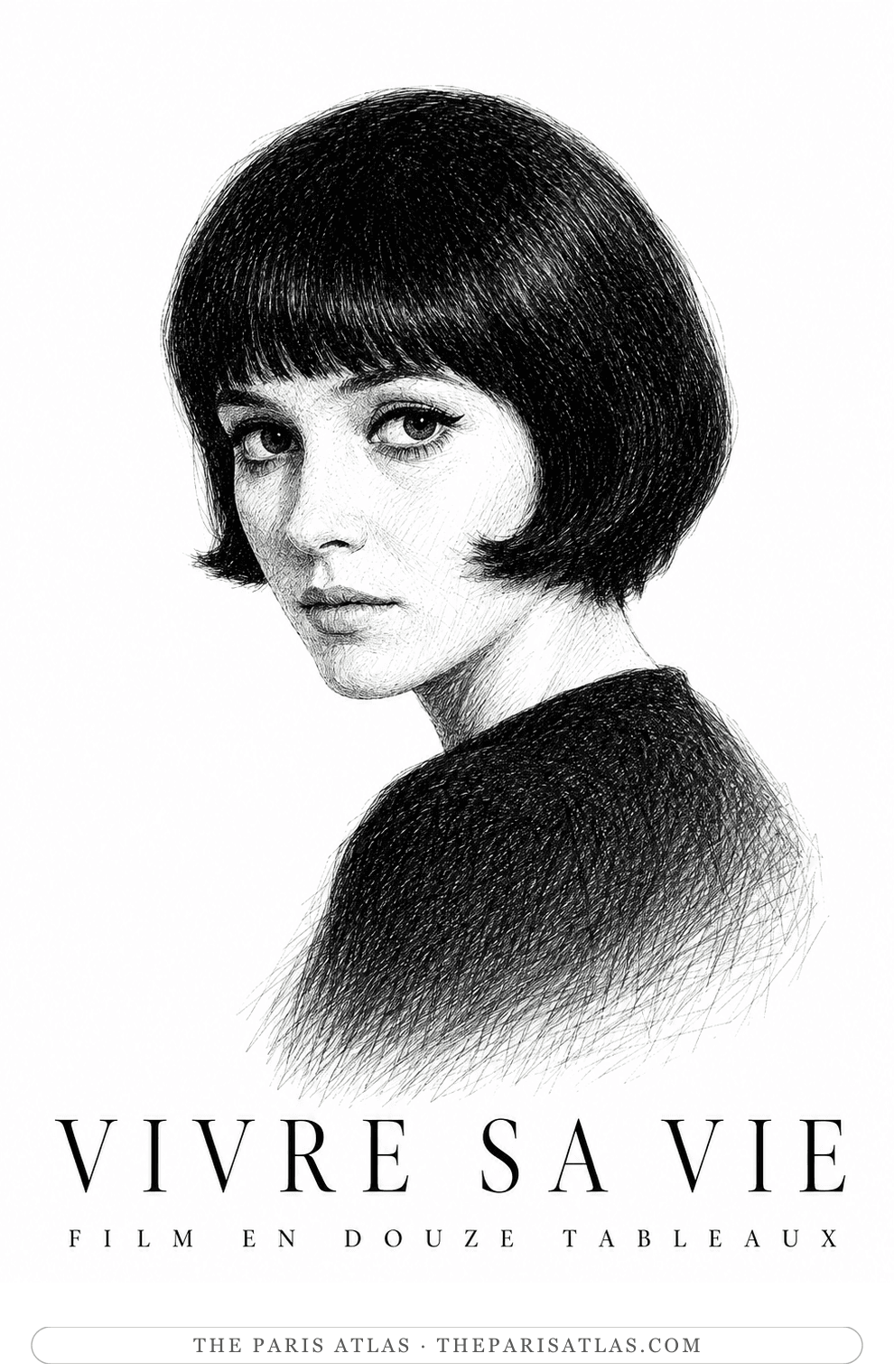
Vivre sa vie
In the third tableau Nana goes to a cinema showing the Lo Duca cut of Dreyer's film, and Godard cuts between Falconetti's weeping Joan and Karina's face. Both women are condemned in their films, and both die at the end.
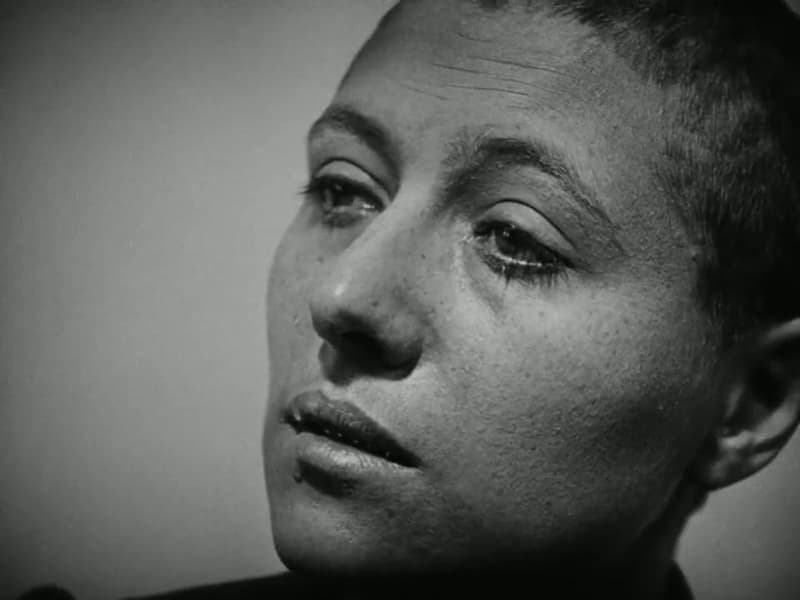
by Carl Theodor Dreyer
Joan's 1431 trial condensed to a single day and shot almost entirely in close-up: Falconetti, without makeup, her hair shorn on camera, against white walls built full-scale and barely shown. A French studio hired a Danish director to film the national saint, and he returned the most intimate epic in cinema — a film about a face, and what institutions do to the people wearing one.
The first question is administrative — Joan's name, her age — and the judges already know the answers. They are not seeking information. They are building a record that will convert a nineteen-year-old prisoner into a heretic.
Dreyer begins near the end of a famous life: no Domrémy visions, no siege of Orléans, no coronation at Reims. A captive at Rouen, a court aligned with the English occupation, and the movement of a face under questioning. Rudolph Maté shot on newly available panchromatic stock that rendered bare skin with merciless tenderness, and no one wears makeup. The judges lean in from unstable angles, eyelines that never quite meet, backgrounds dissolving into white; the courtroom never assembles into a room you could stand in. Without an establishing shot or a neutral distance, you receive each question the way Joan does — at intolerably close range.
Dreyer photographed her more calmly and more frontally than anyone else in the film, so the prisoner is the only stable ground the viewer gets.
Bishop Cauchon and his court question Joan about her visions, her men's clothing, her obedience to the Church, her certainty that she was sent by God. The most dangerous question sounds like the mildest: does she know herself to be in God's grace? To claim certainty would be presumption, itself condemnable. To deny it would surrender her mission. Her answer survives in the record:
“If I am not, may God put me there; and if I am, may God so keep me.”
Some judges mock her. One young cleric, Jean Massieu, cannot hide his sympathy. And the court escalates:
The apparent rescue is worse than death to her: she believes she has denied God. Joan retracts, and her head is shaved — the humiliation Dreyer films like the deposition of a crown.
At the stake she asks for a cross; Massieu improvises one from sticks. As the fire rises, a woman in the crowd cries that a saint is being burned, the people revolt, and soldiers drive them down while smoke fills the square. The body is destroyed while the judgment against her begins to collapse.
The production bought the rights to Joseph Delteil's 1925 bestseller about Joan, and his name stayed on the credits. The finished film abandoned literary biography for the source underneath: the Latin record of the 1431 proceedings, from which Dreyer took his questions and many answers verbatim. The language feels startlingly direct because Joan's own voice survives in it, through the work of the court's notaries.
It is not a transcript performed at feature length. The historical trial ran for months across public and private examinations; Dreyer compresses it into a single continuous ordeal, combining sessions, judges, and stages of the proceeding.
He never claimed to be reconstructing the fifteenth century.
“I wanted to interpret a hymn to the triumph of the soul over life.”
The film's accuracy is real, but it is spiritual and legal, not archaeological.
Dreyer found Renée Jeanne Falconetti acting light comedy on the Paris boulevards and screen-tested her without makeup, seeing — he said — a soul behind the fashionable surface.
The performance she gave is sometimes described as if it were only suffering. It is more active than that. She listens; her gaze moves between the questioner, the consequence, and an interior authority no one else in the room can see; she can look terrified one instant and almost amused the next. The tears never erase the intelligence.
The shoot's severity became legend: retake upon retake, knees on stone, the shearing of her hair filmed for the film while the crew wept. Later retellings inflated all of it into a mythology of calculated abuse, with details — the nails of one persistent story — that no firm evidence supports. The honest version is narrower. Dreyer's methods were exacting and physically hard, and the most sensational anecdotes are production legend.
What survives on screen outsizes every anecdote either way. Most screen acting asks the face to support a story; here the face is the event.
She never appeared in another motion picture.
The Société Générale des Films paid for a prestige production, and designers Hermann Warm — the architect of The Cabinet of Dr. Caligari's painted shadows — and Jean Hugo built one: a vast interconnected Rouen in concrete at the Billancourt studios, towers, walls, drawbridge, courtyards, a marketplace for the execution. Then Dreyer photographed faces instead. The finished film shows a curved wall, a stair, a doorway, a patch of sky. The waste was the method: the complete fortress gave actors and camera real distances to move through even when the edit withheld them, and low camera positions required holes cut in the studio floor.
The producers had bought the fifteenth century, and what they got back was institutional power given a shape — white, sloping, and closed.
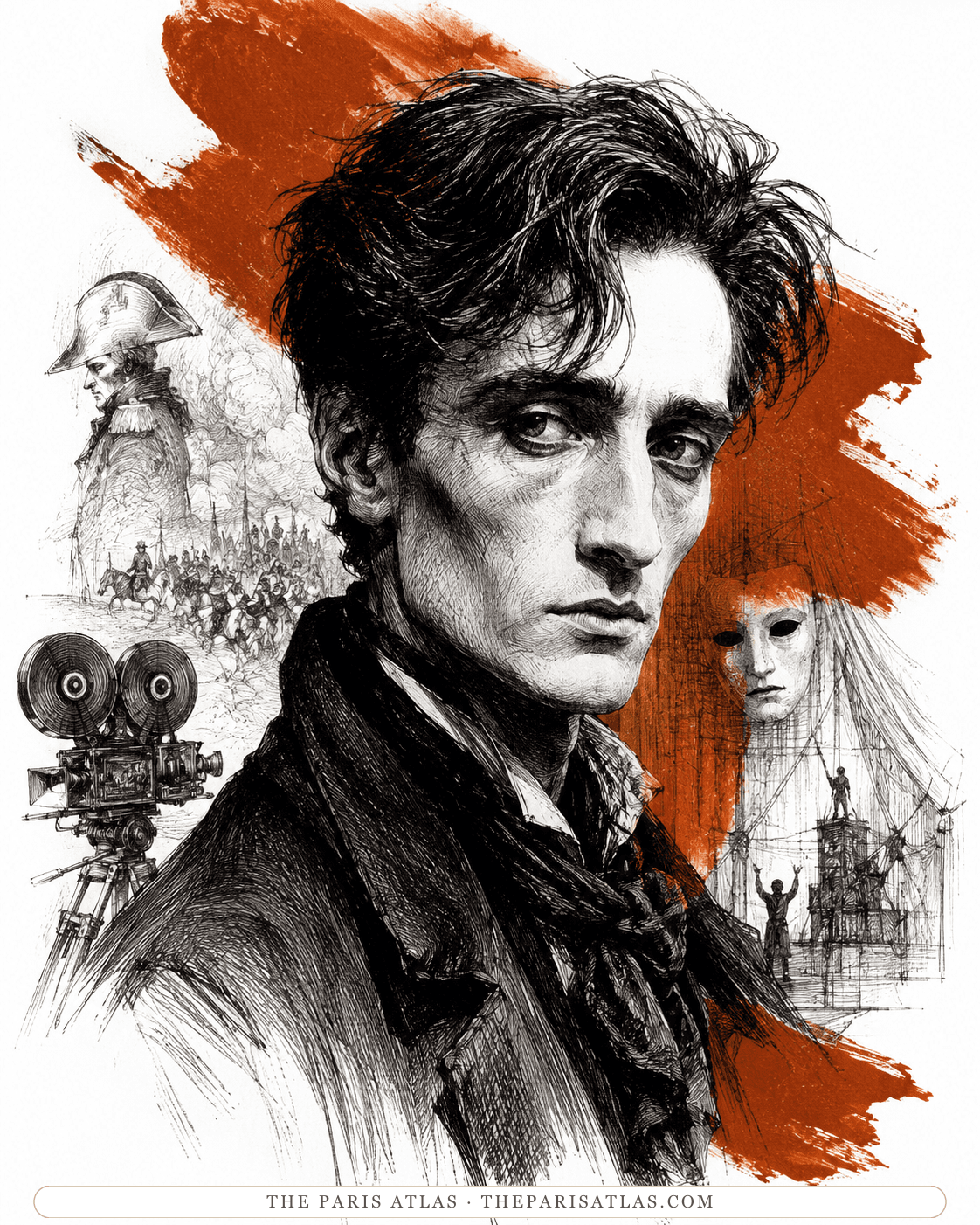
Among the tormentors, one sympathetic face: Antonin Artaud as Jean Massieu, the young cleric who guides Joan through the proceedings and brings her a cross at the stake. It is the poet's other great screen appearance — the same year his scenario for The Seashell and the Clergyman reached the Studio des Ursulines — and the gentlest thing the future theorist of the Theatre of Cruelty ever did in public.
Artaud later described Joan as the victim of a divine principle corrupted in its passage through Church and state, and that is close to the film's political core. Individual judges hesitate, pity, waver; the institution cannot. It requires an answer it can punish. The film's real subject is that machinery — who controls the transcript, and what happens when speech extracted under coercion is entered into the record as consent.
There is no original score. Copenhagen heard a compiled program now lost; Paris got music for orchestra and singers by Léo Pouget and Victor Alix; Dreyer never fixed a definitive accompaniment and reportedly wondered whether the film played best in silence.
The vacancy became an invitation:
The choice changes the film. Chorus makes the faith audible, electronics sharpen the bodily threat, and silence — the version Dreyer suspected was truest — leaves nothing between you and the cutting.[1]
The film's own history ran like a martyrdom. Censors — the archbishop of Paris among the objectors — cut it before the French release, and in December 1928 a fire at UFA's Berlin laboratory destroyed the original negative.[2]
Dreyer and editor Marguerite Beaugé rebuilt the film from alternate takes. The reconstruction burned the following year.[2]
For half a century the world knew mutilated and rearranged versions. The most consequential was the early-1950s Lo Duca edition, re-titled and decorated over Dreyer's objection — the copy Anna Karina watches in tears in Jean-Luc Godard's Vivre sa vie.[3]
Then, in 1981, workers clearing a cupboard at the Dikemark psychiatric hospital outside Oslo found film cans holding a virtually complete print of the original cut, still wrapped with a 1928 Danish censorship label. It had been waiting in an asylum storeroom for sixty years.[2]
Dreyer died in 1968, never knowing his film had survived him.[4]
Gaumont's 2015 restoration descends from the Norwegian print. The 1928 film itself entered the United States public domain on 1 January 2024, but the restorations and modern scores remain under copyright — which is why this page shows the film in frames rather than a player. The Criterion Channel and BFI Player carry authorized editions.[1]
The influence is easiest to see where Godard put it: Nana in the cinema in Vivre sa vie, her tears cut against Falconetti's across three decades — cinema teaching one face to witness another. Dreyer carried the film's concerns into Vampyr, Day of Wrath, Ordet, and Gertrud: faith and doubt, women judged by communities, the invisible made present through exact physical detail. Falconetti's Joan became the benchmark invoked whenever screen acting is described as revelation rather than display.[5]
The 2022 Sight and Sound critics' poll put the film at number 21. The ranking matters less than the persistence.[5]
Watch it, if you can, without 'the greatest performance ever filmed' ringing in your ears. Watch the speed of thought crossing her face, the judges invading the image, a legal question becoming an act of force. The film does not ask whether Joan can escape — history answered that. It asks what remains hers when every authority has taken possession of her body, her clothing, her speech, and her name.
Her face is the answer, and for eighty minutes cinema is the means by which it survives.[6]
10 May 1429
Recording the news from Orléans in the Parlement de Paris register, the clerk Clément de Fauquembergue sketches a Joan he has never seen in the margin — the only image of her made in her lifetime.
1431
Joan is interrogated at Rouen through the winter and spring by an ecclesiastical court aligned with the English occupation; the notaries' Latin record preserves her answers.
30 May 1431
Condemned as a relapsed heretic, Joan is burned in the Rouen marketplace.
1455–56
A nullification trial reexamines the proceedings and annuls her conviction; in 1920 the Church canonizes her, and interest in the new saint surges.
1925
Joseph Delteil publishes his bestselling Jeanne d'Arc; the Société Générale des Films buys the rights and hires a Danish director for the French national saint.
1927
Dreyer shoots in and around the Billancourt studios on Hermann Warm and Jean Hugo's full-scale concrete Rouen — then frames the faces and lets the fortress fall away.
21 April 1928
World premiere at the Palads Teatret, Copenhagen.
25 October 1928
After nationalist controversy and cuts demanded by censors and the archbishop of Paris, the French premiere at the Cinéma Marivaux.
December 1928
Fire at UFA's Berlin laboratory destroys the original negative; Dreyer and Marguerite Beaugé rebuild the film from alternate takes, and the reconstruction burns in a second fire the next year.
1929
American release — the poster trade resells the film of faces as painted flame and spectacle.
1951–52
The heavily altered Lo Duca version circulates for decades — the copy Anna Karina weeps over in Godard's Vivre sa vie (1962).
1981
A virtually complete print of Dreyer's original cut, in 1928 Danish distribution condition, is found in a cupboard at the Dikemark psychiatric hospital outside Oslo.
1994
Richard Einhorn premieres Voices of Light, the oratorio that becomes the film's most famous modern accompaniment.
2015
Gaumont completes a 2K restoration derived from the Norwegian print.
2024
The 1928 film enters the United States public domain on 1 January; the restorations and modern scores remain protected.
Joan of Arc's 1431 heresy trial and execution at Rouen, compressed into a single day and shot almost entirely in close-up. It was directed by the Danish filmmaker Carl Theodor Dreyer for a French studio and released in 1928.
Renée Jeanne Falconetti, in her only major film role. She acted without makeup and had her hair shorn on camera; her performance is often called the greatest in silent cinema.
Dreyer built a full-scale concrete Rouen set and then barely showed it, framing faces instead. The choice makes the film about Joan's ordeal and the churchmen interrogating her, rather than about spectacle.
The original negative burned in a laboratory fire in December 1928, and a reconstruction burned again the next year. For decades only altered versions circulated.
In 1981 a virtually complete print of his original cut was found in a cupboard at the Dikemark psychiatric hospital outside Oslo. It is the basis of the modern restorations.
The 1928 film entered the United States public domain on 1 January 2024. The modern restorations and scores — such as Richard Einhorn's Voices of Light — remain protected.
The Passion of Joan of Arc — Criterion Collection trailer
Mark Kermode reviews The Passion of Joan of Arc — BFI
The Passion of Joan of Arc — restoration demo (Masters of Cinema)
Vivre sa vie — trailer (The Criterion Collection)
Influenced
In the third tableau Nana goes to a cinema showing the Lo Duca cut of Dreyer's film, and Godard cuts between Falconetti's weeping Joan and Karina's face. Both women are condemned in their films, and both die at the end.

The sources below include collection records, catalogues, scholarly research, and primary materials that informed this page. They document The Passion of Joan of Arc, its making, and its place in cultural history.

Web source consulted for documented facts and historical context presented on the The Passion of Joan of Arc page.
Web source consulted for documented facts and historical context presented on the The Passion of Joan of Arc page.

Published analysis and historical context used in preparing the The Passion of Joan of Arc page.
Web source consulted for documented facts and historical context presented on the The Passion of Joan of Arc page.
Archival evidence used to document the historical record connected to The Passion of Joan of Arc.
These references provide the documented foundation for this work's history and interpretation. Claim-level citations remain attached to the specific claims they support.
 Explore more resources