
Responds to · 1937
House of Incest
Porter's bibliography states it plainly: Scenario was inspired by Anaïs Nin's House of Incest, published the year before — Miller refashioning her dream-territory into his own film-on-paper.

by Henry Miller
Miller's surrealist film-on-paper, written after Anaïs Nin's House of Incest — 200 copies from Obelisk in 1937, with a drawing by Abraham Rattner.
A thirty-one-page prose script for a film no one was ever meant to shoot: Miller's answer to Anaïs Nin's House of Incest, moving by dream-image rather than story. Obelisk printed 200 copies in 1937, each with a loose drawing by the painter Abraham Rattner. The rarest kind of Miller — and the most purely surrealist thing he published.
In 1936 Anaïs Nin published House of Incest, the dream-prose poem she had been distilling from the diary for years. Scenario is Miller's response, and the text says so itself: the piece opens with a printed note crediting Nin's book by name. What follows is his interpretation of her imaginative territory, refashioned into his own idiom — a 'film with sound' that exists only as prose.
The form is a script that ignores every practicality of filming. It opens at night in a tropical garden, where an enormous glass bowl of goldfish stands over a pond and the face of a woman named Alraune hovers above the paths like a mask. She is joined by a second woman, Mandra, and the two study each other through the glass of the bowl before the scenes begin to metamorphose: a dance intercut with waves breaking on a beach, a montage of steel girders and collapsing skyscrapers, fortune-telling cards spread on a bed, a mirror in which one woman sees the other's face. Where Nin's book is chiseled and interior, Miller's is aggressively visual, a projector aimed at the page.
Obelisk issued it in 1937 in 200 copies, each carrying a loose drawing by Abraham Rattner, the American painter of Miller's Paris circle. It was reprinted in Max and the White Phagocytes the following year and then in The Cosmological Eye, which is where readers find it now; the pamphlet itself is one of the scarcest Miller items. This account is from a reading of the text in the Internet Archive scan of that collection.
A single image-sequence, thirty-one pages long, with no dialogue and no plot. Alraune and Mandra move from the goldfish garden to a Moorish-furnished house, where Alraune paces in a sheath gown while Mandra sits a throne-like chair; the film cuts between her strides and the sea breaking on a beach, then into flashes of temple dancers, armored men, and the skeletons of skyscrapers buckling to earth. In a stained-glass bedroom the two women spread fortune-telling cards, and a hand mirror gives Alraune back Mandra's face instead of her own.
The later pages darken. The women flee a chanting mob through a door shaped like a skull, visit an astrologer built like a clockwork automaton — he sits oiling the mechanism in his own chest — and the piece closes in a cheap hotel room, where a second Mandra with Alraune's face rises from the body of the first, asleep beside an opium pipe, before a city of coral climbs out of the goldfish bowl. The images are the whole event; nothing is explained, and nothing needs to be.
The mirror sequence makes recognition unstable. In the passage quoted by Patrice Baillargeon, the reflection shifts from Mandra's face to a composite of Mandra and Alraune, as Alraune's features move across Mandra's. The cinematic dissolve therefore does conceptual work: the boundary between looking at another person and recognizing oneself disappears. Instead of explaining the women's relationship psychologically, Miller lets a changing image carry its uncertainty. Rather than guaranteeing an accurate likeness, the reflective surface becomes the means by which individual identity slips out of view. What looks like a special effect is also a disturbance of the self.
The work's dream machinery is also a point of disagreement between Miller and Nin. Nin objected that Miller had turned the inward texture of House of Incest into loud, concrete effects. Her response, reproduced by Princeton's Graphic Arts Collection, challenges the easy assumption that shared images meant shared intentions. What can seem inventive as a sequence of visible transformations can also feel like the loss of another writer's private meanings. Scenario is therefore useful to read as a contested act of adaptation: its acknowledgment of Nin's inspiration does not settle who controls the emotional meaning of the resulting spectacle.
Responds to · 1937
Porter's bibliography states it plainly: Scenario was inspired by Anaïs Nin's House of Incest, published the year before — Miller refashioning her dream-territory into his own film-on-paper.
Half the interest is the dialogue: Nin's House of Incest and Miller's Scenario are the same dream filmed by two different directors.
He kept the movement at arm's length in essays — here he simply does it, for thirty-one pages, without apology or argument.
Obelisk, 200 copies, a loose Rattner drawing in each — the pamphlet is a museum piece of thirties small-press Paris even before the text starts.
1936
Anaïs Nin publishes House of Incest — the book Scenario answers.
1937
Obelisk issues Scenario in 200 copies, each with a loose Abraham Rattner drawing.
1938
Reprinted in Max and the White Phagocytes.
1939
Crosses to America inside The Cosmological Eye, where it remains in print.

The book this one answers — Nin's original dream, one year before Miller's version.
Read our take
Reprinted the text in 1938, inside the Villa Seurat portfolio.
Read our take

The dream sequences of Miller's own masterpiece — the same register at full length.
Read our takeA 31-page surrealist prose piece in the form of a film script — subtitled 'A Film with Sound' — published by Obelisk Press in Paris in 1937 in an edition of 200 copies, each with a loose drawing by Abraham Rattner.
Two women, Alraune and Mandra, meet at night in a garden dominated by a giant bowl of goldfish, and the text moves through metamorphosing scenes: a dance intercut with breaking waves, fortune-telling cards, a clockwork astrologer, an opium room where a double of one woman rises from the other's sleeping body. There is no dialogue and no plot — the images carry everything.
Everything — the opening page carries a printed note crediting her House of Incest, published the year before, as its direct inspiration. Her dream-book supplied the territory; Scenario is his raid on it.
No, and it was never meant to be. The script form is a device — a license for pure image-sequence — not a production document.
In The Cosmological Eye, the 1939 New Directions collection still in print. The 1937 pamphlet is one of the scarcest Miller items and trades as a collector's piece.
Explore authors with a similar voice, perspective, and influence.
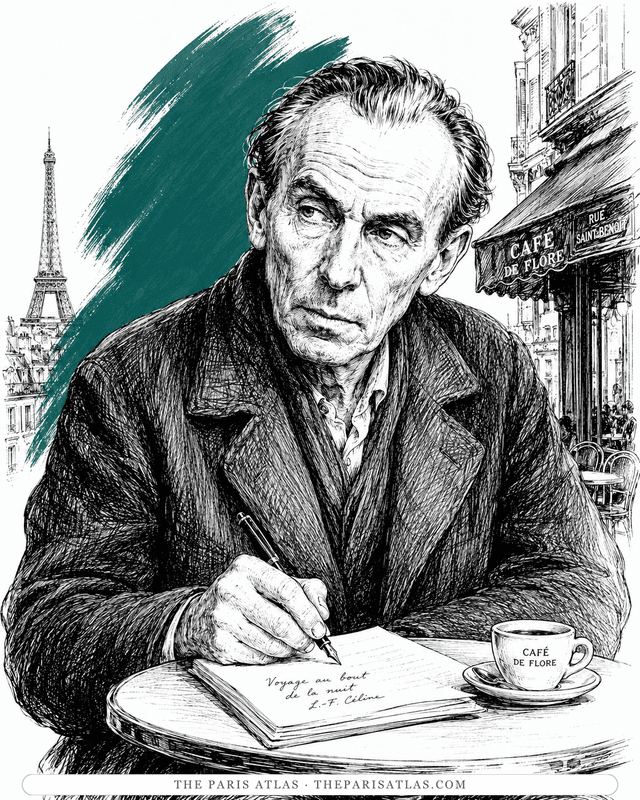
Miller's acknowledged master at making literature out of the gutter. Journey gave him permission; Cancer is what he did with it.
View author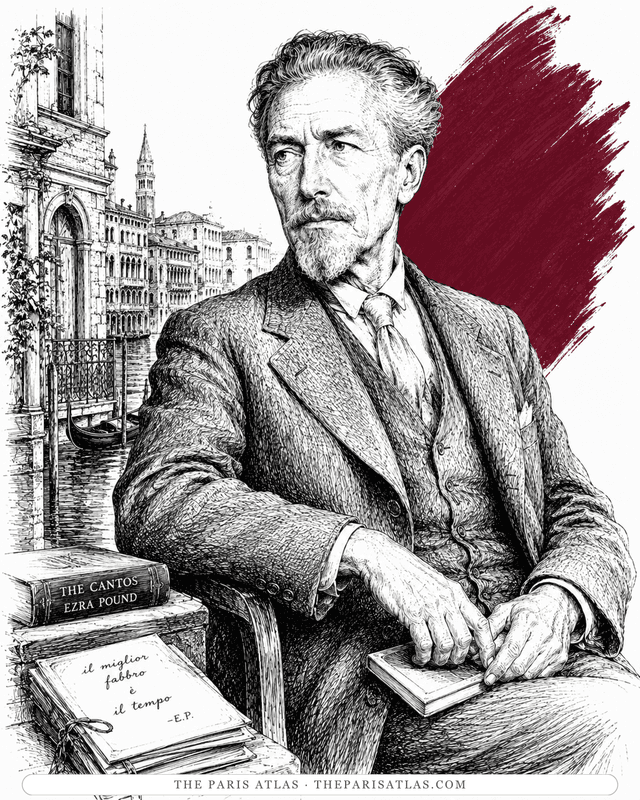
Pound read Cancer and sent Miller a famously backhanded postcard. Both believed literature's job was to wake the reader by any means necessary.
View author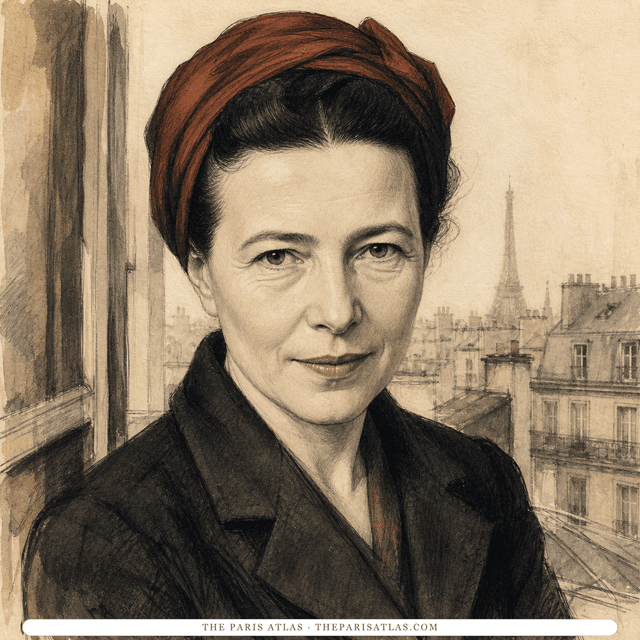
French writer and philosopher whose novels, memoirs, and social analysis examined freedom, gender, responsibility, aging, and the material conditions that shape a life.
View authorThe sources below include the primary text, editions, scholarship, archival materials, and other records that informed this page. They document Scenario, its publication, and its place in literary history.


The primary text represented by this page, used for descriptions of the work’s contents and for any quoted passages shown here.
Used for the primary mirror passage quoted on thesis page 63. The reading does not claim access to the complete Scenario text or adopt all of the thesis's interpretations.
Used for Nin's attributed response and the reproduced prefatory acknowledgment. This is evidence of reception and attribution, not verification of every detail in the retained illustrations.

Archival evidence used to document the historical record connected to Scenario.
Used for the relationship between Miller’s scenario and Nin’s House of Incest and for the Villa Seurat context.
Used as an independent account of the Nin–Miller collaboration and the work’s origins.
Used to place the pamphlet within Miller’s 1930s Paris chronology and bibliography.
The primary text is the baseline reference for every book page. Additional references document publication history, interpretation, and historical context where that evidence is available.
 Explore more resources