Diarist of the century — sixty years of the most famous journal in modern literature, Henry Miller's first champion, and, posthumously, the best-selling erotic writer of her age.
Hugh Parker Guiler · 1923–1977Rupert Pole · 1955–1966, annulled
Roles
AuthorCriticPublisherPrinter
Also known as
Angela Anaïs Juana Antolina Rosa Edelmira Nin y Culmell
About Anaïs Nin
Anaïs Nin spent nearly her entire life turning experience into literature—and then reshaping that literature until the boundary between the woman and the character almost disappeared.
She began her diary at eleven, on a ship carrying her abandoned family from Europe to America, and kept it for more than sixty years: through marriage, 1930s Paris, psychoanalysis, war, decades of literary obscurity, overlapping love affairs, two simultaneous marriages, and an unexpected arrival at fame in her sixties.[1]
The diary became one of the longest sustained self-portraits in modern literature. It was also something less straightforward than a record. Nin revised events, removed people, protected secrets, and transformed the lives around her into stories. She wanted to tell the truth about her interior life, but she also believed identity could be created through writing.
The result was not one Anaïs Nin, but many: the abandoned daughter, the banker's wife, the patron who paid Henry Miller's rent, the experimental novelist, the hand-printer of rejected books, the keeper of several households, and the celebrated diarist whose readers often knew less about her than they believed.
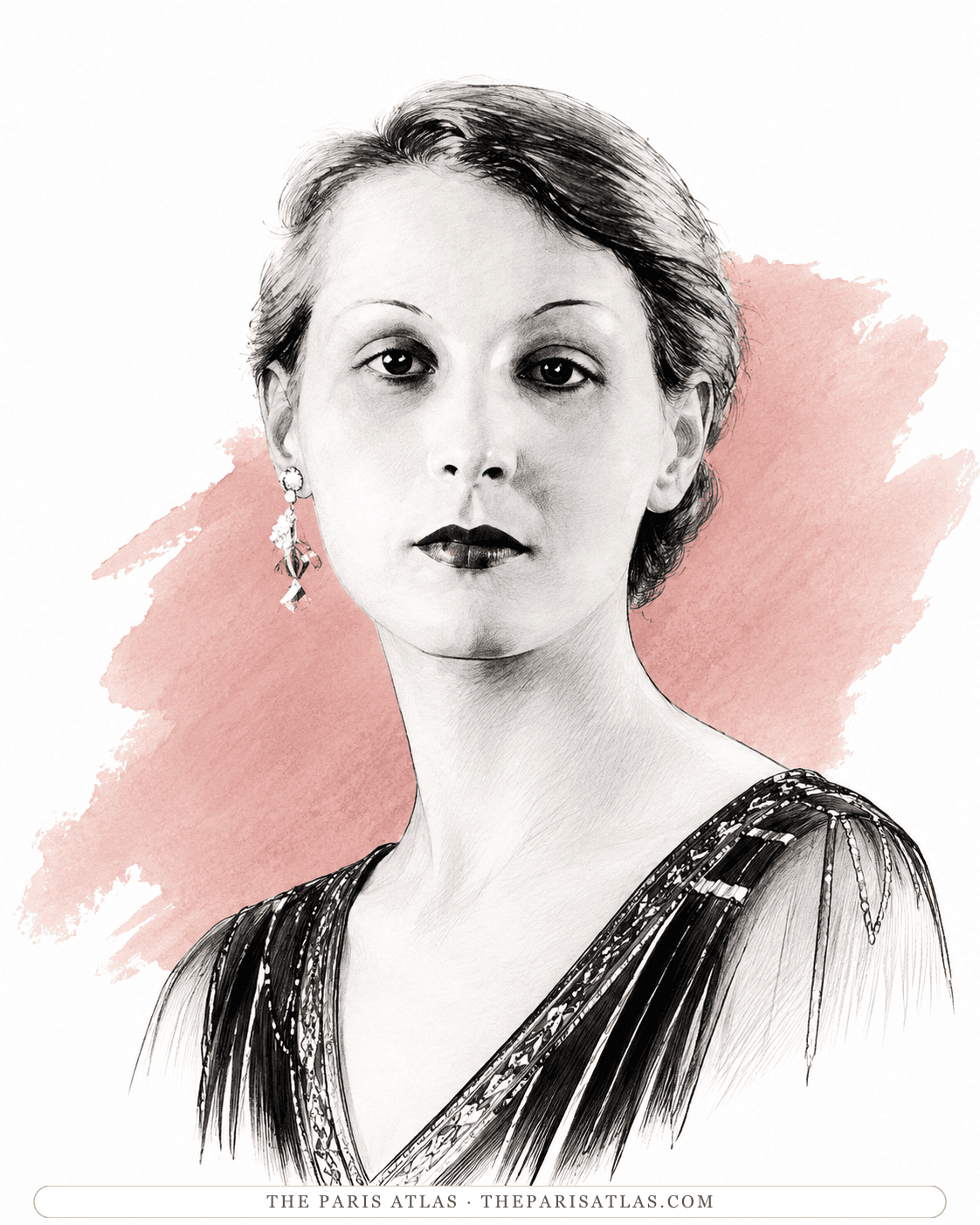
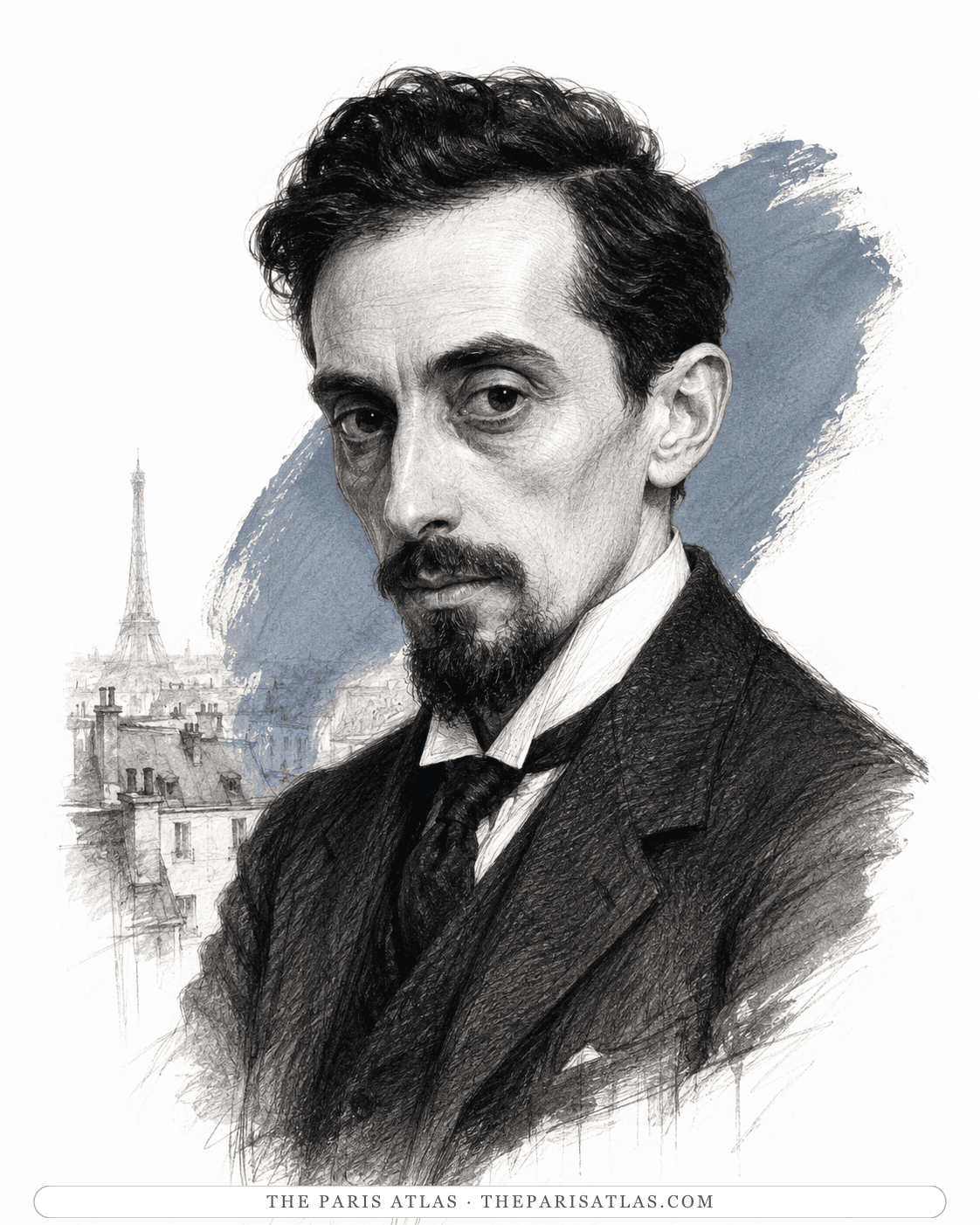
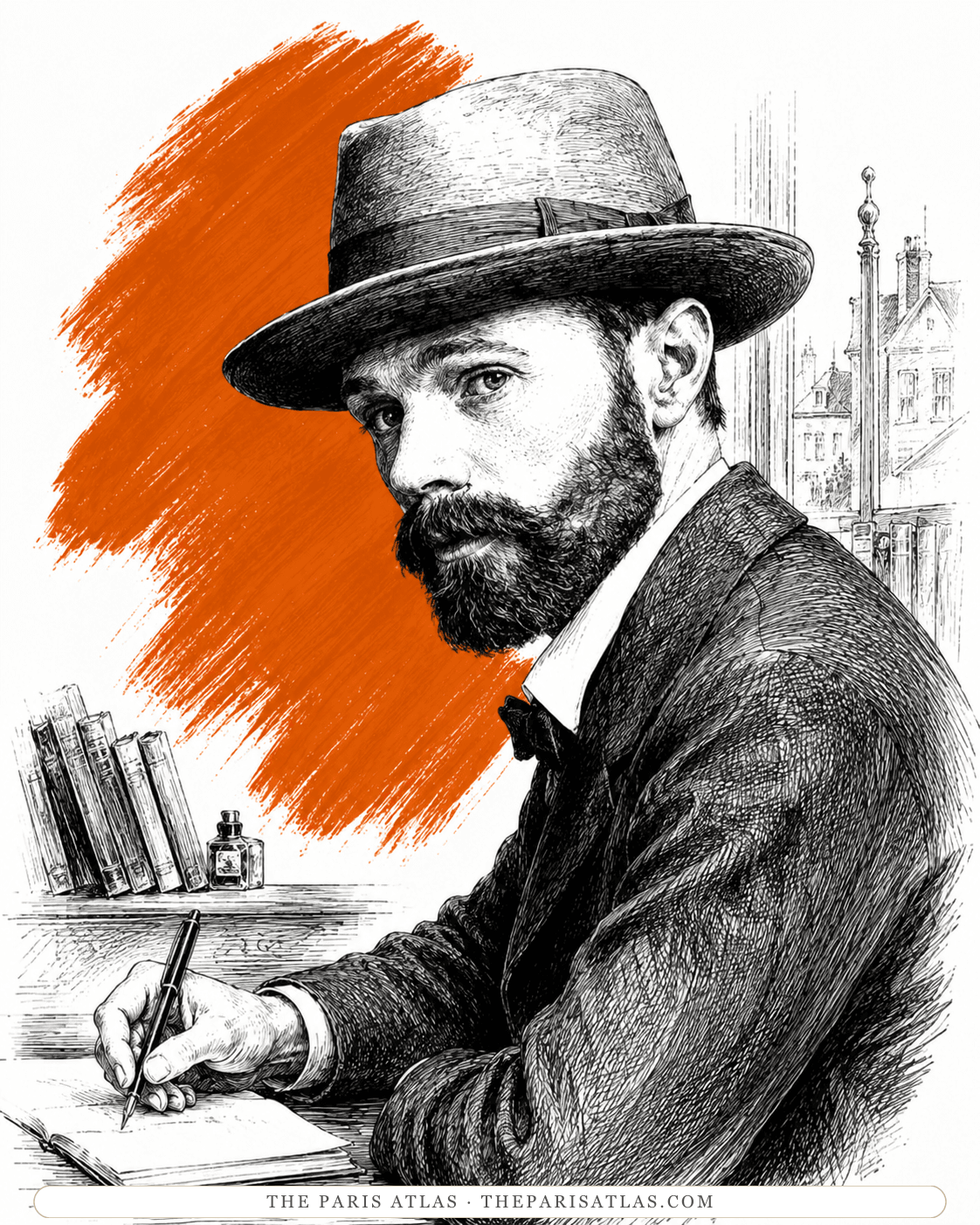
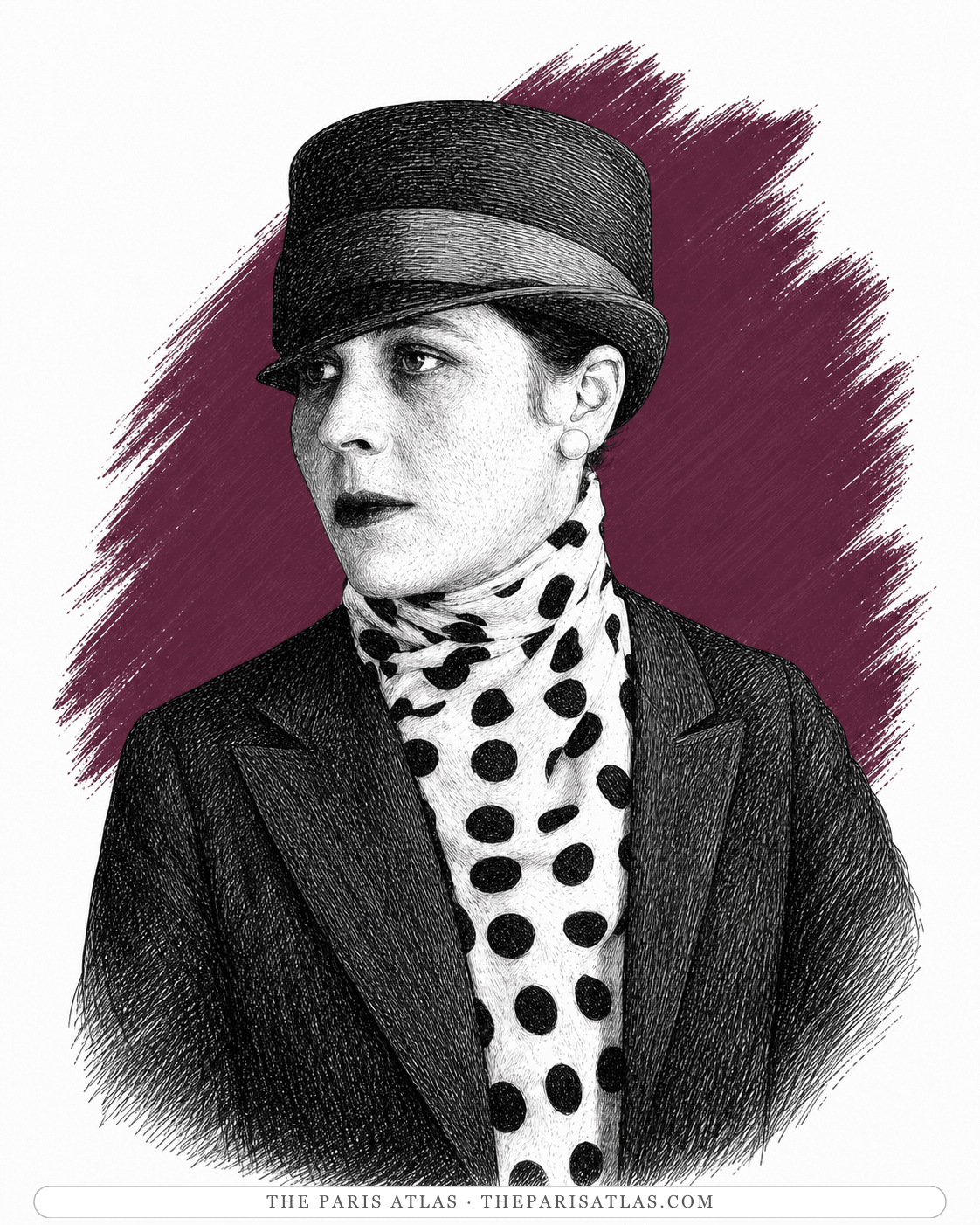
Anaïs Nin, illustrated
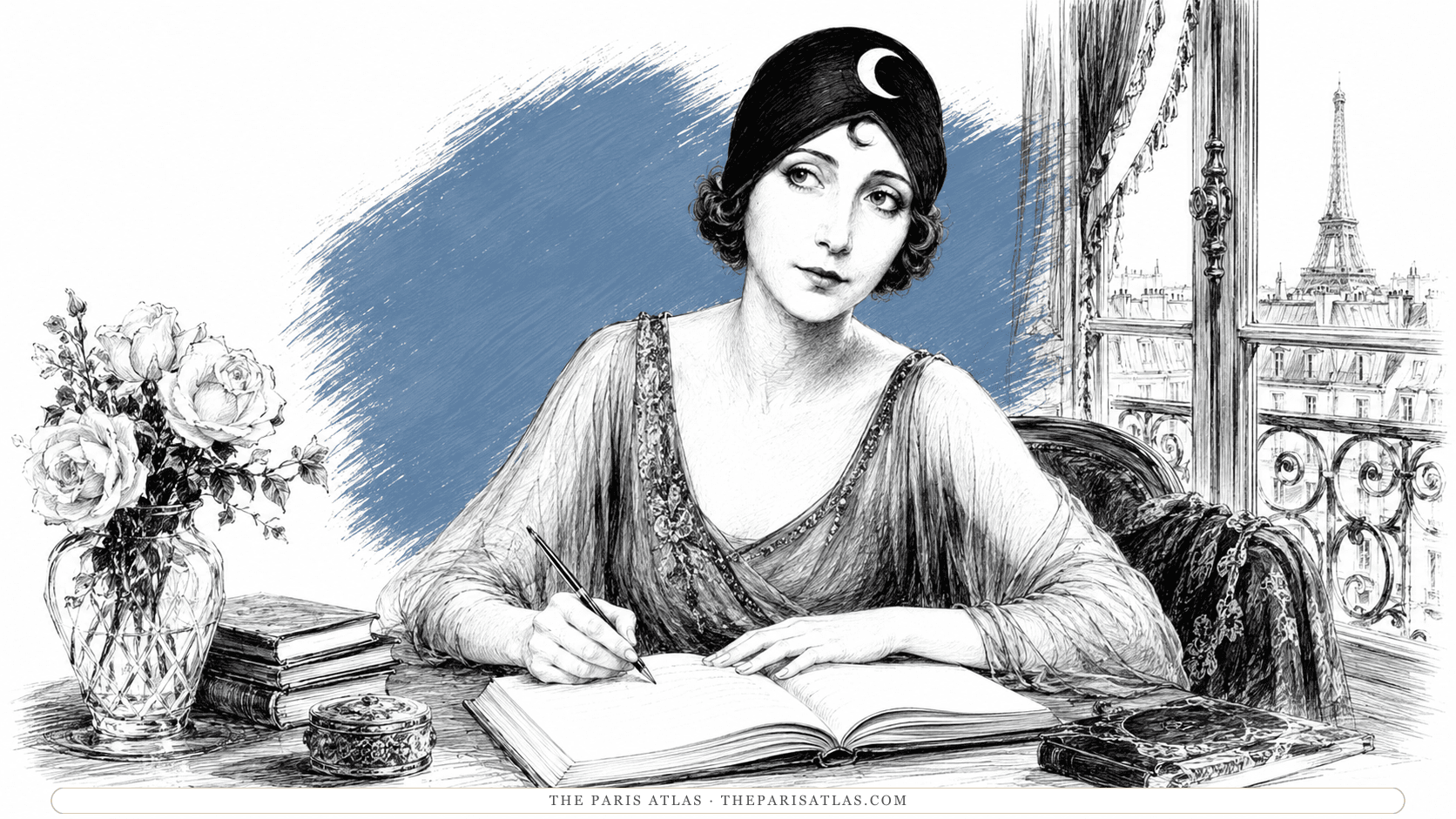
A few drawn scenes from Nin's life — illustrations, not photographs.
A young Anaïs Nin in Paris.Anaïs Nin dancing flamenco.Anaïs Nin writing on the divan.Anaïs Nin with a companion at a café.Anaïs Nin at a Paris window.Anaïs Nin in a shawl.
Illustrations — The Paris Atlas
Why Anaïs Nin still fascinates us
Anaïs Nin occupies a peculiar position in literary history. Many people recognize her name without knowing exactly what she wrote. Some encounter her through the diaries, others through Henry & June or Delta of Venus, and still others through quotations detached from their original sources. She is remembered as a symbol of artistic freedom, female desire, bohemian Paris, confession, secrecy, and self-invention—sometimes all at once.
Her life seems designed to invite curiosity. She helped finance Henry Miller before the literary establishment took him seriously. She was fascinated by his wife, June Miller, and transformed their volatile triangle into literature. She entered psychoanalysis, briefly worked with patients herself, and turned the language of dreams into a fictional method. When publishers rejected her books, she bought a printing press and produced them by hand. Later, while maintaining one marriage in New York, she constructed another domestic life in California.
Yet the scandalous episodes are only part of the reason she remains compelling. Nin anticipated many of the questions that now dominate memoir and autobiographical fiction:
How honestly can anyone write about a life involving other people?
Does emotional truth matter when the factual account has been altered?
Can a diary remain private once its writer begins imagining future readers?
Is self-revelation a form of courage, performance, manipulation—or some combination of all three?
She was also a woman who treated the interior life as a serious artistic subject at a time when it was often dismissed as minor, private, or self-indulgent. Her books made dreams, fantasies, shifting identities, emotional dependence, and the hidden negotiations of relationships central to literature.
That is why her work continues to feel unusually modern. Today's culture is filled with carefully constructed public identities presented as intimate truth, and Nin understood that contradiction long before the language of personal branding, autofiction, or curated lives existed. Her diary promised access to the private self. What it revealed instead was that privacy could also be staged.
The girl who began a letter and never stopped
Angela Anaïs Juana Antolina Rosa Edelmira Nin y Culmell was born on 21 February 1903 in Neuilly-sur-Seine, just outside Paris. Her father, Joaquín Nin, was a Cuban pianist and composer. Her mother, Rosa Culmell, was a classically trained singer, Cuban-born, of Danish and French descent. Music, performance, travel, and artistic ambition surrounded her from the beginning.[1]
Her father's departure fractured that world. In 1914 Rosa Culmell took Anaïs and her two younger brothers to the United States. During the voyage to New York, eleven-year-old Anaïs began writing a long letter to the father who had left them.[2]
The letter became a diary. Her father did not return, but she never truly stopped writing to the absence he had created.
Anaïs Nin at her diary. (Illustration — The Paris Atlas)
The diary became a confidante, rehearsal room, memory archive, and place of refuge. Before Nin became a novelist, critic, publisher, or public figure, she became the attentive observer of her own existence. She learned to watch not only what happened, but how an event changed when remembered and put into words.[1]
She had been born in France to Cuban parents and spent parts of her childhood in several countries. The diary itself changed language along the way: she began it in French and switched to English around the age of seventeen, making the last language she learned the working instrument of her literary life. She never belonged neatly to one place or one national tradition, and that displacement helped shape a writer preoccupied with divided identities, doubles, masks, secret rooms, and the possibility that one person might contain several lives.[2]
Becoming Anaïs
In 1923 Nin married Hugh Parker Guiler, an American banker she had met in New York. They married in Havana and moved to France soon afterwards.[1]
Guiler provided much of the stability that made Nin's early literary life possible, but he was not simply a conventional husband standing outside her artistic world. Under the name Ian Hugo, he became an engraver and experimental filmmaker. He illustrated several of her books and collaborated on films connected to the dreamlike imagery of her writing.
Nin was still searching for her form. She read voraciously, studied dance, worked as a fashion and artists' model, filled her diary, and resisted the identity of a banker's decorative young wife. She wanted to become a writer, although she had no university position, no literary reputation, and no obvious path into publishing.[2]
In D. H. Lawrence she found a writer who treated instinct, the body, psychological conflict, and emotional intensity as serious literary subjects. Her first published book, D. H. Lawrence: An Unprofessional Study, appeared in 1932. The title announced both humility and defiance: Nin had no formal critical credentials, but she believed a reader's emotional recognition could reveal something professional scholarship missed. She distrusted systems that separated intellect from intuition, and she wanted a form of literature capable of recording sensations before they hardened into explanations.
Paris: the door opens
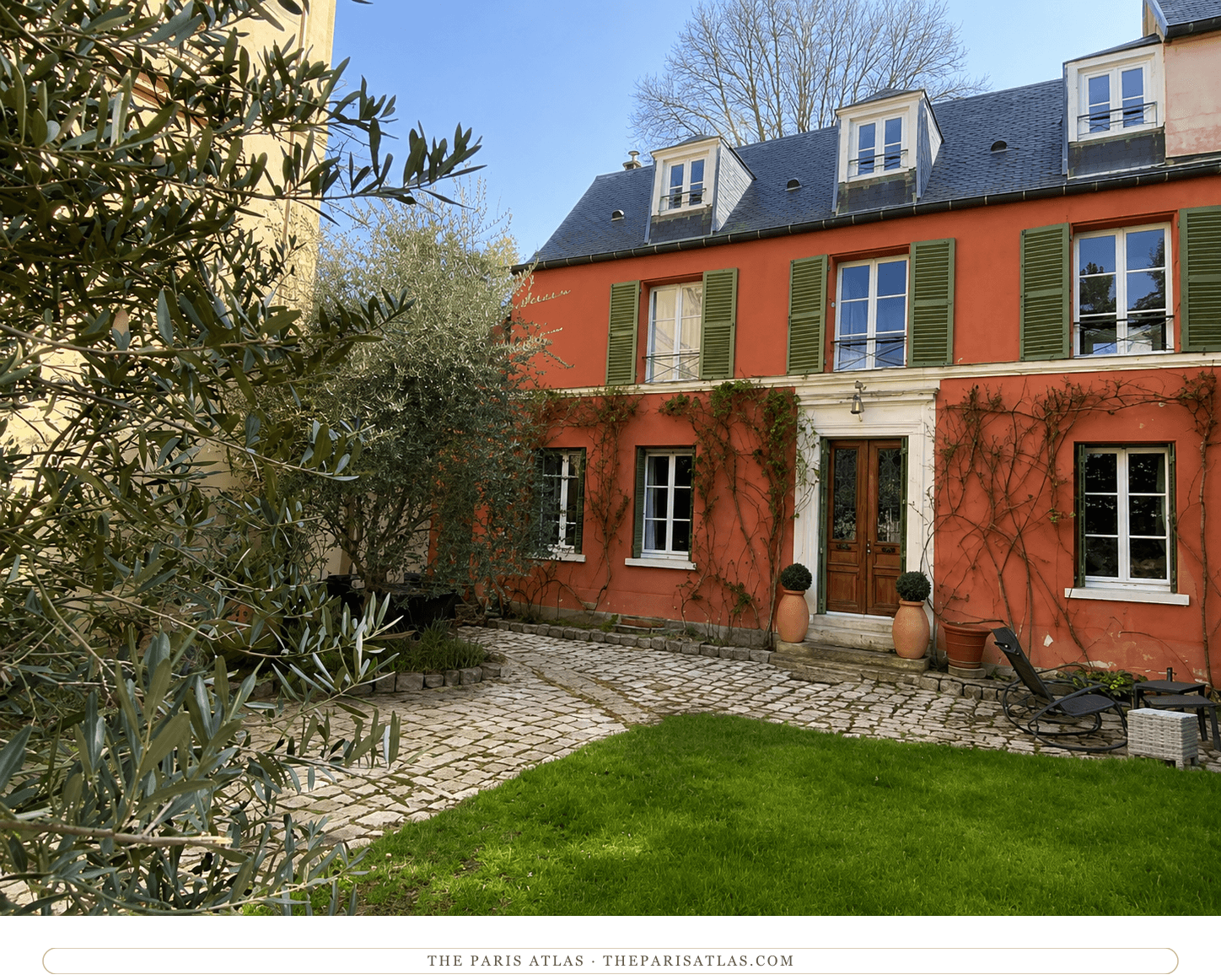
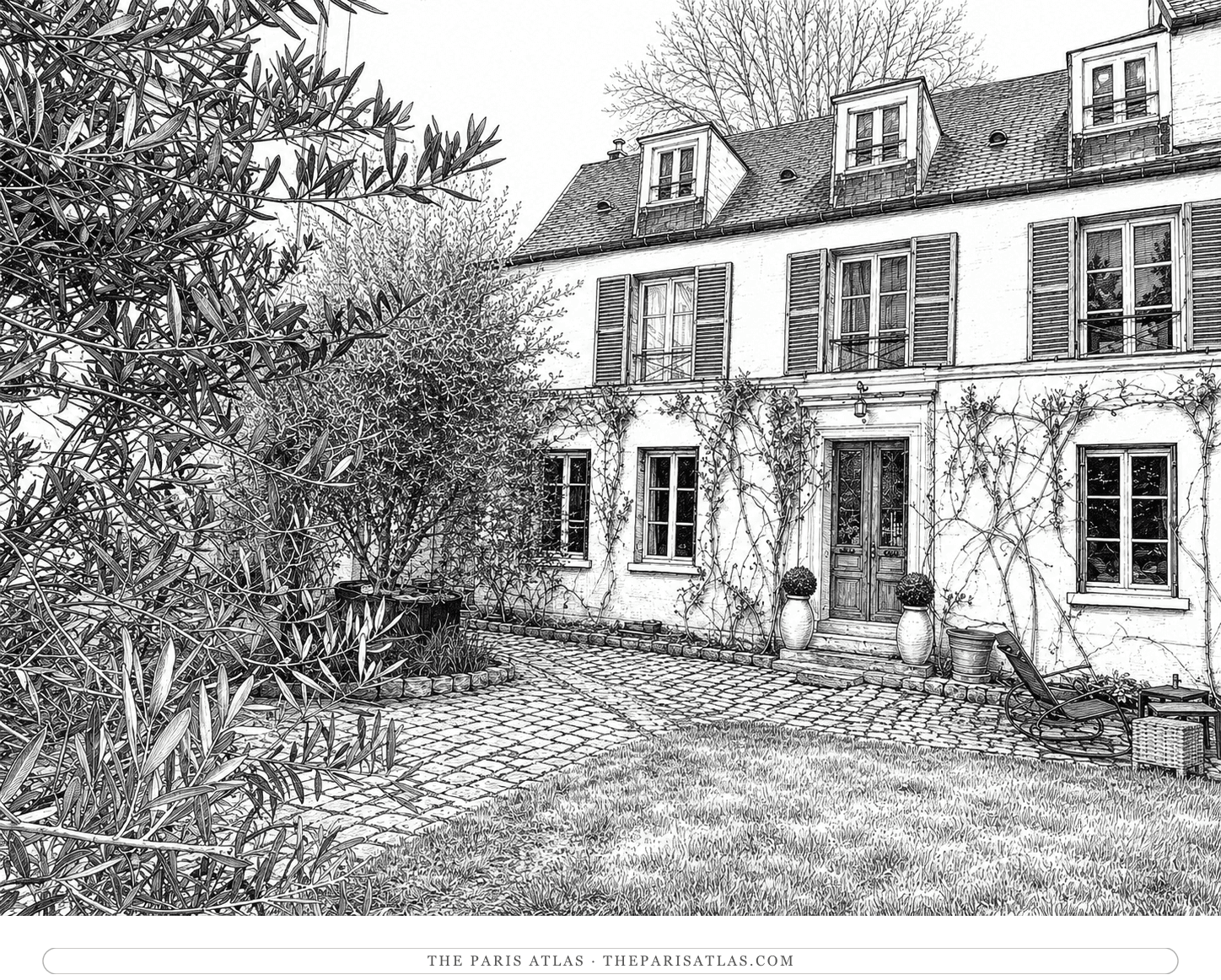
By 1929 Nin and Guiler had settled at 2 bis rue de Montbuisson in Louveciennes, west of Paris. The old house offered distance from the city without complete separation from it. Paris remained close enough for cafés, publishers, theatres, analysts, and artists' studios, while Louveciennes gave Nin a private stage on which to assemble the literary life she had imagined. The house is still there. It is private, and it is the address the published diary opens on.[1]
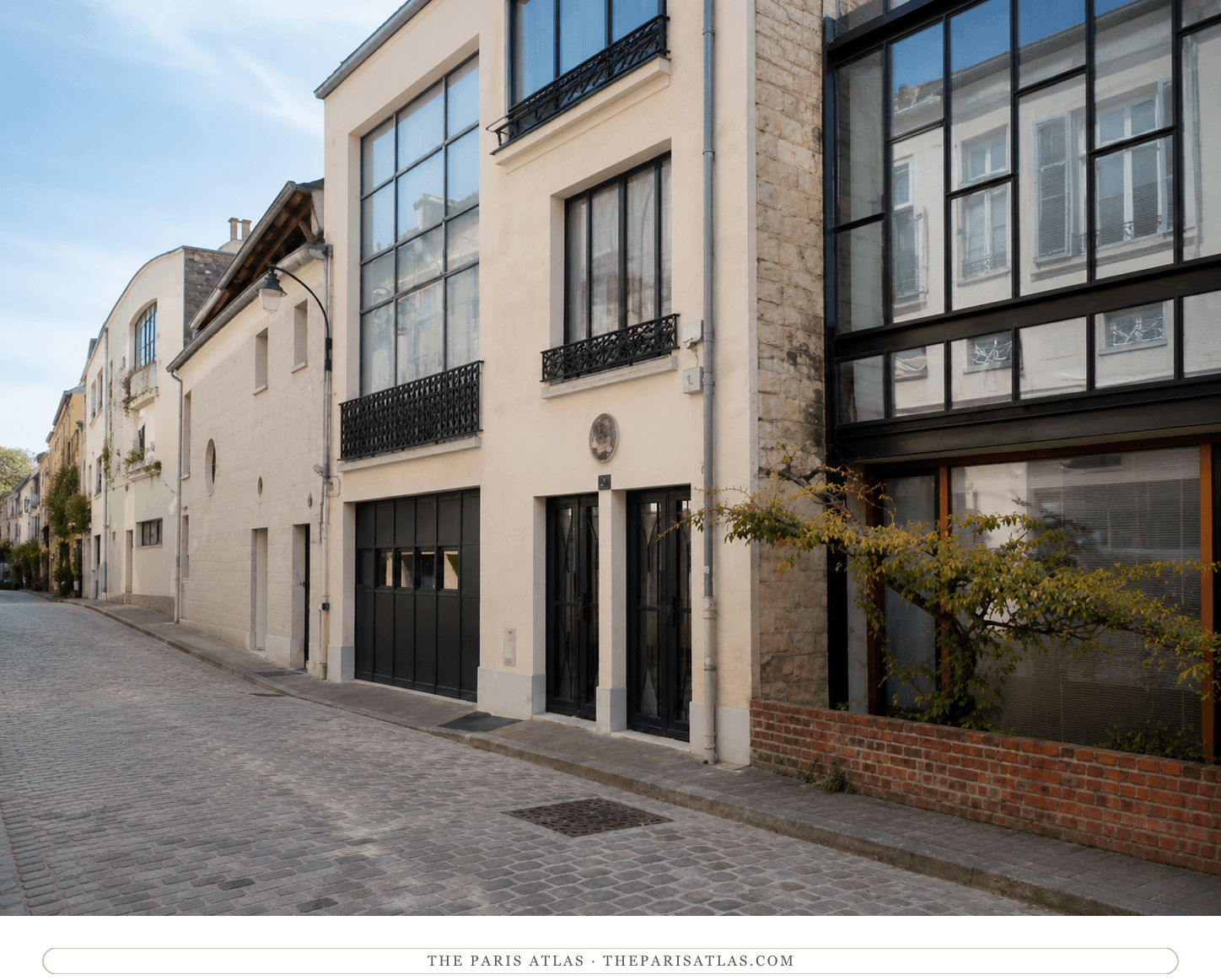
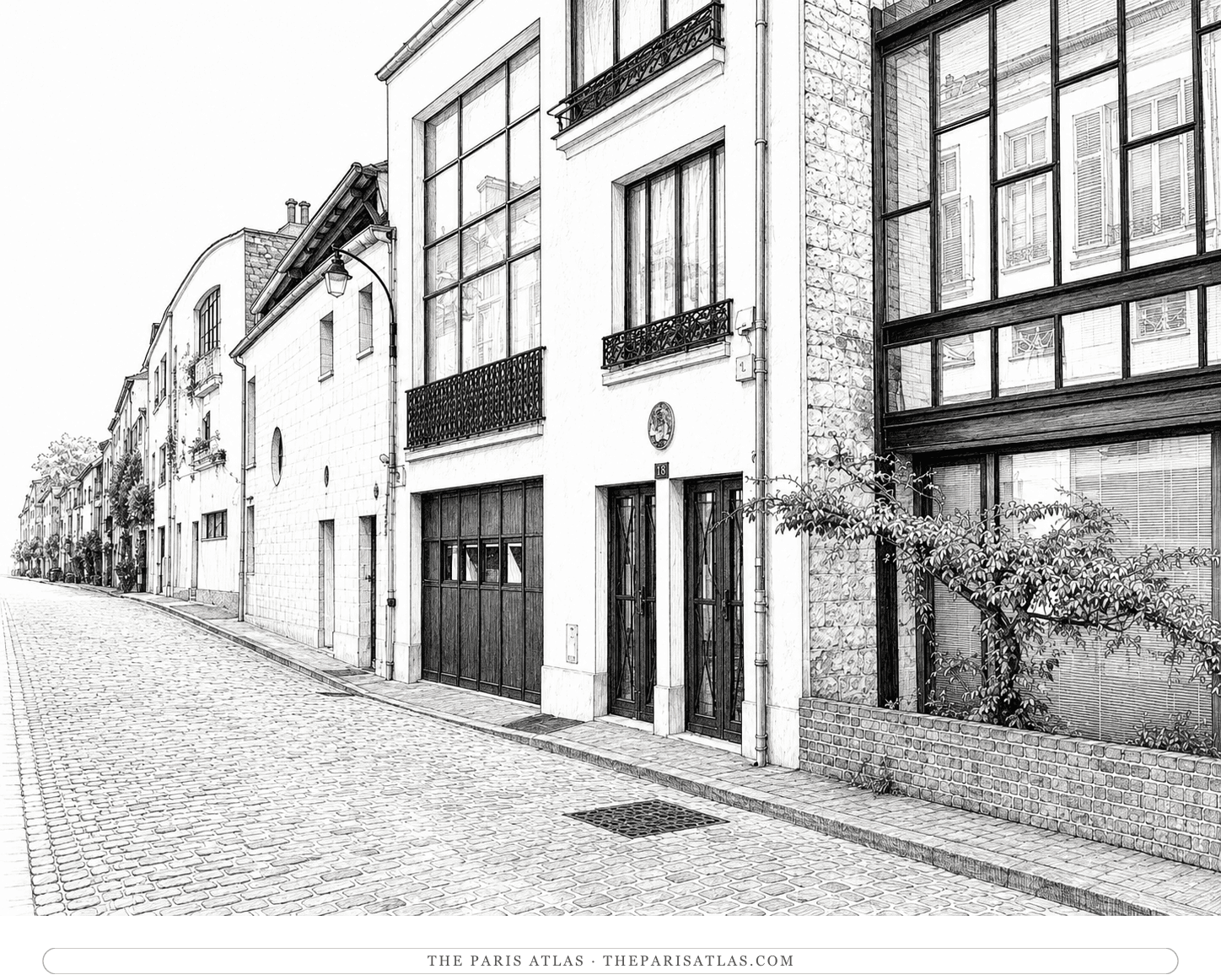
2 bis rue de Montbuisson in 2019. The plaque on the wall beside the smaller door records that Anaïs Nin lived here from 1931 to 1935. (Wolrfam, Wikimedia Commons · CC BY-SA 4.0)
The house became a meeting place. Writers arrived for meals, arguments, manuscripts, introductions, money, and encouragement. Nin listened with unusual intensity. She studied people, supported them, and carried versions of them into her diary. Her hospitality was genuine, but it was also literary: everyone who entered her world risked becoming material.
Nin sat for a painted portrait in these years. The artist was Natashia Troubetskoia, about whom the Smithsonian's National Portrait Gallery can say only "active c. 1932". The canvas is oil, and it is nearly two metres tall. It then disappeared for fifty years, surfacing around 1983 at an antiques fair at Île de Chatou, west of Paris, in what had become a White Russian enclave. A Paris gallery sold it to the Portrait Gallery in 2003. It is not currently on view.
Anaïs Nin at a café. (Illustration — The Paris Atlas)
Louveciennes was where the sheltered young wife began turning herself into the Anaïs Nin later readers would recognize. Paris gave her proximity to the artistic underground; the house gave her a place from which to participate in it. The transformation did not happen quietly. It arrived during the winter of 1931, in the form of an impoverished American writer named Henry Miller.
Henry, June, and the Paris years
Henry Miller had little money and no secure literary reputation when he entered Nin's life, but she immediately recognized the energy of his writing. His prose was undisciplined, comic, furious, and alive in ways she found liberating. Miller, in turn, responded to Nin as a reader and writer rather than merely as a patron's wife. Their friendship became an artistic alliance and then an affair.[2]
Nin did more than praise him. When publishers would not take Tropic of Cancer, she helped find the money that allowed Jack Kahane's Obelisk Press to publish it in 1934. She also wrote the book's original preface. Before Miller became a celebrated literary outlaw, Nin was among his most determined believers.[2]
June Miller, Henry Miller's wife, appeared to Nin as elusive, theatrical, wounded, magnetic, and impossible to possess. Nin was drawn not only to June herself but also to the stories surrounding her. Henry described one June, June performed another, and Nin invented still another in her diary. Her account of those months was published decades later as Henry & June.[2]
Anaïs Nin in conversation at a café. (Illustration — The Paris Atlas)
The triangle's importance reaches beyond literary gossip. Henry Miller encouraged Nin to abandon excessive control and allow more disorder into her prose. June Miller showed her the power of performance, ambiguity, and reinvention. Between them, Nin began to understand that a human being could be both a real person and a character produced by the desires of everyone watching.
Their lives and books began reflecting one another. Conversations entered manuscripts. Manuscripts changed relationships. People encountered fictional versions of themselves and answered with stories of their own. The circle had an address as well: Nin paid the rent on 18 Villa Seurat, the studio where Miller worked from 1934, where Lawrence Durrell and Antonin Artaud passed through, and where her own Winter of Artifice appeared in the building's imprint in 1939.
Entering the labyrinth: dreams and psychoanalysis
Nin's relationships led her toward psychoanalysis, but analysis was never merely a treatment she underwent. It became a language for her fiction and a structure through which she interpreted her life. She entered analysis with René Allendy in 1932 and then with Otto Rank, a former member of Freud's circle who had developed his own ideas about creativity, separation, will, and psychological rebirth. Both analysts became personally involved with her. For several months in the mid-1930s she saw patients of Rank's in New York before dropping the idea of practicing as a therapist.
Psychoanalysis gave her a vocabulary of dreams, doubles, hidden motives, symbolic spaces, and buried memories. It helped shape books that often feel less like conventional novels than rooms inside a psychological house. Time bends, identities dissolve, and an image may carry more importance than an event.
It also blurred dangerous boundaries. Analysts became emotionally entangled with patients. Lovers became interpreters. Experience was sometimes pursued as if it were an experiment that could later be transformed into art.
The unexpurgated diaries published after her death restored material cut from the editions that appeared in her lifetime. The passage Nin herself called the Father Story, describing a sexual relationship with Joaquín Nin after they were reunited in adulthood, appeared in Incest: The Unexpurgated Diary of Anaïs Nin, 1932–1934. Because the surviving narrative comes through Nin's own diary—a form in which memory, fantasy, trauma, confession, and literary construction repeatedly overlap—it should be understood specifically as Nin's account, rather than as an independently witnessed record. It is central to the arguments about her work, her self-mythology, and how literally the diaries should be taken.[2]
Anaïs Nin's relationship with her father
Joaquín Nin was a Cuban pianist and composer with a serious European career. In 1913 he left the family at Arcachon, on the French Atlantic coast, and went off with one of his students, leaving his wife and three children with very little. Anaïs was ten. Her mother took them to Barcelona, and in 1914 to New York.[2]
The diary began as a consequence. On the crossing she started a letter meant to bring him back, and when he did not come back she kept writing it. The most famous journal in modern literature started as a child's attempt to argue her father home.[1]
What happened before he left is harder to state cleanly, and the biographers disagree. Deirdre Bair's 1995 biography describes a father who abused his children. Noël Riley Fitch characterises what Anaïs suffered as childhood sexual abuse. The physical evidence everyone argues from is a set of photographs: Joaquín photographed his daughter nude as a small child, and she pasted one of them into her first diary. Some read that as evidence of what he was. Others note that nude photographs of children were an ordinary convention of the period and establish nothing on their own. The disagreement is real and unresolved.[2]
They were out of each other's lives for the better part of twenty years. In the summer of 1933 they spent a holiday together at Valescure, in the south of France. Nin was thirty. What happened there was a sexual relationship between father and daughter, and it ran for about three months before she ended it. She was in analysis at the time, with René Allendy and then Otto Rank, and by several accounts the ending was planned in that room: leave him, as he had left her. How much of that was analysis and how much was the story she preferred afterwards is not settled either.[2]
She wrote it down as she wrote everything down, in a sequence she called the Father Story. It was cut from the diary published in her lifetime and did not appear until 1992, fifteen years after her death, in Incest: From a Journal of Love. She had already used the material once, transformed, in Winter of Artifice in 1939, where the father is a musician and the daughter meets him again as an adult.[2]
The account is Nin's own, written in a diary she revised for decades, and nothing outside it witnesses those days. How literally to read it is the central argument about her work. Her letters to her father and his to her were found in her Los Angeles house in 2006 and published in 2020 as Reunited: The Correspondence of Anaïs and Joaquín Nin, 1933–1940. They show the two corresponding until 1940 and settle nothing about Valescure. Joaquín Nin died in Havana in 1949.
1934, and the story she made of it
Nin was pregnant through the summer of 1934. The labor came at the end of August, at roughly six months, and the daughter was delivered dead. Nin was thirty-one, living at Louveciennes, and deep in the Rank years.[2]
The two published versions of the diary tell it differently, and the gap between them is the argument about Nin in miniature. The volume that appeared in 1966 presents a stillbirth, something that happened to her. The unexpurgated Incest, published in 1992, makes clear the labor was induced and that ending the pregnancy was her decision. That diary names Henry Miller as the father, though the account is Nin's own and nothing outside it settles the question.[2]
She wrote the entry within days of the event. Ten years later she cut a story out of it, 'Birth', and put it in Under a Glass Bell, where it is the collection's hardest and most direct piece of writing. The sequence is the whole method laid bare: the event, the entry made close to it, the fiction cut from the entry, and then a fourth version, softened, offered to readers in 1966 who had no way of holding the four side by side.
The strange, beautiful books no one knew how to sell
Today, Nin's diary overshadows nearly everything else she wrote. During most of her career, however, she wanted to be recognized primarily as a writer of fiction.
Her stories and novels do not behave like conventional narratives. Events are often less important than atmosphere. Characters divide into doubles, move through symbolic landscapes, and struggle to distinguish the identities they perform from the selves they conceal. Dreams interrupt reality without warning, and time bends around memory and emotion.
House of Incest, published in 1936, is one of the most concentrated examples of this method: brief, surreal, claustrophobic, and closer to a prose poem than a traditional novel. In Under a Glass Bell, enclosed spaces become images of emotional captivity. The interconnected novels later gathered as Cities of the Interior follow women attempting to escape the roles imposed upon them while remaining divided by their own competing desires. A Spy in the House of Love gives that division one of its clearest forms through Sabina, a character attempting to sustain several romantic identities at once. Their importance here lies in what they reveal about the direction of her career.[1]
Across her fiction, she repeatedly returns to one question: can a person live several lives without losing the ability to know which one is real? Nin was asking that question in fiction long before the full extent of her divided private life became public. Her novels can therefore feel less like inventions than rehearsals.
When publishers said no, she became the publisher
Nin's experimental writing was difficult to sell. When the established literary world declined to make room for her, she began producing the books herself.
She published House of Incest in Paris under Siana Editions, a name formed by reversing 'Anaïs'. After leaving France during the Second World War, she acquired a printing press in New York and produced books under the Gemor Press imprint, named for Gonzalo Moré.[1]
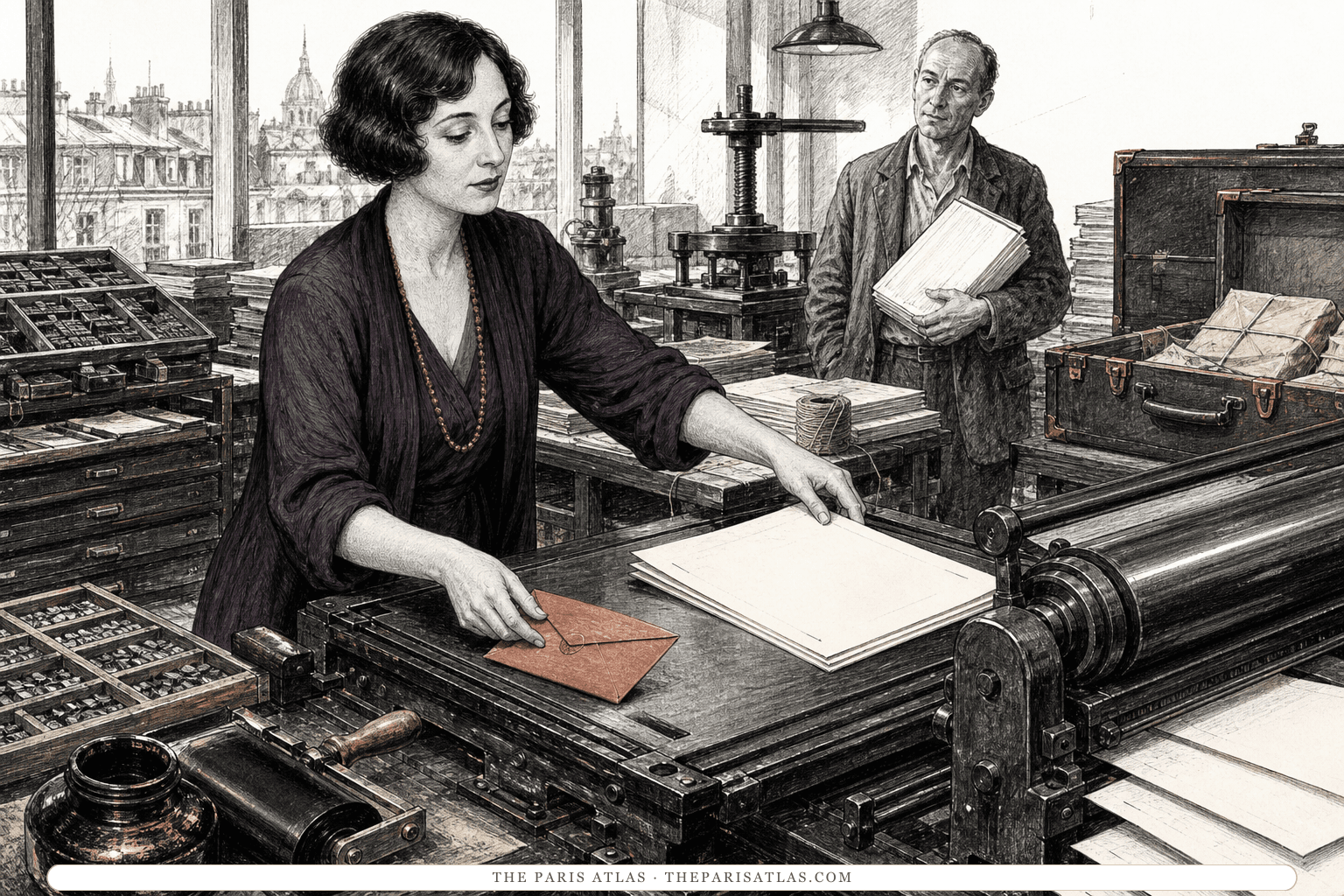
This was not self-publishing in the effortless modern sense. It required machinery, paper, ink, typesetting, binding, physical labor, small print runs, and the constant problem of finding money. Nin and Moré ran the press in Greenwich Village; she taught herself to set type and spent hours at a treadle press, doing most of the physical work. Guiler, working as Ian Hugo, created engravings for several editions, and Frances Steloff of the Gotham Book Mart helped get the finished books distributed. Publication became an object she could physically manufacture rather than an abstract ambition.
Anaïs Nin at her printing press. (Illustration — The Paris Atlas)
When Under a Glass Bell appeared through Gemor Press in 1944, Edmund Wilson reviewed it favorably in The New Yorker, offering one of the first substantial indications that her writing might find an audience. The image of Nin as an elegant diarist surrounded by perfume, silk, and candlelight has survived more easily than the image of her working around heavy printing equipment. Yet the printer is essential to understanding her. She was not passively waiting to be discovered. She was manufacturing the evidence of her own existence as a writer.[2]
The stories written for a mysterious collector
During the financially difficult New York years, Nin became involved in one of the strangest episodes of her writing career. An anonymous private collector commissioned erotic stories and paid the writers by the page. Nin, Miller, and others contributed. The collector wanted directness rather than atmosphere and repeatedly discouraged the writers from becoming too poetic or psychological. The rate was a dollar a page, the work reached Nin through Miller when he needed money, and in her introduction to the collected stories she said she was never certain the client existed at all.[2]
Nin found the instructions restrictive. Yet the commission forced her to confront a larger literary problem: most existing models of erotic writing had been constructed around male fantasy. What might such stories become when a woman attempted to describe desire from within a woman's consciousness?
The resulting pieces were not published under Nin's name until much later. Delta of Venus appeared in 1977, after her death, and Little Birds followed in 1979. The collections became among the most commercially successful and recognizable parts of her work. Their popularity also created another distortion in her reputation. A writer who had struggled for decades to be recognized for experimental and psychological fiction became known to many readers principally through stories she had originally produced for money under another person's instructions. The mysterious collector achieved something Nin's early publishers had not: he paid her regularly to write. But he also misunderstood what she most wanted to contribute—the emotional complexity behind the encounter.[1]
New York, war, and the long years of obscurity
As Europe moved toward war, Nin and Guiler returned to New York. Paris had offered distance from her American upbringing and the intoxicating feeling of belonging to a literary underground. New York forced her to confront the practical problem of sustaining that identity. She wrote, printed, promoted books, appeared in experimental films, maintained relationships with artists, and continued expanding the diary.[1]
The diary itself eventually changed physically. From 1946, instead of remaining only a sequence of conventional bound journals, portions became collections of loose pages mixed with correspondence, photographs, notes, and other records. It was becoming less like a notebook and more like a private archive assembled during the act of living.[3]
Nin at daliel's in Berkeley in 1946, with the bookseller and publisher George Leite. The obscurity was real, but it was never total: Leite's shop published the magazine Circle and drew a small, committed audience for exactly the writers New York publishers would not take. (George Leite archive, released by Daliel Leite via Wikimedia Commons · CC BY-SA 3.0)
Recognition came in fragments. Certain critics championed her, and a devoted readership formed around the fiction, but mainstream success remained elusive. The delay matters. Nin's eventual fame can seem inevitable when viewed backward, yet she spent much of her adult life fearing that the work she considered revolutionary might disappear. She continued anyway. That persistence is one of the least glamorous and most impressive facts about her career.
Two coasts, two husbands, several versions of the truth
In 1947, Nin met Rupert Pole in a Manhattan elevator on her way to a party. He was sixteen years younger than she was and believed she was free to build a life with him. In reality, Nin remained married to Guiler.[2]
On 17 March 1955, she married Pole at Quartzsite, Arizona, without ending her first marriage. She then divided herself between Guiler in New York and Pole in California, constructing separate explanations, calendars, records, and identities. Nin described the arrangement through the image of a trapeze: movement between two lives, with disaster always possible in the space between them. The unexpurgated diary covering those years was published under that title.[2]
Her handbag held two checkbooks, one printed Anaïs Guiler and one Anaïs Pole, and prescription bottles from doctors on both coasts in both names. It also held a file of index cards she called the lie box. Every lie went on a card with its date. When a box filled up she locked the cards away and started another.[2]
Her marriage to Pole was annulled in 1966, after both husbands claimed her as a dependent on their federal tax returns and the legal risk became increasingly difficult to contain, but their relationship continued. Guiler remained an essential presence in her life, as did Pole, who outlived her by nearly thirty years and eventually oversaw publication of the unexpurgated diaries.[2]
The arrangement cannot be reduced to an amusing story about an unconventional artist. It required sustained deception and depended on the trust, care, money, and emotional labor of two men who were not initially given a truthful picture of the lives they were sharing.
At the same time, the double life provides an unsettling key to Nin's fiction. Her divided heroines were not merely abstract symbols. She understood the exhilaration of multiplicity and its administrative absurdity: maintaining stories, remembering what had been said, arranging travel, protecting documents, and fearing the moment when separate worlds might collide. The writer who sought completeness through multiple selves discovered that every additional self produced another set of secrets.
The diary becomes the masterpiece
For decades, the diary had been the source from which Nin drew characters, images, conversations, and emotional material. Gradually, she began to recognize that it might not be merely preparation for her 'real' books. It might be the central book itself.
Publishing it presented an obvious problem. The diary contained affairs, betrayals, private conversations, family conflicts, and descriptions of people who were still alive. Nin and editor Gunther Stuhlmann shaped a version that removed or disguised much of this material. Guiler, despite his enormous importance to her life and work, was largely absent from the early published volumes. Other relationships were rearranged through selection and omission.
Harcourt, Brace published the first volume of The Diary of Anaïs Nin in 1966, when Nin was sixty-three. The response transformed her career. Readers who had found the fiction difficult responded to the direct presence of the diarist: a woman treating creativity, dreams, emotional conflict, work, identity, and self-invention as subjects of enormous consequence. The publication began a seven-volume sequence, running to 1980, and brought Nin the broad recognition her fiction had never achieved. The diary became her masterpiece in the public imagination—the trunk from which readers could trace nearly everything else she had written.[1]
Yet its apparent intimacy contained another performance. The published diary was carefully shaped. People had disappeared. Relationships had been altered through omission. Events were selected according to the identity Nin was prepared to reveal. After Guiler died in 1985, Rupert Pole oversaw the publication of unexpurgated diaries that restored much of what had been removed, among them Henry & June, Incest, Fire, Nearer the Moon, Mirages, and Trapeze. The result was not simply a more detailed version of the same life. It was a different Anaïs Nin: more contradictory, manipulative, vulnerable, daring, and ethically difficult than the figure many readers had first encountered.
Fame arrives at the end
Anaïs Nin in the 1970s, photographed by Elsa Dorfman during the decade the Diary made her famous. (Elsa Dorfman · CC BY 2.5)
The final decade of Nin's life brought lectures, interviews, public appearances, and letters from readers who believed her work had given them permission to examine their own interior lives. The obscure experimental novelist had become a cultural figure.[1]
She found a particularly responsive audience among younger readers and women searching for literary models of artistic independence. Yet her relationship to feminism was never simple. Some readers viewed her as a pioneer who treated female creativity and desire with unusual seriousness. Others objected that her supposed independence had often relied on male financial support and secrecy. The establishment came round late: the sixth volume of the Diary, edited by Gunther Stuhlmann, was a National Book Award finalist in 1977.
On 13 March 1967, Nin delivered a lecture titled 'The Novel of the Future' at the Library of Congress. She argued for literary forms capable of representing psychological reality rather than merely external action. Dreams, subjective time, nonlinear memory, and the hidden self were not decorative additions to fiction; for Nin, they were the unexplored territory toward which fiction needed to move. She expanded the lecture into a book of the same title in 1968.
She spent much of her later life in Los Angeles, where she belonged to an artistic world far removed from the Paris of Miller, June, and the Villa Seurat. She died of cervical cancer at Cedars-Sinai Medical Center on 14 January 1977, at the age of seventy-three, after several years of surgery and radiation.[1]
Her most commercially successful period was only beginning. Delta of Venus appeared later that year. Further collections and unexpurgated diaries followed. Each publication changed the public understanding of the woman who had written the original journal. Even after her death, Anaïs Nin continued revising herself in the eyes of her readers.[1]
What was Anaïs Nin actually trying to do?
The question that follows Nin everywhere is whether she was telling the truth. It may be too simple a question.
Nin recorded an immense amount of her life. She preserved conversations, letters, dreams, expenses, journeys, attractions, humiliations, rivalries, and ambitions. Few writers have left behind a self-portrait of comparable scale. But quantity does not produce neutrality. Nin revised the diary, removed people, protected certain relationships, exposed others, and wrote events through the emotional atmosphere of the moment. She sometimes recorded not simply what she had done, but what an action meant to her—or what she needed it to mean.
That does not make the diary worthless as evidence. It makes it literature. Almost everything we know about these years still comes from it, and reading it well means noticing where she shaped it.
Nin's great discovery was that the self is not a finished subject waiting to be described. It is shaped while being described. Every confession selects. Every memory arranges. Every secret divides the person who keeps it from the person visible to the world.
She began the diary hoping her words might restore the family she had lost. In the end, the diary could not restore a single, unbroken life. Instead, it preserved all the Anaïses she had become: abandoned daughter, banker's wife, Parisian patron, analyst's patient, printer, novelist, lover, secret spouse, celebrity, and aging writer still revising the story. Anaïs Nin did not leave behind one definitive version of herself. She left a hall of mirrors—and made the act of walking through it her life's work.
Related videos
A filmed interview found and restored decades later, recorded in the New York apartment Nin shared with Hugh Guiler. That flat is rarely seen; the house most often photographed is the Los Angeles one she kept with Rupert Pole. She speaks French, and the English subtitles are part of the picture. (The Anaïs Nin Foundation)Hampshire College invited Nin to speak at its second commencement, in 1972. She was sixty-nine, and six years past the first volume of the Diary. Her remarks in full, in English. (Hampshire College TV)
Life events
1903
Born at Neuilly-sur-Seine to Joaquín Nin, Cuban composer, and Rosa Culmell, singer.
1914
The diary begins — on the boat to New York, as a letter to the father who left.
1923
Marries the banker Hugh Parker Guiler in Havana; the couple moves to France.
— Anaïs Nin Papers — diary, March–September 1938
1920s
Returns to France a young wife; settles at Louveciennes, outside Paris, and writes a first book on D. H. Lawrence.
2 bis rue de Montbuisson, Louveciennes, in 2019. The pale green carriage gates open on the house Anaïs Nin rented west of Paris; the commemorative plaque is fixed to the wall beside the smaller door, next to the number. (Wolrfam, Wikimedia Commons)
1931
Henry Miller comes to dinner — the decade's most consequential literary entanglement begins.
1932
D. H. Lawrence: An Unprofessional Study is published in Paris; she begins analysis with René Allendy.
— Anaïs Nin — biography
c. 1932
Natashia Troubetskoia paints her portrait in oil, nearly two metres tall. The canvas is lost until an antiques fair west of Paris turns it up around 1983; the National Portrait Gallery buys it in 2003.
— Anais Nin, by Natashia Troubetskoia, oil on canvas, c. 1932 — object NPG.2003.3, NPG.2003.3
1934
Tropic of Cancer appears with her preface and her borrowed printing money; she follows Otto Rank into psychoanalytic practice.
1934
A daughter is delivered dead at about six months, at the end of August. The diary entry becomes the story 'Birth' ten years later.
— Anaïs Nin — biography
1936
House of Incest — her surrealist prose poem — from the Villa Seurat's own imprint.
1939
Winter of Artifice appears in the Villa Seurat Series; the war sends her back to New York.
1944
Under a Glass Bell, hand-set on her own Gemor Press in New York; Edmund Wilson's review opens the American door.
— Books and Prints: Anaïs Nin and her Gemor Press (2020)
1947
Meets Rupert Pole in New York and travels to California with him.
— Anaïs Nin Papers — diary, March–September 1938
1955
Marries Pole at Quartzsite, Arizona, on 17 March, while still married to Guiler — the start of the bicoastal trapeze.
— Anaïs Nin — biography
1966
The Diary of Anaïs Nin begins publication — the sixty-year project surfaces, and a generation adopts her. The Pole marriage is annulled the same year.
1967
Lectures at the Library of Congress on 13 March; the talk becomes the book The Novel of the Future in 1968.
Anaïs Nin photographed by Elsa Dorfman in the 1970s — the years of the Diary's fame. (Elsa Dorfman)
— Anaïs Nin, 'The Novel of the Future' — Coolidge Auditorium, 13 March 1967 (1967)
1977
Dies in Los Angeles; Delta of Venus appears months later and becomes her bestseller.
Anaïs Nin quotes
Verbatim, as recorded by the witnesses of the era — sources on every quotation.
“
Ordinary life does not interest me.
— Anaïs Nin, The Diary of Anaïs Nin, Volume One: 1931–1934
“
Each friend represents a world in us, a world possibly not born until they arrive.
— Anaïs Nin, The Diary of Anaïs Nin, Volume Two: 1934–1939
“
You cannot save people. You can only love them.
— Anaïs Nin, The Diary of Anaïs Nin, Volume Two: 1934–1939
How Anaïs appears in its pages: Subject of 'Un Être Étoilique' — the essay on her then-unpublished diary, decades before the diary made her famous.
The full portrait — Anaïs Nin in Max and the White Phagocytes
Subject of 'Un Être Étoilique' — the essay on her then-unpublished diary, decades before the diary made her famous.
Who they are in the book
Spoiler-free
Anaïs Nin is not a character in this book. She is the subject of its last piece, 'Un Être Étoilique,' Henry Miller's essay about the diary she had been keeping since she was eleven. It ran first in The Criterion, T. S. Eliot's London quarterly, in October 1937, and closes the collection as the twelfth of twelve pieces. Miller wrote it while the diary stood at fifty volumes and no publisher would take it.
The title is Nin's own word, not Miller's. He reports that she calls herself, mockingly, une étoilique — a word she invented on the model of lunatique. If there is a word for moon-struck, why not one for star-struck. Miller took her coinage for his title and made the whole last stretch of the essay an argument for it.
The timing is what makes the piece unusual. Miller was writing criticism of a book almost nobody had read. That same month he and Alfred Perlès ran a notice on the first page of The Booster, the magazine they had taken over in Paris, seeking subscribers for an edition of the diary. The edition never appeared. Volume One of The Diary of Anaïs Nin was published in 1966, twenty-nine years later, and made her famous at sixty-three.
He was also not a neutral critic. By 1937 Miller had been Nin's lover, her correspondent, her editor and the beneficiary of her money for five years: she had paid to print Tropic of Cancer in 1934 and written the preface at the front of it. The essay praising her unpublished diary appeared in a collection published by Jack Kahane's Obelisk Press, the same house that had printed the novel she paid for.
The profile is drawn from the text of the essay as reprinted in The Cosmological Eye (New Directions), where it runs from page 269 to page 291, read in the Internet Archive scan of that edition.
How Anaïs Nin Is Portrayed
The fiftieth volumeMiller opens by reporting where she has got to: as he writes, Nin has begun the fiftieth volume of her diary, which he calls the record of a twenty-year struggle towards self-realization. He predicts that when it reaches the world it will stand beside the confessions of St. Augustine, Petronius, Abélard, Rousseau and Proust — a claim made about a manuscript no publisher had agreed to print.
A voyage, but not Conrad'sHalf the twenty years were spent in America and half in Europe, and Miller reads the diary as nothing but voyage. He then rules out the obvious comparisons: it is not a journey towards the heart of darkness in Conrad's sense, not a voyage au bout de la nuit as with Céline, not a voyage to the moon in the psychological sense of escape. What he settles on is a mythological voyage towards the source and fountain head of life.
Begun as a letter to her fatherThe diary was begun, Miller writes, in artistic fashion — by which he means not with an artist's technique but with a reader in mind. Started on the voyage to a foreign land, it was a silent communion with the father who had deserted her, a gift she meant to send him from the new home, a gift of love she hoped would reunite them. Two days later the war broke out and kept them apart for years.
Written for the eye of GodMiller breaks off to insist the diary is written absolutely without malice. The war in it is with herself, with God as the sole witness; it was written not for the eyes of others. To lie in a diary, he says, would be the height of absurdity — one would have to be insane to do it. Her concern is with other people only as they reveal something about herself.
The human document that replaces artHe calls the fifty volumes a great pageant of the times, set down by someone who considered herself as nothing and had almost effaced herself in the effort to understand life. It is in this sense, he argues, that the human document rivals the work of art, or in an age like his replaces it — the work of art that never gets written, because the artist whose task it is never gets born.
The psychoanalysts unravelledThe most dramatic pages, Miller thinks, are the ones in which the psychoanalysts arrive to unravel the complexities of her nature and are themselves unravelled and left dangling in a thousand shreds. Everyone who comes under her glance is drawn in, stripped bare, dissected and digested — all of it, he adds, without malice, done automatically as part of life's processes.
The volume titlesMiller notes that in the later volumes Nin began giving each one a title, and lists them in order: 'The Definite Disappearance of the Demon,' 'Death and Disintegration,' 'The Triumph of White Magic,' 'The Birth of Humor in the Whale,' 'Playing at Being God,' 'Fire,' 'Audace,' 'Vive la dynamite,' 'A God who Laughs.' He reads the titles as evidence that the diary had changed — that the accent had moved from sadness to joy.
At a glance
Appears as
Herself — the named subject of an essay, not a figure in a narrative
The piece
'Un Être Étoilique,' the collection's twelfth and last
How Anaïs appears in its pages: The woman at the center of the title novella. She has waited twenty years for the father who walked out when she was a child, and the book is the few months in which she finally gets him back. She is never named.
The eldest of the three children of Joaquín Nin and the singer Rosa Culmell, born at Neuilly-sur-Seine in 1903. He left the family at Arcachon in 1913, when she was ten; the diary she began on the crossing to New York the following year was addressed to him.
— Joaquín Nin-Culmell and José Joaquín Nin y Castellanos family papers (MS 076) — finding aid; Nin (y Castellanos), Joaquín — Baker's Biographical Dictionary of Musicians; The Official Anaïs Nin Blog — 'Anaïs Nin Myth of the Day', 18 February 2009
Met in the winter of 1931 at Louveciennes, and became the decade's most consequential literary entanglement — lover, patron, and first believer: she wrote the preface to Tropic of Cancer and found the money that printed it.
— Henry Miller, Tropic of Cancer (1934), preface; Brassaï, Henry Miller: The Paris Years (1995)
Fellow members of the Villa Seurat orbit in the thirties — Brassaï's memoir of the Miller circle records Nin among its cast, from the Louveciennes salon to the quarter's cafés.
They met in the winter of 1931, while June was visiting Miller in Paris — the encounter that electrifies the first published volume of Nin's diary, where June is its most magnetic figure.
— Anaïs Nin, The Diary of Anaïs Nin, 1931–1934 (1966); Mary V. Dearborn, The Happiest Man Alive: A Biography of Henry Miller (1991)
Nin belonged to his Paris circle alongside Miller, Lowenfels, and Perlès — and it was to her that Fraenkel, twenty years on, still described his 1916 first love as the transforming pain of his existence.
— Michael Fraenkel and Walter Lowenfels Correspondence — finding aid (excerpting Howard McCord's Dictionary of Literary Biography entry), Washington University in St. Louis
Who Inspired Anaïs Nin
People whose work inspired Anaïs Nin. They did not necessarily meet or know one another.
Nin's first published book was D. H. Lawrence: An Unprofessional Study, written fast and issued in Paris in 1932 by Edward Titus — the publisher who had brought out the Paris edition of Lady Chatterley's Lover three years earlier. She read Lawrence for his ideas rather than his life, which set her study apart from the memoirs then appearing.
— Anaïs Nin, D. H. Lawrence: An Unprofessional Study (1932); Anaïs Nin, The Diary of Anaïs Nin, 1931–1934 (1966)
Nin read Nightwood soon after it appeared and wrote to Barnes to say so, calling it the most beautiful thing she had read about women in love and admitting twice in the same letter that she was afraid to write at all; she had seen Barnes once in a café without knowing who she was. She printed the letter in her published diary, and a few pages later set the book as the mark for her own unwritten one, saying she wanted to do June better than Barnes did Nightwood. Nearly thirty years afterwards she named Barnes on the radio as the classic example of the poetic novel in English, and when the interviewer offered Virginia Woolf as a comparison she said Woolf had not influenced her and that reading Barnes had meant much more.
— Anaïs Nin, The Diary of Anaïs Nin, Volume Two: 1934–1939 (1967), pp. 239-240, 268; Anaïs Nin interviewed by Frank Roberts on her diary and letters from Henry Miller (1965), 2:10-2:38
The monument itself: Paris 1931–1934, with Henry Miller, June Miller, Antonin Artaud, and her father walking through its pages — the diary is both her masterpiece and the best guide to everything else.
The second year of verified Nin: 365 more sourced quotations, arranged across life, love, consciousness, women and men, and art.
3.0
The Unexpurgated Diary seriesComplete
The posthumous 'Journal of Love' series restoring what the edited Diary could not print — from Henry & June (1986) through A Joyous Transformation (2023), eight volumes spanning 1931 to 1977.
The unexpurgated series completes: fame with the double life still running underneath, and the ending the published Diary declined to print.
4.0
Cities of the Interior seriesComplete
Nin's 'continuous novel' — five linked books tracing Lillian, Djuna, and Sabina from the studios of Paris to the Mexican sun, written across fifteen years and built to be entered in any order.
The continuous novel's finale: Lillian in the Mexican sun, the labyrinth turned inward, and the journey home as the real voyage.
4.0
The Early Diary of Anaïs Nin seriesComplete
Four posthumous volumes covering 1914 to 1931 — from Linotte, the childhood journal begun in French on the boat to New York, to the eve of the published Diary's Paris years.
The last early volume: dance, the D. H. Lawrence book, and the approach to the exact doorstep where the famous Diary begins.
3.5
The Diary of Anaïs Nin seriesComplete
The seven published volumes of the great journal, 1931 to 1974 — edited with Gunther Stuhlmann from the manuscript diary Nin kept for sixty years, and the work that made her famous.
The century's most famous journal opens on Louveciennes, 1931 — Miller at the table, June in the doorway, and a woman writing it all down as it happens.
Nin paid for Tropic of Cancer with six hundred dollars borrowed from her psychoanalyst, then wrote its preface. The affair is the part everyone knows. The money is the part that got the book printed.
A writer (1903–1977) best known for her decades-long published journal, The Diary of Anaïs Nin. She was Henry Miller's first champion in 1930s Paris and, posthumously, the best-selling erotic writer of her age.
What is Anaïs Nin best known for?
The Diary of Anaïs Nin, drawn from sixty years of journals and published in volumes from 1966. Her prose poem House of Incest (1936) and the erotica collected in Delta of Venus (1977) are the other touchstones.
How was Anaïs Nin connected to Henry Miller?
They met at Louveciennes in the winter of 1931 and became the decade's most consequential literary entanglement — lover, patron, and believer. She financed the printing of Tropic of Cancer and wrote its preface.
Who was Anaïs Nin's father?
The Cuban pianist and composer Joaquín Nin (1879–1949). He left the family at Arcachon in 1913, when Anaïs was ten, and went off with one of his students; the diary began the following year as a letter meant to bring him back.
They met again in the summer of 1933, at Valescure in the south of France, and had a sexual relationship that ran about three months before she ended it. She called the account the Father Story and cut it from the diary published in her lifetime. It appeared in 1992, fifteen years after her death, in Incest: From a Journal of Love. Biographers disagree about his treatment of his children before he left: Deirdre Bair describes a father who abused them, and Noël Riley Fitch calls what Anaïs suffered childhood sexual abuse.
Where did Anaïs Nin live in Paris?
At three apartments and a houseboat, across about fifteen years. She and her husband Hugh Guiler rented two ground-floor studios at 11 bis rue Schoelcher in the 14th arrondissement, against the wall of the Montparnasse cemetery, from 1925 to 1928, and then took a larger apartment on boulevard Suchet by the Bois de Boulogne. In 1929 they left the city for the walled house at Louveciennes, fifteen kilometres west, where the published diary opens and where she met Henry Miller.
She returned to Paris in the mid-1930s to an apartment on the quai de Passy, and from the autumn of 1936 until the war she rented a houseboat, La Belle Aurore, moored at the quai du Pont-Royal, from the actor Michel Simon. Her lover Gonzalo Moré named it Nanankepichu, an Inca word he translated as 'not a home'. It became the setting of her novel The Four-Chambered Heart.
What is House of Incest?
A short prose poem she published in 1936, written at Louveciennes and printed in an edition of 249 copies under her own imprint, Siana Editions. It is a Surrealist work made with the movement's methods and none of its membership. It is not the same book as Incest: From a Journal of Love, the unexpurgated diary volume published in 1992 — the titles are close, the books are fifty-six years apart.
Did Anaïs Nin write poetry?
She published no book of poems. House of Incest, printed in Paris in 1936, is a prose poem, and it is the closest thing in her work to poetry.
Most of the poems circulating under her name online are sentences taken from the diaries and reset with line breaks. The best known of them, “And the day came when the risk to remain tight in a bud…”, was written by Elizabeth Appell in 1979; Sky Blue Press, Nin's own publisher, accepts her authorship.
Did Anaïs Nin write erotica?
Yes. The stories collected in Delta of Venus, published in 1977, became a posthumous bestseller and made her, decades after the fact, one of the most widely read erotic writers of the century. She wrote them in the 1940s for an anonymous private collector who paid a dollar a page.
Is The Diary of Anaïs Nin true?
It is a real journal that was heavily edited before publication. Nin and her editor Gunther Stuhlmann removed or disguised affairs, family conflict, and living people, and her husband Hugh Guiler is largely absent from the early volumes. Unexpurgated editions published after her death restored most of that material and show a more contradictory figure.
Was Anaïs Nin married twice at the same time?
Yes. She married the banker Hugh Guiler in 1923 and remained married to him, and on 17 March 1955 she also married Rupert Pole at Quartzsite, Arizona. She called the arrangement her bicoastal trapeze. The second marriage was annulled in 1966 after both husbands claimed her as a dependent on their tax returns, though she and Pole stayed together until her death.
Did Anaïs Nin publish her own books?
Yes. When publishers turned down her experimental fiction she printed it herself, first under Siana Editions in Paris and then on a hand press in New York under the Gemor Press imprint, where she set type for Under a Glass Bell in 1944.
Did Anaïs Nin have children?
No. She was pregnant in 1934 and the daughter was delivered dead at about six months. The Diary published in 1966 presents this as a stillbirth; the unexpurgated Incest, published in 1992, makes clear the labor was induced. She turned the diary entry into 'Birth', one of the stories in Under a Glass Bell.
How did Anaïs Nin die?
She died of cervical cancer at Cedars-Sinai Medical Center in Los Angeles on 14 January 1977, aged seventy-three, after several years of surgery and radiation.
Connections and Sources
Anaïs Nin’s connections to people, places, and works, with the sources behind each one.
Nin was the studio's patron as much as its visitor — she paid Miller's rent at No. 18, as she had financed Tropic of Cancer's printing, and her Winter of Artifice appeared in the flat's own imprint, the Villa Seurat Series, in 1939.
— Brassaï, Henry Miller: The Paris Years (1995); Ateliers-musée Chana Orloff — La Villa Seurat, cité d'artistes
The walled house at 2 bis rue de Montbuisson, taken with Hugh Guiler in 1929 — the setting the published diary opens on, and the table Henry Miller first came to in 1931.
— Anaïs Nin, The Diary of Anaïs Nin, 1931–1934 (1966); Sur les pas des écrivains : Anaïs Nin
The eldest of the three children of Joaquín Nin and the singer Rosa Culmell, born at Neuilly-sur-Seine in 1903. He left the family at Arcachon in 1913, when she was ten; the diary she began on the crossing to New York the following year was addressed to him.
— Joaquín Nin-Culmell and José Joaquín Nin y Castellanos family papers (MS 076) — finding aid; Nin (y Castellanos), Joaquín — Baker's Biographical Dictionary of Musicians; The Official Anaïs Nin Blog — 'Anaïs Nin Myth of the Day', 18 February 2009
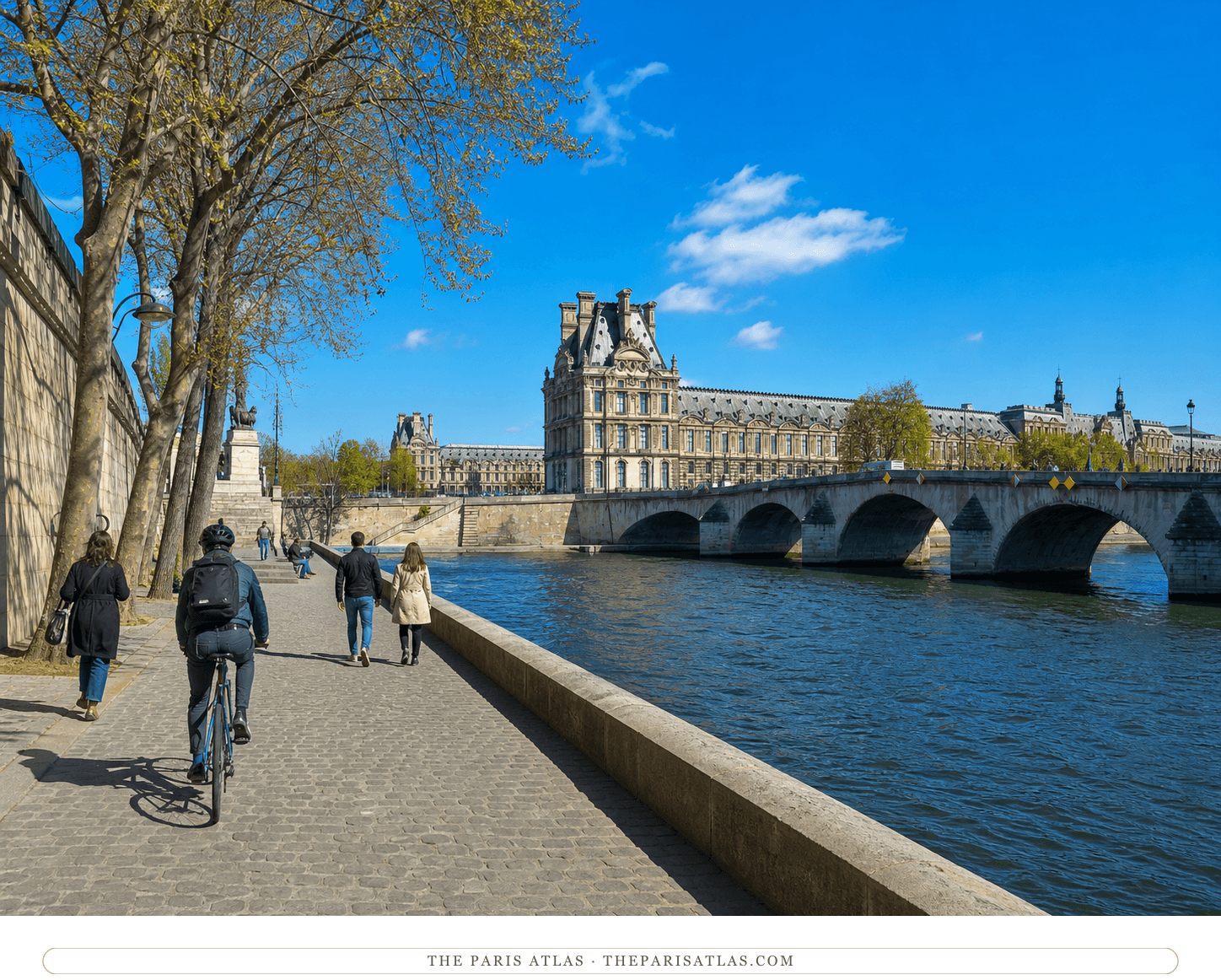
Chez les Vikings, the Scandinavian tavern on the rue Vavin where Nin and Henry Miller met regularly in the early 1930s, as their relationship and their writing formed around each other. A Miller letter of 4 March 1932 is headed from its tables.
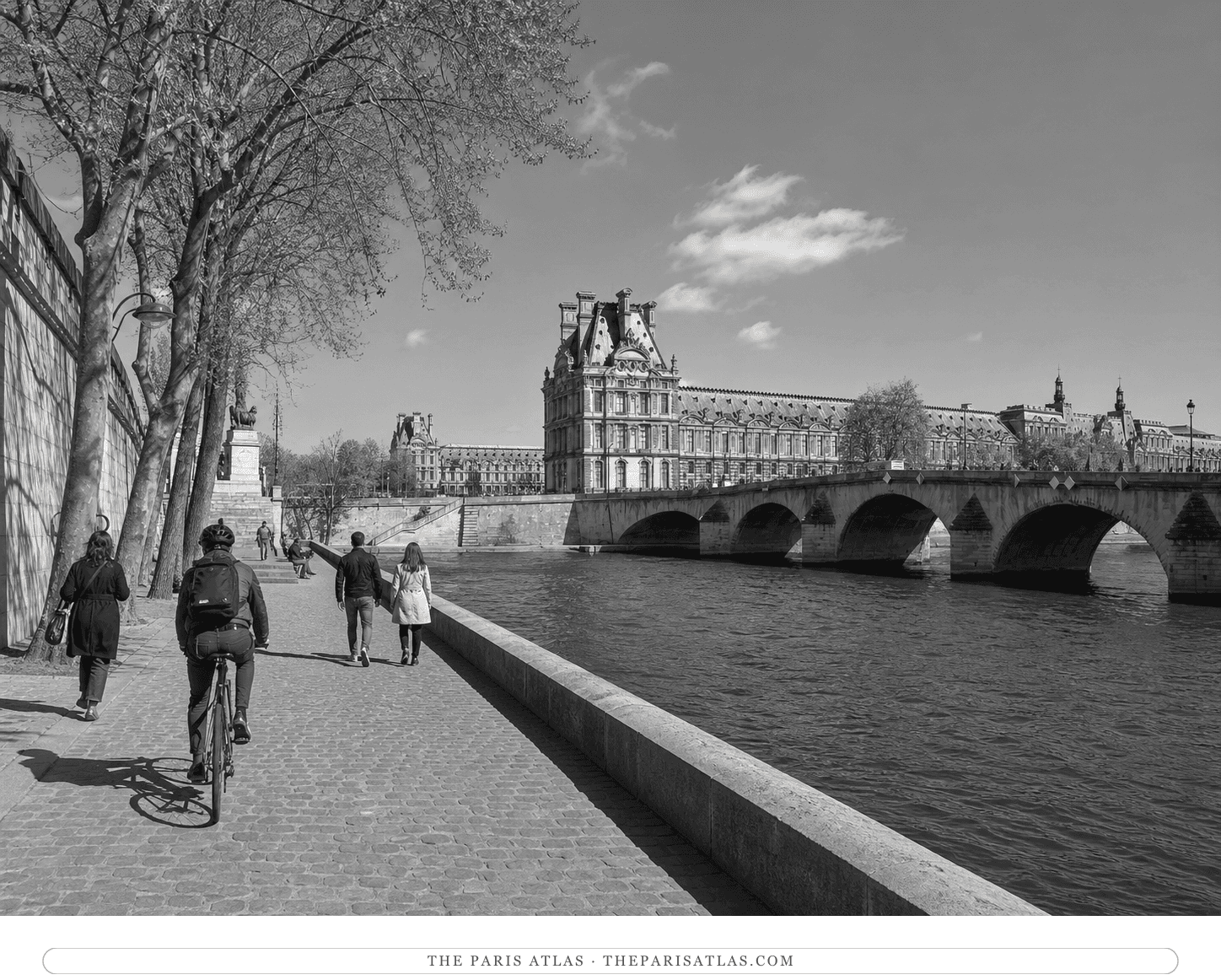
Nin took La Belle Aurore, owned by the actor Michel Simon, on 28 February 1938 and moored on the quai des Tuileries near the Pont Royal. She gave it up that August, when boats were ordered out of Paris for the King of England's visit and the vessel was towed to Neuilly. This is not the 1936 houseboat that Gonzalo Moré nicknamed Nanankepichu — that was an earlier, separate boat.
— Anaïs Nin Papers — diary, March–September 1938; Diary 51. Mon Journal. Vive la Dynamite. Nanankepichu, 1936 August 31–December 27 (1936); Anaïs Nin, mystique de l'amour (1999); Noël Riley Fitch, Anaïs: The Erotic Life of Anaïs Nin (1993); Deirdre Bair, Anaïs Nin: A Biography (1995)
Met in the winter of 1931 at Louveciennes, and became the decade's most consequential literary entanglement — lover, patron, and first believer: she wrote the preface to Tropic of Cancer and found the money that printed it.
— Henry Miller, Tropic of Cancer (1934), preface; Brassaï, Henry Miller: The Paris Years (1995)
Fellow members of the Villa Seurat orbit in the thirties — Brassaï's memoir of the Miller circle records Nin among its cast, from the Louveciennes salon to the quarter's cafés.
They met in the winter of 1931, while June was visiting Miller in Paris — the encounter that electrifies the first published volume of Nin's diary, where June is its most magnetic figure.
— Anaïs Nin, The Diary of Anaïs Nin, 1931–1934 (1966); Mary V. Dearborn, The Happiest Man Alive: A Biography of Henry Miller (1991)
Nin belonged to his Paris circle alongside Miller, Lowenfels, and Perlès — and it was to her that Fraenkel, twenty years on, still described his 1916 first love as the transforming pain of his existence.
— Michael Fraenkel and Walter Lowenfels Correspondence — finding aid (excerpting Howard McCord's Dictionary of Literary Biography entry), Washington University in St. Louis
Nin's first published book was D. H. Lawrence: An Unprofessional Study, written fast and issued in Paris in 1932 by Edward Titus — the publisher who had brought out the Paris edition of Lady Chatterley's Lover three years earlier. She read Lawrence for his ideas rather than his life, which set her study apart from the memoirs then appearing.
— Anaïs Nin, D. H. Lawrence: An Unprofessional Study (1932); Anaïs Nin, The Diary of Anaïs Nin, 1931–1934 (1966)
Nin read Nightwood soon after it appeared and wrote to Barnes to say so, calling it the most beautiful thing she had read about women in love and admitting twice in the same letter that she was afraid to write at all; she had seen Barnes once in a café without knowing who she was. She printed the letter in her published diary, and a few pages later set the book as the mark for her own unwritten one, saying she wanted to do June better than Barnes did Nightwood. Nearly thirty years afterwards she named Barnes on the radio as the classic example of the poetic novel in English, and when the interviewer offered Virginia Woolf as a comparison she said Woolf had not influenced her and that reading Barnes had meant much more.
— Anaïs Nin, The Diary of Anaïs Nin, Volume Two: 1934–1939 (1967), pp. 239-240, 268; Anaïs Nin interviewed by Frank Roberts on her diary and letters from Henry Miller (1965), 2:10-2:38
References
References
The sources below include biographies, scholarly essays, interviews, and primary materials that informed this page. They reflect both the historical record and ongoing critical conversations about Anaïs Nin and their work.
These references anchor the page in the documented record and in the scholarly conversations around Anaïs Nin. Every claim on this page traces back to one or more of the works listed here.








 View source