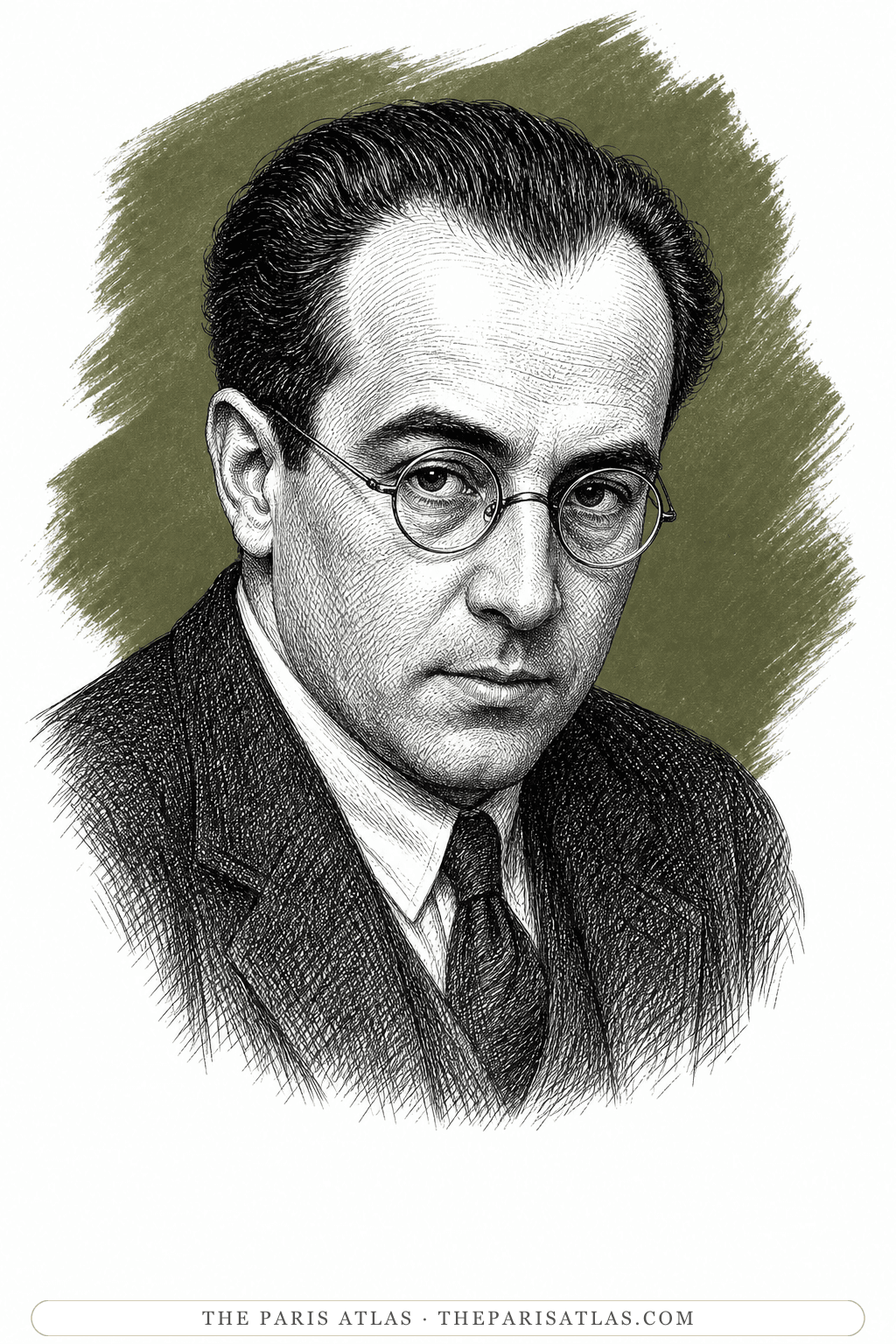
Brassaï
Subject of 'The Eye of Paris' — Miller's essay on the photographer of the night city, argued through particulars: a municipal park chair, a chicken plucked at midnight behind a lit window in Levallois-Perret, the prints spread across the bed of Brassaï's hotel room.
To photograph a thing exactly as he finds it. Miller writes that Brassaï picked out the cheapest chair in a Paris park and shot it where it stood, and that who had sat on it did not interest him in the least.
The book

At a glance
- Himself — the subject of an essay, not a figure in a narrative
- 'The Eye of Paris'
- Globe, a magazine published in Minneapolis
- A hotel in the 13th arrondissement of Paris
- Paris — its streets and architecture, and the city after dark
- Man Ray, the photographer, and André Breton, the surrealist writer
Who they are in the book
Spoiler-freeBrassaï was a real person rather than an invented character: a photographer, born Gyula Halász in Transylvania in 1899, who settled in Paris and became known for pictures of the city at night. 'The Eye of Paris' is an essay about him by the American writer Henry Miller, collected in Max and the White Phagocytes in 1938. Miller had known him for years by the time he wrote it.
The essay carries almost no biography. Miller gives no dates, no account of how Brassaï learned the trade, and no list of his books. What he offers instead is a claim about how the man works: Brassaï photographs ordinary things exactly as he finds them, and Miller thinks that restraint is rarer and harder than invention. He calls it normal vision, and means it as praise.
Much of the essay is written in a heightened, rhapsodic style. Miller spends several pages on eyes and on the act of seeing, and those pages are long and abstract, because they argue about perception rather than describe anything. Miller puts the whole argument into one short sentence: 'For Brassai is an eye, a living eye.' The concrete passages are few, and they are the best of it: a rented park chair, a dead chicken being plucked at midnight behind a lit window, a cemetery photographed from a bridge after dark, and a hotel bed covered with prints.
The profile is drawn from the text of 'The Eye of Paris,' read in the Internet Archive scan of The Wisdom of the Heart (New Directions, 1941), a later Miller collection that reprints the essay. Quotations follow that printing, which sets the photographer's name without its diaeresis.
How Brassaï Is Portrayed
- The chair in the TuileriesThe photograph Miller writes about at greatest length shows a park chair. It is the cheap municipal kind, wire legs looped at the bottom and small holes punched in the seat, which the city of Paris rented out at fifty centimes to anyone who wanted to sit outdoors. Brassaï found one on a path in the Jardin des Tuileries on a spring day, standing at the edge of a grating, and photographed it where it stood. Miller's summary of the result is 'THIS IS A CHAIR. Nothing more.'
- The photographs on the bedMiller had gone to Brassaï's hotel years earlier looking for a painter, and was received by someone else entirely. He describes coming back much later: 'And when one day the door was finally thrust open I beheld to my astonishment a thousand replicas of all the scenes, all the streets, all the walls, all the fragments of that Paris wherein I died and was born again.' The prints were spread across the bed, and this is the essay's account of the first time Miller saw the work.
- The city at nightBrassaï's subject, in Miller's account, is Paris itself. Miller writes that his albums of black-and-white pictures amount to an encyclopaedia of the city's architecture, its growth and its history, and that no part of its life escaped him. The one picture he names is the Montmartre cemetery, shot from the bridge above it at night, the electric light falling in hard patches across the tombs and crosses.
- A chicken boneMiller's test case for the claim that Brassaï can make an unremarkable object worth looking at is a chicken bone. He says it takes on the qualities of something marvellous in Brassaï's photograph, while far more elaborate work by other photographers leaves him with nothing. His explanation is that Brassaï respects the object enough to leave it alone.
- Backstage at the Folies-BergèreMiller pictures him at work in the wings of the Folies-Bergère, the Paris music hall, moving among the candelabras, the painted scenery and the empty tiers of seats. What he fixes on is the timing. Brassaï waits for the curtain to come down rather than go up, and photographs what is left once the performance stops and the dancers are sitting on the floor of the stage.
- The acquaintance who introduced themMiller says he was brought to Brassaï by a man he had no time for — someone who knew every Métro station by heart and could recite them backwards line by line, who could give the history of any arrondissement and the origin of any statue in Paris, and who never wanted to walk anywhere. Miller calls him a human cockroach. He then credits him with two things: the introduction, and the discovery of the 13th arrondissement, where Brassaï was living in a hotel.
- His eyesThe essay's one piece of physical description is of Brassaï's eyes. Miller writes that on meeting him you see at once that his eyes are not ordinary ones, and he describes being looked at by him as being examined, comparing the gaze to a searchlight and to a surgical probe entering through the ear.
- Leaving the subject aloneMiller argues that Brassaï's refusal to arrange or improve a scene is a deliberate choice, and that it does not make his pictures anonymous. A thousand men could photograph the Montmartre cemetery, he writes, and Brassaï's picture would still be recognisable as his. He sets him beside Man Ray, an American photographer working in Paris in the same years: one man interferes with his equipment as little as he can, the other bends it to his will, and the mark of the person shows either way.
If you like Max and the White Phagocytes


If you like Henry Miller
Explore authors with a similar voice, perspective, and influence.
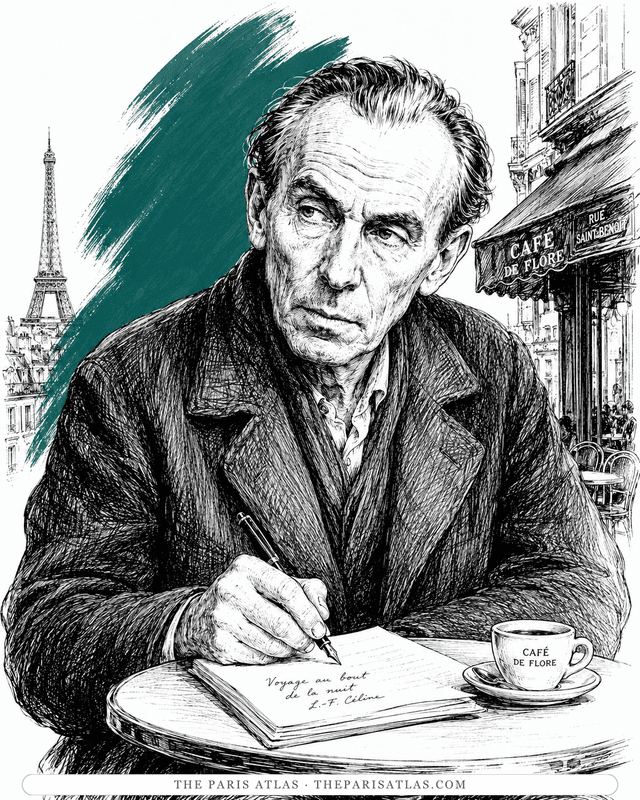
Louis-Ferdinand Céline
Miller's acknowledged master at making literature out of the gutter. Journey gave him permission; Cancer is what he did with it.
View author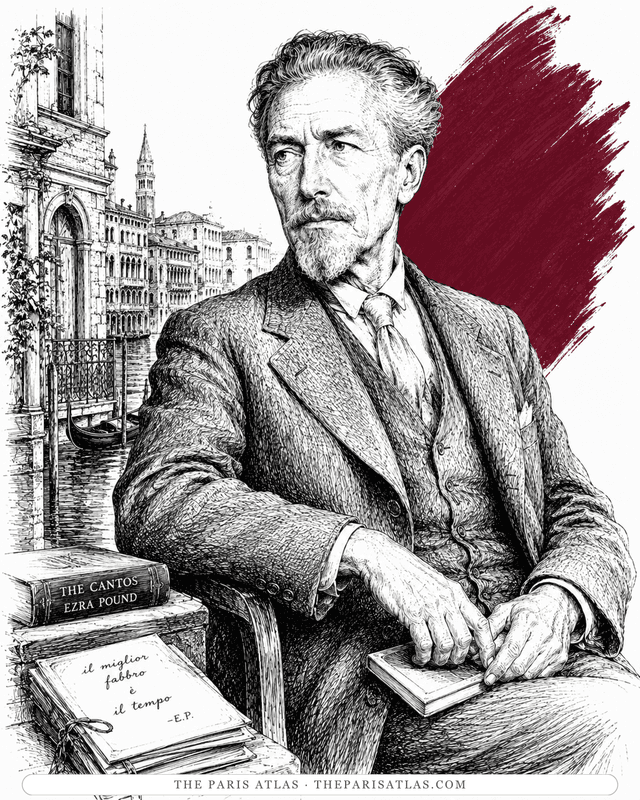
Ezra Pound
Pound read Cancer and sent Miller a famously backhanded postcard. Both believed literature's job was to wake the reader by any means necessary.
View author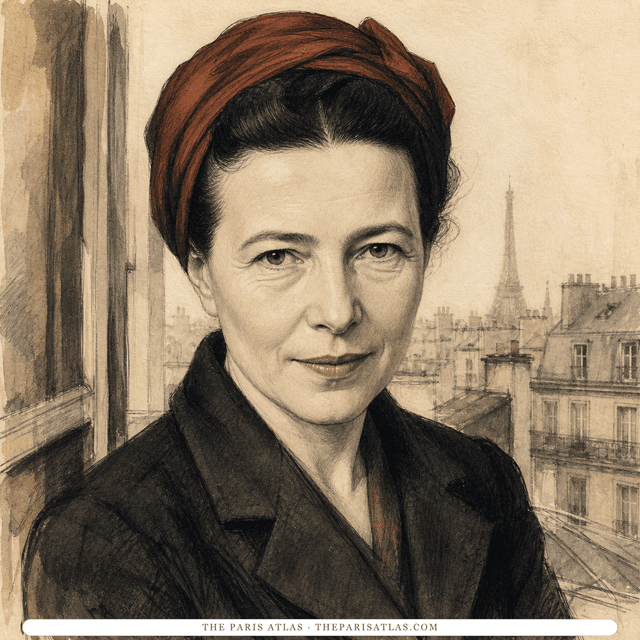
Simone de Beauvoir
French writer and philosopher whose novels, memoirs, and social analysis examined freedom, gender, responsibility, aging, and the material conditions that shape a life.
View author