

Ernest Hemingway: Selected Letters 1917–1961
Six hundred letters he ordered never published — Fitzgerald teased, Perkins courted, wives won and lost — the offstage voice, complete with sins.
- 1981
About Ernest Hemingway
The story, briefly
Spoiler-freeHemingway left written instructions that his letters never be published; twenty years after his death, his estate decided posterity outranked the memo, and Carlos Baker — his biographer — selected nearly six hundred of the thousands: to Fitzgerald and Pound, Stein and Perkins, wives, sons, generals, and enemies, from a 1917 cub reporter to the last painful notes of 1961. Funnier, meaner, more boastful and more wounded than the public prose ever allowed, the letters are the unguarded Hemingway — which is exactly why he forbade them. (Letters — nothing here to spoil.)
The story, in more detail
The letters were where the discipline relaxed: no iceberg, no omission — gossip, shop talk, score-settling, grief, and comedy poured out at speed, spelling optional. The Fitzgerald file alone is a tragicomic novella: advice, affection, cruelty, and the long sad diminuendo of the friendship. The Perkins correspondence is a masterclass in author-editor relations; the letters to Stein before the falling-out, to Dos Passos before theirs, and to each wife in the season of the next one, map every bridge in these pages as it was built and burned.[1]
Baker's 1981 selection was itself an event — reviewers marveled and winced in the same paragraphs, and the ethics of overriding the ban were argued at length. What the volume settled is that the correspondence belongs to the work: the style's off-duty register, the business of literature conducted raw, and a self-portrait more damaging and more endearing than any biographer could assemble. The Cambridge edition has since begun publishing everything; Baker's six hundred remain the essential single-volume tour.[1]
What's inside
Nearly six hundred letters, chronological, 1917 to 1961: Oak Park to Kansas City to the Italian front; the Paris arrival and the campaigns for the first books; the Perkins decades, contract by contract; Key West, Spain, the wars; Cuba, the Nobel, and the failing last years — with recipients from Pound, Stein, and Fitzgerald to sons, in-laws, editors, and the occasional ambushed critic. Baker's notes identify the players and, where kindness requires, the context.[1]
Read it beside the biography or the memoirs — the letters are the same life, told without the varnish, at the time.[1]
Themes and analysis
The voice off duty
In his letter to Fitzgerald of 15 December 1925, Hemingway turns news of illness, family and reading into a lecture on the subjects fiction should tackle. Yet he interrupts that authority himself: he imagines his friend's disagreement, allows that he may be wrong, and jokes about becoming a tired young lecturer. The changing register makes the letter a performance of friendship as well as literary confidence. Its closing demand for a reply also alters the balance. The man dispensing judgments needs an answer; conversation matters alongside the pleasure of having his say.
A life carried by letters
Writing to Arthur Mizener from Cuba on 12 May 1950, Hemingway argues that letters should belong to their immediate occasion rather than be composed for posterity. That insistence becomes poignant in a collection assembled after his death. He also admits to loneliness and says that receiving replies is part of the attraction of writing. The letter therefore offers more than a statement about posterity: it presents correspondence as an exchange whose hoped-for continuation gives it purpose. Reading only one side preserves the author's voice while reminding us of the answering presence that originally called it forth.
Why we recommend it
The voice off duty
The most disciplined stylist alive, writing with the discipline off — revealing by exactly the contrast he feared.
Every bridge, documented
Stein, Anderson, Fitzgerald, Dos Passos — each alliance and rupture of the era has its paper trail here.
The Perkins seminar
Forty years of author-editor correspondence — the business of masterpieces, conducted in real time.
What this book explores
Timeline
1917
The correspondence opens with a Kansas City cub reporter; over four decades it will run to Fitzgerald, Pound, Stein, Perkins, wives, and sons.
1958
Hemingway leaves written instructions that his letters never be published.
1961
He dies; the last painful notes close the file.
1981
The estate overrides the ban, and Scribner publishes Carlos Baker's selection of nearly six hundred letters — an event whose ethics are still argued.
Book editions
Hardcover
- Hardcover
- Scribner
- 1981

- Paperback
- Scribner
- 9780743246894

- Hardcover
- Scribner
- 2003
- 9780743246897
Reader reviews
Readers may also like

By-Line: Ernest Hemingway
The public prose of the same decades — the wire voice beside the private one.
Read our take
Ernest Hemingway: Selected Letters 1917–1961: frequently asked questions
Who wrote the Selected Letters?
Ernest Hemingway. His biographer Carlos Baker selected and edited the volume, which Scribner published in 1981.
What is Ernest Hemingway: Selected Letters 1917–1961?
Nearly six hundred of his letters — to Fitzgerald and Pound, Stein and Perkins, wives, sons, generals, and enemies — from a 1917 cub reporter to the last painful notes of 1961.
Didn't Hemingway forbid their publication?
Yes. He left written instructions that his letters never be published; twenty years after his death his estate overrode the memo, and the ethics of doing so are still argued.
How do the letters differ from his books?
They are the unguarded Hemingway — funnier, meaner, more boastful and more wounded than the public prose allowed, the style's off-duty register with no iceberg and no omission.
What is the heart of the collection?
The Fitzgerald file — affection, advice, and escalating cruelty across the whole arc of the friendship — alongside the decades of correspondence with editor Max Perkins.
If you like Ernest Hemingway
Explore authors with a similar voice, perspective, and influence.

Louis-Ferdinand Céline
The other great stylist the Great War produced — where Hemingway cut the language down, Céline set it on fire. The same wound, opposite treatments.
View author
Henry Miller
Paris on no money a decade later, with the restraint removed. Miller called Hemingway's Paris a tourist's Paris; readers get to referee.
View author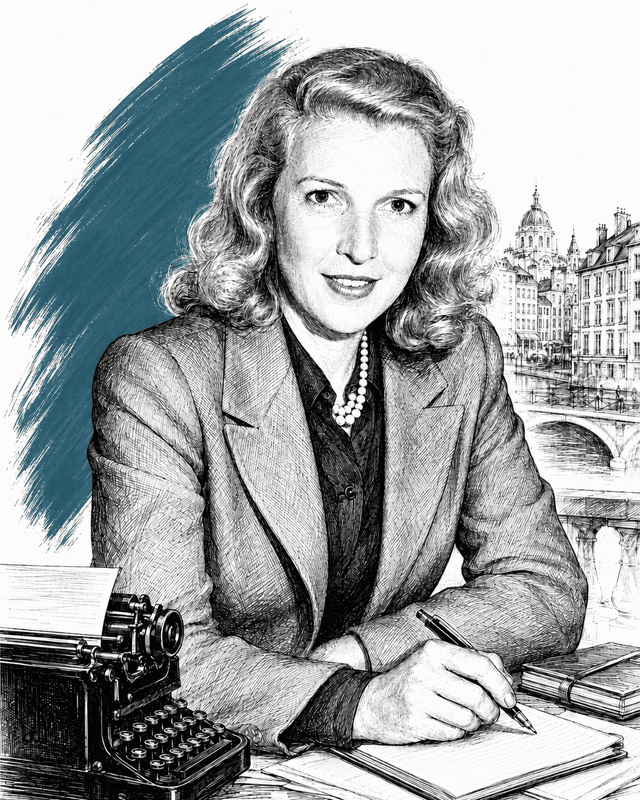
Martha Gellhorn
War correspondent who covered the Spanish Civil War, D-Day, and conflicts across five more decades; Hemingway's third wife, 1940–1945.
View author
References
References
The sources below include the primary text, editions, scholarship, archival materials, and other records that informed this page. They document Ernest Hemingway: Selected Letters 1917–1961, its publication, and its place in literary history.


2Hemingway letters concerning Fitzgerald — selected-letter transcriptions
WebsiteErnest HemingwayUsed forComplete displayed texts of the two dated letters; the transcription credits Hemingway's letters to Baker's 1981 selection. Web item numbers are locators, not original edition pagination.
3Ernest Hemingway: A Life Story
BiographyCarlos Baker, 1969Used forUsed to place Ernest Hemingway: Selected Letters 1917–1961 within Ernest Hemingway's published work and verify its bibliographic context.
4Ernest Hemingway's Life in Key West
WebsiteThe Ernest Hemingway Home & MuseumUsed forUsed for independent biographical, archival, or historical context surrounding Ernest Hemingway's career and the period in which Ernest Hemingway: Selected Letters 1917–1961 appeared.
5Max Perkins: Editor of Genius
BiographyE. P. Dutton, 1978Used forUsed to cross-check authorship, chronology, and the work's place in Ernest Hemingway's wider catalogue.

6Ernest Hemingway, The Art of Fiction No. 21
PeriodicalThe Paris Review, Issue 18, Spring 1958, 1958Used forUsed to verify Ernest Hemingway's bibliography and place Ernest Hemingway: Selected Letters 1917–1961 within the broader chronology of Ernest Hemingway's career.
i
Why these sources are here
The primary text is the baseline reference for every book page. Additional references document publication history, interpretation, and historical context where that evidence is available.
 Explore more resources