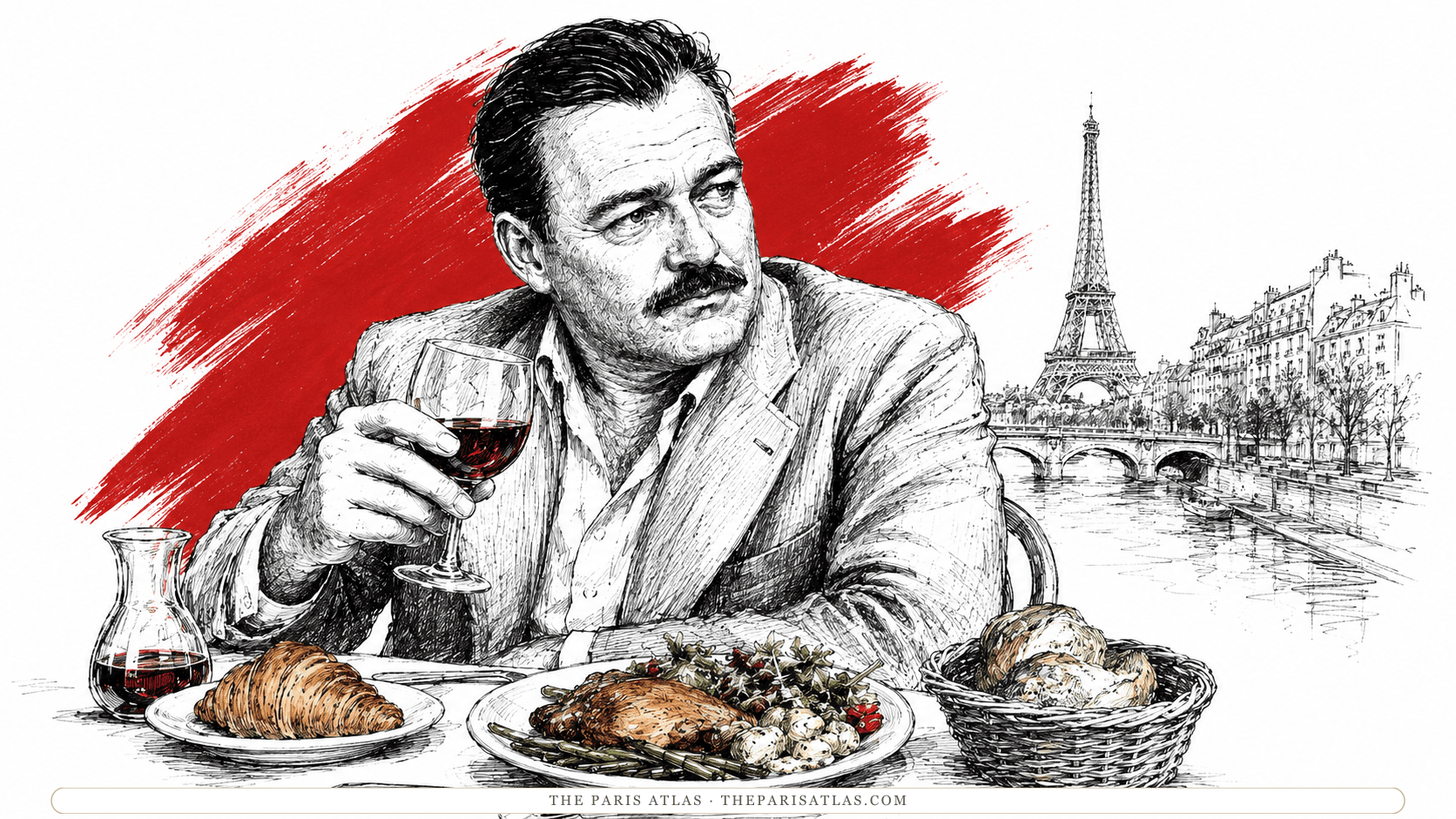

Bill Smith
- Muse
Depicts
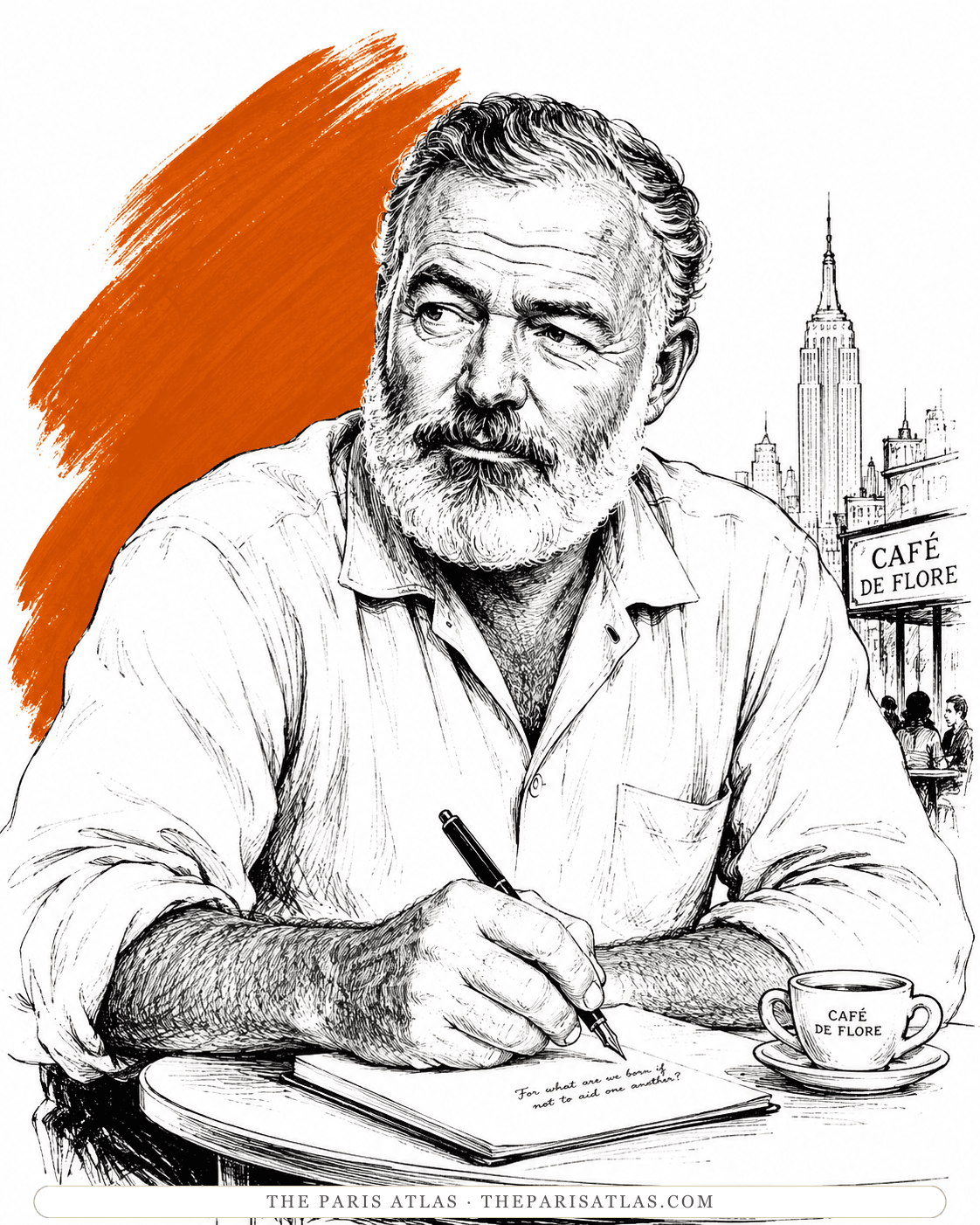
Bill Gorton is a composite, and Smith is the fishing half — Hemingway's boyhood friend from the Michigan summers, present at the 1925 fiesta.

Paris cafés, Pamplona bulls, and a crowd of the beautifully damaged — the novel that named a generation.
Jake Barnes, an American newspaperman carrying an unspeakable war wound, drifts through expatriate Paris in the orbit of Lady Brett Ashley — married twice, waiting on a divorce, magnetic, and impossible for him to have. When the crowd decamps to Pamplona for the fiesta, the drinking, the bullfights, and the jealousies come to a head. Nothing is stated; everything is felt. It remains the essential novel of the Lost Generation, written by the man Gertrude Stein aimed the phrase at.
The novel was practically reported. In July 1925 Hemingway took his crowd — Lady Duff Twysden, Harold Loeb, Pat Guthrie, his boyhood friend Bill Smith, the humorist Donald Ogden Stewart — to the fiesta at Pamplona, watched the week collapse into jealousies over Duff, and started writing days later, on his twenty-sixth birthday, in Valencia. The first draft took about eight weeks, finished in Paris that September: the fastest sustained writing of his life, done while the wounds were still open.[1]
The revision is one of the era's great craft stories. Fitzgerald read the opening — pages of chatty biography about Brett and Mike — and told him to cut it; Hemingway lopped the front of the book off in proof, so the novel now begins with Robert Cohn and trusts the reader with everything else. He set two epigraphs facing each other, Gertrude Stein's 'you are all a lost generation' against the wheel of Ecclesiastes, and let the title come from the second. Britain got it as Fiesta; Scribner published it in October 1926.[1]
It made him famous and cost him nearly every friendship in it. Montparnasse read it as a directory — the quarter played spot-the-original for months — Duff and Loeb carried the portraits for the rest of their lives, and Loeb spent thirty years drafting his answer. Meanwhile the spare, repeating sentences remade American prose, and a generation of young women began talking like Brett. Few novels have ever been simultaneously such good gossip and such permanent literature.[1]
Hemingway splits the novel into three parts, and the first belongs to Paris. Jake Barnes, an American newspaperman carrying a war wound that has made physical love impossible, drifts through the expatriate café world alongside Robert Cohn — a restless novelist who wants his life changed by South America, or by anything. Jake picks up a poule named Georgette out of loneliness and runs into Lady Brett Ashley at a dance club; in a taxi afterward the two of them turn over, one more time, the fact at the book's center: they love each other and it cannot work. Brett collects a devoted Greek count, deflects Cohn's sudden infatuation, and leaves town — to San Sebastián, it later emerges, with Cohn, a weekend that means nothing to her and everything to him. Cohn meanwhile disposes of Frances, the companion who managed three years of his life, absorbing her farewell evisceration in silence.[1]
The second part moves to Spain. Jake and his friend Bill Gorton fish five perfect days at Burguete — the novel's one interval of peace — then rejoin the crowd in Pamplona for the fiesta: Brett, her bankrupt fiancé Mike Campbell, and Cohn, who follows Brett like a wronged creditor. As the fiesta detonates around them, the group turns on Cohn — Mike most viciously — while Jake introduces Brett to Pedro Romero, the nineteen-year-old matador who is everything the crowd is not. Brett, unable to stop herself, asks Jake to bring them together, and he does it, knowingly trading away the respect of the hotelier Montoya and the aficionados' world he treasures. Cohn, told where Brett has gone, knocks Jake and Mike down with his Princeton boxing and then beats Romero terribly — but cannot make the boy stay down or shake his hand, and leaves Pamplona weeping and finished with them all.[1]
The next afternoon is the novel's climax: Romero, his face ruined, fights anyway and is magnificent — he kills the bull that had earlier gored a man to death in the morning's running, cuts the ear, and gives it to Brett. The aging Belmonte, jeered by a crowd that wanted his legend rather than his diminished self, watches the era pass to the boy. When the fiesta ends, the crowd scatters: Bill back to Paris, Mike broke to Saint-Jean-de-Luz, and Brett gone to Madrid with Romero. Jake, alone, retreats to San Sebastián to swim and recover — until Brett's telegram arrives.[1]
Jake finds Brett alone in a cheap Madrid hotel. She has just let Pedro Romero go — the young matador wanted to marry her, and she sent him away instead, refusing his money and refusing, as she tells Jake, to be the kind of woman who ruins a nineteen-year-old. That small decency is her consolation: doing the right thing, she tells Jake, is sort of what people like them have instead of God. The two of them lunch at Botín's, drink too much rioja alta, and take a last taxi ride through Madrid. Pressed together as the cab slows, Brett says they could have had such a damned good time together. The novel ends on Jake's reply — 'Isn't it pretty to think so?' — the gentlest, most devastating no in American literature.
The walk replaces Bill's breakfast performance about irony with an attention that needs less explaining. Footbridges, roots, cattle bells and patches of sunlight give Jake a sequence of things to notice and do. The men carry different parts of their equipment, and their conversation turns to distance and practical choices. Yet the beautiful country does not abolish effort: the route is long, and they arrive tired and hot. The passage makes companionship tangible through shared movement rather than declarations of perfect escape.
Brett moves close to Jake before the traffic presses them together, so the ending holds chosen tenderness beside accidental contact. Her imagined life with him is answered by a question about imagining, not by a description of what their future will be. The bright street remains sharply visible while that possibility stays untestable. After the evasions over lunch and Brett's concern about his drinking, Jake's reply can carry affection and skepticism together; its brevity does not settle their relationship into a single feeling.
“How did you go bankrupt?” Bill asked. “Two ways,” Mike said. “Gradually and then suddenly.”
It is awfully easy to be hard-boiled about everything in the daytime, but at night it is another thing.
Listen, Robert, going to another country doesn’t make any difference. I’ve tried all that. You can’t get away from yourself by moving from one place to another. There’s nothing to that.
Jake's wound, the war, the love story's impossibility — the novel's biggest facts are never stated directly, and land harder for it. This is the style that remade the American sentence.
Nearly everyone in it was a real person at real cafés — the 1925 Pamplona trip happened, feuds included. Few novels let you eavesdrop on an era this directly.
The dialogue sparkles, the drinking is comic, and underneath it all runs the flat despair of people who survived the war without surviving it. 'Isn't it pretty to think so?' still lands like a verdict.
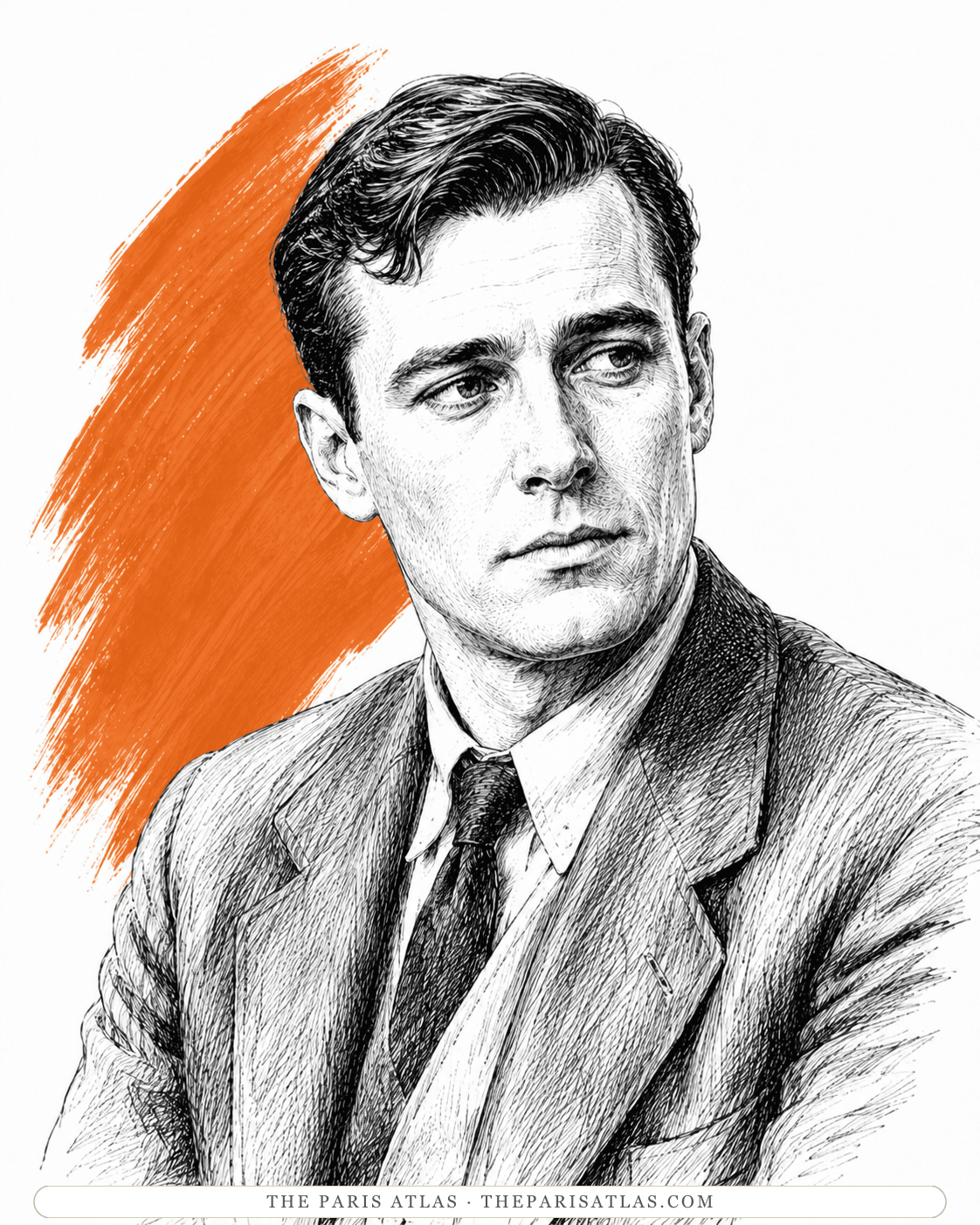
The narrator — an American newspaperman in Paris, carrying a war wound the book never names, in love with the one woman it makes impossible.

Married twice, waiting on a divorce, magnetic to every man in the book — the center of gravity the whole novel orbits.
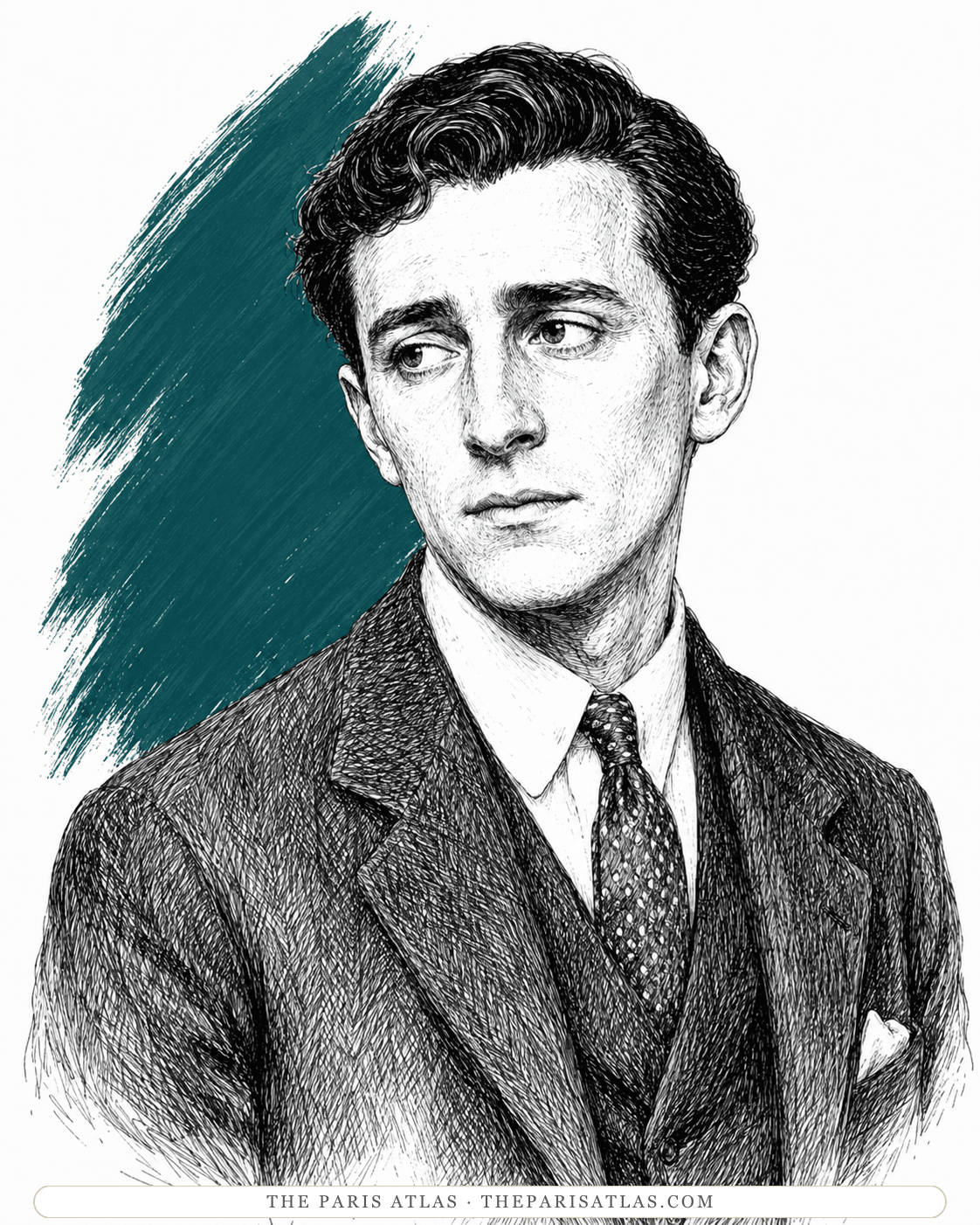
Once middleweight boxing champion of Princeton — the novel's opening line, and the outsider the whole crowd sharpens itself on.
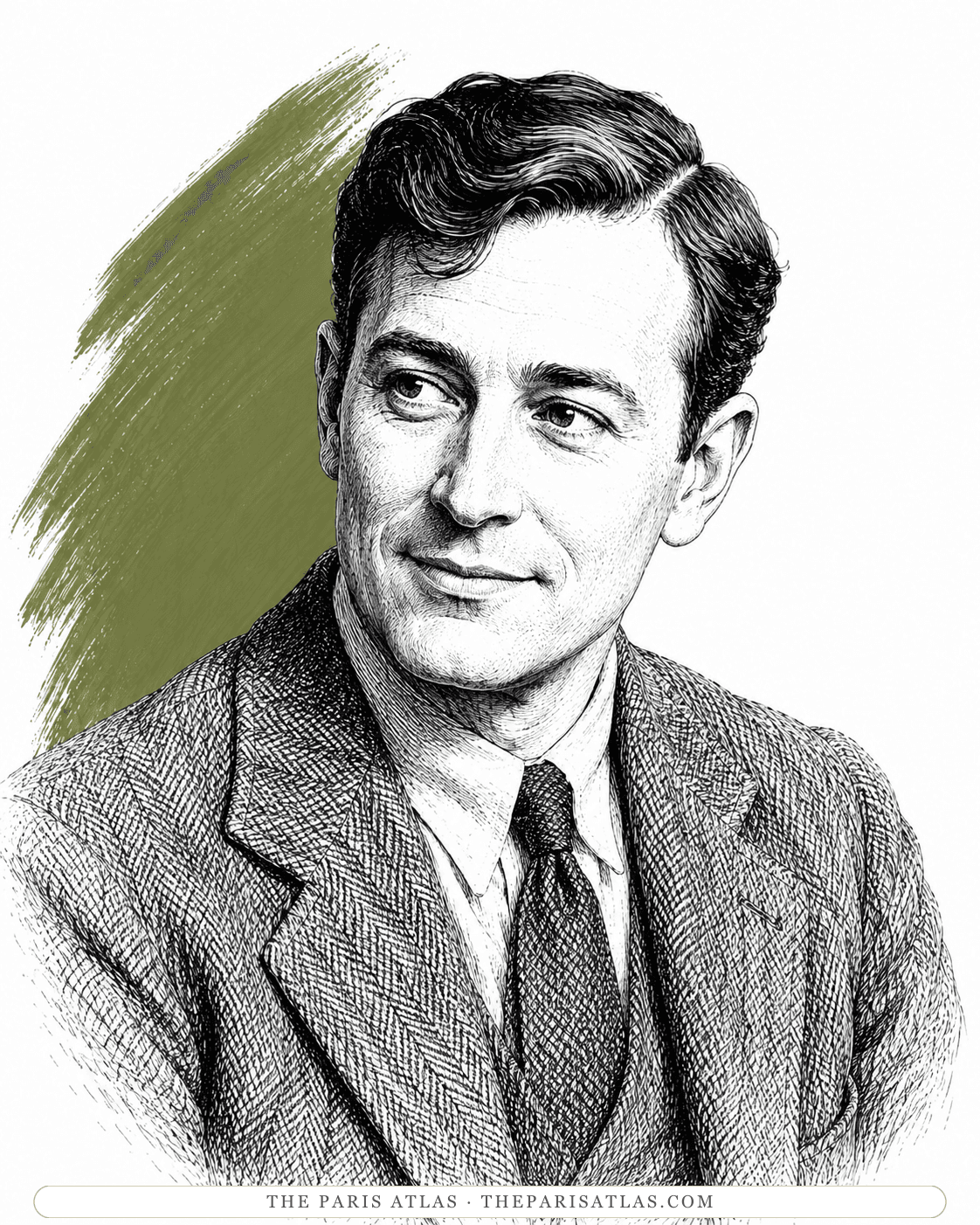
Jake's fishing companion and the book's comic engine — arriving from New York with stuffed dogs on his mind and 'never be daunted' as doctrine.
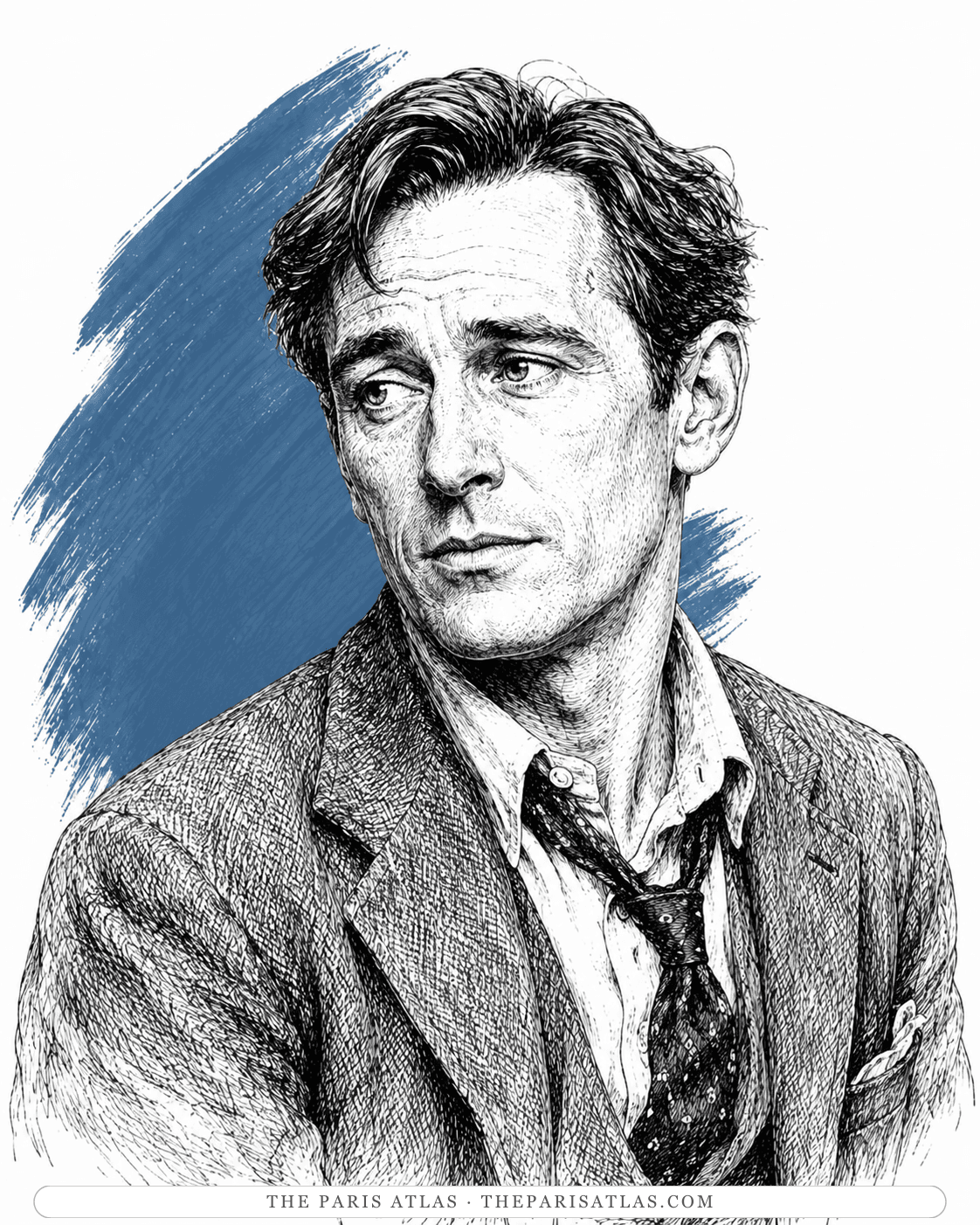
Brett's fiancé — Scottish, charming, bankrupt two ways: gradually and then suddenly.
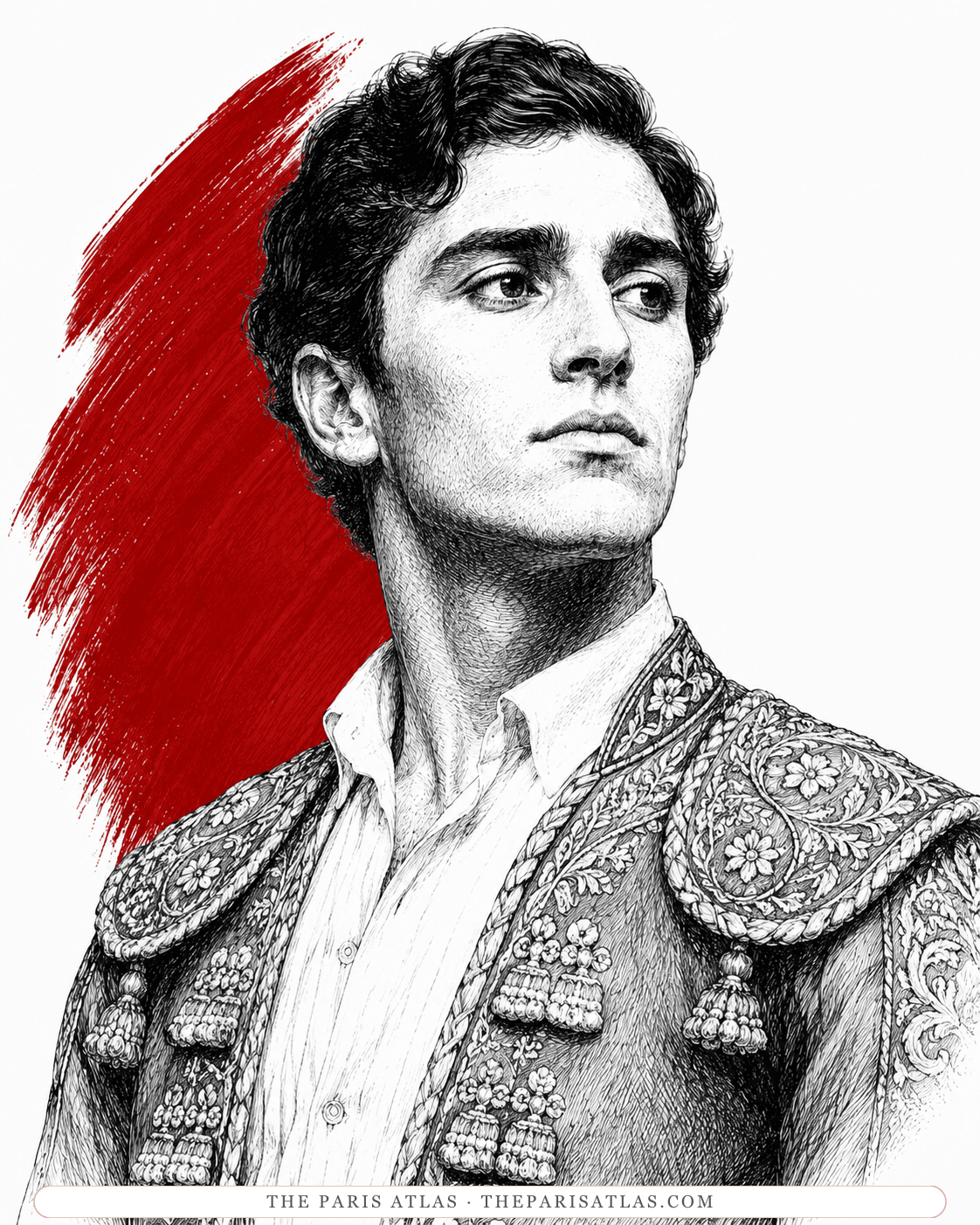
Nineteen, from Ronda, and the real thing — the young matador the book offers as the one unruined man in it.
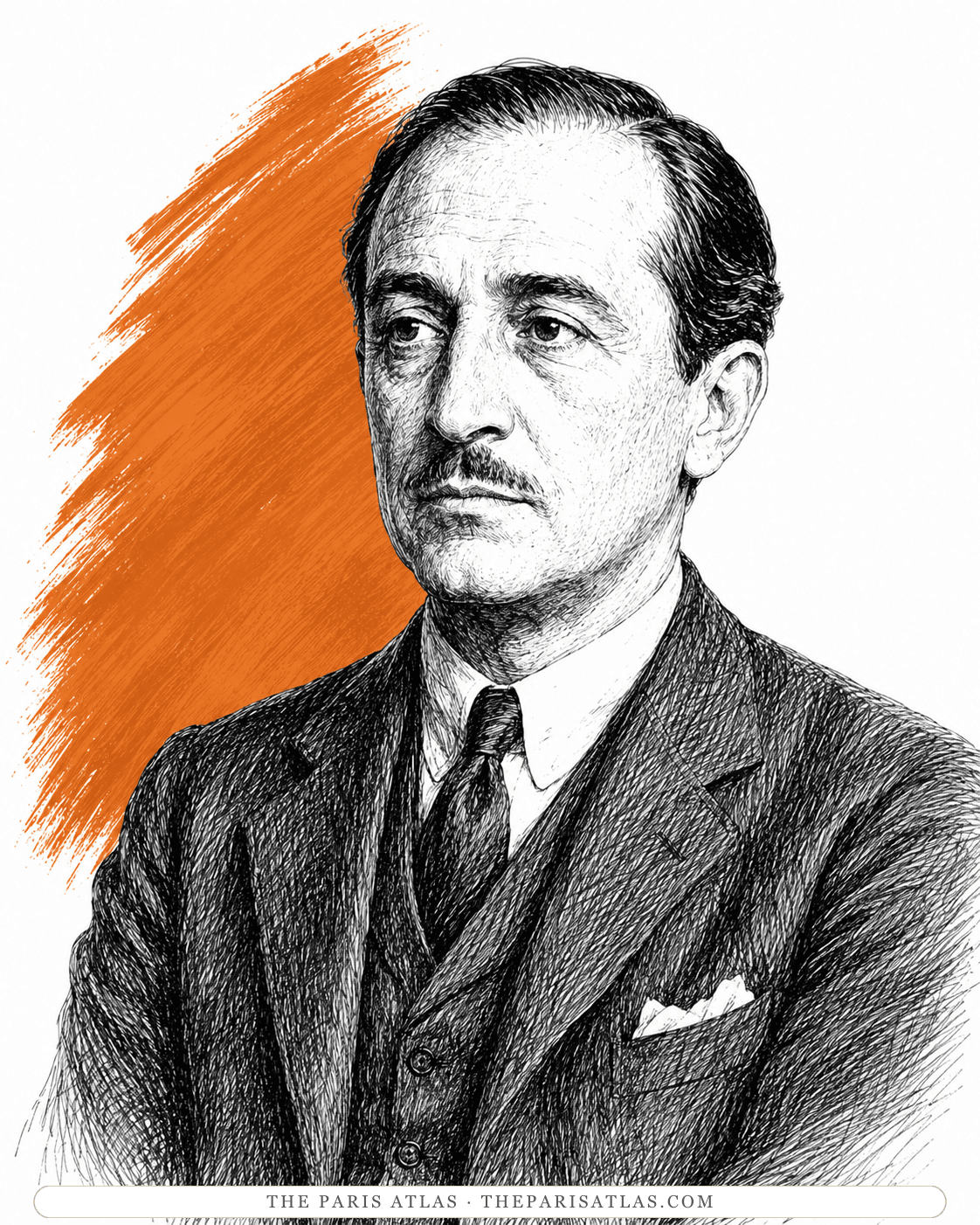
Keeper of the Pamplona hotel where the matadors stay — and of aficion itself, the passion he ranks above money, manners, and guests.
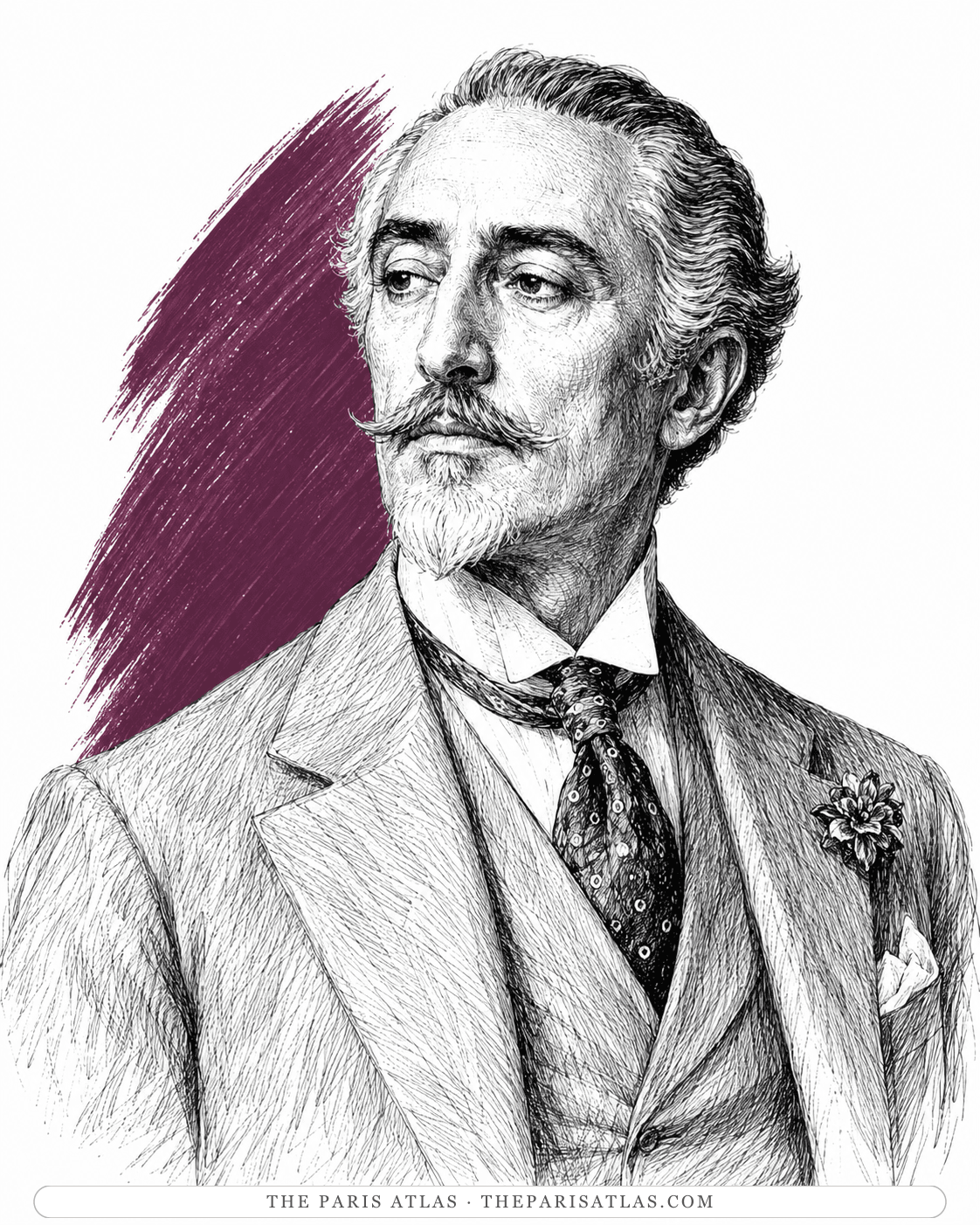
Brett's champagne-buying Greek count — seven wars, four revolutions, and the settled secret of getting to know the values.
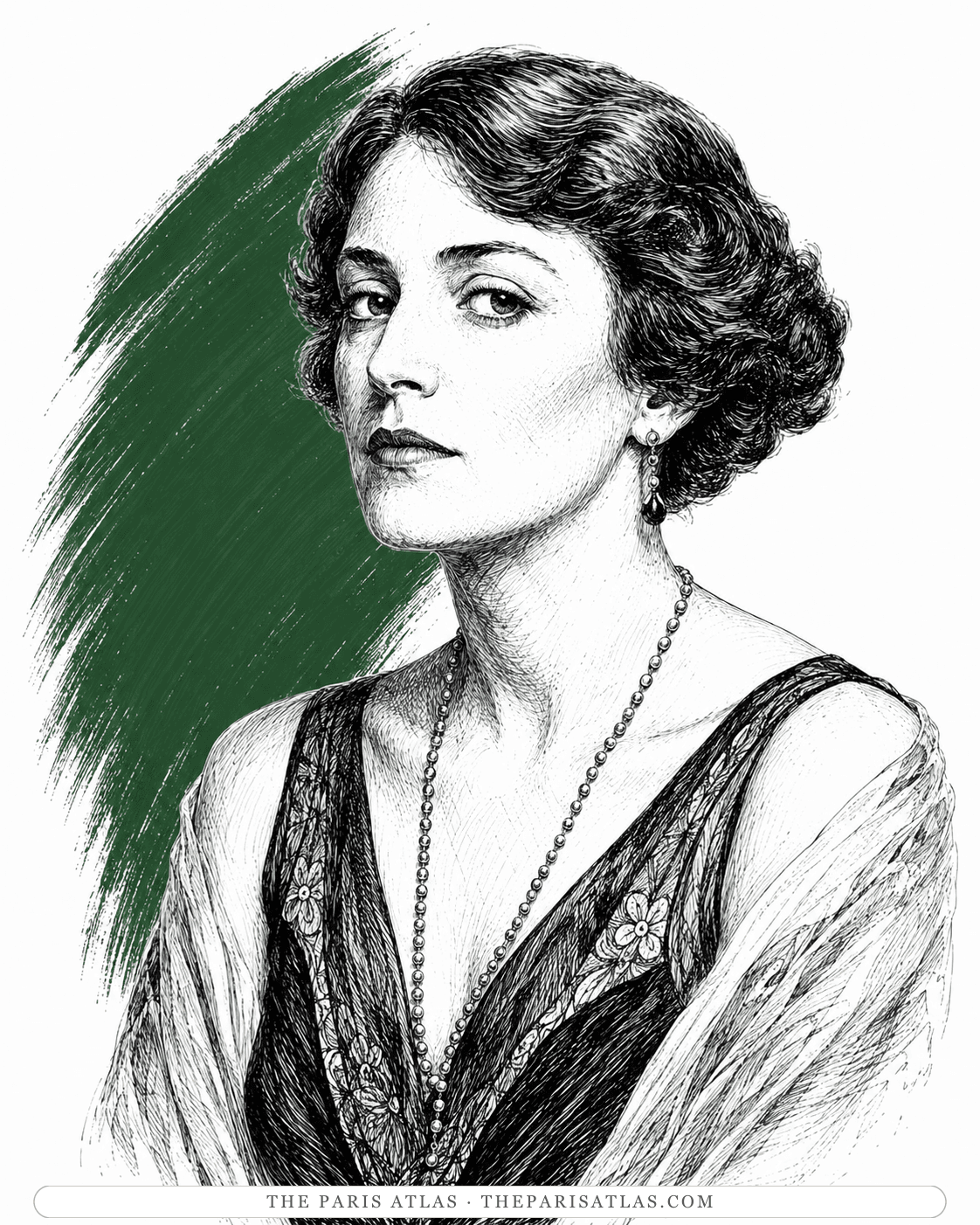
Cohn's companion of three years — and author of the book's most scalding monologue when he decides to trade her in for his new life.
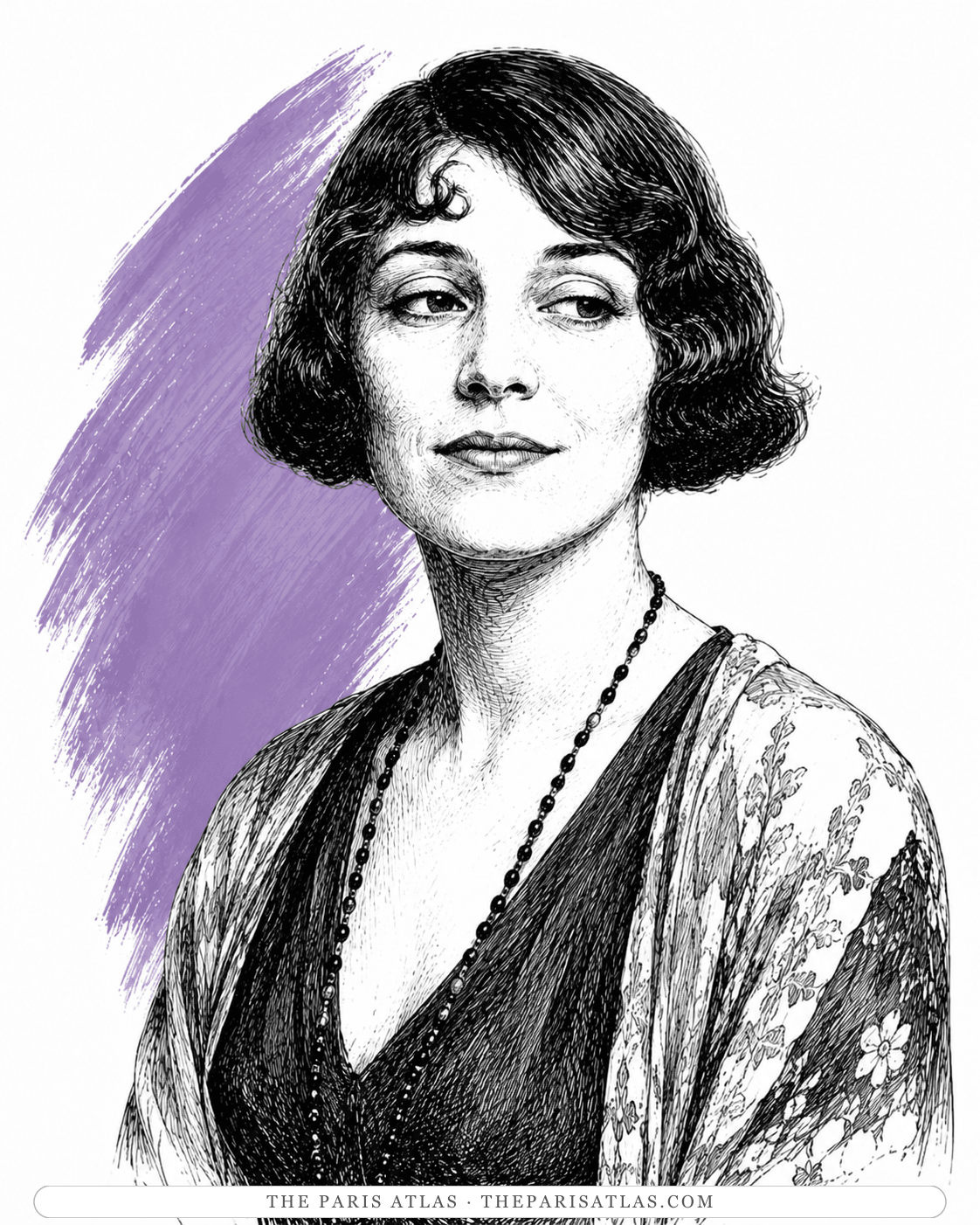
The poule Jake picks up on the Boulevard and squires to dinner — introduced to literary Paris, as a joke, under a famous singer's name.
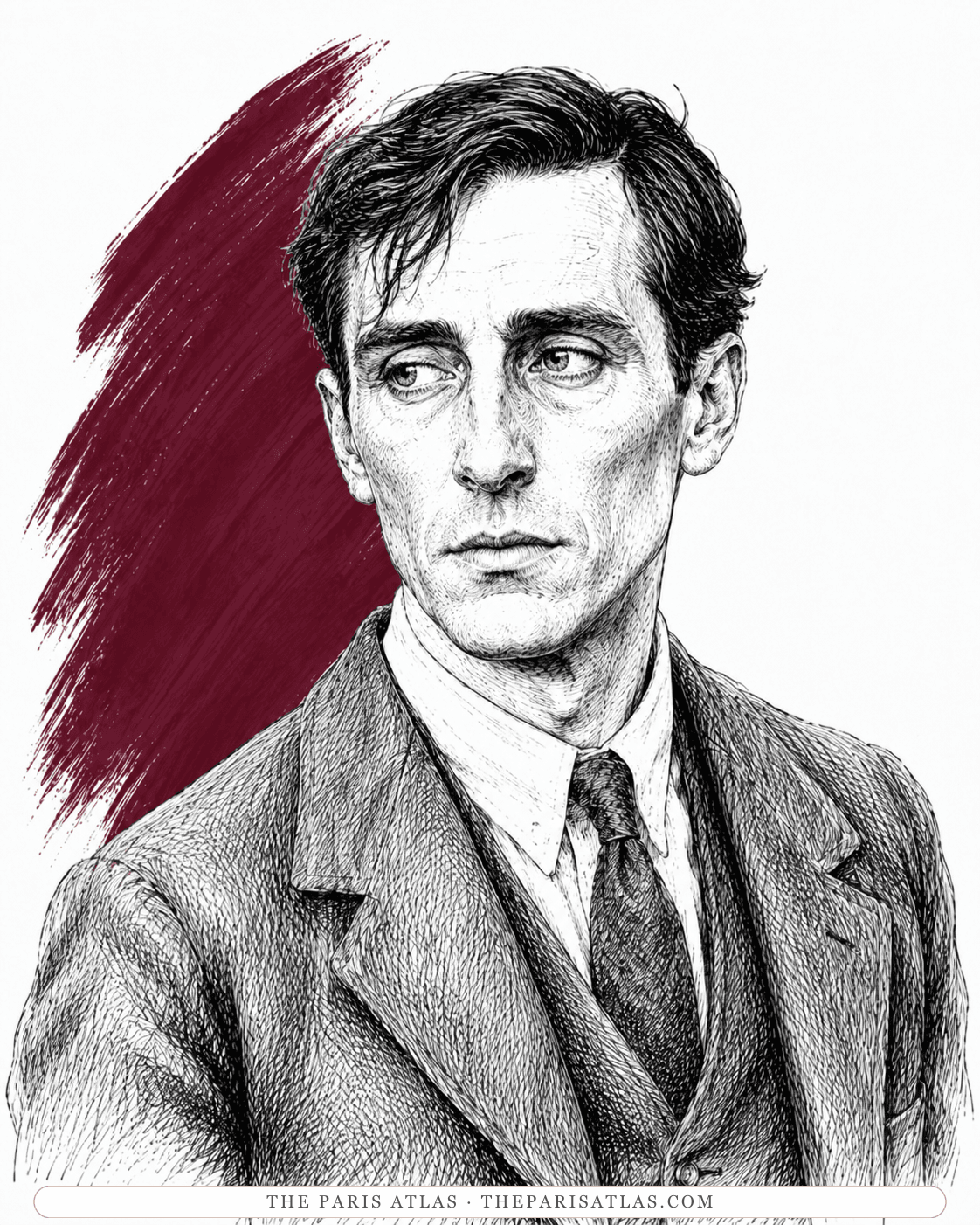
Found at the Select, unshaven and broke, days past his last meal — the expatriate literary life with the varnish burned off.
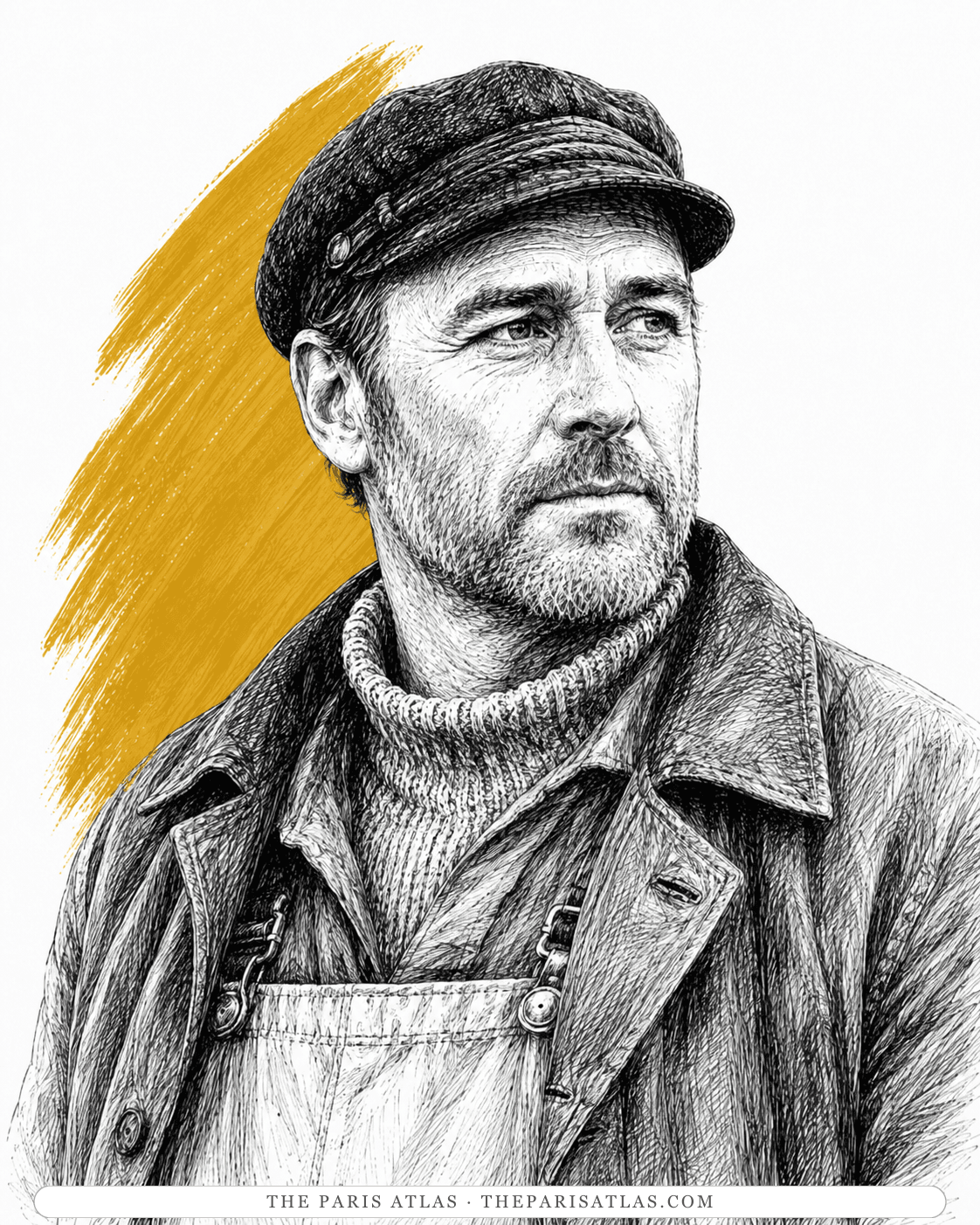
The Englishman at the Burguete inn — a war veteran who fishes with Jake and Bill and can barely say what the five days meant to him.
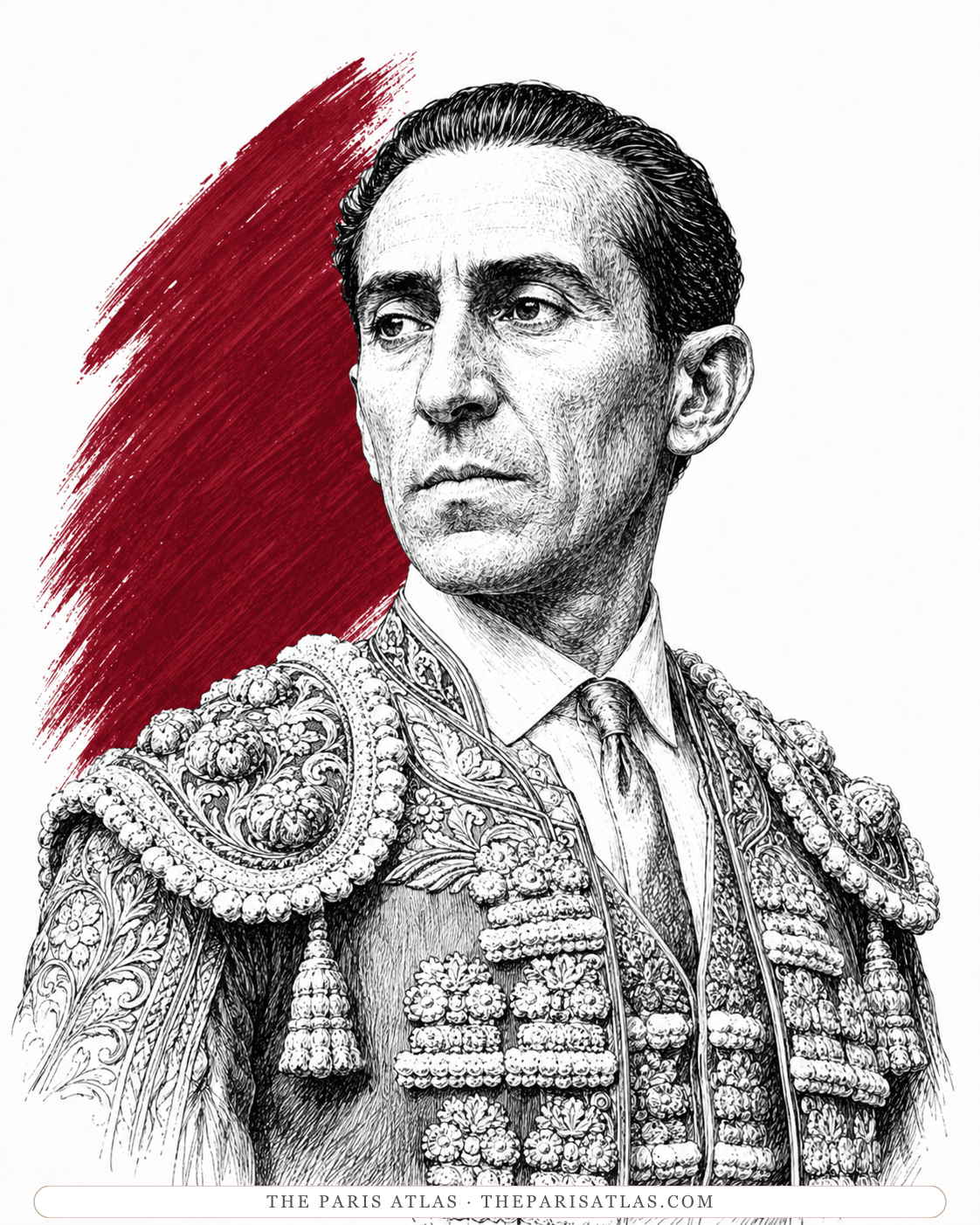
The one real name in the book: Juan Belmonte, greatest matador of his age, caught mid-comeback on the afternoon the novel hands to a boy of nineteen.
Depicts
Bill Gorton is a composite, and Smith is the fishing half — Hemingway's boyhood friend from the Michigan summers, present at the 1925 fiesta.
The fiesta was real: Hemingway's July 1925 Pamplona trip, with the real Lady Duff Twysden in tow, supplied the novel almost scene for scene — and ended most of the friendships in it.
Read the full story in the journalThe most famous label in modern literature started as a complaint about a slow car repair. What 'lost' actually meant — and why the writers it named never accepted it.
Fitzgerald vouched for Hemingway before he'd met him and edited him better than he edited himself. Hemingway outlived him and wrote the eulogy crooked. The friendship, round by round.
Summer reading is a matching problem, not a ranking problem. Our seasonal guide pairs the moderns to the July you're actually having.
The iceberg theory is writing by informed omission: most of the writer’s knowledge stays below the surface, while selected actions and details let the reader feel it.
The Hemingway daiquiri grew from Ernest Hemingway’s real association with El Floridita in Havana, but the name now covers several different drinks.
Methods & practice
1923
Hemingway and Hadley Richardson see the Festival of San Fermín at Pamplona for the first time. His account of it, 'Pamplona in July,' runs in the Toronto Star Weekly that October.
1924
They return to the fiesta and travel on through the Basque country, staying at Burguete, whose trout streams become the novel's fishing chapters.
1925
In July he brings a larger party to Pamplona: Lady Duff Twysden, Harold Loeb, Pat Guthrie, his boyhood friend Bill Smith, and the humorist Donald Ogden Stewart. The week collapses into jealousies over Duff, and Hemingway challenges Loeb to a fight; they exchange apologies the next day instead.
1925
He begins writing in Valencia on his twenty-sixth birthday, 21 July, with several of the party under their real names. The first draft takes about eight weeks, finished in Paris that September.
1925
In November he writes The Torrents of Spring, a parody of Sherwood Anderson, one of Boni & Liveright's own authors. The house rejects it at the end of December, which breaks his contract and frees him to take the novel to Scribner.
1925–1926
He revises through the winter at Schruns, in Austria, and into the spring in Paris, finishing in April.
1926
F. Scott Fitzgerald reads the book and urges him to cut its long explanatory opening. Hemingway removes two chapters of character biography in proof, so the novel now begins with Robert Cohn. The discarded pages survive and are printed in scholarly editions.
1926
The working title Fiesta gives way to The Sun Also Rises, taken from the passage in Ecclesiastes he sets facing Gertrude Stein's 'you are all a lost generation.'
1926
He corrects the proofs in Paris in August, as his marriage breaks up over his relationship with Pauline Pfeiffer. The book is dedicated to Hadley and their son John, and he gave Hadley its royalties in the separation.
1926
Scribner publishes on 22 October. It makes Hemingway famous at twenty-seven.
1926–1927
Montparnasse reads it as a directory, playing spot-the-original for months. Duff Twysden and Harold Loeb carried the portraits for the rest of their lives, and Loeb published his own account of the fiesta in 1959.
1927
Jonathan Cape publishes the first British edition in May, under Hemingway's discarded working title, Fiesta. It is still sold under both titles.
1957
Henry King directs the first film adaptation, with Tyrone Power as Jake, Ava Gardner as Brett, Mel Ferrer as Cohn, and Errol Flynn as Mike Campbell. It opens in August.
2020
Library of America publishes a corrected text established from Hemingway's manuscripts and typescripts, with letters and journalism from the years of composition.
2022
The 1926 American text enters the public domain in the United States.


The memoir of the same years — the nonfiction shadow of this novel, written forty years later with the knives out.
Read our take

The same postwar disgust from the French side of the café, at ten times the volume.
Read our take
Expatriate Paris again, five years and one economic collapse later — no fiesta money left, and no restraint either.
Read our take
The one real name in the cast answers back — Belmonte's own life story, told ten years after the fiesta that caught him.
Read our takeErnest Hemingway. It was his first novel, published in 1926, and the book that made his reputation.
An American newspaperman, Jake Barnes, and a circle of expatriates drift through 1920s Paris and a bullfighting fiesta at Pamplona, in the orbit of the magnetic Lady Brett Ashley. It remains the essential novel of the Lost Generation.
It fixed the Lost Generation in the public imagination and showed Hemingway's stripped-down style at full strength — nothing is stated outright, and everything is felt.
Closely. Hemingway drew on a July 1925 trip to the Pamplona fiesta with friends whose real jealousies over Lady Duff Twysden became the novel's plot; he started writing days later.
Hemingway opened the book with Gertrude Stein's remark, "You are all a lost generation," set against a passage from Ecclesiastes. The line gave the era its name.
Explore authors with a similar voice, perspective, and influence.
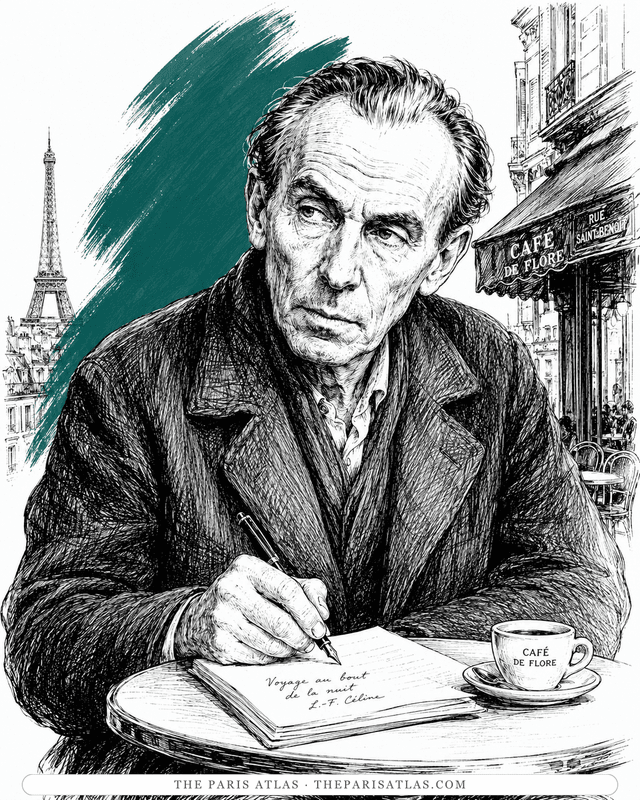
The other great stylist the Great War produced — where Hemingway cut the language down, Céline set it on fire. The same wound, opposite treatments.
View author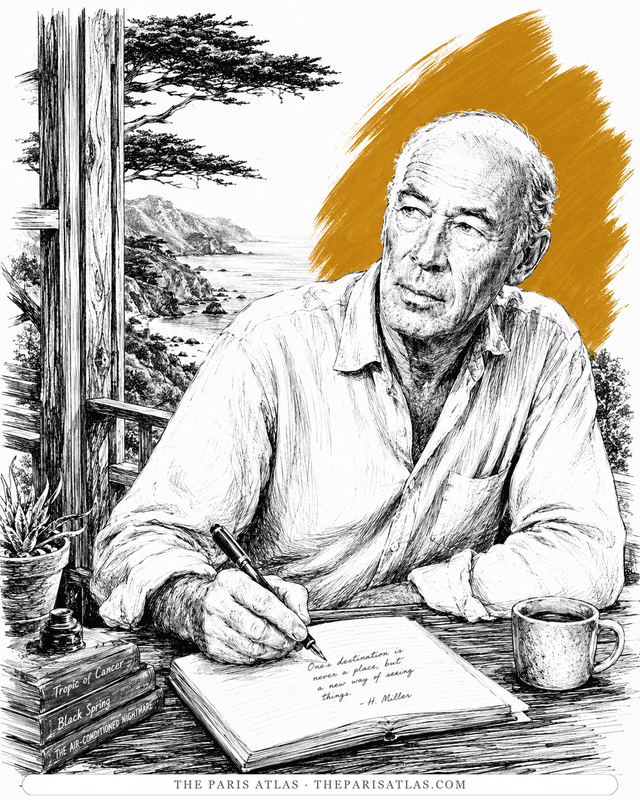
Paris on no money a decade later, with the restraint removed. Miller called Hemingway's Paris a tourist's Paris; readers get to referee.
View author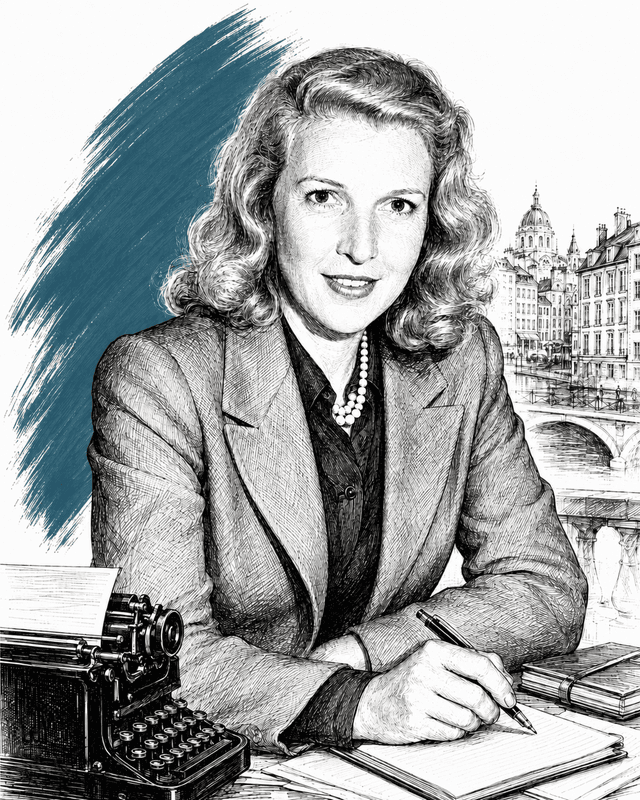
War correspondent who covered the Spanish Civil War, D-Day, and conflicts across five more decades; Hemingway's third wife, 1940–1945.
View author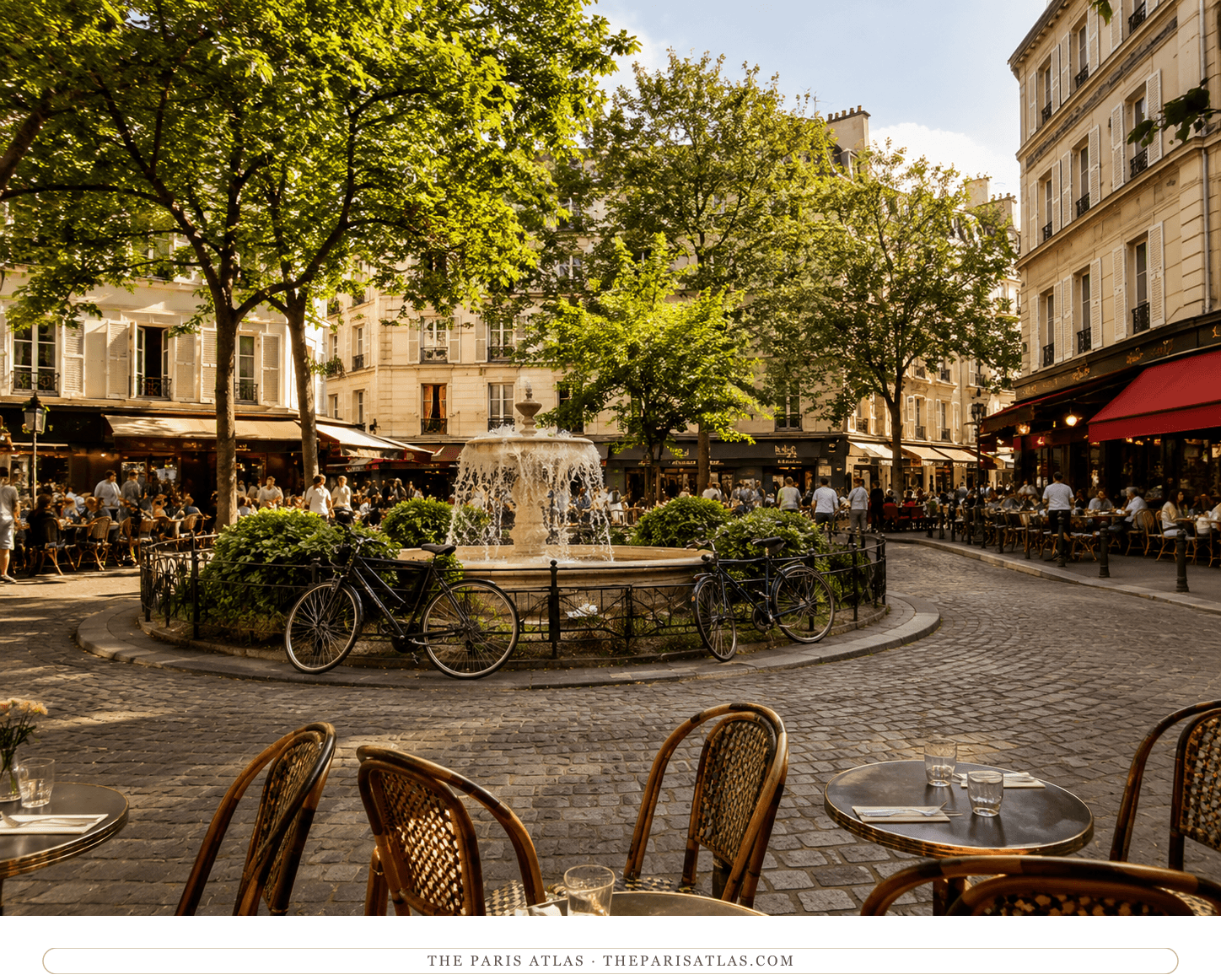
In the story
The small square at the top of the rue Mouffetard, a minute from Hemingway's first flat — now one of the quarter's prettiest corners. The novel visits it after dark.
Visit the place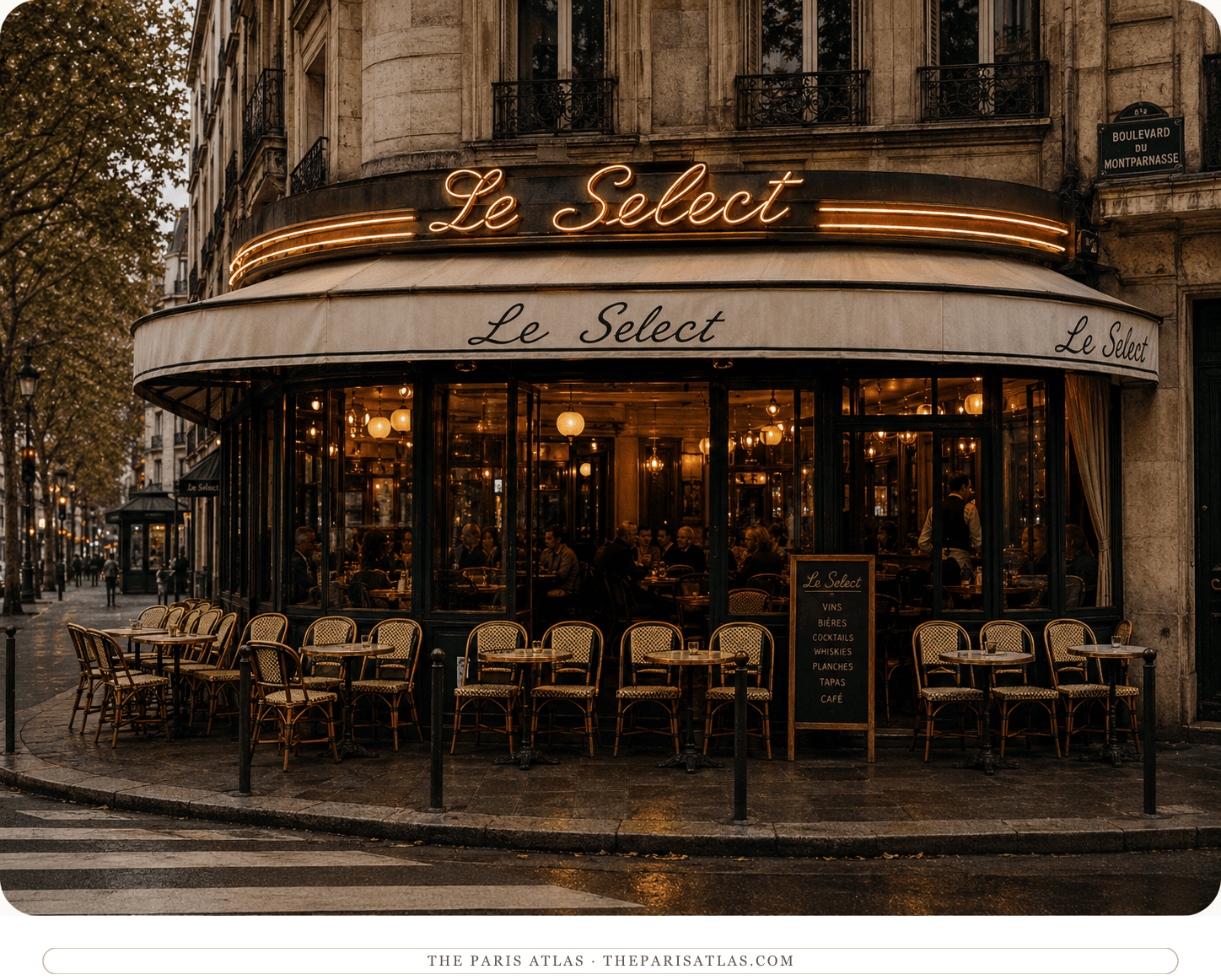
In the story
Open when everywhere else has closed — the last stop of every Montparnasse evening, and the long night-walk across Paris ends at its lights.
Visit the place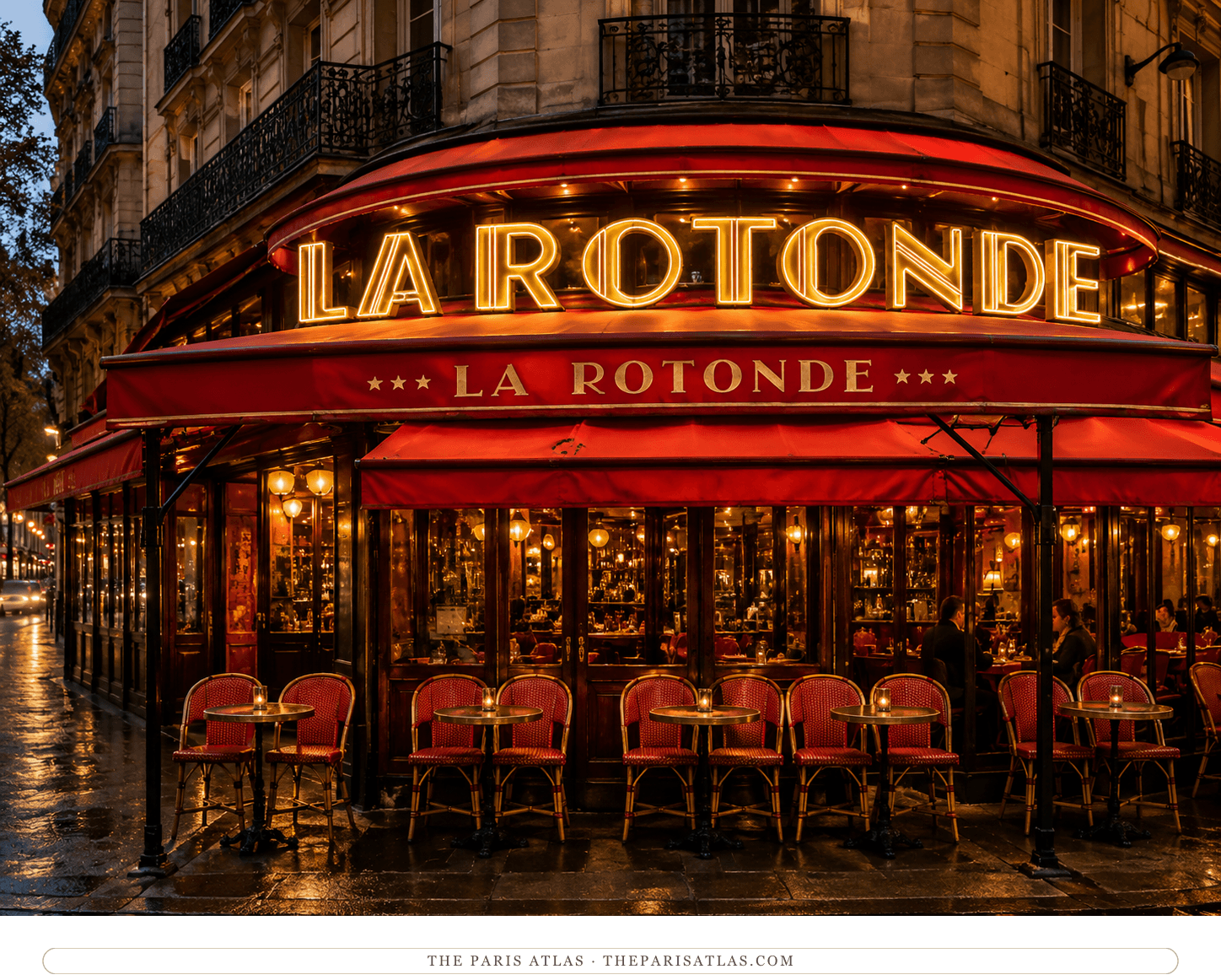
Mentioned
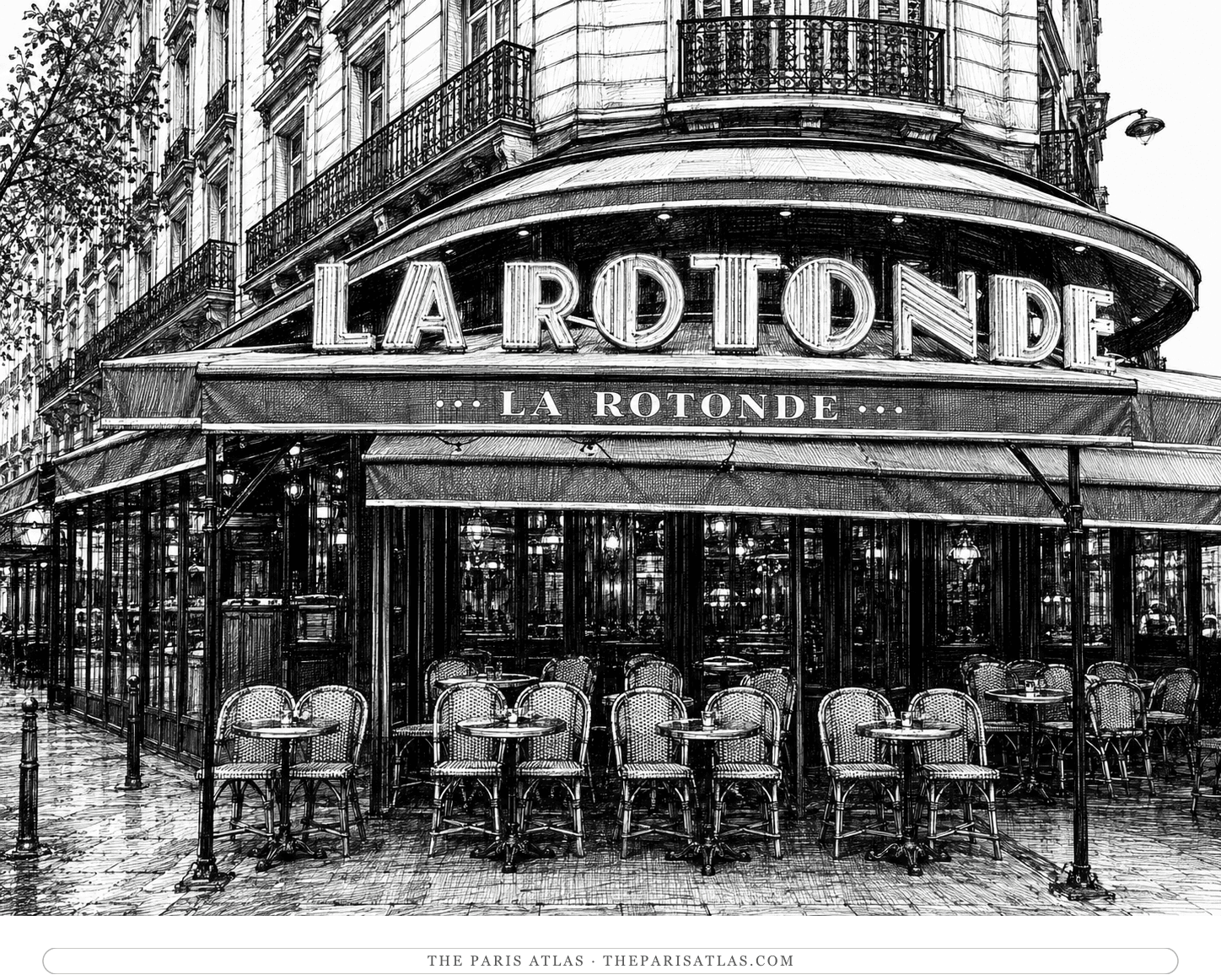
Target of the novel's driest joke: name any café in Montparnasse, and the taxi from the Right Bank still delivers you to the Rotonde.
Visit the place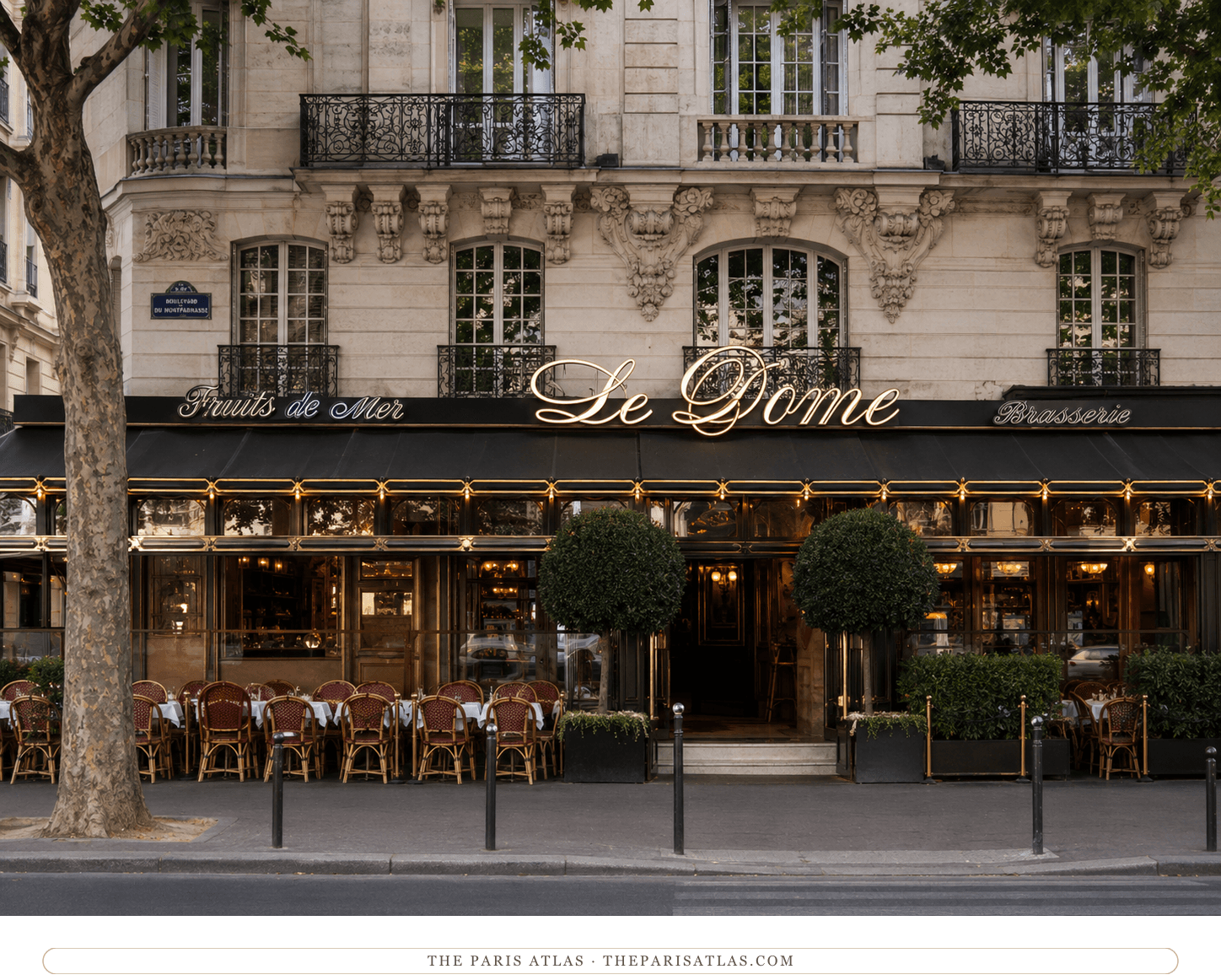
Mentioned
The other corner of Jake's nightly geography — he predicts the taxi drivers will make it the Rotonde's successor within ten years.
Visit the place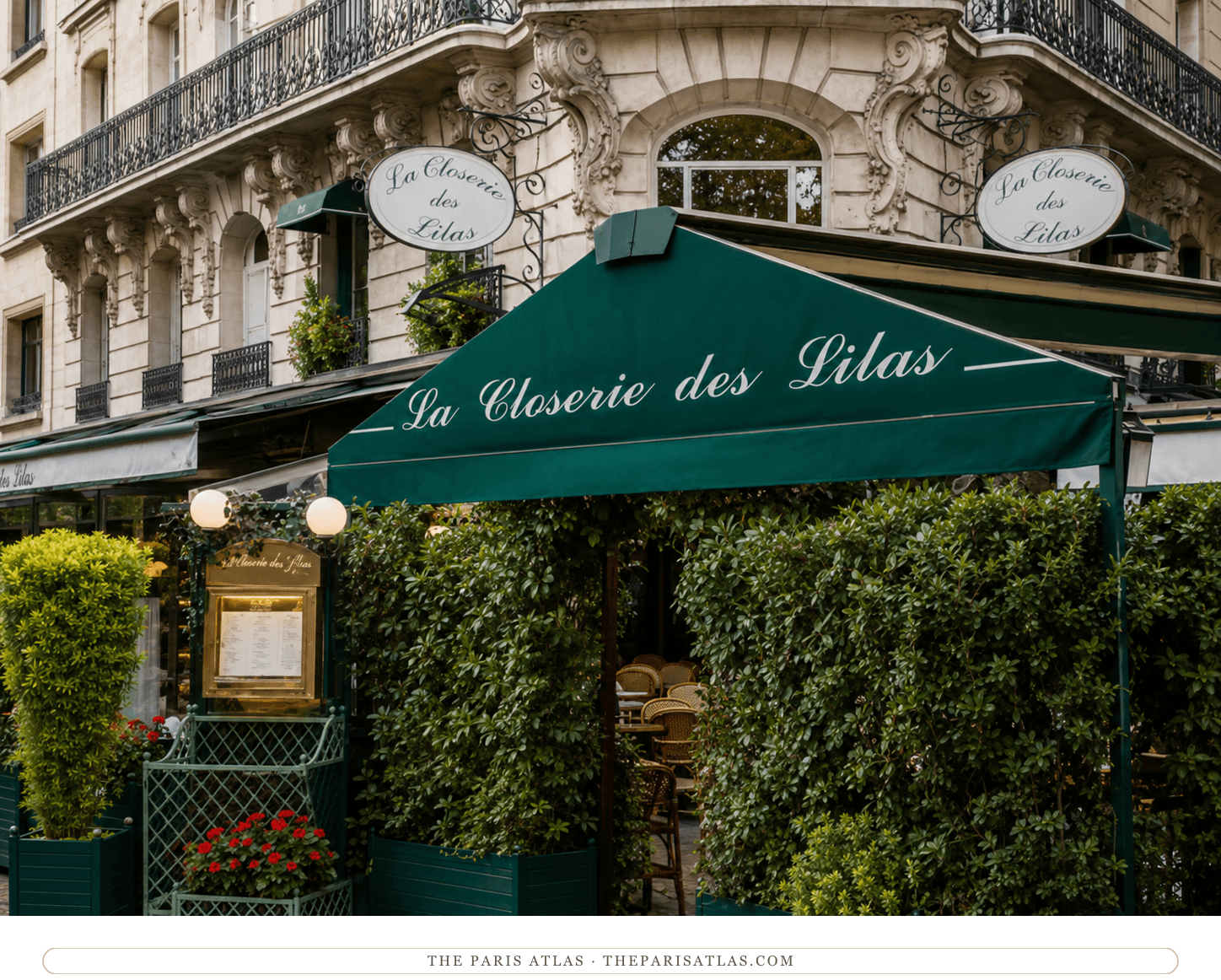
In the story · Written here
Jake walks home past Marshal Ney's statue outside the Lilas — and it was at these tables that Hemingway drafted most of the novel in the autumn of 1925.
Visit the place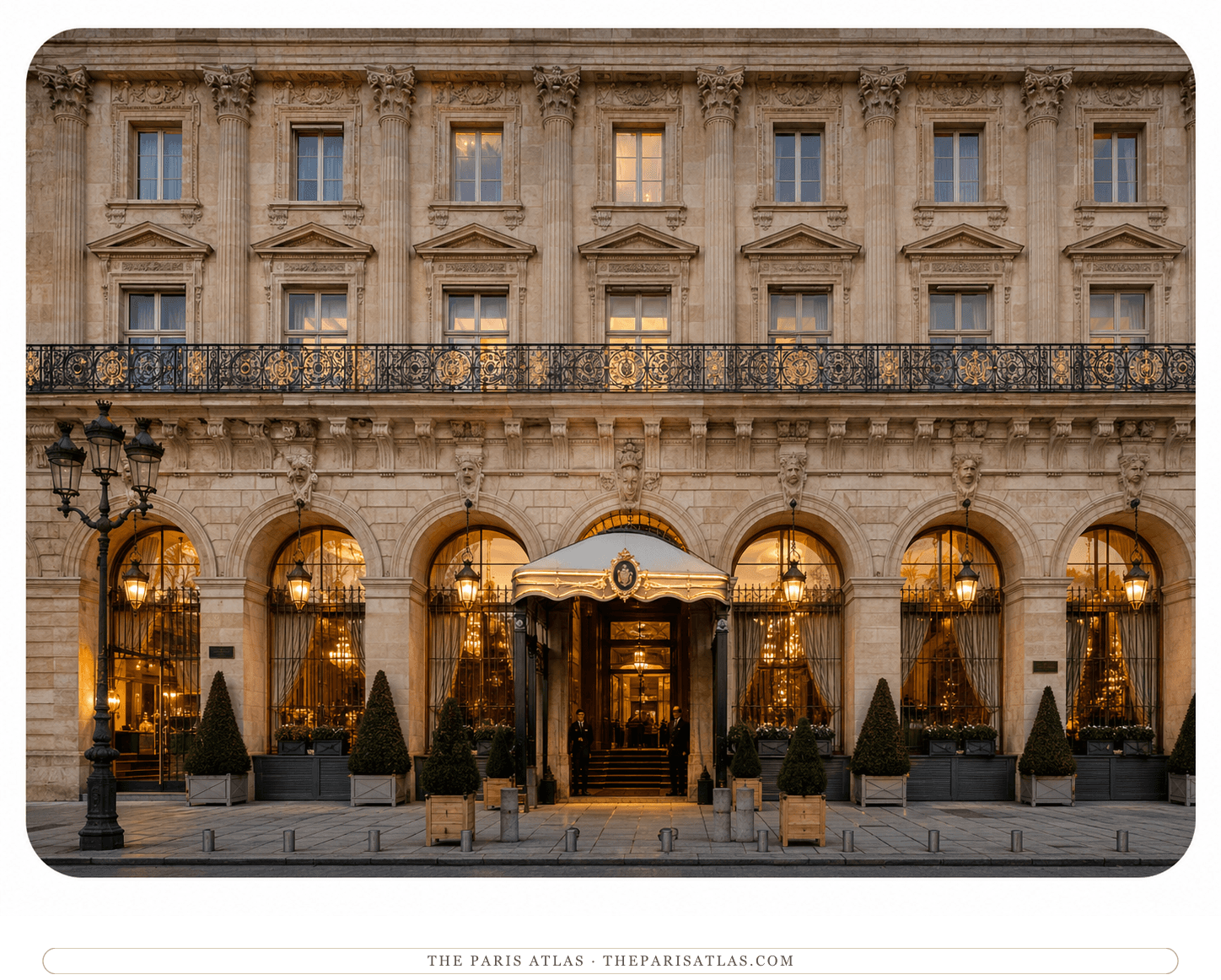
In the story
The Right Bank at its grandest: Jake writes letters on the house stationery, then heads down to the bar for a Jack Rose cocktail with George the barman.
Visit the place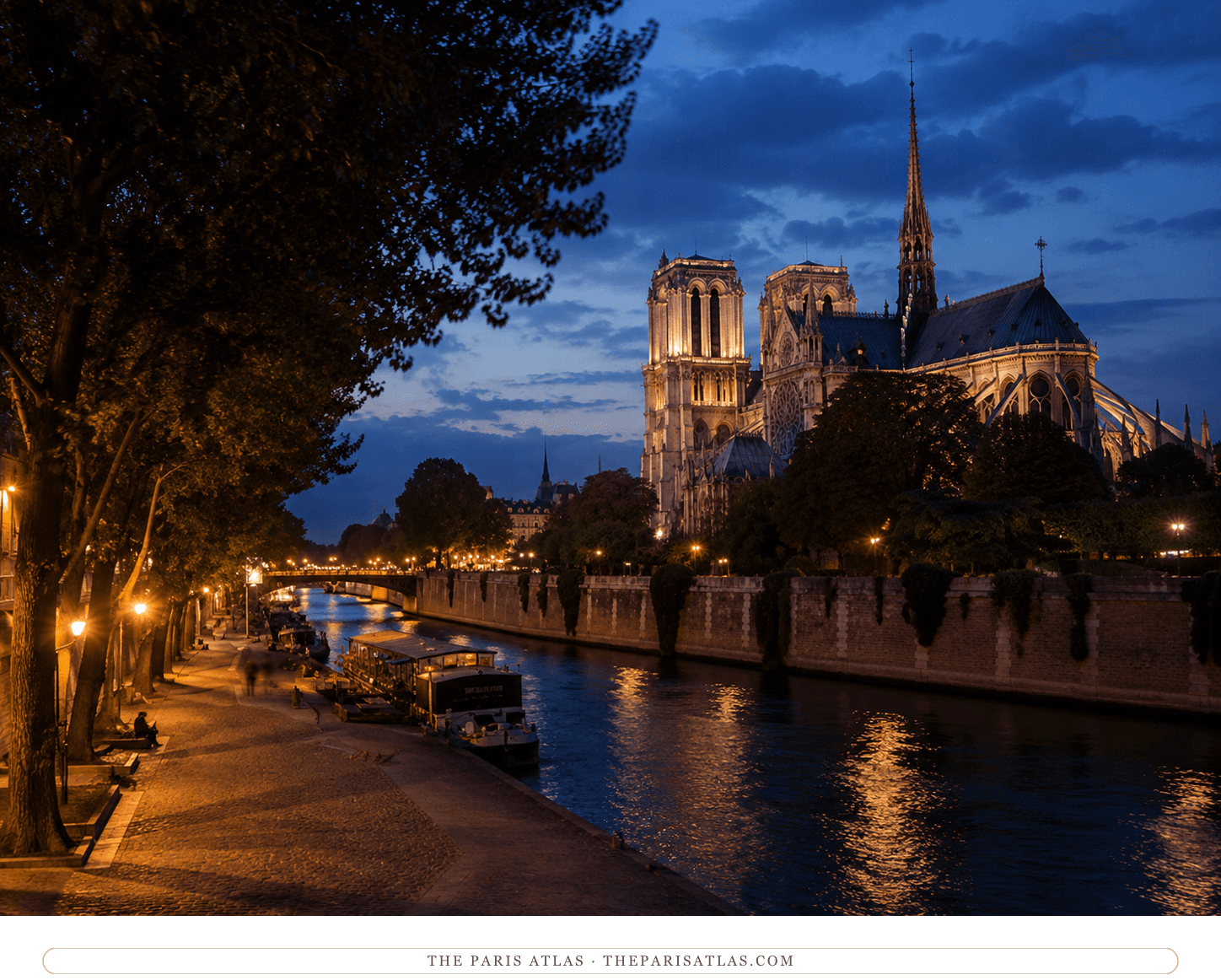
Depicted
Seen from the wooden footbridge off the Quai de Béthune, dark against the night sky — the quiet center of the novel's Paris.
Visit the place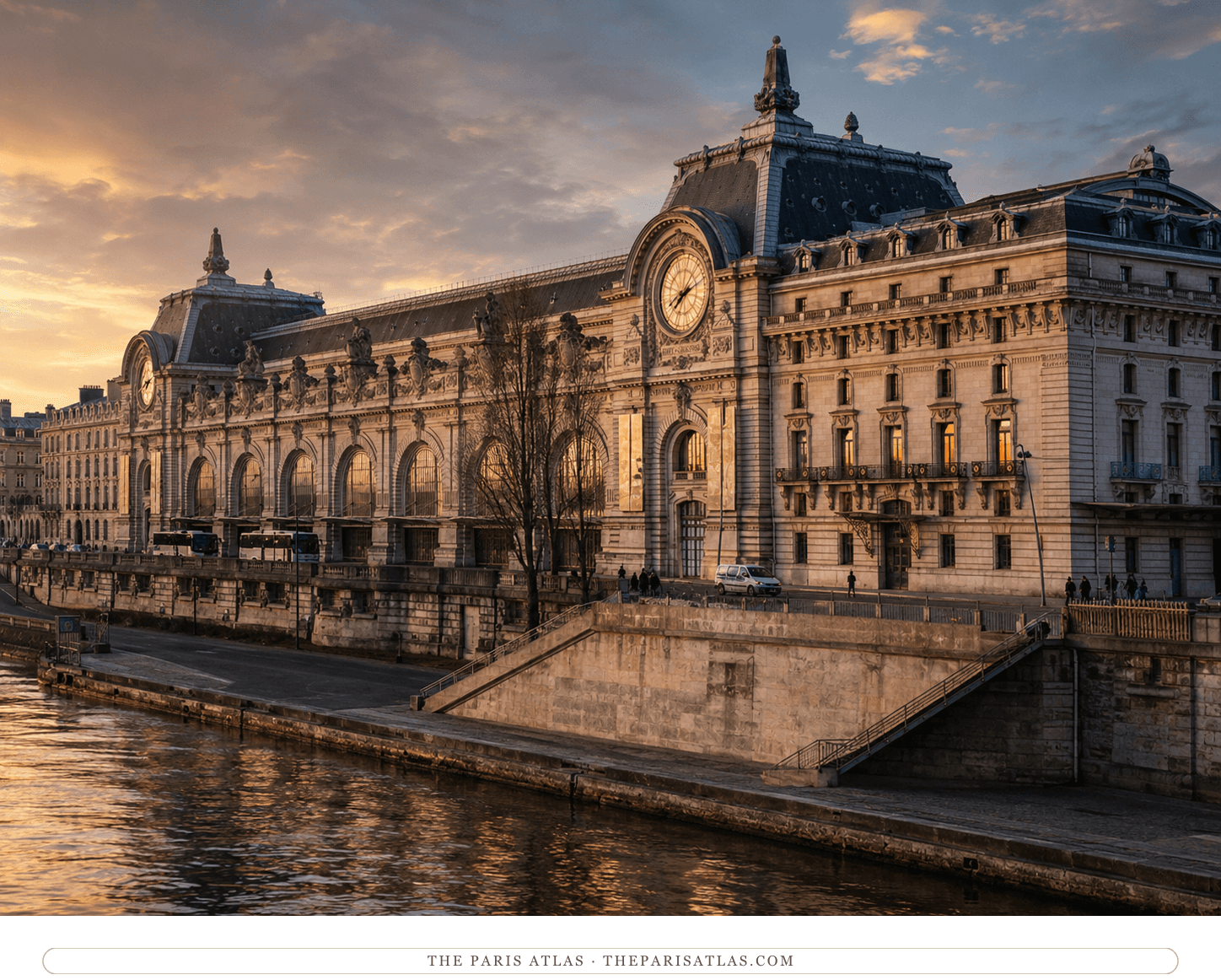
In the story
The morning train south leaves from here — Bill and Jake ride it to the Spanish border, and the novel leaves Paris behind. The station is now the Musée d'Orsay.
Visit the place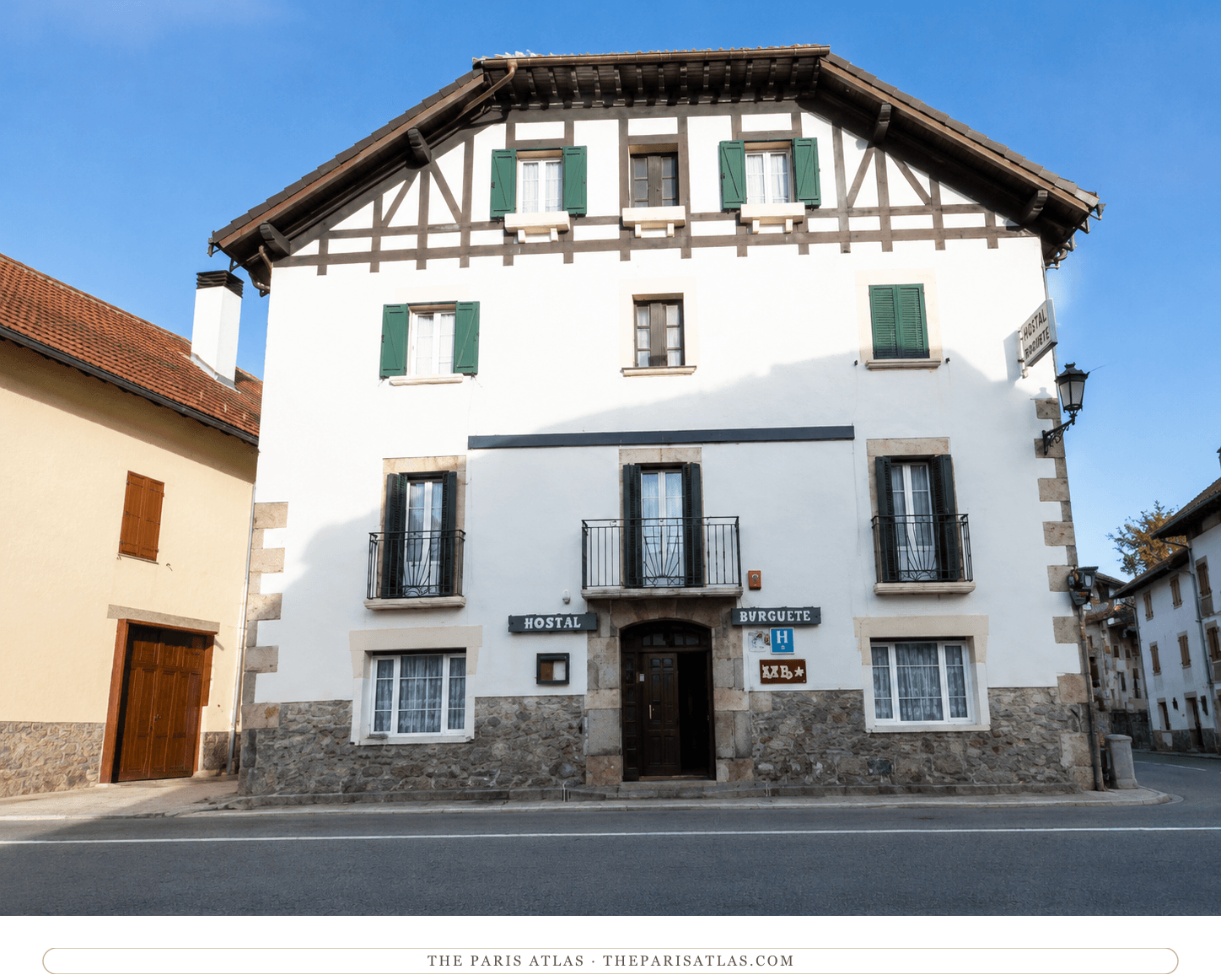
In the story
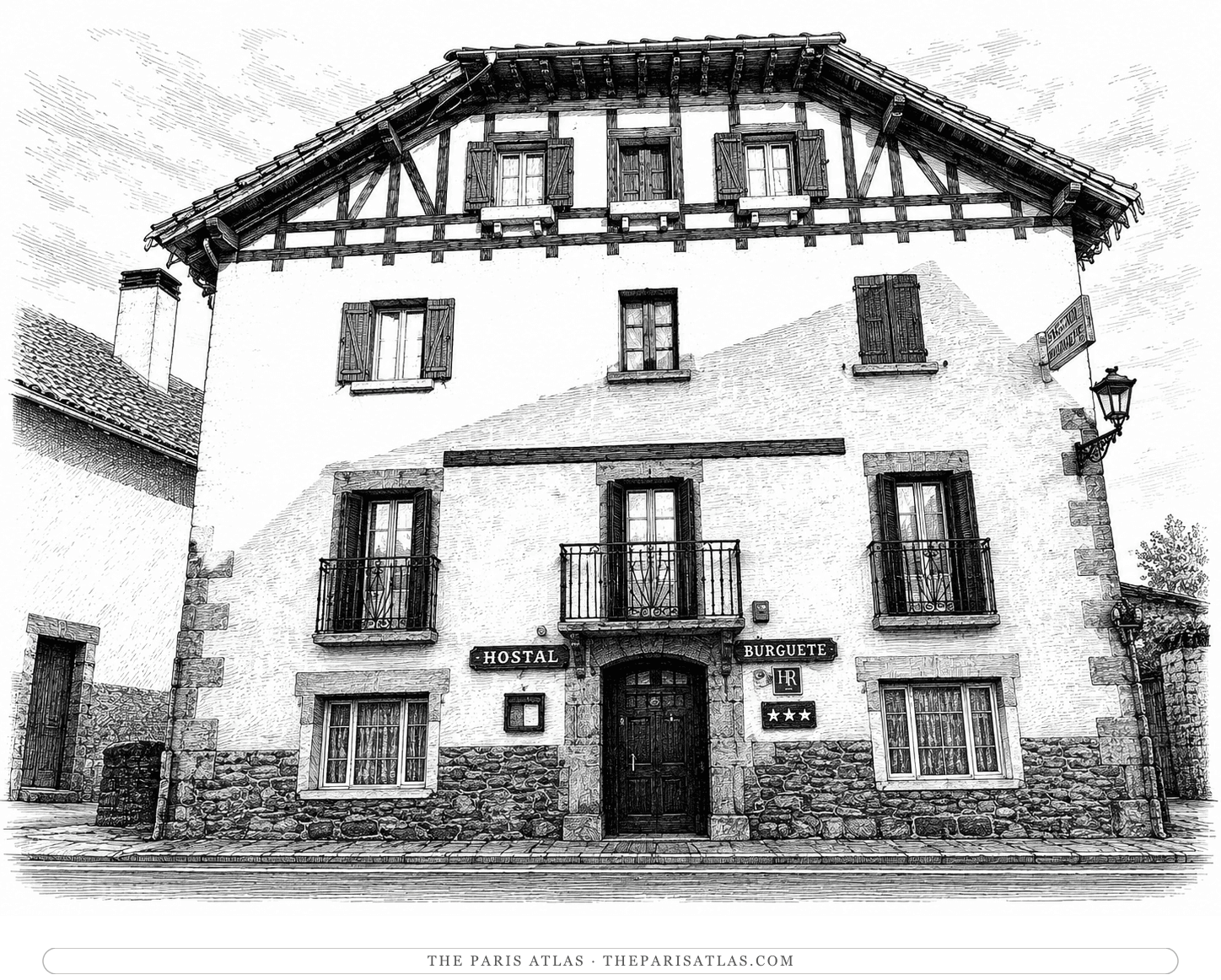
Chapters XI and XII lodge here — the freezing room, the hot rum punch, the trout suppers, and the packed lunches for the walk out to the fishing. The novel's one stretch of peace.
Visit the place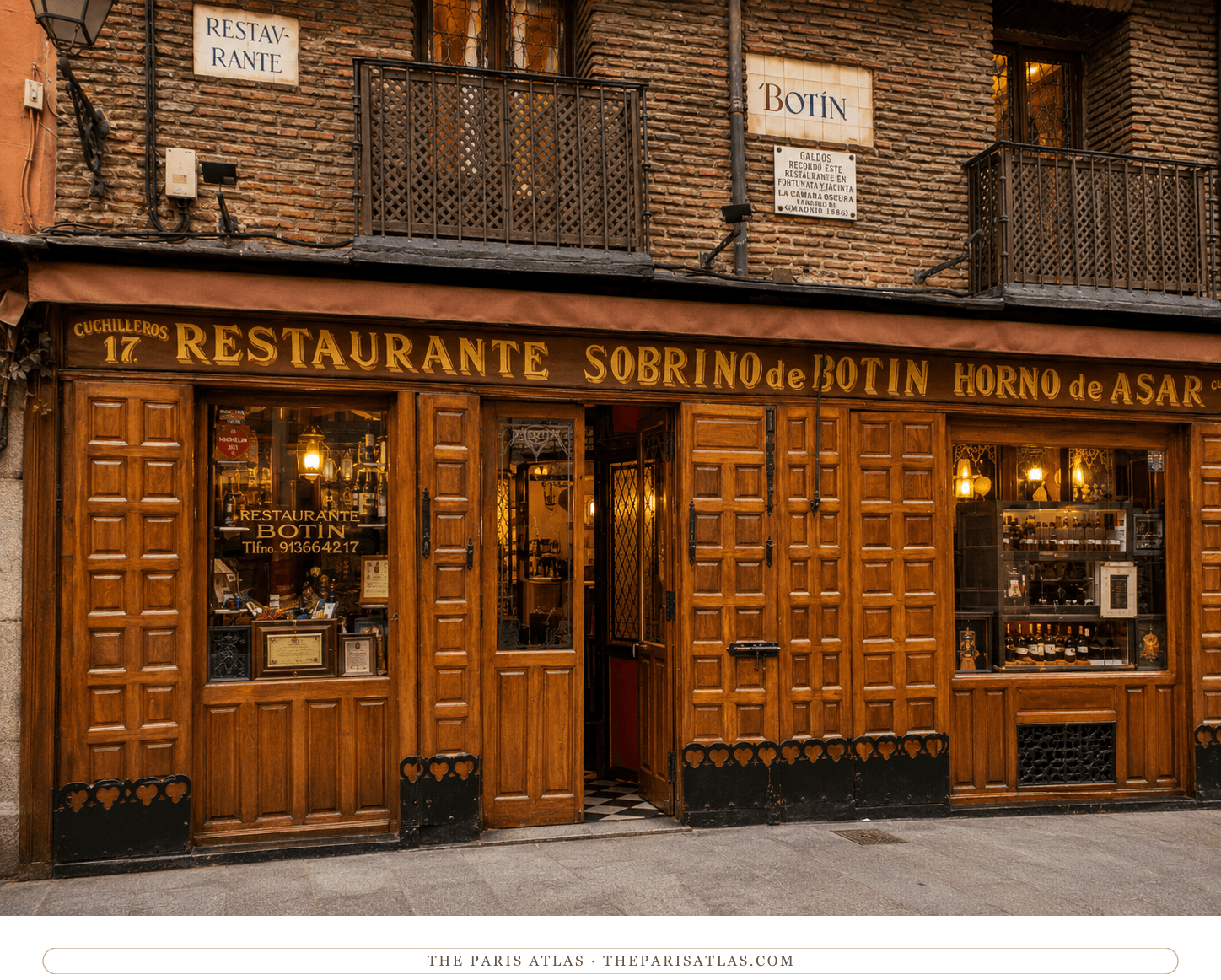
In the story
The last meal: roast young suckling pig and rioja alta in the upstairs room, before the final taxi ride and the book's closing line.
Visit the place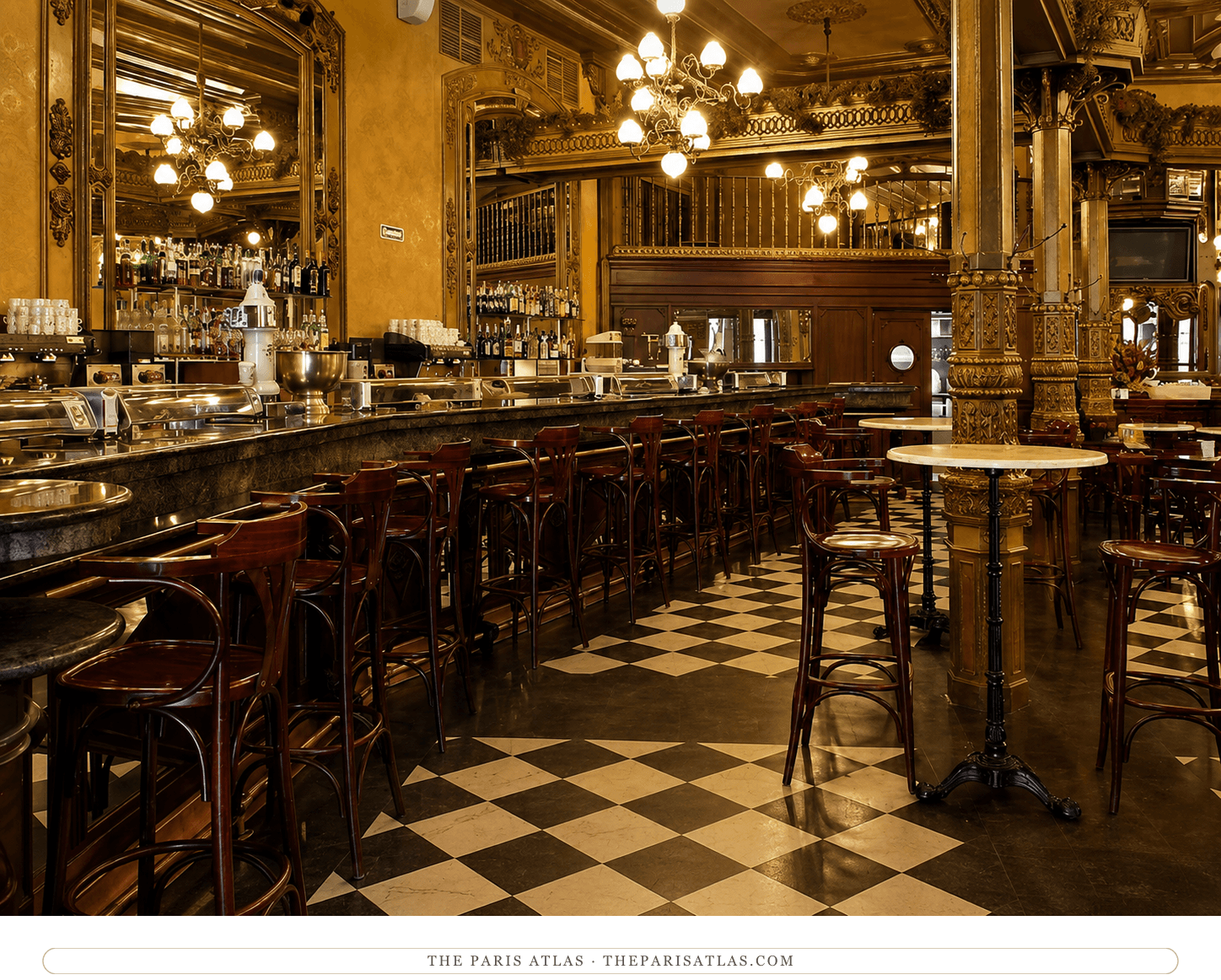
In the story
Named twelve times across chapters X, XIII and XV–XVII — the group's base in Pamplona, from the walk under the arcade on arrival to the meetings arranged there at noon during the fiesta.
Visit the place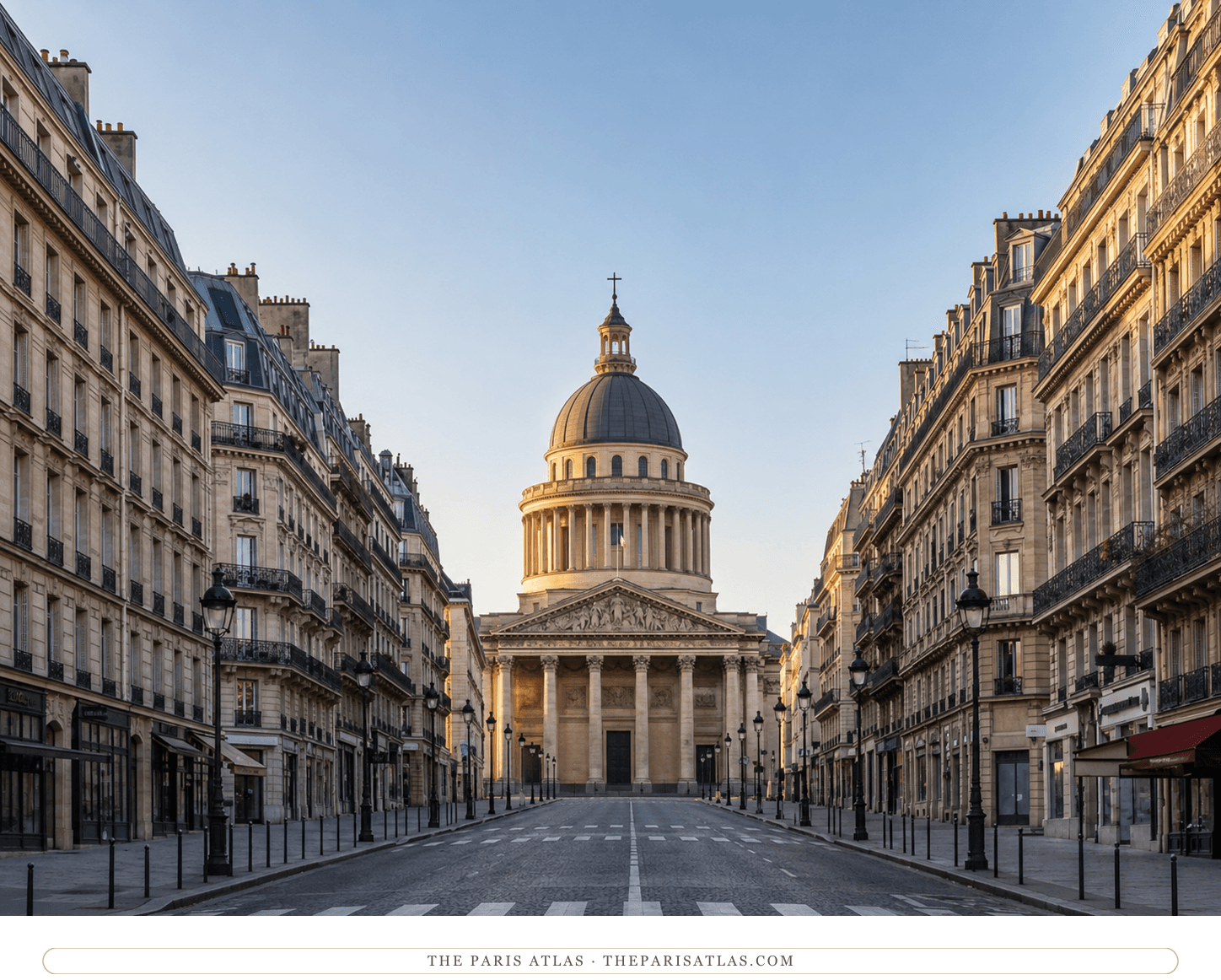
In the story
Chapter V. Jake Barnes walks down the boulevard for coffee and a brioche before work — the only morning the novel shows him at his job. Hemingway names the street and not the café, and the café has never been identified.
Visit the place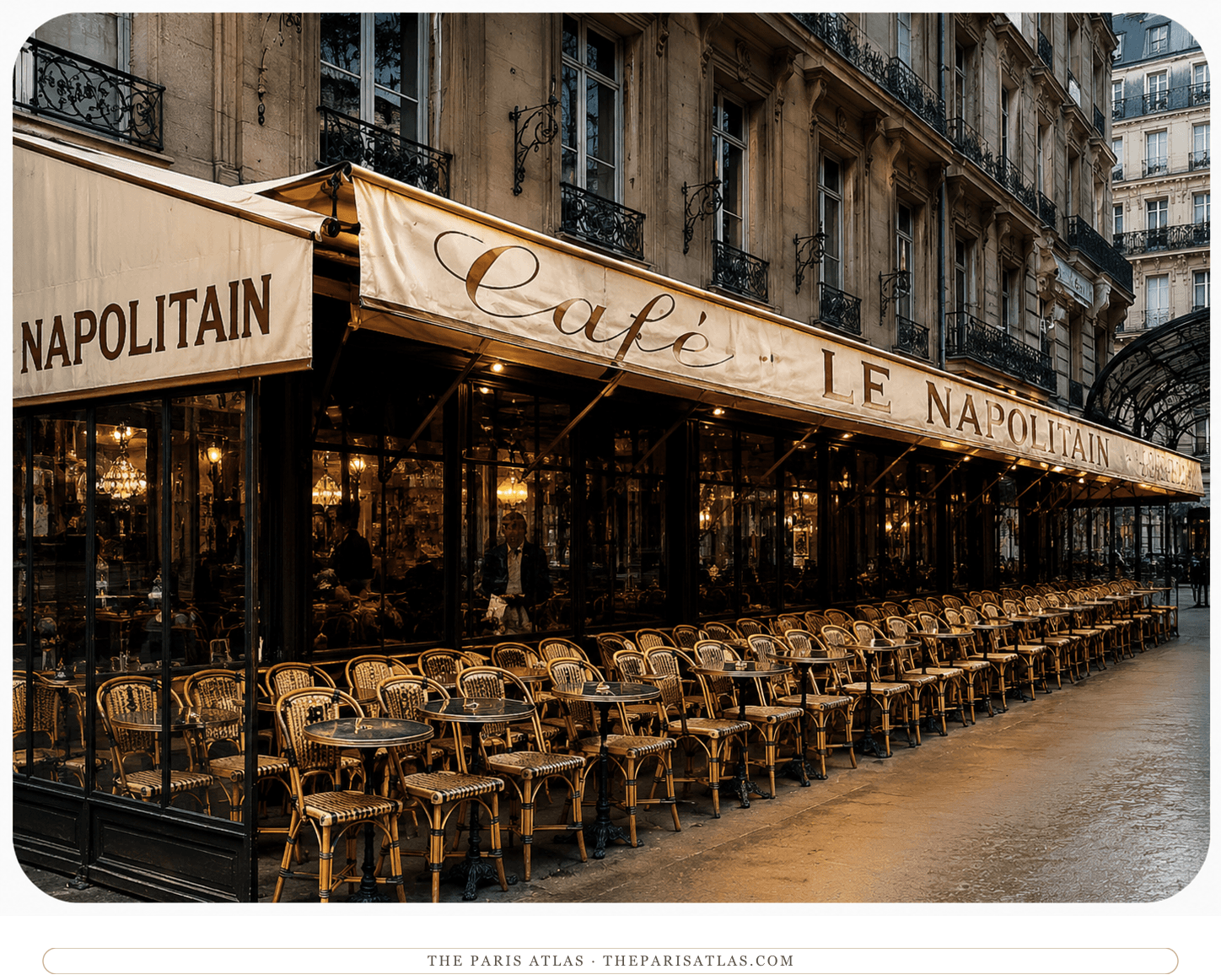
In the story
The book opens here — an apéritif on the Right Bank terrace, watching the evening crowd, the electric signs, and the last horse-cabs go by.
Visit the place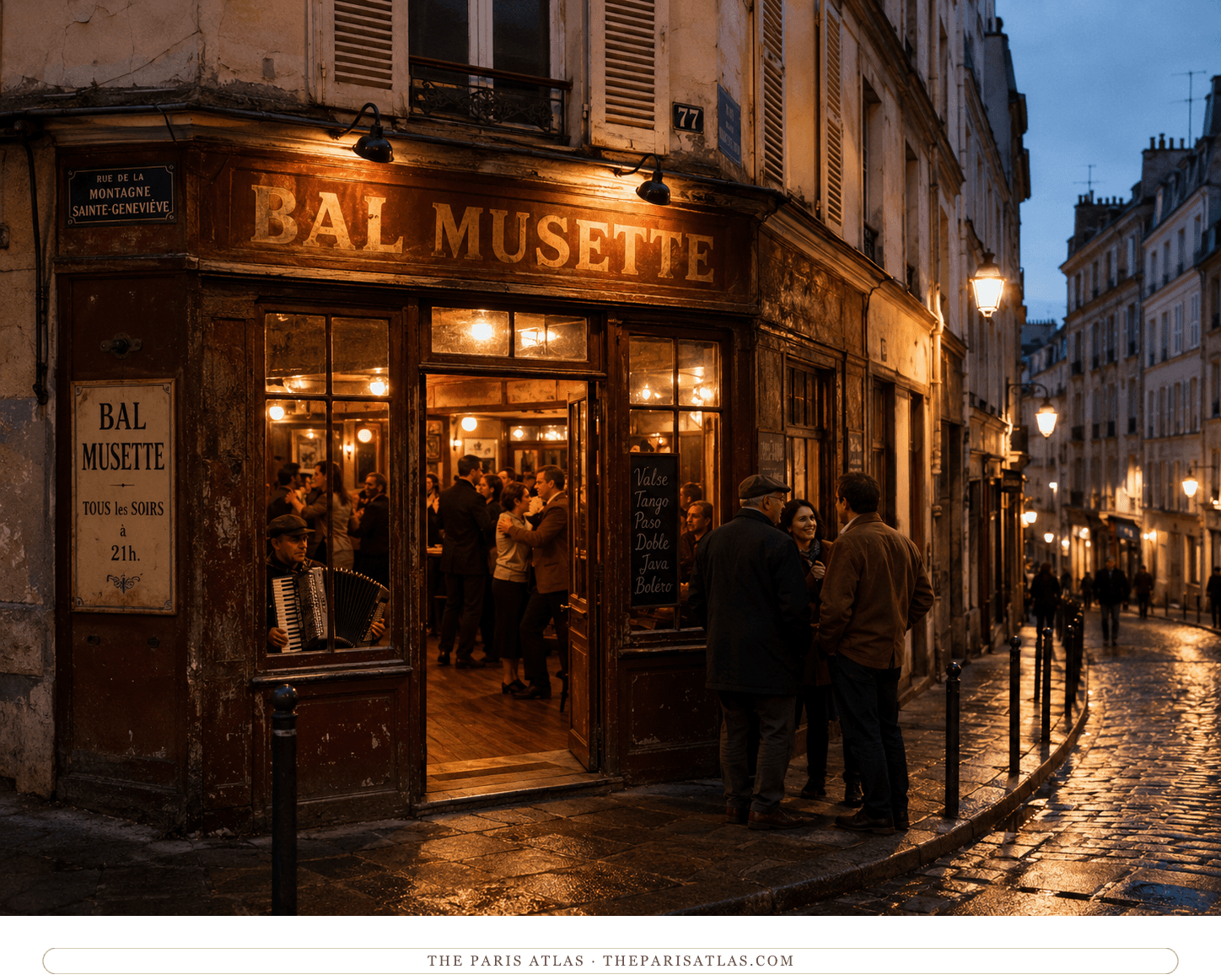
In the story
A working-class accordion dance hall in the Latin Quarter — the neighborhood danced there most nights, and the expatriate crowd borrowed it on Mondays.
Visit the place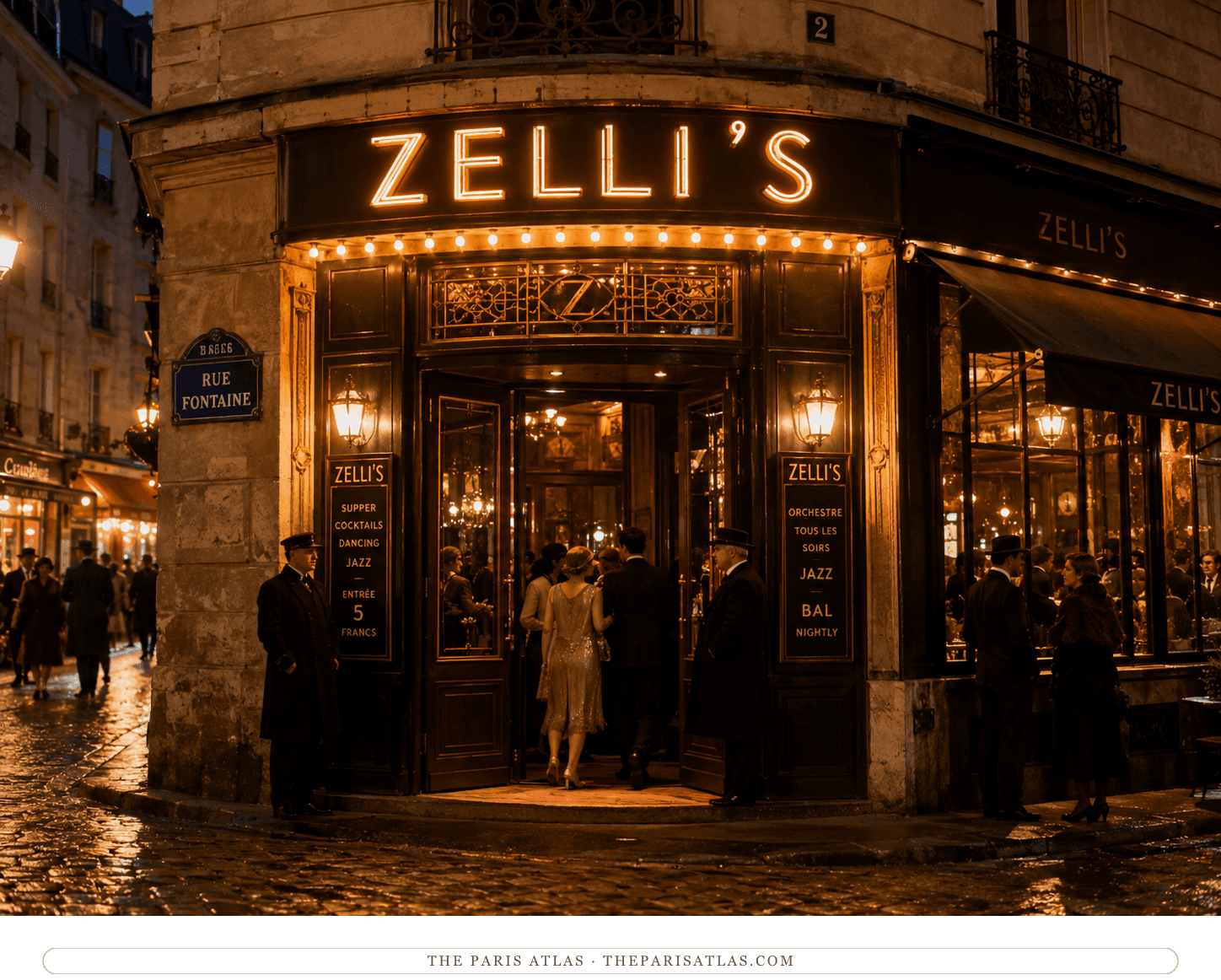
In the story
Crowded, smoky, and loud — the Montmartre boîte where the Paris nights end, the music hitting you at the door.
Visit the place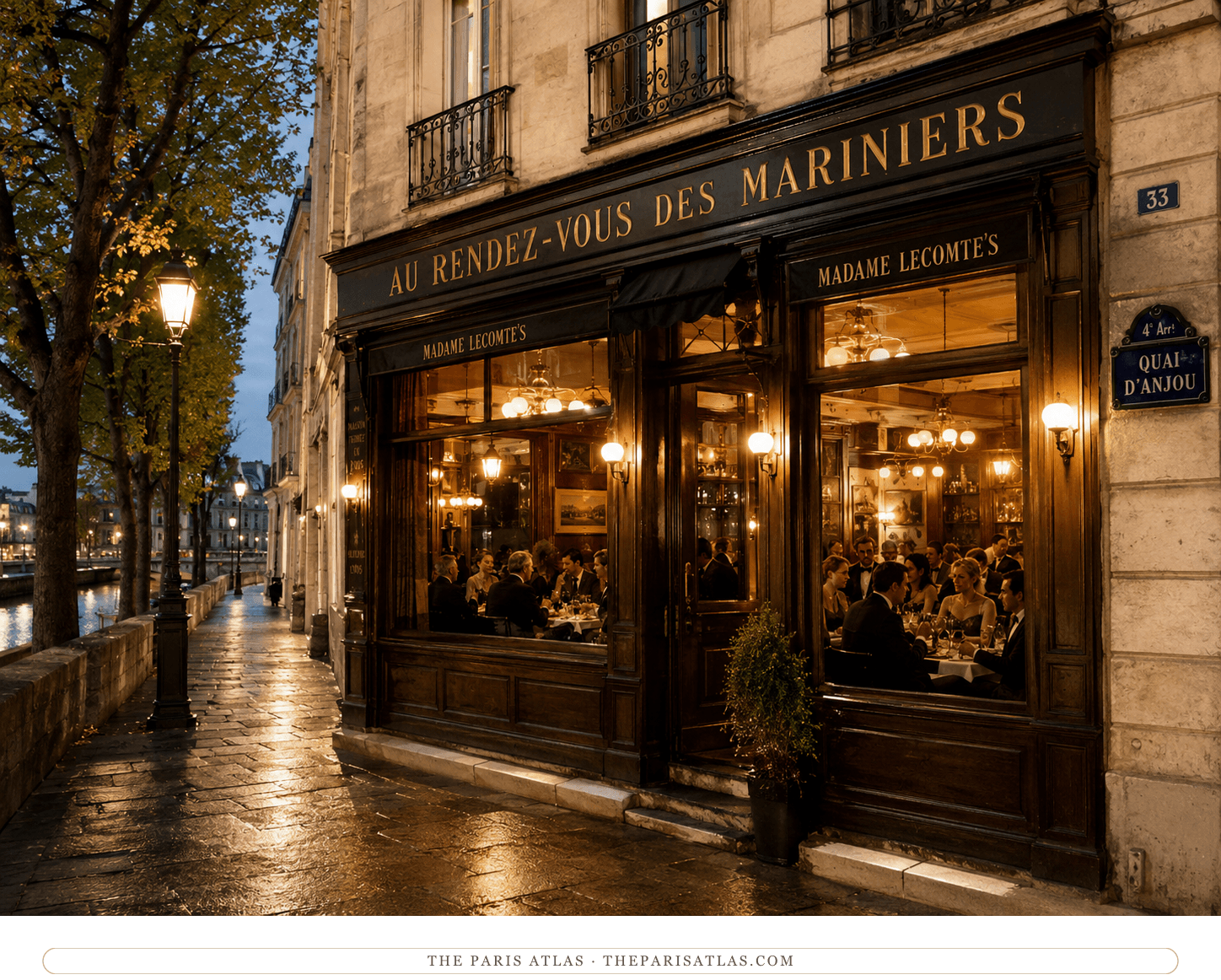
In the story
Bill and Jake's dinner on the far side of the Île Saint-Louis — wonderful food, and a forty-five-minute wait since the American Women's Club listed it.
Visit the place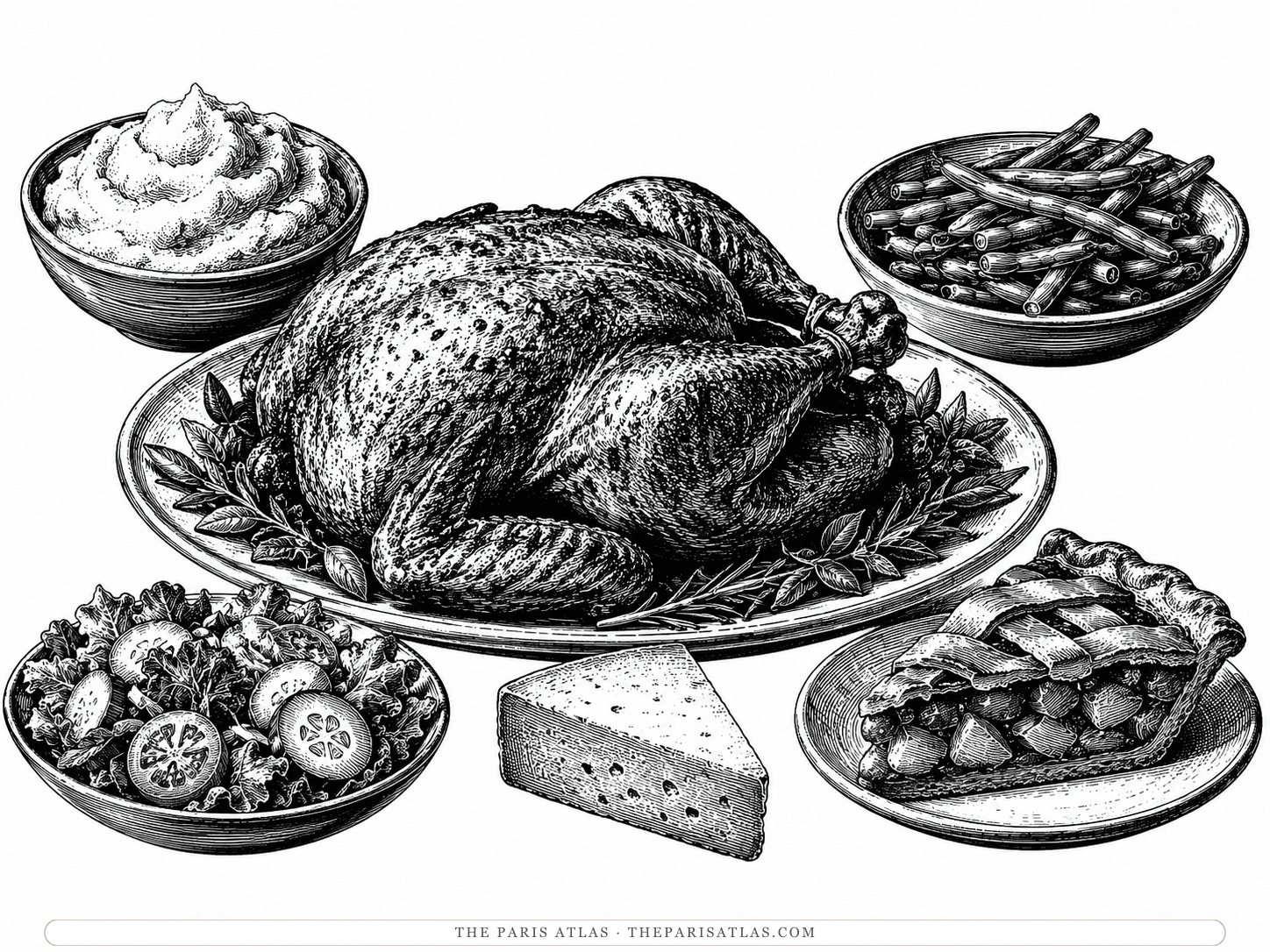
Chapter VIII — dinner with Bill on the Île Saint-Louis
We had a good meal, a roast chicken, new green beans, mashed potatoes, a salad, and some apple-pie and cheese.
Worth the forty-five-minute wait — an American women's club had just listed the place as 'untouched by Americans.'
Visit Madame Lecomte's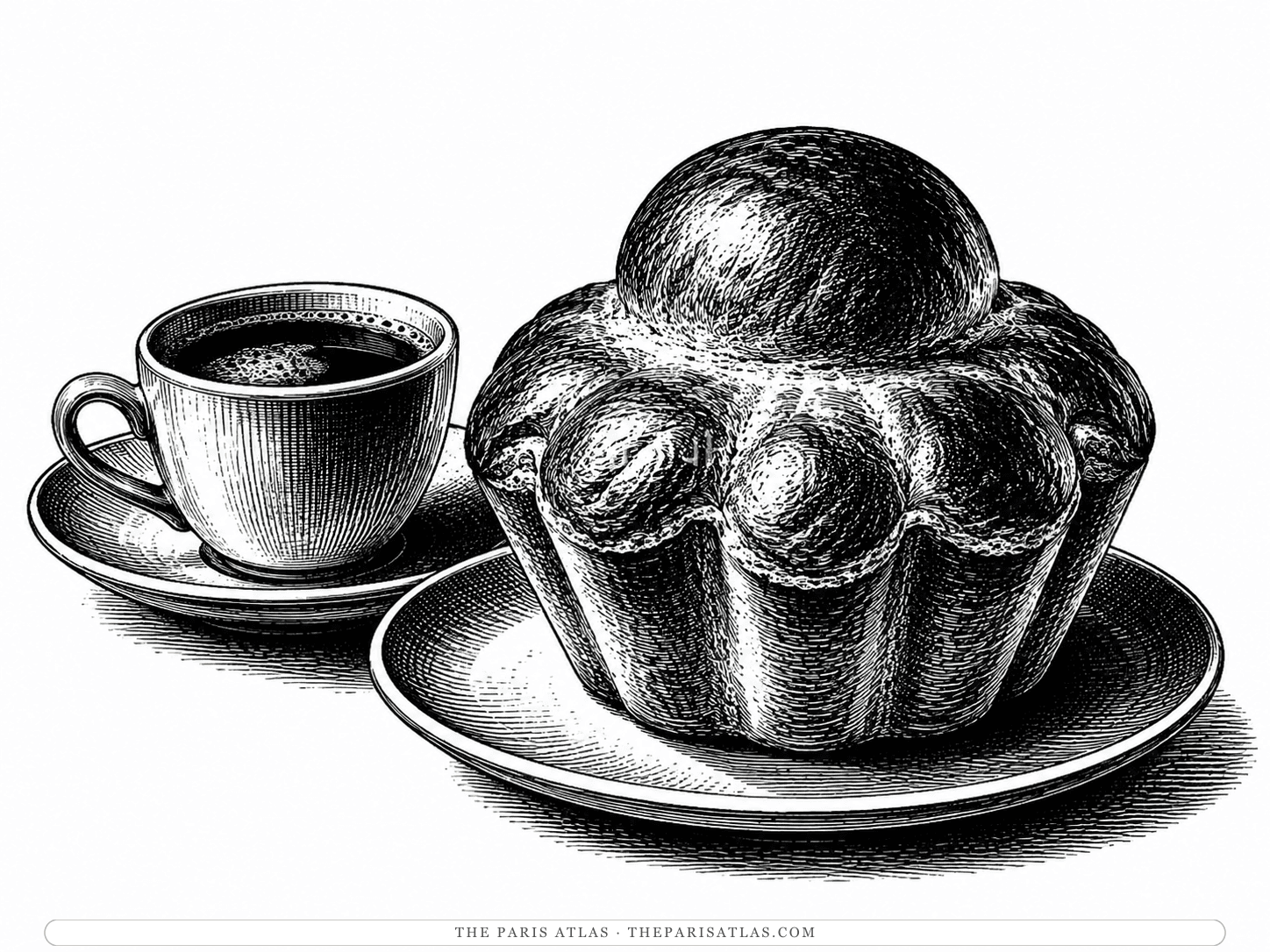
Chapter V — Jake's breakfast, alone
In the morning I walked down the Boulevard to the rue Soufflot for coffee and brioche. It was a fine morning. The horse-chestnut trees in the Luxembourg gardens were in bloom.
The book's quietest meal: one man, one cup, the papers, and the chestnuts in bloom. Hemingway names the street and not the café, and the café has never been identified.
Visit Rue Soufflot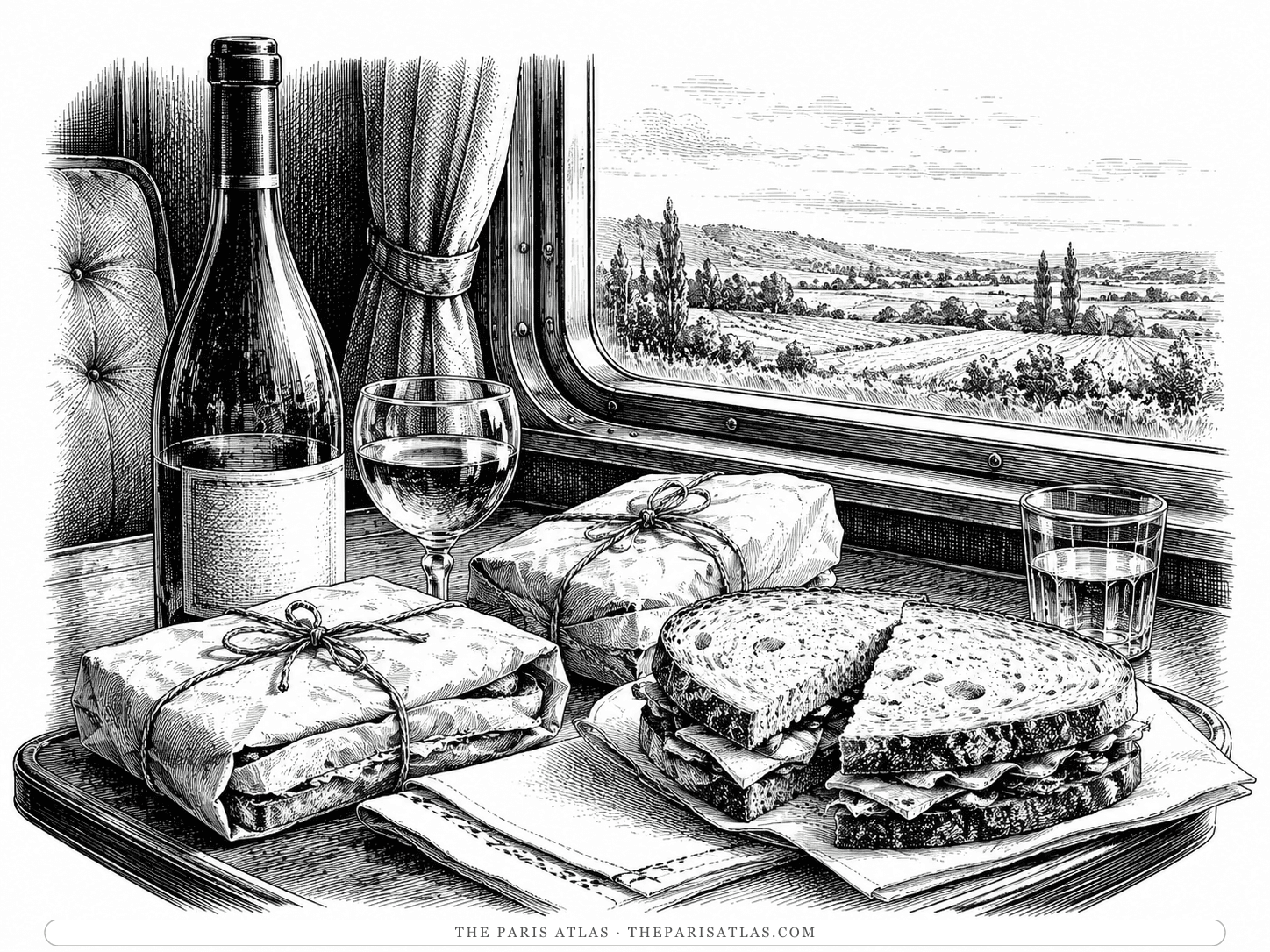
Chapter IX — the train from Paris to Bayonne
We ate the sandwiches and drank the Chablis and watched the country out of the window. The grain was just beginning to ripen and the fields were full of poppies. The pastureland was green, and there were fine trees, and sometimes big rivers and chateaux off in the trees.
Seven carloads of American pilgrims returning from Rome had the dining car booked until half past three, so a waiter brought lunch to the compartment instead.
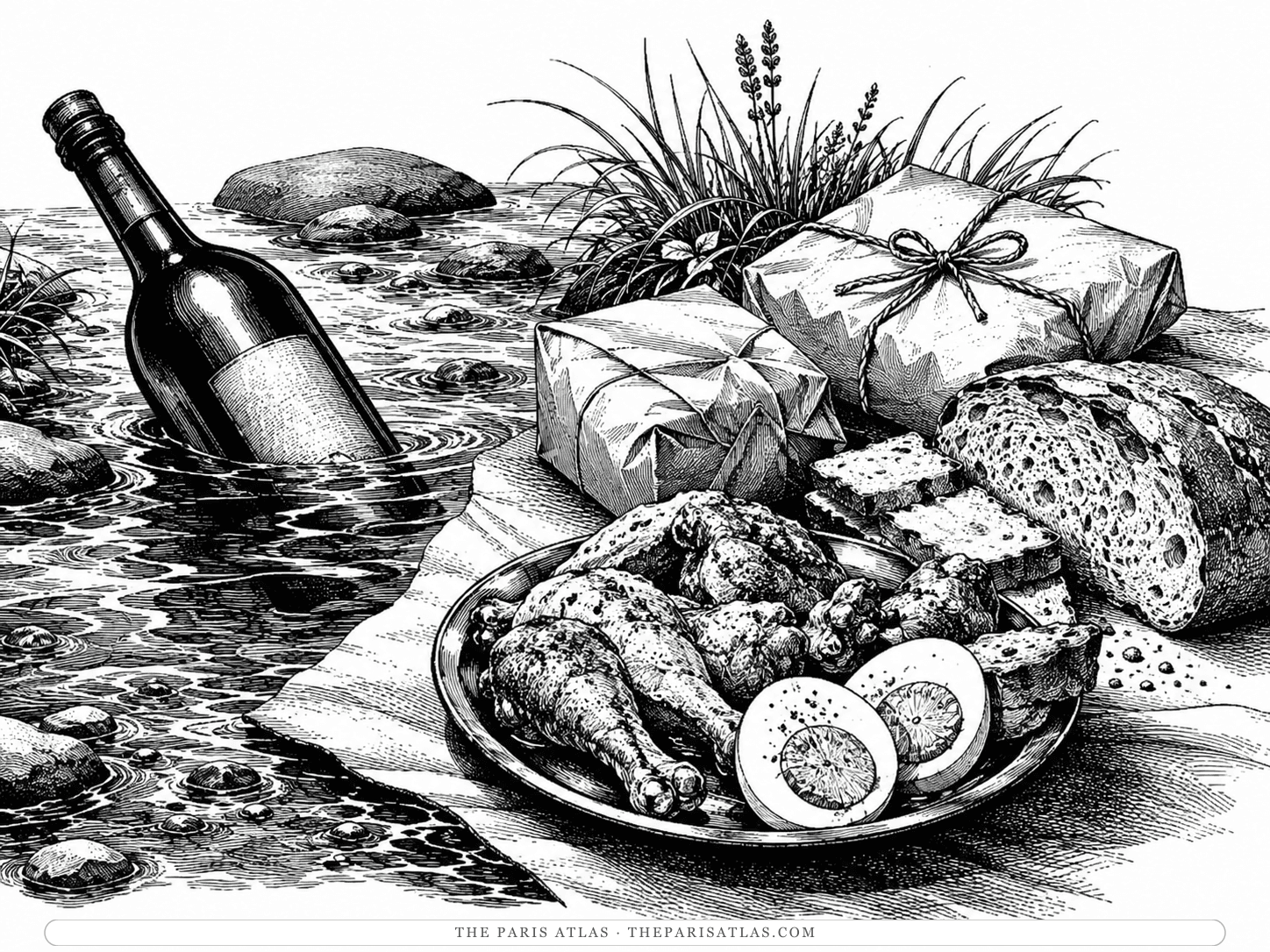
Chapter XII — the fishing picnic, wine chilled in the stream
The wine was icy cold and tasted faintly rusty. “That’s not such filthy wine,” Bill said. “The cold helps it,” I said. We unwrapped the little parcels of lunch. “Chicken.” “There’s hard-boiled eggs.” “Find any salt?” “First the egg,” said Bill. “Then the chicken. Even Bryan could see that.”
The bottles were wedged against roots in the spring at dawn — the era's best-documented wine cooler.
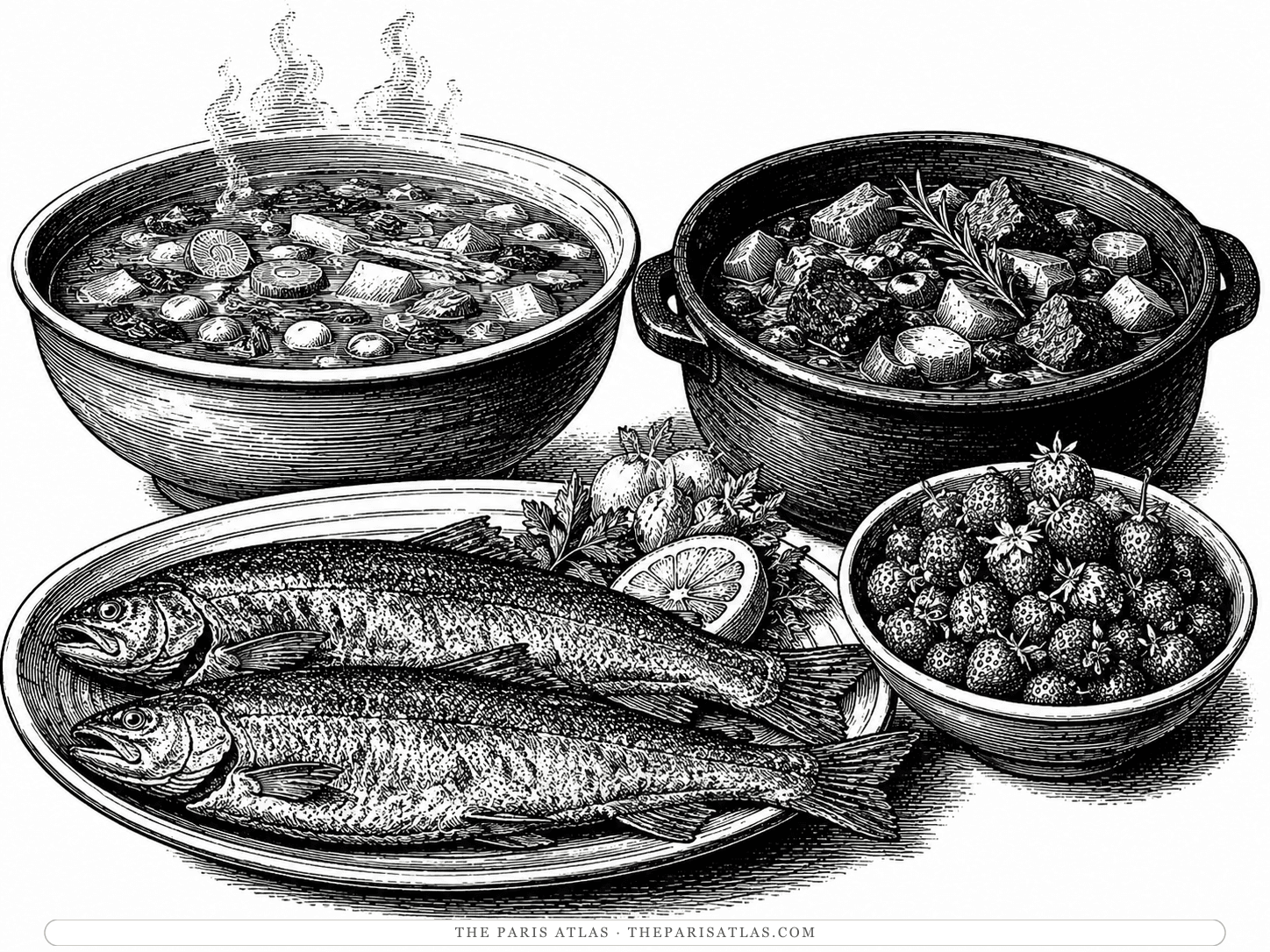
Chapter XI — the cold first night in the mountains
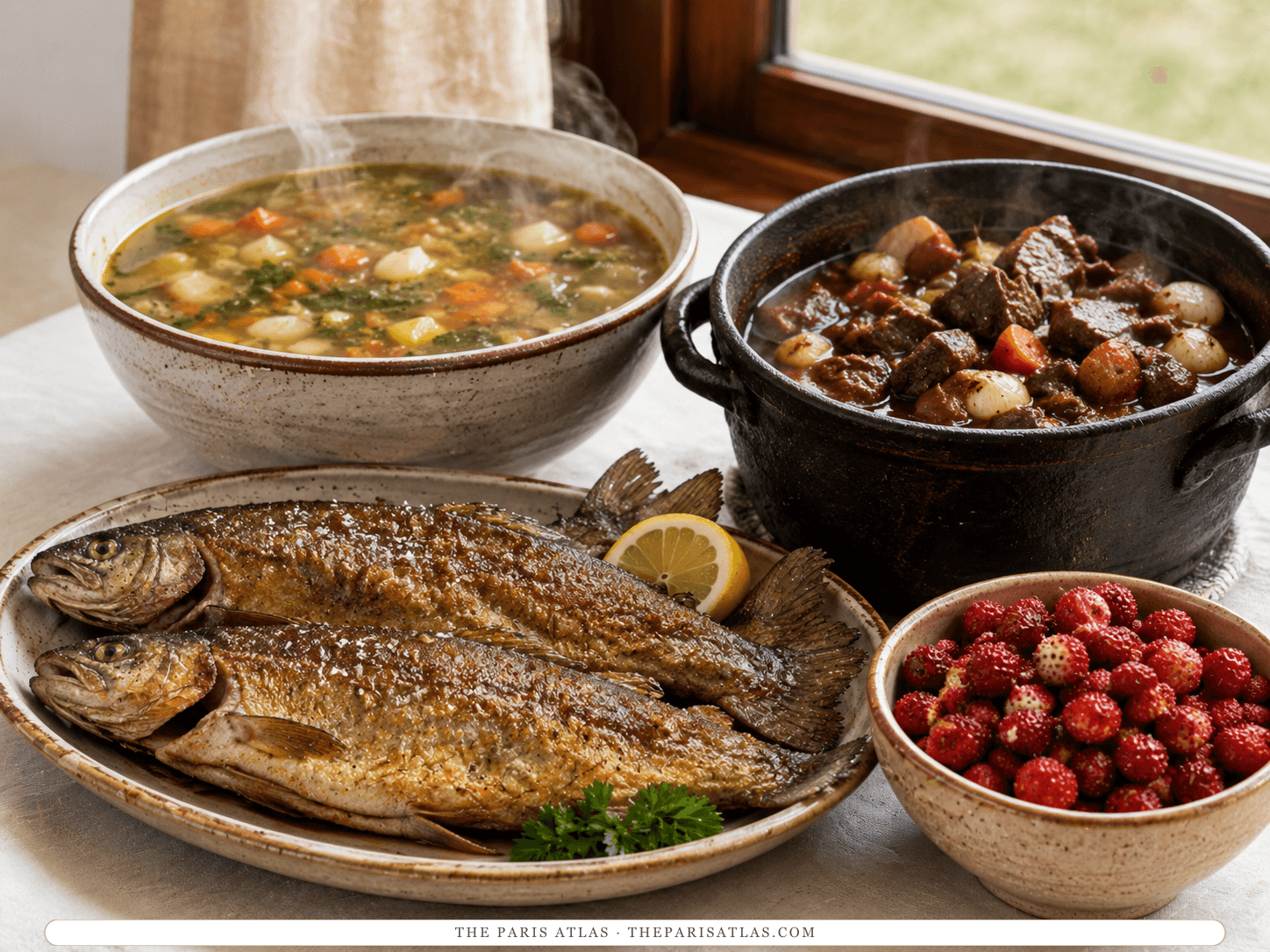
The girl brought in a big bowl of hot vegetable soup and the wine. We had fried trout afterward and some sort of a stew and a big bowl full of wild strawberries.
'We did not lose money on the wine,' the next line reports — the room was freezing and the bottles kept coming.
Visit Hostal Burguete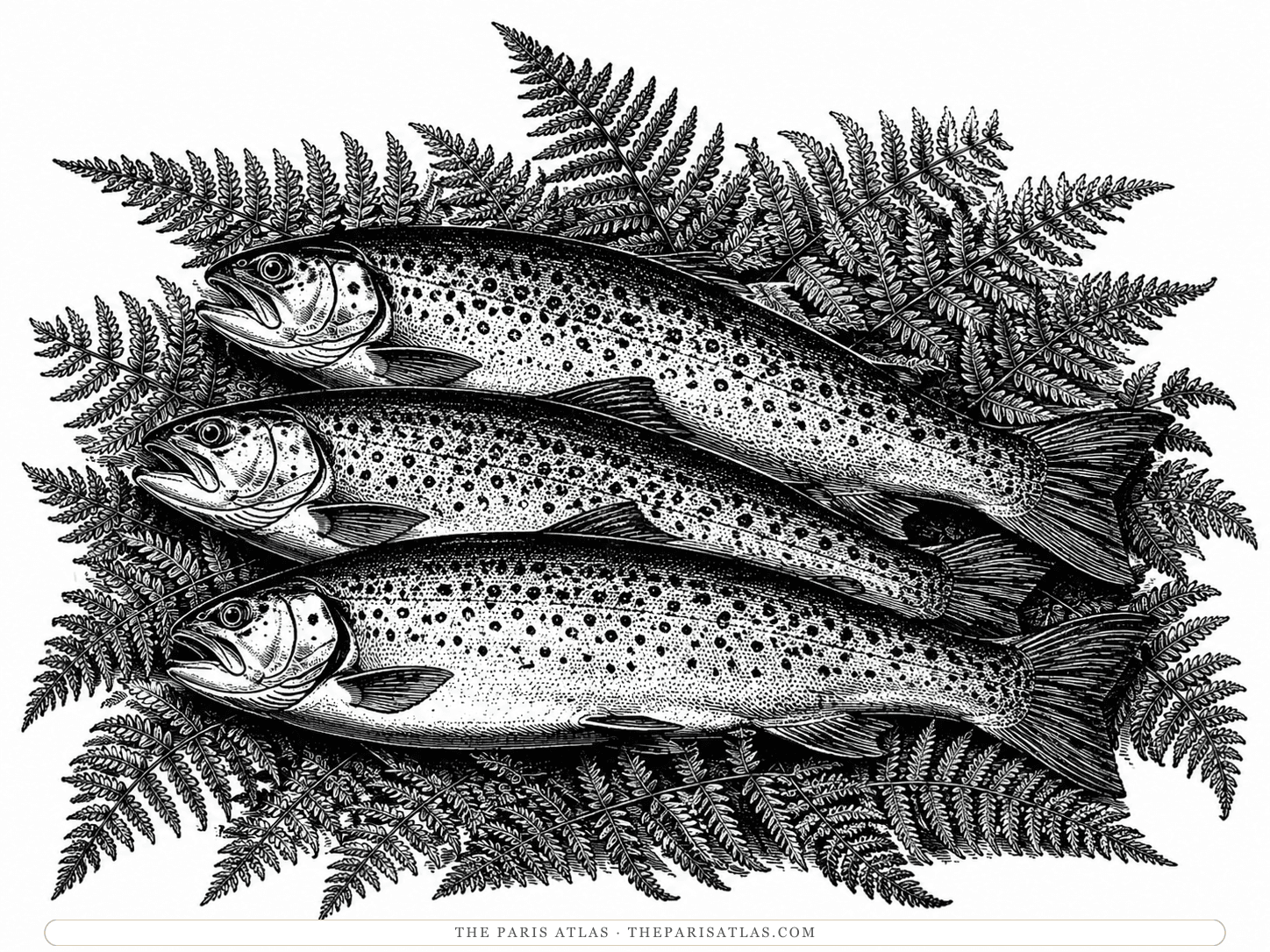
Chapter XII — provisioning as art
I took the trout ashore, washed them in the cold, smoothly heavy water above the dam, and then picked some ferns and packed them all in the bag, three trout on a layer of ferns, then another layer of ferns, then three more trout, and then covered them with ferns.
Not a meal — the making of one. The catch, washed and packed in layers of ferns for the walk home — the book gives the whole process its own paragraph.
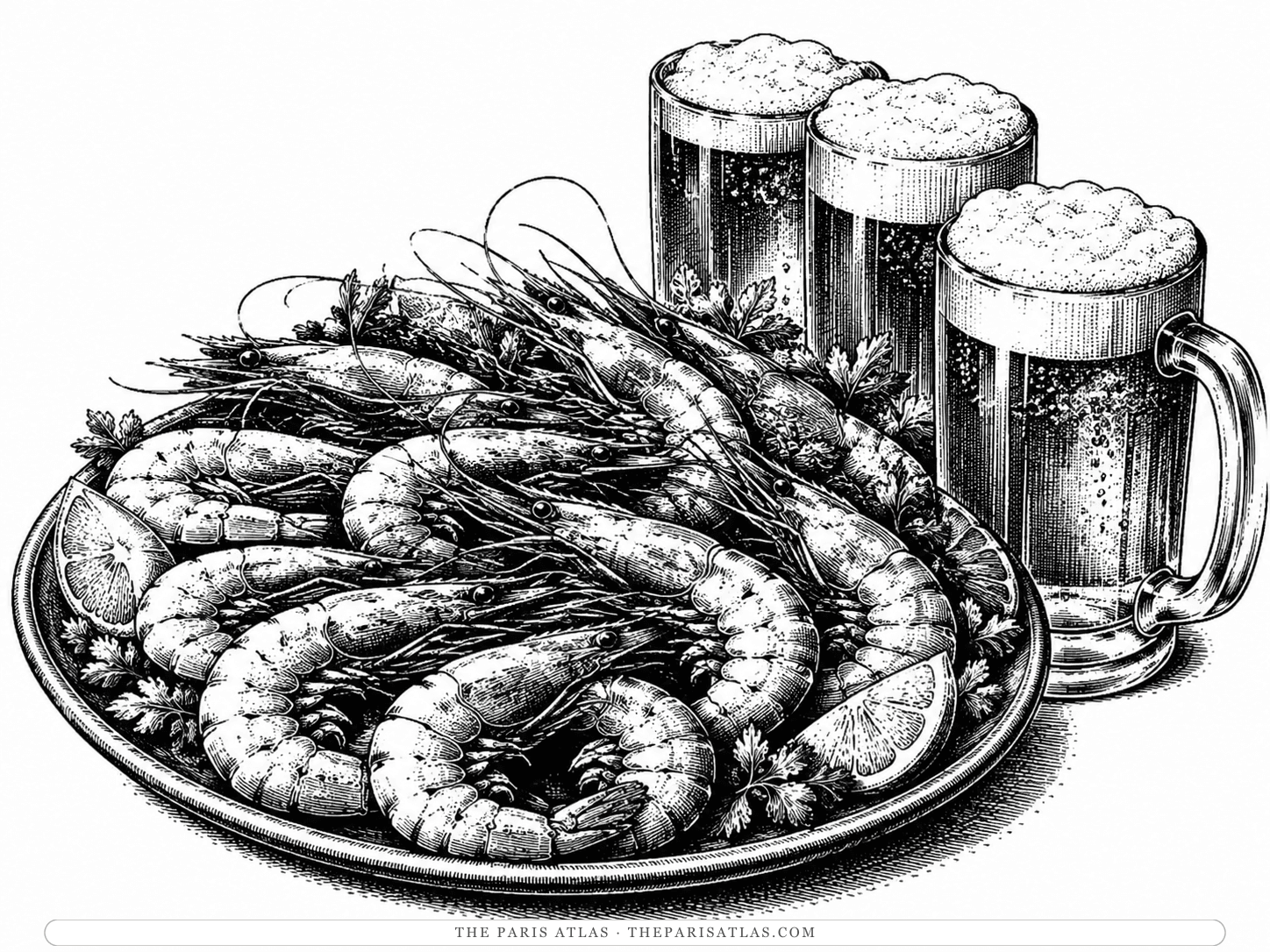
Chapter XVIII — noon at the Café Iruña, Pamplona at full boil
At noon we were all at the café. It was crowded. We were eating shrimps and drinking beer. The town was crowded. Every street was full.
The line does not name the café, but chapter XVII ends with Bill saying they will meet at noon at the Iruña and chapter XVIII opens at that noon. Pages later Mike tips the table and the dish of shrimps goes over in a crash.
Visit Café Iruña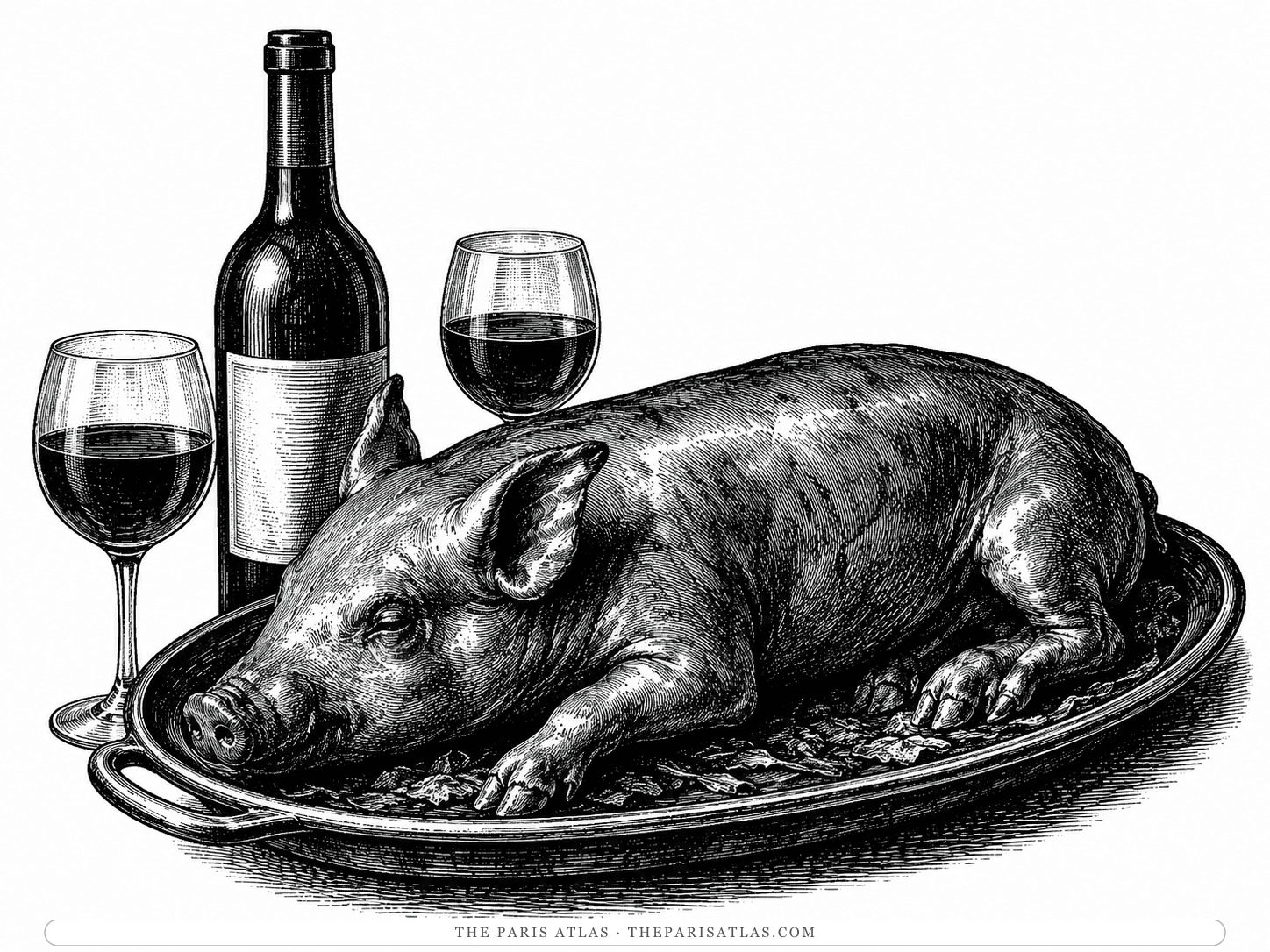
Chapter XIX — the last meal, with Brett in Madrid
We lunched up-stairs at Botin’s. It is one of the best restaurants in the world. We had roast young suckling pig and drank rioja alta. Brett did not eat much. She never ate much. I ate a very big meal and drank three bottles of rioja alta.
Botín's still serves the suckling pig today — Guinness calls it the world's oldest restaurant, and this passage hangs in its stairwell.
Visit Restaurante BotínThe sources below include the primary text, editions, scholarship, archival materials, and other records that informed this page. They document The Sun Also Rises, its publication, and its place in literary history.

Selected passages in chapters 12 and 19 of the Scribner transcription; not a first-edition or manuscript comparison.
First-person evidence and historical context used in preparing the The Sun Also Rises page.
Biographical evidence used to verify chronology, relationships, and historical context connected to The Sun Also Rises.
Web source consulted for documented facts and historical context presented on the The Sun Also Rises page.
First-person evidence and historical context used in preparing the The Sun Also Rises page.
Web source consulted for documented facts and historical context presented on the The Sun Also Rises page.

Archival evidence used to document the historical record connected to The Sun Also Rises.
The primary text is the baseline reference for every book page. Additional references document publication history, interpretation, and historical context where that evidence is available.
 Explore more resources