Hemingway’s Iceberg Theory, Explained Plainly
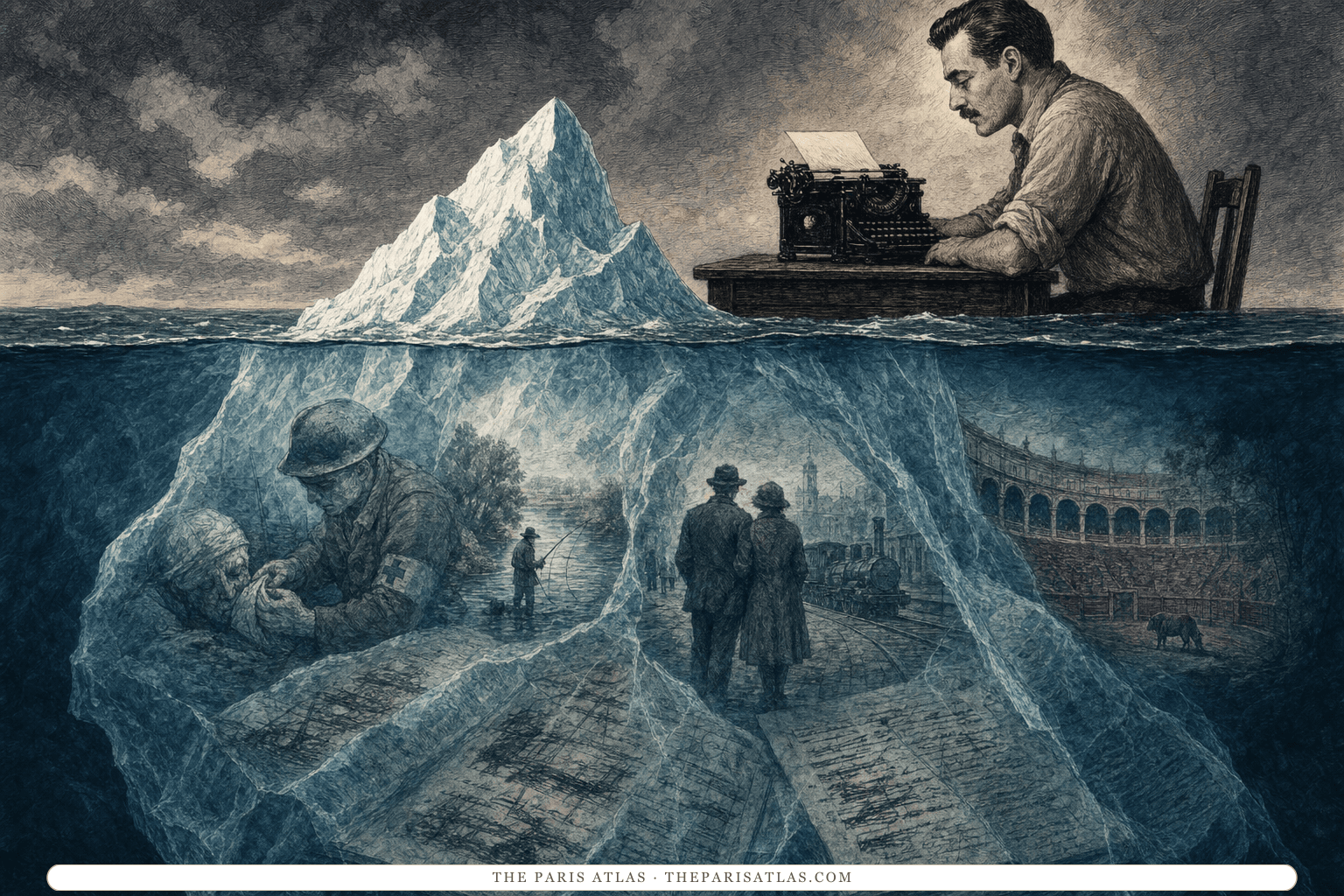
The iceberg theory is writing by informed omission: most of the writer’s knowledge stays below the surface, while selected actions and details let the reader feel it.

The bullfight book: a full treatise on the corrida that keeps turning into a book about death, Spain, and how to write.
Hemingway's 1932 nonfiction monument: everything he knew about the Spanish bullfight — history, technique, breeders, matadors, crowds, cowardice, and glory — delivered as connoisseurship and constantly overflowing into everything else: Spain itself, the fear of death, and, in the famous digressions, the craft of writing, including the fullest statement of the iceberg theory. With a glossary, photographs, and a running argument with an imagined Old Lady who keeps asking for a nicer book. It remains the strangest and richest thing he ever made. (A treatise — nothing here to spoil.)
A decade of afternoons stood behind it: from his first Pamplona ferias in the early twenties, Hemingway had followed the corrida with a student's obsessiveness — seasons of travel, hundreds of fights, friendships with matadors and critics — and the book is the ledger of that education. It takes the bullfight seriously as tragedy rather than sport: three acts, fixed rules, and at the center a man's willingness to hold his ground as the measure of everything. The aficionado's Spain — the cafés, the rings, the dead men remembered by their best afternoons — is rendered with a love the fiction only implies.[1]
What keeps the book alive for readers who will never watch a bull die is the spillage. Asked why a writer's prose fails, Hemingway answers with the iceberg: the dignity of movement of the whole depends on seven-eighths being underwater — the theory of omission, stated here once and for all. The mock-dialogues with the Old Lady let him mock his own pedantry; the appendices grade every working matador with the ruthlessness of a stable tout. Published into the Depression's worst year, it baffled reviewers expecting a novel; it has outlasted most of the novels it wasn't.[1]
Twenty chapters of connoisseurship: the bullfight explained from the ground up — the acts, the passes, the picadors' compromises, the breeds and their decay, the great and fraudulent matadors of the day, with Belmonte and Joselito's revolution as recent scripture. Around the instruction: Spain by region and season, the aesthetics of courage, the recurring meditation on violent death that gives the book its title and its gravity — and the writing lessons, arriving sideways, iceberg first.[1]
Then the apparatus, half the pleasure: a sardonic glossary of ring terms, photographs with opinionated captions, the calendar of ferias, and 'A Natural History of the Dead' smuggled in as a chapter — the war's corpses cataloged with a naturalist's deadpan. Dip or read straight; it rewards both.[1]
Calling the bullfight a tragedy changes the question from who will win to how a known ending is brought about. In Hemingway's account, the unequal chances are not an accidental flaw in the contest: they define its form. The spectator must learn to distinguish skill from a mere display of danger. This makes watching an activity that demands judgment rather than simply excitement. It also exposes the argument's difficult premise. The bull's death is treated as the condition of the spectacle, not a possibility that the reader is invited to hope will be avoided.
The submerged part of the iceberg represents knowledge, not vagueness. Hemingway distinguishes leaving something unstated because the writer understands it from leaving a gap because the writer does not. The metaphor therefore demands preparation rather than offering a shortcut to impressive spareness. Its surrounding discussion also resists making invented people advertise their author's education. What matters is whether the writer's absorbed experience gives the whole work life, including what remains unspoken. Omission succeeds when it lets readers feel more than the page explicitly tells them, not whenever the page says less.
The dignity of movement of an ice-berg is due to only one-eighth of it being above water.
Prose is architecture, not interior decoration, and the Baroque is over.
About morals, I know only that what is moral is what you feel good after and what is immoral is what you feel bad after.
Nobody has written a deeper amateur's-mastery book about anything — the corrida entire, from sand to statistics.
The digressions on writing are the closest Hemingway came to setting down his theory of the craft — quoted in every classroom since.
The country the Civil War books mourn is here still whole — rings full, cafés loud, the dead only individual.
The iceberg theory is writing by informed omission: most of the writer’s knowledge stays below the surface, while selected actions and details let the reader feel it.
Methods & practice
1920s
From his first Pamplona ferias, Hemingway follows the Spanish bullfight with a student's obsessiveness: seasons of travel, hundreds of fights, and friendships with matadors and critics.
1932
Scribner publishes the treatise into the Depression's worst year, baffling reviewers who expected a novel.
1999
Scribner publishes a new paperback edition of Hemingway’s study of bullfighting.


The view from inside the ring — the revolution this book grades, told by the man who made it.
Read our take
The fiesta as fiction — this is the connoisseurship underneath Jake's afición.
Read our take
The sequel, twenty-seven years on — the old aficionado returns to the rings to keep score one last time.
Read our takeErnest Hemingway. It was published in 1932 and is a work of nonfiction.
Everything Hemingway knew about the Spanish bullfight — its history, technique, breeders, matadors, and crowds — that keeps overflowing into Spain itself, the fear of death, and the craft of writing.
Yes. Its famous digressions contain Hemingway's fullest statement of the iceberg theory — that what a writer leaves out strengthens what remains.
No. It is a nonfiction treatise, complete with a glossary, photographs, and a running argument with an imagined "Old Lady" who keeps asking for a nicer book.
He had followed the corrida with a student's obsessiveness since his first Pamplona ferias in the early 1920s — seasons of travel and hundreds of fights stand behind the book.
Explore authors with a similar voice, perspective, and influence.

The other great stylist the Great War produced — where Hemingway cut the language down, Céline set it on fire. The same wound, opposite treatments.
View author
Paris on no money a decade later, with the restraint removed. Miller called Hemingway's Paris a tourist's Paris; readers get to referee.
View author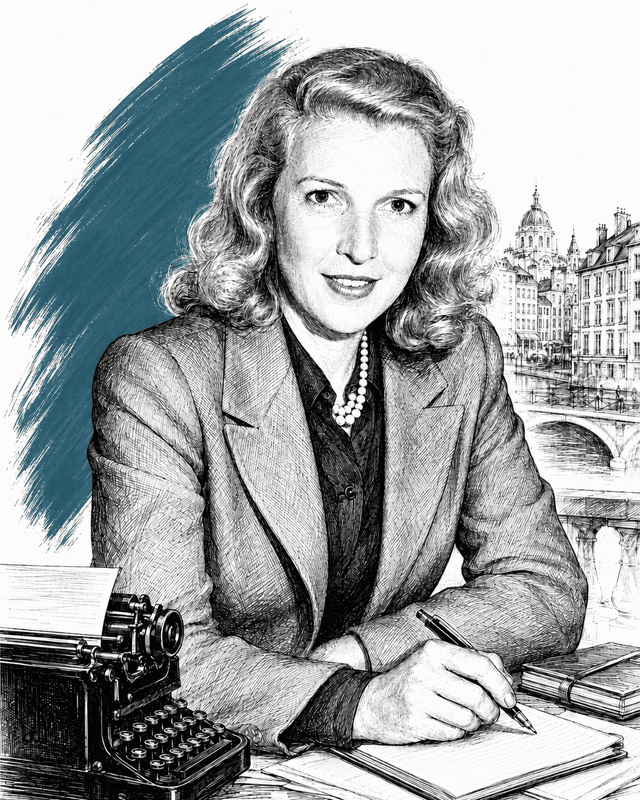
War correspondent who covered the Spanish Civil War, D-Day, and conflicts across five more decades; Hemingway's third wife, 1940–1945.
View authorThe sources below include the primary text, editions, scholarship, archival materials, and other records that informed this page. They document Death in the Afternoon, its publication, and its place in literary history.


Public 2015 transcription from a P. F. Collier & Son printing bearing the 1932 Scribner copyright; exact printing date not established. Analysis uses chapter Two's opening and the writing discussion at the end of chapter Sixteen, not a whole-book or first-edition collation.
Biographical evidence used to verify chronology, relationships, and historical context connected to Death in the Afternoon.
The Hemingway–Perkins correspondence documents the author–publisher relationship surrounding the book’s composition and publication.

Used for Hemingway’s own retrospective account of craft, omission, and his working method.
Publisher record used to verify the 1999 Scribner paperback, ISBN, publication date, and pagination.
The primary text is the baseline reference for every book page. Additional references document publication history, interpretation, and historical context where that evidence is available.
 Explore more resources