The Paris AtlasCharting the artists, works, and places worth returning to.

Hotel · Navarre, below the Roncesvalles pass

Hostal Burguete

The buildingStill standing
Getting inIn, as a customer
What's there nowStill the same

The cold, clean inn at the top of the pass where the narrator Jake Barnes and his friend Bill Gorton, in Ernest Hemingway's The Sun Also Rises, base their fishing week — soup, fried trout, wild strawberries, and wine they did not lose money on.

Address
Calle San Nicolás 71, 31640 Auritz / Burguete
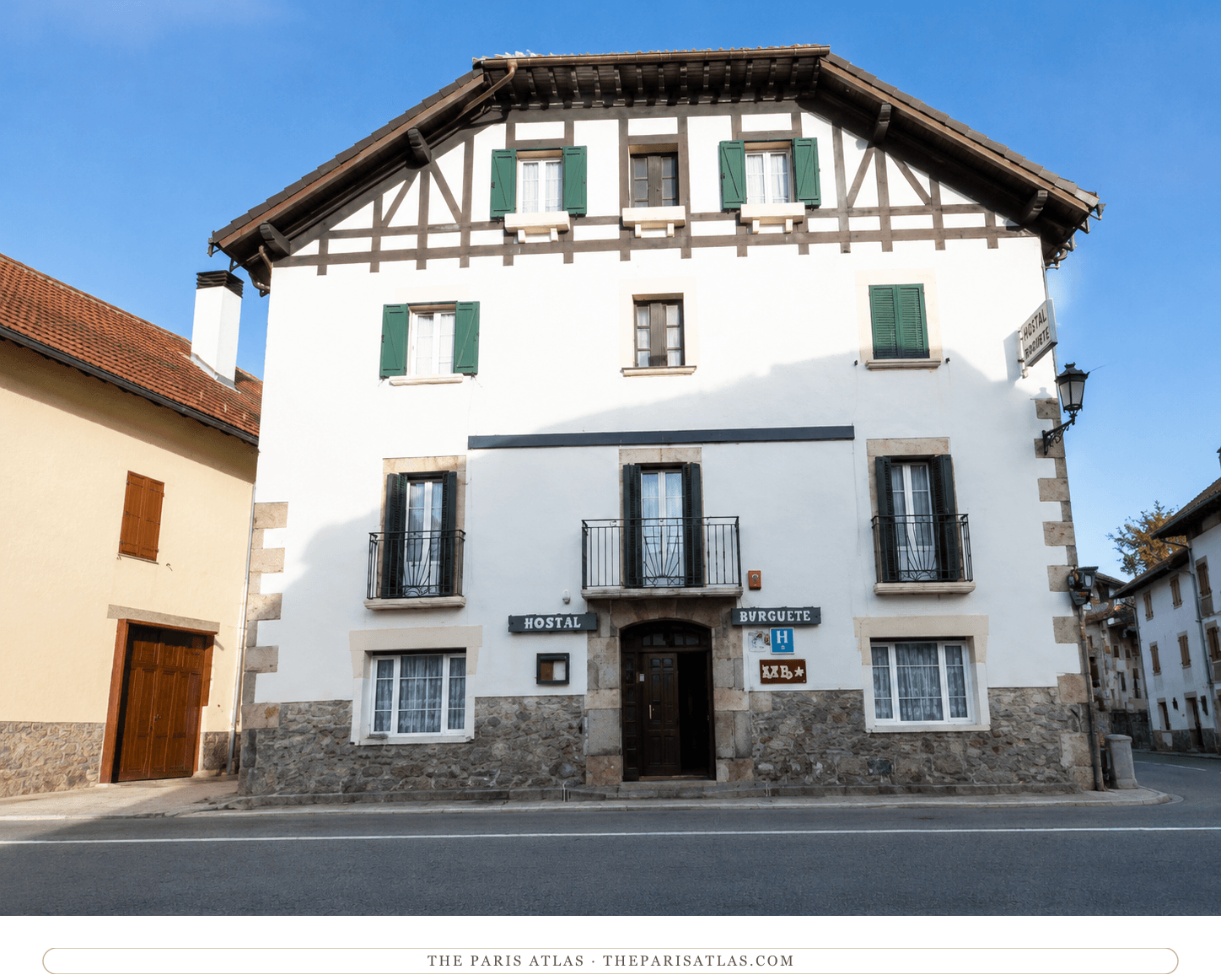
IllustrationThe half-timbered village inn at Auritz/Burguete in color, shutters open over the quiet street

The fishing base of chapters XI and XII — cold nights, hot rum punch, trout in the morning.

Editorial illustration

The story

Arriving by bus, with a rod-case

The two men come up from Pamplona on the bus, past the monastery of Roncesvalles. Burguete has houses along both sides of the road and no side-streets at all, and the bus simply stops. A carabineer in a cocked hat and yellow leather cross-straps wants to know what is in the rod-case, looks at the fishing permits, checks the date, and waves them on. They walk up the street past the whitewashed stone houses with families sitting in the doorways.

The woman who runs the inn comes out of the kitchen to shake hands. She takes off her spectacles, wipes them, puts them back on — a gesture she repeats a few minutes later when Jake Barnes asks the price. The room upstairs has two beds, a washstand, a clothes-chest, and a framed steel engraving of Nuestra Señora de Roncesvalles. It faces north. The wind is already blowing against the shutters.

Twelve pesetas, wine included

The negotiation that follows is the closest the novel comes to pricing a night here, and Jake Barnes loses it. Twelve pesetas a day for room and board, the woman says. He objects that they paid no more than that at a big hotel in Pamplona. She does not argue; she says they have put in a bathroom, and that there is nothing cheaper in summer because now is the big season. They are the only guests in the building.

"Is the wine included?" "Oh, yes."

The Sun Also Rises (1926), ch. XI

That settles it. The dining room downstairs has a stone floor, a low ceiling, and oak panelling, and it is cold enough that the two of them can see their breath. On the walls hang three dark, smoky panels of dead game — rabbits, pheasants, ducks — and there is a cupboard full of liqueur bottles. Bill Gorton sits down at the upright piano in the corner and plays, on the grounds that he has to keep warm somehow.

The hot rum punch that follows is often described as something the inn served them. It is the other way round: Jake Barnes goes out to the kitchen and tells the woman what a rum punch is and how to make one. A girl carries in a steaming stone pitcher, Bill judges the rum content insufficient, and Jake fetches the bottle from the cupboard and pours in another half-tumblerful.

The supper, and what it was not

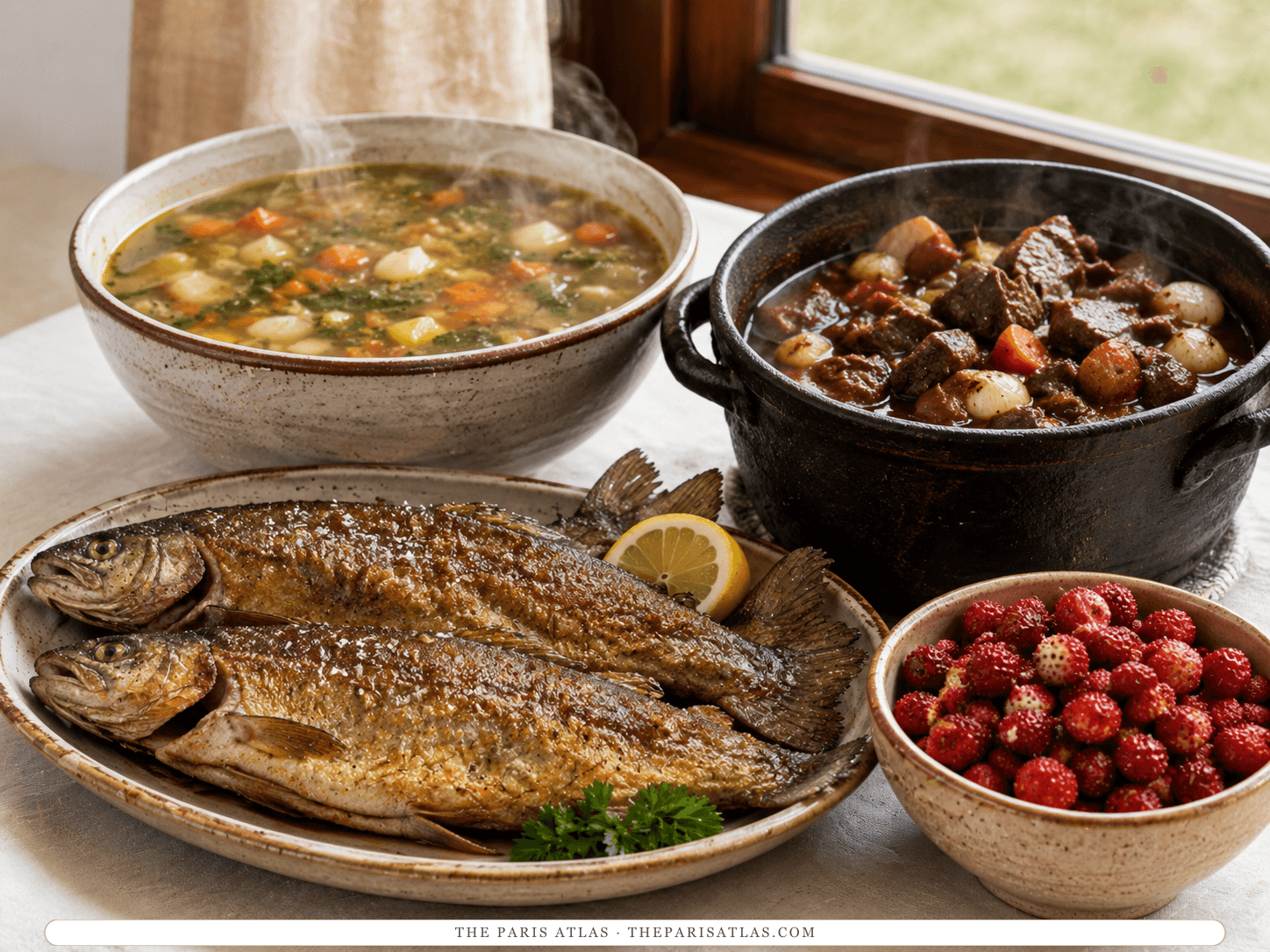
Supper arrives in one sentence, and it is worth reading closely, because almost everything written about this meal adds something Hemingway did not put there. The courses are:

  • A big bowl of hot vegetable soup, brought in with the wine
  • Fried trout
  • "Some sort of a stew" — the narrator does not know what is in it, and neither do we
  • A big bowl full of wild strawberries

The trout is the detail that gets improved on. Navarre's characteristic trout dish is trucha a la navarra, fried and paired with cured ham, and it is genuinely the thing to order in these mountains today. But Hemingway writes fried trout and stops. There is no ham in the passage, no garlic, no flour, no garnish. The novel's trout and the region's most famous trout preparation are two different dishes that happen to share a fish and a valley, and a reader who orders trucha a la navarra at Burguete is eating Navarrese cooking rather than the meal in chapter XI.

The stew resists identification for the same reason. It might have been lamb or beans or game, and the temptation to say so is strong, but the narrator eating it could not tell, and there is no doing better than that from the text. What the sentence does establish is the shape of the meal: soup first, fish after, then a stew, then fruit, with wine on the table throughout. The strawberries were most likely the small wild woodland kind rather than the large cultivated variety sold today, which is what growing in these mountains in July would mean — though Hemingway writes only "wild strawberries", and likely is as far as the text will carry it.

They did not lose money on the wine, Jake Barnes notes, and the girl who kept bringing it was shy but nice about it, and the old woman looked in once to count the empty bottles. Twelve pesetas with wine included turns out to have been a bargain after all, which is presumably why the price stuck in the narrator's head.

Five days

They stay five days, longer than they spend anywhere outside Paris, and it is the only stretch of the book where nobody is unhappy. Jake Barnes wakes early, digs worms with a mattock from the shed behind the inn, and fills two empty tobacco-tins with them. Under the window there are carts and an old diligence with its roof cracked and split by weather, left over from the days before the motor-buses, and a goat climbs onto it while he works.

The nights are cold and the days are hot, with a breeze even at midday. They find a pool deep enough to swim in. In the evenings they play three-handed bridge with an Englishman named Harris, who has walked over from Saint-Jean-Pied-de-Port and is staying at the inn for the fishing. He goes with them to the Irati twice, which is the only time in the book anyone reaches that river.

It ends with a telegram. A girl comes up the road with a leather wallet hanging against her skirt and hands over a message addressed to "Barnes, Burguete" — three words in Spanish announcing that Robert Cohn arrives Thursday. Harris asks them to stay one more day. They take the afternoon bus to Pamplona, and the fiesta takes the rest of the novel.

Can you still stay there

Yes, and it takes guests as a working hotel rather than a monument. The building has a restaurant, Navarre's tourism material treats the village and the Irati as principal locations behind the fishing chapters, and the hotel's own site calls Ernest Hemingway a habitual guest and says its kitchen serves the traditional cuisine of Navarre.

What it does not do is publish a menu naming the soup, the fried trout, the stew and the wild strawberries as a set meal, and we have not verified that the supper in chapter XI can be ordered as such. Trout and other traditional Pyrenean dishes remain part of the region's cooking, and the rooms have been modernised in the century since. A night here puts you where Ernest Hemingway slept. The supper is a separate question, and the answer to it is currently unverified.

In their words

The girl brought in a big bowl of hot vegetable soup and the wine. We had fried trout afterward and some sort of a stew and a big bowl full of wild strawberries.
Jake Barnes at the Burguete inn — The Sun Also Rises (1926), ch. XI

Served here

The dishes the books ate at this table — quoted verbatim from the text.

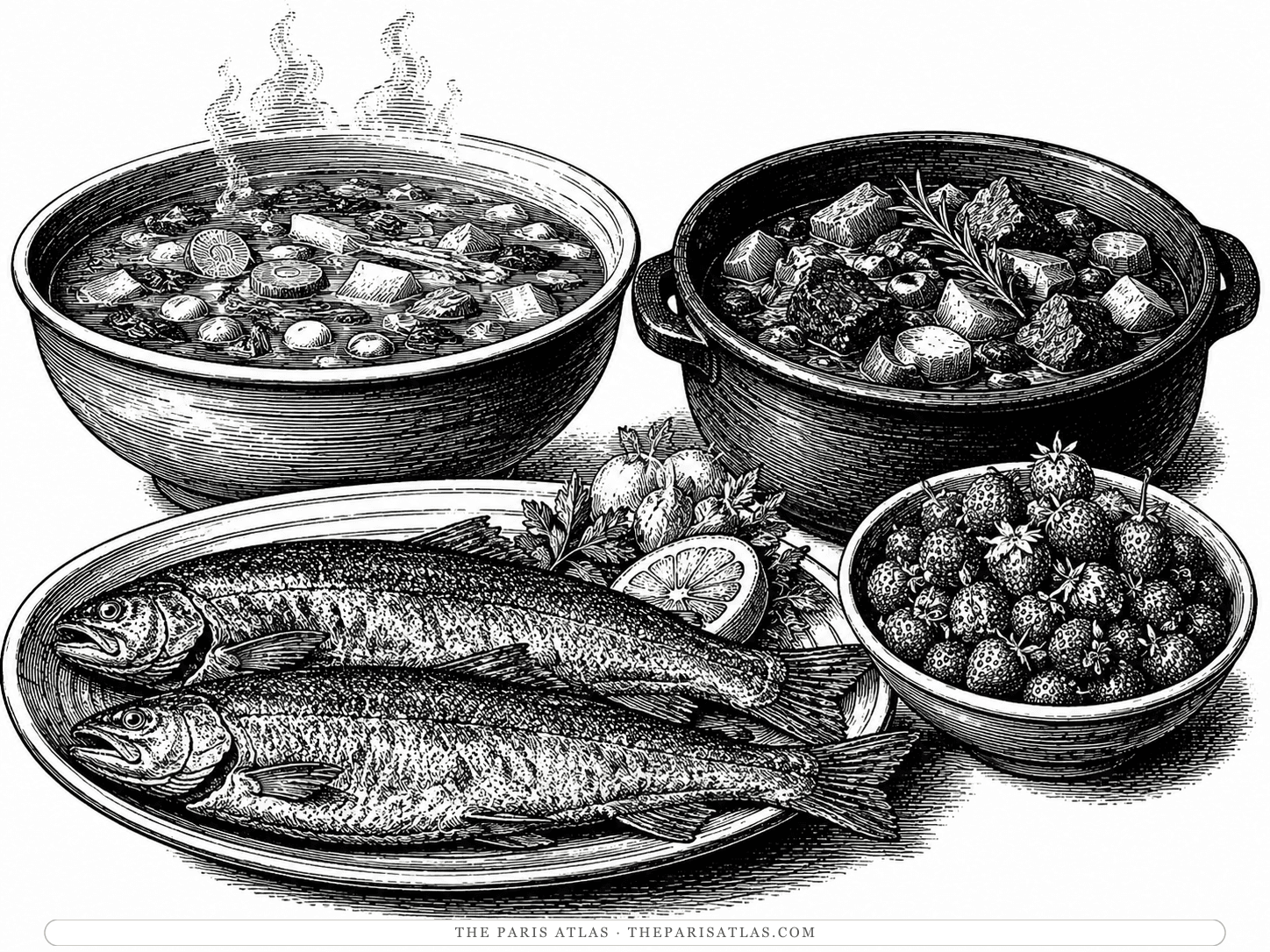
A bowl of vegetable soup, an iron pot of stew, a platter of fried trout with lemon and a bowl of wild strawberries at the inn at Burguete in the Navarrese Pyrenees.

Chapter XI — the cold first night in the mountains

Supper at the Burguete inn

The girl brought in a big bowl of hot vegetable soup and the wine. We had fried trout afterward and some sort of a stew and a big bowl full of wild strawberries.

'We did not lose money on the wine,' the next line reports — the room was freezing and the bottles kept coming.

From The Sun Also Rises
Key facts

What it is
The village inn on Burguete's single street, below the Roncesvalles pass
In Hemingway's The Sun Also Rises
The fishing base of the narrator Jake Barnes and his friend Bill Gorton — chapters XI and XII
Room and board
Twelve pesetas a day in the novel, wine included — a price Jake argues about
How long they stay
Five days — longer than they spend anywhere outside Paris
The kitchen's case
Vegetable soup, fried trout, a stew, wild strawberries — and wine by the bottle
Today
Still an inn, serving Camino pilgrims and Hemingway readers alike
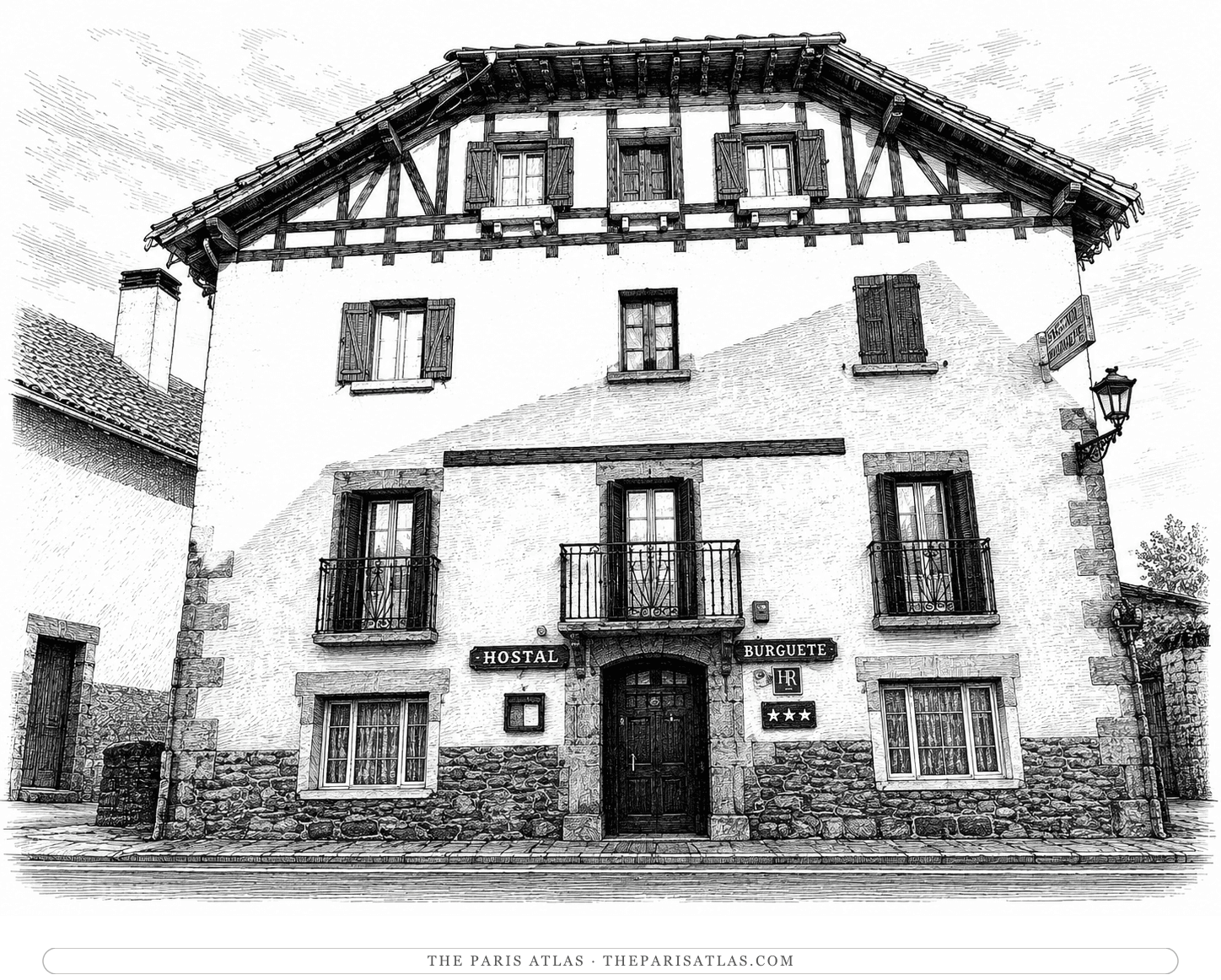
The inn on Burguete's single street — stone below, timber above, the pass behind.Editorial illustration
The fishing base of chapters XI and XII — cold nights, hot rum punch, trout in the morning.Editorial illustration

Timeline

  1. 1924

    Hemingway's first Burguete summer: up from Pamplona to fish the Irati, based at the inn.

  2. 1925

    The second trip, with the Pamplona crowd The Sun Also Rises would immortalize.

  3. 1926

    Ernest Hemingway lodges chapters XI and XII of The Sun Also Rises here — the rum punch, the trout supper, the packed lunches.

  4. Today

    Still the village inn, on the pilgrim road below Roncesvalles, with a restaurant serving Navarrese cooking.

On the map

Questions before you go

Is the Burguete inn in Ernest Hemingway's The Sun Also Rises a real place?

Yes. It is identified with Hostal Burguete, still operating on the single street of Auritz/Burguete in Navarre. Ernest Hemingway used the village as his base for fishing trips in the summers of 1924 and 1925, and gave the inn chapters XI and XII of his 1926 novel.

What do Jake and Bill eat at the inn?

Supper is a big bowl of hot vegetable soup, fried trout, "some sort of a stew" the narrator cannot identify, and a big bowl full of wild strawberries, with wine on the table throughout. Jake Barnes, the novel's narrator, and his friend Bill Gorton are characters in Ernest Hemingway's The Sun Also Rises; the meal is in chapter XI.

Is the trout in the novel trucha a la navarra?

No. Ernest Hemingway writes "fried trout" and nothing more. Trucha a la navarra is fried trout paired with cured ham, and it is the region's characteristic preparation, but there is no ham, garlic or flour in the passage. The two dishes share a fish and a valley, not a recipe.

Can you still eat Hemingway's supper at Hostal Burguete?

Not as a verified set meal. The hotel restaurant serves traditional Navarrese cuisine, but it does not publish a menu offering the soup, fried trout, stew and wild strawberries together, and we have not confirmed that the chapter XI supper can be ordered. Trout remains part of the region's cooking.

How much did the inn cost in the novel?

Twelve pesetas a day for room and board, wine included. Jake Barnes objects that they paid no more at a big hotel in Pamplona; the woman who runs the inn replies that they have put in a bathroom and that nothing is cheaper in summer. They are the only guests in the building.

How long do they stay, and why do they leave?

Five days — the longest stretch the novel spends anywhere outside Paris. A telegram addressed to "Barnes, Burguete" announces that Robert Cohn arrives Thursday, and the two men take the afternoon bus to Pamplona for the fiesta.

Where is Hostal Burguete?

Calle San Nicolás 71 in Auritz/Burguete, Navarre, on the road down from the Roncesvalles pass. The village sits on the Camino de Santiago, and the inn takes pilgrims as well as readers.

Related books

Cover of The Sun Also Rises by Ernest Hemingway

Setting of the story

The Sun Also Rises

Ernest Hemingway · 1926

Chapters XI and XII lodge here — the freezing room, the hot rum punch, the trout suppers, and the packed lunches for the walk out to the fishing. The novel's one stretch of peace.

Writers who knew this place

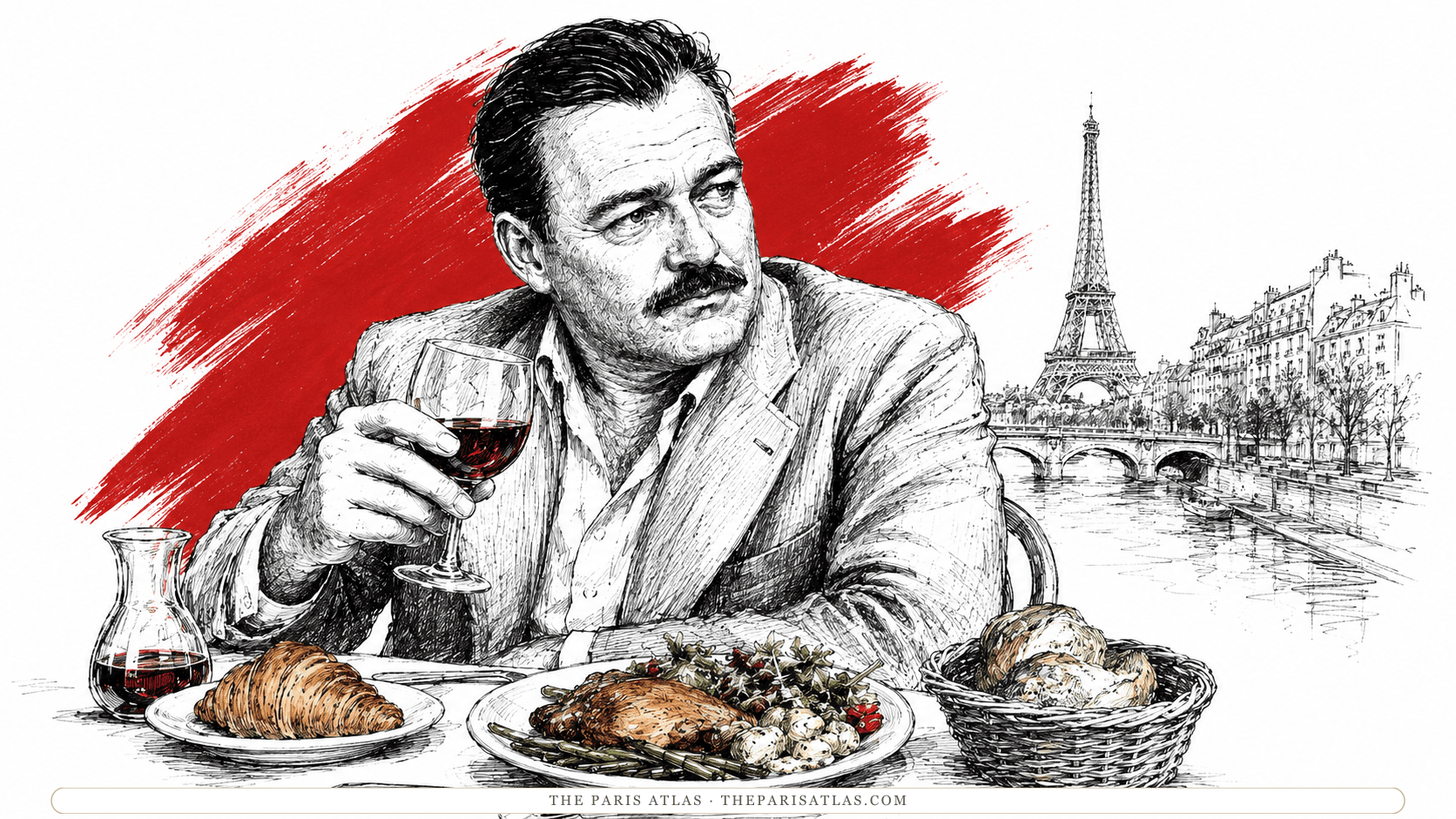
Illustrated portrait of Ernest Hemingway

Ernest Hemingway

American · Author of The Sun Also Rises and A Moveable Feast; his pared-down style, developed in 1920s Paris, became the most imitated in American prose.

Frequented by

His base in the Navarrese mountains for the fishing trips of the summers of 1924 and 1925, before and after San Fermín. The inn still trades on the association and calls him a habitual guest; it publishes no founding date and no menu, so the page treats the building's continuity as established and the meal's as not.

Carlos Baker, Ernest Hemingway: A Life Story (1969); Hostal Burguete — Auritz/Burguete, Navarra

Guides featuring Hostal Burguete

Take them with you.

The Friday Letter

Paris, one address at a time.

The cafés, studios, and walk-up flats where the work was made — one story from the map in every letter.

One email a week. No spam, no selling your address. Unsubscribe anytime.