Eating The Sun Also Rises: Every Meal in Hemingway’s Novel—and Where to Order It Today
Eight meals carry Jake Barnes from a brioche in Paris to a suckling pig in Madrid. Most have disappeared. One is still roasting.
Ernest Hemingway had a reputation for leaving things out. Motives, explanations, emotional reckonings: all could be pared away until a character was left staring into a drink, saying something evasive.
Food was different.
In The Sun Also Rises, Hemingway will not always tell you what his narrator, Jake Barnes, is feeling, but he will tell you that the green beans beside the roast chicken were new. He will tell you that the wine was lowered into a cold spring until it made Bill Gorton’s eyes ache. He will tell you that a Paris restaurant wrote its bill on a slate, that seven carloads of pilgrims had taken over a train’s dining car, and that the final roast pig came with rioja alta.[1]
The novel contains eight meals substantial enough to follow. Some unfold in restaurants, others in train compartments or on riverbanks. Two take place in cafés Hemingway never bothered to name. One item that sounds like a dish — the famous trout packed in ferns — is not a preparation at all, but a way to carry dead fish home without ruining them.[1]
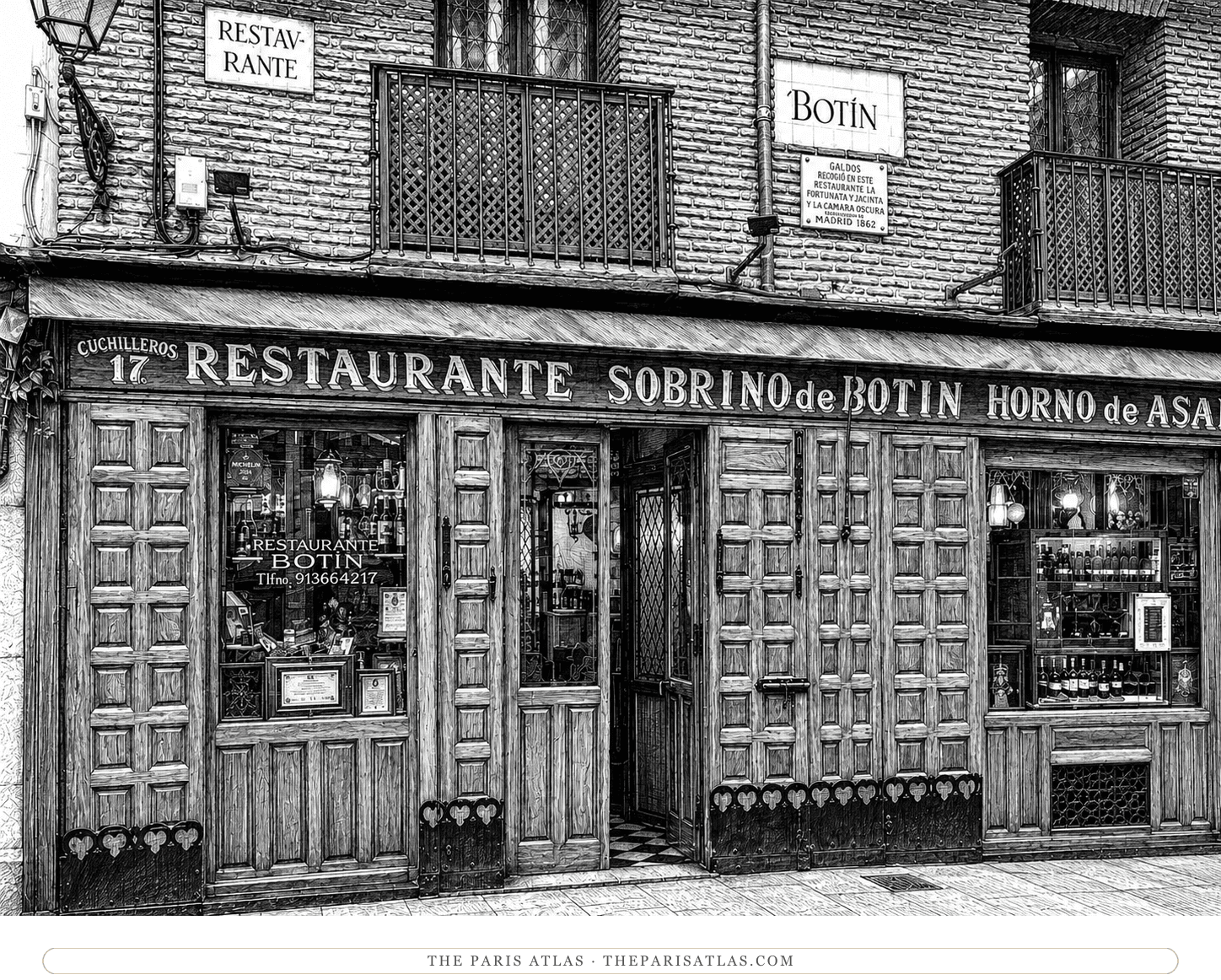
Only one meal survives intact at its original address. Restaurante Botín in Madrid still serves roast suckling pig, still cooks it in the Castilian tradition, and still occupies the building where Jake and Lady Brett Ashley eat together in the final chapter. Hostal Burguete remains open in Navarre, though it makes no promise of recreating the exact supper Hemingway wrote into the novel.[1][2][3]
The other six are gone in six different ways: a restaurant closed, a café unnamed, lunch handed through a train-compartment door, two picnics beside a trout stream, and a plate of shrimp lost somewhere in the noise of San Fermín.
Here they are in the order the book eats them.
| Meal | Chapter | Where | Can you still eat it? |
|---|---|---|---|
| Coffee and a brioche | V | An unnamed café on the rue Soufflot, Paris | The street, yes. The café was never named |
| Roast chicken and apple pie | VIII | Madame Lecomte’s, 33 quai d’Anjou, Paris | No — the restaurant closed in 1953 |
| Sandwiches and Chablis | IX | The Paris–Bayonne train | No venue; lunch was brought to the compartment |
| Soup, fried trout, a stew, wild strawberries | XI | Hostal Burguete, Navarre | The inn is open. This exact supper is unverified |
| Chicken and hard-boiled eggs by the river | XII | The Rio de la Fabrica valley, Navarre | No — a picnic, not a restaurant meal |
| Trout packed in ferns | XII | The riverbank, Navarre | Not a dish at all — see below |
| Shrimps and beer | XVIII | An unnamed café, Pamplona | Shrimp and beer, yes. The café is not identified with certainty |
| Roast suckling pig and Rioja Alta | XIX | Botín, Calle de Cuchilleros, Madrid | Yes — the one meal that survives at its original address |
1. Coffee and a brioche
The first meal in The Sun Also Rises is not really a meal. It is coffee, one brioche and the morning papers.[1]
Jake walks down the boulevard to the rue Soufflot, sits at a café table and smokes while Paris moves around him. Flower sellers come up from the market. Students pass on their way to the law school. Then he catches an S bus to the Madeleine and goes to work at his typewriter.[1]
It is the novel’s only real working morning, and the breakfast matches it: small, quick and solitary.
The brioche should not be imagined as a croissant with a better education. It is an enriched yeast bread made with eggs and butter, soft and rich but still recognisably a loaf. Hemingway gives no shape, filling or flourish. He does not tell us whether the coffee was black, milky, bitter or good. He gives Jake exactly enough to get through the newspaper and into the office.[1]
The café is more elusive. Hemingway names the rue Soufflot but not the establishment, which has not stopped modern cafés on the street from enjoying the glow of proximity. None has demonstrated a connection to the scene.
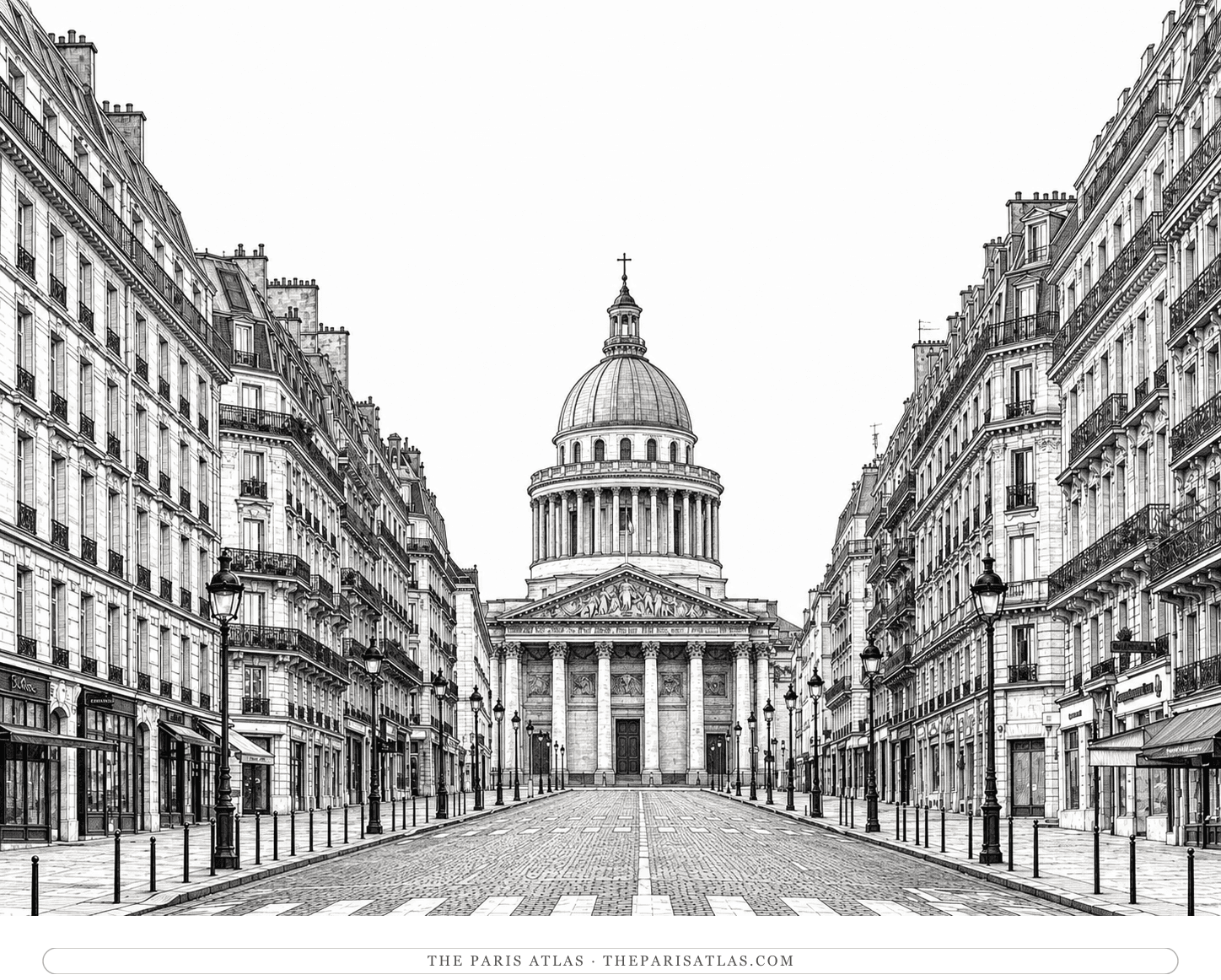
The street itself remains easy to find. It runs uphill from the Boulevard Saint-Michel toward the Panthéon, with the Luxembourg Gardens below. You can sit there with coffee and bread and arrange the scene almost perfectly.
You just cannot claim Jake’s table.
2. Roast chicken and apple pie
This is the dinner most readers would choose.
At Madame Lecomte’s on the Île Saint-Louis, Jake and his friend Bill Gorton eat roast chicken with new green beans, mashed potatoes and salad, followed by apple pie with cheese. They finish with coffee and a fine.[1]
It is sturdy food, abundant but not grand: the kind of dinner that suggests someone in the kitchen understands that roast chicken needs potatoes, that apple pie benefits from cheese, and that Americans will wait an unreasonable amount of time if assured a restaurant is undiscovered.
Jake and Bill wait forty-five minutes because the American Women’s Club has placed Madame Lecomte’s in a guide to quaint Paris restaurants supposedly untouched by Americans. By the time they arrive, the secret has produced a queue.[1]
The bill is written on a slate, which Hemingway suspects is another carefully maintained piece of quaintness. In reality, it was probably just how the restaurant had always charged people.[1]
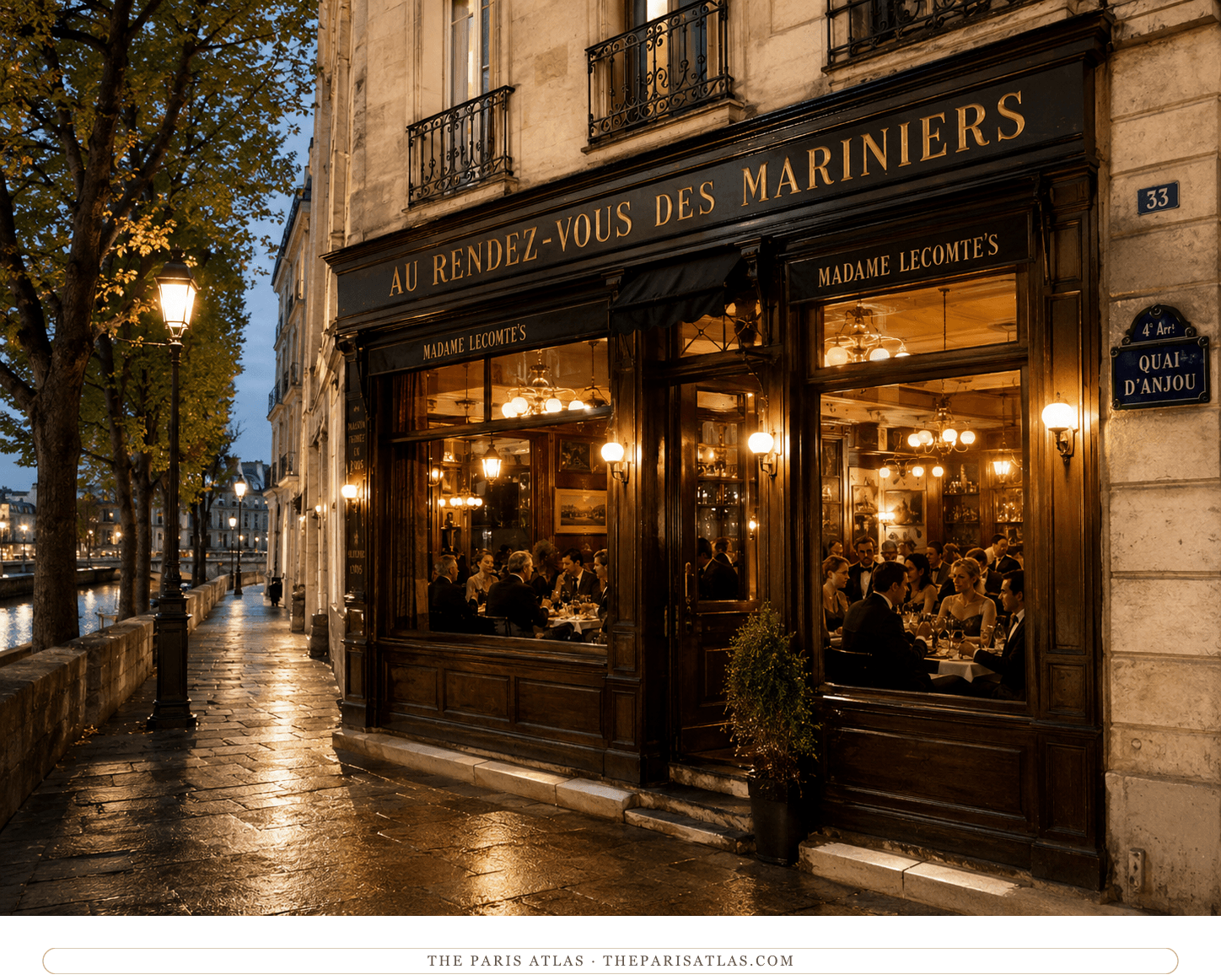
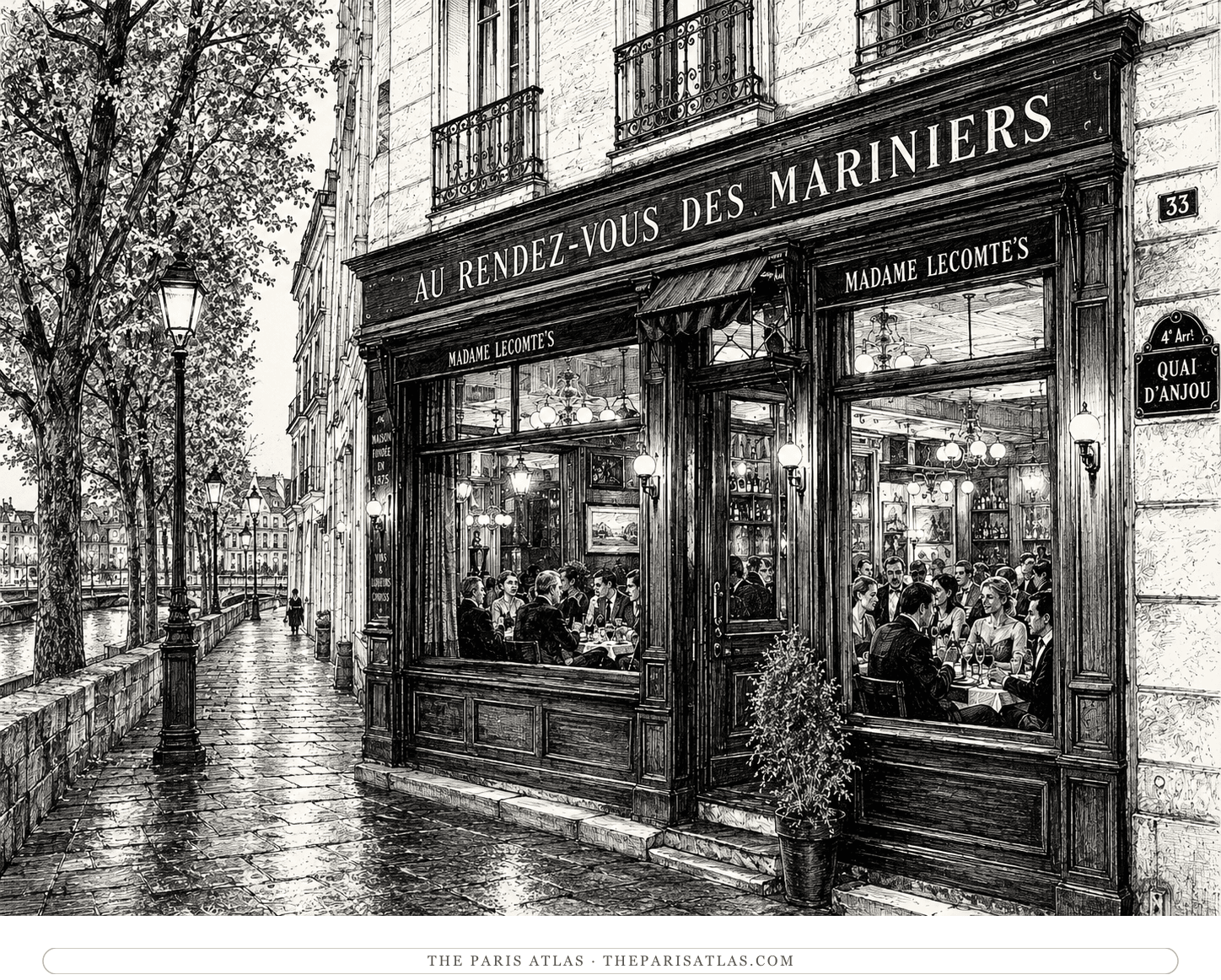
Madame Lecomte’s was almost certainly Au Rendez-vous des Mariniers at 33 quai d’Anjou. Opened in 1904, it fed bargemen, neighbourhood residents and women working on the laundry boats along the Seine. This was not a stage set built for tourists. It was an old working restaurant that tourists eventually discovered and congratulated themselves for discovering.
Then came the guidebooks. Then came Hemingway. Then came generations of readers hoping to eat the chicken.
The restaurant closed in 1953, and nothing directly succeeded it.
Still, this is one of the easiest vanished meals to trace. Walk the quai d’Anjou, then follow the route Jake and Bill take after dinner: around the island, over the river, with Notre-Dame downstream. The restaurant is gone, but the night outside it remains surprisingly intact.
3. Sandwiches and Chablis
There are worse lunches than sandwiches and Chablis on a train heading south through France.
Jake and Bill attempt to use the dining car, only to discover that seven carloads of American pilgrims returning from Rome have booked it until half past three. A waiter brings food to their compartment instead: sandwiches and a bottle of Chablis.[1]
Hemingway barely pauses over what is inside the sandwiches. The point is the movement.
Outside the window are fields of ripening grain, poppies, green pastureland, large rivers and châteaux set back among trees. The lunch is portable and secondary, something to hold while the country begins changing into the country where the rest of the novel will happen.[1]
It is also one of the book’s more attainable pleasures. No secret recipe is involved. No century-old dining room needs to be booked. No disputed café must be identified.
You need bread, something between it, a cold bottle of white Burgundy and a southbound train.
The original journey from Paris toward Bayonne can still be made, though the railway experience has changed enough that a waiter arriving with Chablis may require more planning than Hemingway’s prose suggests.
4. Soup, fried trout, stew and wild strawberries
The best eating in the novel happens in the mountains, in a dining room cold enough for the guests to see their breath.[1]
At the inn in Burguete, Jake and Bill are served a large bowl of hot vegetable soup, fried trout, an unidentified stew and a bowl full of wild strawberries. Wine is included in the price of twelve pesetas a day.[1]
Jake initially argues about the rate. Then the bottles begin to empty.
The old woman running the inn occasionally looks in and counts them, a small act of hospitality mixed with accounting. It is the kind of detail Hemingway loved: no speech about generosity, no declaration of pleasure, just soup steaming in a cold room and someone keeping track of the wine.[1]
The strawberries were probably the small woodland variety that grows wild in the hills of Navarre in summer. The stew remains mysterious because Jake cannot identify it and Hemingway does not rescue him.
The trout requires a little restraint. Navarre is known for trucha a la navarra, generally fried trout paired with cured ham. It is a real regional dish and a sensible thing to order there.
But it is not necessarily what Jake eats.
Hemingway writes fried trout. He does not mention ham, garlic, flour or any other defining preparation. The famous Navarrese dish and the novel’s dinner share a fish and a landscape. That is not enough to turn them into the same plate.[1]
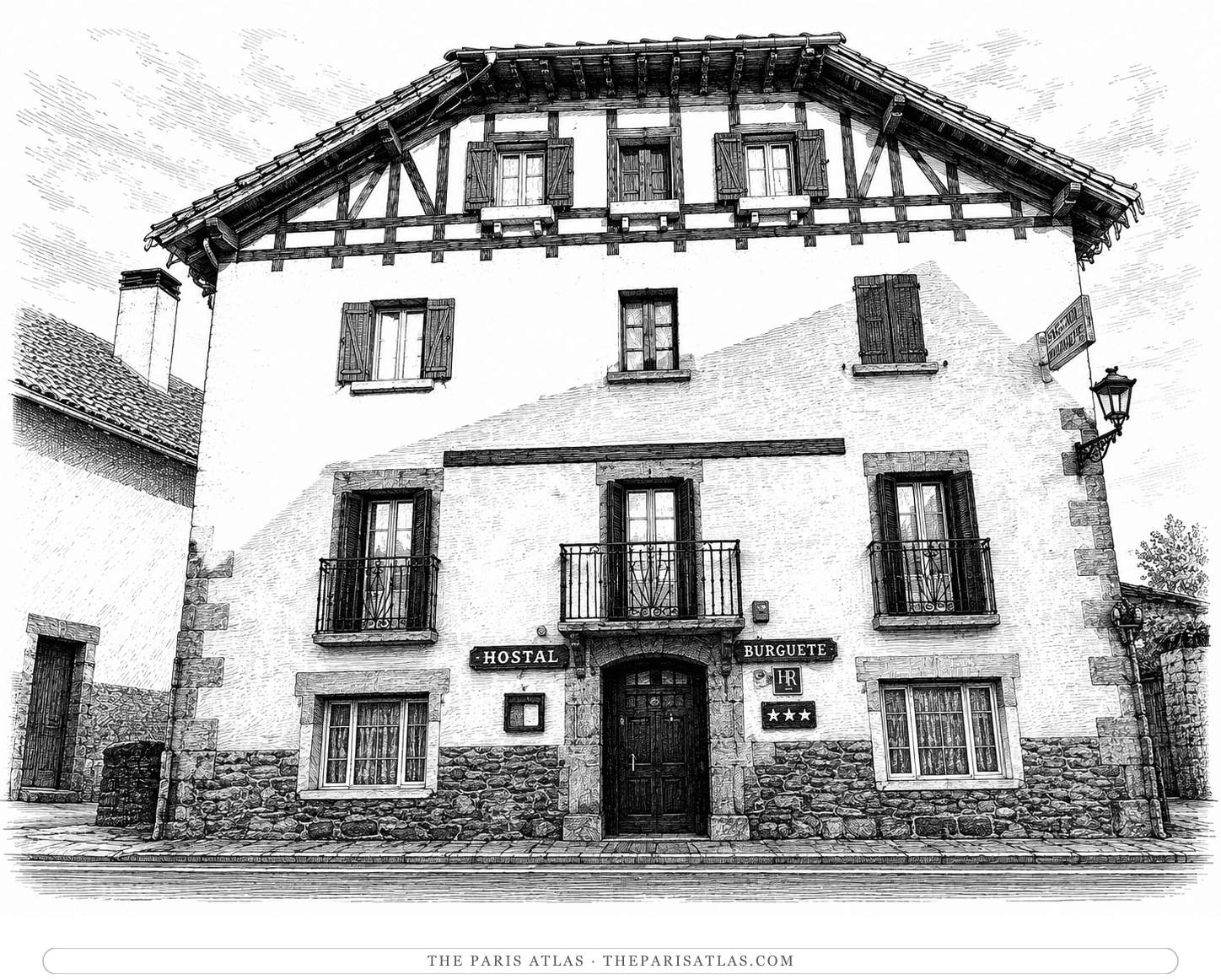
Hostal Burguete is still open on the village street and still serves Navarrese food. It does not advertise Hemingway’s exact supper as a fixed menu, and there is no reason to pretend otherwise.[3]
A night there offers something better than a reenactment: you can sleep in the village where the characters sleep, eat the food of the region and wake close to the road into the fishing country.
5. Chicken and hard-boiled eggs
Out beside the river, the food becomes simpler and the arrangements become better.
Before fishing, Jake carries two bottles of wine up the road to a spring running from an iron pipe. He pounds the corks firmly into place, lifts the board covering the water and lowers the bottles in. The spring is so cold that his hand and wrist go numb.[1]
Then he replaces the board and hopes nobody finds them.
Lunch comes wrapped in paper: chicken, hard-boiled eggs and salt. It is spread across a newspaper on the riverbank. The wine emerges icy, faintly metallic from the spring and cold enough to hurt Bill’s eyes.[1]
“That’s not such filthy wine,” Bill says.[1]
“The cold helps it,” Jake replies.[1]
It may be the most convincing piece of food criticism in the book.
Nothing about the lunch is difficult. The provisions are ordinary. The technique for cooling the wine requires only running water and faith in the corks. Yet the scene has more appetite in it than many of the restaurant meals because everything has been earned: the walk, the fishing, the waiting and the cold bottle pulled from the dark.
There is no restaurant to visit and no chef to credit. It is a picnic assembled from four things and improved by geography.
6. Trout packed in ferns
This is the meal that is not a meal.
After fishing, Jake washes the trout in cold water, picks ferns and lines a bag with them. He places three fish on the first layer, covers them with more ferns, adds another three and closes the bag.[1]
The passage sounds culinary enough to have acquired a life of its own. “Hemingway’s trout in ferns” has the ring of a lost mountain recipe, perhaps involving smoke, herbs and a weathered Basque man refusing to reveal the final step.
There is no final step.
The ferns are damp packing. They help keep the fish cool and separated during the walk home. Hemingway never says they are cooked, never says they contribute flavour and never identifies the species.[1]
That last point matters. A romantic reader might see a rustic cooking method. A practical fisherman sees refrigeration before refrigeration.
No restaurant serves an authenticated version because the trout in the scene are not finished food. They are cargo.
7. Shrimps and beer
At noon during the fiesta, everyone is drinking beer and eating shrimp.[1]
Pamplona is full. The streets are full. The café is full. The group has reached the stage of the novel where hunger, alcohol, jealousy and exhaustion are beginning to occupy the same small table.
Eventually Mike Campbell knocks the table over and the dish hits the floor.[1]
Hemingway tells us almost nothing about the shrimp themselves. Were they boiled or fried? Hot or cold? Peeled or whole? Was there lemon, garlic or mayonnaise? He does not say.[1]
A communal plate of small whole shrimp is about as far as the evidence allows.
The café is never named in the scene. Café Iruña on the Plaza del Castillo is the strongest candidate, because the group agrees at the end of the previous chapter to meet there at noon and the next chapter opens at noon in “the café.”[1]
That is persuasive. It is not proof.
Café Iruña appears repeatedly in the novel and remains one of the most tangible Hemingway sites in Pamplona. What it cannot honestly do is produce a receipt showing that this exact dish fell from this exact table.
Shrimp and beer are not difficult to find in a city with a serious pintxo culture, especially during San Fermín. The problem is not recreating the order. It is deciding where to sit without turning a reasonable guess into a fact.
8. Roast suckling pig and Rioja Alta
At last, a door that still opens.
In the final chapter Jake travels to Madrid to meet Brett. They go to Botín, where he orders roast young suckling pig and rioja alta. Jake eats a very large meal and drinks three bottles of wine. Brett, continuing one of the novel’s more reliable patterns, does not eat much.[1]
Afterward they take the taxi ride containing the exchange everyone remembers.
The meal deserves equal attention.
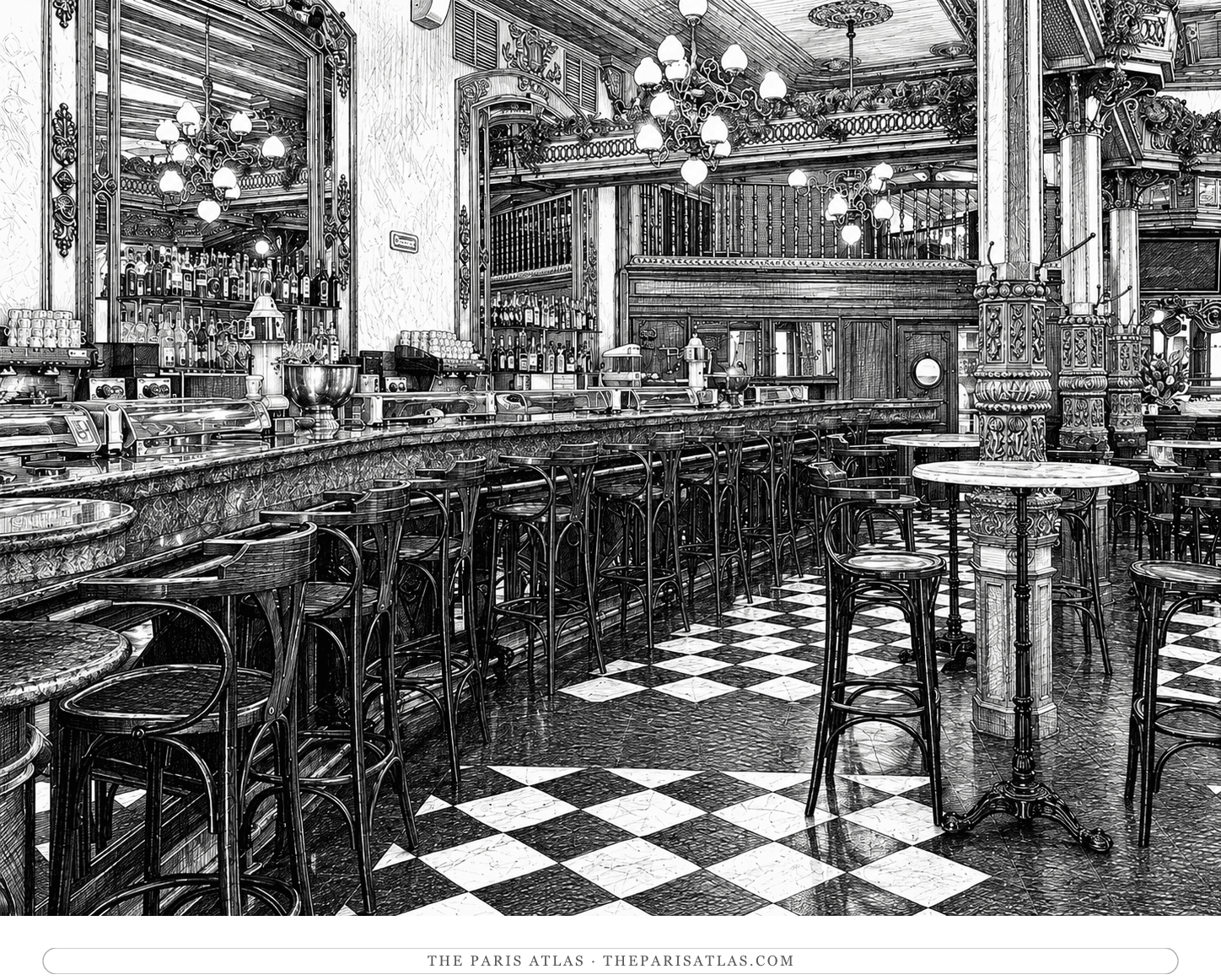
Botín has occupied its address on Calle de Cuchilleros since 1725. Guinness recognises it as the world’s oldest restaurant, and cochinillo asado remains one of its two signature roasts. The pig is cooked in the Castilian tradition, its skin crisped while the meat remains soft beneath it.[2]
The passage from The Sun Also Rises hangs framed in the stairwell.
This does not mean the dish is chemically identical to the one served in the 1920s. Suppliers change. Kitchens change. Regulations change. Even traditions that survive for centuries make daily adjustments no novelist records.
But the essential claim holds.
At Botín, you can eat the same kind of dish at the same address where Hemingway placed the final meal of his novel. Of all eight meals, this is the only one that has survived with its name, location and place on the menu intact.[1][2]
It is also the right food for the scene: excessive, expensive, ancient and slightly too much after everything that has already happened.
The places, if you are going
Eight meals, one survivor
The food in The Sun Also Rises is often described as part of Hemingway’s lifestyle mythology: oysters, wine, trout, cafés, long lunches and heroic appetites.
But the actual meals are stranger and more modest than the mythology.
There is one brioche. There are sandwiches carried into a railway compartment because the dining car is unavailable. There are hard-boiled eggs unwrapped beside a river. There is an unidentified stew in a freezing inn and a plate of shrimp that ends up on the floor.[1]
Even the grandest meal, the roast pig at Botín, occurs after the fiesta is over and the group has broken apart.
That is why the food matters. It does not merely decorate the Lost Generation’s holiday. It measures the movement of the book.
Paris begins with coffee and work. The journey south brings sandwiches and wine. The mountains provide hot soup, trout and wild strawberries. The river reduces everything to chicken, eggs and cold bottles. Pamplona turns a shared plate into wreckage. Madrid ends with a feast for two people who cannot have the life they imagine together.
Hemingway leaves much of that unsaid.
He puts the food on the table and lets you notice.


 View source