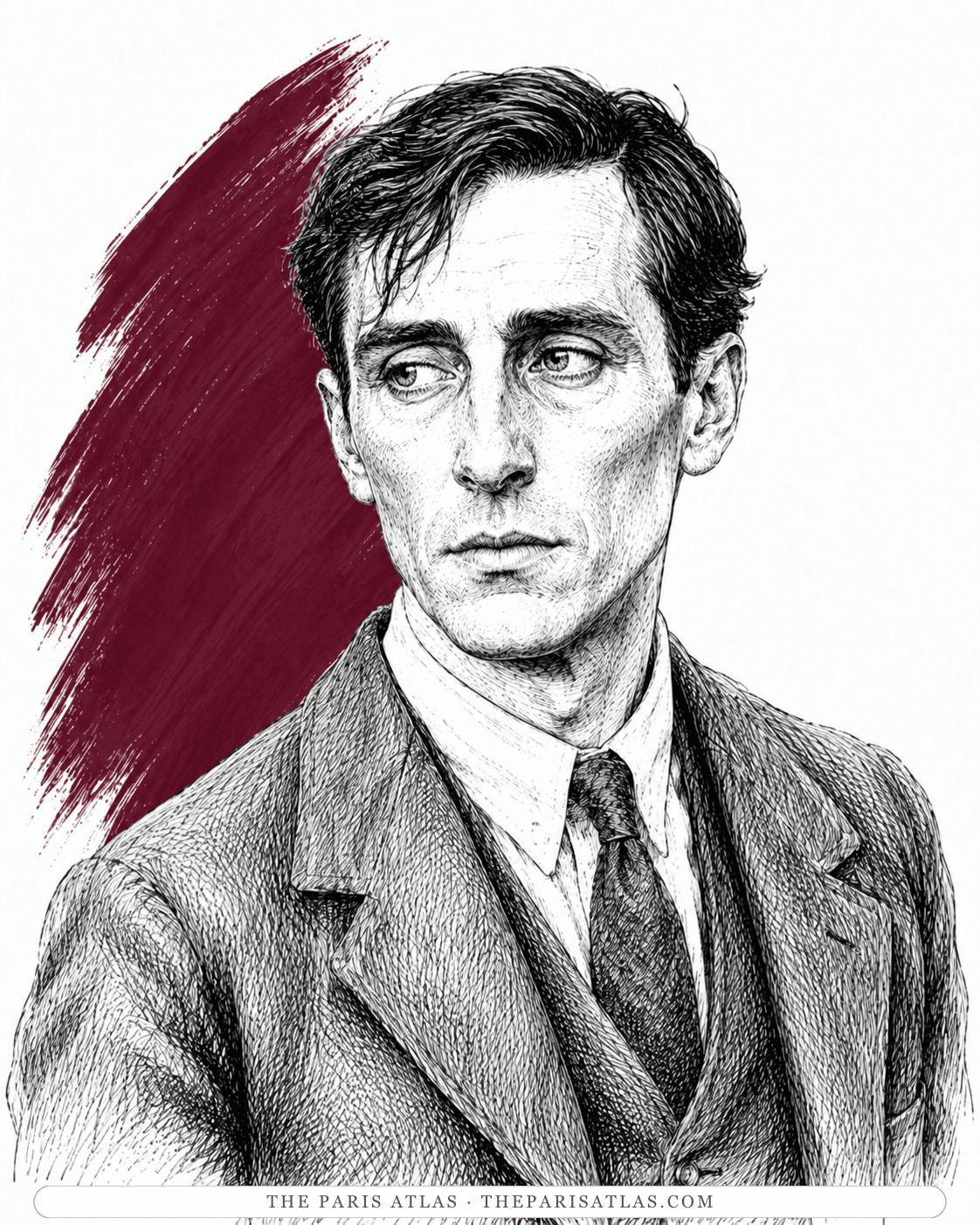
Harvey Stone
Found at the Select, unshaven and broke, days past his last meal — the expatriate literary life with the varnish burned off.
To be left alone in his own room until his money arrives. He tells Jake Barnes he has not eaten in five days and then will not go and eat: when he is like this, he says, he wants to stay in his own room, like a cat.
The book

At a glance
- American writer-about-cafés, broke — the money from the States hasn't come
- One Paris interlude at the Select, Chapter VI
- Five days ago, by his own calm account
- Two hundred francs off Jake, shaking poker dice at the New York Bar three days earlier
- A hundred francs, handed over without a question asked
- Mencken, through; Cohn, a case of arrested development
- Harold Stearns · 1891–1943 · Barre, Massachusetts
Who they are in the book
Spoiler-freeHarvey has one scene, and it is a small masterpiece of the novel's method. The Select was one of the big Montparnasse cafés where the American and English expatriates spent their days, and a café kept your bill in china: every drink arrived on its own saucer, and the stack on your table was the running total. That is how Jake Barnes — the novel's narrator, a working journalist and nearly the only man in the crowd with a salary — finds Harvey: alone on the terrace, unshaven, a pile of saucers in front of him. His money from the States hasn't come. Partway into the conversation he leans forward and says, with unsettling calm, that he hasn't eaten anything in five days. Jake does the quarter's arithmetic silently — three days ago Harvey won two hundred francs off him shaking poker dice at the New York Bar — asks no questions, and hands him a hundred francs. Lending, in this friendship, is the whole economy.
What Harvey buys with the relief is not dinner — he orders another drink first, because when he gets like this, he explains, he doesn't care whether he eats — it is company, and judgment. Judgment is his surviving asset. He files a verdict on the famous critic H. L. Mencken (through, in Harvey's ruling), and then Robert Cohn crosses the street toward the table. Cohn is another American writer in the circle — earnest, romantic, and the man the whole crowd sharpens its wit on — and Harvey greets him with the book's most casually brutal hello: he was just telling Jake that Cohn is a moron. A short quiz follows — what would Cohn rather be doing than this, first thing that comes into his head? — and when Cohn answers that he'd rather be playing college football again, Harvey revises the finding: not a moron after all; only a case of arrested development. It is among the cruelest exchanges in the book and among the most accurate, which is exactly the trouble: a man five days past his last meal, repaying his hundred francs in the only currency he has left.
He matters out of proportion to his page count because he is the cautionary version of every writer in the novel: the brilliant café talker whose books have quietly stopped happening, kept afloat by borrowed francs and the fixed conviction that he is superior to the people he borrows from. Threatened by Cohn with a someday beating, Harvey only shrugs — it would make no difference to him; he isn't a fighter — and the shrug is the whole man: past caring, in a way that looks like serenity and isn't. Yet the book views him with the special tenderness it reserves for honest wrecks. When Harvey finally walks off up the street to eat, Jake watches him go and then defends him, flatly, to the man he just flayed: he likes him; he's fond of him. So, against its better judgment, is the reader.
How Harvey Stone Is Portrayed
- The saucersCafé bills were kept in china — one saucer per drink, stacked on the table until settling time. Harvey's pile is the book's best single image of him: hours of sitting, francs of drinking, nothing to pay with — and when Jake stands the next round, Jake's saucer quietly joins Harvey's stack.
- The introductionHis entire physical description is one clause: a pile of saucers in front of him, and he needed a shave. In a quarter where everyone performs bohemian poverty, Harvey's is the unperformed kind.
- The five daysNothing to eat in five days — delivered not as a plea but as a confidence, the way another man would pass along a tip on a horse. The composure is the alarming part; a complaint would be reassuring.
- The catHis own self-diagnosis: when the money goes he wants only to hole up alone in his room — 'I'm like a cat,' he says. Pride's version of hunger: the animal that hides to suffer, and won't be hurried even to a meal someone else is buying.
- The verdict'You're not a moron. You're only a case of arrested development' — cruelty conducted like criticism, complete with a revised finding after fresh evidence. Warned that somebody will push his face in someday, he shrugs: it wouldn't make any difference; he's not a fighter.
- The exitHe takes the hundred francs and goes off at last to eat, and Jake watches him cross through the taxis — small, heavy, slowly sure of himself. Then Jake tells the seething Cohn, flatly, that he's fond of Harvey. Fondness is the scene's last word, and the book means it.
Harvey drifts out of the book still hungry and still superior; there is no more of him to spoil. Harold Stearns, his unmistakable original, was the era's great cautionary tale in the flesh: the critic who edited Civilization in the United States, pronounced America uninhabitable for artists, sailed for France in 1921 as the intellectuals' standard-bearer — and spent the decade at the Select, handicapping horses as 'Peter Pickem' for the Paris Tribune while the books went unwritten. Broke and half-blind, he was repatriated in 1932, wrote a clear-eyed memoir of the wreckage, The Street I Know, and died in 1943. Hemingway's portrait was recognized by everyone on the terrace, Stearns included.
If you like The Sun Also Rises


If you like Ernest Hemingway
Explore authors with a similar voice, perspective, and influence.

Louis-Ferdinand Céline
The other great stylist the Great War produced — where Hemingway cut the language down, Céline set it on fire. The same wound, opposite treatments.
View author
Henry Miller
Paris on no money a decade later, with the restraint removed. Miller called Hemingway's Paris a tourist's Paris; readers get to referee.
View author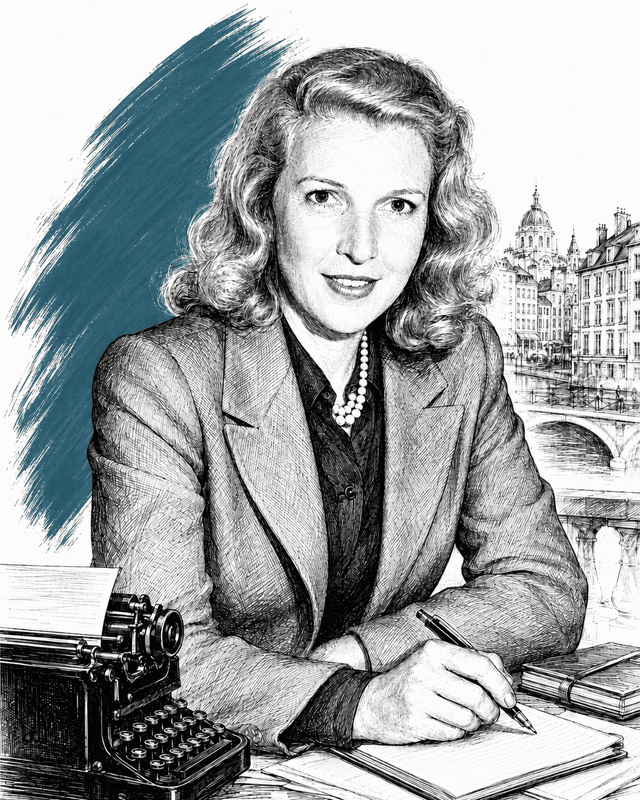
Martha Gellhorn
War correspondent who covered the Spanish Civil War, D-Day, and conflicts across five more decades; Hemingway's third wife, 1940–1945.
View author