The Paris AtlasCharting the artists, works, and places worth returning to.
Cover of A Farewell to Arms by Ernest Hemingway

A Farewell to Arms

by Ernest Hemingway

An American ambulance driver, an English nurse, and the Italian front — the Great War's great love story.

Published
1929
Pages
355
Setting
Italy
Shelf rating
4.6

About Ernest Hemingway

Illustrated portrait of Ernest Hemingway
Ernest Hemingway

31 books on our shelvesWhere to start

The story, briefly

Spoiler-free

Frederic Henry drives ambulances on the Italian front, where the war is mud, bureaucracy, and sudden randomized death; Catherine Barkley is the nurse he begins by lying to and ends by living for. Retreat, desertion, and a rowboat crossing to Switzerland follow. Drawn from Hemingway's own wounding at Fossalta at eighteen, it is the book where the famous style first carries a full-scale tragedy — rain and all.

The story, in more detail

The wound came first. In July 1918, two weeks short of his nineteenth birthday, Red Cross volunteer Ernest Hemingway was blown up by an Austrian trench mortar at Fossalta di Piave and fell in love, in the Milan hospital, with his nurse — Agnes von Kurowsky, who ended it by letter the next spring. It took him ten years to convert the two events into fiction, moving the wound to an ambulance officer named Frederic Henry and the nurse into Catherine Barkley, and folding in a retreat he never saw: the Caporetto chapters were built entirely from maps, testimony, and nerve, and Italian veterans refused to believe he hadn't been there.

He wrote it through 1928 and 1929 — a year that included his father's suicide — and rewrote the ending obsessively; he later claimed thirty-nine attempts, and the surviving manuscripts show even more. Scribner's Magazine serialized it and was banned from Boston newsstands for its trouble, while Max Perkins fought a rearguard action over the soldiers' vocabulary, much of which reached print as dashes.

Published in September 1929, weeks before the Crash, it became his first bestseller — the book that made Hemingway a public institution rather than a modernist rumor. It remains the American novel of the First World War, and the place where his two permanent subjects, love and ruin, first ran the full course together. How it ends is the most famous thing about it, and you will not learn it here.

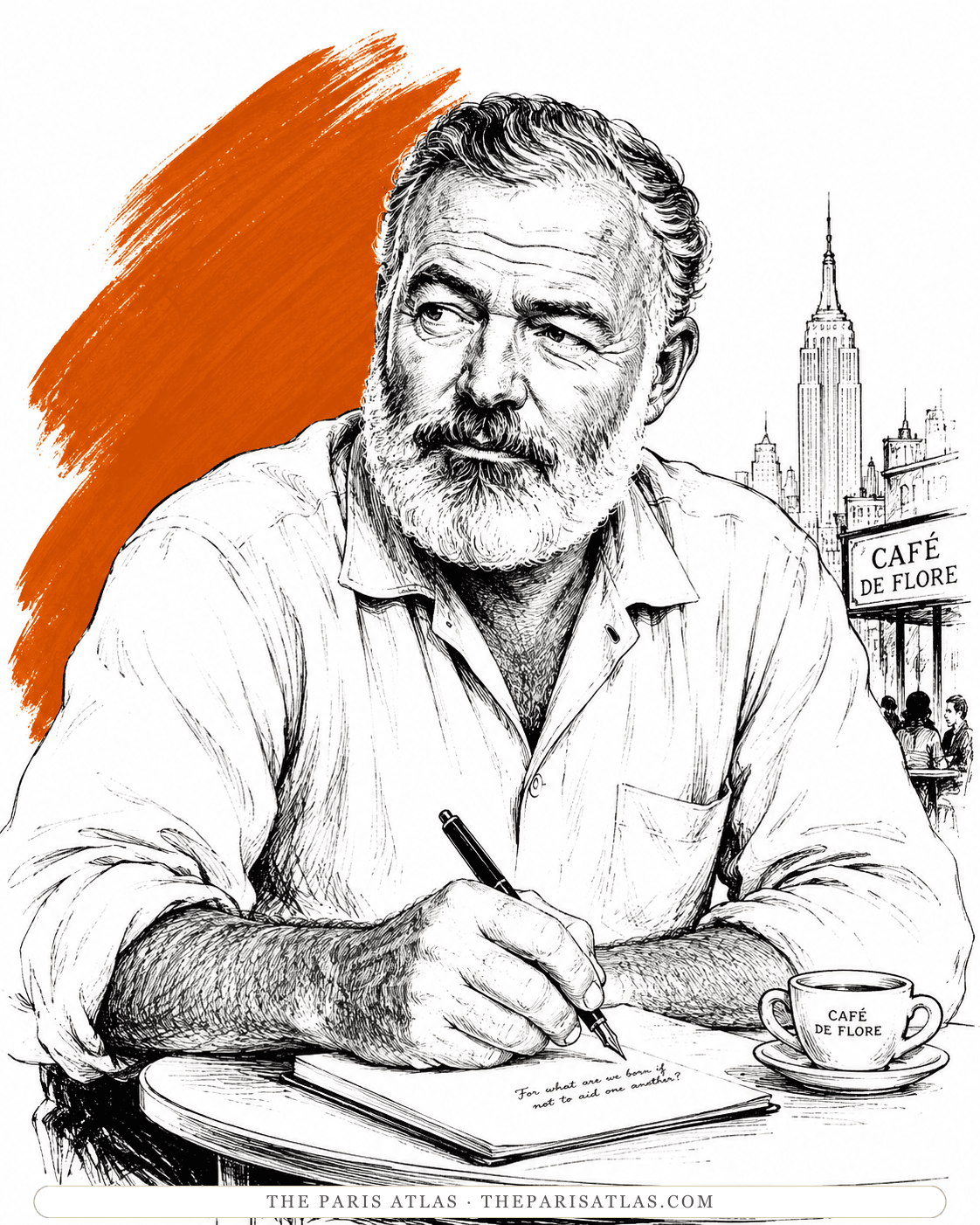
The full plot

What happens, beginning to end — the ending included. Open when you're ready.

Frederic Henry is a young American serving as an ambulance officer in the Italian army during the First World War. Between offensives he meets Catherine Barkley, an English volunteer nurse still reeling from the death of her fiancé at the Somme, and begins what both halfway understand to be a flirtation played as a game. Then an Austrian mortar shell wrecks Frederic's legs at the front, he is sent to a hospital in Milan — and Catherine is posted there. Over a long convalescent summer the game turns entirely real: they are in love, and by the time he is ordered back to the front, Catherine is pregnant.

What he returns to is the collapse at Caporetto — the Italian army's great retreat, rendered in some of the most famous war writing in the language: roads jammed with columns in the rain, discipline dissolving, and battle police at a bridge summarily shooting officers separated from their men. Facing that verdict himself, Frederic dives into the river and deserts — his personal farewell to arms. He makes his way in civilian clothes to Catherine, and when arrest looms, the two of them row all night across the lake into neutral Switzerland.

How it ends — spoilers aheadThe final movement, ending included. Open when you're ready.

Switzerland gives Frederic and Catherine the happiest stretch either has ever had: a chalet in the mountains above Montreux, winter walks, the baby coming in the spring. When labor begins, everything that medicine can do goes slowly wrong. The baby — a boy — is stillborn, and Catherine, hemorrhaging after a caesarean, dies in the night while Frederic waits through the rain. He forces the nurses out to say goodbye alone, finds there is nothing to say to what remains, and walks back to the hotel in the rain — the flattest, most famous ending Hemingway ever wrote, grief rendered as pure weather.

Quotes from A Farewell to Arms

Quoted verbatim from the text, each line verified against its source.

The world breaks every one and afterward many are strong at the broken places. But those that will not break it kills. It kills the very good and the very gentle and the very brave impartially.
Frederic (narration) · Ernest Hemingway, A Farewell to Arms (1929), Book Four, Chapter 34
That is not love. That is only passion and lust. When you love you wish to do things for. You wish to sacrifice for. You wish to serve.
The priest (dialogue) · Ernest Hemingway, A Farewell to Arms (1929), Book One, Chapter 11
I was going to forget the war. I had made a separate peace.
Frederic (narration) · Ernest Hemingway, A Farewell to Arms (1929), Book Four, Chapter 34

All 68 A Farewell to Arms quotes →

Why we recommend it

  1. The passage everyone quotes, in context

    'Abstract words such as glory, honor, courage, or hallow were obscene beside the concrete names of villages, the numbers of roads, the names of rivers, the numbers of regiments and the dates.' The paragraph that defined the generation's disillusionment belongs to this book, and it hits differently with three hundred pages around it.

  2. The retreat from Caporetto

    Fifty pages of collapse — columns in the rain, executions at the bridge — that stand with anything ever written about armies coming apart.

  3. He rewrote the ending 39 times

    By his own count, 'to get the words right.' Read the last page and judge whether draft 39 earned it. (Bring something to hold onto.)

What this book explores

The people in its pages

Three of these characters have a documented real person behind them. Each face opens a spoiler-free guide; endings and aftermath stay behind a warning.

  • Illustrated portrait of Frederic Henry

    Frederic Henry

    An American serving with an Italian ambulance unit. He is badly wounded at the front, falls in love with his nurse, and eventually deserts.

  • Illustrated portrait of Catherine Barkley

    Catherine Barkley

    An English nurse in Italy. Frederic Henry pretends to love her at first, and then finds that he does.

  • Illustrated portrait of Rinaldi

    Rinaldi

    An Italian surgeon, and Frederic's roommate at the front. He calls Frederic "baby" and talks almost without stopping.

  • Illustrated portrait of The priest

    The priest

    The unit's chaplain, who is teased at the officers' mess every night. He wants Frederic to spend his leave with his family in the Abruzzi.

  • Illustrated portrait of Helen Ferguson

    Helen Ferguson

    A Scottish nurse and Catherine's closest friend. She is the only person in the book who says the affair is a bad idea.

Also in the book

  • Illustrated portrait of Luigi Piani

    Luigi Piani

    One of the three ambulance drivers under Frederic Henry. He is the one who stays with him to the end of the retreat.

  • Illustrated portrait of Bonello

    Bonello

    An ambulance driver. He finishes off a wounded sergeant during the retreat, then leaves on his own to be taken prisoner.

  • Illustrated portrait of Bartolomeo Aymo

    Bartolomeo Aymo

    An ambulance driver, and the one Frederic Henry likes best. Italian rear-guard troops take the group for Germans and shoot him.

  • Illustrated portrait of Ettore Moretti

    Ettore Moretti

    An Italian-American officer on leave in Milan. He has five medals and three wounds, and talks about them constantly.

  • Illustrated portrait of Miss Van Campen

    Miss Van Campen

    The superintendent of the hospital in Milan. She dislikes Frederic Henry from the first afternoon, and eventually costs him his leave.

  • Illustrated portrait of Count Greffi

    Count Greffi

    A retired diplomat of ninety-four, staying at the same hotel in Stresa. He plays billiards with Frederic Henry and beats him.

Real people in this book

The real people this book portrays, dedicates itself to, or draws from — every connection carries its source.

Illustrated portrait of Pauline Pfeiffer

Pauline Pfeiffer

  • Journalist
  • Editor

Read in manuscript by · 1928

She worked on the typescript with Hemingway's sister Sunny while he wrote in the barn studio her family had converted at Piggott. This is a first reader's job, not a publisher's: Maxwell Perkins edited the book for Scribner's.

MU J-School grad led a novel life (2023); Pauline Pfeiffer (1895–1951) | Encyclopedia of Arkansas

The real history

Hemingway was blown up by an Austrian mortar at Fossalta in July 1918, at eighteen, and fell for his Red Cross nurse in the Milan hospital — the novel's blueprint, down to the ward.

From the Journal

Stories from the atlas that shelve this book.

Essays

“You Are All a Lost Generation”

The most famous label in modern literature started as a complaint about a slow car repair. What 'lost' actually meant — and why the writers it named never accepted it.

Adriana Pope · · 7 min read

Real history

Scott and Ernest: A Friendship in Five Rounds

Fitzgerald vouched for Hemingway before he'd met him and edited him better than he edited himself. Hemingway outlived him and wrote the eulogy crooked. The friendship, round by round.

Adriana Pope · · 9 min read

Bring it to book club

  • Frederic narrates his own desertion without ever quite defending it. Does the novel judge him? Do you?
  • Catherine is either the book's weakest writing or its most misread character — modern critics split. Where do you land?
  • Rain runs through the novel like a curse. Track where it falls; what is it doing?

A complete discussion guide is on our editorial calendar. Join the letter to hear when it ships.

Timeline

  1. 1917

    The Italian army breaks at Caporetto in late October and falls back through November. Hemingway does not reach Italy until the following year and never witnesses the retreat that becomes the novel's central military episode.

  2. 1918

    Hemingway joins the American Red Cross ambulance service and arrives in Italy in June. On 8 July, thirteen days short of his nineteenth birthday, a trench mortar badly wounds him near Fossalta di Piave.

  3. 1918

    Recovering in a Milan hospital, he falls in love with Agnes von Kurowsky, the American nurse behind much of Catherine Barkley. The novel draws on the affair rather than reporting it.

  4. 1919

    He returns to the United States expecting to marry her. In a letter dated 7 March, von Kurowsky ends the relationship, telling him her feelings are more those of a mother than a sweetheart.

  5. 1928–1929

    Hemingway writes the novel between March 1928 and January 1929, a decade after leaving Italy. The interval lets him build the Caporetto chapters out of maps and testimony rather than memory.

  6. 1929

    He reworks the ending through the spring. He later said he rewrote it thirty-nine times; forty-seven versions survive in his papers.

  7. 1929

    Scribner's Magazine serializes the novel in six monthly installments from May to October. Boston bars the June issue from newsstands over the language and the sexual content, and Scribner's editors fear the ban will reach the book.

  8. 1929

    Charles Scribner's Sons publishes the novel on 27 September, less than a month before the Wall Street Crash. It is Hemingway's first bestseller.

  9. 1930

    Laurence Stallings adapts the novel for Broadway. The production opens at the National Theatre in New York on 22 September and closes after twenty-four performances.

  10. 1932

    Frank Borzage directs the first film adaptation, with Gary Cooper as Frederic Henry and Helen Hayes as Catherine Barkley. It premieres in New York on 8 December.

  11. 1957

    David O. Selznick produces a second adaptation, directed by Charles Vidor, with Rock Hudson, Jennifer Jones, and Vittorio De Sica. It is the last film Selznick made.

  12. 2012

    Scribner's Hemingway Library Edition collects the alternate endings and the early draft material for the first time.

  13. 2025

    The original 1929 text enters the public domain in the United States. Later editions and adaptations keep their own protections.

Book editions

Hardcover
Hardcover
Charles Scribner's Sons
1929
First American edition, 355 pages.
Hardcover
Hardcover
Jonathan Cape
1929
First British edition.
Hardcover
Hardcover
Charles Scribner's Sons
1948
First illustrated edition, with drawings by Daniel Rasmusson and a new introduction by Hemingway.
Paperback edition cover
Paperback
Scribner
1995
ISBN-13
9780684801469
The standard modern paperback.
Audiobook edition cover
Audiobook
Simon & Schuster Audio
2006
ISBN-13
9780743564373
Unabridged, read by John Slattery.
Hardcover edition cover
Hardcover
Scribner
2012
ISBN-13
9781451658163
The Hemingway Library Edition: the alternate endings and draft passages, with Hemingway's 1948 introduction and new material from Patrick and Seán Hemingway.
Ebook edition cover
Ebook
Scribner
2012
ISBN-13
9781451681871
The Hemingway Library Edition.
Paperback edition cover
Paperback
Scribner
2014
ISBN-13
9781476764528
The Hemingway Library Edition in paperback.
Paperback edition cover
Paperback
Penguin Classics
2025
ISBN-13
9780143138839
Penguin Classics Deluxe Edition, with a foreword by Abraham Verghese.

Reader reviews

Loading reviews…

Cover of In Our Time by Ernest Hemingway

In Our Time

Ernest Hemingway

The wound in miniature: the early stories where Nick Adams carries the same front home.

Read our take

Recommended alongside The Old Man and the Sea, For Whom the Bell Tolls, Across the River and into the Trees, Islands in the Stream, Le Feu, I Have Killed and Some Do Not….

Also recommended in books like The Sun Also Rises and books like Journey to the End of the Night.

A Farewell to Arms: frequently asked questions

Who wrote A Farewell to Arms?

Ernest Hemingway. It was published in 1929 and was his first big commercial and critical success.

What is A Farewell to Arms about?

Frederic Henry, an American driving ambulances on the Italian front in the First World War, and his love affair with the English nurse Catherine Barkley — through retreat, desertion, and a crossing to Switzerland.

Is A Farewell to Arms autobiographical?

It draws directly on Hemingway's own experience: he was wounded by a trench mortar at Fossalta di Piave in 1918, two weeks short of his nineteenth birthday, and fell in love with a nurse during his convalescence in Milan.

Why is A Farewell to Arms important?

It is the book where Hemingway's spare style first carries a full-scale tragedy, and it stands among the defining novels of the First World War.

When and where is it set?

On and behind the Italian front during the First World War, moving from the fighting to a final refuge in neutral Switzerland.