The Hemingway Daiquiri: What It Is and Where It Came From
The Hemingway daiquiri grew from Ernest Hemingway’s real association with El Floridita in Havana, but the name now covers several different drinks.

A painter, three sons, a war at sea — the unfinished masterpiece that shows what Hemingway was still reaching for.
In three movements — Bimini, Cuba, at sea — painter Thomas Hudson lives out a summer with his three sons on a Bahamas island, absorbs their loss, and hunts a German submarine crew through the Cuban archipelago. Unfinished at Hemingway's death in 1961 and edited into publication by his widow Mary and Scribner's Charles Scribner III, it is rawer and more emotionally direct than anything he published in his lifetime. The Bimini section, in particular, captures a kind of ease and joy that his published novels rarely permit themselves. Essential reading for anyone who wants the full shape of the work.
After the war Hemingway announced a huge project — one big book of the land, sea, and air — and then spent years feeding it pages that never cohered into an announcement-sized whole. The sea portion, written mostly around 1950 and 1951, followed a painter named Thomas Hudson from Bimini to Cuba to open water; Hemingway mined it for other work, set the rest aside, and never published a word of it.[1]
He died in 1961 with the manuscript in the vault, and in 1970 Mary Hemingway and Charles Scribner Jr. released it in three movements — Bimini, Cuba, At Sea — trimmed but substantially as he left it. The Bimini chapters, with Hudson's three sons, hold some of the tenderest writing of his career; the At Sea section turns his own wartime game of hunting U-boats from a fishing boat into narrative.[1]
That last part was barely fiction: from 1942 to 1943 Hemingway really did patrol Cuban waters aboard the Pilar with government-issued equipment and a crew of friends, hoping to ambush a surfaced submarine. Readers and critics have been rearranging their rankings of the posthumous books ever since; Islands regularly comes out on top of that pile — the book where the machinery shows, and so does the heart.[1]
Thomas Hudson is a painter of real reputation who has organized a hard-won peace on the island of Bimini: work in the morning, the Gulf Stream in the afternoon, discipline against loneliness. Into that peace come his three sons — young Tom, the eldest, child of the Paris marriage Hudson wrecked, and the two younger boys — for a summer the book renders with unbearable warmth: spearfishing, man-of-war birds, and David's marathon, heartbreaking fight with a giant broadbill. The idyll ends the way lightning strikes: a cable arrives — the two younger boys and their mother have been killed in a car accident in France.[1]
The second movement finds Hudson in Cuba during the war, grief managed with cats, gin, and routine, painting abandoned; word comes that young Tom, flying for the RAF, has been shot down. The last movement gives Hudson's sorrow a job: commanding an armed fishing boat and a crew of irregulars — his real-life author did exactly this aboard the Pilar — hunting the survivors of a sunk German U-boat through the keys and mangrove channels of the Cuban coast.[1]
The chase ends in an ambush in a narrow mangrove channel: the German survivors, cornered, fire first, and Thomas Hudson is machine-gunned at his post on the flying bridge. His men take the enemy, and the book closes aboard the boat with Hudson dying among them, held by his friend Willie, who tells him — the last exchange of the novel — that he is loved. Hudson's answer, and the book's: that he understands it now, too late, and that the sea carries him out on that understanding. Hemingway never published a page of it; his widow found the ending exactly where he left it.
The failed catch changes what the struggle can mean. David first wants silence, while the others offer praise, practical care and consoling talk about the record he nearly set. Only afterward does he explain that, at his most exhausted, he could no longer separate himself from the fish. His relief that both have survived replaces the desire for public distinction. The scene preserves the pain of losing without making possession its final measure. David's account asks the listeners to understand an attachment that their language of achievement cannot fully express.
The channel turns Hudson's habit of close observation into a source of uncertainty. The water no longer agrees with the chart, and the banks conceal more than they reveal. He notices the absence of birds and searches for disturbed branches, but the visible landscape offers no clear answer. Even when crabs move abruptly, the threat remains out of sight. This attention slows the approach without giving him control over it. His vulnerability comes partly from having to act within a scene he can read closely but cannot see through.
The opening section — a father and his three young sons on a Bahamas island, fishing and swimming and arguing — is the warmest writing Hemingway left behind. It makes the rest of the novel almost unbearable in the right way.
Without the self-editing that shaped his published novels, Hudson's grief runs closer to the surface than Hemingway usually permitted. Readers who find his published work cold may find this more accessible.
The second section is set in Havana's bars and at the Finca Vigía in ways his other novels aren't — the closest thing to a memoir of the Cuba decades.
The Hemingway daiquiri grew from Ernest Hemingway’s real association with El Floridita in Havana, but the name now covers several different drinks.
1950–1951
Hemingway writes the sea narrative of a painter named Thomas Hudson, mines it for other work, and sets the rest aside, publishing none of it.
1961
He dies with the manuscript still in the vault.
1970
His widow Mary Hemingway and Scribner release it in three movements, Bimini, Cuba, and At Sea, substantially as he left it.


The other Cuban novel — the one he polished and this one he didn't; read them as the published and the private.
Read our take
Key West and Cuba, earlier and angrier — Hudson is what Harry Morgan might have been in a different life.
Read our take
Another aging man reckoning with war and loss; the posthumous companion in tone.
Read our take
The war that made Hudson's generation; the grief that runs underneath the submarine hunt.
Read our takeErnest Hemingway. He left it unfinished at his death in 1961, and it was published posthumously in 1970.
In three movements — Bimini, Cuba, at sea — the painter Thomas Hudson lives a summer with his three sons on a Bahamas island, absorbs their loss, and hunts a German submarine crew through the Cuban archipelago.
No. It was edited into publication after his death by his widow, Mary Hemingway, and the publisher Charles Scribner III.
It is rawer and more emotionally direct. The Bimini section in particular has an ease and joy that his published novels rarely permit themselves.
For the full shape of Hemingway's work — it is a major part of the fiction that appeared only after his death.
Explore authors with a similar voice, perspective, and influence.

The other great stylist the Great War produced — where Hemingway cut the language down, Céline set it on fire. The same wound, opposite treatments.
View author
Paris on no money a decade later, with the restraint removed. Miller called Hemingway's Paris a tourist's Paris; readers get to referee.
View author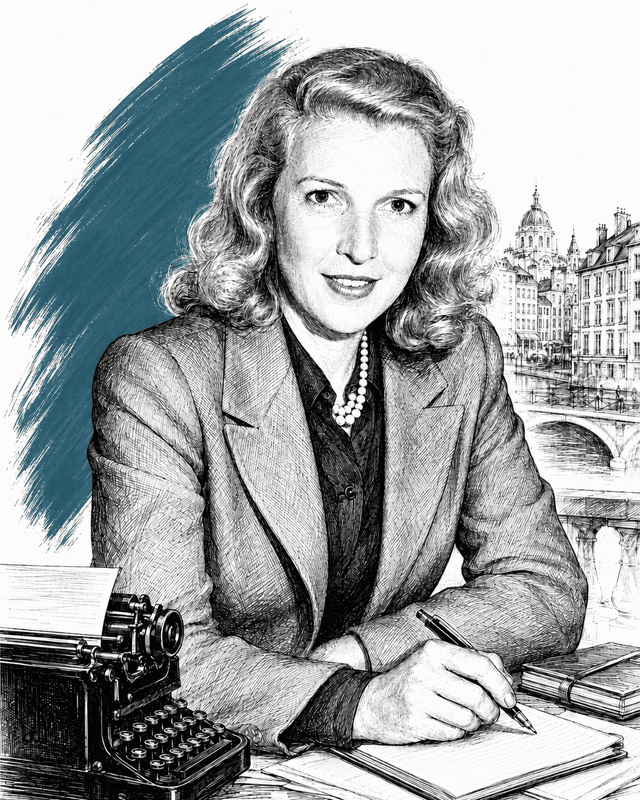
War correspondent who covered the Spanish Civil War, D-Day, and conflicts across five more decades; Hemingway's third wife, 1940–1945.
View authorThe sources below include the primary text, editions, scholarship, archival materials, and other records that informed this page. They document Islands in the Stream, its publication, and its place in literary history.


Third-party 2014 HTML transcription reproducing Bantam front matter dated February 1972. Analysis uses the closing fishing sequence in Bimini IX and the channel approach in At Sea XX. Not collated against a printed edition or the manuscript; no whole-volume review.
Used to place Islands in the Stream within Ernest Hemingway's published work and verify its bibliographic context.
Used for independent biographical, archival, or historical context surrounding Ernest Hemingway's career and the period in which Islands in the Stream appeared.
Used to cross-check authorship, chronology, and the work's place in Ernest Hemingway's wider catalogue.

Used to verify Ernest Hemingway's bibliography and place Islands in the Stream within the broader chronology of Ernest Hemingway's career.
The primary text is the baseline reference for every book page. Additional references document publication history, interpretation, and historical context where that evidence is available.
 Explore more resources