
A Farewell to Arms
Italy, the first time — the war Cantwell has been carrying in his body ever since.
Read our take
A dying American colonel, a winter weekend in Venice, a young countess — the valedictory novel the critics panned and time is slowly rehabilitating.
Colonel Richard Cantwell has a bad heart and knows it. He has driven to Venice for a last duck shoot and a last weekend with Renata, the young countess he loves, walking the winter city he has known since the First World War and which was nearly destroyed when he helped liberate it in the Second. Written in the voice of a man who has exhausted his patience for everything except beauty, it is Hemingway's most confessional novel — not his best, but the most honest account of what happens to soldiers who don't die young. The critics savaged it in 1950; its reputation has been recovering ever since.
Venice in the late forties gave Hemingway his last prewar-style romance: duck shoots in the lagoon at dawn, the Gritti bar, and an eighteen-year-old Venetian aristocrat named Adriana Ivancich, with whom the married, fifty-year-old novelist conducted an infatuation that never became an affair — and immediately became a novel. Colonel Richard Cantwell, fifty, heart-sick in both senses, spends a weekend in Venice with a young countess named Renata; the title is the deathbed sentence of Stonewall Jackson.[1]
Cosmopolitan serialized it and Scribner published it in September 1950, and the reviews were the worst of his life — a decade of pent-up parody found its target, most famously E. B. White's New Yorker send-up 'Across the Street and Into the Grill.' The wounded-lion posturing, the battlefield monologues, the girl called Daughter: critics who had imitated him for twenty years lined up to say the master had become his own imitation.[1]
The sequel to the humiliation is the point of remembering it: stung, he went back to Cuba and wrote The Old Man and the Sea in two months. Meanwhile this book's defenders — and it has serious ones — keep pointing at the Venice light, the professional tenderness about death, and the fact that the old man's comeback was carried in the same tackle box. Read it after the legend, not before.[1]
Colonel Richard Cantwell, fifty years old, twice demoted, and living on nitroglycerin tablets for a failing heart, comes to Venice for a weekend he understands better than anyone around him: a last one. The frame is a duck shoot in the frozen lagoon at dawn; the body of the book is the day and night before it — the Gritti Palace, the bars, the winter city he loves more than any place on earth, and Renata, the nineteen-year-old Venetian contessa who loves him and whom he loves with a tenderness the book dares you to find ridiculous.[1]
Between gondola rides and dinners, Renata draws out of him what she calls his trade: the wars. Cantwell's monologues — the Great War fought in these same river plains at eighteen, the lost regiment in the Hürtgen Forest that cost him his star — are the novel's spine, a professional soldier auditing his century. He performs one private ceremony: revisiting the exact spot by the Piave where he was first wounded, and burying there, with a folding shovel and full military irony, his own monument.[1]
The duck shoot comes and goes in the cold morning light, and on the drive out of the marshes Colonel Cantwell's heart finally makes good on its warnings. He quotes to his driver the dying words of the Confederate general Stonewall Jackson — about crossing over the river and resting under the shade of the trees — climbs with dignity into the back seat of the car, shuts the door carefully, and dies. The driver finds the note the Colonel wrote in advance: the portrait of Renata and his shotguns are to be returned to her, and the rest is silence, handled — like everything Cantwell did — according to procedure.
Calling the gondola a home makes a moving, borrowed space feel briefly permanent. Yet the lovers must keep adjusting to the wind, the tide and Cantwell's injured hand. Their intimacy depends on these small acts of accommodation. Renata gives directions and corrects him; she is not simply another beautiful object in the Venetian scene. Even here, military language and memories enter their conversation. The boat offers shelter, but not an escape from the habits of command or the experience of violence that Cantwell brings with him.
For a moment, shooting releases Cantwell from his rank: the narration identifies him simply by the task his body performs. Timing, restraint and a successful shot give him a clear measure of competence. The boatman's interference then exposes how fragile that composure is. Cantwell's anger interrupts the orderly ritual, and thoughts of Renata redirect his wish to demonstrate skill toward an absent spectator. The scene does not offer an uncomplicated portrait of stoic control. Precision at one task coexists with resentment, vulnerability and the desire to be seen.
The city scenes — the Harry's Bar scenes, the walks through the calli, the lagoon at dawn — are among Hemingway's most atmospheric writing. Whatever the novel's flaws, the place is fully alive.
Cantwell is old, bitter, and not charming — the anti-Jake Barnes. Reading him alongside the earlier heroes shows exactly what the code costs over a lifetime.
The Old Man and the Sea can only be properly understood as a comeback. To understand what Hemingway was coming back from, this is the novel to read.
1948
In Venice, Hemingway meets the young aristocrat Adriana Ivancich, the model for Renata, and the infatuation soon becomes a novel.
1950
Cosmopolitan serializes it and Scribner publishes it in September; the reviews are the worst of his life, among them E. B. White's parody "Across the Street and Into the Grill."
1951
Stung, Hemingway returns to Cuba and writes The Old Man and the Sea in two months.

Italy, the first time — the war Cantwell has been carrying in his body ever since.
Read our take
The triumphant follow-up: what the critics who dismissed this novel were saying was impossible.
Read our take
The war before this war — how the generation of the '30s arrived at the '40s still fighting.
Read our take
Another aging hero, another reckoning — the posthumous companion volume.
Read our takeErnest Hemingway. Scribner published it in September 1950.
Colonel Richard Cantwell, an American with a failing heart, drives to Venice for a last duck shoot and a last winter weekend with Renata, the young countess he loves, in the city he has known since the First World War.
The dying words of the Confederate general Stonewall Jackson: "Let us cross over the river and rest under the shade of the trees."
The reviews were the worst of Hemingway's life, and its reputation has been recovering ever since. It is his most confessional novel — the honest account of what happens to soldiers who do not die young.
Stung by the reception, he returned to Cuba and wrote The Old Man and the Sea in two months.
Explore authors with a similar voice, perspective, and influence.

The other great stylist the Great War produced — where Hemingway cut the language down, Céline set it on fire. The same wound, opposite treatments.
View author
Paris on no money a decade later, with the restraint removed. Miller called Hemingway's Paris a tourist's Paris; readers get to referee.
View author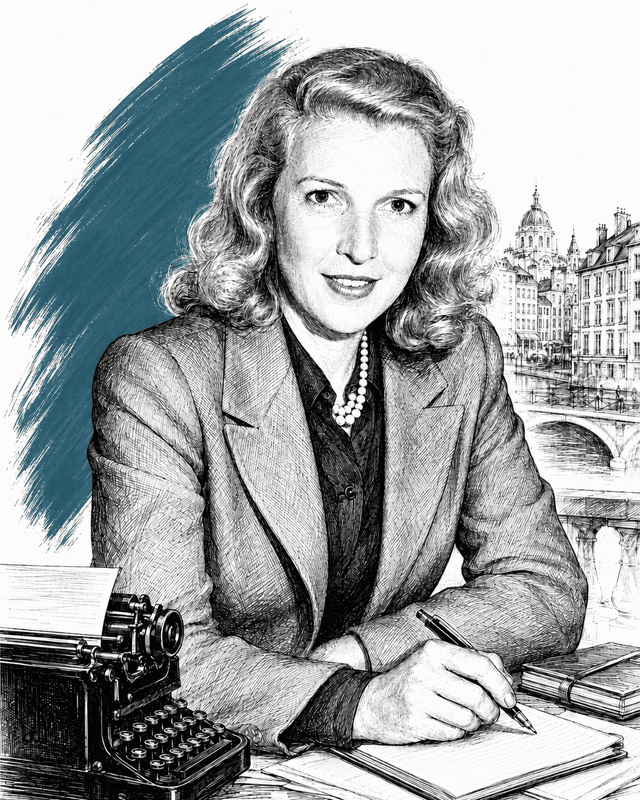
War correspondent who covered the Spanish Civil War, D-Day, and conflicts across five more decades; Hemingway's third wife, 1940–1945.
View authorThe sources below include the primary text, editions, scholarship, archival materials, and other records that informed this page. They document Across the River and into the Trees, its publication, and its place in literary history.


Al Haines's 2012 public transcription of the 1952 Readers Union/Jonathan Cape edition. Complete displayed chapters XIII and XL read; analysis uses the gondola encounter and opening duck-shooting passage. No whole-novel or 1950 first-edition collation.
Used to place Across the River and into the Trees within Ernest Hemingway's published work and verify its bibliographic context.
Used for independent biographical, archival, or historical context surrounding Ernest Hemingway's career and the period in which Across the River and into the Trees appeared.
Used to cross-check authorship, chronology, and the work's place in Ernest Hemingway's wider catalogue.

Used to verify Ernest Hemingway's bibliography and place Across the River and into the Trees within the broader chronology of Ernest Hemingway's career.
The primary text is the baseline reference for every book page. Additional references document publication history, interpretation, and historical context where that evidence is available.
 Explore more resources