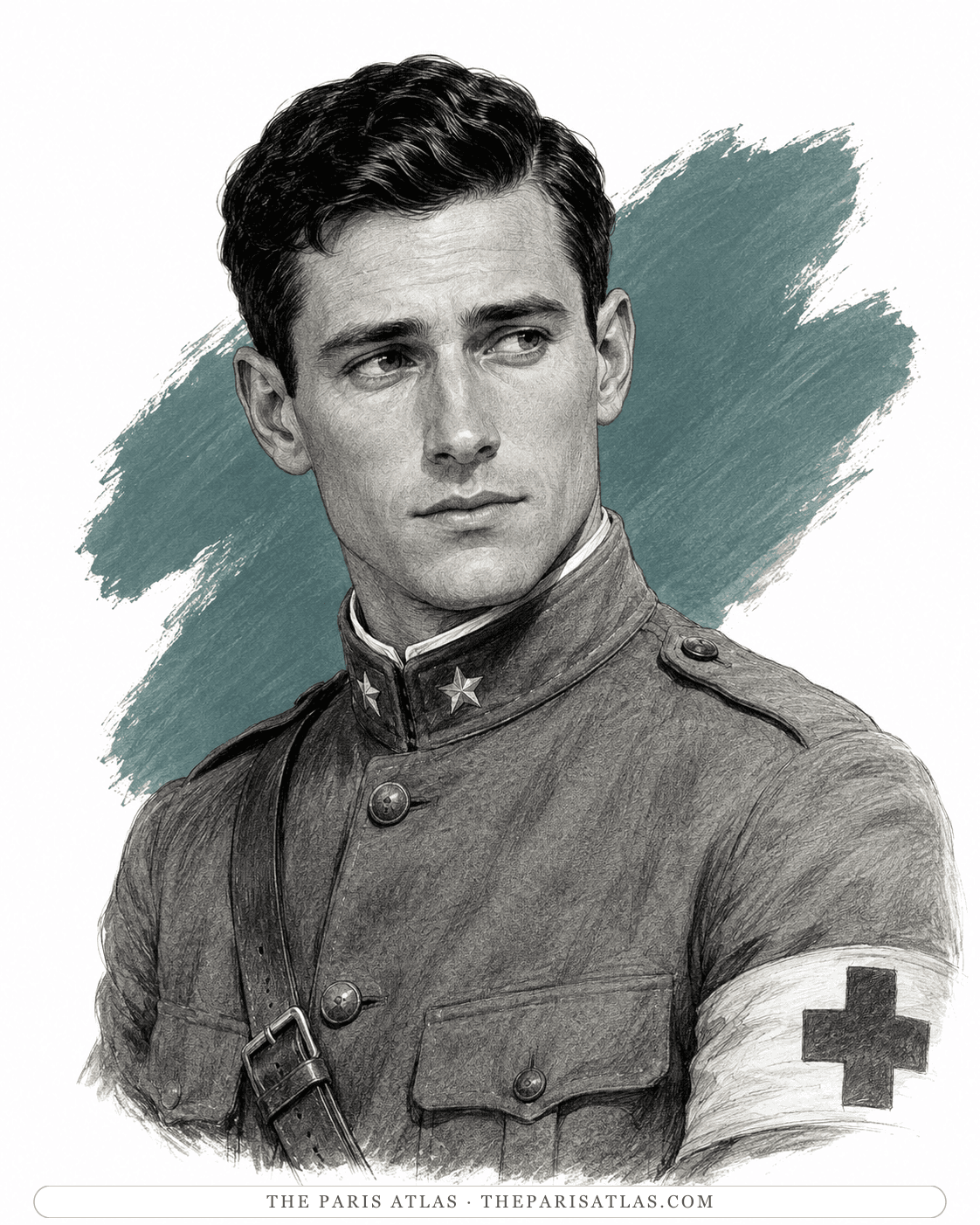
Frederic Henry
An American serving with an Italian ambulance unit. He is badly wounded at the front, falls in love with his nurse, and eventually deserts.
Somewhere clean and cold, away from the war. The unit's chaplain keeps urging him to spend his leave in the Abruzzi, a mountain region of central Italy where the roads freeze hard and the hunting is good, and he means to go, then spends it in the smoke of cafés instead. He says it himself: we did not do the things we wanted to do, we never did such things.
The book

At a glance
- Narrator — an American tenente with an Italian ambulance unit on the Isonzo front
- A doctor; and by his own correction, not really a soldier — "It's only the ambulance"
- By a trench mortar in a forward dugout, in the knee and leg, while eating supper
- The American hospital in Milan, where Catherine Barkley is a nurse
- Wine, vermouth, grappa, cognac, whisky and beer, itemized as carefully as the weather
- A reason for being in the war
- Ernest Hemingway — the author, rearranged · 1899–1961 · Oak Park, Illinois
Who they are in the book
Spoiler-freeFrederic Henry is an American lieutenant attached to an Italian ambulance unit on the Isonzo front in 1917. He is not a doctor, and by his own correction not really a soldier: he runs the cars that carry wounded men down from the mountains. Asked why an American would be in the Italian army, he says it is not really the army, only the ambulance, and then gives up: "I don't know," he says. "There isn't always an explanation for everything."
He narrates the novel in a flat, exact voice that records weather, distances, meals and drinks with the same attention it gives to death. He drinks steadily and itemizes it. What he wants changes exactly once: he begins by pretending to love Catherine Barkley as a way of passing the evenings, and ends with nothing else in his life at all.
How Frederic Henry Is Portrayed
- No explanationCatherine asks why he joined the Italians. He deflects once — "It's not really the army. It's only the ambulance" — and then stops: "I don't know," he says. "There isn't always an explanation for everything." She tells him she was brought up to think there was one. The novel never supplies it.
- The piece of cheeseHe is eating cold macaroni and cheese in a forward dugout when the trench mortar arrives. "I ate the end of my piece of cheese and took a swallow of wine." Then a flash "as when a blast-furnace door is swung open," and the certainty that he has died — "it had all been a mistake to think you just died." Then he slides back and breathes.
- PassiniThe first thing he does on returning to his body is reach for the man next to him. Both of Passini's legs are smashed above the knee, one of them gone, and he is begging to be shot. Frederic's own wound gets a few sentences. Passini's death gets a page.
- "'Yes,' I lied"Catherine asks whether he loves her, on their second evening, and he says he does. His own account of the moment is one word long: "'Yes,' I lied. 'I love you.' I had not said it before."
- What the priest tells himThe priest says what Frederic describes at night is not love: "That is only passion and lust. When you love you wish to do things for. You wish to sacrifice for. You wish to serve." Frederic answers that he doesn't love. "You will," the priest says. "I know you will. Then you will be happy."
- A separate peaceAfter the retreat, having gone into the Tagliamento to get away from the battle police, he stops being an officer without announcing it to anyone: "I had made a separate peace." He buys civilian clothes in Milan and explains himself to nobody for the rest of the book.
He deserts. During the retreat from Caporetto he shoots at a sergeant who refuses an order, watches the battle police executing officers at the Tagliamento bridge for the crime of having been separated from their troops, and . He reaches Milan in civilian clothes, then Stresa, and rows Catherine across the lake to Switzerland overnight with a borrowed boat and an umbrella for a sail. What ends the book is not the war.
Frederic is Hemingway with the facts moved. Hemingway drove ambulances for the American Red Cross on the Italian front at eighteen and was badly wounded by an Austrian trench mortar at Fossalta di Piave on 8 July 1918, taking over two hundred fragments in his legs; he recovered at the Red Cross hospital in Milan and fell in love with a nurse there. But he never fought at Caporetto, never deserted, and never lost a child. The retreat he describes in detail was reconstructed from reading and from other men's accounts a decade later.
If you like A Farewell to Arms


If you like Ernest Hemingway
Explore authors with a similar voice, perspective, and influence.

Louis-Ferdinand Céline
The other great stylist the Great War produced — where Hemingway cut the language down, Céline set it on fire. The same wound, opposite treatments.
View author
Henry Miller
Paris on no money a decade later, with the restraint removed. Miller called Hemingway's Paris a tourist's Paris; readers get to referee.
View author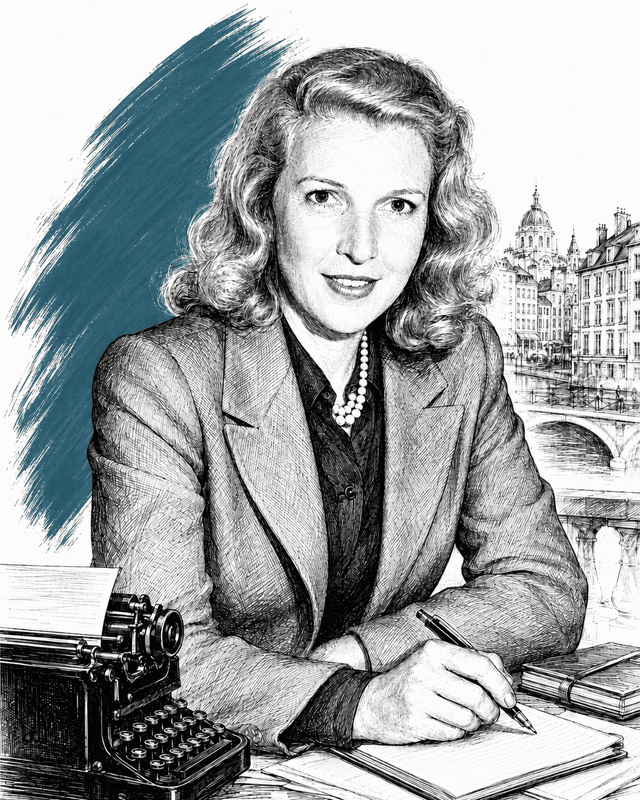
Martha Gellhorn
War correspondent who covered the Spanish Civil War, D-Day, and conflicts across five more decades; Hemingway's third wife, 1940–1945.
View author