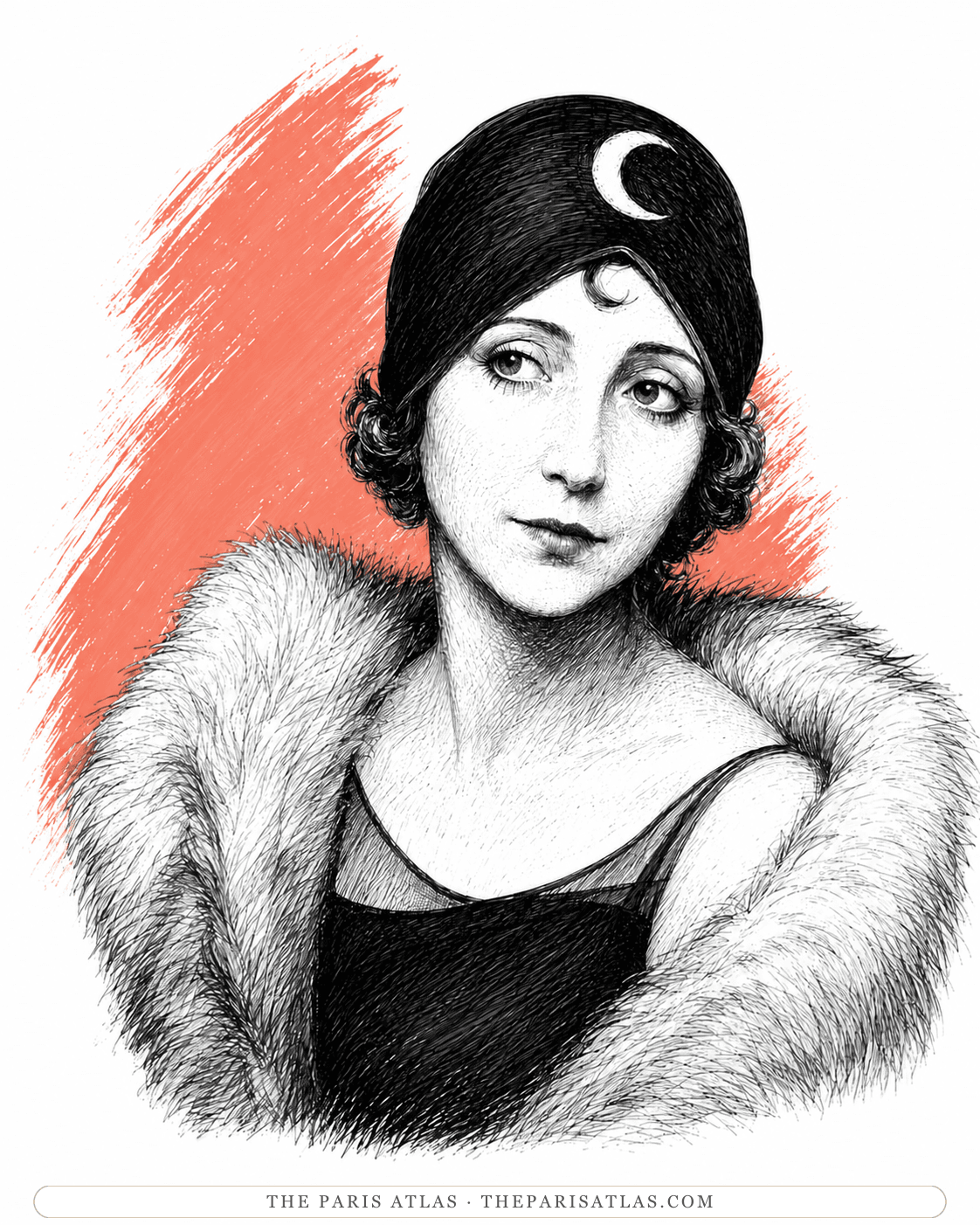
Ladders to Fire
Lillian's book: the hungers, the marriage, Jay's Paris, and the party that assembles the cast.

by Anaïs Nin
The five novels of the continuous novel in one volume — Nin's roman-fleuve of women's inner lives, assembled under its true name.
The omnibus of Nin's 'continuous novel': five linked books — Ladders to Fire, Children of the Albatross, The Four-Chambered Heart, A Spy in the House of Love, and Seduction of the Minotaur — tracing Lillian, Djuna, and Sabina from the studios and cafés of Paris to a houseboat on the Seine, a masked night in New York, and the Mexican sun. Nin first issued the collection herself in 1959; the definitive Swallow edition followed, with the expanded Seduction of the Minotaur in the final seat. One design, five doors. (Contents below — nothing spoiled.)
Nin planned the sequence as a single work from the start: not a series with a plot spine but a roman-fleuve of the interior, where each novel takes one woman deeper while the others move in the margins. She called it the continuous novel, and insisted the books could be entered in any order — cities on one map rather than chapters in one story. The title she finally gave the assembled volume says the design plainly: these are cities of the interior, and the atlas they belong to is one woman's psyche multiplied by three.
The publishing history is pure Nin. No commercial house wanted the assembled work in 1959, so she produced the omnibus herself; Alan Swallow then took over her list, and the collection reached its settled form — with Seduction of the Minotaur, the expansion of Solar Barque, closing the set — in the Swallow editions that have kept it in print since. What had looked for two decades like scattered, hard-to-place novels stood revealed as one sustained project, the era's most patient experiment in writing the inner life at full length.
Five novels, one design. Ladders to Fire opens the sequence with Lillian, the pianist whose force masks anxiety, and seats the whole cast at a Paris party. Children of the Albatross gives Djuna, the dancer turned watcher, her history and her sealed room. The Four-Chambered Heart confines Djuna and the guitarist Rango to a houseboat on the Seine with an invalid wife between them. A Spy in the House of Love follows Sabina, the woman of five selves, through a New York night tracked by her own conscience. Seduction of the Minotaur carries Lillian to the Mexican sun and turns the journey inward, closing the sequence with a homecoming.
The books share people, not plot: read in any order, each is a complete city, and the sequence is the map that shows them belonging to one country.
Recurring characters connect these novels without necessarily making them one continuous action. Maud Rauturier challenges the sequence's unity precisely on this point: the women increasingly pursue separate quests, and their meetings do not supply a common narrative center. Her objection identifies a useful question for readers of the omnibus. Is continuity something the characters experience together, or something readers construct by comparing their different lives? The collected form makes those comparisons easier, but it does not erase the distance between one woman's story and another's.
In her interview with Barbara Freeman, Nin acknowledges that Lillian's development is more complete than the other women's and describes the novels as unfinished in one sense. She explains that her characters changed as her own perception changed, rather than following a predetermined outline. This account complicates the finished volume's appearance of a settled design. Gathering the books allows their patterns to be recognized retrospectively; it need not mean that every life has reached an equivalent resolution. The sequence can offer a shared frame without giving each character the same ending.
Read together, the five books reveal the pattern no single one shows: three women, one interior country.
A roman-fleuve of the inner life, sustained across two decades of writing — few writers of the era attempted it, fewer finished.
The omnibus honors Nin's claim that the sequence has no required order — five entrances to one building.
Lillian's book: the hungers, the marriage, Jay's Paris, and the party that assembles the cast.
Djuna's book: the sealed room, the unfinished young men, and the café where everyone lands.
Djuna and Rango on a Seine houseboat, with his invalid wife aboard in everything but body.
Sabina's book: five selves, one New York night, and the lie detector her guilt invited.
Lillian in the Mexican sun: the labyrinth turned inward, and the sequence's homecoming.
1946–1961
The five novels appear one by one, from Ladders to Fire to Seduction of the Minotaur, under four different imprints including Nin's own.
1959
Nin self-publishes the first assembled Cities of the Interior — the sequence under its true name at last.
1974
Swallow Press issues the definitive one-volume edition, which has kept the continuous novel in print since.


The omnibus of Anaïs Nin's five-novel 'continuous novel': Ladders to Fire, Children of the Albatross, The Four-Chambered Heart, A Spy in the House of Love, and Seduction of the Minotaur, collected in one volume.
No. Nin insisted each stands alone and the sequence can be entered anywhere — the books share people and a design, not a plot.
Nin assembled and issued the collection herself in 1959; the definitive Swallow Press edition, with Seduction of the Minotaur as the fifth book, followed in 1974.
Three women above all — Lillian the pianist, Djuna the watcher, and Sabina the performer — with the painter Jay and a small supporting cast moving among their books.
Nin's figure for the design: each novel is a city in one inner country — the psyche mapped at full length, which she considered the sequence's real subject.
Explore authors with a similar voice, perspective, and influence.

The entangled careers of the Villa Seurat: she financed and prefaced his scandal, he detonated her prose — and each wrote the other into the century's record.
View author
The doctor of the Paris slums who wrote the century's blackest, funniest novel — and changed the sound of French prose.
View author
War correspondent who covered the Spanish Civil War, D-Day, and conflicts across five more decades; Hemingway's third wife, 1940–1945.
View authorThe sources below include the primary text, editions, scholarship, archival materials, and other records that informed this page. They document Cities of the Interior, its publication, and its place in literary history.


The primary text represented by this page, used for descriptions of the work’s contents and for any quoted passages shown here.
Used to place Cities of the Interior within Anaïs Nin's published work and verify its bibliographic context.

Used for independent biographical, archival, or historical context surrounding Anaïs Nin's career and the period in which Cities of the Interior appeared.
Used to cross-check authorship, chronology, and the work's place in Anaïs Nin's wider catalogue.
Used to verify Anaïs Nin's bibliography and place Cities of the Interior within the broader chronology of Anaïs Nin's career.
Used for the explicitly attributed discussion of sequence unity on printed p. 224.
Used for Nin's account of the continuous novels' uneven development and her method in the 1972 Freeman interview.
The primary text is the baseline reference for every book page. Additional references document publication history, interpretation, and historical context where that evidence is available.
 Explore more resources