
Her first fiction: a surrealist prose poem of mirrors, sisters, and drowned rooms, printed on the Villa Seurat's own press in 1936.
57 Anaïs Nin titles: 12 novels, 5 story collections, 26 memoirs and travel books, 1 volume of correspondence, and 13 volumes of nonfiction. They are listed below by form, earliest first, and every one links to its own page.
Start with the first volume of the Diary (1931–1934) — the book that made Anaïs Nin famous and the center everything else refers back to. If you want fiction first, A Spy in the House of Love is the readiest door; if the erotica brought you here, Delta of Venus is where it began. Read the unexpurgated diaries (Henry and June onward) after the 1966 Diary, whose gaps they fill.
Her first fiction: a surrealist prose poem of mirrors, sisters, and drowned rooms, printed on the Villa Seurat's own press in 1936.

Three novellas from the Villa Seurat's last season — including the father story the diary had been rehearsing for twenty-five years.

Hand-set on Nin's own Gemor Press in 1945: the portraits of women that grew into the continuous novel.

The first Cities of the Interior novel: Lillian's hungers, Jay's Paris, and the party where the whole cast finally assembles.

The continuous novel's second book: Djuna, the dancers and the young men who refuse to grow up, and the café where everyone lands.

Djuna, a guitarist named Rango, and a houseboat on the Seine: the continuous novel's most concentrated love story.

Sabina, the woman with five lives, pursued through her own masquerade by a conscience she hired herself — Nin's most read novel.

The slim self-published book of 1958 that carried Lillian to Mexico — and later grew into Seduction of the Minotaur.

The five novels of the continuous novel in one volume — Nin's roman-fleuve of women's inner lives, assembled under its true name.

The continuous novel's finale: Lillian in the Mexican sun, the labyrinth turned inward, and the journey home as the real voyage.

Nin's last and lightest fiction: a painter named Renate, a gallery of originals, and a book that ends by beginning again.

The film actress whose screen self outgrew her: Nin's most portable novella, and the character who wandered her books looking for a home.


The stories that broke the silence — hand-set on her own press in 1944, and reviewed into legitimacy by Edmund Wilson.

Written at a dollar a page for an anonymous collector in the forties — published the year she died, and instantly her bestseller.

The apprentice Nin, published at last: stories written around 1930, before the diary's fame, before even House of Incest.

The second book from the dollar-a-page trunk: thirteen more stories written for the collector, published two years after Delta of Venus.

The trunk's last surprise: collector-era erotica thought lost for seventy years, recovered and published in 2016.
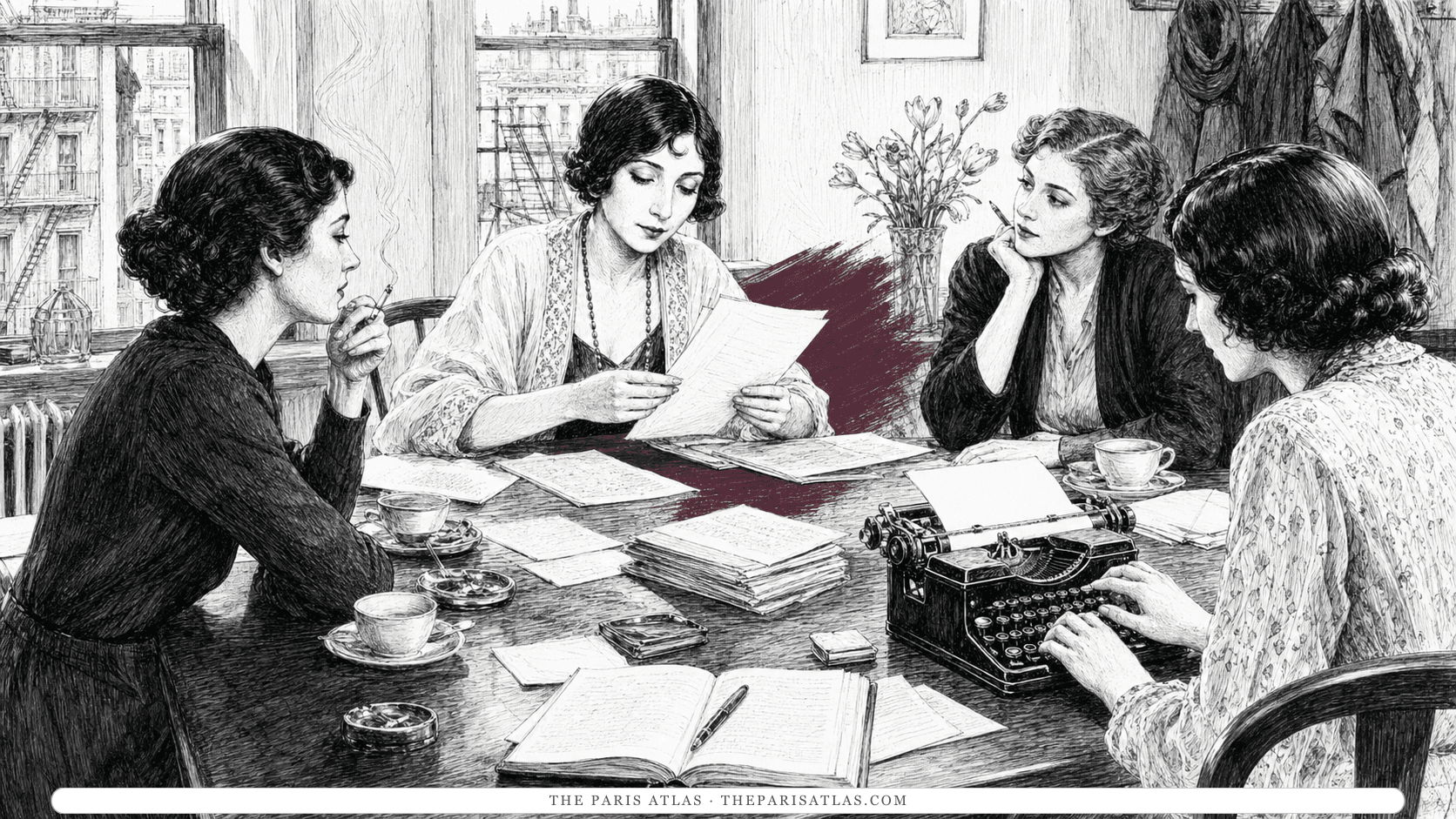

The century's most famous journal opens on Louveciennes, 1931 — Miller at the table, June in the doorway, and a woman writing it all down as it happens.

The second volume: New York with Otto Rank, the return to Paris, the houseboat on the Seine, and Europe arming behind every entry.

The war years in America: Greenwich Village, the hand press on Macdougal Street, erotica for a dollar a page, and the review that changed everything.

After the review: Dutton signs her, the young writers arrive, and the diarist of Paris becomes a figure in postwar New York.

The divided decade: Mexico and California against New York, the fiction out of fashion, and the diary carrying a double life it couldn't print.

The long approach: Alan Swallow rescues the novels, the diary is readied at last for print, and the volume ends on the edge of fame.

Where the whole project begins: the diary an eleven-year-old started on the boat to New York, as a letter to the father who left.

The famous years: lecture halls, honors, a new generation of readers — and the diarist watching her own arrival with a lifetime's practiced eye.

The diary switches to English: work, modeling, a long courtship, and a young woman writing her way toward a marriage and a self.

The third early volume: a very young marriage, the move to Paris, and a would-be writer deciding what a wife is allowed to become.

The last early volume: dance, the D. H. Lawrence book, and the approach to the exact doorstep where the famous Diary begins.

The unexpurgated year — what the 1966 Diary couldn't print about Henry, June, and the winter that changed all three.

The century's most famous literary love affair, in its own hand: two decades of the Nin–Miller letters, selected by Gunther Stuhlmann.

The second unexpurgated volume: the analysts, the abortion chapter, and the reunion with her father that the 1966 Diary could only gesture at.

The fame years by airmail: Nin's letters to the Australian bookseller David Pepperell, 1968 to 1974.

The third unexpurgated volume: New York with Rank, the return to Paris, and a private life running at full burn between two continents.

The last prewar volume: the houseboat, Moré at the center, and the Paris world running out while the diary refuses to look away.

Twenty-four years of letters with the poet-librarian who took her seriously before the world did.

A French curiosity of the shelf: Marcel Moreau's book, published with a group of Nin's letters to him — her contribution, not her volume.

The series resumes after seventeen years: the war decade uncut, from the flight out of Paris to the night the mirages ended.

The double life, documented: eight years swinging between a husband in New York and a lover in California, from the journal that kept both books.

The mail habit, preserved: a small edited collection of Nin's letters to a young admirer, Moira Collins.

Four decades of letters to the third member of the Villa Seurat triangle, from the Booster days to the last year of her life.

The letters behind the diary's hardest chapter: father and daughter writing to each other after the 1933 reunion.

The seventh unexpurgated volume: two households in balance, the fiction winding down, and the decade-long campaign to publish the diary itself.

The unexpurgated series completes: fame with the double life still running underneath, and the ending the published Diary declined to print.

Miller’s side of the defining Paris correspondence: love, rivalry, manuscripts, money, and two writers inventing themselves in public and private.

Her first book: a defense of Lawrence written in sixteen days, published in Paris in 1932 — the door her whole literary life walked through.

A 1946 pamphlet manifesto: why the psychological novel needs the logic of dreams, not the inventory of rooms.

The 1947 credo: writing from the unconscious outward — Nin's working method, stated in a pamphlet's span.

Her criticism at full length: the case for the poetic, psychological novel, written at the height of the Diary's fame.

The first one-volume Nin: fiction, diary, and criticism selected in 1973, at the height of the fame, as the front door to the shelf.

The lecture years on the page: creativity, women, and the examined life, gathered from the talks that made her a campus phenomenon.

The late essays: masculinity reconsidered, women's becoming, travel, and craft — the last collection published in her lifetime.

Herta Hilscher-Wittgenstein’s photographs visit the Gotham Book Mart founder, with Miller and Anaïs Nin adding affectionate testimony.

The interviews, collected: three decades of Nin answering questions, from little magazines to the fame years, in one scholarly volume.

The stray pieces, gathered: four decades of essays and reviews, led by the 1930 Lawrence piece that started her public writing.

The modern one-volume Nin: thirty-eight selections in chronological order, with the whole posthumous shelf finally in the pool.

A quotations collection with receipts: 365 verified Nin lines, each with its citation — the antidote to the internet's fake Nin.

The second year of verified Nin: 365 more sourced quotations, arranged across life, love, consciousness, women and men, and art.
Your progress
Volume one of the edited diary: Louveciennes, Henry Miller, and the 1966 debut that made her famous overnight at sixty-three.
The erotica that outsold everything — stories written to order in the 1940s at a dollar a page, published months after her death.
The first unexpurgated volume — the Miller material cut from volume one. Read it against the edited Diary to watch the edit at work.
The second unexpurgated volume and the hardest. What it contains is in the title; read the content notes first.
Sabina's book — the most read of the five linked novels, and complete on its own.
All five novels in one volume. Nin insisted the sequence can be entered in any order.
The 1936 prose poem her fiction grows from — an hour's read, and the key to the rest.
The mature stories, self-printed on her Gemor Press in 1944; Edmund Wilson's review opened New York.
The Miller correspondence, 1932–1953 — the relationship the diaries orbit, in both hands.
Her case for the poetic novel — the criticism to read once the fiction has won you over.
Nosukumo, Melbourne — a small edition of the letters to David Pepperell.
No. The diary volumes are chronological but each stands alone, the five novels of Cities of the Interior can be entered anywhere by Nin's own design, and the erotica needs no preparation at all. The one ordering that pays off is reading the 1966 Diary before the unexpurgated volumes, so you can see what the edit removed.
The Diary of Anaïs Nin, 1931–1934 — it is the center of the catalog and the book that made her reputation. Delta of Venus is the other honest door: most readers arrive through one or the other.
The seven-volume Diary (1966–1980) was edited by Nin herself under real constraints — her husband Hugh Guiler asked to be removed entirely, and the affairs went with him. The unexpurgated series, begun with Henry and June in 1986 and finished with A Joyous Transformation in 2023, restores the full text from the original journals. The two series cover the same life at two levels of candor.
No — it is a collection of erotic stories written in the early 1940s for a private collector who paid a dollar a page. Nin never published them in her lifetime; they appeared in 1977, months after her death, and became her bestselling book.
Our shelves hold all 55 published works: 25 appeared in her lifetime — the fiction, the first six edited diary volumes, and the criticism — and the other 30 after her death in January 1977, including the erotica, the early and unexpurgated diaries, and the correspondence.
Nin's name for Cities of the Interior: five linked novels — Ladders to Fire, Children of the Albatross, The Four-Chambered Heart, A Spy in the House of Love, and Seduction of the Minotaur — that share three women rather than a plot. She collected them in one volume in 1959, and the set is readable in any order.
The sources below include bibliographies, archives, publisher records, and scholarship used to verify the Anaïs Nin catalogue and publication order.

Web source consulted for documented facts and historical context presented on the Anaïs Nin books page.

Archival evidence used to document the historical record connected to Anaïs Nin books.
Biographical evidence used to verify chronology, relationships, and historical context connected to Anaïs Nin books.
Archival evidence used to document the historical record connected to Anaïs Nin books.
These references document which titles belong in the bibliography and when they appeared. The recommended reading order remains an editorial judgment by The Paris Atlas.
 Explore more resources
Newsletter
We will tell you when this guide adds a book, review, or new reading-order recommendation.