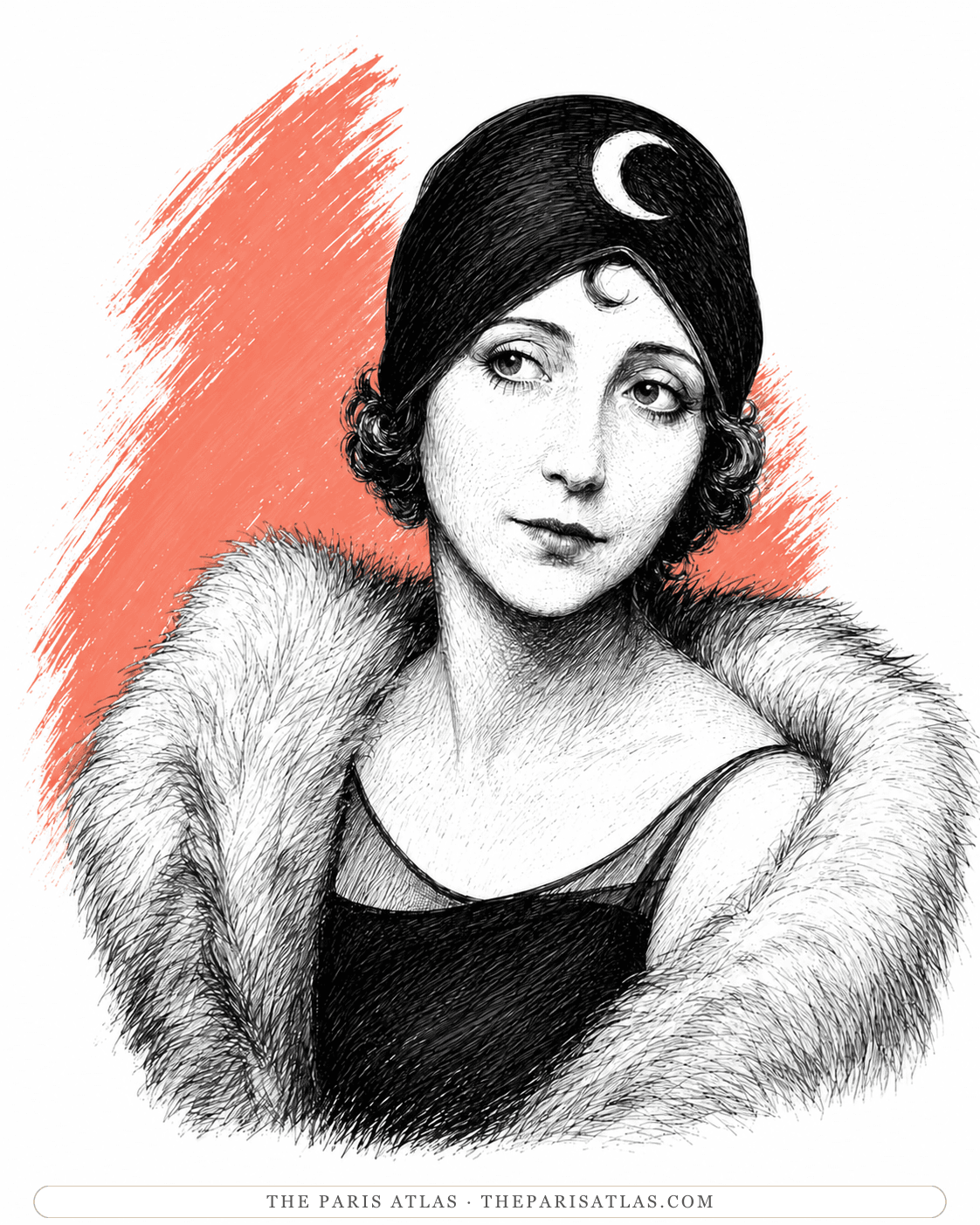

Seduction of the Minotaur
The sequence's finale — the solemn masterpiece this playful book follows and releases.
Read our take
by Anaïs Nin
Nin's last and lightest fiction: a painter named Renate, a gallery of originals, and a book that ends by beginning again.
Renate, a Viennese-born painter living by the Pacific in Malibu, is the thread through a book of linked portraits: the companion who prefers fictions to facts, a consul's wife, a collagist who works in scraps of cloth, a reclusive writer who has stopped publishing. No continuous plot — the structure is the title. Published by Alan Swallow in 1964, it is Nin's warmest, funniest book, and her farewell to fiction: after Collages she gave the rest of her writing life to the diary. (What's inside below — including the famous trick of the last page, kept behind the reveal.)
After the continuous novel closed, Nin wrote one more work of fiction, and it surprised her readers: the interior pressure of the sequence is released, and in its place is play. Collages works the way its title art works — pieces set beside pieces, edges showing, the design emerging from arrangement rather than argument. Renate anchors it: painter, beauty, collector of impossible people, drawn from Nin's friend Renate Druks of the Malibu circle.
The cast is a gallery of originals, several from life — most visibly the collagist modeled on Jean Varda, whose real collages of rag and sail turned women into light, and whose craft gives the book its structural metaphor. Critics who had run out of patience with the sequence's solemnity warmed to this one; it remains the easiest door into late Nin, and the last fiction she published before the Diary's 1966 debut changed her life entirely.
Linked vignettes rather than a plot. The book opens in the Vienna of Renate's girlhood — statues in the garden, a father with theories — and follows her to a life of painting by the Pacific, where the chapters arrive like visitors: Bruce, the beautiful companion who communicates through invented stories and disappearances; a consul and his unraveling household; the collagist in his converted ferryboat, cutting cloth into light; Nina, who talks to no one and everyone; and finally Judith Sands, the barricaded writer who no longer publishes and may no longer write. Each portrait is a small mechanism of sympathy and comedy, and the arrangement — piece against piece — is the argument.
The last portrait springs the book's trick. Renate and a devoted engineer coax the reclusive writer Judith Sands into showing them a manuscript — the work everyone believed she had stopped producing. She reads its opening aloud, and it is, word for word, the first line of Collages itself: 'Vienna was the city of statues.' The book the reader is holding turns out to be — or to contain — the manuscript inside it, and the collage closes its own circle: the ending is the beginning, and the book begins again where it stops.
Renate holds the fragments together without having to occupy every scene. Maud Rauturier emphasizes that she can disappear from individual chapters while remaining the figure toward whom the narrative returns. This distinction makes her a center of attention rather than the owner of every story. Other people retain enough independence to interrupt the pattern of her life. The painter's gathering of a world can therefore be read as a way of looking: unity emerges through renewed encounters, not through reducing every personality to an episode in one heroine's progress.
The portrait of Varda makes collage a transformation of perception, not merely a technique for joining scraps. In the passages quoted by Sandra Rehme, the pictures' colors make the surrounding sea, plants and sunlight seem less vivid, while their female figures acquire the sensations of living bodies. Description passes from sight into touch and scent. The reversal matters: the made object does not copy a more convincing reality outside it. It becomes the standard by which that reality is judged, giving the novel's assembled portraits an ambition beyond accurate likeness.
The one book where her comedy leads — dry, generous, and surprisingly durable.
Portraits arranged like collage pieces, edges showing — her method finally matched to a structure built for it.
The last page's trick — the book restarting inside itself — is one of the era's neatest closing gestures.
1964
Alan Swallow publishes Collages — portraits from the Malibu years, Nin's warmest critical reception in fiction.
1966
The first volume of the Diary appears; Nin never returns to fiction, and Collages stands as the last word.
2019
Swallow Press reissues the novel with an introduction by Anita Jarczok.
The sequence's finale — the solemn masterpiece this playful book follows and releases.
Read our take
Her earlier short forms — the surrealist stories to this book's comic portraits.
Read our take
Anaïs Nin. Alan Swallow published it in 1964, and it proved to be her last work of fiction.
Renate, a Viennese-born painter in Malibu, and the gallery of originals who pass through her life — told as linked portraits arranged like the pieces of a collage rather than as a single plot.
Between the two, by design: linked vignettes with one continuous heroine, structured on the logic of collage — the title names the method.
Several are. Renate is drawn from the painter Renate Druks, and the cloth-collagist from Jean Varda; Nin worked openly from her Malibu circle.
Yes — it is her lightest and most approachable book, needing no knowledge of the continuous novel, though its pleasures deepen if you arrive knowing her usual weather.
Explore authors with a similar voice, perspective, and influence.

The entangled careers of the Villa Seurat: she financed and prefaced his scandal, he detonated her prose — and each wrote the other into the century's record.
View author
The doctor of the Paris slums who wrote the century's blackest, funniest novel — and changed the sound of French prose.
View author
War correspondent who covered the Spanish Civil War, D-Day, and conflicts across five more decades; Hemingway's third wife, 1940–1945.
View authorThe sources below include the primary text, editions, scholarship, archival materials, and other records that informed this page. They document Collages, its publication, and its place in literary history.


The primary text represented by this page, used for descriptions of the work’s contents and for any quoted passages shown here.
Used to verify Collages's bibliographic context and its place within Anaïs Nin's published work.

Used for independent archival, institutional, or historical context surrounding Anaïs Nin and Collages.
Used to cross-check chronology, publication history, and the circumstances in which Collages appeared.
Used for an additional scholarly or biographical perspective on Collages and Anaïs Nin's wider career.
Documents the dated edition or contemporary reception included in the timeline.
Printed pp. 224–225: attributed reading of Renate and narrative fragmentation.
Printed pp. 256–257: Varda's colors and sensory transformation, including primary passages quoted from Collages.
The primary text is the baseline reference for every book page. Additional references document publication history, interpretation, and historical context where that evidence is available.
 Explore more resources