

The Diary of Anaïs Nin, 1939–1944
The years of printing and obscurity this volume's success pays off.
Read our take
by Anaïs Nin
After the review: Dutton signs her, the young writers arrive, and the diarist of Paris becomes a figure in postwar New York.
The fourth volume covers the shortest span so far — three years — because so much crowds in: the aftermath of Edmund Wilson's review, the leap from hand press to commercial publisher with This Hunger and Ladders to Fire, and the circle of younger writers, Gore Vidal chief among them, who gather around a woman suddenly famous in miniature. Underneath the arrival runs the old current: the fiction still fighting for its audience, and the diary absorbing the cost of every compromise. (A diary — the closing pages wait behind the reveal.)
Success, when it finally came, arrived at an angle. The Wilson review made Nin a name; the names it drew were the young — students, poets, and veterans just back, for whom the diary legend and the Paris pedigree made her an oracle. The volume's most storied friendship is with Gore Vidal, twenty and precocious, then an editor at Dutton: the alliance carried her from the Gemor Press to a commercial house, and its later souring — conducted in novels and memoirs on both sides — became one of the era's running feuds. Here it is at its warm beginning.
The professional story is the volume's spine: This Hunger printed on her own press in 1945, then Ladders to Fire from Dutton in 1946, the continuous novel launched at last, and the reviews arriving with the mixture of awe and bafflement that would follow the sequence for decades. The diary keeps its own ledger throughout — what the public versions of her were costing the private one — and closes with Nin doing what she always did at a chapter's end: getting moving.
New York, 1944–1947: the Glass Bell aftermath and the second printing; the young circle assembling — Vidal, the poets, the analysands of her legend; the Dutton years and the launch of the continuous novel; Provincetown and Long Island interludes; and the diary's running argument with American literary culture, which wanted her story more than her sentences. The volume ends westward: the first long drive across the country, and the discovery of the other coast that would divide the rest of her life.
The closing movement is a departure that reads, in hindsight, like a hinge: Nin drives west across America — the desert entries are some of the volume's best — and reaches a California that offers what New York withheld: sun, distance, and a life not yet on the record. The published diary keeps its silences here (the man at the end of that road stayed out of every volume printed in her lifetime), but the geography speaks: from this volume on, hers is a two-coast story.
The opening press account does not let artistic independence remain an abstraction. Moving equipment, buying supplies and altering the next edition's production make freedom dependent on rent, labor and cooperation. Nin observes Gonzalo's new pride while also mourning some of the enjoyment responsibility displaces. Her own exhaustion sits beside satisfaction in what they have accomplished. The sequence therefore resists a simple opposition between liberating art and oppressive work: making books can ease dependence and shame, yet consume the time and energy that independence was meant to release.
Before Nin's own westward journey, Miller's letter introduces California as both a promise and a practical difficulty. His attraction to the apparently empty mountains immediately produces a list of unfamiliar equipment and an admission of fear. The isolated house offers solitude, but reaching it on foot is difficult, and peace does not abolish what he misses. Read within Nin's diary, the letter makes the distant coast available through another person's divided feelings. The west first arrives here as correspondence: an invitation to imagine elsewhere without proving that elsewhere solves everything.
What recognition actually bought: a publisher, a public, and a new set of misreadings — audited nightly.
One of the era's storied literary friendships at its generous start, before the novels weaponized it.
The closing drive west draws some of the diary's most open-air writing — a new key for a chamber instrument.
1944–1945
The Glass Bell aftermath: the young circle gathers, and This Hunger comes off the Gemor Press.
1946
Dutton publishes Ladders to Fire; the continuous novel reaches commercial print at last.
1947
The first long drive west closes the volume — the two-coast life begins.
1971
Harcourt Brace Jovanovich publishes the fourth volume.
The years of printing and obscurity this volume's success pays off.
Read our take


1944 to 1947 — from the aftermath of Edmund Wilson's Under a Glass Bell review through the Dutton years and the launch of the continuous novel, ending with her first drive west.
1971, by Harcourt Brace Jovanovich, edited with Gunther Stuhlmann — the fourth volume of the published Diary.
Yes — he enters here at twenty, as a Dutton editor and close friend; the volume records the warm years of a friendship that later became a public feud.
This Hunger (1945) on her own Gemor Press, then Ladders to Fire (1946) and the start of the continuous novel with E. P. Dutton.
With her first cross-country drive to California — the opening of the two-coast existence the next volumes trace.
Explore authors with a similar voice, perspective, and influence.

The entangled careers of the Villa Seurat: she financed and prefaced his scandal, he detonated her prose — and each wrote the other into the century's record.
View author
The doctor of the Paris slums who wrote the century's blackest, funniest novel — and changed the sound of French prose.
View author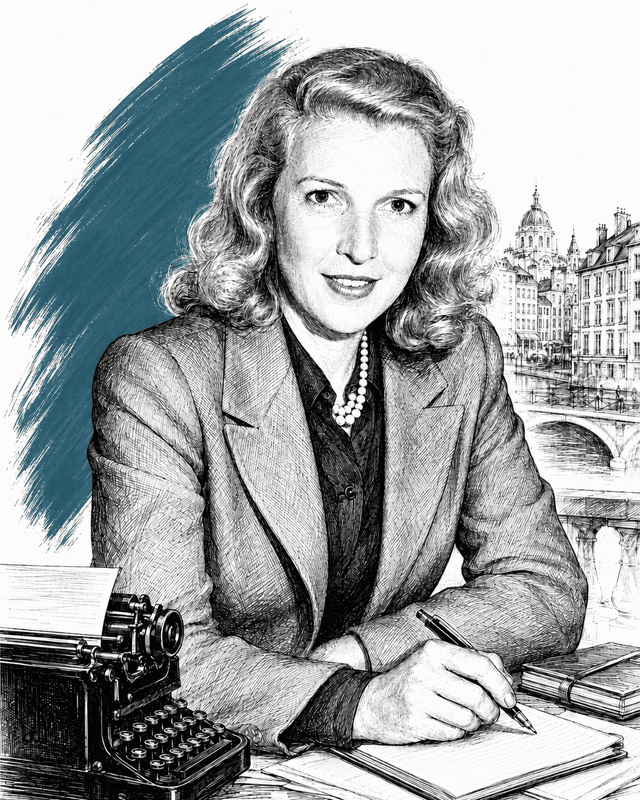
War correspondent who covered the Spanish Civil War, D-Day, and conflicts across five more decades; Hemingway's third wife, 1940–1945.
View authorThe sources below include the primary text, editions, scholarship, archival materials, and other records that informed this page. They document The Diary of Anaïs Nin, 1944–1947, its publication, and its place in literary history.


The primary text represented by this page, used for descriptions of the work’s contents and for any quoted passages shown here.
Used to verify The Diary of Anaïs Nin, 1944–1947's bibliographic context and its place within Anaïs Nin's published work.

Used for independent archival, institutional, or historical context surrounding Anaïs Nin and The Diary of Anaïs Nin, 1944–1947.
Used to cross-check chronology, publication history, and the circumstances in which The Diary of Anaïs Nin, 1944–1947 appeared.
Used for an additional scholarly or biographical perspective on The Diary of Anaïs Nin, 1944–1947 and Anaïs Nin's wider career.
Uses the April 1944 press account and Miller's letter from Big Sur. The added westward reading precedes Nin's own journey; it does not claim to inspect the later road chapter or the 1945 This Hunger printing.
The primary text is the baseline reference for every book page. Additional references document publication history, interpretation, and historical context where that evidence is available.
 Explore more resources