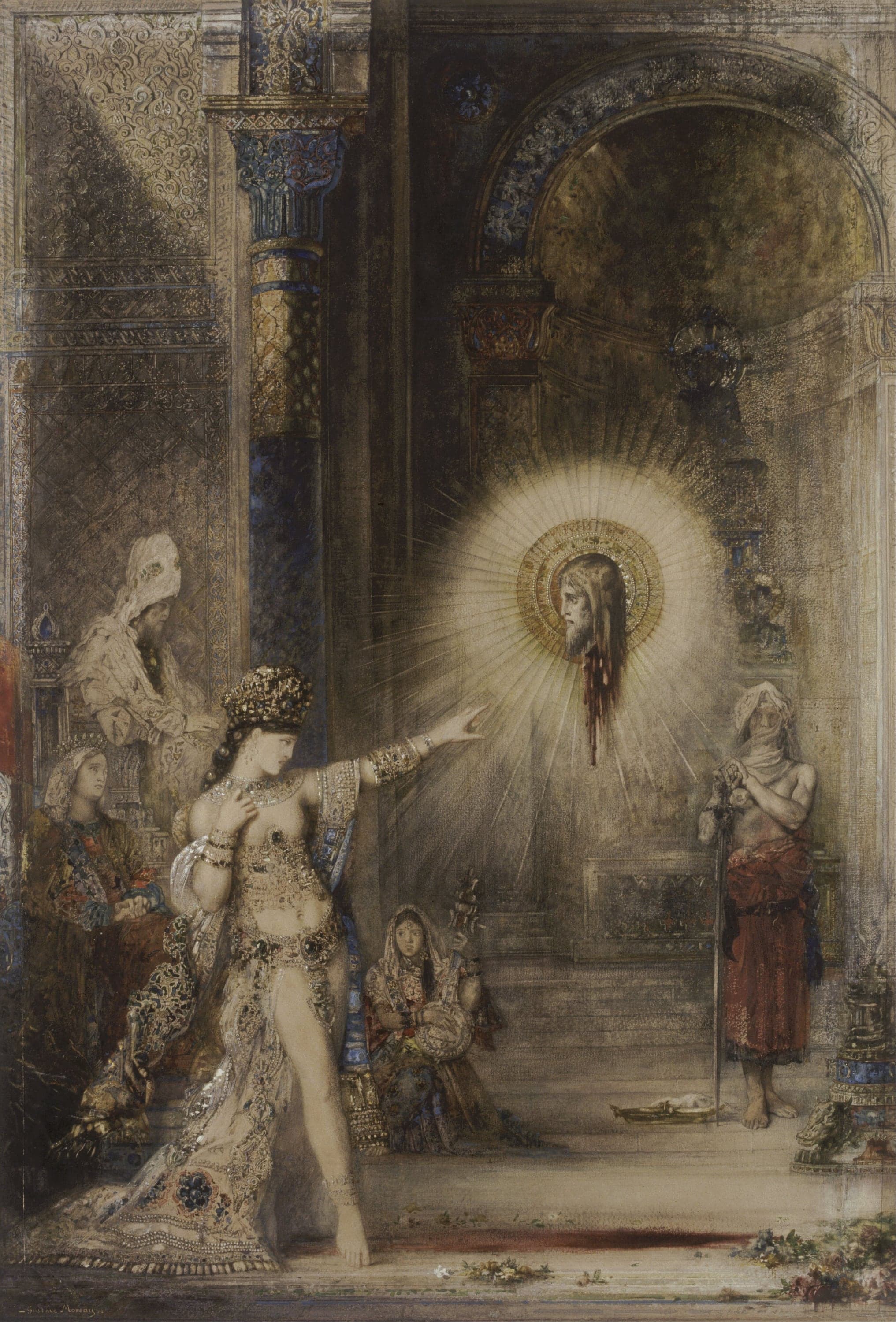
The Apparition
Salome, crowned and hung with jewels, points at the severed head of John the Baptist, which hangs in mid-air inside a blazing halo. Gustave Moreau showed the watercolor at the Salon of 1876, sold it that May to the dealer Léon Gauchez, and saw it made famous by Joris-Karl Huysmans's novel À rebours in 1884. It belongs to the Musée d'Orsay, accession RF 2130, and is kept with the Louvre's graphic-arts collection, so it is shown only occasionally.
- 1876
- Watercolor
- Musée d'OrsayParis, France
About Gustave Moreau
What the watercolor shows
Salome stands left of center, almost naked under a mass of jewels: a tall crown, a collar, arm bands, bracelets stacked along her left forearm, and a belt from which a long embroidered train hangs behind her. Her right hand rests at her chest. Her left arm is stretched out level, and the hand at the end of it points at the head.
The head of John the Baptist floats right of center with no body beneath it, inside a gold disc ringed with dots and a burst of pale rays. Its eyes are open, its beard is long, and a stream of dark blood runs from the neck. Nothing in the room reacts to it except Salome.
Herod sits at the upper left under a white hood and veil, an old man on a raised throne with a blue-domed finial beside him. A crowned woman sits below him at the far left. At the right an executioner stands bare-chested in a red skirt, his hands resting on the hilt of a sword held point-down. At the bottom center a veiled woman sits with a long-necked stringed instrument in her lap and looks out at the viewer.
The floor is pale stone, and a pool of blood spreads across it beneath the head, with scattered flowers around it. Behind everything rise arches and a dome decorated with pale arabesques on blue and gold. Moreau signed the sheet at the lower left in gold letters. It measures 106 by 72.2 centimeters, large for a watercolor.[1]
The Salon of 1876 and the sale to Léon Gauchez
Moreau had shown nothing at the Salon since 1869. He returned in 1876 with the oil Salome Dancing, Hercules and the Hydra of Lerna, Saint Sebastian, and one watercolor, The Apparition.[2] The Salon livret lists him as hors concours, exempt from the jury. Hercules and Salome hang among the paintings as numbers 1505 and 1506, while L'Apparition, marked aquarelle, is number 2774 in the section for drawings.[3]
The Belgian dealer Léon Gauchez bought the watercolor at the Salon. The Louvre's record gives the price and the date: 8,000 francs, on 31 May 1876. The following year Gauchez lent it to the first exhibition of the Grosvenor Gallery in London.[4][5]
By 1879 it belonged to Charles Hayem, who gave it to the French state for the Musée du Luxembourg, then the museum for living artists. The gift was accepted in 1879, and the sheet physically entered the Luxembourg on 14 May 1898. It passed to the Louvre in 1929 and now forms part of the Musée d'Orsay's collection, kept in the Louvre's Département des Arts graphiques.[1]
Huysmans and des Esseintes
In 1884 Joris-Karl Huysmans published À rebours. Its hero, Jean des Esseintes, owns two works by Moreau, a Salome and this watercolor, and the fifth chapter describes both at length.[6]
“The murder was accomplished. The executioner stood impassive, his hands on the hilt of his long, blood-stained sword. The severed head of the saint stared lividly on the charger resting on the slabs; the mouth was discolored and open, the neck crimson, and tears fell from the eyes.”
Salome, he goes on, thrusts the vision away with a gesture of terror. The Musée d'Orsay draws out what that means: for Huysmans the murder had already been committed, so the head is a vision after the beheading rather than a wish during the dance.[7][5]
The Orsay also records a rumor that has followed the picture: that Moreau's visions came from opium. The museum calls the accusation unfounded.[5]
Where the motifs came from
Moreau assembled the scene from things he had copied. The haloed head recalls a Japanese print he copied at the Palais de l'Industrie in 1869, and the head of Medusa held up by Perseus in Benvenuto Cellini's bronze in Florence. The palace decoration comes from the Alhambra in Granada. He built the surface with highlights, scraping and incised lines.[5]
The Louvre's record adds one name: the model Marie Gay posed for the figure of Salome.[4]
The oil version at the Musée Gustave Moreau
Moreau painted the same composition in oil on a canvas of 142 by 103 centimeters, which stayed in his studio and is catalogued as number 222 at the Musée Gustave Moreau. It is undated and unfinished. The museum says it takes up the iconography of the famous watercolor, with Herod and his wife enthroned at the left, the executioner at the right and pagan divinities sketched into the architecture behind.[8]
The state's Joconde notice adds two details. The white medieval sculptural motifs on that canvas date from the last months of Moreau's life in 1898. Its size almost matches Salome Dancing before Herod, the oil of the 1876 Salon now in the Armand Hammer Collection in Los Angeles, so it may have been planned as a pendant and abandoned.[9]
Close reading
Reading the work, detail by detail
A watercolor this large is read like a painting. These nine views move from Salome and her pointing arm to the head, the court around them, the blood on the floor and the signature.
1.Salome's face
Salome faces the head with her chin up. The crown is a mound of gold and stones picked out with white highlights, and the collar and earring are drawn in the same dotted gold. The Louvre's record names the model who posed for her: Marie Gay.
2.The pointing arm
The arm is the straightest line in the picture. It runs level across the sheet and ends in an open hand, with bracelets stacked from the wrist to the elbow. Everything she wears is painted with small opaque touches over transparent washes, which is how a watercolor gets this much glitter.
3.The head in its halo
The head has no platter and no body. It hangs in the air inside a gold disc and a burst of rays, the eyes open and turned toward Salome, and blood runs from the cut neck in a single dark stream. The Musée d'Orsay connects the halo to a Japanese print Moreau copied in 1869 and to the head of Medusa in Cellini's bronze Perseus.
4.Herod on his throne
Herod sits above the scene at the left, so wrapped in white cloth that only his face shows. He is looking down, not at the head. The Louvre's index also lists Herodias among the figures, and a crowned woman sits below him at the far left edge of the sheet.
5.The executioner
The executioner has finished. He stands with his hands folded on the hilt of the sword and its point on the floor, his head wrapped in white, in a red skirt with a dark belt. Joris-Karl Huysmans described exactly this figure: impassive, his hands on the hilt of a long, blood-stained sword.
6.The musician at the foot of the throne
A woman sits at the foot of the throne with a long-necked lute across her lap, the only person in the room who looks out at us. Salome's hip and jeweled belt cut across the left of the frame. The musician is not named in the Louvre's or the Orsay's records.
7.Blood on the floor
The head bleeds in the air, and the blood arrives on the floor as a long red stain. Flowers lie scattered across it. On the step above sits a shallow gold dish, and the pearl-edged hem of Salome's train enters from the left.
8.The arch from the Alhambra
The upper half of the sheet is architecture, painted in thin gray-brown washes with the ornament picked out in white and blue. The Orsay says the palace decoration comes straight from the Alhambra in Granada, and the arabesque band around the arch is the clearest borrowing.
9.The signature
The signature sits on the floor at the lower left, framed by dashes, under the hem of the train. The Orsay's record says it is written in gold letters; in reproduction it reads dark against the pale floor. The train above it carries a medallion of dark blue stones inside a red border.
Timeline
1876
Shown at the Salon as number 2774, among the drawings, with Salome Dancing, Hercules and the Hydra of Lerna and Saint Sebastian. Sold by Moreau to Léon Gauchez on 31 May for 8,000 francs.
1877
Lent by Gauchez to the first exhibition of the Grosvenor Gallery in London.
1879
Charles Hayem's gift to the French state for the Musée du Luxembourg is accepted.
1884
Joris-Karl Huysmans describes the watercolor in chapter five of À rebours.
1898
Physically enters the Musée du Luxembourg on 14 May, a month after Moreau's death on 18 April.
1929
Transferred to the Musée du Louvre; later assigned to the Musée d'Orsay's collection and kept in the Louvre's Département des Arts graphiques.
2019–20
Shown in Huysmans critique d'art, de Degas à Grünewald at the Musée d'Orsay.
2026
Returned to the Louvre's storage for framed works on paper on 18 February, according to the Louvre's record.
Where to see it
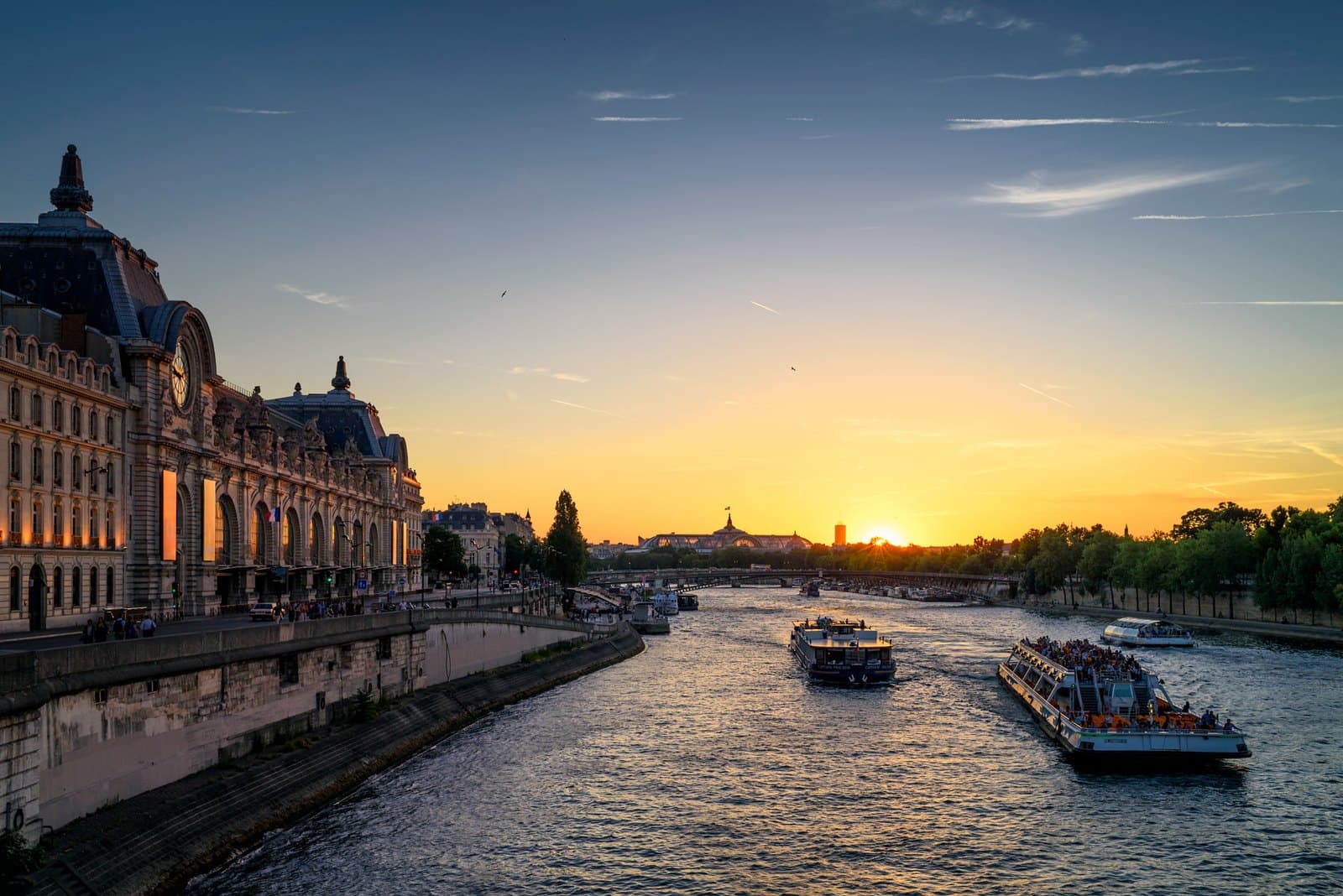
Musée d'Orsay
Esplanade Valéry Giscard d’Estaing, 75007 Paris, France
A work on paper, kept for the Musée d'Orsay in the Louvre's Département des Arts graphiques and shown only for limited periods. The Orsay's object record lists it as not currently exhibited, and the Louvre's record notes its return to storage on 18 February 2026.
Plan your visitFrequently asked questions
Where is The Apparition?
It belongs to the Musée d'Orsay in Paris, accession number RF 2130, and is kept for the Orsay in the Louvre's Département des Arts graphiques because it is a work on paper. The Orsay's object record lists it as not currently exhibited, and the Louvre's record notes its return to storage on 18 February 2026. Check the Orsay's record before a special visit.
Is The Apparition a painting or a watercolor?
The famous version is a watercolor, 106 by 72.2 centimeters, signed in gold letters at the lower left. Moreau also painted the composition in oil on a canvas of 142 by 103 centimeters, which is undated, unfinished and catalogued as number 222 at the Musée Gustave Moreau in Paris.
What is happening in The Apparition?
Salome has danced for Herod and been promised the head of John the Baptist, the story told in Matthew 14 and Mark 6. Moreau shows the head appearing in mid-air, haloed and bleeding, while Salome points at it and nobody else in the hall reacts. The Musée d'Orsay asks whether the scene is the end of the dance or a vision of remorse after the beheading, and leaves the question open.
Who is the woman in The Apparition?
Salome, the daughter of Herodias, who danced for Herod. The Louvre's record adds that the model Marie Gay posed for the figure.
Why is The Apparition famous?
It was one of the pictures that brought Moreau back to the Salon in 1876 after seven years away, and Joris-Karl Huysmans described it at length in his 1884 novel À rebours, whose hero owns it. The Musée d'Orsay's own commentary on the sheet still quotes his reading of it.
Who owned The Apparition before the museum?
The Belgian dealer Léon Gauchez bought it from Moreau at the Salon of 1876 for 8,000 francs. By 1879 it belonged to Charles Hayem, who gave it to the French state for the Musée du Luxembourg. It moved to the Louvre in 1929 and is now part of the Musée d'Orsay's collection.
What building is Herod's palace based on?
The Musée d'Orsay says the decoration comes directly from the Alhambra in Granada. The haloed head, it adds, recalls a Japanese print Moreau copied in 1869 and the head of Medusa in Benvenuto Cellini's bronze Perseus in Florence.
More by Gustave Moreau
If you like Gustave Moreau
Explore painters from the same movements and circles.
Pierre Bonnard
French painter, printmaker and illustrator whose intimate rooms, Paris streets, gardens and bathing figures transformed everyday life into complex fields of color, memory and perception.
View artist
Paul Gauguin
Stockbroker turned painter who came into art through Camille Pissarro, showed with the Impressionists, and left Europe for Polynesia.
View artist
Edvard Munch
Norwegian painter of The Scream, who arrived in Paris in 1889 on a state scholarship to learn academic drawing from an anti-Impressionist professor, lost his father that November, and spent a bleak winter in the riverside suburb of Saint-Cloud writing down the vow that redirected his art — paint the moments when people are most alive, not the furniture around them.
View artist
References
The sources below include collection records, catalogues, scholarly research, and primary materials that informed this page. They document The Apparition, its making, and its place in cultural history.


2↑Biography of Gustave Moreau — Musée Gustave Moreau
WebsiteMusée Gustave Moreau, ParisUsed forWeb source consulted for documented facts and historical context presented on the The Apparition page.

3↑Explication des ouvrages de peinture, sculpture, architecture, gravure et lithographie des artistes vivants exposés au Palais des Champs-Élysées le 1er mai 1876 (Salon livret)
Exhibition catalogueImprimerie nationale, Paris; Getty Research Institute copy on the Internet Archive, 1876Used forCatalogue scholarship used to verify attribution, provenance, chronology, and interpretive context for The Apparition.
6↑À rebours
NovelCharpentier, 1884Used forPrimary text included as part of the documented record for The Apparition.
7↑Against the Grain (À rebours), translated by John Howard
NovelProject Gutenberg, ebook 12341, 1922Used forPrimary text included as part of the documented record for The Apparition.
8↑Gustave Moreau, The Apparition
WebsiteMusee national Gustave MoreauUsed forWeb source consulted for documented facts and historical context presented on the The Apparition page.
9↑L'Apparition, Gustave Moreau (Cat. 222) — Joconde notice 50410000420
Official recordMinistère de la Culture, POP: la plateforme ouverte du patrimoineUsed forOfficial record used to verify names, dates, institutional details, or other factual information on this page.
These references provide the documented foundation for this work's history and interpretation. Claim-level citations remain attached to the specific claims they support.
 Explore more resources