
Depicts · 1949
Gala Dalí
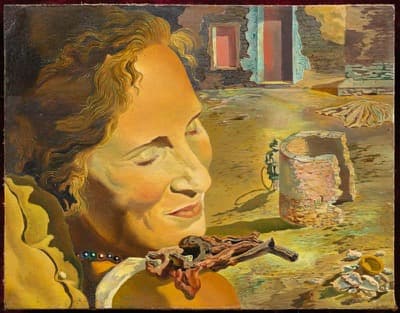
Gala appears as the mythological Leda in Dalí's weightless, mathematically ordered composition.
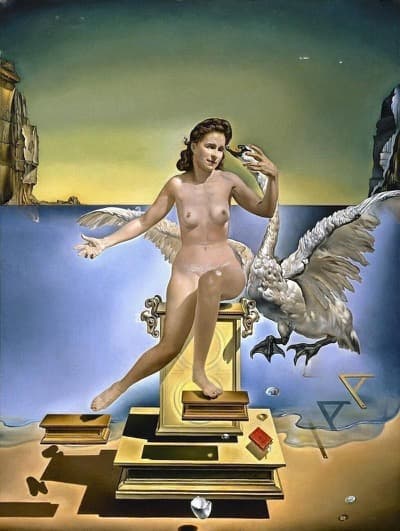
Gala becomes the mythological Leda in a composition ordered by a pentagon and the golden ratio. Figure, swan, books, egg and sea remain suspended without touching.
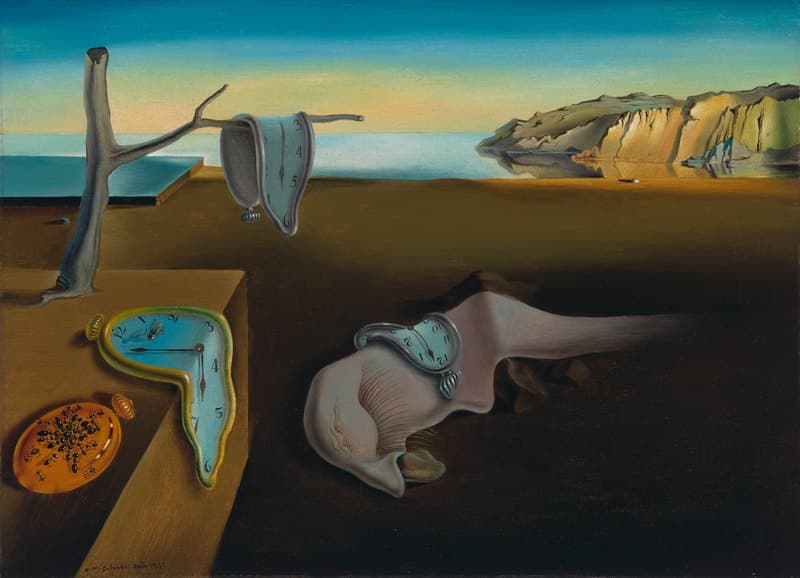
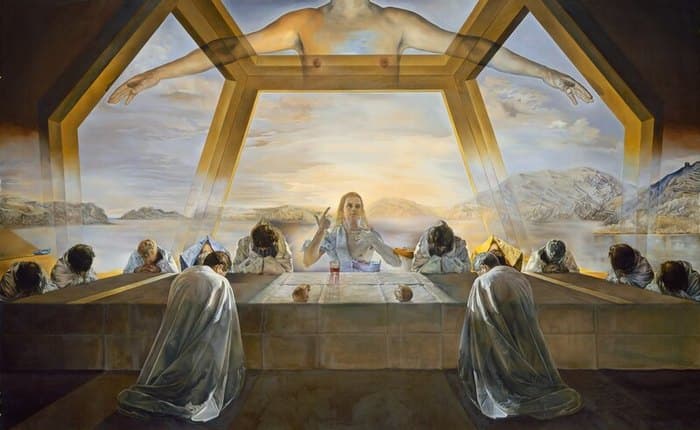
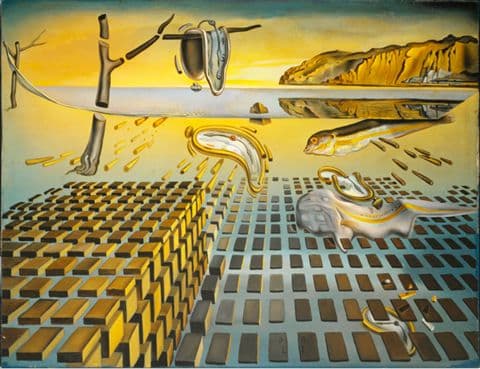
To see where Dalí's nuclear mysticism began, compare Leda Atomica with The Persistence of Memory. The earlier painting destabilizes time and solid objects; this one suspends an entire classical scene so that nothing touches.
Gala sits nude on a square pedestal while a swan approaches her face. Her left hand nearly touches its head, but contact never occurs. Books, a set square and an eggshell float around the pedestal. Even the base separates into parts rather than bearing her weight.[1]
The separation continues into the landscape. Sea and shore do not meet, and the rocks at either side appear detached from the water. Dalí built an entire scene around things held together visually while remaining physically apart.[1]
In Greek myth, Zeus approaches Leda in the form of a swan. One widely told version has two eggs producing two pairs of children: Castor and Pollux, and Helen and Clytemnestra. The floating eggshell in Dalí's painting refers to that birth story.[2]
Dalí replaces the myth's physical union with an encounter that stops just short of touch. The Centre for Dalinian Studies contrasts this treatment with more carnal Ledas by Michelangelo and Nicolas Poussin. Gala is identifiable, but she is also recast as a mythological mother and the “goddess” of Dalí's private system.[2]
Dalí wrote that he began Leda Atomica to exalt Gala and succeeded in creating “suspended space.” He connected the absence of contact with what he called cledalism, his term for intense love maintained without physical possession.[1][3]
The suspension also belongs to the atomic turn in his work after 1945. Dalí treated the discontinuity of matter as a visual premise: a world can appear coherent even when its parts do not touch. The painting is not a scientific diagram. It is his pictorial analogy for ideas he drew from modern physics.[4][5]
The figure and swan are organized inside a pentagon containing a five-pointed star. Dalí based the proportions on the Renaissance treatise De divina proportione by Luca Pacioli and on the writings of the Romanian mathematician Matila Ghyka.[4]
Preparatory drawings and correspondence preserved by the Fundació document the extent of that mathematical work. The geometry does not appear as a drawn grid in the finished painting. It governs the placement of the body, swan and surrounding objects.[1][4]
The rocks in the distance are Cape Norfeu, between Roses and Cadaqués. Dalí therefore sets a Greek story in the landscape of the Costa Brava rather than in an archaeological past. That local setting is central to the work: Gala, classical myth, Renaissance proportion and modern physics are all organized against the coast where the Dalís made their home at Portlligat.[1]
The Fundació records that Dalí began the project in the United States in 1945. An unfinished version, painted on plywood around 1947, remains in the Fundació collection. The final oil on canvas was developed from 1947 to 1949 and signed in 1949.[1]
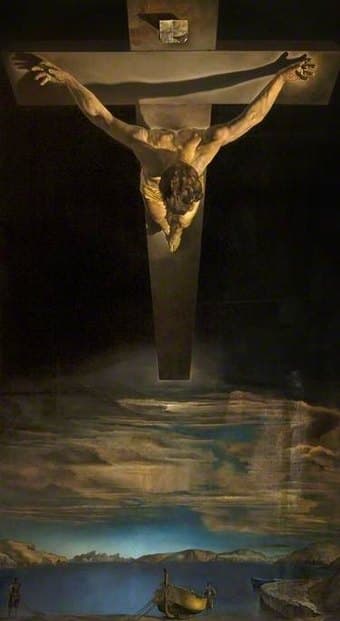
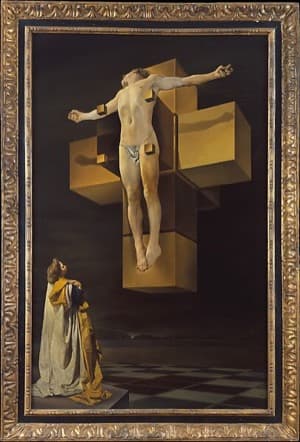
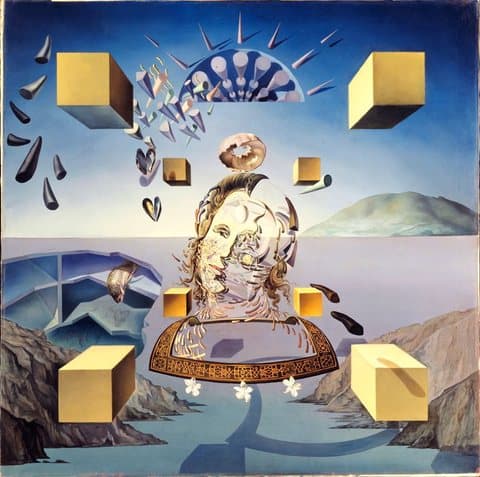
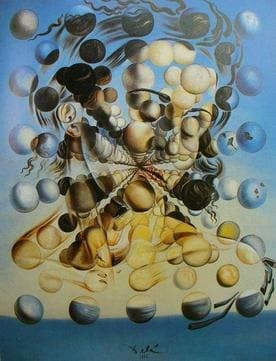
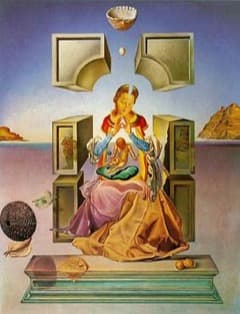
The long preparation places the painting at the hinge between Dalí's wartime atomic pictures and the explicitly religious nuclear mysticism of The Madonna of Portlligat, Galatea of the Spheres and Crucifixion (Corpus Hypercubus).[5]
The painting brings several durable strands of Dalí's later work together for the first time at full strength: Gala as an elevated central figure, classical precedent, mathematical composition, the Catalan landscape and a visual language of matter held in suspension. It also makes Gala more than a portrait sitter. She becomes the point through which Dalí connects erotic attachment, myth and his emerging account of the physical world.
Close reading
Everything in Leda Atomica is close to touching and carefully prevented from doing so. The enlarged passages make suspension—not mythological narrative—the painting's governing condition.
1.The encounter stops just before contact
Beak, hand, face, and wing approach across narrow gaps. Those intervals hold the erotic charge. Dalí replaces the usual violence of the myth with a choreography of attraction kept permanently in suspension.
2.Even furniture refuses gravity
Books, pedestal, and shell-like objects occupy different heights without visible support. Their academic finish makes the impossibility look observed. The atomic metaphor is expressed as a room whose parts no longer touch.
3.The egg repeats the logic of sealed potential
The egg is complete, smooth, and unattached, a compact image of form held before emergence. Behind it the Catalan water stays unnaturally calm, turning local landscape into a stage for weightlessness.
4.The swan opens the composition sideways
The broad wing reaches toward the edge of the painting while its feathers separate into fine, pale blades. Their spreading pattern counteracts the upright body and pedestal at the center. Dalí makes the wing look physically substantial while leaving the space beneath it conspicuously empty.
5.The distant cliff sets a different scale
The cliff occupies a thin strip at the side of the picture, cut off abruptly by the frame. Its small ledges and dark crevices establish a scale separate from the large figure and swan. The straight waterline carries that distant setting behind the suspended forms without visibly disturbing it.
6.The platform's shadows make the gaps visible
Golden ledges and flat rectangular forms cast sharply bounded shadows across the lower part of the painting. The sharp shadows make the forms look solid, while narrow gaps leave them appearing suspended. The gaps are especially clear beneath the stepped platform at the left.
1945
Dalí begins developing the Leda project while living in the United States.
c. 1947
Produces an unfinished oil-on-plywood version, now held by the Fundació Gala-Salvador Dalí.
1947–49
Dalí develops and completes the mathematically ordered image of Gala as Leda.
1949
Signs and dates the finished painting.
Dalí Theatre-Museum, Figueres
Plaça Gala i Salvador Dalí 5, 17600 Figueres, Girona, Spain
Displays and loans can change. Check whether this work is on view before making a special trip.
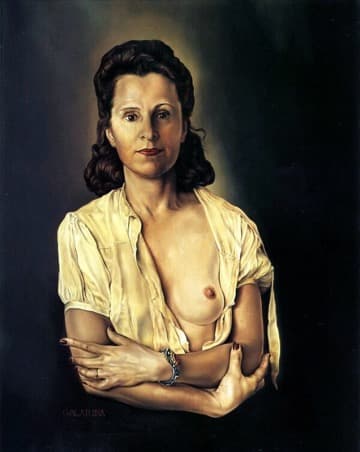
Plan your visit on the museum’s official website (opens in a new tab)Gala Dalí, the artist's wife, model, manager and collaborator. Dalí casts her as Leda from Greek myth and described the painting as an effort to exalt Gala.
Zeus approaches Leda in the form of a swan. In a common version of the story, two eggs produce Castor, Pollux, Helen and Clytemnestra. Dalí includes a broken eggshell but removes physical contact between Leda and the swan.
Dalí called the effect “suspended space.” It joins his idea of love without physical contact to his post-1945 interest in atomic matter as discontinuous rather than solid and continuous.
He arranged Leda and the swan within a pentagon and five-pointed star, using the golden or divine proportion through Luca Pacioli's Renaissance treatise and the work of mathematician Matila Ghyka.
Cape Norfeu on the Catalan coast, between Roses and Cadaqués. Dalí placed the classical myth in the landscape near his home at Portlligat.
It grows out of Dalí's Surrealism, but it marks his transition toward the atomic and nuclear-mystical work of the 1950s. Its dreamlike suspension is joined to classicism, mathematics and a stated interest in science.
The final 1947–49 canvas is in the Dalí Theatre-Museum in Figueres. The Fundació also holds an unfinished version from about 1947.
Depicts · 1949
Gala appears as the mythological Leda in Dalí's weightless, mathematically ordered composition.
Explore painters from the same movements and circles.
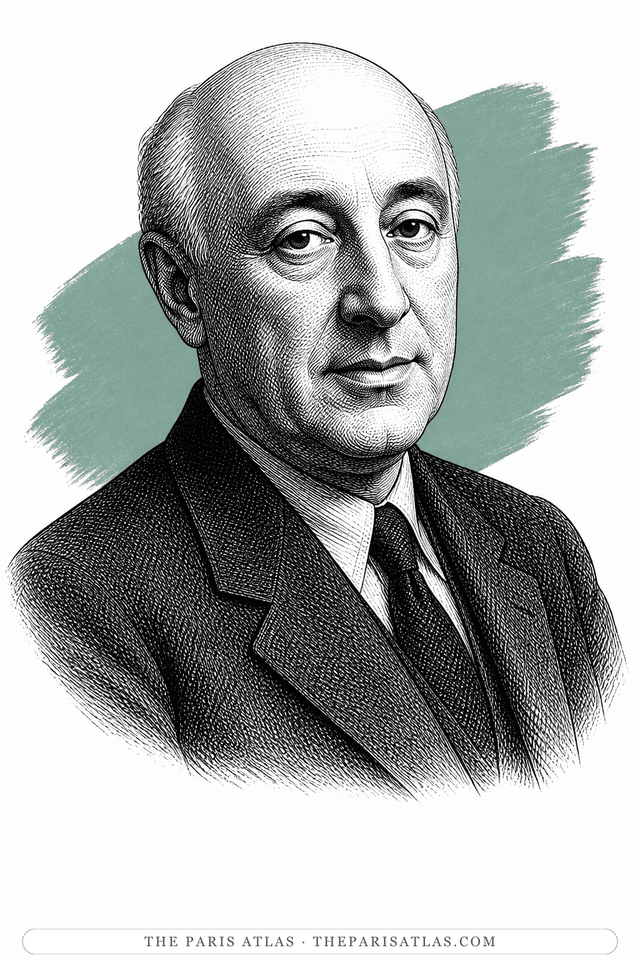
Strasbourg-born sculptor and poet — Hans in German, Jean in French, both all his life — who co-founded Dada at the Cabaret Voltaire in 1916, composed collages by dropping torn paper 'according to the laws of chance', and settled at Meudon outside Paris in a house his wife Sophie Taeuber-Arp designed.
View artist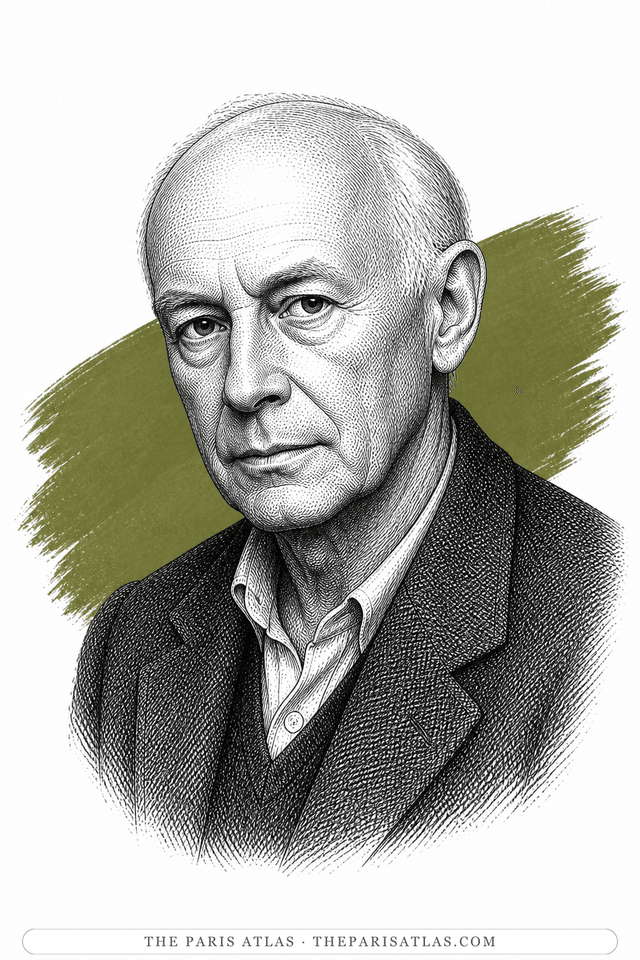
French photographer who turned a pocket-sized 35mm camera into an instrument of split-second composition — the idea the world knows as 'the decisive moment'. He trained as a painter, was taken prisoner in 1940 and escaped on his third try, photographed the Liberation of Paris in August 1944, co-founded the photographer-owned agency Magnum Photos in 1947, gave up reporting for drawing in the 1970s, and left Paris a foundation in the Marais that deliberately hangs no permanent display of his own pictures.
View artist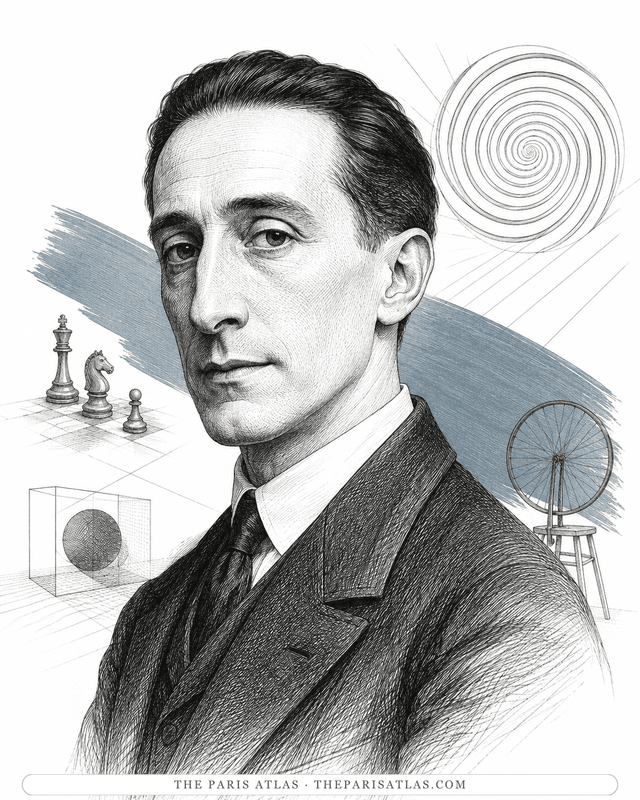
The century's quietest revolutionary — readymades, the abandonment of painting, chess on a Paris rooftop in Entr'acte, and one anemic film of spinning puns signed Rrose Sélavy.
View artistThe sources below include collection records, catalogues, scholarly research, and primary materials that informed this page. They document Leda Atomica, its making, and its place in cultural history.


Web source consulted for documented facts and historical context presented on the Leda Atomica page.
These references provide the documented foundation for this work's history and interpretation. Claim-level citations remain attached to the specific claims they support.
 Explore more resources