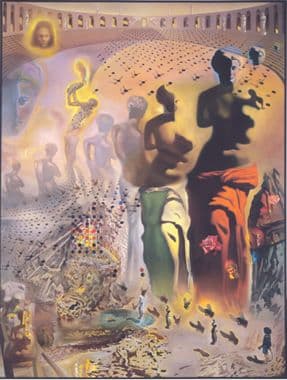
The Hallucinogenic Toreador
Salvador Dalí's monumental painting hides a bullfighter's face inside repeated images of the Venus de Milo. This guide shows where to find the face, the bull, the arena, and the other images.
- 1969–1970
- Oil on canvas
About Salvador Dalí
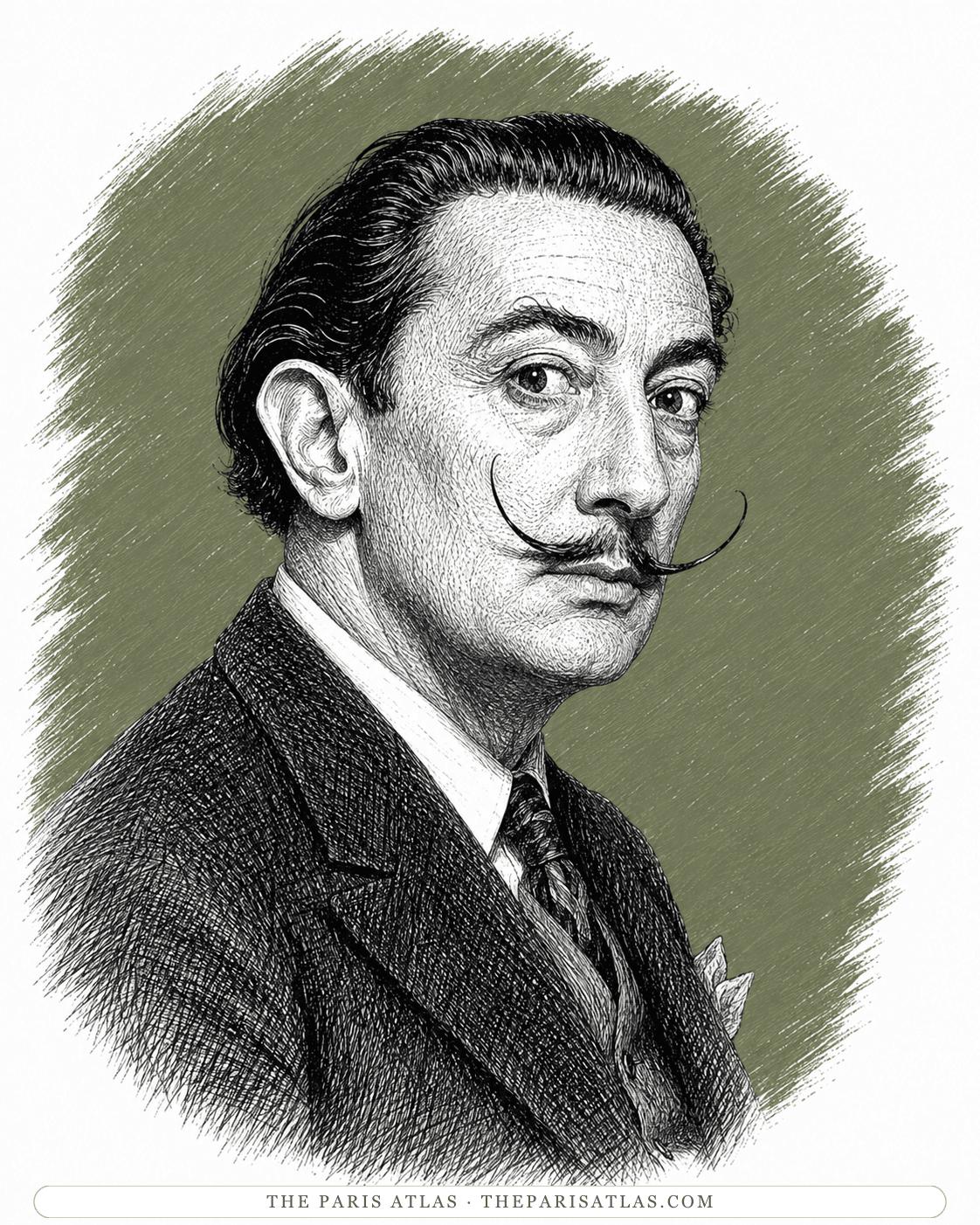
A route through Dalí's work
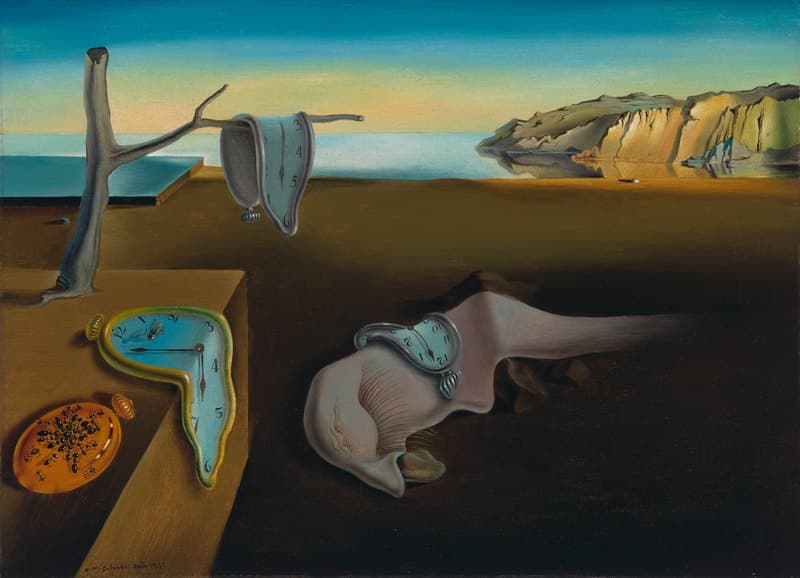
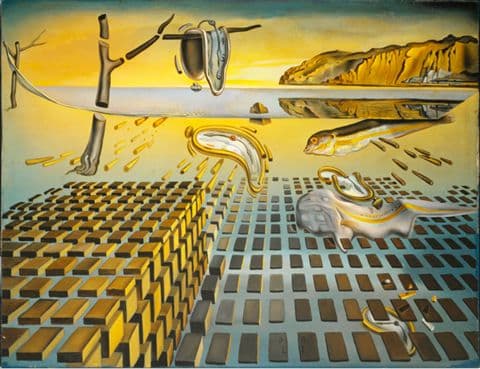
For the compact early painting behind Dalí's later visual puzzles, see The Persistence of Memory. Its impossible objects register immediately; The Hallucinogenic Toreador expands the same exacting technique into a monumental field of repeated and hidden images.
What the painting shows
The Hallucinogenic Toreador is a nearly four-metre-high painting filled with repeated versions of the Venus de Milo, the ancient Greek statue with missing arms. A bullfighting arena curves across the upper half. Flies, dots, shadows, a boy in a sailor suit, a woman in a bathing suit, and a dying bull occupy the rest of the canvas.
The large face is easy to miss because Salvador Dalí did not draw a separate outline around it. He built it from parts of the repeated Venus figures. Once the face appears, the same forms keep switching between statue and bullfighter.
How to find the hidden bullfighter
Start with the Venus wearing a green skirt near the centre. The green shape becomes the bullfighter's necktie, and the white skirt behind it becomes his shirt. Move upward: the central Venus's abdomen becomes his chin, her waist becomes his mouth, and her left breast becomes his nose.
The shadow across the statue's face forms one eye. The pink arch above the statues completes the top of his head, and the circular arena becomes his hat. On the right, a red skirt doubles as the bullfighter's cape. The Dalí Museum's guide describes a tear at the back of the Venus's neck as a tear for the bull.
Reading the picture, detail by detail
The Hallucinogenic Toreador is monumental — almost four metres high, three metres wide — so a viewer at the Dalí Museum stands under a painting nearly twice as tall as they are. Seven passages carry the picture's argument. Each one requires the viewer to switch between reading a statue and reading a face.
The Venus de Milo figures repeated across the canvas are Dalí's copies of the second-century BCE Greek marble statue in the Louvre, missing arms and draped from the hips down. Dalí painted several Venuses at different scales across the picture, most of them nearly identical in pose. The one at dead centre is the largest and most fully painted; the smaller Venuses arrayed to her left and right at descending scales create the field of repetition from which the second image emerges.
The bullfighter's face is not drawn as a separate outline. It emerges from the central Venus and the surrounding statues. To find it, start at the green skirt near the centre — that becomes his necktie. The white skirt behind it becomes his shirt. The central Venus's abdomen becomes his chin. Her waist becomes his mouth. Her left breast becomes his nose. The shadow across her face becomes his eye. Once the face is visible, it is hard to unsee.
The starting point for finding the face is the green skirt at the centre — Dalí used it as the bullfighter's necktie, with the white skirt of the Venus behind it as his shirt collar. Once the necktie is visible the rest of the face assembles itself upward.
The chin, mouth and nose of the bullfighter emerge from the mid-section of the central Venus — her abdomen, waist, and left breast, each read as a piece of face rather than as a piece of body. Dalí painted the statue precisely enough that both readings work at once.
The shadow across the central Venus's face becomes the bullfighter's eye. At the back of her neck the Dalí Museum's guide identifies a small painted tear — a tear the bullfighter sheds for the dying bull below.
The bullfighter's hat is the arena. The curving pink arch across the upper half of the canvas — the seating tiers of a bullring — becomes the top of his head. Dalí used the perspective of the amphitheatre to give the face its cranial roundness, so the bullring above the toreador is also the bullring under which he fights.
The bullfighter's cape is the bright red draped skirt of a Venus on the right of the composition. Dalí used the red Venus fabric as the muleta — the red cape the bullfighter uses to guide the bull's charge in the final third of a corrida.
The bull is at the lower left. Its head is turned toward the viewer, and its horns rise into the blue water. The bright green fly hovering near the bull's face is one of the picture's small paranoiac substitutions: the fly is also the bull's eye. Blood-red marks near the muzzle indicate the animal is dying. The Dalí Museum's guide identifies a specific tear at the back of the central Venus's neck as a tear shed for the bull.
At close range the bull is a specific dying animal, not a generic one. Blood runs from the wounds near the muzzle. Dalí gave the picture the physical cost of the bullfight it depends on for its subject.
The bull's muzzle appears a second time in the blue water below — the same head painted again, dissolving into a reflection or a pool of water. Dalí did this with several of the picture's objects, painting each one at least twice at different scales so nothing in the composition sits in only one place.
The small boy in a sailor suit at the lower right is a self-portrait of Dalí as a child. He appears in several late Dalí paintings in the same costume, holding the same rolled hoop. His presence here is not incidental — Dalí placed the child version of himself as a witness to the bullfight, which he watched with his father in Figueres and Barcelona in his childhood.
The dots scattered across the canvas are Ben-Day dots — the printer's dots of newspaper reproduction, which Dalí knew from Roy Lichtenstein's Pop Art paintings of the mid-1960s. Dalí used them here as a nod to the pop-art vocabulary of the years he was painting in and as the visual equivalent of the multiplied Venuses: many tiny elements arranged so a larger pattern emerges.
The woman in the yellow bathing suit at the far lower right is Gala Dalí — Dalí's wife, and by 1969 the recipient of most of his paintings' dedications. She watches the bullfight from outside the arena. Dalí signed the painting in the lower right, near her feet: Gala Salvador Dalí, 1970. The signature is the same joined name he had used since the 1930s.
The image began on a pencil box
The Dalí Museum says Dalí conceived the painting in 1968 after seeing a Venus de Milo printed on a box of art pencils. He noticed that the light and shadow across the statue could also suggest a man's face. The finished painting turns that small visual accident into a monumental system of repeated figures.
A surviving oil study from about 1969 shows that Dalí worked out the double image before completing the large canvas. The study is now held by the Fundació Gala-Salvador Dalí in Figueres.
Why the picture changes while you look at it
Dalí had used double images since his central Surrealist years. The method gives one painted form two identities: what first looks like a statue can become part of a face without changing shape. The viewer supplies the switch.
In 1970 Dalí described using repeated images of the Venus de Milo to produce what he called a hallucinogenic structure. The title does not mean that the painting records a drug experience. It names a controlled visual effect in which an image seems to appear from a field of other images.
The bull, the bullfighter, and the cost of the spectacle
The bullfighter is not the only hidden figure. At lower left, one of the bright flies becomes the bull's eye. Its horns rise above it, and its muzzle appears in the blue water below. Blood-red marks and the bull's lowered position make the animal's death part of the composition rather than a separate detail.
The Dalí Museum's educational material identifies the bullfighter as Manuel Laureano Rodríguez Sánchez, known as Manolete, who was killed after being gored in the ring in 1947. That identification is useful but should be stated carefully: the monumental face is assembled from optical clues rather than presented as a conventional signed portrait.
Why Venus de Milo and bullfighting share the canvas
The painting brings an ancient museum icon together with a modern Spanish public spectacle. The Venus de Milo supplies an immediately recognizable body, while the arena, cape, bull, and bullfighter create a second image associated with Spain. Neither subject simply illustrates the other; the painting depends on their shapes fitting together.
Dalí had altered the Venus de Milo before, most famously by adding drawers to copies of the statue in the 1930s. Here he does not change the sculpture with an attached object. He multiplies it until repetition itself creates a new face.[1]
Where it fits in Dalí's career
Dalí painted The Hallucinogenic Toreador long after his break with André Breton's organized Surrealism. By the late 1960s he was combining earlier double-image methods with large canvases, optical effects, classical art, religion, science, and references to popular culture.[2]
The Dalí Museum calls paintings of this scale and sustained production his masterworks. This one qualifies both physically and conceptually: it took roughly a year to paint and turns a small optical discovery into a canvas almost four metres high.[3]
How large it is and where to see it
The canvas measures 398.8 centimetres high by 299.7 centimetres wide, or about 13 feet 1 inch by 9 feet 10 inches. Its size matters because the hidden face is not a small puzzle in the corner. It occupies much of the viewer's field of vision.[4]
The painting belongs to The Dalí Museum in St. Petersburg, Florida. The museum includes it among the monumental canvases in its permanent collection. Current display can change for conservation or exhibition reasons, so visitors should check the museum's live collection and visit information before travelling specifically to see it.[2]
From a New York gallery to the Dalí Museum
The Fundació's catalogue raisonné records the painting at M. Knoedler & Co. in New York and then in the collection of A. Reynolds and Eleanor Reese Morse. The Morses built the collection that became The Dalí Museum.[4]
Knoedler displayed the canvas as a work in progress from February to April 1970. Dalí signed and dated it 1970, so the catalogue uses that year even though work began in 1969. In 2001 the museum included it in an exhibition about the Venus de Milo in twentieth-century art.[5]
Why The Hallucinogenic Toreador matters
The painting explains Dalí's double-image method more clearly than almost any written definition can. A viewer can identify each Venus, follow its shadows, and then experience the moment when separate objects become one face.[3]
It also shows that his late work did not simply abandon Surrealism for classical painting. He made a classical statue, a modern bullfighter, a tourist arena, a dying animal, and a memory of a shop display occupy the same visual structure. The strongest connection between them is not a vague theme. It is the exact way their shapes overlap.
Timeline
1968
Dalí sees the suggestion of a bullfighter's face in a Venus de Milo printed on an art-pencil box and develops the idea for the painting.
c. 1969
He makes an oil study for the composition, now in the Fundació Gala-Salvador Dalí collection in Figueres.
1969–1970
Dalí paints the monumental canvas. He signs and dates it 1970.
10 February–4 April 1970
M. Knoedler & Co. in New York displays the painting while it is still recorded as in progress.
2001
The Dalí Museum includes it in A Disarming Beauty: The Venus of Milo in 20th Century Art.
Where to see it
The Dalí Museum, St. Petersburg, Florida
One Dalí Boulevard, St. Petersburg, FL 33701, United States
Displays and loans can change. Check whether this work is on view before making a special trip.
Plan your visit on the museum’s official website (opens in a new tab)Frequently asked questions
What is hidden in The Hallucinogenic Toreador?
The main hidden image is a bullfighter's face built from repeated Venus de Milo figures and their shadows. The painting also contains a dying bull whose eye is formed by a fly near the lower left.
How do I see the bullfighter's face?
Start at the green skirt near the centre, which becomes his necktie. The white skirt behind it is his shirt. The central Venus's abdomen, waist, and breast become his chin, mouth, and nose, while the shadow across her face forms his eye.
Who is the bullfighter in the painting?
The Dalí Museum's educational material identifies him as Manolete, the famous Spanish bullfighter who died after being gored in 1947. Because the face is an optical construction rather than a conventional portrait, the identification is best presented as the museum's interpretation.
Why did Dalí use the Venus de Milo?
He first noticed the double image on a box of Venus pencils. The statue's familiar profile and strong shadows gave him shapes he could repeat and combine into the bullfighter's face.
Does hallucinogenic mean Dalí was using drugs?
No evidence cited by the museum or catalogue says the painting came from drug use. Dalí used the word for the perceptual effect of one image emerging from repeated versions of another.
When did Dalí paint The Hallucinogenic Toreador?
He painted it during 1969 and 1970. Because he signed and dated it 1970, the Fundació Gala-Salvador Dalí catalogue lists 1970 as its formal date.
How big is The Hallucinogenic Toreador?
It is 398.8 centimetres high by 299.7 centimetres wide, approximately 13 feet 1 inch by 9 feet 10 inches.
Where is The Hallucinogenic Toreador now?
It is in the collection of The Dalí Museum in St. Petersburg, Florida, which groups it with Dalí's monumental masterworks.
Is The Hallucinogenic Toreador Surrealist?
It was made decades after Dalí left André Breton's Surrealist group, but it deliberately renews his Surrealist double-image method. It is best understood as a late Dalí painting that carries Surrealist visual practice into a new period.
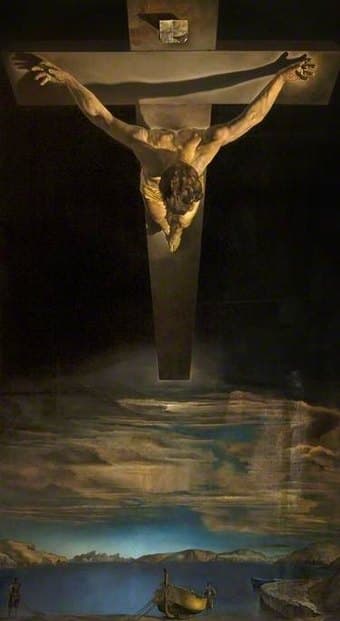
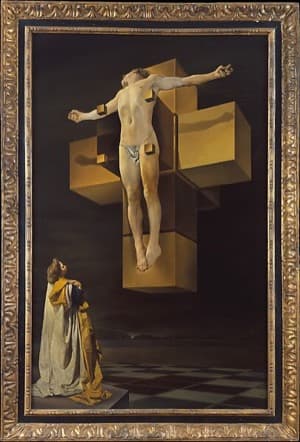
More by Salvador Dalí

If you like Salvador Dalí
Explore painters from the same movements and circles.
Jean Arp
Strasbourg-born sculptor and poet — Hans in German, Jean in French, both all his life — who co-founded Dada at the Cabaret Voltaire in 1916, composed collages by dropping torn paper 'according to the laws of chance', and settled at Meudon outside Paris in a house his wife Sophie Taeuber-Arp designed.
View artist
Henri Cartier-Bresson
French photographer who turned a pocket-sized 35mm camera into an instrument of split-second composition — the idea the world knows as 'the decisive moment'. He trained as a painter, was taken prisoner in 1940 and escaped on his third try, photographed the Liberation of Paris in August 1944, co-founded the photographer-owned agency Magnum Photos in 1947, gave up reporting for drawing in the 1970s, and left Paris a foundation in the Marais that deliberately hangs no permanent display of his own pictures.
View artist
Marcel Duchamp
The century's quietest revolutionary — readymades, the abandonment of painting, chess on a Paris rooftop in Entr'acte, and one anemic film of spinning puns signed Rrose Sélavy.
View artist
In images
References
The sources below include collection records, catalogues, scholarly research, and primary materials that informed this page. They document The Hallucinogenic Toreador, its making, and its place in cultural history.


1↑Transgressing Venus
WebsiteFundació Gala-Salvador DalíUsed forWeb source consulted for documented facts and historical context presented on the The Hallucinogenic Toreador page.
5↑Study for The Hallucinogenic Toreador
WebsiteFundació Gala-Salvador DalíUsed forWeb source consulted for documented facts and historical context presented on the The Hallucinogenic Toreador page.
These references provide the documented foundation for this work's history and interpretation. Claim-level citations remain attached to the specific claims they support.
 Explore more resources