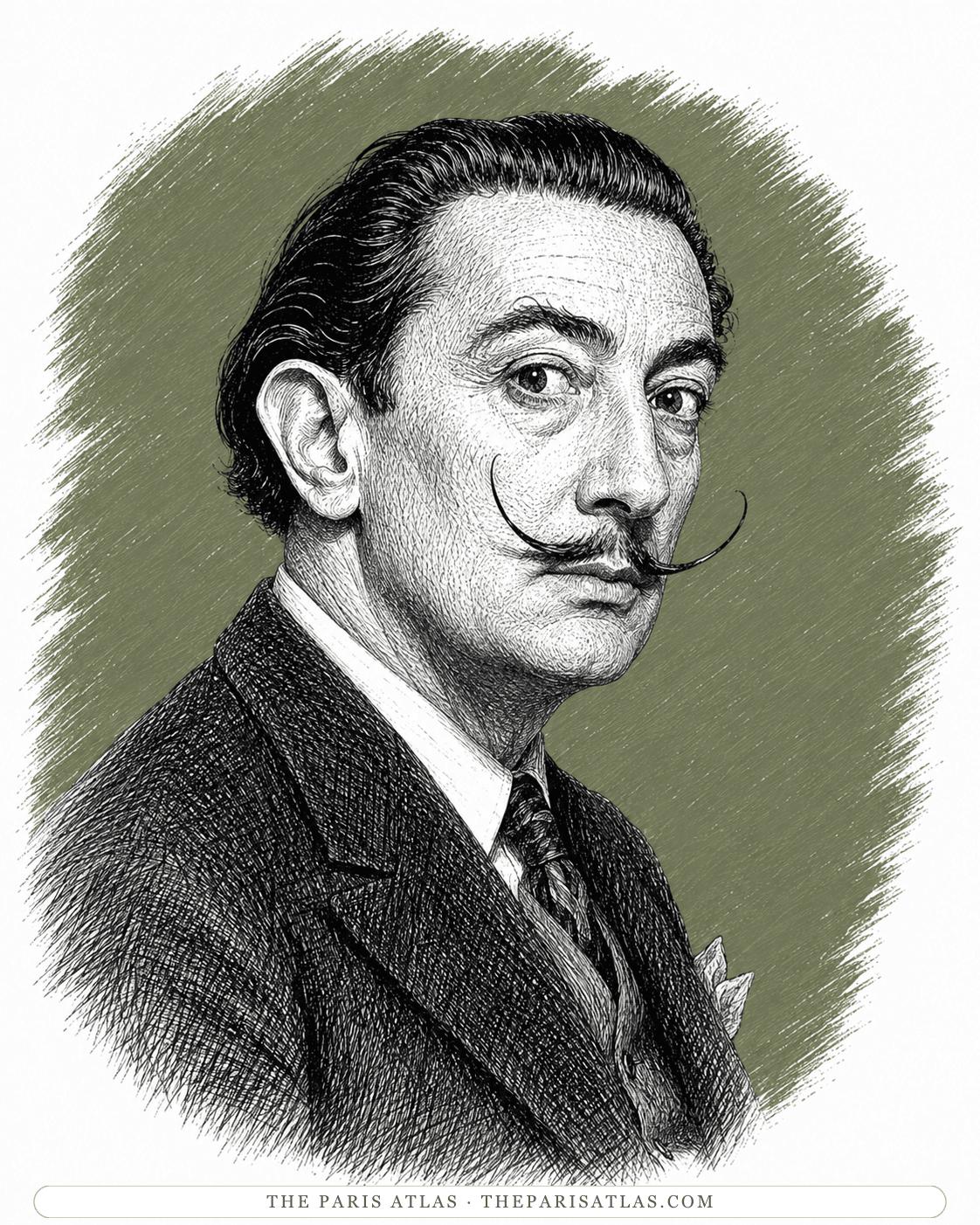
Salvador Dalí
Salvador Dalí is buried in the crypt beneath the stage of the Dalí Theatre-Museum in Figueres, the city where he was born and died.
A practical guide to Figueres, the inland Catalan city where Salvador Dalí was born and buried, with a walkable centre, two rail stations, the Dalí Theatre-Museum, and the vast Sant Ferran fortress.
Figueres is the capital of Alt Empordà in Girona province, Catalonia. The city lies on the Empordà plain, about 15 kilometres from the Mediterranean and south of the Pyrenean foothills. It is a working regional centre of nearly 50,000 people, not a preserved village built around one museum.[1]
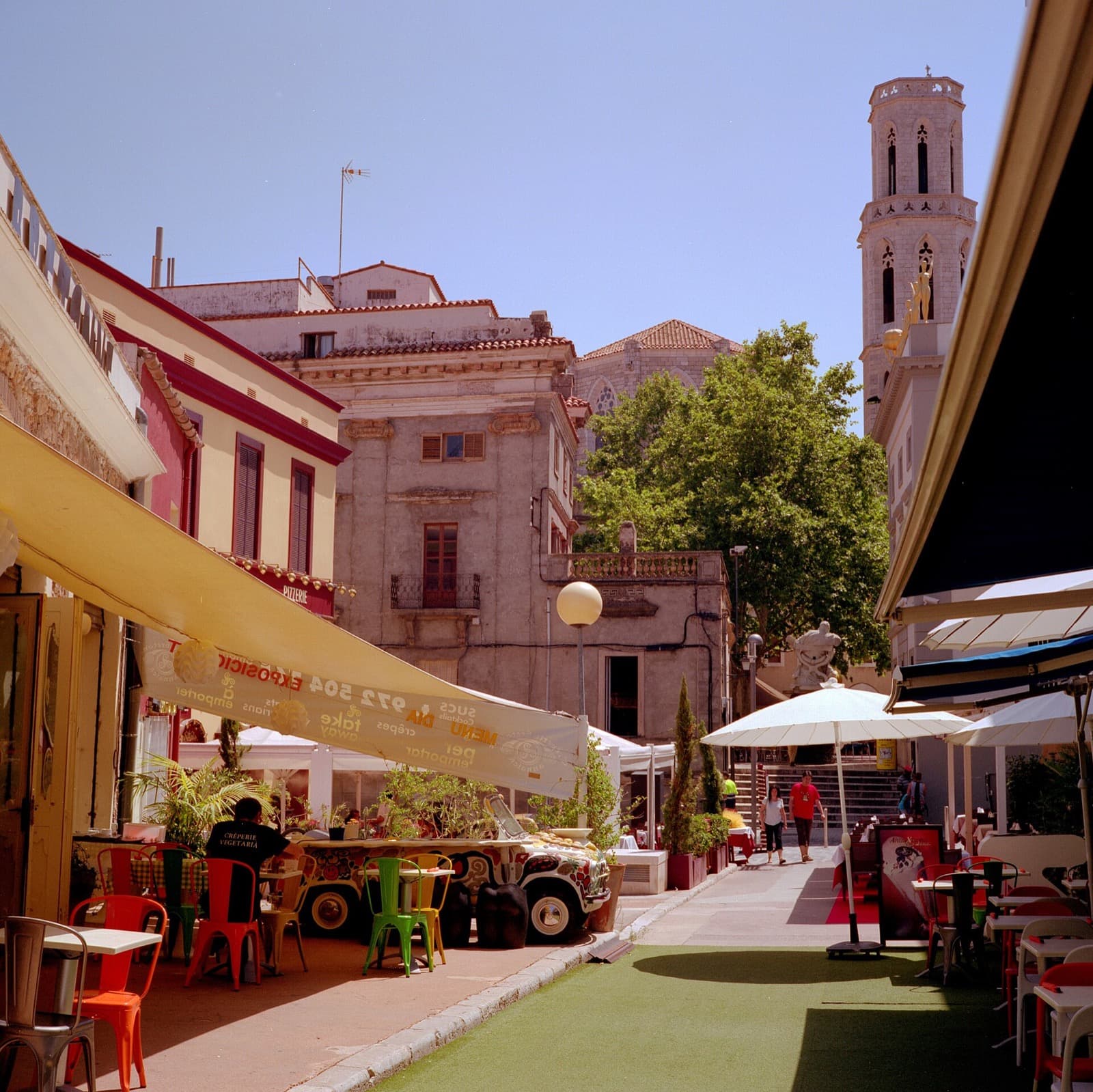
The central visitor area is easy to understand. La Rambla, the Dalí Theatre-Museum, Saint Peter's Church, Salvador Dalí's birthplace, the Toy Museum of Catalonia, and the Empordà Museum sit within a compact pedestrian centre. Sant Ferran Castle is uphill to the northwest and requires a longer walk or a short taxi ride.[2]
The Catalan name is Figueres. Figueras is the traditional Spanish form and still appears in older books, maps, and search queries. They refer to the same city.[1]
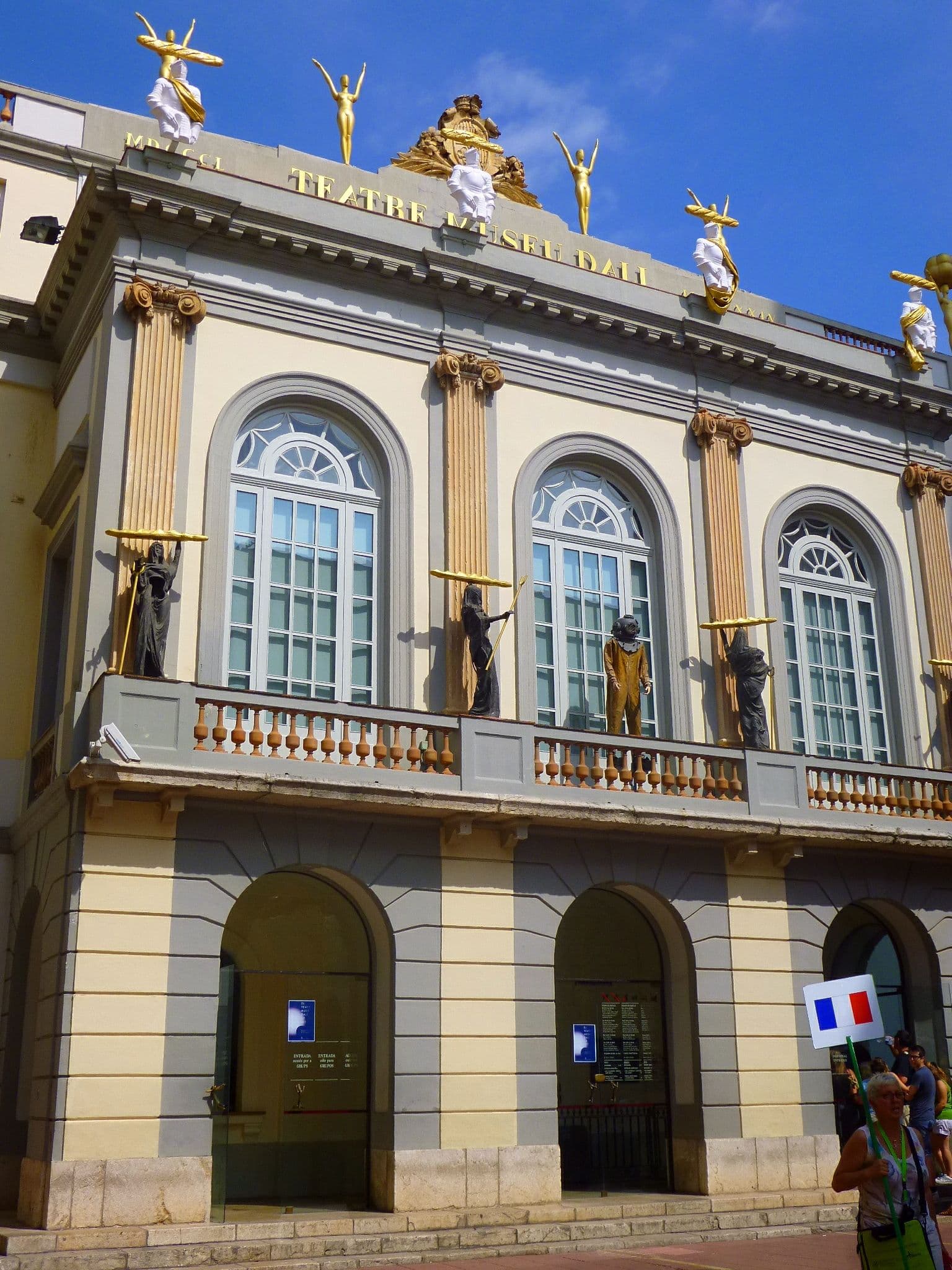
If the Dalí Theatre-Museum is your priority, reserve a timed entry first and build the rest of the day around it. The Fundació Gala-Salvador Dalí estimates 90 minutes to two hours for a self-guided visit. The building is intentionally dense, so a rushed forty-five-minute pass misses the reason to come.[3]
After the museum, walk beside Saint Peter's Church and follow the city's Dalí Route through the centre. Ant symbols in the paving connect the theatre, church, Toy Museum, Empordà Museum, La Rambla, Dalí family addresses, and birthplace. This makes the biography legible as a real set of streets rather than a single museum visit.[4]
The Dalí Theatre-Museum occupies the ruins of Figueres's former municipal theatre. Salvador Dalí conceived and designed the conversion as a total work of art rather than a neutral sequence of galleries. It opened on 28 September 1974.[3]
The collection covers his earliest experiments, Surrealist works, later paintings, installations, sculpture, holograms, and the Dalí Jewels rooms. Dalí selected and arranged much of the experience himself. The museum therefore explains his public self-presentation as well as individual works. One expectation to correct before you go: the melting watches are not here. The Persistence of Memory has hung at the Museum of Modern Art in New York since 1934.[3]
Hours and prices change by season. The official museum recommends advance booking, and entry is subject to capacity. Use the current ticket page rather than relying on a timetable copied into an older travel article.[5]
Current tickets, opening hours, prices, access, and museum map.
Salvador Dalí i Domènech was born on 11 May 1904 in an Art Nouveau building on Carrer Monturiol. His family lived on the mezzanine floor, while his father, Salvador Dalí Cusí, kept his notary's office below. The family moved farther along the same street in 1912.[6]
The birthplace is now a separate audiovisual museum. It is not included automatically with the Theatre-Museum, and the official visit estimate is about 80 minutes. Readers interested in Dalí's family and childhood will get more from it than visitors looking mainly for finished paintings.[6]
Saint Peter's Church supplies another direct link: Dalí was baptized there, and his funeral was held there. After his death in Figueres on 23 January 1989, he was buried in the crypt beneath the Theatre-Museum stage. The museum is therefore both his designed monument and his burial place.[4]
Federico García Lorca visited the Dalí family in Figueres in 1925 and 1927. The connection is concrete enough to keep: their friendship unfolded in family houses, streets, and journeys through Figueres and Cadaqués, not only in letters exchanged from a distance.
La Rambla is the city's central promenade and meeting place. Since 1831 it has covered the Galligans stream, once a work and refuse area beside the medieval wall. Its present form dates largely from a 1917–18 renovation, and its cafés, shops, fairs, and public events still make it a useful centre of gravity.[7]
The surrounding streets mix older fabric with Neoclassical and Catalan Modernist buildings. The official heritage route links eleven central points. Walking it is the simplest way to see that Figueres developed as a commercial city before Dalí became its international symbol.[8]
The Rambla also carries a monument to Narcís Monturiol, the Figueres-born inventor associated with early crewed submarines, and a reflective portrait sculpture of Dalí. These civic monuments place two very different kinds of local invention in the same public space.[7]
The Toy Museum of Catalonia displays industrial toys and games from the late nineteenth century to the present, including model railways, tin vehicles, dolls, board games, and early moving-image devices. Its Dalí material includes family photographs, school records, and Don Osito Marquina, a toy associated with Salvador and Anna Maria Dalí and named by Federico García Lorca.[1]
The Empordà Museum reads the region through archaeology and art, from ancient ceramics and medieval sculpture to nineteenth- and twentieth-century Catalan work. It is the better choice if you want Figueres placed inside the longer history of its region rather than treated only as Dalí's hometown.[1]
A Tuesday, Thursday, or Saturday visit also intersects with the city's regular markets. The official tourism office lists clothing stalls at Passeig Nou and fruit and vegetable markets at Plaça del Gra and Plaça Catalunya. Market locations or hours can change, so confirm them locally.[1]
Sant Ferran Castle is a vast eighteenth-century bastioned fortress on the hill above Figueres. The Government of Catalonia describes a 550,000-square-metre complex with six bastions, stables for 500 horses, stores planned for 10,000 people, and four cisterns holding nine million litres of water.[9]
Its scale answers a border problem. After the Peace of the Pyrenees moved the Franco-Spanish border in 1659, the Spanish crown needed a stronger inland defence. Construction began in the eighteenth century and continued through later phases; the tourist office associates the design with military engineer Juan Martín Zermeño.[9]
This is not a quick courtyard beside the museum. The outer works, parade ground, buildings, and underground water system occupy a separate site. Check the official visit program and last-entry time before walking uphill, especially outside summer.[9]
Figueres's location near the French border made it a passage for soldiers and civilians retreating north at the end of the Spanish Civil War. The city government records sustained bombing through 1938 and early 1939 and gives an official death toll of 291, while noting estimates close to 400 because many people passing through were never fully identified.[1]
The bombing damaged streets, the hospital, Saint Peter's Church, and the municipal theatre that later became the Dalí Theatre-Museum. A present-day visit can follow the city's historical Civil War route and memorial points instead of treating the ruined theatre as an isolated event in Dalí's biography.
Sant Ferran Castle also belongs to the final Republican retreat. The official tourism history identifies it as the site of the last meeting of the Republican government before the fall of Catalonia. That event and the bombing history give the fortress a twentieth-century meaning beyond its original border defence.[9]
Figueres has a conventional station near the centre and a separate high-speed station called Figueres-Vilafant on the western edge of the city. Regional R11 trains use the central station. AVE, Avant, and other high-speed or long-distance services use Figueres-Vilafant.[2]
The distinction matters when planning a museum entry. From the conventional station, the centre is walkable. From Figueres-Vilafant, use the shuttle bus, taxi, or allow additional walking time. The city tourism office lists the shuttle and keeps a transport map; Renfe publishes the current train schedule.[2]
A Barcelona day trip is practical by rail, but do not assume every ticket arrives at the same station or takes the same time. Search both station names, reserve the museum after choosing a train, and leave a margin between arrival and timed entry.
Walking, city buses, the Figueres-Vilafant shuttle, and taxis.
Current station and rail-service information.
The Dalinian Triangle joins Figueres, Portlligat, and Púbol as three separate places. Figueres holds the theatre-museum and Dalí's public monument. Portlligat holds the house and studio he built with Gala Dalí. Púbol holds the castle he gave her.[10]
The Fundació explicitly advises against trying to visit all three Dalí museums in one day. Figueres to Portlligat requires a road journey toward Cadaqués, while Púbol lies in another direction. Use Figueres as a rail base if that suits the trip, but allow at least two days for the full triangle.[10]
For a first day trip, Figueres stands alone. The Theatre-Museum, birthplace, centre, and one additional museum already make a complete visit without turning the city into a hurried transfer point for the coast.
A walled settlement develops around the streets now leading between La Rambla and Pujada del Castell.
The Peace of the Pyrenees shifts the border with France and helps create the strategic need for a major fortress at Figueres.
Construction begins on Sant Ferran Castle, the enormous bastioned fortress above the city.
La Rambla covers the Galligans stream and becomes the city's central promenade.
Salvador Dalí i Domènech is born on Carrer Monturiol in Figueres.
Federico García Lorca visits the Dalí family in Figueres during his friendship with Salvador and Anna Maria Dalí.
Repeated bombing kills hundreds, damages the city, and destroys much of the municipal theatre.
The Dalí Theatre-Museum opens inside the transformed ruins of the former municipal theatre.
Salvador Dalí dies in Figueres and is buried beneath the Theatre-Museum stage.
The official population count reaches 49,556, confirming Figueres as a substantial regional city rather than a museum village.
Figueres is an inland city in Girona province, Catalonia, Spain. It is the capital of Alt Empordà, about 15 kilometres from the Mediterranean and roughly 33 kilometres by road from Cadaqués.
Yes if you want the Dalí Theatre-Museum, Salvador Dalí's birthplace, a compact Catalan city centre, or Sant Ferran Castle. A visitor interested only in beaches should continue to the coast; Figueres itself is inland.
Yes. Regional and high-speed trains make a same-day visit practical. Check whether your train uses central Figueres station or Figueres-Vilafant, then reserve the Dalí museum with enough time for the transfer.
Allow a full day for the Dalí Theatre-Museum, the centre, lunch, and one additional site. Stay longer or return for Sant Ferran Castle, the birthplace, and the other museums without rushing.
The Fundació Gala-Salvador Dalí says a self-guided visit generally takes between 90 minutes and two hours. The visit has no single required route, so interested readers may take longer.
Advance booking is strongly recommended because entry is capacity-controlled. Hours, prices, and closing days change by season, so buy from the museum's current official page.
Figueres is the conventional station near the centre and serves regional trains. Figueres-Vilafant is the separate high-speed station west of the centre; a shuttle bus and taxis connect it with town.
Yes. Salvador Dalí is buried in the crypt beneath the stage of the Dalí Theatre-Museum, the building he conceived and designed from the ruins of the municipal theatre.
No. Figueres is the inland regional capital with rail stations and the Theatre-Museum. Cadaqués is a coastal town about 33 kilometres away by road; Portlligat and Dalí's house are beside Cadaqués.
The strongest alternatives are Sant Ferran Castle, La Rambla, Saint Peter's Church, the Toy Museum of Catalonia, the Empordà Museum, the historic-centre heritage route, and the Civil War memorial route.
The historic and commercial centre is compact and largely pedestrian. Sant Ferran Castle and Figueres-Vilafant station sit outside the tight central circuit, so some visitors will prefer a bus or taxi for those legs.
No. Figueres is about 15 kilometres inland on the Empordà plain. Roses, Cadaqués, Portlligat, and Cap de Creus are separate coastal destinations reached by road or bus.
No. Figueres is the official Catalan name. Figueras is the traditional Spanish form and often appears in older English-language sources. Both names refer to the same city.
Salvador Dalí is buried in the crypt beneath the stage of the Dalí Theatre-Museum in Figueres, the city where he was born and died.
The sources below include histories, archival materials, scholarly research, and official records that informed this page. They document Figueres, the people connected to it, and its place in Figueres, Girona.

Web source consulted for documented facts and historical context presented on the Figueres page.
Web source consulted for documented facts and historical context presented on the Figueres page.
Web source consulted for documented facts and historical context presented on the Figueres page.

Official record used to verify names, dates, institutional details, or other factual information on this page.
Official record used to verify names, dates, institutional details, or other factual information on this page.
Web source consulted for documented facts and historical context presented on the Figueres page.
These references provide the documented foundation for this page's history and context. Claim-level citations remain attached to the specific claims they support.
 Explore more resources
Newsletter
The cafés, studios, and walk-up flats where the work was made — one story from the map in every letter.