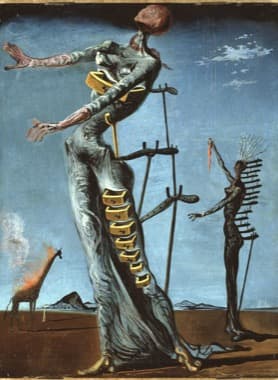
The Burning Giraffe
Salvador Dalí's small 1937 painting shows two distorted human figures supported by crutches while a giraffe burns in the distance. This guide separates what is visible from what the surviving records can prove.
- c. 1937
- Oil on wood panel
About Salvador Dalí
A route through Dalí's work
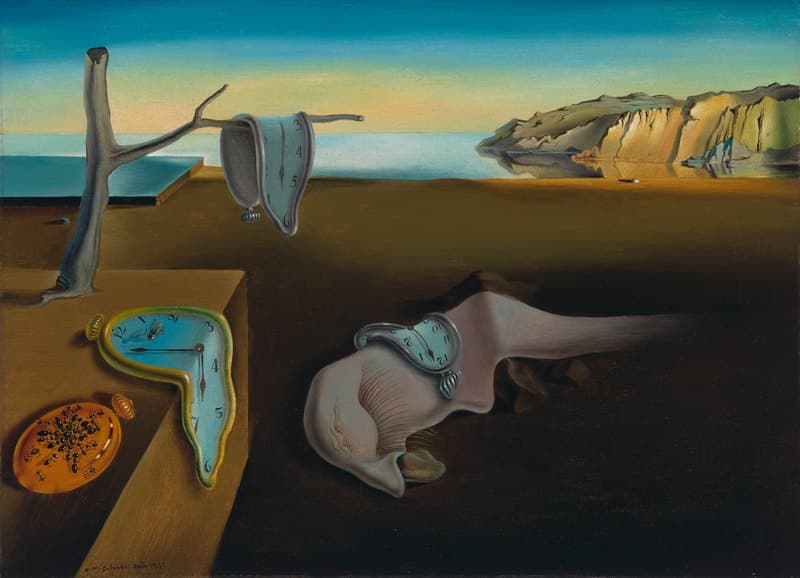
For the quieter early landscape behind this image of bodily strain, see The Persistence of Memory. Both paintings place impossible transformations in sharply rendered, nearly empty spaces, but The Burning Giraffe turns that unease toward the human body.
What the painting shows
A tall human figure leans backward across the centre of The Burning Giraffe. The figure wears a long blue garment, extends two red, skinless-looking hands, and has a red face with no clearly painted features. A row of open drawers runs down the left side of the torso and leg. Several crutches support the body from behind.
A second, narrower figure stands to the right. Its torso looks skeletal, branch-like forms project from its head and back, and another set of crutches holds it upright. Far to the left, a small giraffe walks across the empty ground with flames rising from its back. Low mountains meet a blue evening sky at the horizon.
The title directs attention to the smallest of the three figures. The giraffe is easy to miss in a reproduction because it occupies only a small part of an already small panel.
It is much smaller than most reproductions suggest
The panel measures 35 by 27 centimetres, about 13.8 by 10.6 inches. It is slightly larger than a sheet of A4 paper and is painted on wood rather than canvas.
That size changes the viewing experience. The central figure dominates the composition, but the burning animal is only a few centimetres high. The open drawers, flames, ribs, and thin supports depend on controlled detail rather than monumental scale.
Reading the picture, detail by detail
The Burning Giraffe is a small panel — 35 by 27 centimetres, slightly larger than a sheet of A4 paper — with a lot happening in it. The passages below carry the picture's argument, and each of them is small enough that reproductions tend to lose the detail entirely.
The tall central figure leans backward with her arms extended forward. She wears a long blue dress and her face is painted red, with no distinct features. Her hands are flayed — Dalí painted them as if the skin had been removed, showing the muscles and tendons of the palm and fingers in a red so deep it reads almost as raw meat. The stripped hands are the closest thing in the picture to a wound; every other body is intact if strange.
The drawers running down the left side of the central figure's torso and thigh are Dalí's recurring device. He had added drawers to a plaster Venus de Milo the year before, in 1936, and he wrote later that Freud had shown the human body to contain 'secret drawers' that psychoanalysis could open. Each drawer here is painted with a small round handle, the kind found on a nineteenth-century writing desk. Two of the drawers are pulled open, showing nothing inside — the interior of the body Dalí has invited the viewer to inspect is empty.
The crutches supporting both figures from behind are painted with the exact form of the wooden crutches used in French hospitals in the 1930s — a Y-shape at the top for the armpit, a straight shaft below, a wide foot at the bottom. Dalí drew and painted the same object in dozens of pictures across the decade. Without the crutches, both figures would fall backward; the picture is a scene of bodies extended beyond what they can hold up on their own.
The second figure on the right is smaller and more skeletal than the central figure. Her ribs are visible through the flesh of her torso, and dark branch-like forms rise from her head and shoulders in the shape of antlers or dead trees. Dalí gave her a longer, thinner set of crutches, and her head is bowed. The two figures are the same species of impossible body — extended, supported, stripped — but she is the further-along or more decayed version of what the central figure has become.
The branch-like forms rising from the second figure's head and shoulders are painted as split bark and dead-wood twigs, in the same manner as the dead olive tree Dalí had painted in The Persistence of Memory five years earlier. They read as antlers, or as the skeletal remains of a plant growing out of the body — the human form drying out under strain.
The giraffe burning in the distance at left is remarkably small — about the height of a fingernail on the actual panel. It is walking away from the viewer with flames rising from its neck and back. Dalí used the same flaming-giraffe motif in Inventions of the Monsters (Art Institute of Chicago), also from 1937, and described the flaming giraffe there in a 1943 letter as 'the masculine, cosmic, apocalyptic monster.' The same phrase can carry over to this picture with caution, since Dalí's later account describes the other canvas directly.
The landscape behind the figures is the same barren rocky ground Dalí painted through the 1930s — dry, empty, blue-grey mountains on the horizon under a blue-black late-evening sky. There is no vegetation. The Spanish Civil War had started in July 1936 and was ongoing when Dalí painted this in 1937; the landscape is not identified in the catalogue as a specific place, but it belongs to the same family of blasted, unpopulated backgrounds Dalí used in Soft Construction with Boiled Beans (Philadelphia Museum of Art), his 1936 painting explicitly subtitled Premonition of Civil War.
Why the body has drawers
Drawers were already part of Dalí's work before this painting. In 1936 he added drawers to a plaster version of the Venus de Milo and made other figures and objects with compartments. The Art Institute of Chicago connects those works to Dalí's statement that Sigmund Freud had revealed the human body to be full of secret drawers that psychoanalysis could open.
On the central figure here, the drawers turn a body into a piece of furniture while also suggesting an interior that has been pulled into public view. That general connection to Dalí's Freudian imagery is documented. A claim that each drawer contains one fixed secret is not.
What the crutches do
The crutches are literal supports inside the painted scene. Without them, both stretched figures appear unable to remain upright. Dalí used the same object repeatedly in drawings, paintings, and sculpture during the 1930s.
It is reasonable to read the supports as signs of weakness, dependence, or instability, but the catalogue record does not assign them a single meaning. The visible fact is stronger than any slogan: these bodies are extended beyond what they can support on their own.
What the burning giraffe means—and what we cannot prove
Dalí did explain a flaming giraffe in another 1937 painting. In a 1943 message about Inventions of the Monsters, now at the Art Institute of Chicago, he called its flaming giraffe a masculine apocalyptic monster. That statement is the strongest surviving explanation of the motif from Dalí himself.
The statement was written six years later and referred to a different canvas. It helps establish what the image could mean for Dalí, but it does not prove that every burning giraffe carries exactly the same message. On this page, the documented phrase is presented as a close comparison rather than a definitive key.
The 1937 wartime context
The Fundació Gala-Salvador Dalí dates The Burning Giraffe to about 1937. The Spanish Civil War had begun in July 1936, and Dalí and Gala Dalí were spending most of their time in France. Other paintings from these years, including Soft Construction with Boiled Beans (Premonition of Civil War), use distorted bodies and self-destruction to address the conflict directly.
The date and imagery make the wartime connection important, but the painting's own catalogue record does not call it an allegory of the Spanish Civil War. Dalí also resisted stable political commitments. The careful conclusion is that the work belongs to a period of civil war and widening European danger, not that every object in it maps neatly onto one event.
Its closest companion is Inventions of the Monsters
Inventions of the Monsters is the strongest comparison because Dalí painted it in the same year and placed another flaming giraffe in a threatening landscape. He began that larger picture in Paris and completed it in the Austrian Alps as conflict spread across Europe.
The two pictures are not alternate titles or versions of one work. Inventions of the Monsters is a crowded horizontal canvas with Gala and Dalí among its figures; The Burning Giraffe is a narrow vertical panel dominated by two standing bodies. Their connection is the repeated motif and date, not identical composition.
Where it fits in Surrealism
Dalí joined André Breton's organized Surrealism in Paris in 1929. By 1937 he had spent years combining dream imagery, psychoanalytic ideas, precise illusionistic painting, and what he called the paranoiac-critical method.[1]
The Burning Giraffe uses that combination in a direct way. The landscape is painted with clear perspective, while bodies behave as furniture, exposed anatomy, and unsupported extensions. The strangeness comes from recognizable objects joined in physically impossible ways.[2]
Who owns it and where it is
The Emanuel Hoffmann Foundation owns The Burning Giraffe. It is on permanent loan to the Öffentliche Kunstsammlung Basel and is closely associated with the Kunstmuseum Basel, which calls it one of the foundation's prominent masterworks.[3]
That distinction matters. The work is commonly described as being at the Kunstmuseum Basel, which is useful for visitors, but the museum is the long-term borrower rather than the owner. Display can still change, so a visitor travelling specifically for the painting should check the museum's current galleries first.[3]
What the provenance record tells us
The Fundació catalogue lists Dr. E. Grandjean of Lausanne in the provenance. It does not give a complete chain of owners on the public record, so this page does not invent one.[4]
The documented exhibition history begins in Basel in 1952, when the panel appeared in Phantastische Kunst des XX. Jahrhunderts at the Kunsthalle Basel. It was shown at the Kunstmuseum Basel in 1953 and travelled to the Centre Pompidou's major Dalí retrospective in Paris in 1979–80.[4]
Why The Burning Giraffe matters
The painting gathers several of Dalí's most recognizable 1930s devices into one compact panel: bodies with drawers, crutches, exposed anatomy, a barren landscape, and a distant animal on fire. It gives a reader a practical way to see how those devices work before assigning them meanings.[5]
It also shows why chronology matters in interpretation. The picture was made during the Spanish Civil War, the flaming giraffe appears in another 1937 work, and Dalí later described that related animal as apocalyptic. Those are strong connections. Calling this panel a precise political code would go beyond the record.
Timeline
1929
Dalí joins the Surrealist group in Paris and begins the central phase of his work with dream imagery and psychoanalysis.
1936
He makes Venus de Milo with Drawers and Soft Construction with Boiled Beans; the Spanish Civil War begins in July.
c. 1937
Dalí paints The Burning Giraffe. The panel is unsigned and undated, so the Fundació catalogue keeps the date approximate.
1937
He also paints Inventions of the Monsters, which includes another flaming giraffe.
1943
After the Art Institute of Chicago acquires Inventions of the Monsters, Dalí sends the museum a message describing that painting's flaming giraffe as an apocalyptic monster.
1952
The Burning Giraffe is shown in Phantastische Kunst des XX. Jahrhunderts at the Kunsthalle Basel, catalogue number 62.
1953
It appears in the Kunstmuseum Basel exhibition marking twenty years of the Emanuel Hoffmann Foundation, catalogue number 63.
1979–1980
It travels to the Centre Pompidou in Paris for the Salvador Dalí retrospective, catalogue number 199.
Where to see it
Emanuel Hoffmann Foundation, on permanent loan to the Öffentliche Kunstsammlung Basel
St. Alban-Graben 16, 4051 Basel, Switzerland
This is the Hauptbau address. The museum has three buildings; confirm the artwork’s current building and display before travelling.
Plan your visit on the museum’s official website (opens in a new tab)Frequently asked questions
Who painted The Burning Giraffe?
Salvador Dalí, the Catalan-Spanish painter associated with Surrealism, painted it. The Fundació Gala-Salvador Dalí lists it as catalogue raisonné number P 412.
When was The Burning Giraffe painted?
About 1937. The panel is unsigned and undated, so the Fundació catalogue uses the approximate date “c. 1937” rather than claiming a precise day or month.
What does The Burning Giraffe show?
It shows two distorted human figures supported by crutches in a bare landscape. The larger blue figure has open drawers running down its side, while a small giraffe burns in the distance at left.
What does the burning giraffe symbolize?
Dalí called the flaming giraffe in his related 1937 painting Inventions of the Monsters a masculine apocalyptic monster. Because that later explanation refers to another canvas, it is useful evidence for the motif but not a complete, proven key to this painting.
Why does the central figure have drawers?
Dalí connected his drawer-filled bodies to Sigmund Freud and the idea that psychoanalysis opens the hidden compartments of human experience. The drawers suggest an interior made visible, but no reliable source assigns one fixed secret to each drawer.
What do the crutches mean?
They visibly support bodies that could not otherwise stand in their stretched positions. Weakness, dependence, and instability are reasonable interpretations, but the catalogue does not give the crutches one official meaning.
Is The Burning Giraffe about the Spanish Civil War?
It was painted during the war and belongs to a group of disturbing works Dalí made in that period. The surviving catalogue record does not identify this specific panel as a direct allegory, so the wartime context should not be turned into a one-to-one code.
How big is The Burning Giraffe?
It measures 35 by 27 centimetres, about 13.8 by 10.6 inches. It is a small oil painting on a wood panel, only slightly larger than A4 paper.
Where is The Burning Giraffe now?
It belongs to the Emanuel Hoffmann Foundation and is on permanent loan to the Öffentliche Kunstsammlung Basel at the Kunstmuseum Basel. Visitors should check the current display before making a special trip.
Is Burning Giraffe the same painting as Inventions of the Monsters?
No. Both are 1937 paintings with a flaming giraffe, but they have different compositions, dimensions, and collections. Inventions of the Monsters is at the Art Institute of Chicago; The Burning Giraffe is associated with the Kunstmuseum Basel.
What is the original title?
The French title used by the Kunstmuseum Basel is Girafe en feu, which translates directly as Burning Giraffe. The titles refer to the same painting.
Is The Burning Giraffe signed?
No signature or date is recorded on the panel. The Fundació catalogue attributes it to Dalí and dates it through the scholarly catalogue rather than an inscription on the work.
More by Salvador Dalí
If you like Salvador Dalí
Explore painters from the same movements and circles.
Jean Arp
Strasbourg-born sculptor and poet — Hans in German, Jean in French, both all his life — who co-founded Dada at the Cabaret Voltaire in 1916, composed collages by dropping torn paper 'according to the laws of chance', and settled at Meudon outside Paris in a house his wife Sophie Taeuber-Arp designed.
View artist
Henri Cartier-Bresson
French photographer who turned a pocket-sized 35mm camera into an instrument of split-second composition — the idea the world knows as 'the decisive moment'. He trained as a painter, was taken prisoner in 1940 and escaped on his third try, photographed the Liberation of Paris in August 1944, co-founded the photographer-owned agency Magnum Photos in 1947, gave up reporting for drawing in the 1970s, and left Paris a foundation in the Marais that deliberately hangs no permanent display of his own pictures.
View artist
Marcel Duchamp
The century's quietest revolutionary — readymades, the abandonment of painting, chess on a Paris rooftop in Entr'acte, and one anemic film of spinning puns signed Rrose Sélavy.
View artist
In images
References
The sources below include collection records, catalogues, scholarly research, and primary materials that informed this page. They document The Burning Giraffe, its making, and its place in cultural history.


1↑Salvador Dalí
WebsiteArt Institute of ChicagoUsed forWeb source consulted for documented facts and historical context presented on the The Burning Giraffe page.
2↑Inventions of the Monsters
WebsiteArt Institute of ChicagoUsed forWeb source consulted for documented facts and historical context presented on the The Burning Giraffe page.
5↑Philadelphia Museum of Art — collection
WebsiteUsed forWeb source consulted for documented facts and historical context presented on the The Burning Giraffe page.
These references provide the documented foundation for this work's history and interpretation. Claim-level citations remain attached to the specific claims they support.
 Explore more resources