The Paris AtlasCharting the artists, works, and places worth returning to.
  • Psychoanalyst
  • Author
· Austrian · 1856–1939

Sigmund Freud

The Interpretation of Dreams gave Surrealism the theory it worked from. Dalí spent years trying to meet him and managed it once, in London on 19 July 1938, carrying Metamorphosis of Narcissus to show him.

5 books on our shelves

In images

Details

Lived
1856–1939
Born
6 May 1856
Birthplace
Freiberg, Moravia, Austrian Empire (now Příbor, Czech Republic)
Died
23 September 1939 · aged 83
Place of death
London, England
Nationality
Austrian
Married
Martha Bernays · 1886–1939
Roles
PsychoanalystAuthor

About Sigmund Freud

Freud is in these pages for what the artists took from him rather than for the clinical work itself. The Interpretation of Dreams (1899) supplied the twentieth-century avant-garde with a usable proposition: that the mind edits itself, that the edit can be got around, and that what surfaces when it is has meaning. Surrealism built a method on that, and André Breton — who had used psychoanalytic technique on shell-shocked soldiers during the war — wrote it into the 1924 manifesto.

Freud himself was unimpressed. He thought the Surrealists cranks, and said so, until Salvador Dalí was brought to his house in London on 19 July 1938 with a painting under his arm.[1] Freud had fled Vienna three months earlier and had a year to live.[1] He wrote to Stefan Zweig the following day that the young Spaniard's technical mastery had made him reconsider.

Sigmund Freud began as a laboratory neurologist, cutting and staining nervous tissue. A winter in Paris changed the scale of the problem he thought medicine had to solve. At the Salpêtrière hospital he watched Jean-Martin Charcot demonstrate that paralysis and other physical symptoms could appear without visible damage to the brain or ner[2]ves. Freud returned to Vienna asking how an idea, memory or fear could act on the body. Psychoanalysis grew from that question.

From Freiberg to Vienna

Freud was born on 6 May 1856 in Freiberg in Moravia, now Příbor in the Czech Republic, into a Jewish family of wool merchants.[3] The family moved to Vienna when he was four. He entered the University of Vienna in 1873, trained in medicine and spent years in Ernst Brücke's physiology laboratory.[3] His earliest published research concerned the nervous systems of eels and crayfish; the later theorist of dreams first learned to argue from anatomy.

He qualified as a doctor in 1881, worked at Vienna General Hospital and became a lecturer in neuropathology. In 1886 he married Martha Bernays after a four-year engagement conducted largely by letter. They had six children. The youngest, Anna Freud, became a major psychoanalyst in her own right.[3]

The Paris winter

A travel grant took Freud to Paris in the winter of 1885–86 to study under Jean-Martin Charcot, the celebrated neurologist at the Salpêtrière.[2] Charcot's public Tuesday lectures were part clinic and part theater. Through hypnosis he could induce, move or temporarily remove symptoms diagnosed as hysteria.[2] The performances convinced Freud that a genuine bodily symptom could have a psychological cause.

The six months did not instantly create psychoanalysis, but they turned Freud from the anatomy of the brain toward the life of the mind. Back in Vienna he opened a private practice for nervous disorders, translated Charcot's lectures into German and began using hypnosis. His colleagues reacted with hostility. The Paris training that had made his new direction possible also marked his departure from respectable Viennese neurology.

The talking cure becomes psychoanalysis

Freud worked first with the physician Josef Breuer, whose patient Bertha Pappenheim—known in their published case as Anna O.—had described the relief of speaking as a 'talking cure.' Studies on Hysteria appeared in 1895.[3] Freud gradually set hypnosis aside for free association: the patient said whatever came to mind while the analyst listened for repetitions, evasions, slips and the emotional force transferred onto the analyst.

The Interpretation of Dreams, dated 1900 though printed in late 1899, was his first large map of a dynamic unconscious. It argued that dreams transform hidden wishes through condensation, displacement and visual substitution. The Psychopathology of Everyday Life, Three Essays on the Theory of Sexuality and later works extended the claim: ordinary mistakes, jokes, symptoms and attachments could carry meanings the conscious mind had not authorized.

A movement, and its arguments

A small Wednesday discussion group in Freud's waiting room became the Vienna Psychoanalytic Society. Carl Jung, Alfred Adler, Sándor Ferenczi, Ernest Jones and others helped turn a disputed Viennese method into an international movement, then broke with Freud over theory and authority. Psychoanalysis never became a single settled doctrine. Its ideas about childhood, sexuality, repression and interpretation were influential precisely because they were argued over in clinics, novels, films and political theory as well as medicine.

Many of Freud's clinical claims and universal theories have been challenged, and some do not meet the evidentiary standards of contemporary experimental psychology. His historical importance does not depend on treating every proposition as established science. He gave twentieth-century culture a vocabulary for conflict inside the self and a dramatic model of speech as evidence.

Freud, Surrealism and Dalí

André Breton and the Surrealists treated Freud's unconscious as permission to bypass conscious taste through dreams, chance and automatic writing. Freud did not return the admiration. He regarded the group with suspicion and resisted Dalí's repeated attempts to meet him.

The meeting finally happened in London on 19 July 1938. Stefan Zweig arranged it, and Salvador Dalí arrived with his patron Edward James, a copy of his essay on Millet's Angelus and Metamorphosis of Narcissus. Dalí sketched Freud's head while trying to explain his paranoiac-critical method. The next day Freud told Zweig that Dalí's technical mastery had made him reconsider his opinion of the Surrealists, though not in the terms Dalí had hoped.

Exile

Nazi Germany annexed Austria in March 1938. Freud's home and publishing house were searched, and his daughter Anna was interrogated by the Gestapo. With help from friends and from the French psychoanalyst Princess Marie Bonaparte, the family escaped Vienna in June. They stopped in Paris at Bonaparte's house before reaching London, where Freud settled at 20 Maresfield Gardens.

He had endured cancer of the jaw and repeated operations since 1923 but continued writing and receiving visitors. He died at home on 23 September 1939, three weeks after the Second World War began. The London house is now the Freud Museum; his Vienna apartment at Berggasse 19 is also a museum.

How Freud worked

The physical arrangement was part of the method. The patient lay on a couch, covered with a Persian rug, and Freud sat behind the head of it, out of sight. His reason was practical: a patient who can watch the analyst's face will read it and adjust what they say, and he wanted the talk to run without that correction. He also admitted he could not bear being stared at for eight hours a day.

Patients came most days of the week, for an hour at a time, often for years. The instruction was to say everything that came to mind without selecting or tidying, which sounds easy and is not; the points where a patient stopped, changed the subject or went quiet were the ones Freud treated as significant.

The consulting room was crowded with antiquities. Freud collected Egyptian, Greek, Roman and Chinese objects for forty years and kept some two thousand of them, ranged along shelves and across the desk he wrote at. He drew the comparison himself: the analyst works like an archaeologist, clearing layer after layer of a buried site, and what has been buried longest lies deepest.

Cancer, morphine, and the end

Freud was diagnosed with cancer of the upper right jaw in 1923, at sixty-seven, after years of smoking twenty cigars a day. It cost him more than thirty operations over the next sixteen years, most performed by the Viennese oral surgeon Hans Pichler, and a prosthesis fitted between his mouth and nasal cavity to replace what had been cut away. The device made eating and speech difficult and had to be forced back into place when it slipped.

He refused painkillers for most of that time, on the grounds that he would rather think clearly than be comfortable, and he kept working and seeing patients almost to the end. By September 1939 the cancer was inoperable and had broken through the skin of his cheek.

Years earlier Freud had asked his personal physician, Max Schur, to promise not to let him suffer needlessly when the time came, and Schur had agreed. On 21 September 1939 Freud told him the pain had become senseless and held him to it. Schur injected a dose of morphine, repeated it about twelve hours later, and Freud lost consciousness. He died at three in the morning on 23 September 1939, at 20 Maresfield Gardens in Hampstead, aged eighty-three, three weeks after the Second World War began.

He was cremated at Golders Green in north London. His ashes were placed in an ancient Greek urn that Marie Bonaparte, the analyst and Bonaparte descendant who had helped buy the family out of Vienna the year before, had given him from her own collection.

Life events

  1. 1856

    Born in Freiberg, Moravia, on 6 May.

  2. 1860

    Moves with his family to Vienna, where he spends most of his life.

  3. 1881

    Qualifies as a doctor at the University of Vienna.

  4. 1885–1886

    Studies with Jean-Martin Charcot at the Salpêtrière in Paris, a turning point from neurology toward psychogenic illness.

  5. 1886

    Marries Martha Bernays and opens a private practice in Vienna.

  6. 1895

    Publishes Studies on Hysteria with Josef Breuer.

  7. 1900

    The Interpretation of Dreams appears with the new century's date.

  8. 1902

    The Wednesday discussion group that becomes the Vienna Psychoanalytic Society begins meeting.

  9. 1923

    Undergoes the first operation for cancer of the jaw.

  10. 1938

    Escapes Nazi-occupied Vienna for London; meets Salvador Dalí there on 19 July.

  11. 1939

    Dies at 20 Maresfield Gardens in London on 23 September.

Sigmund Freud quotes

Verbatim, as recorded by the witnesses of the era — sources on every quotation.

The interpretation of dreams is the royal road to a knowledge of the unconscious activities of the mind.
— Sigmund Freud, The Interpretation of Dreams
The ego is not master in its own house.
— Sigmund Freud, A Difficulty in the Path of Psycho-Analysis (1917)

People Sigmund Freud Knew

Relationships with other people, with sources for each connection.

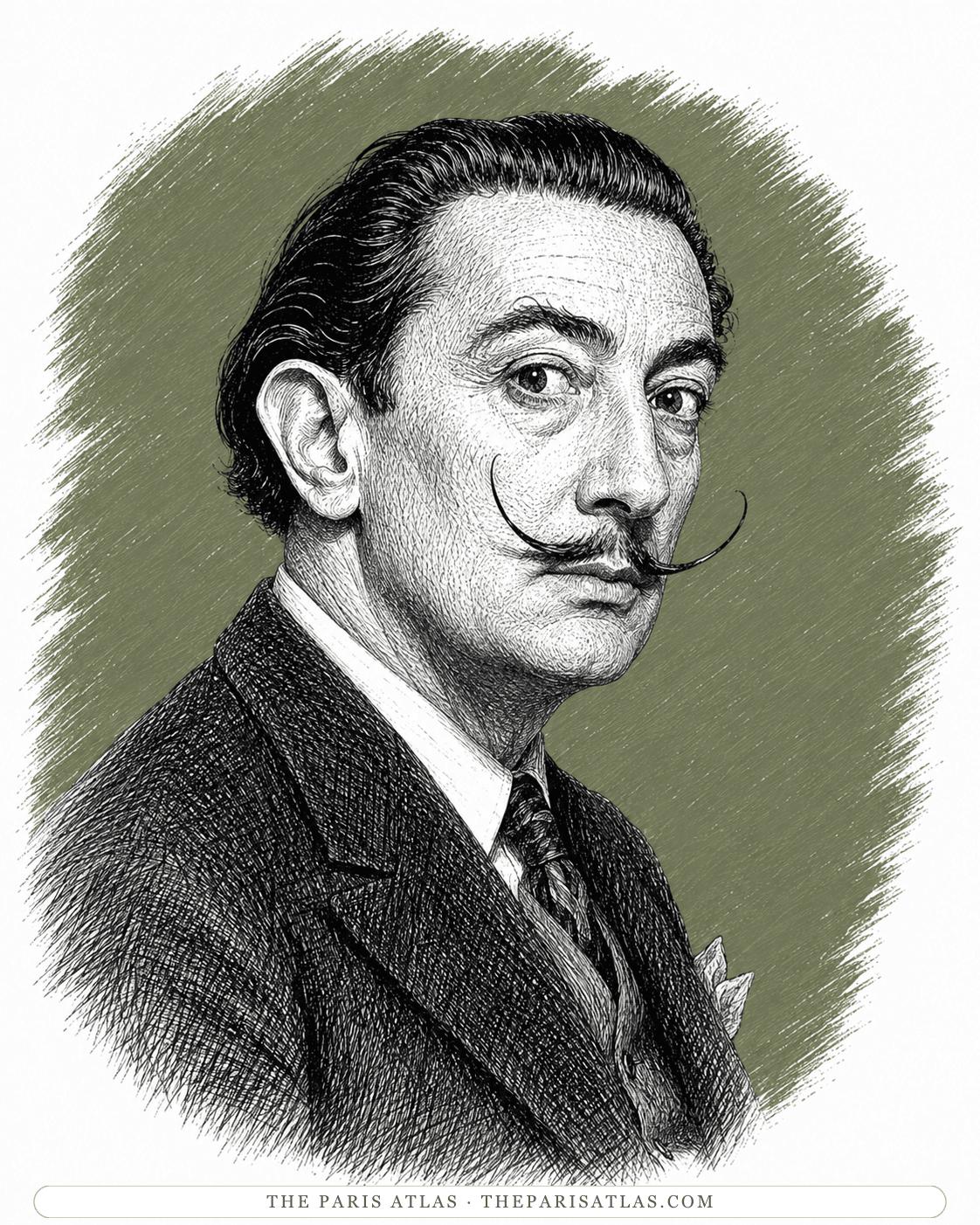
Illustrated portrait of Salvador Dalí

Salvador Dalí

  • Painter
  • Filmmaker
  • Sculptor

Met · 1938

Once, on 19 July 1938, at Freud's house in London, arranged by Stefan Zweig and Edward James after years of failed attempts. Dalí brought Metamorphosis of Narcissus and drew Freud while the others talked. Freud wrote to Zweig the next day that the visit had changed his opinion of the Surrealists.

— Freud Museum London — Freud, Dalí and the Metamorphosis of Narcissus

Who Sigmund Freud Inspired

People who found inspiration in Sigmund Freud’s work.

Illustrated portrait of Salvador Dalí

Salvador Dalí

Dalí read The Interpretation of Dreams as a student in Madrid and built the paranoiac-critical method on psychoanalytic ground. The influence runs one way: Freud had not heard of him before 1938 and thought the Surrealists cranks.

— Ian Gibson, The Shameful Life of Salvador Dalí (1997); Freud Museum London — Freud, Dalí and the Metamorphosis of Narcissus

Books by Sigmund Freud

Cover of Beyond the Pleasure Principle by Sigmund Freud

Essays & criticism

The 1920 essay in which Freud watched his grandson throw a wooden reel out of his cot and concluded that something in us wants to repeat, and something wants to die.

4.3
Cover of The Ego and the Id by Sigmund Freud

Essays & criticism

The 1923 book that redrew the mind as three parts, the I, the It and the Over-I, and gave English its ego, id and super-ego.

4.1

Questions about Sigmund Freud

What is Sigmund Freud known for?

For founding psychoanalysis: a theory of unconscious mental life, a method of interpreting symptoms and dreams, and a clinical practice built around free association and close listening.

Why did Freud study in Paris?

A medical travel grant took him to the Salpêtrière hospital in 1885–86 to study with neurologist Jean-Martin Charcot. Charcot's work on hysteria and hypnosis convinced Freud that physical symptoms could have psychological causes.

What did Freud say about dreams?

He argued that dreams transform unconscious wishes and conflicts into the images and stories we remember. He called dream interpretation the royal road to knowledge of unconscious mental activity.

Did Sigmund Freud meet Salvador Dalí?

Yes, once, at Freud's London home on 19 July 1938. Stefan Zweig arranged the meeting; Dalí brought Metamorphosis of Narcissus, sketched Freud and tried to explain his paranoiac-critical method.

Where did Sigmund Freud live in Paris?

Freud came to Paris for six months in 1885–86 to work at the Salpêtrière. Paris was a decisive training period, not his permanent home; he lived chiefly in Vienna and spent his final year in London.

Connections and Sources

Sigmund Freud’s connections to people, places, and works, with the sources behind each one.

Influenced

Salvador Dalí

Dalí read The Interpretation of Dreams as a student in Madrid and built the paranoiac-critical method on psychoanalytic ground. The influence runs one way: Freud had not heard of him before 1938 and thought the Surrealists cranks.

— Ian Gibson, The Shameful Life of Salvador Dalí (1997); Freud Museum London — Freud, Dalí and the Metamorphosis of Narcissus

Met · 1938

Salvador Dalí

Once, on 19 July 1938, at Freud's house in London, arranged by Stefan Zweig and Edward James after years of failed attempts. Dalí brought Metamorphosis of Narcissus and drew Freud while the others talked. Freud wrote to Zweig the next day that the visit had changed his opinion of the Surrealists.

— Freud Museum London — Freud, Dalí and the Metamorphosis of Narcissus

References

References

The sources below include biographies, scholarly essays, interviews, and primary materials that informed this page. They reflect both the historical record and ongoing critical conversations about Sigmund Freud and their work.

  1. 1abWhen Dalí met Freud

    Website
    Freud Museum London
    Used for

    The museum's account of the 19 July 1938 meeting with Dalí, Zweig and Edward James.

    View source
  2. 2abcFrom Medicine to Psychoanalysis

    Website
    Freud Museum London
    Used for

    The 1885–86 Salpêtrière grant, Charcot's demonstrations and the turn from brain anatomy to psychogenic illness.

    View source
  1. 3abcdWho was Sigmund Freud?

    Biography
    Freud Museum London
    Used for

    Museum biography, major works, dates, exile and a concise account of psychoanalysis.

    View source
  2. 4Sigmund Freud Papers

    Archive
    Library of Congress
    Used for

    Primary manuscripts, correspondence, family papers and records documenting Freud's life and the development of psychoanalysis.

    View source
i
Why these sources are here

These references anchor the page in the documented record and in the scholarly conversations around Sigmund Freud. Every claim on this page traces back to one or more of the works listed here.

Explore more resources
Browse all authors