
The Ego and the Id
Sigmund Freud
The Ego and the Id
The super-ego that the seventh chapter turns into the engine of guilt was defined there in 1923.
Read our takeCivilization and Its Discontents
Sigmund Freud
Freud's late argument that living together costs each of us the satisfactions we most want, and that the price is paid in guilt.
Sigmund Freud wrote this book in the summer of 1929, at seventy-three, and his press published it with 1930 on the title page.[1] The argument is bleak and short. People want happiness, and suffering comes at them from three directions: the body, the outside world and other people. Civilisation, the whole apparatus of law, work, cleanliness and family, protects against the first two by demanding that each person give up much of what they want, above all their aggression. The aggression does not go away. Turned inward, it becomes the super-ego's severity, which a person feels as guilt. Freud's conclusion is that the sense of guilt is the most important problem in the development of civilisation, and that the unease of the title is the fee.[2]
The book opens with a letter. Freud had sent The Future of an Illusion, his 1927 book on religion, to the French writer Romain Rolland. Rolland replied on 5 December 1927 that Freud had missed the real source of religious feeling. He described a sensation of eternity, of something limitless and unbounded, and called it oceanic. Freud says plainly that he cannot find this feeling in himself, and spends the first chapter tracing it to the infant's early state before it learned where its body ended and the world began.[2][3]
The second and third chapters ask what people want and what civilisation gives them. Freud's answer to the first is happiness, and he lists the ways people pursue it and dull its absence: work, intoxicants, art, love, withdrawal, religion. His answer to the second is protection bought with renunciation. The fourth chapter argues that love and civilisation pull against each other, since a couple wants to be left alone and a society needs its members' attention. The fifth turns to aggression, with the Latin tag that man is a wolf to man, and reads the commandment to love one's neighbour as the clearest sign of how much civilisation has to ask.[2]
The sixth chapter restates the death instinct from Beyond the Pleasure Principle, now as the source of aggression. The seventh is the book's real destination. Aggression that cannot be spent on others is taken over by the super-ego and turned back on the ego, and the tension between the two is felt as guilt. The more a person renounces, the harsher the super-ego grows, so that the good are punished more than the wicked. The eighth chapter sums up and ends with Eros and death facing each other, and a sentence about humanity's new power to exterminate itself.[2]
Freud's first title was Das Unglück in der Kultur, unhappiness in civilisation; he changed the noun to Unbehagen, a word for unease or discomfort, before publication.[1] Joan Riviere's English translation appeared in 1930 from the Hogarth Press in London and Jonathan Cape and Harrison Smith in New York; James Strachey's followed in 1961 and David McLintock's in 2002. A second German edition in 1931 added one last sentence asking who could foresee the outcome, written as the Nazi vote was rising.[4]
Freud opens by reporting a disagreement with a friend he admires, unnamed in the text but known to be Romain Rolland. The friend accepts Freud's verdict on religion but says its true source is a feeling of eternity, of something without limit or boundary, as if oceanic, which millions share and which needs no doctrine. Freud replies that he cannot discover the feeling in himself, and that feelings are hard to study scientifically. So he does what he always does and asks what idea the feeling attaches to. The idea is oneness with the world, and he sets out to explain where such an idea could come from.
His explanation is developmental. A newborn, he argues, does not yet know where its own body stops; the breast that feeds it is at first part of itself. The boundary between self and world is learned, painfully, as the world refuses to obey. The oceanic feeling would then be a survival of that first state, before the boundary. To show that an early state can survive beside a later one, Freud reaches for Rome. Imagine, he says, a city in which nothing built has ever been demolished, so that the palace of the emperors stands in the same space as the church built over it, and all the ages are visible at once. That is what he thinks the mind is like, and it is the image readers remember from the chapter.
The second chapter begins by asking what people show by their behaviour that they want from life, and answers: to be happy, which means both the absence of pain and the presence of strong pleasure. Freud thinks the second is unreachable for long, since strong pleasure comes only from contrast and fades into mild contentment. Being unhappy is far easier. Suffering, he writes, threatens from three sides. The first is our own body, built to decay and unable to do without pain as a warning. The second is the outside world, which can turn on us with overwhelming force. The third is our relations with other people.
The third source, Freud says, is the one people find hardest to bear, because it feels avoidable in a way the body and the weather do not. The rest of the chapter is a catalogue of what people do about it. They deaden the senses with intoxicants, which Freud calls the crudest but most effective method. They withdraw into work, or into art, or into the study of nature. They love, which he thinks the most natural technique and the one that leaves a person most exposed, since nobody is so helpless as someone who has lost what they love. And they take up religion, which he treats as a mass delusion that spares its adherents the trouble of finding their own way to be unhappy. The chapter's tone is even, and the verdicts are severe.
The fifth chapter is where the argument turns. Freud has been asking why civilisation makes people unhappy, and his answer so far has been sexual: a society needs its members to give up most of what they want and to spread thin what remains as friendship. Here he adds a second demand. People, he writes, are not gentle creatures who only defend themselves when attacked. A neighbour is not only a possible helper or a possible lover but a temptation. Freud's list is blunt: someone on whom to spend aggression, whose work can be used without payment, whose goods can be taken, who can be humiliated, hurt, tortured and killed. Man is a wolf to man, he writes, and asks who has the courage to dispute it after what history and one's own life have shown.
Two consequences follow. The first is that the commandment to love one's neighbour as oneself, which Freud calls the strongest defence civilisation has raised against aggression, is also the clearest evidence of how unnatural the demand is. He treats the commandment with a mixture of respect and bafflement: why should he love a stranger who has done nothing to earn it? The second is his short argument against communism. He does not object to abolishing private property; he objects to the idea that doing so would abolish aggression, which existed, he says, before there was any property to fight over. The pages were written in 1929 and read differently after 1933, which Freud acknowledged in the sentence he added to the 1931 edition.
The seventh chapter carries the whole weight. If aggression is native and civilisation cannot allow it, where does it go? Freud's answer is that it is taken back into the person who would have spent it, and handed to the super-ego, the judging part of the mind he had described in The Ego and the Id. The super-ego then turns the aggression against the ego, and what the ego feels under that pressure is guilt. A conscience, on this account, is aggression that has changed direction. The harsher the renunciation, the more aggression there is to turn inward, and the more severe the conscience becomes.
Freud draws out the result that most readers find hardest. The person who gives up most, who behaves best, suffers the harshest conscience, because the aggression not spent on others has nowhere else to go. The saint is more guilty than the sinner. Guilt need not be felt as guilt at all; it can appear as a vague unease, the Unbehagen of the title, or as a need for punishment. Freud then names the sense of guilt as the most important problem in the development of civilisation, and says that the price of progress is a loss of happiness through the heightening of guilt. The last chapter ends with the two forces, Eros and death, facing each other, and the observation that people now have the means to exterminate one another to the last man.
Suffering threatens from three sides: from our own body, which, destined for decay and dissolution, cannot even do without pain and anxiety as warning signals; from the outside world, which can rage against us with overwhelming, merciless, destructive forces; and finally from our relations with other people.Von drei Seiten droht das Leiden, vom eigenen Körper her, der zu Verfall und Auflösung bestimmt sogar Schmerz und Angst als Warnungssignale nicht entbehren kann, von der Außenwelt, die mit übermächtigen, unerbittlichen, zerstörenden Kräften gegen uns wüten kann, und endlich aus den Beziehungen zu anderen Menschen.
I myself cannot discover this 'oceanic' feeling in myself.Ich selbst kann dies „ozeanische“ Gefühl nicht in mir entdecken.
And now it is to be expected that the other of the two 'heavenly powers', eternal Eros, will make an effort to hold his own in the struggle with his equally immortal adversary.Und nun ist zu erwarten, daß die andere der beiden „himmlischen Mächte“, der ewige Eros, eine Anstrengung machen wird, um sich im Kampf mit seinem ebenso unsterblichen Gegner zu behaupten.
Eight chapters, no case histories, and the three-part mind and the death instinct both explained on the way to a conclusion about how people live together.
The argument that a society runs on the guilt it makes its members feel sits beside Hobbes and Rousseau and is answered by Herbert Marcuse and others. The pages on communism are two paragraphs and much quoted.
Unbehagen is unease, the low-grade discomfort of a life that is going well enough. Freud's claim is that the feeling has a cause and that the cause is the price of civilisation.
Finished in the summer of 1929 by a man of seventy-three in Vienna. The last page, on humanity's new power to exterminate itself, was written before the Nazi vote and read after it.
1927
Romain Rolland writes to Freud on 5 December, after reading The Future of an Illusion, describing the oceanic feeling he thinks Freud has missed.
1929
Freud writes the book over the summer, at seventy-three. His working title is Das Unglück in der Kultur, unhappiness in civilisation.
1930
The Internationaler Psychoanalytischer Verlag publishes Das Unbehagen in der Kultur, dated 1930. Joan Riviere's English translation appears the same year in London and New York.
1931
A second German edition adds one final sentence asking who can foresee the outcome of the struggle between Eros and death.
1961
James Strachey's translation appears in volume 21 of the Standard Edition and becomes the text most English readers know.
2002
David McLintock's new translation is published in Penguin Modern Classics.
2026
The 1930 German text and Riviere's translation enter the public domain in the United States on 1 January, ninety-five years after publication.


The Ego and the Id
Sigmund Freud
The super-ego that the seventh chapter turns into the engine of guilt was defined there in 1923.
Read our takeBeyond the Pleasure Principle
Sigmund Freud
The death instinct restated in the sixth chapter, and the source of the aggression the whole book is about.
Read our takeThe Interpretation of Dreams
Sigmund Freud
Freud's first book, whose method of reading a disguised wish is here applied to a whole society.
Read our takeThree Essays on the Theory of Sexuality
Sigmund Freud
The desires that the fourth chapter says civilisation has to restrict.
Read our takeSigmund Freud's 1930 argument that civilisation protects people from the body and the world by demanding they give up much of what they want, above all aggression, and that the aggression they give up is turned inward as guilt. The unease of the title is the cost.
A phrase from a letter Romain Rolland wrote to Freud in December 1927: a sense of eternity and of being one with the world, which Rolland thought was the real source of religion. Freud says he cannot find it in himself and traces it to an infant's state before it learns where its body ends.
The German is Das Unbehagen in der Kultur. Unbehagen means unease or discomfort rather than discontent, and Kultur covers what English calls both culture and civilisation. Freud's working title had been Das Unglück in der Kultur, unhappiness in civilisation.
Our own body, which decays and hurts; the outside world, which can destroy us; and our relations with other people, which Freud says we find the hardest to bear because they seem avoidable.
James Strachey's, in the Norton edition, is the standard one. David McLintock's Penguin Modern Classics version is newer and plainer. Joan Riviere's 1930 translation is free online in the United States and is printed with documents in the Broadview edition.
The German original is public domain in the European Union, and both it and Joan Riviere's 1930 translation entered the public domain in the United States on 1 January 2026. Riviere's translation remains in copyright in Britain and the European Union until 2032, and James Strachey's and David McLintock's translations are in copyright everywhere.
The 1930 first edition ends with Eros facing its immortal adversary. For the 1931 edition Freud added a sentence asking who could foresee the outcome, as the Nazi vote in Germany was rising. Most modern editions print the 1931 ending.
Explore authors with a similar voice, perspective, and influence.
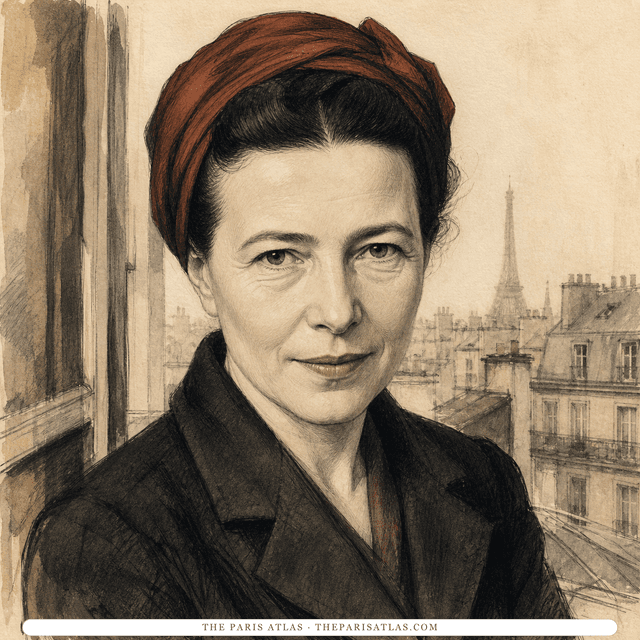
French writer and philosopher whose novels, memoirs, and social analysis examined freedom, gender, responsibility, aging, and the material conditions that shape a life.
View author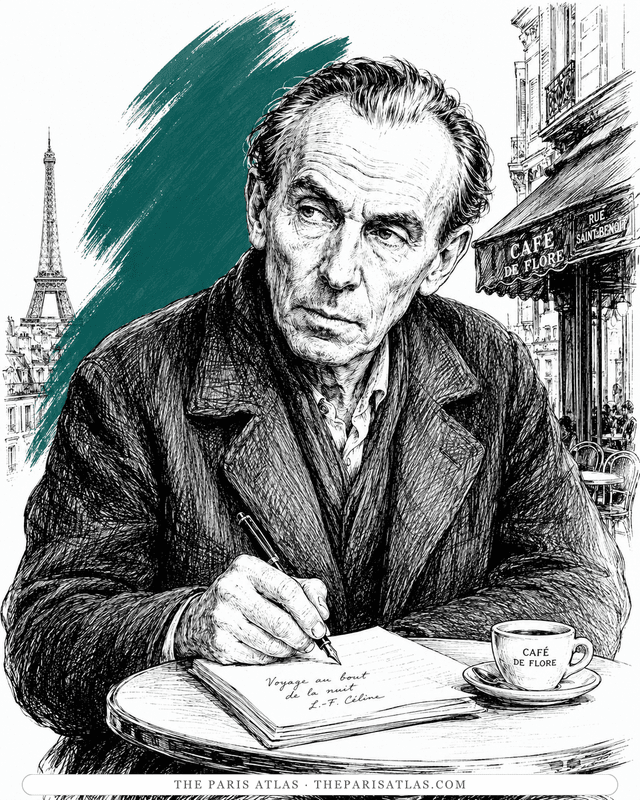
The doctor of the Paris slums who wrote the century's blackest, funniest novel — and changed the sound of French prose.
View author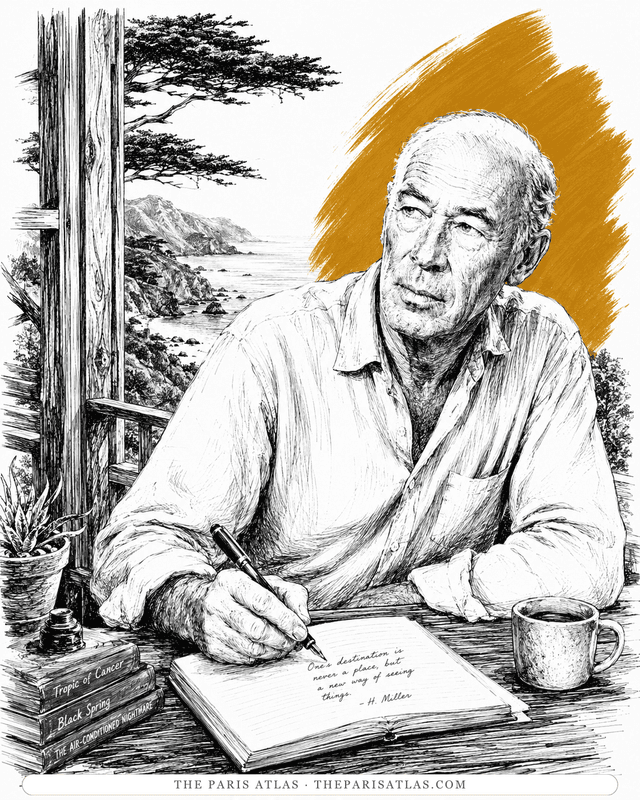
The Brooklyn dropout who arrived in Paris broke at thirty-eight and wrote the exuberant, banned books that ended American censorship.
View authorThe sources below include the primary text, editions, scholarship, archival materials, and other records that informed this page. They document Civilization and Its Discontents, its publication, and its place in literary history.


Joan Riviere's 1930 translation on Project Gutenberg, used to check the renderings above and as the record of the first English text.

Norton's catalogue page for the Strachey edition, the source for that ISBN and for Strachey's note on the sentence added in 1931.
Ernest Jones's biography, the other standard account of the book's writing and reception.
Open Library edition records, used to verify the Norton, Penguin and Broadview ISBNs listed above.
The primary text is the baseline reference for every book page. Additional references document publication history, interpretation, and historical context where that evidence is available.
 Explore more resources