
The Interpretation of Dreams
Sigmund Freud
The Interpretation of Dreams
The book that came first, and whose theory of wishes the essays give a childhood.
Read our takeThree Essays on the Theory of Sexuality
Sigmund Freud
The short 1905 book that argued children have a sexual life, and that Freud rewrote five times before he was done.
Sigmund Freud published these three essays with Franz Deuticke in Vienna in 1905, and they made him notorious. The first essay looks at adults whose desire points somewhere other than the usual place, and argues that desire is not one thing with one aim but a bundle of parts that can come apart. The second essay argues that children have a sexual life from infancy, centred on the mouth, the skin and the wish for closeness, and that adults forget it. The third describes what puberty does to the pieces. Freud revised the book in 1910, 1915, 1920, 1922 and 1925, so the version most people read is much longer than the one that caused the scandal.[1][2]
The first essay, on what Freud calls the sexual aberrations, starts from cases doctors of the 1890s had already catalogued. Men attracted to men, adults attracted to children, people whose desire fixes on a shoe or a glove, people who need to hurt or be hurt. Freud's move is to refuse to treat any of these as a separate species. He separates the person desired, which he calls the object, from the thing wanted, which he calls the aim, and shows that both can vary in people who are otherwise ordinary. Desire, on his account, is assembled from parts.[3]
The second essay is the one that shocked readers. Freud argues that the reason adults believe childhood is innocent is that they have forgotten their own, a forgetting he compares to the memory gaps of his hysterical patients. He then describes what he thinks a baby wants: the pleasure of sucking, first at the breast and then at the thumb, the pleasure of the skin, and later the pleasure of holding on and letting go. He calls a child polymorphous perverse, meaning that the parts of desire are all present but not yet organised. A quiet period follows, which he names latency, before puberty.[3]
The third essay describes puberty as the moment the parts are gathered under one aim and pointed at another person. The person chosen, Freud argues, is chosen on the model of the first: the mother who fed the child. His sentence is that the finding of an object is really a re-finding. The essay ends by weighing inborn constitution against childhood experience, and refuses to choose between them.[3]
Abraham Brill translated the book into English in 1910 under the title Three Contributions to the Sexual Theory, one of the first Freud books available in English. His second edition, from the third German text, is the public-domain version quoted here.[3] James Strachey's 1953 translation prints the final 1925 text and marks the additions by date. In 2017 Verso published Ulrike Kistner's translation of the 1905 first edition on its own, on the argument that the short original makes a different case from the enlarged one.[2]
The first essay's opening move is a definition. Freud borrows a word from physics and speaks of a sexual instinct the way one speaks of hunger, then immediately splits it. The person or thing the instinct is drawn to is the sexual object. The act the instinct pushes toward is the sexual aim. Popular opinion, he says, assumes one object, an adult of the other sex, and one aim, intercourse. The cases in the essay are arranged to show that each can vary on its own.
The section on inversion, Freud's term for attraction to one's own sex, takes the largest space. He rejects the idea that it is a sign of degeneracy, points out that it was ordinary in ancient Greece, and argues that the choice of a man or a woman is not fixed at birth. The sections on fetishes and on pleasure in hurting or being hurt make the same argument from the aim side. His conclusion is that the ordinary adult arrangement is an achievement, put together over years, and not a starting point. Later readers have taken this as the book's most durable idea and the one the enlarged editions partly buried.
Freud opens the second essay by asking why nobody had written about children's sexual life before, and answers that adults cannot remember their own. He calls this infantile amnesia and says it makes each person treat their early childhood as a prehistoric time. The comparison he draws is with his hysterical patients, who also could not recall what mattered most. The forgetting, in other words, is not an absence but a piece of work the mind has done.
The evidence that follows is drawn from watching children. A baby sucks at the breast to feed, then goes on sucking a thumb or a blanket when there is no food in it, and Freud reads the second act as pleasure sought for its own sake. He calls the mouth an erogenous zone and adds others. The claim readers found hardest to accept was not any single observation but the word sexual attached to all of them. Freud's defence, in the preface to the third edition, was that he meant sexuality in a wider sense than reproduction and that the observations were the ordinary stuff of a doctor's day.
Between early childhood and puberty Freud places a quiet stretch he calls the latency period. During it, on his account, the energy of the early wishes is turned toward other ends, and the feelings that will later hold desire in check, shame, disgust and morality, are built up. He is careful to say the quiet is partial and can be interrupted. The idea matters for the rest of the book because it explains why the adult arrangement looks natural: the years in which it was assembled have been forgotten.
The 1915 edition added a section on what Freud called the pregenital organisations, stages in which the mouth and then the bowel are the centre of a child's pleasure before the genitals take over. That is the material most people now associate with the book, the oral and anal stages, and it was not in the 1905 text. Freud kept adding: a section on the libido theory in 1915, a preface in 1920, further changes for the sixth edition of 1925. Ulrike Kistner's 2017 translation of the first edition was made to show what the argument looked like before those layers.
The third essay's argument turns on one sentence. Describing how an adolescent comes to love a particular person, Freud writes that the child's sucking at the mother's breast has become the model for every love, and that the finding of an object is really a re-finding. The person chosen later is chosen because something about them repeats the first closeness. He adds that the choice must avoid the loved person of infancy and is first made in imagination, in the daydreams of adolescence.
The essay closes by refusing an easy answer. Freud weighs what a person is born with against what happens to them in childhood and says that theory tends to overrate the first while treatment keeps showing the second. The two cooperate, he writes, and neither works without the other. The book that had opened by dismantling the idea of a natural sexuality ends by declining to say how much of anyone's desire is chosen. Critics from Karl Kraus onward have attacked the book's claims about women, and the second essay's remarks on prostitutes and on what Freud calls uncultured women are among the passages later editions did not soften.
It is not without good reason that the suckling of the child at its mother's breast has become a model for every amour. The object-finding is really a re-finding.
I believe that the infantile amnesia which causes the individual to look upon his childhood as if it were a prehistoric time and conceals from him the beginning of his own sexual life—that this amnesia is responsible for the fact that one does not usually attribute any value to the infantile period in the development of the sexual life.
Let me emphasize in the first place that whatever is here presented is derived entirely from every-day medical experience which is to be made more profound and scientifically important through the results of psychoanalytic investigation.
Freud placed it beside The Interpretation of Dreams as the book he kept current all his life. The childhood theory everything later assumes is set out here first.
The first essay's separation of whom one desires from what one wants remains the starting point for later writers on the subject, including those who reject the rest.
Strachey's edition dates every addition, and Kistner's prints the 1905 original, so a reader can watch the argument change over twenty years.
1905
Franz Deuticke publishes Drei Abhandlungen zur Sexualtheorie in Leipzig and Vienna. Reviews treat the second essay, on childhood, as a scandal.
1910
Second German edition. The same year Abraham Brill's English translation appears in New York as Three Contributions to the Sexual Theory.
1915
Third edition, with a new preface answering ten years of misreadings and new sections on the oral and anal stages and on the libido theory.
1920
Fourth edition, with a new preface. Brill's second English edition is reprinted in New York the same year.
1925
Sixth and last edition revised by Freud, the text James Strachey translates for the Standard Edition in 1953.
2017
Verso publishes Ulrike Kistner's translation of the 1905 first edition, the first time English readers can see the short original on its own.


The Interpretation of Dreams
Sigmund Freud
The book that came first, and whose theory of wishes the essays give a childhood.
Read our takeBeyond the Pleasure Principle
Sigmund Freud
Where Freud sets a second drive beside the one described here.
Read our takeThe Ego and the Id
Sigmund Freud
The 1923 book that turns the child's attachment to its parents into a permanent structure, the super-ego.
Read our takeCivilization and Its Discontents
Sigmund Freud
The late book on what a society demands that the desires described here be given up.
Read our takeThe first is on what Freud calls the sexual aberrations, adult desires that point somewhere other than the usual place. The second is on the sexual life of children. The third is on puberty, when the parts described in the first two are gathered and pointed at another person.
Freud's phrase for the state of a young child, in whom all the parts of desire are present but not yet organised under one aim. He uses it in the second essay to argue that the adult arrangement is built up over years rather than given at birth.
James Strachey's, in the Basic Books and Penguin Freud Library editions, is the standard one and prints the final 1925 text with every addition dated. Shaun Whiteside's Penguin Modern Classics version is newer. Abraham Brill's translation is free online and is quoted here.
Freud revised it in 1910, 1915, 1920, 1922 and 1925. The oral and anal stages were added in 1915. Verso's 2017 edition, translated by Ulrike Kistner, prints only the 1905 text, which is much shorter and makes less of the parents.
Yes. The claim that infants have a sexual life was widely treated as an outrage, and Freud's preface to the third edition answers a decade of hostile reception. The first essay's refusal to call same-sex desire a disease was also unusual for 1905.
Freud treated the two as his lasting books and kept both revised. The dream book shows adults' disguised wishes; the essays argue those wishes have a childhood and describe it.
Explore authors with a similar voice, perspective, and influence.
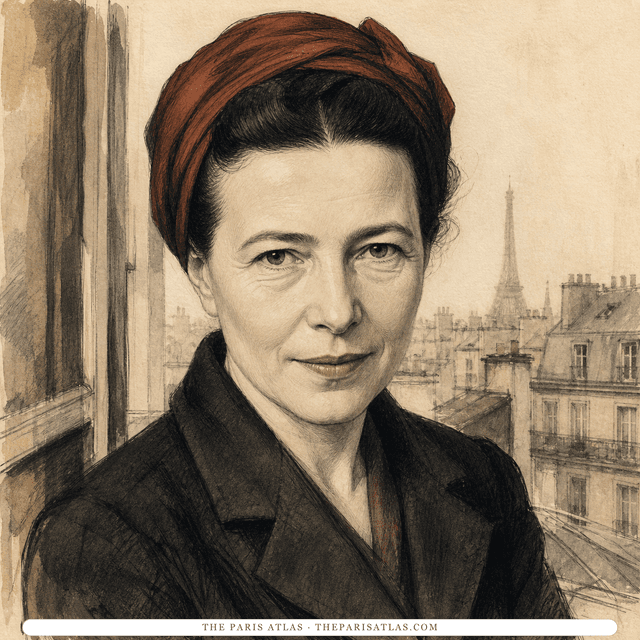
French writer and philosopher whose novels, memoirs, and social analysis examined freedom, gender, responsibility, aging, and the material conditions that shape a life.
View author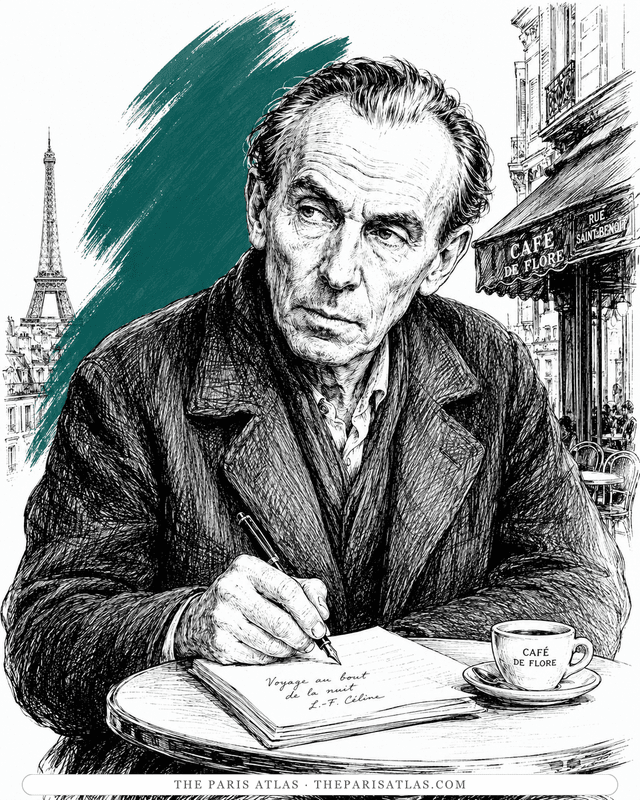
The doctor of the Paris slums who wrote the century's blackest, funniest novel — and changed the sound of French prose.
View author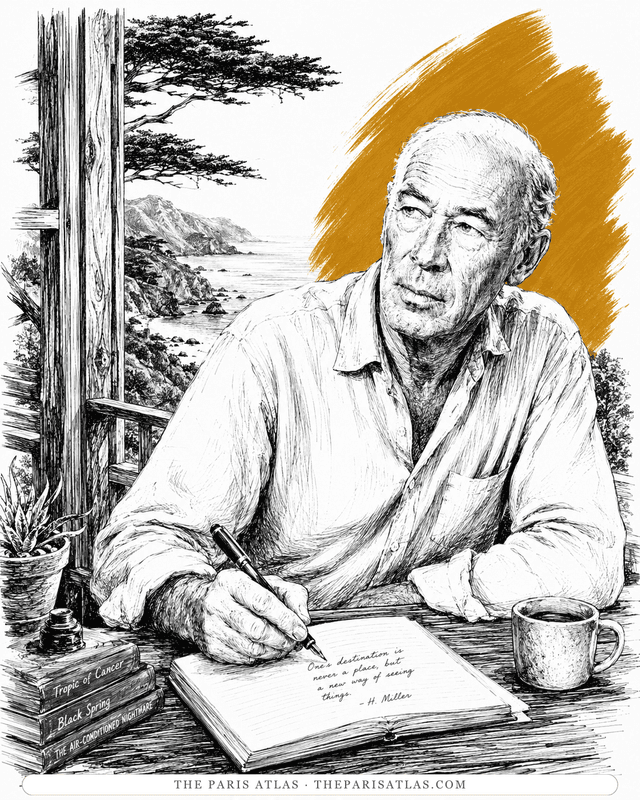
The Brooklyn dropout who arrived in Paris broke at thirty-eight and wrote the exuberant, banned books that ended American censorship.
View authorThe sources below include the primary text, editions, scholarship, archival materials, and other records that informed this page. They document Three Essays on the Theory of Sexuality, its publication, and its place in literary history.


Basic Books' catalogue page for the Strachey edition, the source for that ISBN and for the dating of additions in Strachey's edition.

The German fifth edition of 1922, used to confirm the wording and the record of translations printed in it.
Ernest Jones's biography, the other standard account of the book's composition and the scandal that followed.
Open Library edition records, used to verify the Penguin ISBNs listed above.
The primary text is the baseline reference for every book page. Additional references document publication history, interpretation, and historical context where that evidence is available.
 Explore more resources