
Three Essays on the Theory of Sexuality
Sigmund Freud
Three Essays on the Theory of Sexuality
The other book Freud kept revising all his life, and the one that put childhood behind the wishes the dream book uncovers.
Read our takeThe Interpretation of Dreams
Sigmund Freud
Freud's argument that every dream is a disguised wish, built on his own dreams and printed in 1899 with 1900 on the title page.
Sigmund Freud's first big book argues that a dream is not noise. A dream is a wish the sleeper cannot admit, disguised well enough to get past the part of the mind that stands guard. Freud calls that guard the censorship, and the disguising work the dream-work. The evidence is mostly his own dreams, taken apart one association at a time, beginning with a dream about a patient he calls Irma. Franz Deuticke printed the book in Vienna in November 1899 and put 1900 on the title page, so both dates are in circulation.[1] Freud kept revising it for thirty years, through eight editions.[2]
Freud sets the book out in seven chapters. The first surveys what doctors and philosophers had written about dreams before him. The second explains his method and works through one dream in full, the dream of Irma's injection. The third states the thesis: a dream is the fulfilment of a wish. The fourth answers the obvious objection, the unpleasant dream, by arguing that the wish is disguised. The fifth catalogues where dream material comes from. The sixth, the longest, describes the dream-work. The seventh sketches a model of the mind that could produce all of this.[3]
The dream-work is the part of the argument readers most often carry away. Freud names four operations. Condensation packs several thoughts into one dream image. Displacement moves the emotional weight from the thing that matters to something trivial. Regard for representability turns abstract thoughts into pictures. Secondary elaboration tidies the result into something like a story. Abraham Brill's 1913 English rendering used those terms, and James Strachey kept most of them in 1953.[3]
Paris sits inside the book at one point. In the chapter on dream sources Freud discusses a string of dreams about Rome, a city he longed for and kept failing to reach. He writes that Paris was for many years the object of his own longing, and that first setting foot on its pavement felt like a warrant that other wishes would also be fulfilled. He had spent the winter of 1885 to 1886 there, studying under Jean-Martin Charcot at the Salpêtrière hospital.[3][1]
Almost nobody bought it. Deuticke printed six hundred copies and needed eight years to sell them.[1] Reviews were thin. Freud's answer was to keep enlarging the book: a second edition in 1909, then 1911, 1914, 1919, 1921, 1922 and 1930. The 1914 edition added a whole section on symbols and two essays by Otto Rank, which Freud later dropped.[2] By the 1920s the book he had struggled to sell had become the founding text of a movement.
Freud opens the argument with a dream of his own. In the summer of 1895 he had treated a young woman he calls Irma, a family friend, and the treatment had ended with her only partly better. A colleague, Otto, visited her at her summer resort and reported that she was better but not altogether well. Freud heard a reproach in the remark. That evening he wrote up her case to justify himself to a senior colleague, Dr. M. The dream came the same night, 23 to 24 July 1895.
In the dream Freud receives guests in a great hall, takes Irma aside and blames her for not accepting his solution. He looks into her throat and finds white patches and grey scabs. Dr. M. examines her and says something absurd. Otto, it turns out, had given her an injection with a dirty syringe. Freud then walks through the dream phrase by phrase, asking what each element brings to mind. Every path leads to the same place: the dream shifts the blame for Irma's illness onto Otto and onto Irma herself. He concludes that the content of the dream is the fulfilment of a wish, and that its motive is a wish.
Five years later Freud wrote to his friend Wilhelm Fliess and joked that a marble tablet might one day mark the house where, on 24 July 1895, the secret of dreams was revealed to him. The house, the Bellevue outside Vienna, was demolished in 1963, and a plaque with that wording now stands on the site. Later readers have pointed out how much the dream leaves out, including the surgery Fliess himself had botched on the real patient. Freud's own reading is the one the book gives.
The wish theory has an obvious problem, and Freud raises it himself in chapter IV. Many dreams are unpleasant, and some are frightening. His answer is to split the dream in two. The dream as remembered, which he calls the manifest content, is a disguise. Underneath sits what the dream actually means, the latent dream-thoughts, and the wish lives there. Between the two stands a censor, a part of the mind that will not let certain wishes appear undisguised.
Freud's comparison is political. A writer under a strict government cannot say what he means, so he says it sideways, in allusions and jokes, and the censor lets the piece through because it looks harmless. A dream does the same. The unpleasant feeling in a bad dream, on Freud's account, belongs to the censoring side, which is distressed that a forbidden wish has come so close to the surface. Critics from the start have called the move unfalsifiable, since any dream that fails to look like a wish can be read as a wish in disguise. Freud's reply is that the disguise can be undone by association, and the book is his attempt to show that at length.
Chapter VI is where the book does its most detailed work. Freud asks how the dream-thoughts become the dream, and he answers with a set of operations. The first is condensation. Set the written-out dream beside the associations it produces, and the dream is short while the associations run to pages. One figure in a dream turns out to stand for three or four people at once. A made-up word turns out to be several real words fused together.
The second is displacement. The dream puts its emphasis somewhere the dream-thoughts did not, so that the trivial detail is vivid and the thing that matters is barely there. Freud treats this as the censor's main instrument. The third he calls regard for representability: the dream must show its thoughts as pictures, so an abstract idea is replaced by something that can be drawn. The fourth, secondary elaboration, smooths the pictures into a passable story after the fact. The 1914 edition added a long section on fixed symbols, houses and staircases and the like, which Freud had at first resisted and which later became the most quoted and most mocked part of the book.
The last chapter turns from dreams to the mind that makes them. Freud draws the mind as an apparatus with a direction of flow, from perception at one end to movement at the other, with memory systems in between. In sleep the path to movement is closed, so the excitation runs backwards toward perception and becomes a picture. That is his explanation for why a dream is seen rather than thought. He uses the same model to distinguish two ways of thinking: a primary process that follows wishes and ignores contradiction, and a secondary process that reasons.
The chapter contains the book's most quoted line. In Brill's 1913 rendering, the interpretation of dreams is the via regia to a knowledge of the unconscious in the psychic life; Strachey later made it the royal road. The phrase claims a lot. Freud is saying that dreams are not merely interesting but are the best available evidence for a part of the mind a person cannot see into directly. Whether the model in chapter VII describes anything real is exactly what later psychology has argued about. What the chapter shows is Freud's ambition: a book about dreams that ends as a theory of the whole mind.
At any rate the interpretation of dreams is the via regia to a knowledge of the unconscious in the psychic life.Die Traumdeutung aber ist die Via regia zur Kenntnis des Unbewußten im Seelenleben.
The content of the dream is thus the fulfilment of a wish; its motive is a wish.
Paris was for many years the object of my own longing, and I took the great satisfaction with which I first set foot on the pavement in Paris as a warrant that I should also attain the fulfilment of other wishes.Auch Paris war lange Jahre hindurch ein Ziel meiner Sehnsucht, und die Seligkeit, in welcher ich zuerst den Fuß auf das Pflaster von Paris setzte, nahm ich als Gewähr, daß ich auch die Erfüllung anderer Wünsche erreichen werde.
Freud called it his most important work, and the dream-work chapter is where his method of reading by association was first shown at length.
The argument is built from ordinary dreams, told plainly and taken apart step by step. A reader does not need to accept the theory to follow the reading.
André Breton and the painters who followed him took their working theory of the mind from this book. Reading it explains what they thought they were doing.
The Rome dreams in chapter V carry Freud's own account of what arriving in Paris in 1885 meant to him.
1885
Freud arrives in Paris to study under Jean-Martin Charcot at the Salpêtrière. He later writes in the dream book that the city had long been the object of his longing.
1895
The night of 23 to 24 July, at the Bellevue outside Vienna: the dream of Irma's injection, which will open the argument of the book.
1899
Franz Deuticke publishes Die Traumdeutung in Leipzig and Vienna in November, with 1900 on the title page. Six hundred copies are printed.
1900
Freud writes to Wilhelm Fliess on 12 June imagining a marble tablet on the Bellevue marking the night the secret of dreams was revealed to him.
1907
The first printing finally sells out, eight years after publication.
1909
Second edition. Freud will enlarge the book again in 1911, 1914, 1919, 1921, 1922 and 1930.
1913
Abraham Brill's English translation, made from the third German edition, is published by Macmillan in New York and George Allen in London.
1914
The fourth edition adds a section on symbolism and two essays by Otto Rank. Freud drops Rank's essays from his collected works in 1925.
1930
Eighth and last edition in Freud's lifetime, the text James Strachey translates for the Standard Edition in 1953.
1999
Joyce Crick's Oxford World's Classics translation returns English readers to the short first edition of 1899.


Three Essays on the Theory of Sexuality
Sigmund Freud
The other book Freud kept revising all his life, and the one that put childhood behind the wishes the dream book uncovers.
Read our takeBeyond the Pleasure Principle
Sigmund Freud
Twenty years on, Freud admits that some dreams are not wishes at all, and rebuilds the theory around repetition.
Read our takeThe Ego and the Id
Sigmund Freud
The model of the mind sketched in chapter VII, redrawn in 1923 as ego, id and super-ego.
Read our takeCivilization and Its Discontents
Sigmund Freud
The late Freud applying the same method of reading disguised wishes to whole societies.
Read our takeSigmund Freud argues that every dream is the disguised fulfilment of a wish. The book explains how the disguise works, which he calls the dream-work, and ends with a model of the mind that could produce it. The evidence is mainly his own dreams, analysed in detail.
Both dates are correct in different senses. Franz Deuticke issued the book in November 1899 but printed 1900 on the title page. Freud liked the new-century date and it stuck.
James Strachey's 1953 translation, in the Basic Books and Penguin editions, is the standard one and prints Freud's final 1930 text. Joyce Crick's Oxford World's Classics version translates the much shorter first edition. Abraham Brill's 1913 translation is free online and is the one quoted here.
The dream Freud had on the night of 23 to 24 July 1895, after a colleague hinted that a patient of his was not fully cured. Freud analyses it in chapter II to demonstrate his method, and concludes that the dream fulfils his wish not to be blamed.
Freud's name for the operations that turn hidden dream-thoughts into the dream a person remembers: condensation, displacement, turning thoughts into pictures, and a final tidying he calls secondary elaboration. Chapter VI describes each with examples.
Not at first. Six hundred copies were printed in 1899 and took eight years to sell. Freud revised and enlarged the book seven times, and by the 1920s it was the founding text of psychoanalysis.
The wish theory of dreams is widely rejected by sleep researchers, and Freud's model of the mind is contested. The book is read now for its method of interpretation and for its influence on twentieth-century literature and art, including Surrealism.
Explore authors with a similar voice, perspective, and influence.
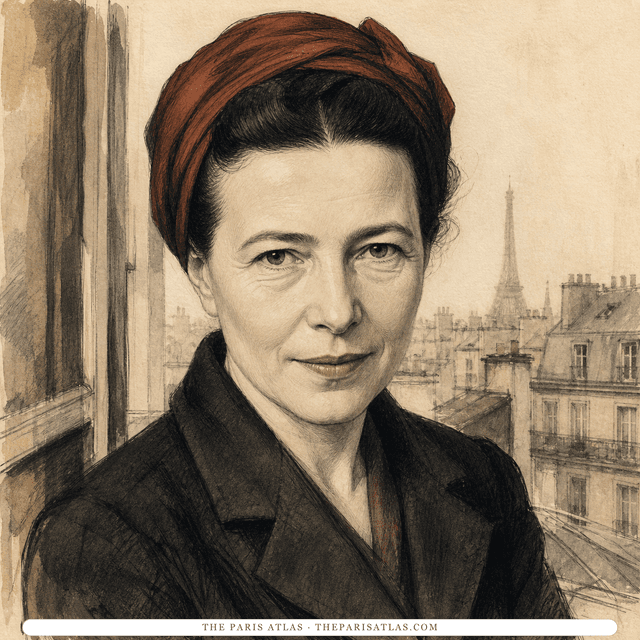
French writer and philosopher whose novels, memoirs, and social analysis examined freedom, gender, responsibility, aging, and the material conditions that shape a life.
View author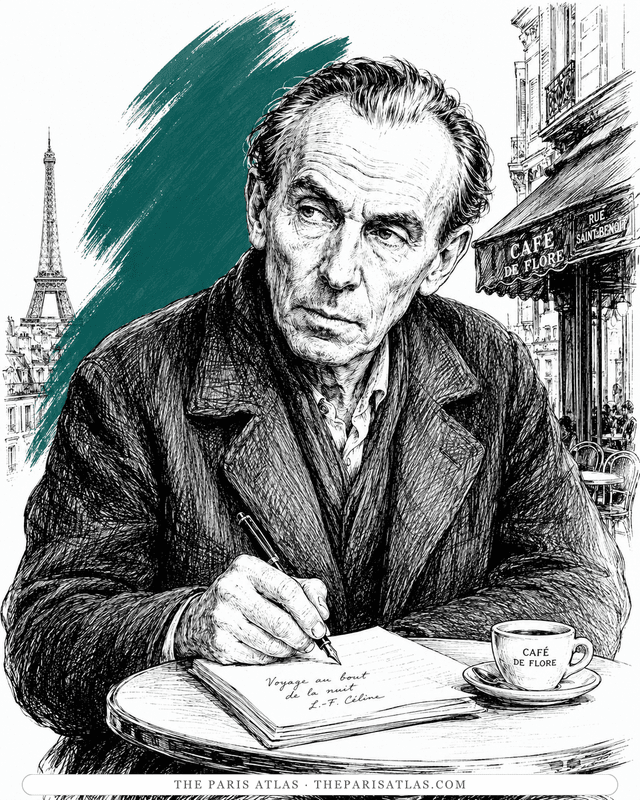
The doctor of the Paris slums who wrote the century's blackest, funniest novel — and changed the sound of French prose.
View author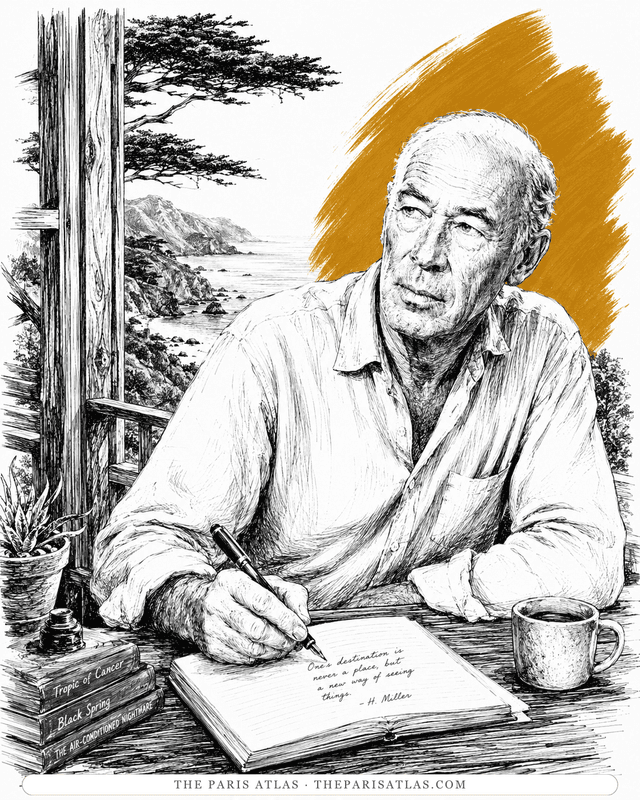
The Brooklyn dropout who arrived in Paris broke at thirty-eight and wrote the exuberant, banned books that ended American censorship.
View authorThe sources below include the primary text, editions, scholarship, archival materials, and other records that informed this page. They document The Interpretation of Dreams, its publication, and its place in literary history.


The German fourth edition of 1914, used for the original wording of the quoted lines.

Ernest Jones's three-volume biography, the other standard account of the book's composition and reception.
Freud Museum London's learning resource, for the marble-tablet letter and the plaque on the Bellevue site.
Open Library edition records, used to verify the ISBNs listed above.
The primary text is the baseline reference for every book page. Additional references document publication history, interpretation, and historical context where that evidence is available.
 Explore more resources