Associated with · 1929
Surrealism
The Paris Surrealists took up the film on its 1929 release, and it is routinely treated as the movement's central work of cinema. The edge attaches the film to the movement directly rather than only through Dalí.
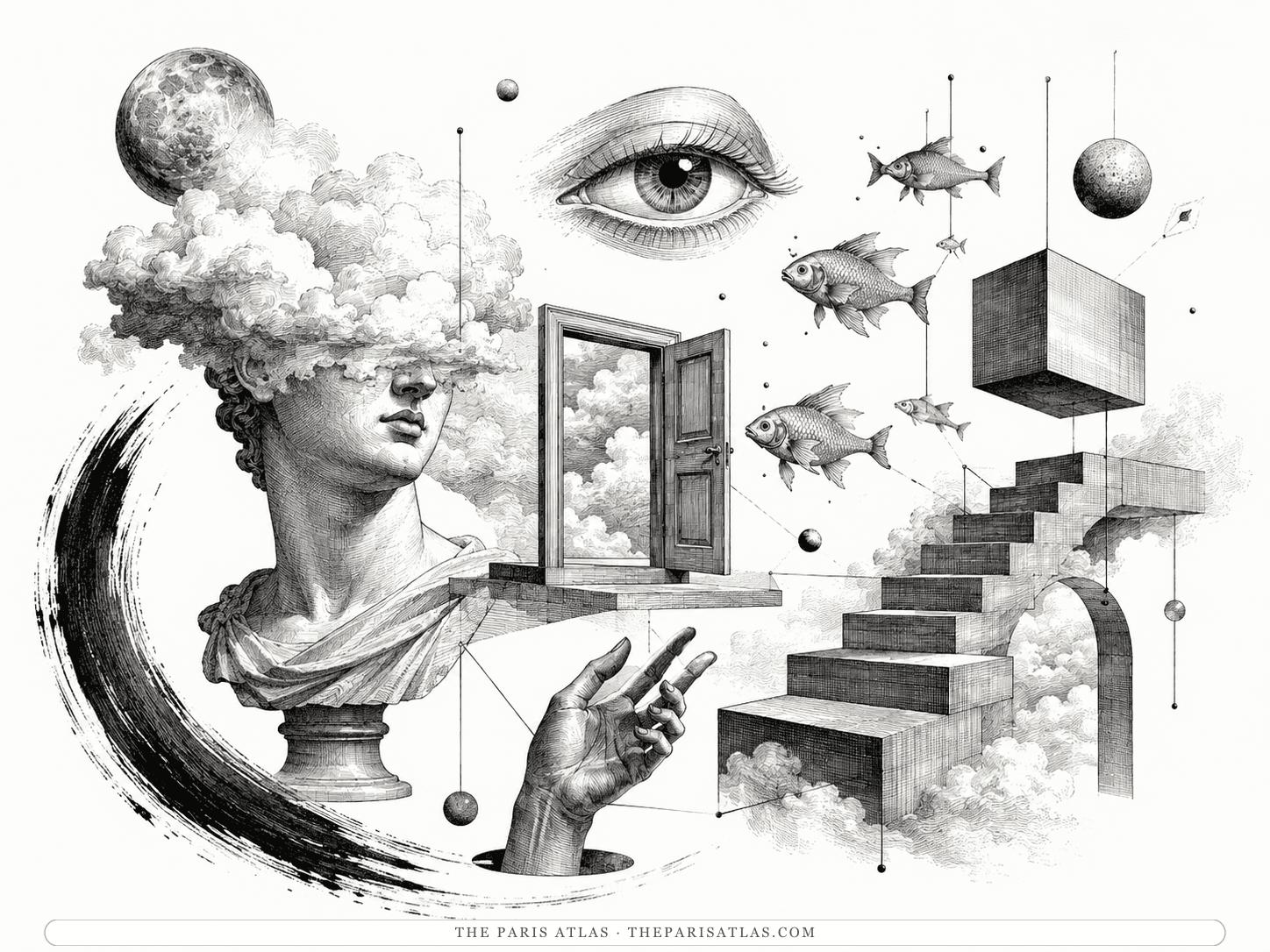
A cloud crosses the moon; a razor crosses an eye — and cinema acquires its most famous seventeen minutes. Written in six days by two young Spaniards trading dreams, on one rule: no image that could be explained. Ants pour from a hole in a palm, a man drags pianos loaded with dead donkeys and live priests, and a Paris premiere its director attended with stones in his pockets ends, to his disgust, in applause.
Viewing note: The film opens with a brief but graphic simulated image of an eye being cut, and includes images of dead animals and sexual aggression.
This film brought Dalí into the Paris Surrealist group two years before he painted The Persistence of Memory. Seeing them together connects the ants, bodily transformations, and dream logic of his cinema with the meticulous stillness of his most famous canvas.
The first intertitle is almost courteous: 'Il était une fois' — once upon a time. A man, played by Buñuel himself, strops a straight razor at a window, tests it on his thumbnail, and steps onto the balcony. A narrow cloud approaches the full moon. He holds open a woman's eyelid.
As the cloud crosses the moon, the razor crosses the eye.
The shock lasts seconds, but it declares the film's whole method. The cut joins two actions by resemblance — cloud and razor, moon and eye — and makes the splice between shots feel like a physical incision. Editing, cinema's basic operation, becomes the subject of its most notorious image.
And no, no one was harmed. The close-up used a dead calf's eye, lit and framed to pass for skin. Knowing that has never protected anyone watching.
'Eight years later,' a young man in a frilled maid's costume and striped box bicycles through Paris and falls in the street. The woman who takes him in lays his costume out on a bed like a body. He reappears; ants crawl from a hole in his palm. The hole becomes an armpit, a sea urchin, a severed hand in the street below, which an androgynous figure prods with a cane while a crowd presses in and the couple watch, rapt, from the window.
Desire advances and is burdened: reaching for the woman, the man strains against two ropes, hauling cork mats, two grand pianos stuffed with dead donkeys, and two live Marist brothers across the parlor floor. A stern double arrives and is shot with pistols that were schoolbooks a moment earlier. The woman walks out onto a beach, finds another man, and the pair stroll off past the wreckage of the costume washed up on the stones. 'Au printemps' — in spring — promises the last intertitle, over the couple buried to their chests in sand.
The summary can name the recurring people and objects. It cannot make them a plot. The transformations are the action.
Buñuel and Dalí had met as students at Madrid's Residencia de Estudiantes, in the circle that included Federico García Lorca. By 1929 Buñuel was working in Paris film studios and Dalí was painting his way toward the imagery that would make him famous. The origin story begins with two dreams — Buñuel's cloud slicing the moon like a razor through an eye, Dalí's hand crawling with ants — and at the Dalí family house in Figueres in January 1929, they wrote the scenario in about six days.
“Our only rule was very simple: no idea or image that might lend itself to a rational explanation of any kind would be accepted. We had to open all doors to the irrational and keep only those images that surprised us, without trying to explain why.”
The irrationality was, in other words, manufactured with great care — repeated shapes, migrating objects, false chronology — which is why the film plays as a machine rather than a doodle. Later the two gave competing accounts of who contributed what. The film belongs to the friction between them.
The title, taken from a collection of Buñuel's unpublished poems, promises a dog the film never delivers — its first broken promise. Lorca, an Andalusian, took it personally.
Buñuel financed the film with 25,000 pesetas from his mother and shot it in about two weeks in April 1929 — interiors at the Billancourt studios, the ending on the beach at Le Havre — with Albert Duverger at the camera. Simone Mareuil and Pierre Batcheff played the couple; Buñuel took the prologue for himself, and Dalí appears among the Marist brothers dragged across the floor.
Everything impossible in the film is stubbornly physical:
The camera stays calm throughout. The violence lives in what appears inside the frame, and in the collision between frames.[1]
The first screening, at the Studio des Ursulines on 6 June 1929, shared a program with Man Ray's Les Mystères du château du Dé. Buñuel stood behind the screen alternating Wagner's Tristan und Isolde with Argentine tangos on a gramophone, stones in his pockets in case the audience charged.[2]
It did not. The house — the assembled avant-garde, André Breton's surrealists among them — gave the film prolonged applause. Private screenings hosted by the patrons Charles de Noailles and his wife Marie-Laure followed, and a public run opened at Studio 28 that October and lasted roughly eight months. The 'riotous premiere' of legend belongs to a different film: the genuine mob, the ink and the ban, arrived the next year with L'Âge d'Or.[2]
Buñuel's own verdict on his film's warm reception, published with the scenario in La Révolution surréaliste that December, has no gratitude in it:[3]
“But what can I do against those who adore novelty, even when novelty offends their deepest convictions, against a corrupt or insincere press, against that pack of imbeciles who finds beautiful and poetic what, in reality, is nothing less than a desperate, passionate call to murder.”
He had aimed an insult at the avant-garde's taste, and the avant-garde had swallowed it as one more marvel. By the end of 1929 both men were formally inside Breton's group.
The film has no official key, by design — a chart in which the ants equal decay and the pianos equal culture would tame exactly what it was built to release. But refusing a code is not refusing interpretation, and certain pressures recur:[1]
It is dreamlike without being anyone's dream. No sleeper frames it; it simply borrows the dream's grammar — condensation, displacement, emotionally convincing impossibility — and builds it into the editing.[1]
That is the film's real invention. A cut can behave like a pun, a memory, an intrusive thought, or a wound.
It was not the first surrealist film — Germaine Dulac's The Seashell and the Clergyman, from Antonin Artaud's scenario, had reached the same Studio des Ursulines a year earlier — but it became the movement's canonical screen work, the one in which surrealist method and cinematic form fused completely. Its imagery runs straight out of Dalí's canvases of those months — the ants, the severed parts, the hard sunlit perspectives of paintings like The First Days of Spring — set in motion faster than a viewer can master them.[4]
For Buñuel it opened a lifelong method: puncture the respectable surface and watch what pours out. It runs from L'Âge d'Or through Los Olvidados, Belle de Jour, and The Discreet Charm of the Bourgeoisie — five decades of cinema by the man who introduced himself to Paris with an eye and a blade.[3]
The film's images detach easily — the eye, the ants, the donkeys on the pianos — and they have been detaching for nearly a century. David Bowie opened his 1976 concerts with the film. The Pixies compressed it into Debaser, alternative rock's most gleeful piece of film criticism. Its DNA is everywhere an object turns psychically dangerous between one shot and the next, from Maya Deren to David Lynch to the language of the music video.
On 1 January 2025 the film entered the public domain in the United States — which is why we can show it to you above. France, where it was made, protects it for decades yet.[5]
Influence has not made it safe. The film remains funny, ugly, erotic, juvenile, and hostile, sometimes within a single cut.
Close reading
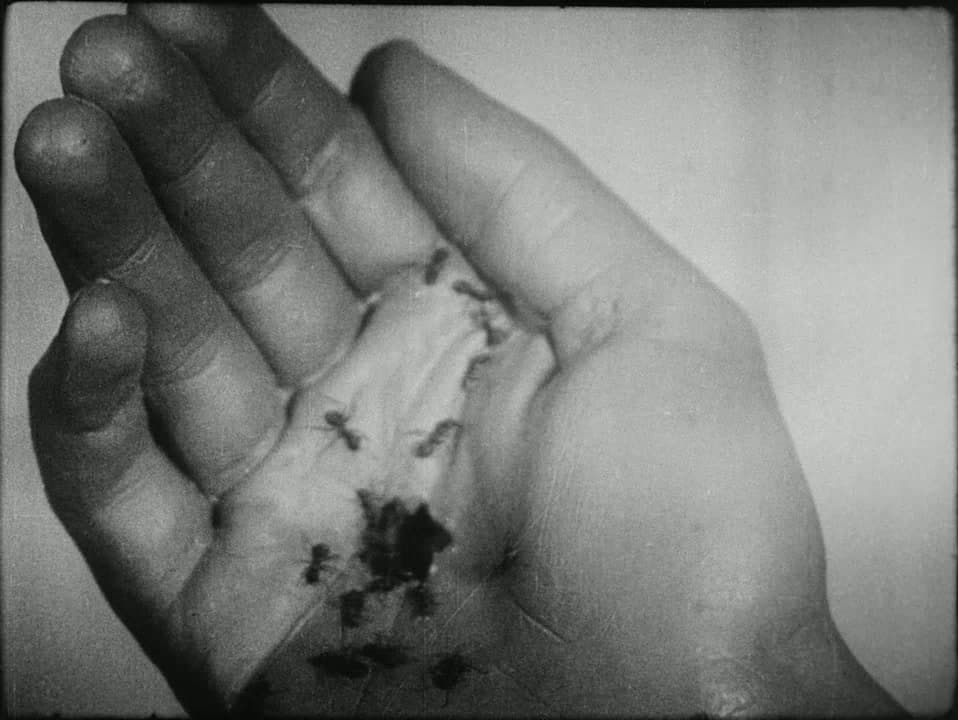
A film moves, but its most famous images were built to survive as stills. This close reading stays with the ant-filled hand—the page's verified frame—and shows how one compact image makes the familiar body suddenly unreadable.
1.The palm becomes an opening
The hole is placed where the palm should be most ordinary and intact. Its dark center refuses a stable reading: wound, burrow, and portal all arrive at once. The shock comes from precise placement, not from gore.
2.The ants turn a hand into a landscape
The insects scatter from the center in several directions, making the skin read like ground seen from above. Scale becomes unstable: a human hand is suddenly a terrain crossed by a swarm.
3.The recognizable hand frames the impossible one
Fingers, creases, and skin remain calmly photographic around the disturbance. That ordinary frame is essential. Buñuel and Dalí make the impossible persuasive by refusing to stylize the body that contains it.
Early 1920s
Buñuel and Dalí meet as students at Madrid's Residencia de Estudiantes, in the circle that includes Federico García Lorca.
January 1929
At Dalí's family house in Figueres, the two write the scenario in about six days, starting from the sliced-moon and ant-filled-hand dreams.
April 1929
A two-week shoot: interiors at the Billancourt studios, the ending on the beach at Le Havre, Albert Duverger at the camera — 25,000 pesetas from Buñuel's mother.
6 June 1929
First screening at the Studio des Ursulines, on a program with Man Ray's Les Mystères du château du Dé — prolonged applause, to the director's professed disappointment.
October 1929
The public engagement opens at Studio 28 in Montmartre and runs roughly eight months; Buñuel and Dalí enter Breton's surrealist group.
1930
L'Âge d'Or — the collaboration's second film — draws the riot, the ink, and the police ban that legend keeps attaching to the first.
1960
Buñuel supervises a recorded soundtrack recreating his gramophone program: Wagner's Liebestod alternating with Argentine tangos.
1976
David Bowie screens the film before concerts on the Isolar tour.
1989
Pixies release Debaser — 'slicing up eyeballs' enters the alternative-rock songbook.
2025
The film enters the public domain in the United States on 1 January; it remains protected in France until at least 2059.
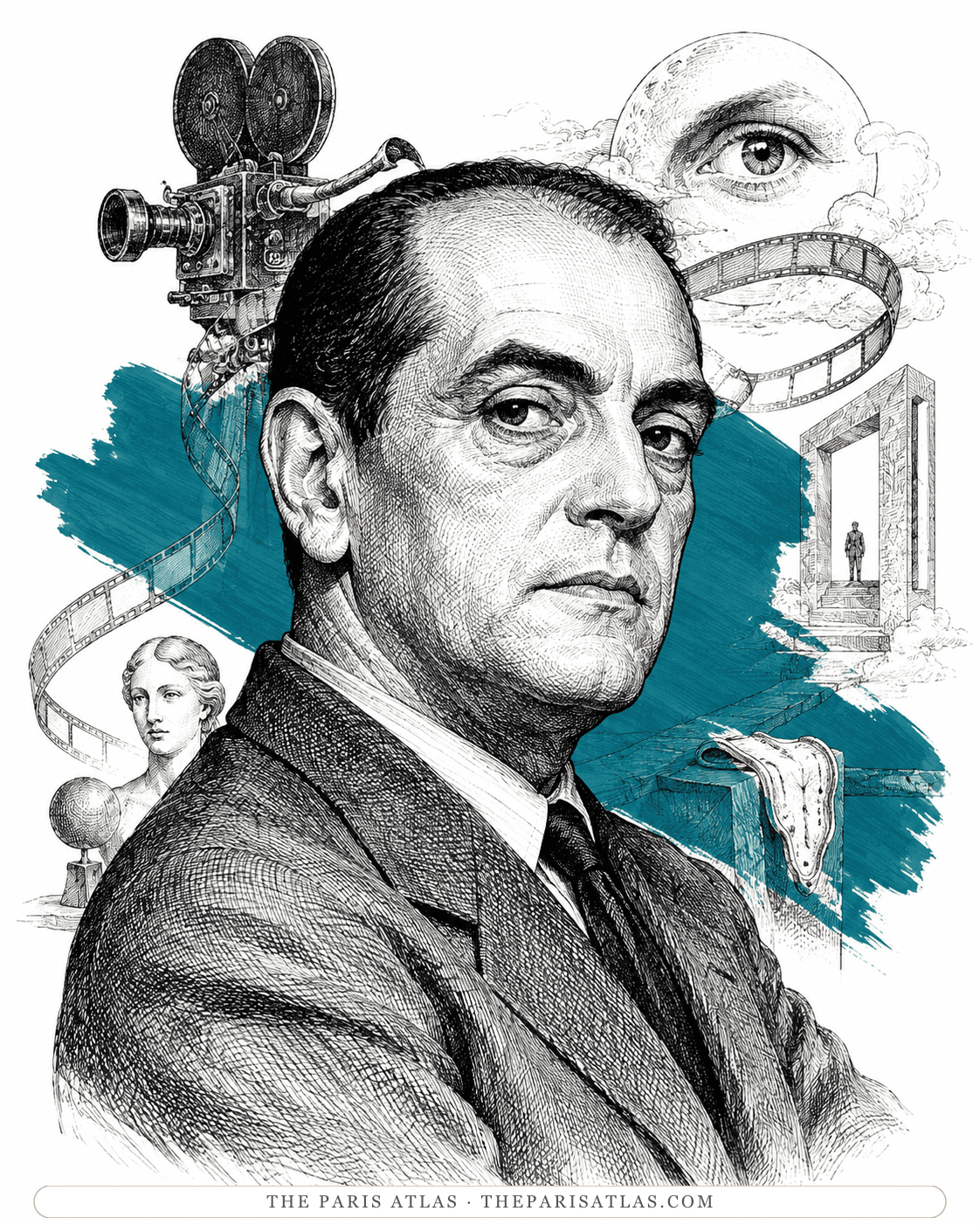
Luis Buñuel and Salvador Dalí, two young Spaniards, who wrote the scenario in about six days in early 1929 from their own dreams. Buñuel directed; the film was his debut.
The prologue, in which a razor appears to slice a woman's eye as a thin cloud crosses the moon. A dead animal's eye was used for the cut; it remains one of the most shocking images in cinema.
Deliberately not. Buñuel and Dalí worked to one rule — admit no image that could be rationally explained — producing a run of dream-logic scenes: ants pouring from a hand, a man dragging pianos loaded with dead donkeys and live priests.
It refuses a single meaning by design, as an attack on rational narrative. It became Surrealism's defining film and drew Buñuel and Dalí into André Breton's group.
By his own account Buñuel came to the 1929 Paris screening with stones in his pockets, expecting a riot. Instead the audience applauded — to his professed disappointment.
It entered the United States public domain on 1 January 2025. It remains under copyright in France until at least 2059.
Mark Kermode reviews Un Chien Andalou — BFI
Pixies — Debaser (1989)
Associated with · 1929
The Paris Surrealists took up the film on its 1929 release, and it is routinely treated as the movement's central work of cinema. The edge attaches the film to the movement directly rather than only through Dalí.

Discussed in
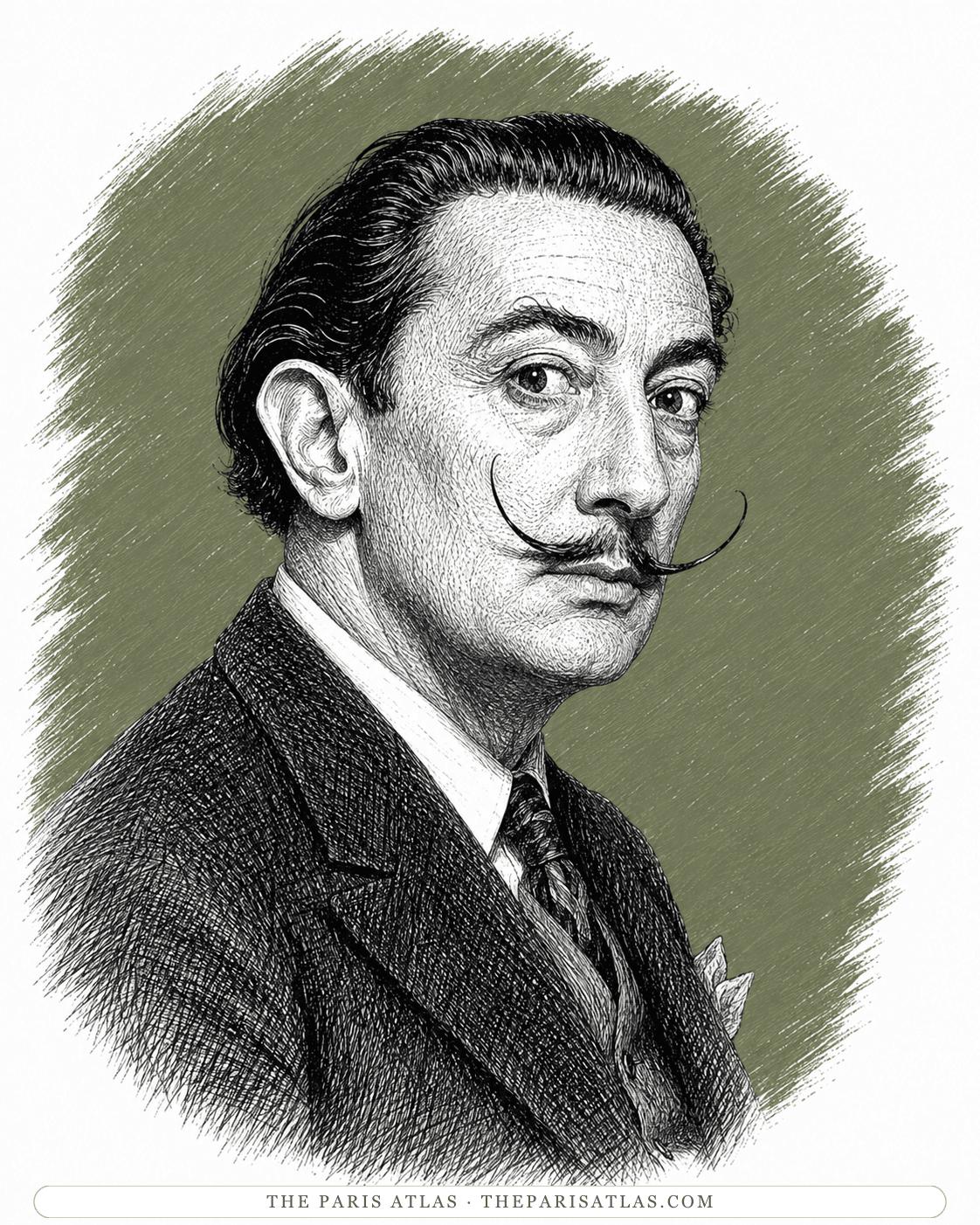
In his Dalí essay, Orwell examines an image from Un Chien Andalou while arguing that the painter's technical gifts cannot be separated from the cruelty of his imagery.
Explore directors from the same movements and circles.
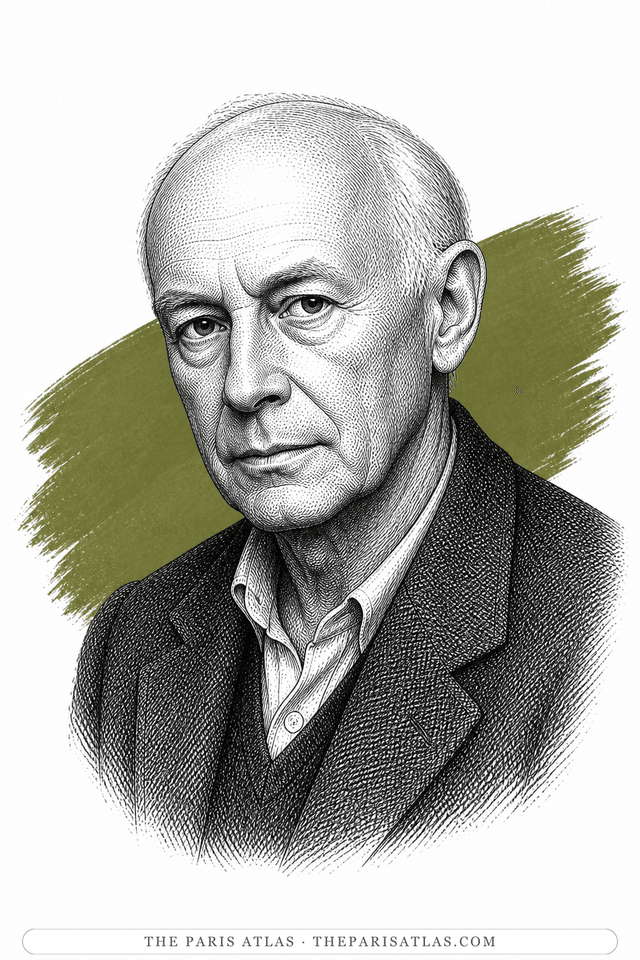
French photographer who turned a pocket-sized 35mm camera into an instrument of split-second composition — the idea the world knows as 'the decisive moment'. He trained as a painter, was taken prisoner in 1940 and escaped on his third try, photographed the Liberation of Paris in August 1944, co-founded the photographer-owned agency Magnum Photos in 1947, gave up reporting for drawing in the 1970s, and left Paris a foundation in the Marais that deliberately hangs no permanent display of his own pictures.
View artist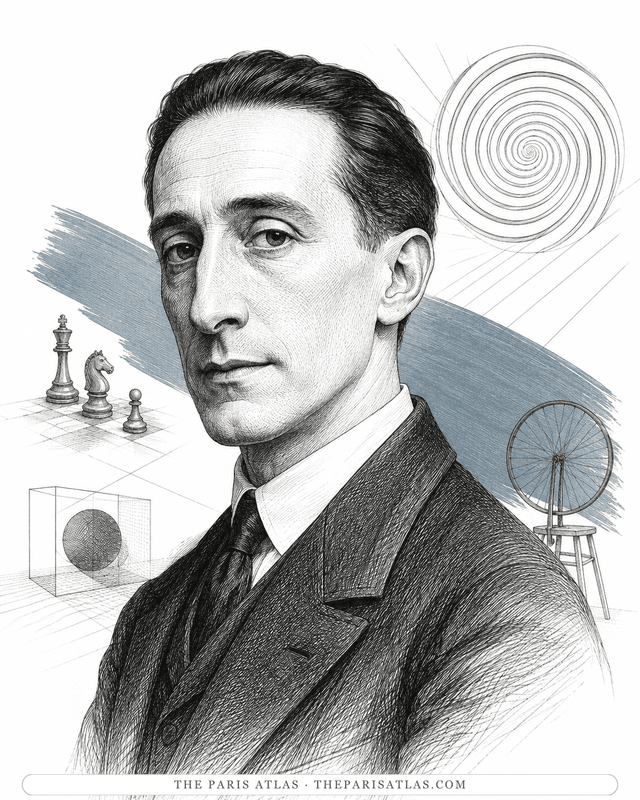
The century's quietest revolutionary — readymades, the abandonment of painting, chess on a Paris rooftop in Entr'acte, and one anemic film of spinning puns signed Rrose Sélavy.
View artist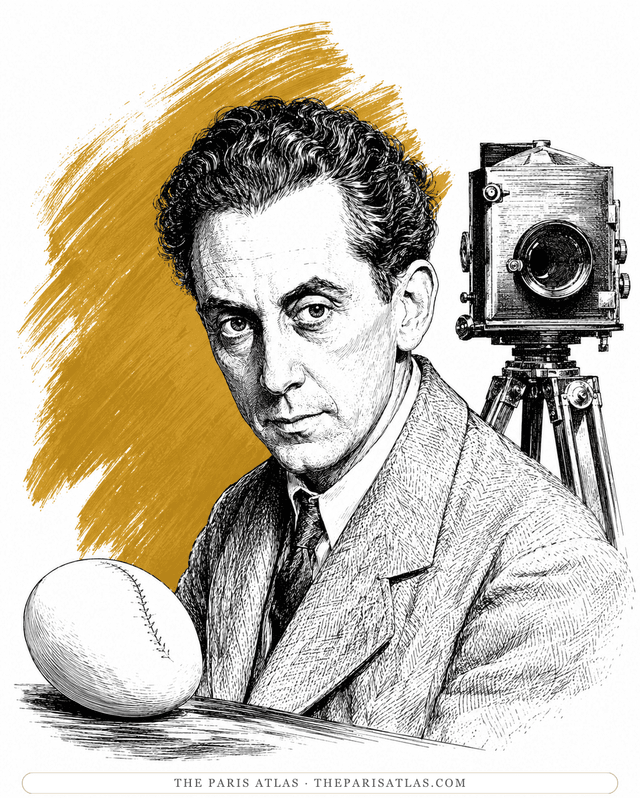
Montparnasse's American eye — portraitist of the whole expatriate quarter, inventor of the rayograph, and maker of films (Emak-Bakia, L'Étoile de mer) that treated the camera as another darkroom.
View artistThe sources below include collection records, catalogues, scholarly research, and primary materials that informed this page. They document Un Chien Andalou, its making, and its place in cultural history.


Web source consulted for documented facts and historical context presented on the Un Chien Andalou page.

Archival evidence used to document the historical record connected to Un Chien Andalou.
These references provide the documented foundation for this work's history and interpretation. Claim-level citations remain attached to the specific claims they support.
 Explore more resources