The Dream
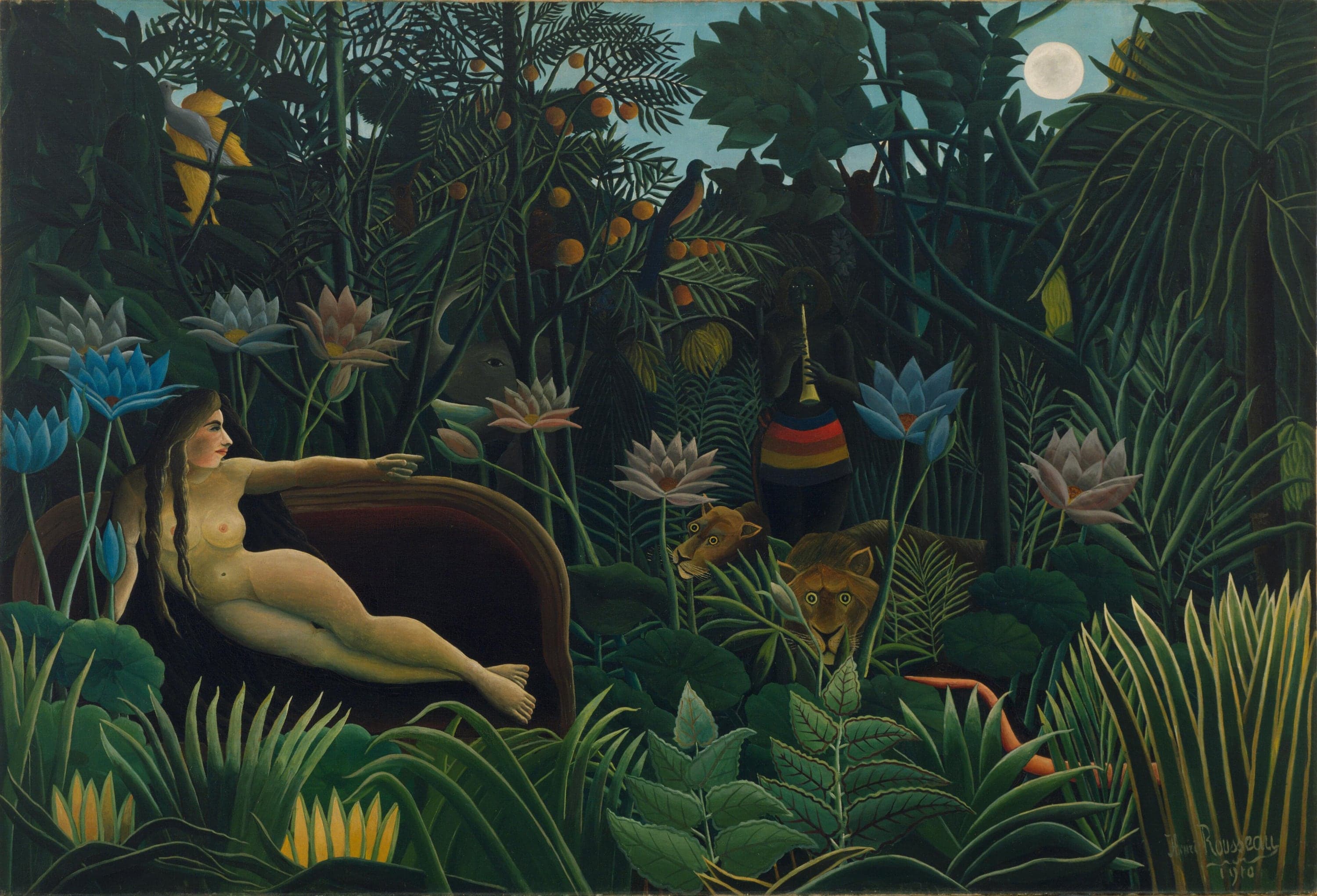
A naked woman lies on a dark red sofa in a moonlit jungle, one arm stretched out toward a piper standing among the leaves. Around them are a lion and a lioness, an elephant, a snake, two birds and a monkey, with flowers the size of heads cut open to show their centers. Henri Rousseau finished it in March 1910 and it was his only entry at the Salon des Indépendants that spring. He died six months later. The Museum of Modern Art in New York has owned it since 1954.
- 1910
- Oil on canvas
- The Museum of Modern ArtNew York, United States
About Henri Rousseau
What the painting shows
The woman lies along the left third of the canvas on a dark oxblood sofa with a curved, scrolled back. Her head is at the far left, in profile, turned toward the jungle. Her right arm reaches straight out along the top rail of the sofa, hand open, and her hair falls in long dark strands over her shoulder. Her legs stretch to the right and her feet rest at the sofa's far end.
The rest is animals and plants. The Museum of Modern Art's 1985 catalogue gives the census: a lion and a lioness, a serpent, an elephant, two birds and a monkey. The lion's head stares straight out of the picture from the lower center-right, and the lioness turns her muzzle to the left beside him. The elephant's grey head and one pale tusk show behind the stems above the woman's outstretched hand. The snake is pale pink and winds through the grasses at the lower right, where most viewers miss it. A monkey raises both arms from a branch at the upper right, and a full white moon sits in a gap of pale sky above it.
A dark-skinned figure stands upright at the center-right, playing a pale conical wind instrument with a flared bell, held to the lips with both hands. The wrap around the hips is striped in blue, black, red, ochre and red again.
The 1985 catalogue points out what makes the plants unusual even for Rousseau. Most of the flowers are gigantic, and most are shown in cross-section, cut open so that their hearts are visible. It also notes that the foliage does not form the usual wall behind the figures: it is arranged in a series of planes stacked in tiers.
The verse Rousseau printed with it
Rousseau wrote eight lines of verse to go with the painting, and they were printed in the pamphlet of the 1910 Salon des Indépendants, where the picture was catalogue number 4468. They name the sleeper, who has no name anywhere else.
“Having fallen into a gentle sleep / Yadwigha, in a dream, / Heard the sounds of a musette / Played by a benevolent magician. / While the moon shone down / Upon the flowers, the green trees, / The wild serpents listened to / The instrument's merry tunes.”
One word in the French has been wrong in print for a century. The sixth line reads Sur les fleurs, les arbres verdoyants, on the flowers, the green trees. Wilhelm Uhde, Rousseau's first biographer, transcribed fleurs as fleuves, rivers, and the 1985 catalogue records that later writers copied the mistake, Guillaume Apollinaire among them. Dora Vallier went further and suggested that Apollinaire wrote the verse rather than Rousseau; the Museum of Modern Art rejects that. The linguist Roman Jakobson analyzed the poem's structure in Linguistic Inquiry in January 1970.
Why there is a sofa in the jungle
People asked Rousseau about the furniture, and he answered twice, differently. On 1 April 1910 he wrote to the critic André Dupont to explain it. The woman asleep on the couch, he said, is dreaming that she has been transported into the forest and is hearing the sounds of the enchanter's instrument. On that account the jungle is inside her head and the sofa is the only real object in the picture.
To André Salmon he gave the other answer: the sofa is there only because of its glowing red color. The Museum of Modern Art has printed both since 1942 without choosing between them.
The setting came from a fifteen-minute walk. The museum's gallery label quotes Rousseau on the Paris botanical gardens: when he was in the hothouses among the strange plants from other countries, he said, it seemed to him that he was entering a dream. He never went further than that. The label for the 2021 display makes the consequence plain, calling him a crucial precedent for Surrealist painters such as Salvador Dalí and René Magritte.
The last Salon
Rousseau sent one painting to the Salon des Indépendants in March 1910 and this was it. A week before the opening he wrote to Guillaume Apollinaire asking for help. Everyone likes the large picture, he wrote. He hoped Apollinaire would use his literary talent to avenge him for all the insults and affronts he had received.
Apollinaire delivered. His review in L'Intransigeant of 18 March 1910 said the painting held a beauty that was indisputable, and that he did not believe anyone would dare laugh that year. The painters, he wrote, were unanimous in their admiration, even of the Louis-Philippe sofa lost in the virgin forest.
Not everyone agreed. Louis Dimier wrote in L'Action Française on 19 March that Rousseau was a fugitive from the customs office whose failings had not discouraged the gaping art-lover or the clever merchants. Henri Ghéon called the greenery applied, ridiculous and decorative in the Nouvelle Revue Française that May. The Italian painter Ardengo Soffici wrote about it with more penetration than Apollinaire, in the judgment of the 1985 catalogue. The couch, the naked body, the moon, the birds, the beasts and the flowers made a purely artistic unity, he wrote, independent of any discursive logic.
André Breton returned to it in 1942. He was almost on the point of believing, he wrote, that all the poetry and mysterious gestations of the age were present in the canvas. The day would come, he added, when it would be carried through the streets in procession like Cimabue's Maestà.
Is it his last painting?
The Museum of Modern Art has said so repeatedly, calling it his last completed painting in 1985 and the last painting by the artist in 1954. Rousseau died of gangrene in Paris on 2 September 1910, six months after the Salon opened, with seven people at his funeral.
The museum's own catalogue complicates the claim. On 5 March 1910 Rousseau wrote to the dealer Ambroise Vollard that The Dream was finished and that he was beginning a new canvas whose subject would be a fight between a lion and a horse. A receipt dated 22 March 1910 records a hundred francs paid by Vollard for a picture of a combat between a jaguar and a horse. That painting, Horse Attacked by a Jaguar, is in the Pushkin State Museum of Fine Arts in Moscow.
So the accurate form is narrower: The Dream is the last of his big, ambitious canvases, and the last work he finished before the 1910 Salon. At least one smaller picture was started and paid for after it.
Vollard, Knoedler, Janis, Rockefeller
Ambroise Vollard was the painting's first owner, and the 1985 catalogue notes that he may have commissioned it. From Vollard it went to M. Knoedler & Co. in New York and then to the Sidney Janis Gallery. The museum's 1942 press release records it as Sidney Janis's loan, given a whole wall to itself at the end of that year's Rousseau exhibition.
Nelson A. Rockefeller bought it from a New York private collector who had acquired it in 1933, and gave it to the Museum of Modern Art in 1954, where it is accession 252.1954. Alfred H. Barr, Jr. called it the culminating masterpiece of Rousseau's career and one of the capital achievements of modern French painting.
One number about the surface has been repeated ever since 1942, when Daniel Catton Rich put it in the museum's catalogue: an artist counted more than fifty variations of green in the picture. Rich did not name the artist, and no technical study has replaced the figure.
Close reading
Reading the work, detail by detail
Rousseau packed more into this canvas than into any of his other jungles, and several of its inhabitants are easy to walk past. Take the woman and the piper first, then hunt for the animals hiding in the leaves.
1.Called asleep, painted awake
Rousseau's verse says Yadwigha fell gently asleep, and the letter he wrote to André Dupont calls her the woman asleep on the couch. The painted eye is open and turned toward the piper. Whatever the words say, the figure in the picture is looking.
2.The hand, and the furniture under it
Her arm lies along the rolled rail of a dark red sofa and her open hand points into the leaves. The sofa is the thing everyone asked Rousseau about. He told André Salmon it was there only for the glow of its red, and told André Dupont that the jungle was the woman's dream and the couch was where she actually lay.
3.The piper in the striped wrap
The figure stands upright and frontal, both hands on a pale conical pipe with a flared bell. The wrap at the hips is banded in blue, black, red and ochre, the strongest sequence of flat color in the picture. Rousseau's verse calls the player a benevolent magician and the instrument a musette.
4.Two cats, four yellow eyes
The maned lion looks straight out at the viewer; the lioness beside him turns away to the left. Both have the same pale ringed yellow eyes, and whiskers picked out in white. Below and to the right of them, in the spiky grass, a pale pink snake winds through the foreground where almost nobody finds it.
5.An elephant behind the stems
A grey head, one eye, one ear and a pale curved tusk show between the stems above the woman's outstretched hand. Nothing else of the animal is painted. The Museum of Modern Art's 1985 catalogue counts it in the picture's population alongside the lion, the lioness, the snake, two birds and a monkey.
6.Flowers opened to show their centers
The blooms are enormous and most of them face the viewer, opened so the heart of each one shows. The Museum of Modern Art's 1985 catalogue treats this as unique to The Dream among Rousseau's jungles. The same entry notes that the plants here are stacked in tiers rather than closing into the usual wall of leaves.
Timeline
1910
Rousseau writes to the dealer Ambroise Vollard on 5 March that the painting is finished and that he is starting a canvas of a lion fighting a horse.
1910
On 11 March, Rousseau asks Guillaume Apollinaire to defend the picture, writing that everyone likes it and asking to be avenged for the insults he has received.
1910
Shown at the Salon des Indépendants in Paris as catalogue number 4468, Rousseau's only entry that year, with eight lines of his own verse printed in the pamphlet.
1910
Guillaume Apollinaire reviews it in L'Intransigeant on 18 March, writing that no one will dare laugh this year. Louis Dimier attacks it in L'Action Française the next day.
1910
On 1 April, Rousseau writes to the critic André Dupont explaining that the woman is dreaming she has been carried into the forest, which is why the couch is there.
1910
Rousseau dies in Paris on 2 September of an infection in his leg. Seven people attend the funeral, among them Paul Signac.
1942
Lent by the Sidney Janis Gallery to the Museum of Modern Art's Rousseau exhibition, which gives it a wall of its own.
1954
Given to the Museum of Modern Art by Nelson A. Rockefeller as accession 252.1954, and announced on 12 September.
1985
Anchors the Rousseau retrospective organized by the Museum of Modern Art with the Réunion des musées nationaux.
Where to see it
The Museum of Modern Art
11 West 53 Street, New York, NY 10019, United States
The Museum of Modern Art listed the painting as not on view in September 2026. Check the collection page before a visit.
Plan your visit on the museum’s official website (opens in a new tab)Frequently asked questions
Where is The Dream by Henri Rousseau?
The Museum of Modern Art in New York, as accession 252.1954. Nelson A. Rockefeller gave it to the museum in 1954. It was not on view in September 2026, so check the collection page before making a trip for it.
Why is there a sofa in the jungle?
Rousseau gave two answers. He wrote to the critic André Dupont on 1 April 1910 that the woman asleep on the couch is dreaming she has been carried into the forest, and is hearing the enchanter's instrument. On that account the jungle is a dream and the sofa is the one real thing in the picture. To André Salmon he said the sofa was there only for its glowing red color.
Who is Yadwigha?
The name Rousseau gave the sleeping woman in the eight lines of verse he had printed with the painting in the 1910 Salon des Indépendants pamphlet. The verse says Yadwigha fell gently asleep and in her dream heard a musette played by a benevolent magician. She is named nowhere else.
What animals are in The Dream?
A lion and a lioness, a snake, an elephant, two birds and a monkey, by the count in the Museum of Modern Art's 1985 catalogue. The lion stares straight out at the viewer from the lower center. The snake is pale pink and hard to find, winding through the grasses at the lower right.
Was The Dream Rousseau's last painting?
Nearly. The Museum of Modern Art calls it his last completed painting, and it was the last large canvas he finished, six months before he died on 2 September 1910. But he wrote to Ambroise Vollard on 5 March 1910 that he was starting a picture of a lion fighting a horse, and Vollard paid a hundred francs for it on 22 March. That painting is now in the Pushkin State Museum of Fine Arts in Moscow.
How many greens are in The Dream?
More than fifty, by a count that has been repeated since 1942. Daniel Catton Rich put the figure in the Museum of Modern Art's catalogue that year, crediting it to an unnamed artist who had counted them. No technical study has since replaced the number.
How big is The Dream?
204.5 by 298.5 centimetres, or roughly six feet eight inches by nine feet nine. It is oil on canvas and is signed and dated at the lower right.
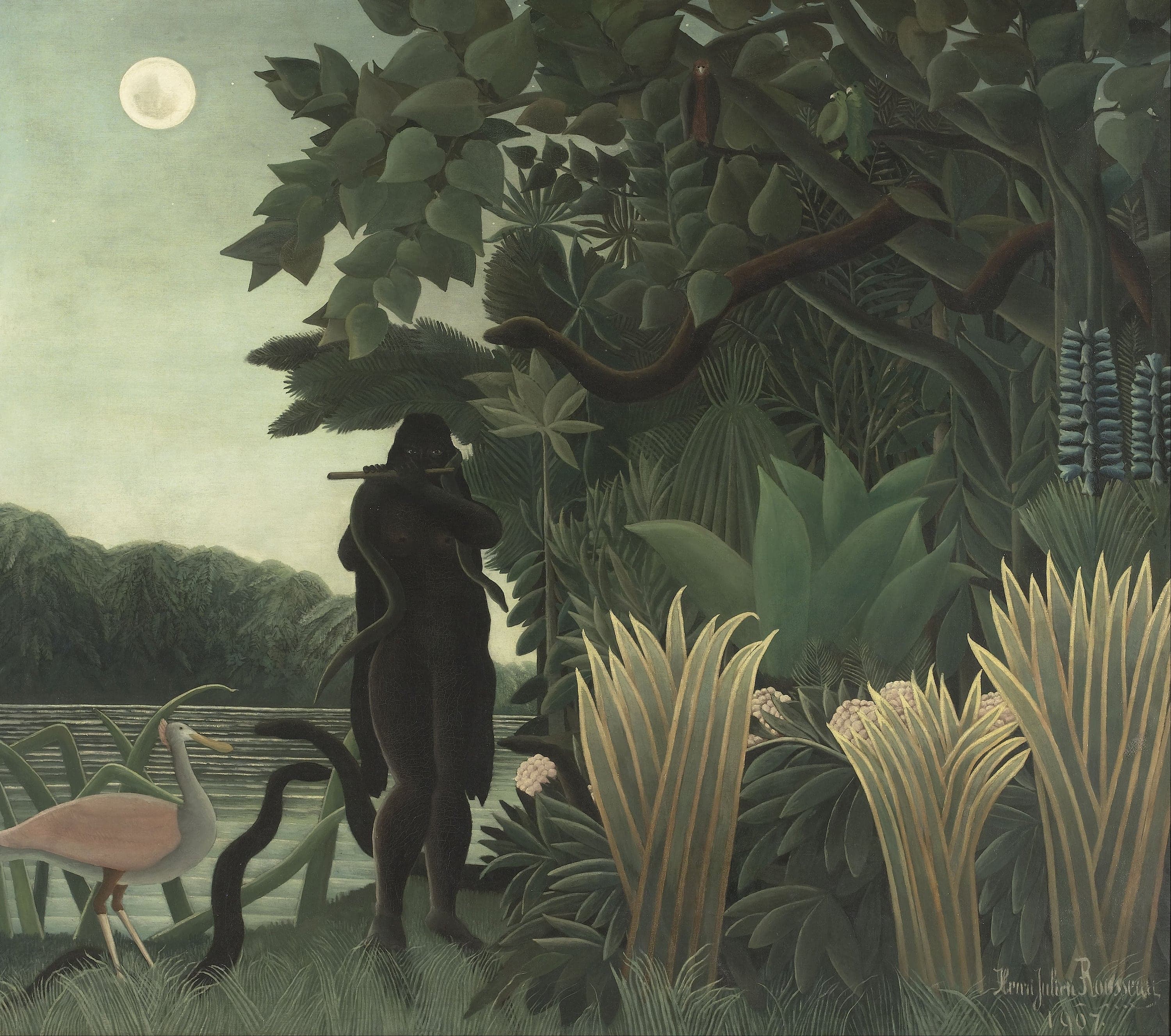
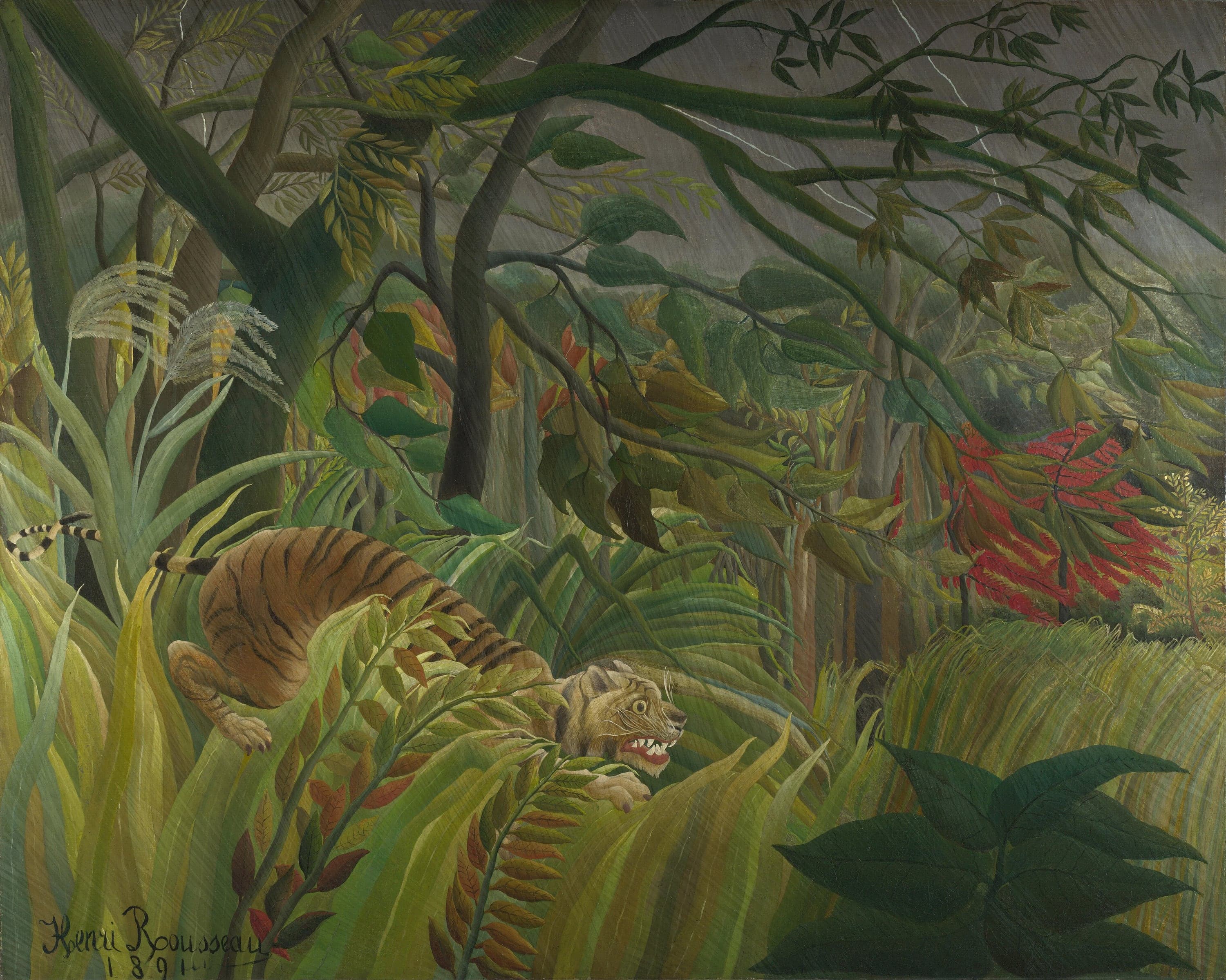
More by Henri Rousseau
If you like Henri Rousseau
Explore painters from the same movements and circles.
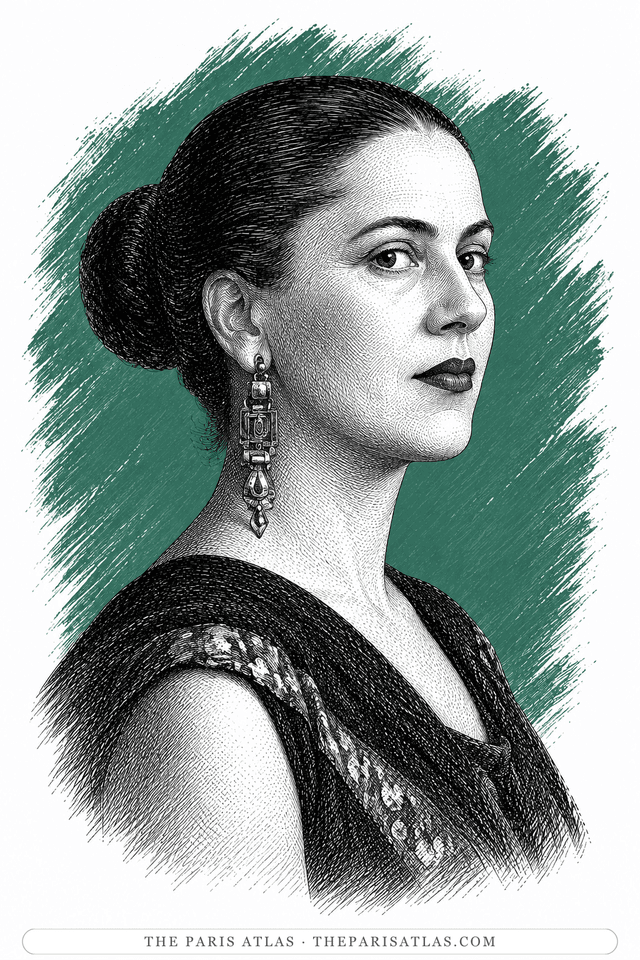
Tarsila do Amaral
Brazilian painter who spent the 1920s moving between São Paulo and Paris, studied Cubism under André Lhote, Albert Gleizes and Fernand Léger, and used what she learned to paint Brazilian towns, railways, plants and bodies. Her 1928 painting Abaporu prompted the manifesto that gave the Anthropophagic movement its name.
View artist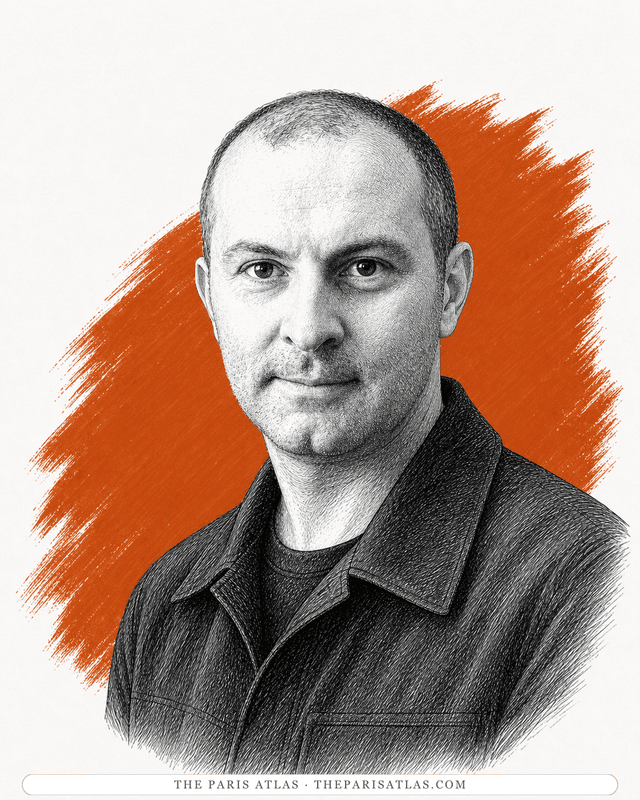
Arman
French-American artist, lifelong friend of Yves Klein, and a founder of New Realism.
View artist
Jean Arp
Strasbourg-born sculptor and poet — Hans in German, Jean in French, both all his life — who co-founded Dada at the Cabaret Voltaire in 1916, composed collages by dropping torn paper 'according to the laws of chance', and settled at Meudon outside Paris in a house his wife Sophie Taeuber-Arp designed.
View artist
References
The sources below include collection records, catalogues, scholarly research, and primary materials that informed this page. They document The Dream, its making, and its place in cultural history.

1Henri Rousseau, The Dream, 1910
WebsiteThe Museum of Modern ArtUsed forThe holding museum's catalogue entry: medium, dimensions, credit line, accession number, display status, and the gallery labels quoting Rousseau on the Paris hothouses.

2Henri Rousseau
Exhibition catalogueThe Museum of Modern Art, New York, and Réunion des musées nationaux, Paris, 1985Used forThe 1985 Museum of Modern Art and Réunion des musées nationaux catalogue: the signature, the provenance, the Salon number, the animal census, the French text of the verse, the letters to Ambroise Vollard and André Dupont, and the reviews of 1910.
3Henri Rousseau
Exhibition catalogueThe Museum of Modern Art, New York, 1942Used forDaniel Catton Rich's 1942 catalogue, source of the count of more than fifty greens and of the earliest printed versions of Rousseau's remarks about the sofa.
4Museum of Modern Art given famous Rousseau painting
ArchiveThe Museum of Modern Art press archive, 1954Used forThe museum's press release of September 1954 announcing Nelson A. Rockefeller's gift, with the ownership summary and Alfred H. Barr, Jr.'s appraisal.
5Landmark survey of the paintings of Henri Rousseau to be exhibited at The Museum of Modern Art
ArchiveThe Museum of Modern Art press archive, 1985Used forThe museum's announcement of its 1985 retrospective, which describes this painting as Rousseau's last completed work.
These references provide the documented foundation for this work's history and interpretation. Claim-level citations remain attached to the specific claims they support.
 Explore more resources