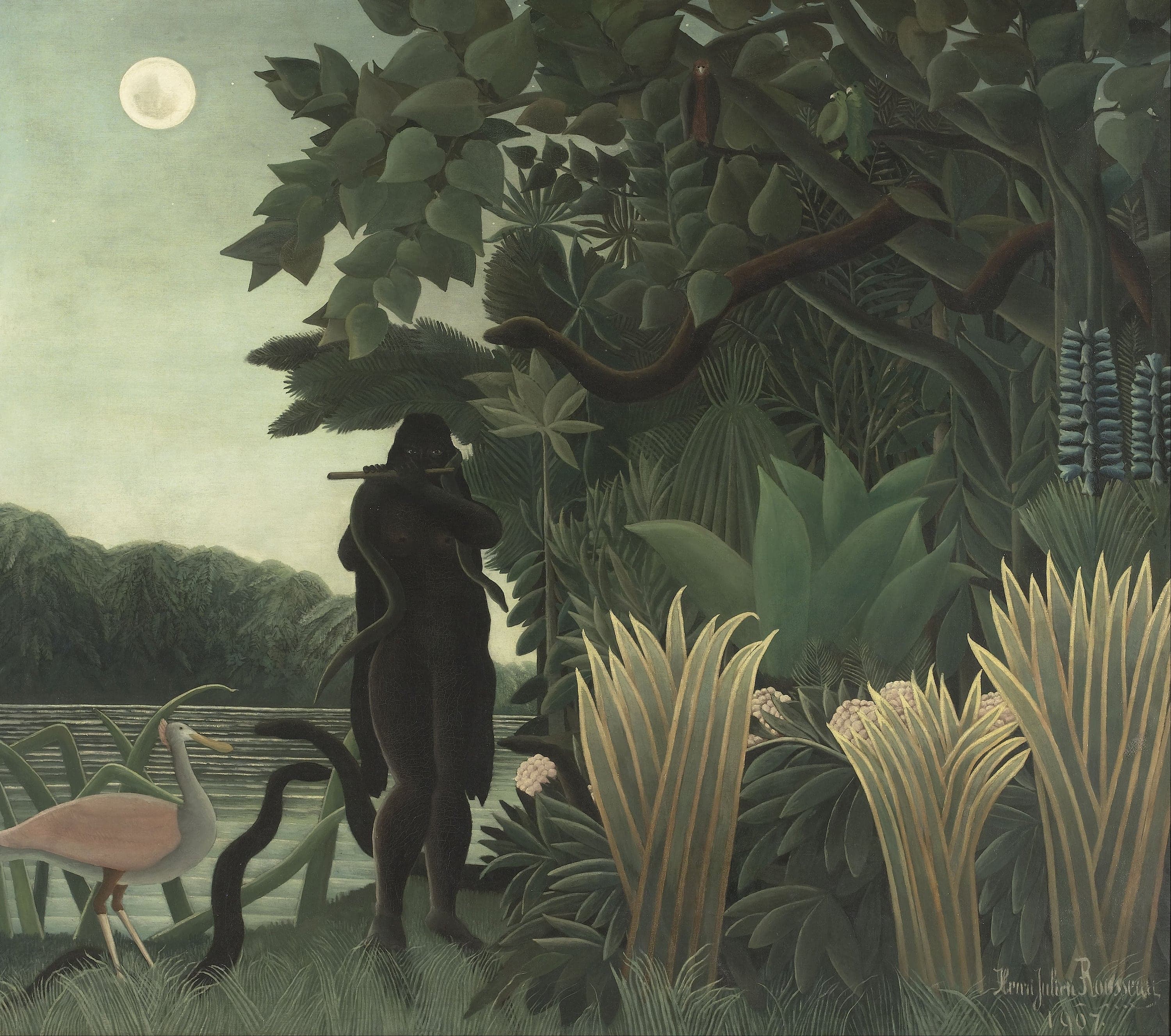
The Snake Charmer
A dark, almost black figure stands at the edge of a river playing a wooden pipe, with a snake across her shoulders and another rising from the grass at her feet. A full moon hangs in a pale grey-green sky and a pink spoonbill wades at the left. Henri Rousseau painted it in 1907 on commission from Berthe Delaunay, the mother of the painter Robert Delaunay, and showed it that autumn at the Salon d'Automne. It is at the Musée d'Orsay in Paris.
- 1907
- Oil on canvas
- Musée d'OrsayParis, France
About Henri Rousseau
What the painting shows
The figure stands left of center, nude and rendered as a near-black silhouette against the pale sky behind her. Nothing of her face is modeled except the eyes, which are pale almonds with dark pupils and look straight out of the picture. She holds a plain wooden pipe across her mouth with both hands. A snake drapes over her shoulders and loops down across her body.
There are more snakes. One rises out of the grass at her feet in a long glossy S-curve. A thick brown snake lies along a branch in the upper right, its body so close in color and thickness to the wood that it takes a moment to separate them. Panorama de l'art, the analysis site published by the Réunion des musées nationaux, counts four in all.
The left half of the picture is open. A band of river runs across it, ruled with fine horizontal lines for the moon's reflection, with a dark feathery treeline on the far bank. A pink bird wades at the left edge; its bill is flat and spoon-shaped, which makes it a spoonbill rather than the flamingo it is sometimes called. The right half is dense jungle: palm fans, a large rosette of thick leaves, clumps of gold-edged sword leaves. Pale pink flower heads sit among them and blue flower spikes stand at the far edge. A brown bird and two green parrots hide high in the canopy.
Tate, which borrowed the painting in 2005, makes a point about where the viewer is standing. In most of Rousseau's jungle pictures the foliage closes over everything. Here the river and the open sky mean the scene is set at the edge of the jungle rather than inside it.
Who ordered it
The painting was commissioned by Berthe Delaunay, the mother of the painter Robert Delaunay. The French national collections database records the fact in those terms, naming her only as Madame Delaunay, mother of the painter Robert Delaunay; Panorama de l'art supplies the forename Berthe. Panorama de l'art also reports that she asked for the subject after traveling in India. That detail rests on a single source and the national record does not carry it.
Daniel Catton Rich, writing the Museum of Modern Art's Rousseau catalogue in 1942, called it the first large commission Rousseau ever received. Rousseau was sixty-three and had been painting full time for fourteen years.
The Musée d'Orsay names Alfred Jarry, André Breton, Guillaume Apollinaire, Robert Delaunay and Pablo Picasso among Rousseau's most committed admirers. It also notes that it was Robert Delaunay's mother who ordered this canvas. The order came from inside that circle, not from the official art world that had been dismissing him for twenty years.
A jungle from the greenhouse
Rousseau never saw any of this. The Musée d'Orsay states that he traveled very little and that most of his jungles were painted in the natural history museum and the big greenhouse of the botanical gardens in Paris. The plants in the right half of the canvas are hothouse specimens rearranged into a forest.
The Musée d'Orsay's own commentary describes the subject as a black Eve in a disquieting Garden of Eden, charming a snake as terrifying as the snake in Genesis was seductive. It picks out the bright, dense, backlit colors as anticipating a painter like René Magritte, and calls the drawing precise and naïve at the same time.
The Salon d'Automne and what followed
Rousseau showed the painting at the Salon d'Automne in Paris in 1907 as number 41. Daniel Catton Rich records that the showing drew praise and brought Rousseau wide fame, which is a different account from the ridicule that usually attaches to his exhibition history. Rich also notes that shortsighted critics still called Rousseau's work ridiculous. At the same time a younger group had begun to take a serious interest: the painters Robert Delaunay, Maurice de Vlaminck, Marie Laurencin and Pablo Picasso, and the writers Guillaume Apollinaire and André Salmon.
The Musée d'Orsay says the fantastic world of the canvas heralds Surrealism. André Breton put the case in his own terms, quoted by Tate: it is with Rousseau, he wrote, that one can speak for the first time of Magic Realism and of the intervention of magic causality. Panorama de l'art points to the painter Victor Brauner as one artist who borrowed directly from the picture.
From Doucet to the French State
The chain of ownership runs from Berthe Delaunay to her son Robert Delaunay and his wife Sonia Delaunay, who held it by 1922, and then to the couturier and collector Jacques Doucet. Peter Campbell, writing in the London Review of Books in January 2006, sets out what happened next. The painting was promised to the Louvre, and accepted by it, in 1925, fifteen years after Rousseau's death. It entered the collection in 1937.
The national record matches that account. It gives the mode of acquisition as a bequest, the owner as the French State through the Musée du Louvre's painting department, and the dates as 1925 and 1935, with the inventory number RF 1937 7. The painting has been on deposit at the Musée d'Orsay since 1986, which is when that museum opened. Title still sits with the Louvre.
It hung as number 36 in Le Douanier Rousseau at the Grand Palais in 1984. It traveled to Tate Modern for Henri Rousseau: Jungles in Paris in 2005, and was shown at the Musée d'Orsay in Le Douanier Rousseau: l'innocence archaïque in 2016.
Close reading
Reading the work, detail by detail
Rousseau lights this scene from behind, so the figure reads as a flat black shape and the jungle behind her stays legible leaf by leaf. Look at the eyes first, then find the snakes, which are harder to count than they look.
1.The face gives you only the eyes
Nothing in the head is modeled except two pale almonds with dark pupils, and they look directly out of the picture. Everything else about the figure is a flat dark shape against the sky. The Musée d'Orsay reads her as a black Eve in a Garden of Eden that has gone wrong.
2.An ordinary wooden pipe
The instrument is a plain pale tube with her dark fingers closed along it. Rousseau gives it no decoration and no visible finger holes beyond a row of marks. The pipe is the one light-colored object on the figure and it sets the horizontal line that the whole upright body hangs from.
3.A snake that is also a branch
The brown snake on the branch matches the wood in both color and thickness, and the join between them is deliberately hard to find. Its head turns down toward the charmer. Panorama de l'art counts four snakes in the painting, and this is the one most viewers miss.
4.The S-curve in the grass
A black snake climbs out of the grass in a single long S. It is the strongest drawn line in the lower half of the canvas and it repeats, upside down, the curve of the snake across her shoulders. Rousseau keeps the two curves in different halves of the picture so they read as a pair.
5.The bill settles what bird it is
The bill is flat and widens to a spatula, which makes this a spoonbill and not the flamingo it is sometimes called. Behind it the river is drawn with fine horizontal lines for the moonlight. The bird's pink is the only soft color in a picture otherwise built from greens, greys and black.
6.A full moon in a sky that is not blue
The moon is a plain cream disc with no halo. The sky around it is a flat pale grey-green rather than night blue, and it lightens toward the horizon. That backlighting is why the figure and the plants in front of it stay dark: the Musée d'Orsay picks out the backlit color as the thing that anticipates a painter like René Magritte.
Timeline
1907
Painted on commission from Berthe Delaunay, mother of the painter Robert Delaunay, and signed and dated lower right.
1907
Shown at the Salon d'Automne in Paris as number 41. Daniel Catton Rich later wrote that the showing drew praise and brought Rousseau wide fame.
1922
In the hands of Robert and Sonia Delaunay, according to the French national collections record.
1925
Promised to the Musée du Louvre from the collection of the couturier Jacques Doucet, and accepted.
1937
Enters the Louvre's painting department as RF 1937 7, property of the French State.
1984
Shown as number 36 in Le Douanier Rousseau at the Grand Palais, Paris.
1986
Placed on deposit at the Musée d'Orsay, where it has hung since.
2005–06
Travels to Tate Modern for Henri Rousseau: Jungles in Paris, then to the Grand Palais in Paris and the National Gallery of Art in Washington.
2016
Shown at the Musée d'Orsay in Le Douanier Rousseau: l'innocence archaïque, from 22 March to 17 July.
Where to see it
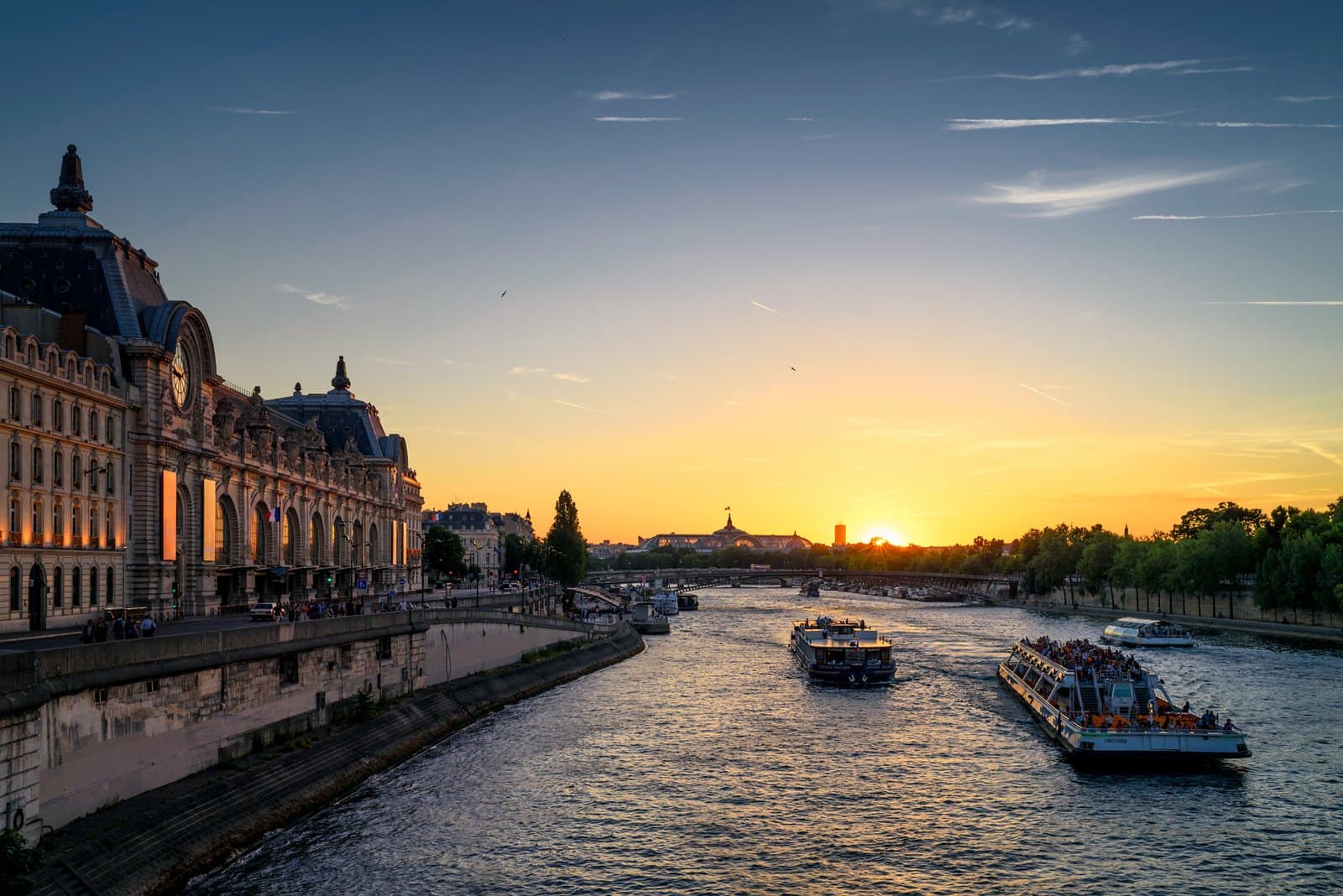
Musée d'Orsay
Esplanade Valéry Giscard d’Estaing, 75007 Paris, France
Owned by the Musée du Louvre's painting department and on deposit at the Musée d'Orsay since 1986.
Plan your visitFrequently asked questions
Where is The Snake Charmer?
The Musée d'Orsay in Paris, under the inventory number RF 1937 7. The painting belongs to the French State through the Musée du Louvre's painting department and has been on deposit at the Musée d'Orsay since 1986.
Who commissioned The Snake Charmer?
Berthe Delaunay, the mother of the painter Robert Delaunay. The French national collections record names her as Madame Delaunay, mother of the painter Robert Delaunay, and Panorama de l'art gives her forename. Daniel Catton Rich called it the first large commission of Rousseau's career.
How many snakes are in The Snake Charmer?
Four, by the count published by Panorama de l'art. One lies across the woman's shoulders and one rises from the grass at her feet in an S-curve. A third stretches along a branch in the upper right, where it is easy to mistake for the wood. The fourth is in the grass at the lower left.
What is the pink bird in The Snake Charmer?
A spoonbill. Its bill is flat and widens to a spatula at the tip, which is the feature that separates a spoonbill from a flamingo. It wades at the left edge of the canvas and carries the only warm color in the picture apart from the moon.
Did Rousseau paint The Snake Charmer from life?
No. The Musée d'Orsay states that Rousseau traveled very little and that most of his jungles were painted in the natural history museum and the big greenhouse of the Paris botanical gardens. The plants are hothouse specimens rearranged into a forest.
Why is The Snake Charmer linked to Surrealism?
Because the Surrealists claimed it. The Musée d'Orsay says the fantastic world of the canvas heralds Surrealism, and André Breton wrote that it is with Rousseau that one can speak for the first time of Magic Realism and of the intervention of magic causality. The painter Victor Brauner borrowed from the picture directly.
How big is The Snake Charmer?
169 by 189.5 centimetres, in oil on canvas, signed and dated at the lower right. Those measurements come from the French national collections record and from the Musée d'Orsay.
More by Henri Rousseau
If you like Henri Rousseau
Explore painters from the same movements and circles.
Tarsila do Amaral
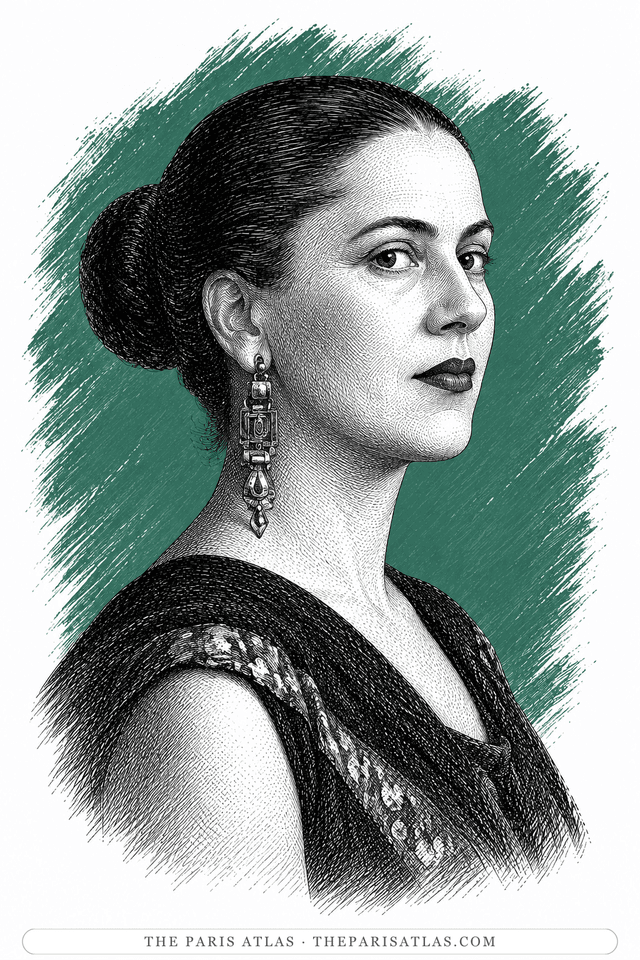
Brazilian painter who spent the 1920s moving between São Paulo and Paris, studied Cubism under André Lhote, Albert Gleizes and Fernand Léger, and used what she learned to paint Brazilian towns, railways, plants and bodies. Her 1928 painting Abaporu prompted the manifesto that gave the Anthropophagic movement its name.
View artist
Arman
French-American artist, lifelong friend of Yves Klein, and a founder of New Realism.
View artist
Jean Arp
Strasbourg-born sculptor and poet — Hans in German, Jean in French, both all his life — who co-founded Dada at the Cabaret Voltaire in 1916, composed collages by dropping torn paper 'according to the laws of chance', and settled at Meudon outside Paris in a house his wife Sophie Taeuber-Arp designed.
View artist
References
The sources below include collection records, catalogues, scholarly research, and primary materials that informed this page. They document The Snake Charmer, its making, and its place in cultural history.


1La charmeuse de serpents — notice 000PE004110, base Joconde
Official recordMinistère de la Culture, Plateforme ouverte du patrimoineUsed forThe French national collections record: inventory number RF 1937 7, dimensions, the signature, the commission by Madame Delaunay, the chain of ownership, and the Salon d'Automne entry number.

2Henri Rousseau, La charmeuse de serpents
WebsiteMusée d'OrsayUsed forThe holding museum's commentary: the black Eve reading, the comparison with René Magritte, the list of Rousseau's admirers, and the statement that his jungles were painted in the Paris greenhouses.
3Henri Rousseau
Exhibition catalogueThe Museum of Modern Art, New York, 1942Used forDaniel Catton Rich's 1942 catalogue for the Museum of Modern Art, which calls this Rousseau's first large commission and records that the Salon d'Automne showing drew praise.
4La Charmeuse de serpents
WebsitePanorama de l'art, Réunion des musées nationaux – Grand PalaisUsed forThe Réunion des musées nationaux analysis, which names Berthe Delaunay, counts the snakes, and traces the painting's influence on Victor Brauner.
5At Tate Modern
PeriodicalLondon Review of Books, volume 28 number 1, 2006Used forPeter Campbell's review of the Tate Modern exhibition, which dates the promise to the Louvre to 1925 and the painting's entry into the collection to 1937.
6Henri Rousseau: Jungles in Paris — poster pack for teachers
Exhibition catalogueTate, 2005Used forTate's study pack for the 2005 exhibition, source of André Breton's Magic Realism remark and the observation that this scene sits at the edge of the jungle rather than inside it.
These references provide the documented foundation for this work's history and interpretation. Claim-level citations remain attached to the specific claims they support.
 Explore more resources